

Part 1: The Secret Behind the Ballroom Doors
My name is Clara Hart. I’m thirty-two, and throughout my life, my family has treated me as the troublesome older daughter whose main role was making my younger sister, Sophie, appear more successful.
Her wedding was supposed to be another evening of quietly enduring their behavior.
I came without a companion.
That was enough to give my father an opportunity.
During the reception, Graham Hart picked up the microphone and gestured directly toward me.
“Look, there’s Clara,” he announced. “All by herself. Couldn’t even find a date for her sister’s big day.”
Laughter swept through the ballroom.
It wasn’t nervous or uncomfortable laughter.
People genuinely found it amusing.
Relatives hid their smiles behind their hands. Family acquaintances turned to look at me. Even strangers seemed delighted that my humiliation had become part of the entertainment.
I walked away before anyone could see how deeply it hurt.
Outside, I stopped beside the terrace fountain, struggling to control the tears threatening to spill down my cheeks.
Then my father came after me.
“Stop sulking,” he said. “You’re ruining the aesthetic.”
I faced him.
“I’m not sulking.”
He approached, placed both hands against my shoulders, and pushed.
It wasn’t forceful enough to appear like a deliberate assault to the people watching.
But it was enough.
My heel slid against the damp stone.
I lost my balance.
A moment later, I plunged into the fountain.
The cold water swallowed my pale green dress, weighing down the fabric against my body. My hair covered my eyes, and for one bewildering instant, all I could hear was the splash and the frantic beating of my heart.
Then I heard clapping.
That sound would remain with me forever.
Nobody hurried to help.
Nobody confronted my father.
Instead, they applauded.
He stood above the fountain, microphone still in hand, grinning as though he’d just delivered a brilliant joke.
Something within me became completely quiet.
Thirty-two years of comparisons, ridicule, dismissal, and being treated as the family’s favorite target ended in that moment.
I cleared the water from my eyes and stared straight at him.
“Remember this moment.”
His grin weakened.
I pulled myself out of the fountain.
“Remember exactly what you just did to me,” I said. “Because I will.”
For the first time that night, silence spread through the people gathered nearby.
Without another word, I returned to the building.
Inside the lobby restroom, I removed my drenched dress and changed into the black cocktail dress I’d brought in case of an emergency. I dried my hair as thoroughly as possible, applied red lipstick, and examined my reflection.
I was finished making myself invisible.
Taking out my water-damaged phone, I found a contact whose name would mean nothing to my relatives.
For three years, I’d kept that relationship hidden.
For three years, I’d endured being called lonely, pathetic, and unwanted.
I opened our conversation and wrote two words.
Come now.
Then I sent the message.
My family believed I had come to the wedding without anyone.
They had no idea I was married.
And my husband was already approaching the ballroom.
For several seconds, I remained in the restroom, staring at my phone.
The ventilation fan hummed overhead while distant music drifted through the walls. Outside, the celebration continued as though my father hadn’t just shoved me into a fountain.
Someone laughed.
Glasses touched.
The quartet began playing again.
My message had been delivered.
Daniel hadn’t replied, but I wasn’t concerned.
He rarely wasted time sending reassurances when he was already doing what he’d promised. If he said he’d come, I could trust him to appear.
Still, my hands wouldn’t stop trembling.
For three years, I’d separated my husband from my family.
It wasn’t because I felt embarrassed by him.
I felt embarrassed by them.
By their cruel remarks.
By their habit of belittling every achievement I shared.
By the way they transformed my relationships, hopes, and successes into opportunities for ridicule.
I was also frightened that once Daniel witnessed their behavior, he’d ask the question I couldn’t answer.
Why do you keep going back?
Because they were still my family.
Because I remembered when my mother had been different.
Because Sophie had once been the little girl who reached for my hand whenever our parents fought.
Because I continued hoping that enough patience, kindness, and effort might eventually convince them to see me as a daughter rather than someone to compare against my sister.
But that hope had disappeared beneath the fountain’s surface.
I slipped my phone into my clutch and stepped outside.
Elise, the wedding coordinator, stood waiting in the hallway.
Her expression softened when she saw me.
“Oh,” she said softly. “Clara.”
“I’m all right.”
She examined my changed clothes and carefully repaired appearance.
“You don’t have to go back in there.”
“I know.”
“I can arrange a car.”
“I know that too.”
She lowered her voice.
“Your sister asked about you.”
I nearly smiled.
“Did she?”
“She seemed worried.”
“Sophie usually worries after something happens. Not before.”
Elise appeared uneasy, as though she’d witnessed something she wished she hadn’t.
With four hundred guests present, there was no doubt many people had watched what my father did.
They could call it a joke, but that didn’t change what they’d seen.
“Thank you,” I said. “But I’m not leaving yet.”
She nodded.
I walked into the ballroom.
Conversations faded as guests noticed me.
Some were seated, while others stood near the entrance. Faces turned in my direction, and whispers followed my steps.
For once, I refused to look down.
Sophie stood at the head table beside her new husband, Mark. Her white gown shimmered beneath the chandeliers, but her face looked drained of color.
Dad remained beside the dance floor, holding the microphone.
Mom sat at our family table, her napkin neatly folded in her lap.
She watched me without getting up.
My father spoke first.
“There she is,” he said, attempting a laugh. “The bride’s dramatic sister has made her grand return.”
Nobody joined him.
His smile became strained.
I approached the family table, where an empty chair waited beside my mother.
Sophie moved toward me.
“Clara,” she said.
I stopped.
Nearby guests pretended not to hear.
“I’m sorry,” she said.
Her apology was soft but unmistakable.
Dad immediately interrupted.
“Sophie, don’t start this now.”
She turned toward him.
“You pushed her.”
“I barely touched her.”
“You pushed her.”
“I was joking.”
“You were holding a microphone and making everyone laugh at her.”
His jaw clenched.
“It was a wedding toast.”
“It wasn’t a toast.”
Silence spread around us.
Sophie had always been careful not to challenge Dad.
She’d grown up knowing how quickly he could turn disagreement into disloyalty.
Seeing her confront him in her wedding dress was almost more shocking than what had happened outside.
He lowered the microphone.
“Your sister is making this about herself,” he said.
I looked at Sophie.
“Is that what you think?”
Tears gathered in her eyes.
“No,” she said. “I don’t.”
Mom rose from her chair.
“Please,” she whispered. “Not here.”
Not here.
That familiar excuse.
Not during holidays.
Not at birthdays.
Not in front of company.
Not when Sophie had something important to celebrate.
There was always a reason to postpone the truth until everyone could pretend it no longer mattered.
I rested one hand against the empty chair.
“I won’t ruin your wedding,” I told Sophie. “I came here to support you.”
Her face tightened with emotion.
“I know.”
“But I’m not going to pretend tonight was harmless.”
Dad laughed sharply.
“You’re making a scene again.”
I faced him.
“No. The scene happened when you put your hands on me. I’m simply refusing to help you rewrite it.”
Several guests lowered their gazes.
My father’s face reddened.
Before he could answer, the ballroom doors opened.
A quiet movement.
A soft creak.
Footsteps across polished flooring.
Yet the guests near the entrance immediately turned.
Daniel stood in the doorway.
His navy suit was slightly open at the collar, and the wind had disturbed his hair. He carried nothing and offered no dramatic introduction.
He simply looked across the room until he found me.
His eyes traveled over my face, my black dress, and the faint mark on my wrist from the fountain’s stone edge.
Then he walked directly toward me.
My mother went still.
Sophie stared.
Dad frowned, apparently trying to remember where he’d seen him.
Daniel stopped beside me.
“Are you hurt?” he asked.
“Only embarrassed.”
His expression softened.
“That’s not what I asked.”
“I’m fine.”
He studied me another moment before facing my family.
“Mr. Hart,” he said.
Dad frowned.
“I’m sorry,” he said. “Do I know you?”
Daniel offered his hand.
“Daniel Vale.”
Dad didn’t accept it.
My mother gripped the tablecloth.
Sophie noticed.
“You’re Clara’s—” she began.
“My husband,” Daniel said.
He didn’t raise his voice.
He didn’t need to.
The words seemed to reach every corner of the ballroom.
Mom stood motionless.
Sophie looked between us in disbelief.
Dad stared at Daniel’s silver wedding band.
Then he looked at my bare ring finger.
For three years, I’d worn my own wedding band on a chain beneath my clothes whenever I attended family events.
Daniel and I had married quietly at a courthouse near the harbor.
I had never been ashamed of marrying him.
I’d been afraid of what my family would do with the knowledge.
Sophie finally spoke.
“You’re married?”
“Yes.”
“How long?”
“Three years.”
Dad looked stunned.
“You’re married to him?”
“Yes.”
“And you didn’t tell us?”
“You made it clear you weren’t interested in my life unless it could be used to improve Sophie’s.”
“That’s ridiculous.”
“Is it?”
He searched the room for support.
Nobody offered any.
Daniel brushed his hand against mine.
Dad noticed.
“You hid a husband from your own family,” he said. “Do you understand how humiliating that is?”
I stared at him.
“You’re worried about humiliation?”
His expression hardened.
Sophie stepped forward.
“Stop.”
Dad faced her.
“I’m your father.”
“And she’s my sister.”
“That doesn’t give her the right to—”
“It gives her the right to be treated like a person.”
The ballroom fell silent.
Daniel leaned toward me.
“Do you want to leave?”
I desperately wanted to.
But Sophie stood there in her wedding gown, tears on her cheeks.
Despite everything, I didn’t want her wedding to become another painful memory.
“Are you happy?” I asked her.
She looked toward Mark, who moved closer and rested a hand against her back.
“Yes,” she said. “I am.”
“Then I’m glad.”
Dad scoffed.
“Don’t pretend this is noble.”
I ignored him.
From my clutch, I removed a small envelope.
Sophie frowned.
“What’s that?”
“Your wedding gift.”
“I thought you said you were leaving.”
“I am. But I wanted you to have this.”
She opened it.
Inside were a letter and a key.
“What is this?”
“The key is for the apartment above my studio. I’m not using it anymore. You and Mark can stay there for a few months if you need a place while you look for something permanent.”
The apartment had been mine since I was twenty-six.
It wasn’t extravagant, but its tall windows, balcony, and comfortable rooms made it a wonderful place for a newly married couple to begin their lives.
Sophie shook her head.
“I can’t take this.”
“You can.”
“Clara—”
“It’s not charity. I own it. And I want you to have somewhere that belongs to you.”
Dad stepped forward.
“She doesn’t need you rescuing her.”
I turned.
“I’m not rescuing her. I’m offering help to my sister.”
“You always have to make yourself indispensable.”
His words struck a familiar wound.
Daniel gently squeezed my hand.
Sophie unfolded the letter.
After reading a few lines, she began crying.
“What did you write?” Mark asked gently.
She passed it to him.
I’d written that I loved her, but love couldn’t keep requiring silence.
That I hoped her marriage would be built on honesty.
That the apartment was available if she wanted it, but the choice belonged to her alone.
Sophie held the letter against her chest.
“I knew,” she whispered.
I stared at her.
“Knew what?”
She glanced toward our parents.
“That you were married.”
My heartbeat quickened.
Dad turned.
“What?”
Sophie looked frightened, but continued.
“Not at first. I found out last year.”
“How?”
“Mom told me.”
We all looked toward our mother.
She lowered her eyes.
Dad frowned.
“What are you talking about?”
Mom stood slowly.
“I found the invitation.”
My fingers turned cold.
“What invitation?”
She looked at me.
“It came three years ago,” she said. “A few weeks after Clara’s wedding.”
I stared at her.
“You received an invitation?”
She nodded.
I had sent a wedding announcement after our private courthouse ceremony.
It included our names, the date, and a request that everyone respect our decision to keep the ceremony intimate.
Nobody had replied.
I’d assumed it had been lost.
“What did it say?” I asked.
Mom’s hands trembled.
“It said you and Daniel had married. It said you would be holding a small dinner the following month for anyone who wished to celebrate with you.”
“There was no dinner.”
“There was supposed to be.”
“Why didn’t anyone tell me?”
She shut her eyes.
Dad looked at her.
“You’re saying you kept this from us?”
“I didn’t keep it. I thought you knew.”
“How could I know?”
“Because I gave it to you.”
All the color seemed to disappear from his face.
Mom looked at me again.
“I put the announcement on the desk in his study. You called that week, and he said you were being secretive again. He told me you had probably married some stranger and were trying to make us feel guilty.”
I stared at my father.
He offered no denial.
“You knew,” I said.
His jaw tightened.
“I knew you had sent something.”
“You knew I was married.”
“I didn’t know who he was.”
“You knew enough to ask.”
“You never invited us properly.”
“I sent an announcement.”
“You disappeared.”
“I waited for someone to call.”
He looked away.
And that single movement told me he’d known the truth all along.
But before I could ask anything else, my mother whispered something that made Daniel’s hand tighten around mine.
There had been another page.
One she had never shown my father.
And the letter inside it had been written by my husband.
Part 2: The Letter My Father Hid
I looked at the cream-colored envelope in my mother’s trembling hand.
The edges were worn, and my name appeared across the front.
Clara Hart.
Mom swallowed.
“I found it in his study this morning. It was hidden inside an old file.”
Dad stood completely still.
I accepted the envelope.
“What does it say?”
She glanced toward him.
“It isn’t from you,” she whispered. “It’s from Daniel.”
I opened it.
Inside was a letter dated three years earlier.
The handwriting was unmistakably my husband’s.
Its first line made my breath catch.
Clara never asked me to keep this from her family. Graham Hart did.
I read it again.
Then I looked at Daniel.
“Where did you get that?” I asked.
Mom explained that she’d discovered it while searching through Dad’s study for insurance documents.
The envelope had been hidden behind old tax records.
She’d recognized my name immediately.
Dad remained silent.
“Is this true?” I asked him.
He offered no answer.
I unfolded the letter completely.
It was three pages long.
Daniel had written to my father shortly before our courthouse wedding, explaining why I’d chosen a private ceremony.
He’d described my fear of disappointing my family.
He’d explained that I wasn’t excluding anyone out of spite.
I simply wanted a peaceful day surrounded by people who loved me.
He’d also written that he hoped my father would see him as someone who wanted to build a future with his daughter, not as a stranger stealing her away.
My throat tightened as I read.
For three years, I’d believed my parents had ignored my wedding announcement because I’d failed to invite them properly.
Now I discovered Daniel had personally attempted to bridge the distance between us.
I turned another page.
He had asked my father to speak to him directly if he objected to the ceremony.
He’d urged him not to make me defend every decision alone.
And he’d explained that I’d spent too many years believing I needed to make myself small to deserve love.
I lowered the letter.
Mom was crying.
Sophie stood beside Mark, one hand covering her mouth.
“What happened?” she asked.
I faced Dad.
“What did you say to him?”
He stared at the paper.
“I told him it wasn’t his place.”
Daniel spoke.
“You told me Clara was confused.”
Dad snapped toward him.
“You had known her for less than a year.”
“Almost two years.”
“That doesn’t change anything.”
“It changed everything for her.”
My father looked away.
“You asked him to keep the conversation from me,” I said.
“I didn’t ask him to lie.”
“You told him not to tell me.”
Daniel nodded.
My father had claimed I’d cancel our wedding if I discovered he’d been contacted.
He’d described me as emotional and easily manipulated.
A familiar pain spread through my chest.
Years earlier, after a relationship ended, I’d confided in Dad about my fear of being alone.
Instead of comforting me, he’d accused me of confusing attention with love.
Now he’d repeated those private fears to my future husband.
“I was trying to protect you,” Dad insisted.
“No,” I replied. “You were trying to protect your authority.”
His expression stiffened.
Daniel stepped closer.
“Mr. Hart, I agreed to keep our conversation private because I believed you were frightened and needed time. I did not realize you would use that conversation to convince Clara that no one had contacted you.”
Dad glared.
“You could have told her.”
“I should have.”
I turned toward Daniel.
He met my eyes.
“I thought I was respecting your family,” he said. “I thought if I gave him space, he would eventually speak to you honestly.”
“You waited three years.”
“I know.”
“I was wrong.”
His admission hurt, but it also mattered.
Daniel hadn’t acted perfectly.
Neither had I.
He’d withheld a conversation because he believed he was helping.
I’d concealed our marriage from my relatives because I believed I was protecting him.
We’d both allowed silence to take the place of honesty.
I continued reading.
Daniel’s letter made it clear that he wasn’t seeking my father’s permission.
He wanted him to understand that marrying Daniel didn’t mean I was rejecting my family.
He reminded Dad that I still remembered the good moments from childhood.
That I appreciated the practical lessons he’d taught me.
That I wanted him to remain part of my life.
But he also asked him to stop treating me as someone who existed only to make Sophie seem better.
My eyes blurred.
Daniel had seen the truth long before I was willing to admit it.
I folded the pages carefully.
“Did you ever read it?” I asked Dad.
He said nothing.
Mom answered.
“I think he did.”
He turned sharply.
“You think?”
“I found it in the folder with the wedding announcement.”
Sophie frowned.
“What folder?”
Mom explained that Dad had kept old school records, financial papers, and documents relating to my studio in his study.
I stared at her.
“My business documents?”
“Some of them.”
“Why would he have those?”
Dad interrupted.
“It was a financial matter.”
“What financial matter?”
“The studio loan.”
I’d obtained a loan when establishing my business.
Dad had agreed to provide a short-term guarantee because the bank required additional collateral.
But I’d repaid every installment.
I couldn’t understand why he still had the paperwork.
He claimed he’d been protecting me.
I reminded him that I hadn’t requested his continued involvement.
The argument was beginning to expose something larger than my marriage.
Before it could continue, Sophie spoke.
“I should have said something years ago.”
I looked at her.
She recalled the times Dad had minimized my achievements.
When I’d earned a promotion, he’d compared me unfavorably with her.
When I’d purchased my studio, he’d accused me of wasting money.
When I’d first mentioned Daniel, he’d suggested I was inventing a relationship to seem more interesting.
“I was there,” she said.
Her words surprised me.
I’d always assumed she was too sheltered to recognize what was happening.
But she had noticed.
She’d simply been afraid to challenge him.
Sophie admitted that Mom had told her about my marriage the previous year.
She’d tried calling me afterward.
I remembered that conversation.
She’d asked if I was happy.
I’d told her I was.
And she’d replied, “That’s all that matters.”
Now she confessed that Dad had been sitting nearby.
She hadn’t dared ask anything more.
I wanted to be angry with her.
Part of me was.
But I understood the fear that had kept her silent.
I’d lived with it too.
Mom approached.
“I should have asked you directly,” she said. “I should have called. I should have opened the letter before Graham put it away. I told myself I was avoiding conflict, but I was really choosing the quieter person to disappoint.”
I looked at her.
“Why did you stay quiet tonight?”
She lowered her eyes.
“I thought if I said anything, he would make it worse.”
“He already had.”
“I know.”
She began crying again.
“I know that now.”
Daniel turned toward me.
“What do you want to do?”
He didn’t tell me how to respond.
He didn’t try to make the decision for me.
He simply waited.
I looked around the ballroom.
For years, my father had controlled our family through ridicule and the threat of embarrassment.
Tonight, he’d lost that control.
I approached the small platform where the microphone stood.
I didn’t pick it up.
I simply spoke.
“This evening began with a joke about me arriving alone,” I said. “It turned into something else because the joke was never really about a date. It was about the story my family has told about me for years—that I am difficult, lonely, and somehow less complete than my sister.”
Sophie lowered her head.
I explained that the story wasn’t true.
I had a husband.
A business.
Friends.
Responsibilities.
A life I’d built through my own choices.
And I’d concealed my marriage because I was frightened of how my family would treat it.
“I am not asking anyone here to take sides,” I said. “I am asking you not to laugh when someone is being hurt simply because the person holding the microphone calls it a joke.”
Silence followed.
Then Sophie began applauding.
Mark joined her.
Elise and several nearby guests followed.
It wasn’t a triumphant roar.
It was an acknowledgment.
Dad stared at me.
“You think this makes you better than us?”
“No.”
“Then why say it?”
“Because I used to think silence made me kinder. It didn’t. It only made it easier for everyone else to pretend nothing was happening.”
He looked toward Daniel.
“You’ve changed.”
“Yes.”
“Since meeting him.”
“Since meeting myself,” I said.
Mom approached and cautiously touched my arm.
“Can I see you before you go?”
I agreed.
We moved to a quiet alcove near the windows.
She admitted that she’d read part of Daniel’s letter years earlier.
Dad had told her he’d already handled everything.
He’d claimed Daniel was possessive and trying to separate me from my family.
Rather than question him, she’d accepted his explanation.
“I don’t expect forgiveness tonight,” she said.
“Good.”
My response came out harsher than I intended.
She accepted it.
I asked what she intended to change.
She promised to stop concealing information.
Then she mentioned something that made me pay closer attention.
There were more documents in the folder.
Financial documents.
Records connected to my studio.
And another file Dad had taken away before she could examine it.
“What kind?” I asked.
“I don’t know.”
She said Dad had insisted it was private.
When he noticed us talking, he came over.
“What did you tell her?”
Mom looked at him.
“The truth.”
I faced him.
“What is in the file?”
“Nothing that concerns you.”
“My name is on it.”
“That doesn’t make it yours.”
“Then why was it hidden?”
His eyes moved toward the wedding guests.
He seemed increasingly nervous.
Finally, he admitted that he’d refinanced the guarantee associated with my studio loan.
I frowned.
“What does that mean?”
“It means I moved some of the collateral.”
“Without telling me?”
“You were behind on one payment.”
“One payment?”
“It was corrected.”
“Where did the money come from?”
He avoided my gaze.
Mom answered.
“From an account in Clara’s name.”
I felt cold.
“What account?”
Dad closed his eyes.
“The savings account your grandmother established for you.”
My grandmother had left me an inheritance.
My parents managed it while I was young.
When I turned twenty-five, Dad told me the account had been closed because there wasn’t enough money left to justify maintaining it.
I’d believed him.
“How much was in it?”
“It wasn’t much.”
“How much?”
Mom answered quietly.
“Thirty-eight thousand dollars.”
I stared at Dad.
Thirty-eight thousand dollars.
Enough to have made an enormous difference when I was starting my business.
“You used my inheritance to secure my loan?”
“I used it to protect your business.”
“You told me the account was closed.”
“It was complicated.”
“You took my money and lied to me.”
“I did not take it. It was transferred temporarily.”
“Where is it now?”
He remained silent.
Sophie approached.
“Dad,” she said, “where is it?”
He looked at her.
“I put it into the business.”
I gave a bitter laugh.
“Into my business?”
“Yes.”
“Without telling me?”
“I knew you would refuse.”
“Because it was mine.”
“Because you were too proud to accept help.”
“That was not help.”
His expression faltered.
Mom looked horrified.
“Graham, you said the account had been used to cover the guarantee, not that you had moved the entire balance.”
“It was necessary.”
“No,” I said. “It was convenient.”
I looked at the folder he was trying so desperately to keep hidden.
My marriage announcement.
Daniel’s letter.
My inheritance.
Financial records he’d never allowed me to examine.
“What is in the file?” I asked again.
Dad refused to answer.
Mom said she’d seen it in his study that morning.
She offered to retrieve it.
Dad immediately objected.
“Not here.”
“Why not?” she asked.
“Because this is Sophie’s wedding.”
Sophie looked directly at him.
“Get it.”
He stared at her.
“Get it,” she repeated.
Her voice was soft but unwavering.
Mark moved beside her.
“We can pause the reception.”
“No,” Sophie said. “We’ve paused enough things.”
Dad looked furious.
“This is not the time.”
“It became the time when you took Clara’s money,” Sophie replied.
I looked at my sister.
“You don’t have to do this.”
“I know,” she answered. “That’s why I’m doing it.”
Mom turned toward the study.
Dad reached for her arm, then stopped himself.
“I’ll get it.”
“No,” Mom replied.
And for the first time I could remember, she walked away without waiting for his permission.
I followed her down the corridor.
The study door stood open.
Inside, she went straight to a wooden cabinet and opened its bottom drawer.
She pulled out a thick gray folder.
My name was written across the tab.
Underneath it were the words:
Hart Studio—Collateral and Personal Funds.
Mom placed the folder on the desk.
Dad appeared behind us.
“Give it to me.”
“No,” she said.
I opened it.
The first statement showed my grandmother’s account.
The balance was $38,412.67.
The next document recorded a transfer of $30,000 into Hart Properties LLC, one of my father’s companies.
I turned another page.
Then another.
There were loan agreements, bank letters, and repayment records.
Finally, I found a restructuring document.
At the bottom was a signature.
My signature.
Except I had never signed it.
And when Daniel pointed to the date, I realized something even worse.
I had been out of town when the document was supposedly executed.
Someone had signed my name while I wasn’t even there.
Part 3: The Truth He Could No Longer Hide
I stared at the signature.
The handwriting resembled mine, but the final stroke was wrong.
My signature always ended with a sharp upward movement.
This one curved downward.
“This isn’t my signature,” I said.
Dad stepped closer.
“It is.”
“No.”
“You signed the original guarantee.”
“I signed a guarantee for the studio loan. Not this.”
“It was part of the same packet.”
“It wasn’t.”
Mom leaned toward the desk.
“What is it?”
I showed her the document.
Her expression changed.
“Graham, what is this?”
He looked exhausted.
“It was a restructuring agreement.”
“Why does it have Clara’s signature?”
“She was responsible for the account.”
“I was not responsible for your company.”
“I had to make sure the transfer was documented.”
“You made me sign a document transferring responsibility for money you moved from my inheritance.”
“I told you the paperwork was necessary for the bank.”
“You told me it was the guarantee.”
Dad insisted I’d been eager to obtain the loan.
I reminded him that wanting financial assistance didn’t give him permission to misrepresent documents.
Then Daniel spoke.
“Clara,” he said quietly, “look at the date.”
The paperwork had supposedly been signed six months after the original studio loan.
I remembered that week.
I’d attended a design conference in another city.
There was no possibility I’d been present to sign the document.
“I wasn’t here,” I said.
Dad hesitated.
“You could have signed it earlier.”
I looked at Mom.
“Graham,” she whispered. “Did you sign her name?”
He avoided her eyes.
“I had authorization.”
“From whom?”
“She was my daughter.”
“That is not authorization.”
Sophie stood in the doorway, visibly shaken.
Dad claimed he had power of attorney.
I searched the folder until I found a document titled Limited Financial Authorization.
It supposedly granted him authority to handle certain financial transactions on my behalf.
I remembered signing a similar form at twenty-two, shortly after my grandmother’s death.
Dad had said it would allow him to move the inheritance into a better account.
But the document in front of me carried a much later date.
I had never signed it.
Daniel examined the page.
“This is not a power of attorney,” he said. “It is an authorization to transfer funds.”
Dad’s face turned pale.
“What does that mean?” Sophie asked.
“It means Clara supposedly gave him permission to move her money,” Daniel replied. “But the wording is limited. It does not authorize him to borrow against it or transfer the debt back to her.”
I felt an unexpected calm settle over me.
The documents finally gave shape to years of confusion.
Dad had used my inheritance to support his own business.
When he couldn’t replace the money, he’d transferred the financial responsibility back to me using paperwork I hadn’t signed.
Perhaps he’d always intended to repay it.
Perhaps he’d convinced himself it was temporary.
But neither explanation changed what he’d done.
“Why?” I asked.
Dad lowered himself into a chair.
For the first time that evening, he seemed unable to summon another excuse.
“Because the building was failing,” he said.
The room went silent.
He explained that tenants had been leaving his commercial property.
The bank had threatened to call the loan.
He’d feared losing the building and eventually the family home.
I stared at him.
“You had other assets.”
“Not liquid ones.”
“You had friends. Business partners.”
“They wanted out.”
“And you had my money.”
“I thought I could fix everything before you noticed.”
His confession was painfully ordinary.
One dishonest decision.
Then another.
Each justified as a temporary solution.
Until telling the truth became more frightening than continuing the lie.
“You should have told me,” I said.
“I knew you would refuse.”
“I might have helped.”
“You would have asked questions.”
“Yes.”
“And I didn’t have answers.”
At last, he’d said something truthful.
Mom sat across from him.
“You used her because you thought she would not fight you.”
Dad looked at her.
“I thought I was protecting all of us.”
“You protected yourself.”
He lowered his head.
I closed the folder.
“What happens now?”
He looked up.
“I will repay you.”
“With what?”
“I can sell the building.”
“You do not need to sell everything tonight.”
“I should have done it years ago.”
“No. You should have told me years ago.”
He nodded.
“I know.”
I felt no satisfaction.
I’d imagined exposing my father’s cruelty would bring relief.
Instead, the truth left me exhausted.
It wasn’t a victory.
It was a responsibility to decide what came next.
“I want an independent accountant and an attorney to review everything,” I said. “Not you. Not Mom. Someone who represents me.”
Dad nodded.
“That’s fair.”
“You will not contact my bank, my business partners, or Daniel about this without my written permission.”
“Yes.”
“If money was transferred improperly, it comes back to me. If there are taxes or legal consequences, we handle them honestly.”
He appeared uncomfortable but agreed.
“I understand.”
“And you will tell the truth to Sophie.”
He looked toward the doorway.
Sophie stood beside Mark, tears shining in her eyes.
“What truth?” she asked.
Dad hesitated.
Then he finally spoke.
“That I used Clara’s money,” he said. “That I hid her marriage announcement and Daniel’s letter. That I made decisions about both of your lives because I believed I had the right.”
Sophie struggled to contain her emotions.
“Why did you hide the letter?”
He rubbed his hands together.
“Because Daniel’s letter made me feel judged.”
“He never insulted you.”
“I knew that.”
“Then why?”
Dad stared down at the desk.
“Because he saw what I was doing.”
No one responded.
The truth was devastating in its simplicity.
My father hadn’t hidden Daniel’s letter because it threatened our family.
He’d hidden it because it revealed how much of his authority depended on making everyone else afraid to challenge him.
I turned toward Mom.
“What about you?”
She lifted her head.
“I will help you find the accountant. And I will give you every document I have.”
“Even if Dad says no?”
“Yes.”
Dad remained silent.
Sophie came closer.
“I’ll help too,” she said.
I looked at her wedding dress.
“You have a wedding.”
She glanced toward the ballroom.
“I have a marriage now. The wedding can survive a delayed dinner.”
Mark smiled faintly.
“I agree.”
For the first time since I’d fallen into the fountain, I laughed.
A small, genuine laugh.
Sophie smiled through her tears.
“Do you still want to stay for one dance?”
I looked at Daniel.
He stood beside me, patient and attentive.
Then I turned back to my sister.
“Yes,” I said. “I do.”
We returned to the ballroom.
Guests were beginning to settle into their seats again.
No one questioned us as we crossed the room.
Perhaps they already understood enough.
Perhaps they recognized that some family matters were more complicated than the version presented through a microphone.
Sophie and Mark stepped onto the dance floor.
The quartet began a gentle melody.
Daniel held out his hand.
“You’re sure?” he asked.
“I’m sure I want the dance.”
“And after?”
“After, I want to go home.”
He smiled.
“Good.”
We began moving slowly beneath the chandeliers.
My ankle still ached from slipping beside the fountain, but Daniel held me carefully.
For several moments, I allowed myself to listen to the music.
Then I spoke.
“I’m sorry,” I said.
“You’ve said that.”
“I mean it differently now.”
He looked at me.
“I should have told you about your father’s conversation.”
“Yes.”
“I thought I was giving you time to choose freely.”
“You were giving me silence.”
“I know.”
I rested my head against his shoulder.
“I also chose silence.”
“We both did.”
“Will you forgive me?”
He took a moment before answering.
“I already did. But forgiveness does not mean we stop telling each other the truth.”
“I know.”
“I want to meet your family as your husband, not as a secret you carry under your clothes.”
I looked into his eyes.
“You will.”
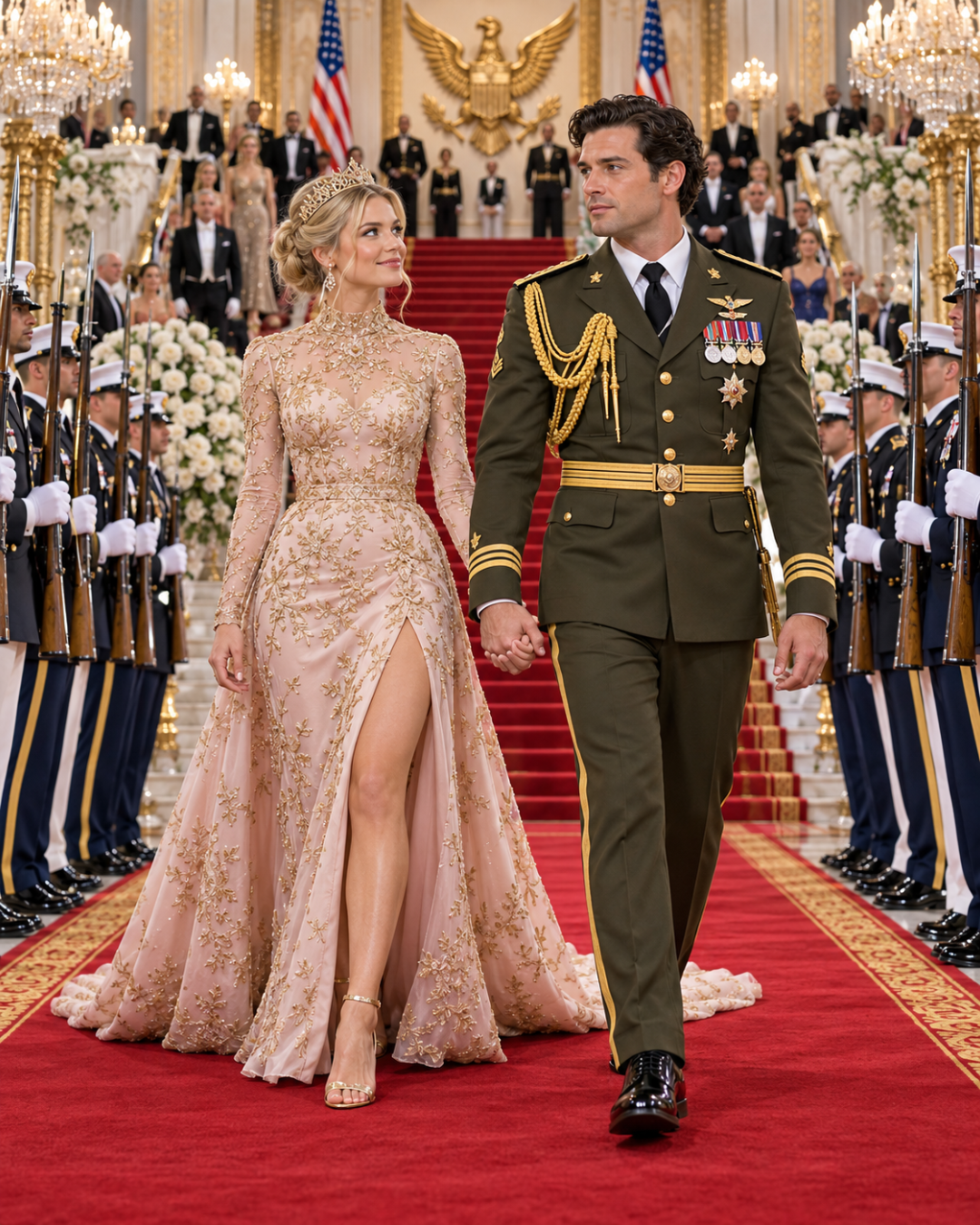
He smiled gently.
“Not because they finally know my name.”
“No,” I said. “Because I finally know my own.”
Across the room, Mom sat beside Sophie.
They were talking quietly.
Mark had joined them.
Dad stood nearby, without a microphone, no longer commanding everyone’s attention.
He seemed smaller without an audience.
I didn’t hate him.
But I finally understood how much of his influence had depended on the rest of us accepting his version of reality.
The music ended.
Sophie approached us.
“I want to make a toast,” she said.
Daniel looked toward me.
I nodded.
Sophie took the microphone with both hands.
“Tonight did not go as planned,” she began.
A few guests smiled.
“But I think my husband and I learned something important. A beautiful wedding is not the same thing as a perfect family. Families are made of people who disappoint each other, misunderstand each other, and sometimes hurt each other. What matters is whether we are willing to stop pretending and begin repairing what we have damaged.”
She looked directly at me.
“My sister Clara is married to Daniel Vale. They have been married for three years. I am sorry I did not stand beside them when I should have. I am sorry I believed silence was the same as peace.”
Her voice trembled.
“To Clara and Daniel, I wish you a life where neither of you has to hide to be loved.”
The guests applauded.
This time, the sound didn’t feel cruel.
It felt warm.
Sophie looked toward Dad.
After a long pause, he raised his glass.
“To Clara,” he said.
His voice sounded rough.
“To the life she built. And to the truth I should have faced sooner.”
It wasn’t a perfect apology.
It didn’t undo decades of humiliation.
But it was the first time he’d admitted wrongdoing without dismissing it as humor.
I lifted my glass.
“To choosing better,” I said.
Mom reached for my hand.
This time, I let her hold it.
Later, Daniel and I stepped onto the terrace.
The fountain glimmered beneath the lights.
Water moved quietly over the stone, reflecting the ballroom windows.
I stood looking at the place where my evening had changed.
“Do you regret coming?” Daniel asked.
“No.”
“Even the part where your father announced our marriage to four hundred people?”
I smiled.
“He did not announce it very well.”
“He could use some practice.”
I leaned against him.
Through the glass doors, I could see Sophie and Mark beginning their first dance.
Mom watched with one hand resting over her heart.
Dad stood nearby, no longer interrupting or demanding attention.
I knew the difficult work wasn’t finished.
There would be lawyers.
Accountants.
Bank statements.
Questions about the documents bearing my name.
Dad would need to demonstrate that his remorse was more than embarrassment.
Mom would have to learn that avoiding confrontation wasn’t the same as protecting her children.
Sophie and I would need to build a relationship that wasn’t defined by our father’s comparisons.
And Daniel and I would have to keep choosing honesty, even when telling the truth was uncomfortable.
None of it would be easy.
But easy had never guaranteed happiness.
Daniel took my hand.
My wedding ring, hidden on a chain for three years, now rested openly on my finger.
It felt strange and familiar at once.
As though something that had always belonged to me was finally where it should have been.
“You ready to go home?” he asked.
I looked through the glass one final time.
Sophie noticed me and lifted her hand.
I waved back.
“Yes,” I said.
We walked toward the ballroom doors together.
Earlier that evening, I’d entered the wedding alone because I believed keeping my husband hidden was the only way to protect our marriage from my family.
Now I understood something different.
Love didn’t require me to disappear.
Respect didn’t require silence.
And being someone’s daughter didn’t mean surrendering the right to live my own life.
My father had pushed me into a fountain to make four hundred people laugh.
But the woman who climbed out of that water was no longer willing to be the family joke.
I had a husband who loved me.
A sister who was finally learning to stand beside me.
A life I’d built for myself.
And a future that no longer depended on earning my father’s approval.
For the first time in thirty-two years, I didn’t need anyone in that ballroom to tell me I belonged.
I already knew.
And as Daniel and I walked away together, I realized that the most important thing I’d recovered that night wasn’t my inheritance, my reputation, or even the truth about my wedding.
It was my own voice.
