

PART 1
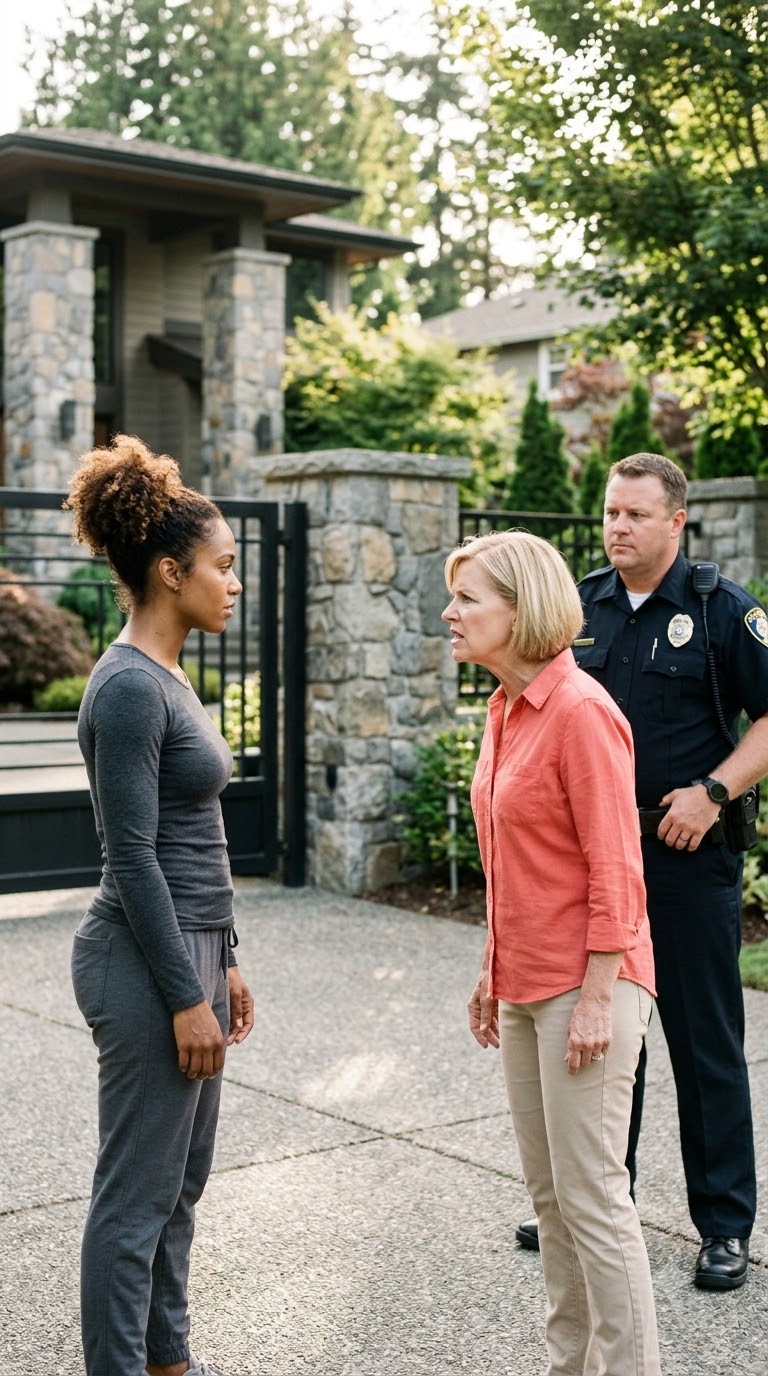
Karen Whitmore stepped closer, scrutinizing Nia Carter from head to toe.
“You don’t live here,” she said. “Stop pretending.”
Behind Karen, a closed steel gate stood between two stone pillars. Beyond it lay the driveway, the front garden, and the house Nia had left less than an hour earlier.
A police officer stepped directly into her path.
Nia’s gaze shifted from his navy uniform to Karen’s satisfied expression. Sweat cooled beneath the collar of her forest-green athletic shirt, and her legs still carried the pleasant fatigue of a completed run.
Her plan had been simple: get some water, take a shower, and find something to eat.
Instead, she found herself standing on a public sidewalk while two strangers questioned whether she belonged at her own address.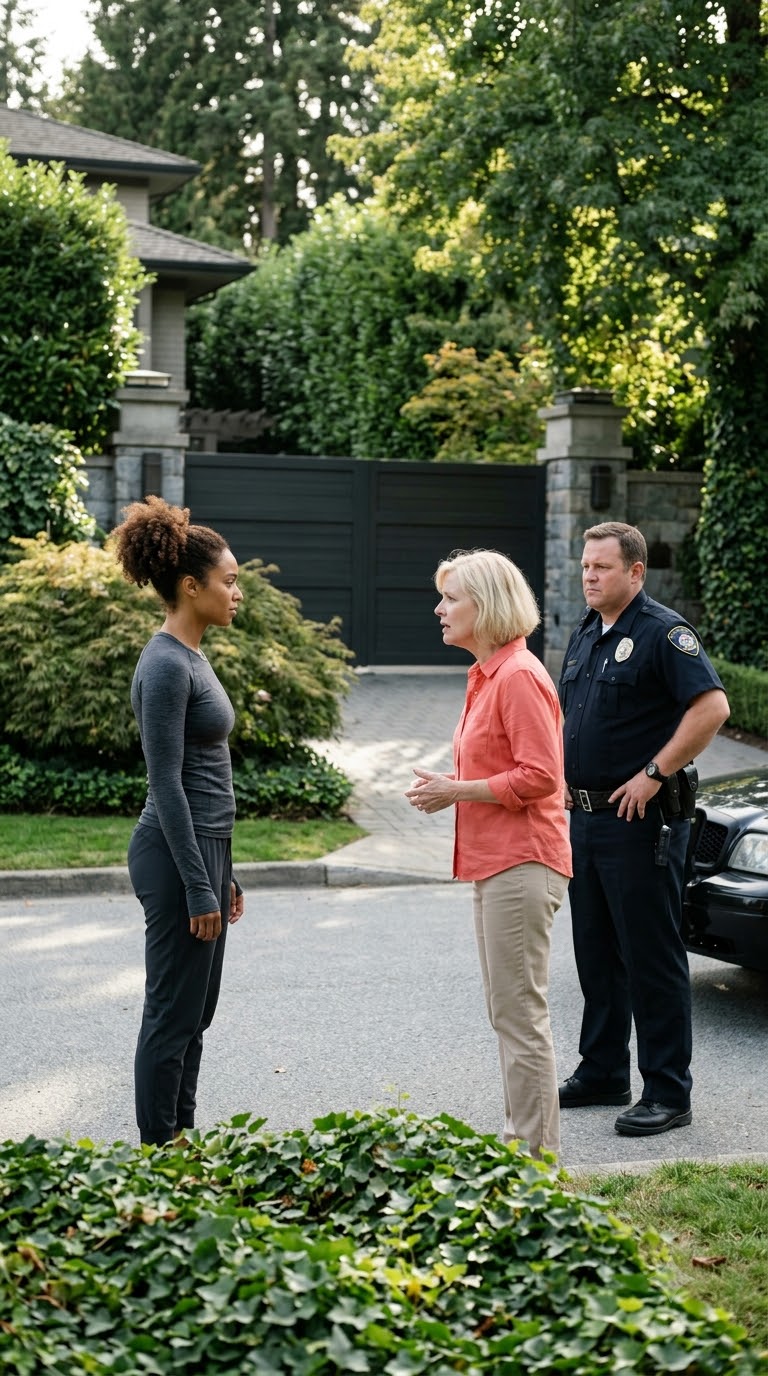
Her gate was within reach.
Neither of them intended to let her pass.
Seven weeks earlier, Nia had stood inside that same gate, balancing a moving box against one hip and laughing because she couldn’t find the kitchen.
The problem wasn’t that the house was too large.
It was that everything seemed to be in the wrong place.
A lamp sat beside the refrigerator. Books covered half the dining table. The box marked KITCHEN contained towels, a screwdriver, and a pair of shoes she’d been searching for since morning.
Her mother appeared in the hallway carrying two mugs.
“Where do these go?”
Nia glanced down at the box in her arms.
“At this point, wherever you can find room.”
Her mother grinned.
“That’s how people lose mugs.”
“I’ve already lost the entire coffee supply.”
“Then the mugs aren’t your biggest problem.”
Together, they found the kitchen, placed the mugs beside the sink, and cleared a space on the counter. For the first time that day, Nia finally stopped moving.
Through the rear window, she could see the garden.
From the front rooms, the driveway stretched toward the gate.
The house still felt unfamiliar in ways she enjoyed.
One door opened farther than she expected. Afternoon sunlight reached a wall that had looked plain during her first viewing. The floors made different sounds beneath her shoes depending on where she walked.
She had been careful about choosing the property.
She had inspected everything that required attention, asked questions, reviewed the paperwork, and spent more sleepless nights than she cared to admit considering a decision that would influence the next several years of her life.
Certainty hadn’t simply been given to her.
She had made her choice with enough information to accept whatever uncertainty remained.
Now, the boxes were inside.
The keys were hers.
The gate closed behind the driveway without anyone else deciding when she was permitted to enter.
That last detail had mattered more than she had expected.
At twenty-nine, Nia had lived in places where privacy depended on negotiating noise, shared entrances, neighbors’ schedules, and unreliable locks that everyone assumed someone else would report.
She had learned to carry groceries while holding a door open with one foot. She knew which staircase creaked and which delivery instructions people routinely ignored.
None of those places had been embarrassing.
They had been homes.
But this house offered something she had wanted for years: room to settle down without constantly accommodating someone else’s access.
Her mother noticed her looking through the window.
“You’re quiet.”
“I’m trying to believe it’s actually happened.”
“It has.”
“I know that.”
Her mother rested one hand on the counter.
“Knowing takes a little while to catch up sometimes.”
Nia nodded.
Outside, a vehicle passed beyond the stone pillars.
Only its upper portion was visible through the gate.
The separation felt peaceful.
She had no idea how differently that same barrier would feel when someone insisted on keeping her on the wrong side.
The first week was devoted to practical matters.
She found the towels.
Located the coffee.
Discovered that one moving-box label was accurate and treated the achievement as a personal victory.
She reorganized shelves, made a list of minor repairs, and learned how the house held the afternoon warmth.
The gate needed attention, too.
Before making it part of her daily routine, she wanted to understand how it operated. She checked the controls, confirmed that the access system worked properly, and tested the connection available through her smartwatch.
It was convenient for running.
She didn’t want to carry a collection of keys every time she went outside.
When she returned from her first short run and opened the gate from her wrist, she smiled at the convenience.
It seemed too ordinary to remember.
A tap.
The latch.
The opening.
One small inconvenience eliminated from an otherwise ordinary day.
She went inside and put the kettle on.
Over the following weeks, the house gradually became less of a purchase and more of a place where life unfolded naturally.
A plant found its place beside a window.
A chair was moved twice before she settled on the right position. Her running shoes began waiting near the door instead of disappearing into boxes.
She learned to recognize the gate’s sound before seeing it move.
The latch produced a distinct mechanical click. The gate then opened quietly, without an announcement or recorded voice.
She preferred it that way.
The system did its job without disturbing the neighborhood.
Her mother visited again after most of the boxes had disappeared.
This time, she brought fruit instead of packing supplies.
Nia showed her where the mugs were kept.
“Progress,” her mother said.
“Don’t look in the spare room.”
“That much progress?”
“Exactly that much.”
They sat at the kitchen table with the windows open.
The street outside was peaceful.
By then, Nia had met several neighbors. One had recommended a local gardener. Another had returned a package delivered to the wrong house.
Most of their encounters had been brief and ordinary.
Nia appreciated ordinary.
It allowed people to become familiar without requiring everyone to become friends.
Her mother asked how she liked the neighborhood.
“Good,” Nia said. “Quiet.”
“Quiet can be nice.”
“It is.”
She didn’t mention that she was still aware of being the newcomer.
Every move came with that awareness.
Which person recognized your car.
Which wave was meant for you.
Whether someone looking toward your house was simply glancing around or trying to identify the person who had recently moved in.
Nia didn’t want to interpret every look as a warning.
She had no intention of entering a neighborhood already convinced that the worst should be expected.
But she understood the difference between keeping an open mind and pretending she never noticed anything.
Some people had asked if she was visiting.
She had answered them.
A man had once assumed she was looking for the house next door.
She had corrected him.
Those encounters ended as soon as the information became clear.
That was how misunderstandings were supposed to be resolved.
Nia had no reason to expect that one afternoon, someone would refuse to accept the information itself.
The August day began without any sign that it would become memorable.
Nia opened the curtains, watered a plant, and realized she had forgotten to buy something for lunch. She stood in front of the refrigerator longer than necessary, wondering whether the available ingredients could somehow become a meal.
They could.
Just not yet.
She prepared breakfast and postponed the question of lunch.
The morning passed in a series of small chores.
She folded laundry, moved a box out of the spare room, and finally hung a framed photograph she had left leaning against a wall since moving day.
The picture showed her mother laughing at something beyond the frame.
Nia straightened it, stepped back, and left it in place.
There was always a point when checking something again became an excuse not to finish.
By early afternoon, she wanted to go outside.
Not to run an errand.
To move.
The sky was clear, the trees were full of summer leaves, and the neighborhood had enough shaded stretches to make a comfortable route possible.
She changed into her fitted forest-green athletic shirt and slate leggings, pulled her natural curls into a high ponytail, and sat on the edge of the bed to tie her white running shoes.
She checked her watch.
It was ready.
She left her phone inside.
Her identification stayed with the other belongings she didn’t need for a familiar run around her own neighborhood.
Before leaving, she drank some water, checked the house, and locked the door.
At the gate, she waited for it to open.
The street beyond looked just as it had through the windows: leafy, peaceful, and filled with the ordinary details of an afternoon.
A delivery van moved slowly in the distance.
Someone was washing a vehicle in a driveway.
A dog barked once before apparently deciding the effort wasn’t worthwhile.
Nia stepped outside and watched the gate close behind her.
She started at a comfortable pace.
The first few minutes always involved negotiating between what her body remembered from the previous run and what it could manage that day. She never tried to force the issue immediately.
She let her breathing settle.
Allowed her feet to establish a rhythm.
At the first corner, she moved aside for a couple walking together.
They thanked her.
She raised a hand and continued.
Her route passed gardens where flowers leaned over low fences, driveways decorated with chalk, and a house where a sprinkler swept the edge of the sidewalk in a bright, steady arc. Nia waited for it to turn away before continuing past.
She settled into the rhythm of her run, enjoying the steady movement and the quiet street.
At one intersection, she slowed to let a vehicle turn. The driver lifted a hand in acknowledgment, and Nia continued without giving the encounter another thought.
She had almost completed her usual route when she noticed a woman standing near the entrance to her property.
The woman was dressed neatly, with her hair arranged carefully and her posture suggesting she was accustomed to being listened to. She stood beside the stone pillars, looking toward the house with an expression that seemed more suspicious than curious.
Nia recognized her vaguely from the neighborhood.
Karen Whitmore.
They had exchanged brief greetings once, although they had never had a real conversation.
Nia reduced her pace as she approached the gate.
Karen’s eyes followed her.
When Nia reached the entrance, she raised her wrist toward the access system.
Before she could activate it, Karen stepped forward.
“Excuse me. What are you doing?”
Nia looked at her.
“Going home.”
Karen glanced toward the house and then back at Nia.
“Whose home?”
Nia initially thought she had misunderstood the question.
“Mine.”
Karen’s expression tightened.
“I don’t think so.”
Nia kept her voice even.
“I live here.”
Karen moved closer to the gate, placing herself between Nia and the entrance.
“No, you don’t.”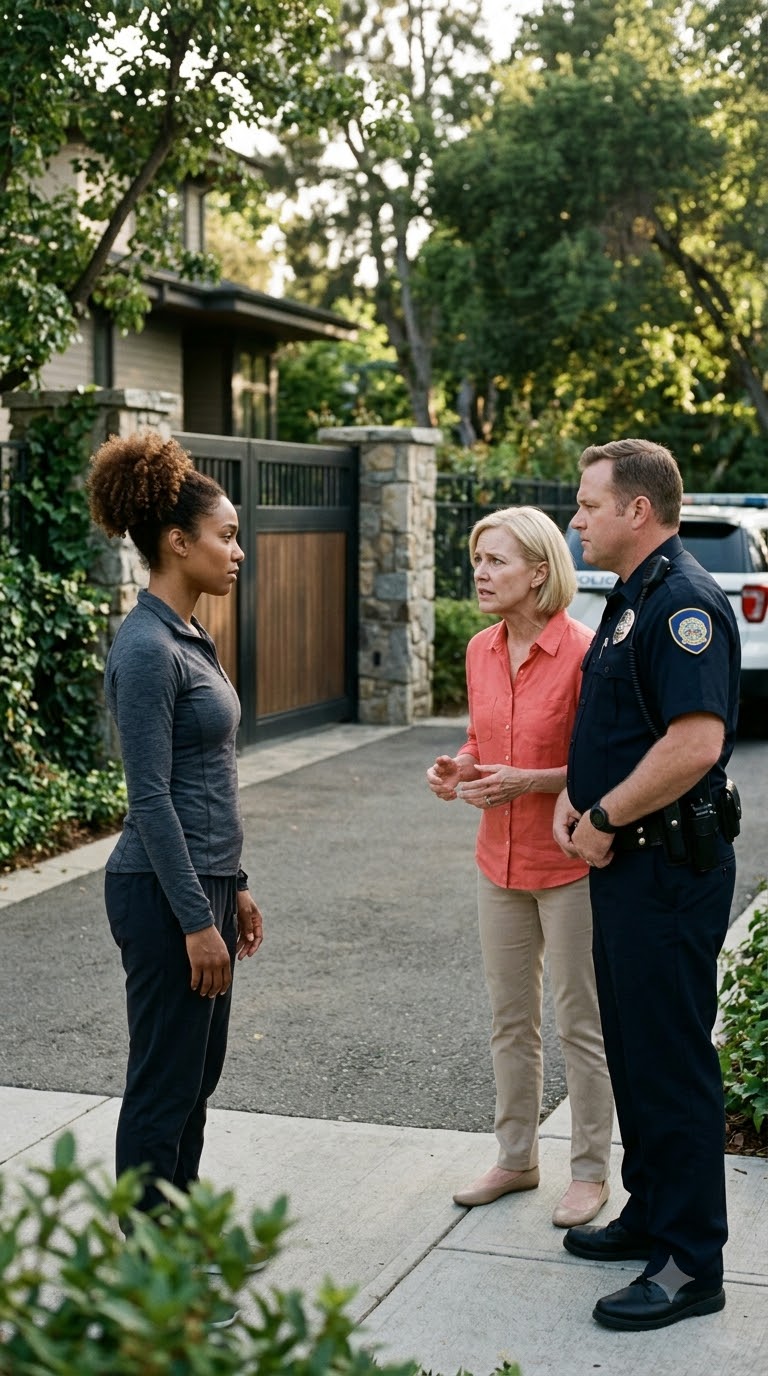
Nia looked beyond her at the familiar driveway.
“I’m not sure what you’re asking me.”
“I’m asking why you’re trying to get into this property.”
“Because I live here.”
Karen folded her arms.
“You expect me to believe that?”
Nia stared at her for a moment, trying to determine whether Karen was joking.
She wasn’t.
“I own this house,” Nia explained. “Please move aside so I can get inside.”
Karen shook her head.
“I’ve seen people come through here before. That doesn’t mean you belong here.”
Nia’s patience began to thin, although she made a deliberate effort to keep her voice controlled.
“I’m not asking you to let me into someone else’s property. This is my home.”
Karen looked her up and down, her gaze lingering on Nia’s running clothes and sweat-dampened shirt.
“People say all sorts of things when they’re caught somewhere they shouldn’t be.”
Nia felt the situation shifting from an awkward misunderstanding into something more deliberate.
She reached toward her smartwatch.
Karen immediately stepped in front of her.
“Don’t touch anything.”
Nia lowered her arm.
“I’m opening my gate.”
“Not until we establish who you are.”
Nia stared at her.
“Establish who I am? I have just told you.”
Karen pulled out her phone.
“I think the police need to deal with this.”
Nia took a slow breath.
“You can call whoever you want. I’m still going home.”
Karen’s expression hardened.
“Then you shouldn’t have a problem waiting.”
Nia could have argued. She could have raised her voice or attempted to squeeze past the woman.
Instead, she stepped back and decided not to let the situation escalate physically.
She had done nothing wrong.
She would not give Karen an opportunity to turn a simple attempt to enter her own property into a confrontation over her behavior.
Within minutes, a police vehicle appeared.
The officer stepped out and approached the two women.
Karen immediately began speaking.
“Officer, thank goodness you’re here. This woman is trying to get into a private residence, and she refuses to explain what she’s doing.”
Nia watched the officer’s attention shift toward her.
He appeared to be in his forties, with a composed expression and a firm manner. His uniform was neat, and one hand rested near his equipment belt as he approached.
“Ma’am,” he said to Nia, “step away from the gate.”
She complied, moving several paces toward the sidewalk.
PART 2
The officer turned to Karen.
“Tell me what happened.”
Karen pointed toward Nia.
“She came up here and tried to enter the property. I questioned her, and she claims she lives here, but I don’t believe her.”
The officer looked at Nia.
“Do you live at this address?”
“Yes.”
“Can you prove that?”
Nia glanced at the gate.
“I can show you the property documents inside the house. I also have access to the gate through my smartwatch.”
“Do you have identification on you?”
“My identification is inside. I went for a run and left my phone and other belongings at home.”
The officer’s expression remained guarded.
“Then I need you to remain here while we sort this out.”
Nia nodded.
“All right. But I want to be clear that I was trying to enter my own home when she stopped me.”
Karen gave a small, satisfied smile.
The officer turned back toward Nia.
“Do you have anything with your name and address on it?”
“Inside the house.”
“Then we’ll need to verify your identity.”
Nia looked at the closed gate again.
She had lived in the property for seven weeks. Her belongings were inside. Her keys and documents were inside. Her name appeared on the paperwork that established her ownership.
Yet she was being asked to prove that she belonged in a place she had legally purchased.
The officer remained between her and the entrance.
Karen stood nearby, looking increasingly confident.
Nia realized that neither of them had asked why Karen believed she had the authority to prevent her from entering.
“Officer,” she said, “may I ask you something?”
“Go ahead.”
“What exactly is the reason I’m being prevented from entering my own property?”
“I’m responding to a complaint. We need to establish what’s going on.”
“I understand that. But have I committed an offense?”
The officer paused.
“I’m trying to determine whether you have a legitimate reason to be here.”
Nia held his gaze.
“I have already told you that I live here. I have offered to show you the documents proving it. What else would you like me to do?”
Karen interrupted.
“She could be lying. You can’t just take her word for it.”
Nia turned toward her.
“And you expect him to take your word for it?”
Karen’s face tightened.
“I’m a concerned resident.”
“So am I. I live here.”
The officer raised one hand.
“Both of you, please. Let’s keep this calm.”
Nia fell silent.
She wasn’t interested in shouting over anyone. She wanted to go inside, drink some water, and take a shower.
But she was beginning to understand that remaining calm did not necessarily mean the other people involved would treat her fairly.
A second vehicle slowed on the opposite side of the street.
A neighbor who had been working in his driveway stopped what he was doing and looked toward the gate.
Karen noticed him watching.
She straightened slightly, as though the presence of an audience reinforced her position.
“This is exactly why people have concerns about unfamiliar individuals entering private neighborhoods,” she said.
Nia looked at her.
“I’m not unfamiliar to this address.”
The officer glanced toward Karen.
“Do you have any specific reason to believe she’s trespassing?”
Karen hesitated for a fraction of a second.
“I don’t recognize her.”
Nia let out a quiet breath.
“You don’t recognize me, so you decided I couldn’t live here?”
“That’s not what I said.”
“It’s exactly what you’ve been saying.”
The officer’s expression changed slightly. He looked from Karen to Nia and then toward the property.
For the first time, he seemed to recognize that the situation might be more complicated than the original complaint suggested.
“Ma’am,” he said to Karen, “do you own this property?”
“No.”
“Are you responsible for managing it?”
“No, but—”
“Do you have any documentation showing that you have authority over access to it?”
Karen’s confidence faltered.
“I’m familiar with the neighborhood. I’ve lived here for years.”
“That doesn’t answer my question.”
Nia remained silent, allowing the officer to finish.
Karen glanced toward the gate.
“I was only trying to protect the community.”
“From what?” Nia asked.
Karen turned sharply.
“From people who don’t belong here.”
Nia’s expression hardened.
“And how did you determine that I don’t belong here?”
Karen opened her mouth, then closed it.
For several seconds, the only sound was the faint rustling of leaves overhead.
The officer looked at Nia again.
“Is there a way for you to demonstrate access to the property without entering the gate?”
“Yes.”
Nia raised her wrist, keeping her movements slow and visible.
“My smartwatch is connected to the gate system. I can activate the opening mechanism from here.”
The officer stepped slightly aside.
“Go ahead.”
Nia touched the screen and selected the control she used every day.
A quiet mechanical click came from the gate.
The latch released.
The steel gate began to move inward.
Karen’s expression changed immediately.
Nia lowered her wrist.
The gate continued opening, revealing the driveway and the familiar front garden beyond it.
She looked at the officer.
“Would you like me to show you the documents now?”
He glanced at the open entrance.
“Yes. We’ll need to verify the details.”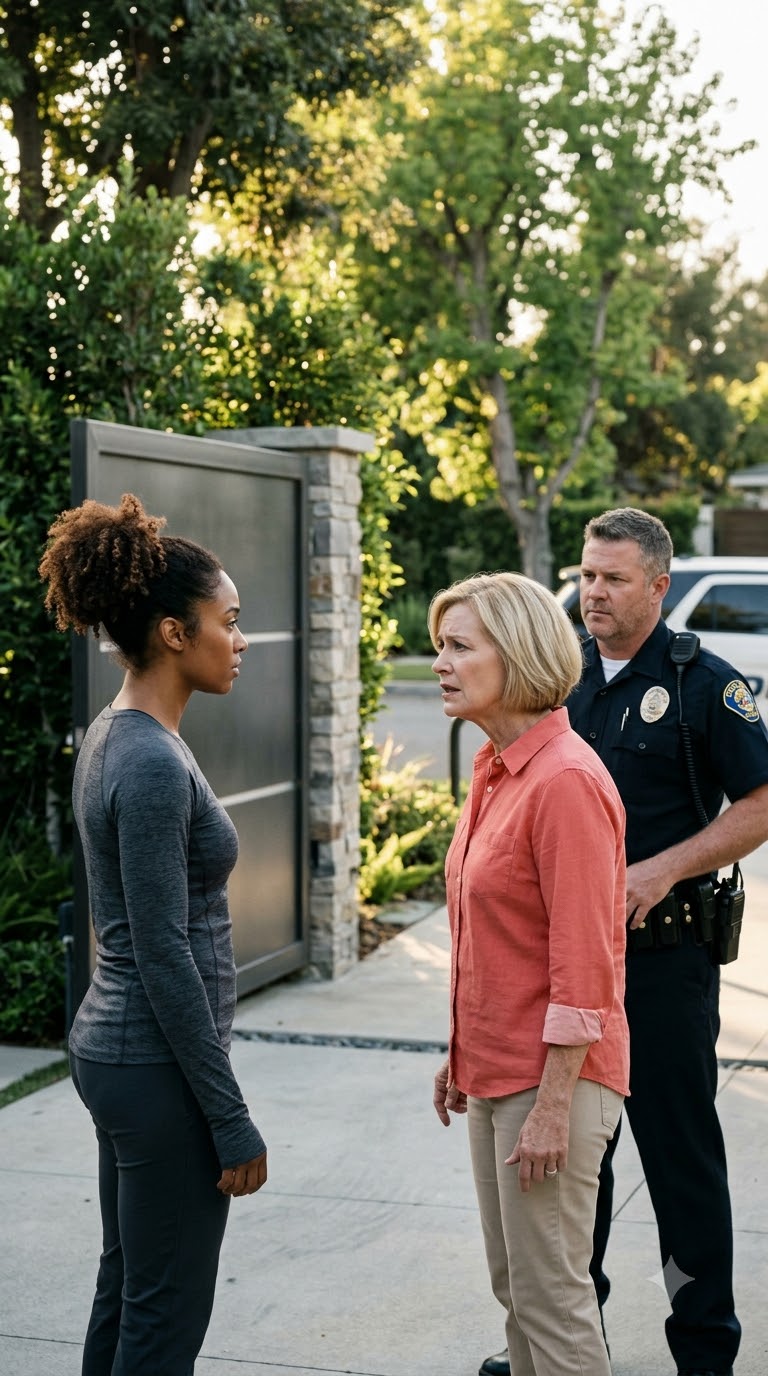
Nia walked through the gate.
Neither Karen nor the officer followed immediately.
For the first time since the confrontation began, she was standing on her own driveway without someone physically blocking her path.
She turned toward the house, unlocked the front door, and stepped inside.
The familiar scent of the house greeted her.
Everything was exactly where she had left it.
Her phone sat on the kitchen counter. Her identification was in the drawer where she kept it. The folder containing her property documents remained on the shelf in the study.
She retrieved the folder and returned to the entrance.
The officer stood just beyond the open gate, while Karen remained several feet away.
Nia handed over the relevant paperwork.
The officer examined the documents carefully.
He checked the property address, reviewed the ownership information, and compared the details with the identification Nia had brought from inside.
Then he looked up.
“Ms. Carter, these documents confirm that you own the property.”
Nia nodded.
“Yes.”
The officer returned the paperwork.
“Thank you for providing that.”
She took the folder.
“Now that we’ve established that I live here, can I ask why I was prevented from entering?”
The officer looked uncomfortable.
“I was responding to a report of possible trespassing. I needed to establish the facts.”
“I understand the need to investigate a complaint. But I told you who I was and offered to prove it. I was standing outside my own home while someone who has no ownership interest in it decided whether I could enter.”
The officer glanced toward Karen.
“I understand your concern.”
Nia shook her head slightly.
“I don’t think you do. I wasn’t trying to get into a stranger’s house. I was trying to get into mine.”
The words were quiet, but they carried the weight of everything that had happened over the preceding minutes.
Karen stepped forward.
“This is being blown out of proportion. I was only being cautious.”
Nia turned to face her.
“Cautious would have meant asking a question and listening to the answer. You accused me of lying before you had any information about me. Then you blocked my entrance and called the police.”
“I had every right to be concerned.”
“You had every right to ask a question. You did not have the right to decide that I couldn’t enter my own property because you didn’t recognize me.”
Karen looked toward the officer, apparently expecting him to intervene.
Instead, he addressed her directly.
“Ma’am, unless you have a specific legal basis for restricting access to this property, you cannot prevent the owner from entering it simply because you don’t recognize her.”
Karen’s mouth tightened.
“I was trying to help.”
“I understand that you say that. But the complaint has been investigated, and the documents establish that Ms. Carter is the owner.”
Nia watched Karen’s expression shift from indignation to reluctant uncertainty.
The neighbor across the street was still observing the situation.
He had put down his tools and was standing beside his driveway with his arms folded.
Nia didn’t look at him for long.
She wasn’t interested in performing for an audience.
She wanted the situation resolved.
The officer asked Karen a few additional questions about what she had seen and why she had decided to call the police. Her answers became less specific as the conversation continued.
Eventually, he made it clear that there was no evidence supporting her allegation of trespassing.
He turned back to Nia.
“Ms. Carter, you are free to return to your home. I’m sorry this situation has caused you inconvenience.”
Nia studied him for a moment.
“Thank you for confirming the ownership. I also hope you’ll consider how this was handled. Being asked to prove that I belong in my own home, after I’ve already explained the situation, is not something anyone should have to experience unnecessarily.”
The officer nodded.
“I understand.”
He returned to his vehicle after completing the necessary documentation.
Karen remained near the gate.
For a moment, she appeared as though she might say something else. Instead, she turned away and walked toward the neighboring street without offering an apology.
Nia watched her leave.
The entire encounter had lasted less than half an hour.
Yet the experience left her with a feeling that was difficult to shake.
She closed the gate and stood on the driveway, listening to the latch settle into place.
The same gate she had opened countless times without thinking had become the center of a confrontation over whether she belonged in her own home.
She went inside and placed the documents back in the study.
Then she stood in the kitchen, looking at the glass of water she had originally intended to drink.
She filled it and took several slow sips.
Her hands were steady, but her thoughts were not.
She replayed the conversation, considering whether she could have handled anything differently.
She could have carried her identification.
She could have taken her phone.
She could have tried to avoid engaging with Karen.
But none of those possibilities changed the essential fact.
She had done nothing wrong by going for a run and returning home.
She had done nothing wrong by leaving her belongings inside.
And she had not needed to earn the right to be believed simply because someone else had decided she looked out of place.
Nia finished her water and went upstairs to shower.
For the rest of the afternoon, she tried to return to her routine.
She changed clothes, prepared something to eat, and opened the windows to let in the breeze.
But when she passed the front window, she noticed that a small group of neighbors had gathered farther down the street.
They were talking quietly.
One of them glanced toward her house.
Nia stepped away from the window.
She had no idea what Karen had told them, and she had no intention of guessing.
She couldn’t control what people chose to believe.
She could control what she did next.
That evening, she called her mother.
Her mother answered after the second ring.
“Everything all right?”
Nia sat at the kitchen table.
“Something strange happened today.”
“What kind of strange?”
Nia explained the confrontation, beginning with Karen blocking the gate and ending with the officer confirming her ownership.
Her mother listened without interrupting.
When Nia finished, there was a long pause.
“Are you okay?” her mother asked.
“I’m fine. I’m just angry.”
“You have every reason to be.”
Nia looked toward the front door.
“I keep thinking about how ordinary the whole thing should have been. I went for a run. I came home. That’s all I was trying to do.”
“I know.”
“And somehow, I ended up having to prove that my own house belonged to me.”
Her mother sighed.
“People sometimes confuse their assumptions with facts.”
Nia leaned back in her chair.
“I don’t want to spend the next several months worrying about whether someone will decide I don’t belong here.”
“Then don’t let their assumptions determine how you live.”
Nia smiled faintly.
“You make it sound simple.”
“No. I make it sound possible.”
They talked for a while longer, eventually moving to other subjects.
PART 3
After the call ended, Nia sat quietly for a few minutes.
Her mother was right about one thing.
The incident did not have to define her experience of the neighborhood.
But ignoring it would not make it disappear, either.
The following morning, Nia began by writing down what had happened.
She recorded the approximate time, the sequence of events, what Karen had said, and the officer’s response. She kept the notes factual and avoided adding interpretations she could not substantiate.
She saved the relevant property documents and made a copy of the ownership information.
Then she reviewed the gate system to ensure that its access controls were functioning properly.
Everything worked as expected.
She had not been locked out because of a technical failure.
The problem had been someone else’s decision to stop her.
Later that day, Nia contacted the police department through its non-emergency channel to ask how she could obtain information about the incident and submit feedback concerning the response.
She explained that she was not disputing the need to investigate legitimate complaints. Her concern was that the encounter had proceeded on the assumption that she was an intruder, even after she repeatedly explained that she lived at the property.
She asked for the incident reference number and requested information about the department’s procedure for reviewing such concerns.
The person who took her call explained the next steps.
Nia followed them.
She didn’t demand that anyone be punished before the facts were reviewed. She wanted a record of what had happened and a clear explanation of how similar situations should be handled in the future.
Once the call ended, she returned to her work.
The days that followed were ordinary in many ways.
She went for runs.
She watered her plants.
She continued unpacking the remaining boxes.
But she also began paying closer attention to the people around her.
Not because she expected another confrontation.
Because she had learned that a peaceful appearance did not guarantee that everyone would treat one another fairly.
Several days later, as Nia returned from the grocery store, she saw the neighbor who had watched the confrontation standing near his driveway.
He raised a hand.
“Ms. Carter?”
She stopped at a comfortable distance.
“Yes?”
“My name’s David. I live across the street.”
“I know. We’ve met before.”
He nodded.
“I wanted to say something about the other day.”
Nia waited.
“I saw what happened. I didn’t know whether to get involved, and I wasn’t sure what was going on at first. But after the officer checked your documents, it was obvious that you were telling the truth.”
Nia shifted the grocery bag in her hand.
“All right.”
David looked uncomfortable.
“I should have said something when Karen started making those accusations. I didn’t. I’m sorry.”
His apology seemed sincere, although Nia had no reason to pretend that it erased what had happened.
“Thank you for saying that,” she replied.
He nodded.
“I hope you know not everyone around here thinks that way.”
“I hope so, too.”
They exchanged a few more words before Nia continued toward her gate.
The conversation did not transform the neighborhood overnight.
It did, however, remind her that silence and hostility were not the same thing. Some people might hesitate because they were uncertain or uncomfortable, while others were willing to reconsider what they had witnessed.
She could acknowledge the difference without excusing what had happened.
Over the next week, Nia learned that the incident had become a topic of conversation among several residents.
She heard no direct accusations, but she noticed that a few people who had previously ignored her now offered greetings.
One afternoon, a woman walking a dog stopped to introduce herself.
Another neighbor asked whether Nia had found a reliable gardener.
Their conversations were brief, and Nia didn’t volunteer details about the confrontation.
She preferred to let future interactions speak for themselves.
Karen, however, continued to avoid her.
Whenever they happened to be in the same area, Karen looked away or found a reason to leave.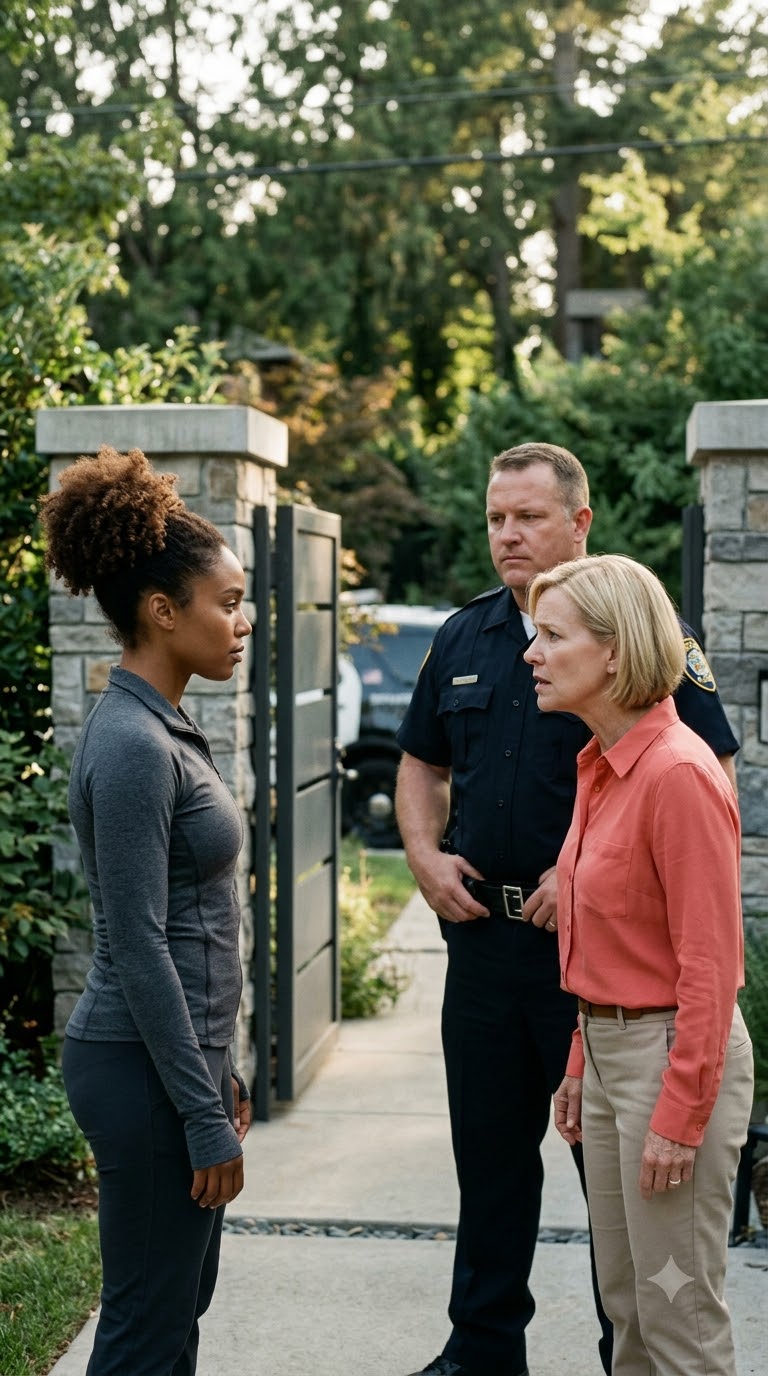
Nia did not chase her down to demand an apology.
An apology offered under pressure would not necessarily change anything.
What mattered more was whether Karen would stop treating an unfamiliar face as evidence of wrongdoing.
A few weeks later, the neighborhood association held a scheduled meeting in a community room near the main entrance to the development.
Nia had initially planned to skip it.
She was busy, and she had no desire to spend an evening discussing neighborhood gossip.
But when she received the agenda, she noticed an item concerning access, security, and the handling of suspicious-activity reports.
She decided to attend.
The room contained a dozen residents seated around a long table. Some were people Nia recognized from her walks, while others were unfamiliar.
Karen sat near the far end.
When Nia entered, Karen glanced up and then returned her attention to the papers in front of her.
The meeting began with routine matters.
A resident asked about street maintenance. Another discussed a proposal to improve lighting near the entrance.
Eventually, the chairperson introduced the discussion about neighborhood security.
Several people expressed concern about protecting their homes.
Nia listened carefully.
She agreed that residents should report specific concerns. She understood why people valued secure entrances, reliable locks, and functioning surveillance systems.
But she also recognized the danger of allowing vague suspicion to replace evidence.
When the chairperson invited comments, Nia raised her hand.
“My name is Nia Carter. I moved into the neighborhood about seven weeks ago.”
Several people nodded.
“I’d like to share something that happened to me recently. I returned from a run and was prevented from entering my own property by a resident who didn’t recognize me. The police were called, and I was asked to establish my ownership before I could go inside.”
The room became quiet.
Nia continued in a measured voice.
“I understand that security matters. If someone sees a genuine sign of a break-in or another specific problem, reporting it is reasonable. But not recognizing someone is not the same as having evidence that they are trespassing.”
She paused to let her words settle.
“I had just left my own home. I had no phone or identification with me because I was going for a run. I offered to demonstrate that I had access to the gate, and I eventually provided the ownership documents. The situation was resolved, but it should never have become a confrontation in the first place.”
A resident near the window leaned forward.
“Are you saying people shouldn’t question strangers?”
“No,” Nia answered. “I’m saying we should question behavior, not assume guilt based on appearance. If there’s a specific reason to be concerned, explain it. If the person provides a reasonable answer, listen. And if the situation is unclear, let the appropriate authorities establish the facts without treating assumptions as proof.”
The chairperson nodded thoughtfully.
“That’s a fair distinction.”
Another resident spoke.
“We’ve had incidents in the past, and people are naturally protective of their homes.”
“I understand that,” Nia said. “I want to feel safe here, too. But safety should apply to everyone who lives in the neighborhood, not only the people others already recognize.”
Several residents exchanged glances.
Karen shifted in her seat.
Finally, she spoke.
“I don’t think anyone intended to make you feel unwelcome.”
Nia turned toward her.
“I can’t tell you what anyone intended. I can tell you what happened.”
Karen pressed her lips together.
“I was trying to protect the neighborhood.”
Nia nodded once.
“Then I hope we can agree that protecting a neighborhood means treating people fairly, too.”
For a moment, nobody spoke.
Then David, who was sitting near the door, raised his hand.
“I saw part of the incident,” he said. “I think Nia has made an important point. We shouldn’t have to choose between security and fairness.”
A woman beside him agreed.
“Perhaps we should establish clearer guidelines for reporting concerns. People should know what to do without making assumptions about who belongs.”
The chairperson wrote down the suggestion.
The discussion continued for another twenty minutes. By the end, the residents had agreed to review their guidance on security concerns and emphasize that reports should be based on observable behavior rather than unfamiliarity alone.
No dramatic announcement followed.
No one stood up to applaud.
The meeting ended as ordinary meetings do, with chairs moving across the floor and people gathering their belongings.
But Nia left feeling that the evening had accomplished something worthwhile.
She had not needed to humiliate Karen or turn the confrontation into a contest.
She had simply described what happened and explained why it mattered.
As she walked toward her car, David caught up with her.
“You handled that well.”
Nia gave him a small smile.
“I just wanted people to understand the difference between being careful and making assumptions.”
“I think they understood.”
“I hope so.”
He nodded before heading in the opposite direction.
Nia drove home beneath the fading evening light.
When she reached her property, she used her smartwatch to open the gate.
The latch clicked.
The steel panels moved inward.
She drove through, parked in the driveway, and watched the gate close behind her.
For a moment, she remained in the car.
Seven weeks earlier, she had stood in this same driveway with a moving box against her hip, laughing with her mother because she couldn’t find the kitchen.
She remembered the excitement of that afternoon, the unfamiliar rooms, the boxes waiting to be unpacked, and the quiet satisfaction of knowing she had made a home of her own.
She had purchased this property through careful planning and hard work. She had reviewed the documents, made the necessary decisions, and accepted the responsibilities that came with ownership.
None of that had changed because Karen Whitmore failed to recognize her.
None of it had become less real because a police officer initially approached her as a possible intruder.
And none of it required anyone else’s approval.
Nia stepped out of the car and walked toward the front door.
Inside, the framed photograph of her mother remained straight on the wall.
The plant beside the window needed watering.
A few books were still stacked on the dining table, and the spare room had not yet reached the level of organization she wanted.
The house was imperfect.
It was also hers.
She put away the groceries, filled a glass of water, and opened the window above the kitchen sink.
Outside, the neighborhood settled into the quiet of another evening.
A car passed.
Somewhere down the street, a dog barked.
The gate stood between the driveway and the sidewalk, performing the simple task for which it had been installed.
It was a barrier designed to protect a property, not a tool for deciding who deserved to belong.
Nia understood that she could not prevent every misunderstanding or control every person’s assumptions.
But she could insist that her rights be respected. She could document what happened, seek accountability through appropriate channels, and speak when a situation revealed a problem that others needed to recognize.
She had done those things without abandoning her composure or pretending that the experience had been harmless.
That mattered to her.
The next morning, she went for another run.
She checked her watch, tied her shoes, and left her phone on the kitchen counter.
At the gate, she tapped the screen.
The latch released immediately.
Nia stepped onto the sidewalk and began her familiar route beneath the summer trees.
She passed the same gardens, the same driveways, and the same intersection where she had slowed for a turning vehicle the previous week.
A couple walking together greeted her.
She returned the greeting.
At the corner, she adjusted her pace and continued running.
For the first time since the confrontation, she noticed that she was no longer thinking about Karen or the officer.
She was thinking about her breathing, the rhythm of her feet, and the distance remaining before she turned toward home.
The ordinary pleasure of the run had returned.
When she eventually reached her street, the house appeared between the trees exactly as it always had.
The stone pillars stood on either side of the driveway.
The steel gate remained closed.
Nia raised her wrist.
A tap.
The latch.
The opening.
She passed through without asking permission from anyone standing nearby.
Then she watched the gate close behind her and continued up the driveway toward the front door.
She had not won a contest over who belonged in the neighborhood.
She had never needed to.
She was a homeowner returning to her own home, and that simple truth had been there from the beginning.
The experience had taught her something about the difference between suspicion and evidence, between authority and entitlement, and between keeping a community safe and deciding that some people must prove their worth before being treated with dignity.
A gate could control access.
A uniform could establish authority.
A confident accusation could make an ordinary person hesitate.
But none of those things could change the facts.
And the facts had never been in doubt.
Nia Carter belonged in her home because it was her home.
She had always belonged there.
The only thing that had needed to change was the assumption that she had to prove it to someone who had already decided otherwise.
