

PART 1
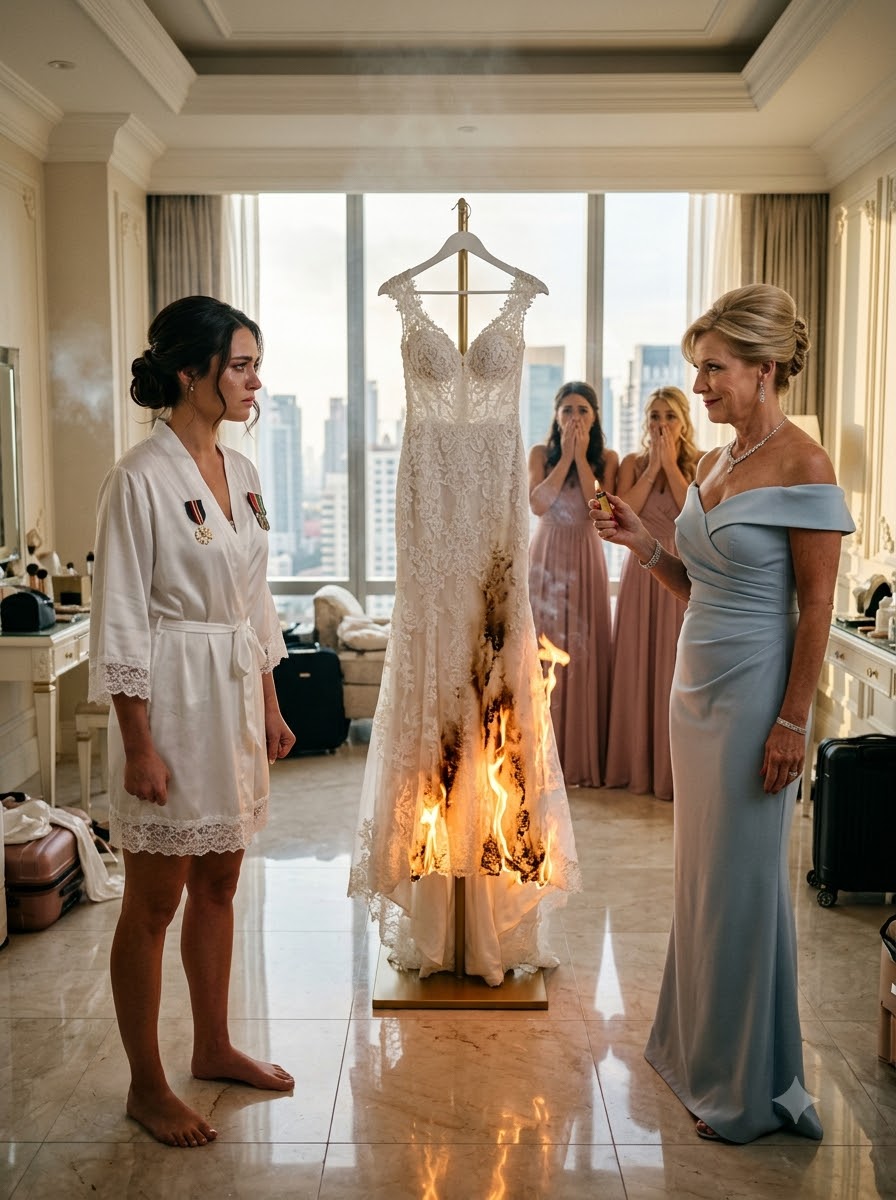
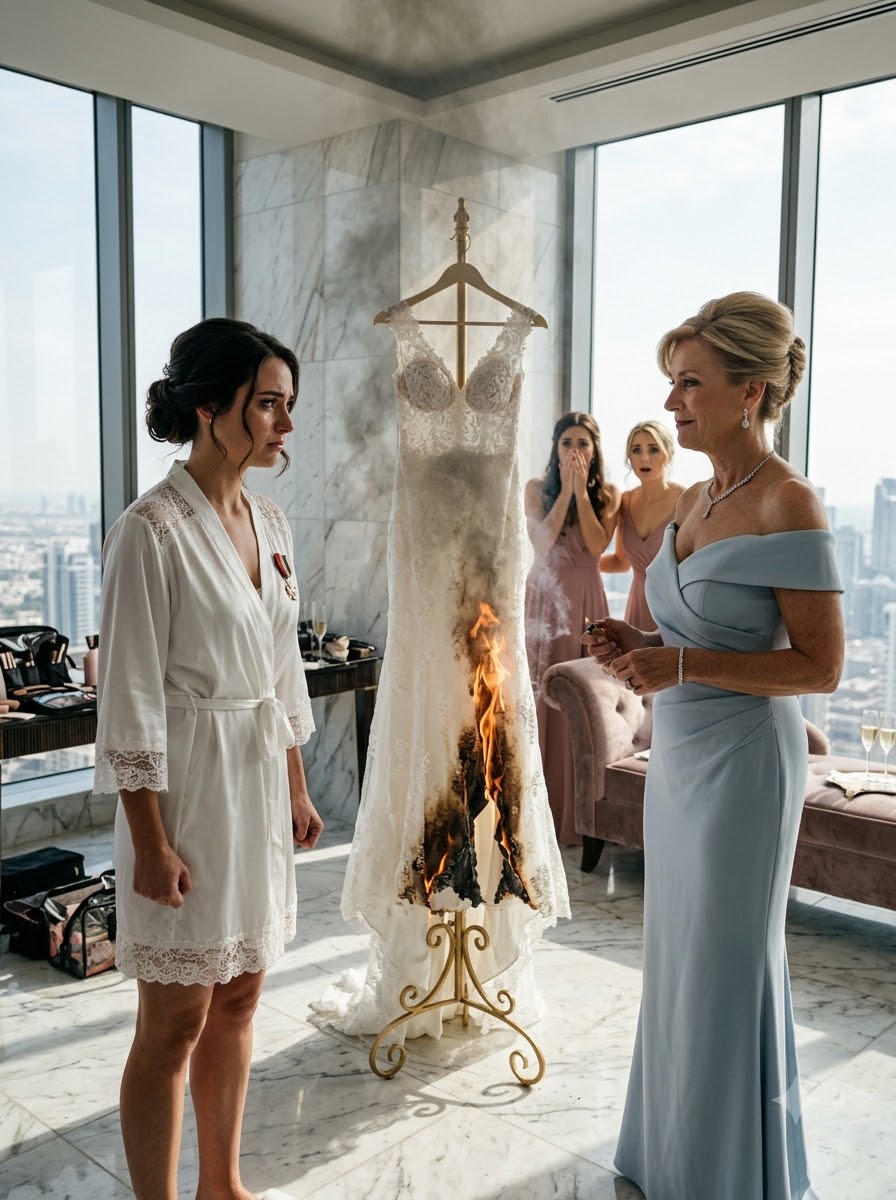
The first thing that truly registered wasn’t the sight of the flames. It was the smell. An acrid chemical stench clawed at the back of my throat, the unmistakable odor of something beautiful being violently unmade. My wedding dress, which had hung pristine from an ornate hook only moments earlier, was now engulfed in hungry orange flames. Heat washed over my skin in dry, blistering waves, making the air inside the bridal suite shimmer.
The fire didn’t roar. It hissed, a venomous sound as it consumed six months of late nights, careful stitches, aching fingers, and whispered dreams. I remembered sitting at my sewing machine after exhausting shifts, guiding delicate fabric beneath the needle while imagining Jason waiting at the altar. I remembered holding pieces of lace against the light, wondering whether my grandmother would have approved of the design. I remembered the quiet happiness of creating something with my own hands for the day I would promise to share my life with the man I loved.
All of it was disappearing before my eyes.
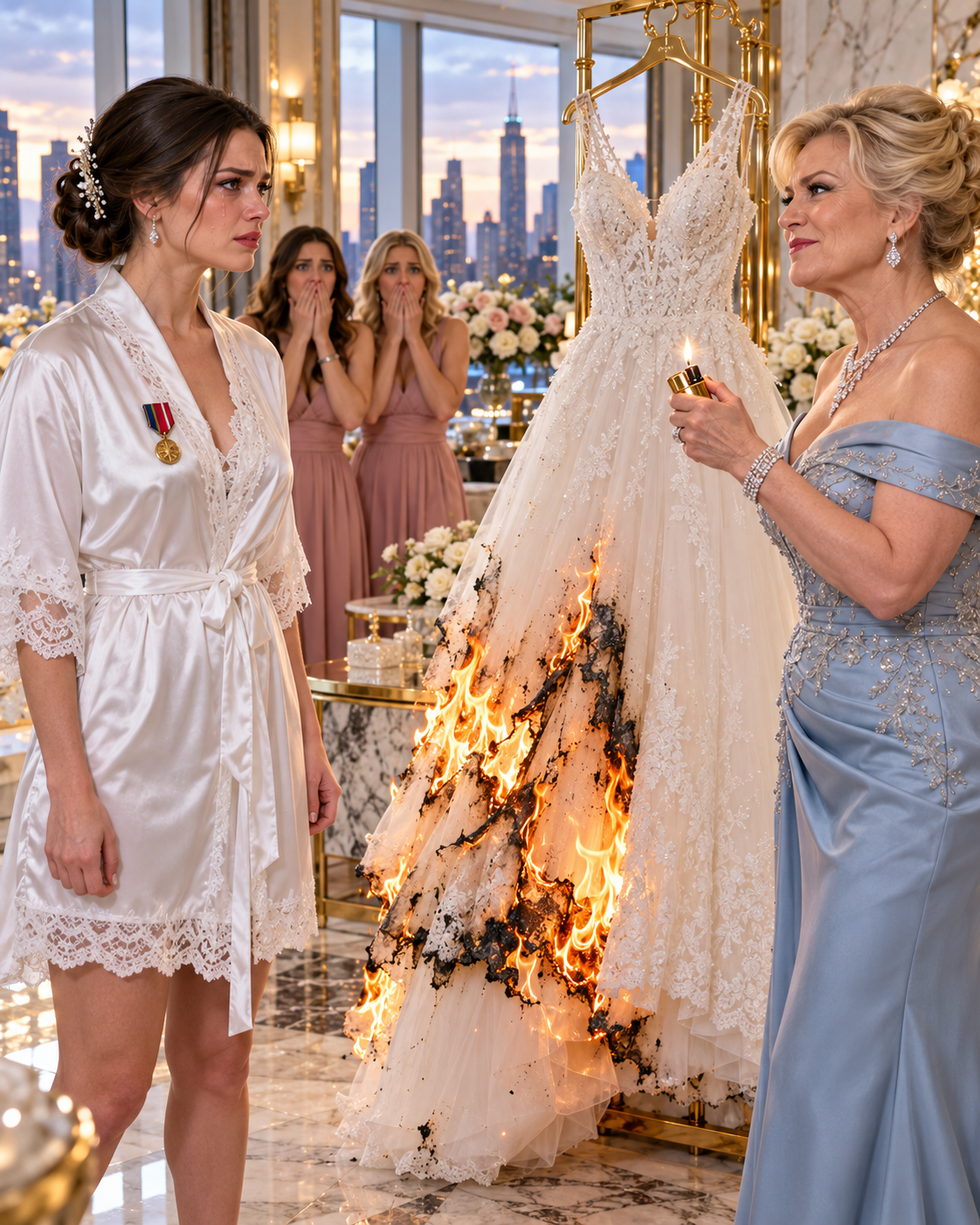
Behind me, my bridesmaids gasped, their horrified breaths seeming to steal the remaining oxygen from the room. Someone whispered my name. Another woman made a small, strangled sound of disbelief. I heard them, but their voices seemed distant, as though they were coming from the other side of a thick glass wall.
I didn’t scream, and I didn’t cry. My body became perfectly still while my mind accelerated into the disciplined patterns years of military training had carved into me.
Threat assessment. One hostile individual: Margaret Wilson. Motive: elimination of someone she considered socially unacceptable. Asset destroyed: handmade wedding dress, high monetary and sentimental value. Enemy objective: complete psychological demoralization immediately before a major life event.
This was psychological warfare, carried out in a room decorated with ivory roses and crystal chandeliers instead of on a battlefield.
Everything slowed down the way it sometimes did in the moments before an ambush. The frantic movements of my friends blurred at the edges of my vision. I could hear the crackle of burning fabric and the faint ticking of the antique clock on the mantel. But the only thing that remained perfectly clear was Margaret’s face.
I studied every detail with cold precision: the triumphant curl of her lips, the feverish gleam in her eyes, and the slight tremor in her hand that betrayed the adrenaline rushing through her veins. She wasn’t behaving like a frightened woman who had made a terrible mistake. She was enjoying what she believed was her victory.
I wasn’t simply watching a dress burn. I was witnessing a declaration of war.
One of my old instructors at West Point had repeated the same lesson until his voice was hoarse. When you’re under enemy fire, you do not panic. You analyze, you adapt, and you overcome.
Margaret allowed the silence to linger, savoring the devastation she had caused. Then she began another assault, this time using words instead of fire.
“Did you really think this was going to happen?” she asked, gesturing toward the smoldering remains of my dress. “Did you actually believe you could just waltz into this family, into this life, and become one of us? You don’t belong here, Katie. You never have.”
She took a step closer. Her diamond necklace caught the light, glittering brilliantly against the dark smoke drifting through the room. She tapped one perfectly manicured finger against her collarbone, drawing my attention to the expensive stones.
“This necklace is worth more than every penny you’ll ever earn in your little Army career,” she declared. “And certainly more than that cheap piece of jewelry you insist on wearing.”
Her eyes flickered toward the Bronze Star Medal I had pinned to the inside of my bridal robe for good luck.
I had earned that medal in Afghanistan. Not because I considered myself extraordinary, but because I had done my job when everything around us was falling apart. I had made decisions that helped bring my soldiers home. Whenever I touched that medal, I remembered the faces of the men and women who had trusted me with their lives.
“It’s not jewelry,” I said quietly.
Margaret laughed, the sound brittle and utterly devoid of warmth.
“Oh, of course not. It’s a prop, isn’t it? A little costume accessory to make you feel important. Your father is a firefighter back in Columbus, isn’t he? How admirable.”
She pronounced the last word as though it were an insult.
“But my son needs a wife who can sit on the board of the Cleveland Museum of Art. He needs someone who understands society, culture, and influence. Not a woman whose idea of fine dining is eating an MRE out of a plastic pouch. You don’t understand our world, Katie. You are filth.”
Filth.
The word struck something deep inside me, but it didn’t break me. Instead, it clarified everything.
Throughout Margaret’s tirade, my bridesmaids had remained remarkably still. My maid of honor, Sergeant Jessica Reyes, stood with her back straight and her hands clasped behind her. Jessica had served alongside me long enough to recognize the difference between fear and concentration. Her expression was unreadable, her breathing controlled.
The other women followed her lead. They weren’t paralyzed by terror or intimidated by Margaret’s wealth. They were waiting for me to tell them what to do.
Their collective composure formed a wall of loyalty that Margaret, blinded by arrogance, couldn’t comprehend. She was accustomed to housekeepers lowering their eyes when she entered a room and social climbers flattering her in hopes of gaining favor. She assumed our discipline was submission, that my silence meant she had successfully crushed my spirit.
A small, cruel smile appeared on her face.
“You’re very good at taking orders,” she said, delivering what she obviously believed would be her final blow. “But you will never, ever give them in this house.”
That was enough.
I didn’t answer immediately. There was nothing left to gain from arguing with a woman who had made her intentions so unmistakably clear. Instead, I moved.
Three deliberate steps brought me to the marble-topped vanity against the far wall. I reached for my phone, closing my fingers around its cool, smooth case. My hand didn’t shake. There was no hesitation, no fumbling, only the quiet efficiency of a soldier carrying out a familiar task.
When I turned back toward Margaret, the room seemed to hold its breath. Even the faint hissing of the dying flames appeared to recede into the background.
I met her gaze. For the first time, she seemed to notice something in my eyes that wasn’t shock or pain. It was control.
“Mrs. Wilson,” I said, my voice level and steady, “you have absolutely no idea what you’ve just done.”
For the briefest moment, uncertainty crossed her face. I watched the confidence falter in her eyes, and my thoughts returned to the long series of humiliations that had brought us to this moment.
This wasn’t an isolated incident. It was the culmination of a cold war Margaret had been waging against me for nearly two years. The destruction of my wedding dress was simply the first time she had used an actual flame.
Before that, she had tried to burn away my confidence with contempt, carefully delivered insults, and calculated gestures designed to remind me that I would never be good enough for her son.
It had begun at Thanksgiving, during my first visit to the Wilson family estate on the shores of Lake Erie.
I still remembered how nervous I had been as I drove along the winding driveway, past perfectly trimmed hedges and enormous trees that framed the sprawling stone mansion. The house looked like something from an architectural magazine, all pale limestone, towering windows, and a front entrance grand enough to accommodate a presidential reception.
I wanted desperately to make a good impression. I wanted Jason’s family to see me as more than the soldier he had fallen in love with. I hoped they would recognize the woman beneath the uniform, someone who valued family, loyalty, and the ordinary kindnesses that made a house feel like a home.
For that reason, I spent two days preparing a pumpkin pie from my grandmother’s recipe. I rolled the dough by hand, carefully fluted the crust, and filled my little apartment with the comforting scents of cinnamon and nutmeg. It wasn’t an expensive gift, but it represented everything home had always meant to me.
I carried it into the Wilson mansion in a glass dish, hoping it might become the beginning of a warm family tradition.
Margaret met us in the cavernous marble foyer. When I offered her the pie, she glanced at it briefly. Something unreadable crossed her expression before a tight, dismissive smile settled on her lips.
“Maria,” she called to the housekeeper standing nearby, “take this to the kitchen for the staff.”
She didn’t thank me. She didn’t ask whether I had made it myself. She simply turned away, dismissing my offering as something unworthy of the family dining table.
I stood there holding my empty hands together, feeling foolish and strangely exposed. Jason touched the small of my back and gave me an apologetic look, but the damage had already been done.
The rest of Thanksgiving dinner became an exercise in carefully orchestrated exclusion. Margaret spoke endlessly about Melissa Hammond, the daughter of a wealthy real estate tycoon whose family moved within the same social circles as the Wilsons.
She described Melissa’s latest charity trip to Monaco, an expensive painting she’d acquired at a Sotheby’s auction, and the glorious summer parties her family hosted in the Hamptons. Every anecdote was polished to perfection, every detail chosen to emphasize the difference between Melissa’s privileged world and mine.
I sat at the long dining table, trying to maintain a polite smile while pushing mashed potatoes around my plate. Beneath the table, Jason found my hand and squeezed it gently. The gesture was an apology he couldn’t bring himself to speak aloud.
I loved him for trying, but his affection couldn’t erase the humiliation. I had arrived hoping to be welcomed into a family. Instead, I had been made to feel like an intruder who had wandered into a private club without the proper credentials.
Christmas brought another opportunity for Margaret to remind me of my place.
I had spent weeks searching for a gift for Jason’s father, Richard Wilson. Unlike his wife, Richard had always treated me with a reserved but genuine courtesy. He was a serious man who had built Wilson Steel into a powerful business, and I knew he possessed a lifelong fascination with history, particularly military strategy.
After hours of searching online and visiting dusty old bookstores, I found something special: a rare first-edition book about the Civil War, signed by its author.
It wasn’t easy to obtain, and it cost more than I would ordinarily spend on a Christmas gift. But I knew Richard would appreciate it, and I wanted to give him something meaningful.
When he unwrapped the package on Christmas morning, his expression changed immediately. His eyes brightened as he ran his fingers over the worn leather cover, examining the title page with obvious delight.
“Katie, this is remarkable,” he said, looking up at me. “Where on earth did you find it?”
I told him about my search, and he began asking questions about the book’s history. For a few wonderful minutes, we shared a genuine conversation. I felt as though I had finally found a small place within the family.
Then Margaret spoke.
“Oh, Richard, do we really have room for more dusty old things?”
She looked at me with a smile as sharp as a broken Christmas ornament.
“Katie, dear, next time a nice bottle of wine will do just fine. It’s simpler, and much more suited to our standards.”
The warmth vanished. Richard’s delight became awkward silence, and I felt my face growing hot.
She had taken a thoughtful gift, one that had created a moment of genuine connection, and transformed it into another lesson about social standing. In her version of the world, my effort was embarrassing because it didn’t carry the right luxury label or reflect the right kind of sophistication.
But the moment that truly revealed how deeply she resented me came several months later.
I had arrived early at the Wilson house to pick up Jason, and as I passed his father’s study, I heard Margaret speaking to him. Her voice was low, but there was an intensity beneath it that made me stop.
“You’re ruining your future, Jason,” she said. “What can that girl possibly offer you? A meager Army salary and stories about life in a foxhole? You need a wife who can advance your career, someone who understands our world. Love doesn’t pay the yacht club dues.”
I stood motionless in the hallway, an invisible fist tightening around my stomach.
Until then, some small part of me had hoped that Margaret’s behavior came from fear of losing her son. I thought perhaps she was overprotective, or frightened by a future that didn’t match the one she had imagined for him.
But hearing her speak so plainly destroyed that illusion.
To Margaret Wilson, I wasn’t a person. I wasn’t a woman who loved her son, or an officer who had dedicated her life to serving her country. I was a liability, a bad investment, a line on a balance sheet that failed to produce the expected return.
After each humiliation, Jason tried to repair the damage. He would wrap his arms around me, apologize for his mother’s behavior, and tell me how ashamed he was of the cruelty I had endured. Sometimes he sounded angry. Other times he sounded exhausted, as though he had spent his entire life trying to reason with someone who refused to hear him.
But he always made the same promise.
“Once we’re married, Katie, everything will be different,” he would tell me, looking into my eyes with an earnestness I wanted to believe. “She’ll have to accept you. You’ll be my family, my first priority. I promise.”
I held on to those words through every condescending remark, every dismissive gesture, and every gathering where Margaret went out of her way to make me uncomfortable.
I endured because I believed in Jason’s love. I believed that love could build a bridge across the enormous divide his mother insisted on maintaining between us.
That faith had brought me to the bridal suite, to the white dress I had spent six months sewing and the future I had imagined so carefully.
Now, surrounded by the stench of burned silk, I understood that a promise was not enough to protect me from someone determined to cause harm.
I thought of my father, a firefighter who had spent his life running toward emergencies when everyone else was desperate to escape. He was a quiet man, practical and unpretentious, with rough hands and a patient heart. When I was young, he had taught me more about courage than he probably realized.
“You can’t choose the fires you have to face, Katie girl,” he used to tell me. “But you can always choose how you walk into them, and how you walk out.”
For two years, I had tolerated Margaret’s small, insidious fires because I believed marriage would finally bring peace. Looking at the blackened remains of my wedding dress, I realized how wrong I had been.
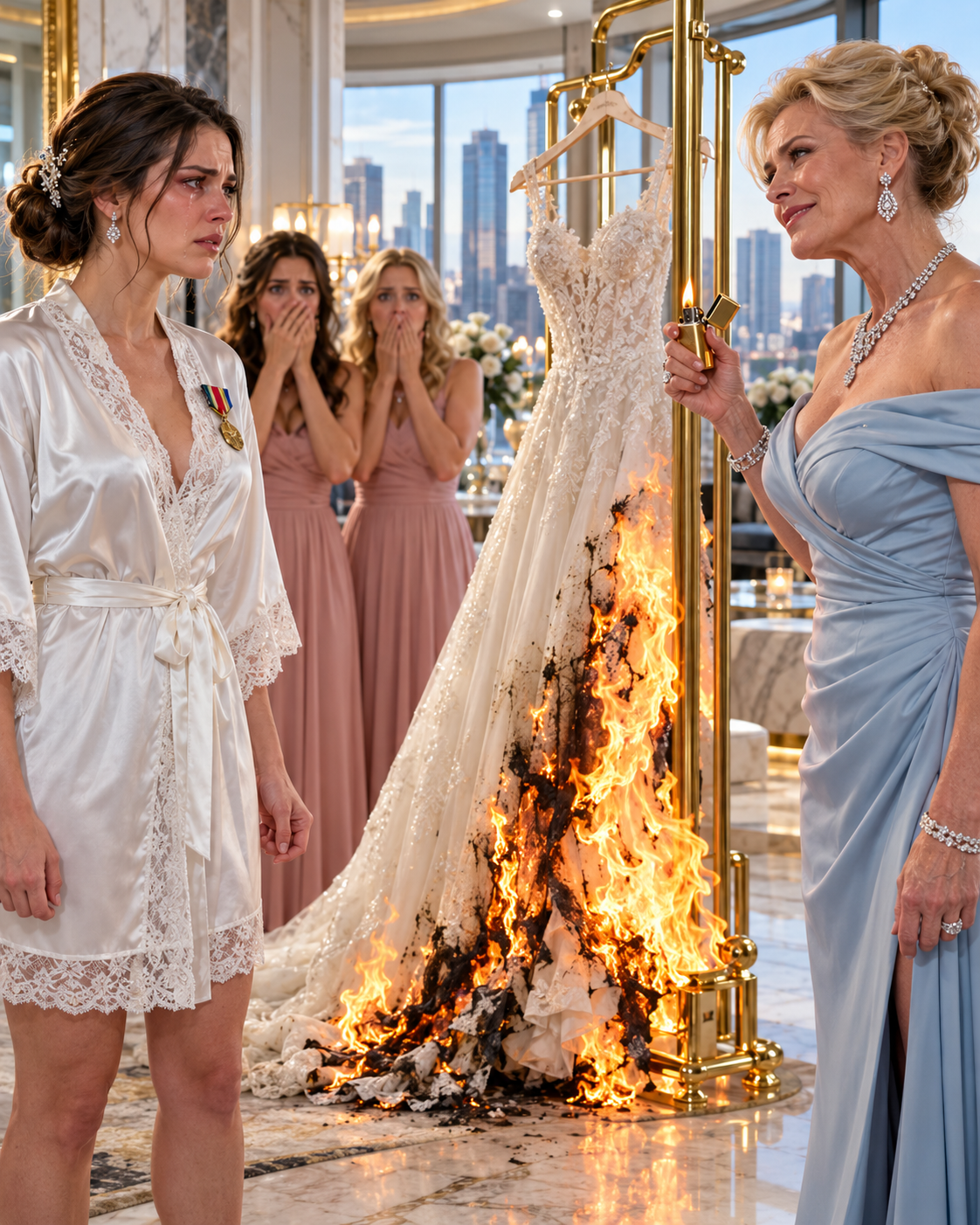
The war wasn’t over. It had only just begun.
And this time, I wouldn’t rely on someone else’s promise to protect me. I would rely on my own strength.
For several seconds after I spoke, the bridal suite remained suspended in an almost unnatural silence. Smoke curled toward the ceiling, mingling with the sweet fragrance of the flowers arranged around the room. Margaret stared at me, her expression caught somewhere between defiance and confusion. She hadn’t understood what my words meant or why the balance of power had suddenly changed.
My mind traveled somewhere far removed from that elegant hotel. I was back at West Point, standing in the bitter winter wind of upstate New York. I could almost feel the weight of a fifty-pound rucksack digging into my shoulders as I marched through miles of frozen mud, my feet blistered inside my boots and every muscle in my body screaming for relief.
I remembered the loneliness of being one of only a handful of women in my company. The constant, unspoken pressure to work twice as hard, to prove myself twice as often, and to display twice as much endurance simply to receive the respect other cadets seemed to take for granted. I remembered pushing myself toward exhaustion and discovering that I could go further than I had believed possible.
Those years had been a crucible. They had stripped away my illusions and forged something stronger beneath them. I learned that pain was temporary, that discipline mattered most when circumstances became unbearable, and that true strength wasn’t measured by how loudly someone could shout. It was measured by the ability to hold the line when everything around you seemed determined to break.
Compared with what I had already endured, Margaret Wilson was a spoiled woman playing with matches. Her wealth and cruelty might have impressed people who feared losing her approval, but neither could erase the person I had become.
Then my thoughts turned to Jason, and the hard edge of my anger softened.
I remembered the weekend he had driven eight hours from Cleveland to Fort Drum just to spend a few precious hours with me before turning around and making the long journey home. He had arrived exhausted, carrying takeout food and wearing that familiar crooked smile that always made me feel as though no distance between us could possibly matter.
I remembered him sitting cross-legged on the floor of my barracks room while I explained how to field-strip and clean an M4 rifle. He had no particular interest in firearms, but he listened carefully, asking questions because he wanted to understand the world that shaped so much of my life.
More than anything, I remembered the long nights during my deployment in Afghanistan. Sometimes his voice came through a crackling satellite connection while distant explosions reminded me how fragile everything was. He never filled those conversations with empty reassurances or told me to be careful. He knew I would be. He simply listened, asked about my day, and made me feel connected to a world beyond the dangers surrounding us.
His love was real. I had never doubted that. It had been a steady beacon during the most uncertain moments of my life.
And it was for him, as much as for myself, that I knew this confrontation could no longer be avoided. I wasn’t merely defending my own dignity. I was fighting to free our future from the shadow of a woman who believed affection could be measured in wealth, influence, and yacht club memberships.
My gaze moved toward the Bronze Star pinned to my robe. Margaret had called it a cheap piece of metal, but to me, it represented something no amount of money could purchase.
When I looked at that medal, I didn’t see polished bronze. I saw the soldiers who had depended on me. I remembered their faces, their determination, their fear, and their courage. I remembered the responsibility of making decisions when a single mistake could change lives forever. I remembered how deeply we trusted one another, not because we came from important families or possessed impressive bank accounts, but because we had demonstrated our loyalty through action.
That was what honor meant to me.
Honor wasn’t something a family could inherit along with a mansion or a corporate fortune. It couldn’t be bought at an auction, displayed in a glass cabinet, or announced through an expensive society event. It was earned in quiet moments of integrity, in choosing what was right when doing so was difficult, and in remaining faithful to a responsibility greater than personal comfort.
West Point’s motto, Duty, Honor, Country, wasn’t merely a slogan engraved on the academy’s walls. It had become the foundation of the person I wanted to be.
Setting fire to another woman’s wedding dress was an act of cowardice. Deliberately humiliating someone because of her background or profession was an act utterly devoid of honor.
And I had never been taught to surrender to cowardice.
I thought back to the day my acceptance letter from West Point arrived. My family hadn’t celebrated with champagne at an exclusive restaurant. We had gathered in the small backyard of our home outside Columbus with pepperoni pizza from a neighborhood shop, cheap beer for the adults, and folding chairs borrowed from the garage.
My father had just returned from a shift at the firehouse. His uniform still carried the faint smell of smoke when he wrapped his arms around me. He held me so tightly that I could barely breathe, then whispered something I would never forget.
“I have never been more proud of you, Katie.”
There was nothing polished or rehearsed about his words. They came from a man who understood sacrifice, who had spent his life helping people without expecting recognition in return.
That moment of pride meant more to me than all the Wilson Steel money in the world.
Standing before Margaret, I could feel those memories gathering into one unshakable conviction. My father’s love, Jason’s devotion, the lessons of West Point, and the sacrifices of my soldiers had given me an identity she could neither diminish nor destroy.
My composure was no longer simply a defense against her cruelty. It had become the means by which I would take control of the situation.
Slowly, I turned the phone in my hand so Margaret could see the screen.
Her own face stared back at her, twisted into an expression of arrogant fury. The image was clear, immediate, and unmistakably live.
PART 2
For the first time that afternoon, genuine alarm appeared in her eyes.
“The wedding live stream,” I explained calmly. “It’s for my unit stationed in Germany and for Jason’s relatives in Florida who couldn’t be here.”
I allowed the significance of those words to settle before continuing.
“It’s been running for the last twenty minutes.”
Margaret’s expression shattered.
Her carefully cultivated superiority collapsed into open panic. Her lips parted, and she glanced from the screen to the other women in the room as though searching for someone who might tell her this was an elaborate joke.
“You’re lying,” she stammered. “You wouldn’t dare. You couldn’t possibly have—”
Before she could finish, voices began spilling from the phone’s speaker. Men and women thousands of miles away were reacting to what they had just witnessed. I heard disbelief, anger, and a rising murmur of outrage.
Then one familiar voice cut through the noise.
“Captain Harvey, we’ve got your six! Bravo Company is right behind you!”
It was one of my sergeants in Germany.
A burst of cheering followed, loud enough to fill the bridal suite. These were my soldiers, the men and women with whom I had shared danger, exhaustion, and uncertainty. They knew the person Margaret had tried to belittle, and they were making their support unmistakable.
Margaret recoiled as though the voices themselves had struck her.
Then she lunged toward my phone.
Her carefully manicured fingers reached for it, her face contorted by desperation. She might have succeeded if Sergeant Jessica Reyes hadn’t been standing nearby.
Jessica moved with the controlled efficiency of a trained soldier. She didn’t grab Margaret or lay a hand on her. She simply stepped into her path, placing herself between the furious woman and the phone.
“Ma’am,” Jessica said in an even voice, “I strongly advise against that.”
Margaret stopped so abruptly that she nearly lost her balance.
“You have just deliberately destroyed someone else’s property and subjected a decorated Army officer to a prolonged public tirade,” Jessica continued. “Several hundred military and civilian witnesses have seen what happened. I suggest you consider your next actions very carefully.”
The words were neither shouted nor delivered with theatrical menace. Jessica spoke with the detached authority of someone stating facts that could not be argued away.
Margaret stared at her, apparently astonished that anyone would dare challenge her in a place she considered part of her own domain.
Then the live stream revealed something else.
One of the bridesmaids had been helping coordinate the coverage of the wedding, and the video feed shifted to the outdoor courtyard where the ceremony was supposed to take place. Rows of white chairs stood beneath carefully arranged flowers, and guests were beginning to exchange confused glances.
The camera settled near the groomsmen, where Jason was standing.
Even through the small screen, I could see the expression on his face. He looked as though he had been struck by something he couldn’t comprehend. His jaw tightened, and his hands curled into fists at his sides.
For several seconds, he stood motionless. Then disbelief hardened into an anger I had never seen in him before.
He started running.
He didn’t hesitate or look around for approval. He sprinted between the rows of chairs, barely avoiding guests who stepped into his path. He struck a decorative stand of lilies with his shoulder, sending it crashing to the ground.
People called his name, startled by the sudden commotion, but he didn’t stop. He ran with the desperate urgency of someone rushing toward a person he loved who was in immediate danger.
Moments later, the bridal suite door flew open and struck the wall.
Jason stood in the doorway, breathing hard, his face pale and his eyes searching frantically.
He barely glanced at his mother. He didn’t look at the ruined dress or the blackened fabric scattered across the floor.
He looked straight at me.
For one terrible moment, I could see the silent plea in his expression. He wanted me to tell him that what he’d witnessed wasn’t real, that there had been some misunderstanding, that his mother couldn’t possibly have done something so cruel.
I gave him a single, slow nod.
That was all he needed.
The anger on his face changed into something heavier and more devastating. It was the expression of a man whose last remaining illusions about someone he loved had finally collapsed.
Jason turned toward Margaret.
“Mom,” he said, his voice low and trembling, “tell me I did not just watch you set fire to the wedding dress of a decorated officer of the United States Army.”
Margaret opened her mouth, but no words emerged.
Meanwhile, another confrontation was developing outside.
Richard Wilson had been sitting in the front row when the live stream revealed his wife’s actions. Ordinarily, Richard was the picture of corporate composure. As the head of Wilson Steel, he had built a reputation for remaining calm during crises that unsettled everyone around him.
But the sight of his wife deliberately destroying my wedding dress left him visibly shaken.
He stared at the screen of his phone, his expression pale and rigid. For a long moment, he didn’t move. Then something changed in his face. The shock disappeared, replaced by a quiet resolve.
Richard rose from his seat, straightened his jacket, and walked toward a member of the hotel’s security staff. He spoke briefly to the man, who immediately reached for his radio.
Richard wasn’t going to manage this as another embarrassing family disagreement. He was treating it as a serious violation that demanded decisive action.
When he entered the bridal suite, the tension was almost unbearable.
Margaret had finally recovered enough to begin offering excuses, but she stopped when she saw her husband. For a brief instant, relief crossed her face. She seemed to believe he would come to her defense, restore order, and insist that everyone forget what had happened.
Instead, Richard walked past her.
He passed his furious son and stopped directly in front of me. His expression carried a depth of shame I had never expected to see in such a proud man.
“Captain Harvey,” he said firmly, “I am profoundly sorry. There is no excuse for what has happened here. None whatsoever.”
He took a measured breath and looked at the scorched remains of my dress before returning his attention to me.
“This will be handled. And the wedding will still proceed, if that is what you wish.”
I looked at him, trying to absorb the significance of his words. For two years, I had wondered whether anyone in the Wilson family would openly acknowledge Margaret’s cruelty. Richard had sometimes offered me courtesy, but he had rarely challenged his wife’s behavior.
Now he was standing in front of witnesses, making it clear that he would not protect her from the consequences of her actions.
Jason turned toward his mother, drawing strength from his father’s decision.
“You heard Dad,” he said. “You’re not welcome here anymore.”
Margaret stared at him, her mouth hanging open.
It was as though she had never considered the possibility that her son might choose me over her. She had built her entire plan around the assumption that family loyalty, money, and social expectations would eventually bring him back under her control.
Instead, her actions had pushed him further away than ever before.
She had gambled everything on one act of calculated humiliation, believing it would destroy my wedding and force Jason to recognize what she considered my inferiority. But the fire had consumed something she valued far more than the dress.
It had destroyed her authority.
At West Point, we studied asymmetric warfare and the ways an opponent might change tactics when an initial strategy failed. A direct assault could become an attempt at psychological manipulation. A defeated adversary might exploit guilt, loyalty, or sympathy to regain the advantage.
As two hotel security guards appeared in the doorway, I watched Margaret adopt precisely that approach.
Her fury vanished almost instantly. Her rigid posture crumpled, and tears began streaming down her face. She pressed one hand against her chest as though overcome by unbearable grief.
“Jason, my baby, please,” she sobbed, grabbing his arm. “Don’t do this to your mother. I was only trying to protect you. Everything I’ve ever done has been for you. Can’t you see what she’s doing? She’s turned you against your own family.”
She looked desperately toward Richard.
“Richard, are you really going to let this happen? Are you going to let that girl tear our family apart?”
The change was extraordinary. Moments earlier, Margaret had been celebrating the destruction of my dress. Now she was presenting herself as the injured party, a heartbroken mother abandoned by her husband and son.
And she knew her audience.
Guests had begun gathering near the doorway, drawn by the commotion. Some had witnessed the entire incident through the live stream, while others were only now trying to understand what had happened. I heard murmurs of sympathy from people who saw a wealthy, distraught mother standing in tears on her son’s wedding day.
Margaret was attempting to transform a clear act of cruelty into a story about a family being torn apart by an outsider.
I recognized her final strategy immediately. If she couldn’t win the confrontation itself, she would try to control the way people remembered it.
But the only person whose reaction truly mattered to me was Jason.
For years, I had watched him struggle beneath the weight of his mother’s emotional demands. He would try to reason with her, soften his disagreements, or offer compromises that left everyone dissatisfied. He wanted to be a good son, and Margaret had learned to use that desire against him.
A cold knot of anxiety tightened in my stomach as I watched them.
I knew Jason loved me. I knew he was furious. But I also knew how difficult it could be to break free from patterns that had existed since childhood.
For a moment, he studied his mother’s face. Then he looked at me.
When he spoke again, the anger had drained from his voice, leaving a weariness so profound that it hurt to hear.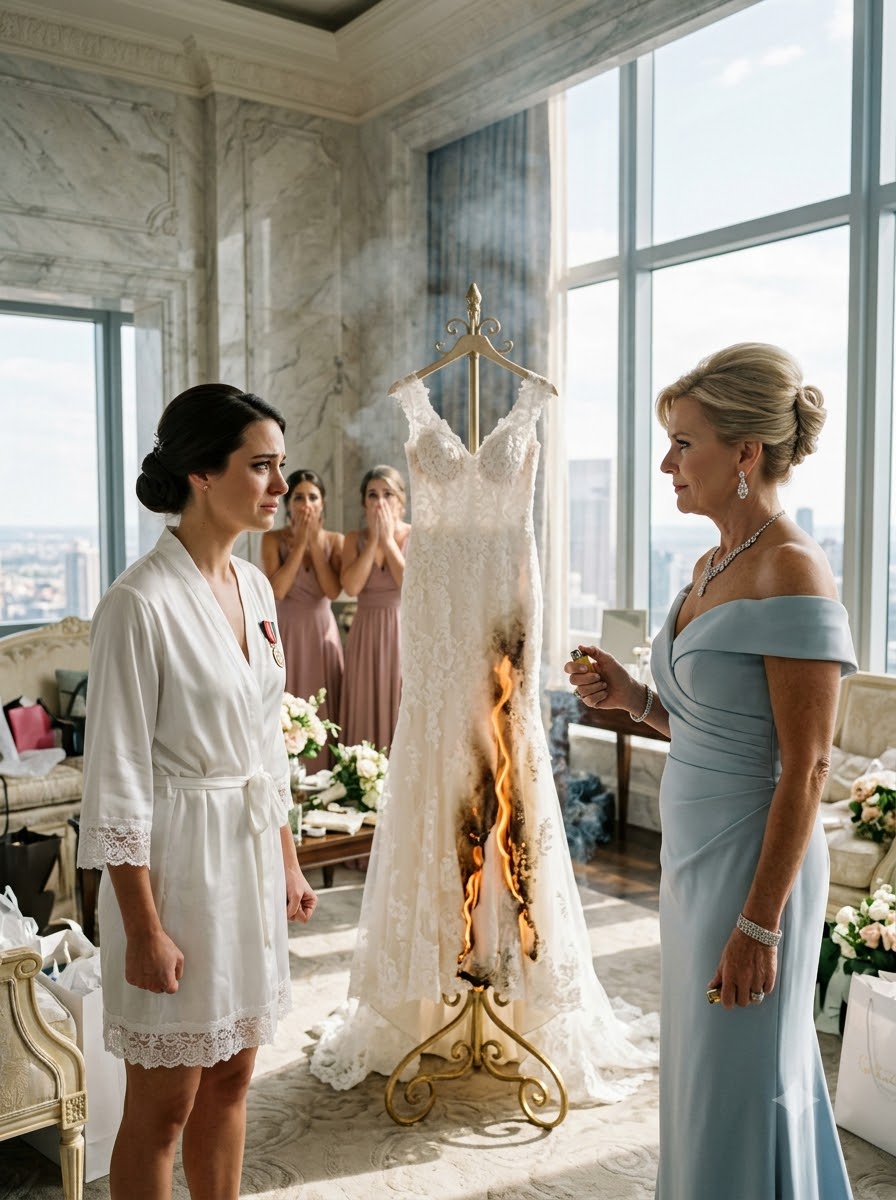
“That’s enough, Mom.”
He gently but firmly removed her fingers from his arm and took a step backward. The small distance between them seemed to carry the weight of years.
“What’s best for me is standing right here,” he said, gesturing toward me. “You’ve had so many chances to accept Katie. You could have been part of our lives, part of the family we’re trying to build. But every time you had a choice, you chose to hurt her.”
Margaret shook her head, tears continuing to fall.
“Jason, you don’t understand—”
“No, Mom. I understand perfectly now. You chose to burn a bridge today, and I’m not going to let you burn anything else.”
His refusal to engage with her performance was more effective than any argument could have been. Margaret’s expression faltered. She had expected pleading, anger, and negotiation. She had no idea how to respond to his calm determination.
That was when Richard stepped forward.
He positioned himself between Margaret and us, his expression grim and his patience visibly exhausted.
“Please escort Mrs. Wilson to her car,” he told the security guards. “Make certain she leaves the hotel premises immediately.”
The order was delivered with the same crisp authority he used when making difficult business decisions. Then he turned toward his wife.
“Margaret, we will discuss this at home. But today belongs to our son.”
He paused, then placed a firm, steady hand on my shoulder.
“And this young woman,” he continued, looking directly into Margaret’s eyes, “is my daughter now. If you ever touch her or speak to her that way again, you will answer to me.”
The room fell utterly silent.
Those words meant more than any formal apology Richard could have offered. They represented a boundary that Margaret could no longer dismiss. For years, she had operated as though her family’s position gave her unlimited authority over everyone who entered its orbit.
Now her husband had publicly rejected that assumption.
The woman who had spent her life controlling the Wilson family’s social world suddenly found herself without the support she had always counted on.
Her tears stopped.
The expression on her face became strangely empty, as though the enormity of what had happened had finally reached her. She looked at Richard, then at Jason, searching for some trace of the power she had wielded only minutes earlier.
There was none.
The security guards approached respectfully and indicated that she needed to leave. She made no further attempt to argue. Her shoulders sagged, and she allowed them to guide her toward the doorway.
As she passed me, she stopped.
For one chilling moment, our eyes met.
She didn’t apologize. She didn’t speak. Her gaze carried an unmistakable hatred, dark and concentrated, as though she were trying to communicate that I had not heard the last of her.
I held her stare without responding.
Then the guards led her away, and the door clicked shut behind them.
The immediate danger was gone, but the damage remained. The bridal suite smelled of smoke, my friends were still visibly shaken, and the beautiful dress I had spent months making lay in blackened ruins.
For several seconds, no one moved. The silence felt heavy with everything that had happened and everything we had yet to understand.
I drew a long breath and looked at the clock.
Our ceremony should have started ten minutes earlier.
A strange calm settled over me. The confrontation had ended, but the day wasn’t over. Jason was still standing beside me, my father was waiting outside, and more than a hundred people had gathered to witness a marriage that Margaret had tried to destroy.
I looked around the room at the faces of the people who had stood beside me.
“All right,” I said, my voice cutting cleanly through the silence. “We have twenty minutes. Let’s get to work.”
The atmosphere changed immediately.
Jessica straightened. The other bridesmaids exchanged determined looks. Jason wiped a hand across his face, took a breath, and stepped closer. Even Richard appeared to shift instinctively into the focused posture of a man who understood that the time for discussion had ended and the time for action had begun.
I had spent years learning how to coordinate people under pressure. This crisis was different from anything I’d faced in uniform, but the principles were familiar. We needed a clear objective, a workable plan, and people willing to execute it without surrendering to panic.
The objective was simple.
The wedding would happen.
“Listen up,” I told everyone. “The ceremony proceeds in twenty minutes. We have a major wardrobe problem, but we’re not canceling anything. We need a new plan, and we need it now.”
Jason watched me with an expression that was part astonishment and part admiration. I would have time to appreciate it later. For the moment, I needed his help.
“Jason, you’re in charge of the guests. Find the wedding coordinator, explain that we have a wardrobe delay, and make sure everyone stays calm. Keep things moving. Project confidence.”
He nodded immediately.
“Got it.”
He was out the door almost before he’d finished speaking.
I turned to Jessica.
“Jess, you’re my executive officer for this operation. Get everyone organized. Check on the bridesmaids, make sure nobody loses focus, and get us ready for the next phase. No panic. We hold the line.”
Jessica’s expression remained professional, but I saw a spark of fierce pride in her eyes.
“Hooah, Captain.”
She immediately began coordinating the other women. Makeup bags appeared, garment bags were opened, and the anxious energy that had filled the room became purposeful movement.
One of my bridesmaids, Sarah, looked at me nervously.
“Katie, what’s Plan B? We don’t have a wedding dress.”
For the first time since Margaret had struck the lighter, I felt a genuine smile spreading across my face.
“There’s always a Plan B.”
My eyes found Melody, another bridesmaid who worked as a buyer for an upscale fashion boutique in downtown Cleveland.
“Mel, remember the designer we met at the Veterans Housing fundraiser? Michelle Keane?”
Melody’s eyes widened as she understood what I was thinking.
“Of course. Michelle. She’s brilliant.”
“Call her. Tell her Captain Harvey has an emergency and needs to ask a favor. We need a sample gown, size four, ivory or white. Something clean, elegant, and powerful. Tell her it’s urgent.”
Melody had her phone out before I’d finished speaking. She stepped toward the door, already searching for Michelle’s number.
Richard, who had been watching the entire exchange from the corner, moved forward.
“Let me help,” he said.
He pulled out his phone and began giving instructions to his driver. Within moments, he had arranged for the man to go directly to Michelle Keane’s boutique and bring back whatever gown she could provide.
“My driver will be at her shop in ten minutes,” Richard assured me. “He knows the city, and he’ll get back here as quickly as possible.”
It wasn’t an empty offer of assistance. It was a practical solution to a logistical problem, delivered without fuss or unnecessary discussion.
I looked at him with gratitude.
“Thank you, Richard.”
He nodded, then studied me quietly for a moment.
“Your father,” he said at last, his voice softening, “must be a very proud man.”
The words caught me off guard. For two years, I had wanted nothing more from this family than a little genuine respect. I had imagined that acceptance might arrive through elaborate gestures or some formal moment of reconciliation. Instead, it came quietly, in a smoke-filled bridal suite, from a man who had just watched me take charge of a crisis.
A lump rose in my throat, but I swallowed it.
There would be time for tears later.
Jason returned several minutes afterward, looking considerably more relaxed.
“Coordinator’s briefed. Guests think we’re running on bride time,” he reported with a faint grin. “Everything’s under control out there.”
He came to stand beside me. He didn’t try to take charge or question the decisions I’d made. Instead, he slipped his hand into mine and looked at me with a warmth that almost made my composure falter.
“What’s next, Captain?”
I squeezed his hand, grateful beyond words for the man standing beside me.
Before answering, I turned toward the vanity. My phone was still broadcasting, its small indicator light confirming that the live stream remained active.
I picked it up and looked directly into the camera.
“To everyone watching, especially Bravo Company,” I said, “thank you for your patience and your support. We’ve had an unexpected change in our operational timeline, but I promise you the mission will be accomplished.”
I paused, allowing a small smile to reach my lips.
“Love and honor will always win, even when we’re under fire.”
A thunderous cheer erupted from the speaker.
I recognized the voices of my soldiers, my brothers and sisters in arms who were watching from their base in Germany. They had witnessed the worst moment of what was supposed to be the happiest day of my life, and now they were standing with me as I refused to let it define the ending.
Their support washed over me like a powerful wave.
I placed the phone back on the vanity and returned to the work waiting in front of us.
The next seventeen minutes felt longer than almost any seventeen minutes I could remember.
The controlled energy in the room gradually became a tense, collective anticipation. We had a plan, but plans meant very little until they were successfully carried out. I had learned that lesson in Afghanistan, where even the most carefully prepared operation could be disrupted by a single unexpected development.
A small, cynical part of my mind kept whispering questions.
What if Michelle didn’t have anything suitable? What if the dress didn’t fit? What if Richard’s driver got caught in traffic? What if we had to postpone the ceremony after all?
I pushed each thought aside.
The clock continued ticking, every passing second reminding me that our guests were waiting and that the day I had dreamed about for so long was slipping further from its original schedule.
Then I heard hurried footsteps outside the door.
A man in a crisp suit appeared, breathing heavily and carrying a long white garment bag with both hands. He looked as though he had been entrusted with something priceless.
Richard’s driver had returned.
For a moment, everyone in the room seemed to exhale at once.
Melody took the garment bag from him and laid it carefully across the sofa. When she unzipped it, the fabric inside caught the light.
There was no elaborate lace, no intricate beadwork, and none of the flowing satin that had characterized my original gown. Instead, she revealed an exquisite dress made from substantial ivory crepe.
It was a masterpiece of understated design. The lines were clean, the silhouette strong, and the construction so precise that it seemed to possess its own quiet authority. It was elegant without being fragile, beautiful without asking for attention.
My first dress had been full of soft, hopeful dreams. This one seemed to belong to a woman who knew exactly who she was.
“Michelle says it’s yours for the day,” Melody told me, her smile trembling with relief. “She sent her emergency alterations kit, too.”
I touched the fabric and felt its reassuring weight beneath my fingers.
“It’s perfect.”
Jessica and Melody helped me change. As the gown settled over my shoulders, its cool, substantial fabric felt almost like a ceremonial mantle. I turned toward the mirror and studied my reflection.
The woman looking back at me wasn’t the same person who had stood helplessly watching her wedding dress burn.
Something had changed during the confrontation. It wasn’t that my earlier dreams had been foolish or that tenderness had somehow become a weakness. It was that I had stopped believing I needed to make myself smaller in order to earn acceptance.
The original dress had reflected my hope for a beautiful beginning. The new one reflected the strength that would carry me through whatever followed.
If the first dress belonged to a fairy tale, this one belonged to a woman prepared to write her own future.
Melody quickly adjusted the fit with a needle and thread from her emergency kit while the other bridesmaids repaired my hair and makeup. Jessica checked the time, coordinated the remaining preparations, and made sure no one lost sight of the goal.
The room operated with the smooth efficiency of a team that understood both its responsibilities and the importance of the moment.
One bridesmaid was still holding the phone, filming the preparations for the people watching remotely. I met her eyes in the mirror and nodded.
“Keep it rolling,” I told her. “Let them see us march.”
When the bridal suite doors finally opened, the first notes of the wedding march began to play.
PART 3
My father stood waiting for me in his firefighter’s dress uniform. Every button had been polished, every detail carefully arranged. His weathered face showed a mixture of pride, love, and emotions he was struggling to contain.
He looked at my gown, then at my face. His expression softened, and for a moment I saw the same man who had held me in our backyard when my West Point acceptance letter arrived.
He knew what had happened. Somehow, the knowledge only seemed to deepen the pride in his eyes.
He offered me his arm.
“Ready, Captain?” he murmured.
I took it, feeling the familiar strength in the hand that had carried people out of burning buildings and lifted me onto his shoulders when I was little.
“Ready, Dad,” I whispered.
Together, we stepped into the courtyard.
What happened next took my breath away.
Every guest rose to their feet, as they would at any wedding. But instead of the usual respectful silence, a tremendous wave of applause erupted around us.
It rolled across the courtyard like thunder.
People were clapping, cheering, and calling out encouragement. I saw friends from home standing beside Jason’s colleagues, relatives embracing one another, and strangers wiping tears from their eyes.
They weren’t applauding simply because a bride had appeared at the beginning of a wedding ceremony. They knew what had happened. They had seen the cruelty, the confrontation, and the extraordinary effort it had taken to reclaim this day.
Their applause was a declaration that Margaret Wilson had failed.
I felt my father’s hand tighten around mine. When I glanced at him, tears were streaming openly down his cheeks.
We began walking down the aisle, and my vision blurred.
In the second row, I noticed an elderly gentleman wearing a beautifully tailored suit. Several service ribbons were displayed on his chest. His posture was remarkably straight for a man of his age, and there was something unmistakably military about the way he carried himself.
As I passed, he slowly raised his right hand to his brow in a crisp salute.
I recognized him then as a retired Army general.
A few rows farther down, a former Marine with a bulldog tattoo on his forearm stood straighter and saluted as well. Then another veteran raised a hand. And another.
Across the courtyard, active-duty service members and veterans, men and women of different generations, were offering me the same quiet gesture of respect.
Some had served in wars fought long before I was born. Others were young enough to have trained alongside me. Their backgrounds were different, but the meaning of their gesture was unmistakable.
They recognized me as one of their own.
They weren’t saluting wealth, status, or the name of the family I was about to marry into. They were acknowledging service, resilience, and the shared understanding of what it meant to stand firm when circumstances became difficult.
The tears I had held back since Margaret struck the lighter finally spilled down my cheeks.
For the first time that day, I allowed myself to cry.
But these were not tears of defeat. They were tears of gratitude, relief, and a powerful sense of belonging.
When we reached the altar, Jason stepped forward and took my hands. His eyes were shining, and the love I saw in them felt almost tangible.
Our officiant was a retired Army chaplain, a gentle man with silver hair and a reassuring manner. He looked at us for a moment, then set aside the notes he had prepared for the ceremony.
He turned toward the guests.
“We are gathered here today not simply to witness a marriage,” he began, his voice warm and steady, “but to celebrate courage, commitment, and the extraordinary strength that comes from standing beside someone you love.”
He paused, letting his gaze move across the courtyard.
“In the Army, there’s a term for the person you trust when everything around you becomes uncertain. The person who has your back through confusion, hardship, and danger. We call that person a battle buddy.”
A gentle murmur moved through the audience.
“Today, Jason and Katie are choosing to be battle buddies for life. They’re promising to defend and support one another, not only when life is easy and peaceful, but also when they face the challenges that every marriage must eventually endure.”
I looked at Jason and felt the last traces of fear begin to loosen their grip on me.
When it was time for our vows, he turned toward me and enclosed both of my hands in his. He didn’t use the traditional words we had rehearsed. Instead, he spoke with a sincerity that seemed to come from somewhere deeper.
“Katie,” he began, “I promise to be your constant rear guard. I’ll be your cover in every firefight and your comrade in every battle life throws at us. I will never accept defeat when it comes to protecting what we have. I will never quit on us, and I will never leave a fallen comrade behind.”
His voice grew stronger.
“My mission, starting today and for the rest of my life, is you. Not my family’s expectations, not society’s approval, and not anyone else’s idea of what our marriage should be. You.”
By the time he finished speaking, I was crying freely. So were many of the guests.
The words weren’t simply romantic promises. They were an acknowledgment of what we had endured together and a commitment to face the future as equals.
Margaret had wanted me to feel unworthy of her family. Jason was standing before everyone we loved, telling me that I was the family he had chosen.
When the chaplain finally pronounced us husband and wife, Jason pulled me into an embrace so fierce and reassuring that I could feel his heartbeat against mine.
He kissed me, then held me for a long moment, his arms wrapped tightly around me.
There was relief in that embrace, and love, and a respect that had been tested in the most unexpected way.
We had made it through the fire.
The applause that followed was deafening. It echoed across the courtyard, rising into a joyous celebration that seemed almost impossible when I remembered the destruction I’d witnessed less than an hour earlier.
From the live-stream speaker came another burst of cheering from Bravo Company in Germany.
Our friends, our families, and my soldiers were celebrating with us, even from thousands of miles away.
The ceremony was more than the beginning of a marriage.
It was proof that the worst moment of a day did not have to determine how that day ended.
Walking into the reception hall felt like stepping from a battlefield into a victory celebration. Only an hour earlier, the atmosphere had been filled with anxiety and confusion. Now the grand ballroom seemed alive with a joyous, almost electric energy.
As Jason and I entered together and were introduced as husband and wife, the applause rose even louder than it had during the ceremony. Guests stood from their tables, lifting champagne glasses and cheering while the band played a triumphant melody.
For several minutes, I simply allowed myself to enjoy it.
I watched Jason smile at our friends, felt the comforting weight of his hand against mine, and tried to absorb the extraordinary fact that we were married. Despite everything Margaret had done, despite the blackened ruins of my original dress and the terrible uncertainty that had followed, we had reached the moment we’d been waiting for.
Yet beneath the celebration, something fundamental had shifted.
This wasn’t merely a wedding reception anymore. It felt almost like an after-action review, with the consequences of the afternoon’s confrontation becoming clearer by the minute.
As we made our way through the ballroom, I noticed how many guests were looking at their phones. The live stream hadn’t simply been watched and forgotten. Clips of Margaret setting my dress on fire, delivering her contemptuous tirade, and facing Jason’s anger had already begun circulating through our community.
Other clips showed the hastily organized effort to rescue the wedding, my father’s emotional expression, and the extraordinary moment when veterans had saluted me during my walk down the aisle.
Within a remarkably short time, the story had spread far beyond the people who attended the ceremony.
A local news reporter who happened to be among the guests was already delivering an account from a quiet corner of the ballroom. Messages of support appeared across social media, accompanied by phrases such as “Captain Katie,” “Wedding Under Fire,” and “Honor Wins.”
I had never imagined that my wedding would become a public event for reasons other than the marriage itself.
What Margaret had intended as a private act of humiliation had become a public examination of her character. And the judgment people were forming was very different from the one she had expected.
I saw the consequences in the behavior of the women who had once surrounded her.
Margaret’s closest social circle consisted of wealthy, influential women who regarded charity luncheons and exclusive gatherings as extensions of their personal power. At ordinary events, they moved together with polished confidence, occupying the best tables and quietly deciding who deserved their attention.
Now several of them stood awkwardly near the far side of the ballroom, speaking in hushed voices. Their usual superiority had been replaced by visible discomfort.
They had come expecting a lavish wedding that would reinforce the Wilson family’s social position. Instead, they had witnessed the spectacular collapse of the woman who had spent years presenting herself as the guardian of that position.
One by one, they began leaving.
Some slipped through a side entrance without saying goodbye. Others offered vague excuses about prior commitments before retreating toward the elevators. I watched them disappear and realized that the friendships Margaret had considered unbreakable were proving astonishingly fragile.
They had depended on the appearance of power, not on genuine affection.
The people who stayed were different.
Jason’s colleagues from his architecture firm gathered around him, laughing and clapping him on the back. My friends from Columbus embraced me with a warmth that made it difficult to keep my emotions under control. Several veterans had formed an informal gathering near our table, exchanging stories and welcoming everyone who approached.
They weren’t concerned with preserving anyone’s social reputation. They were celebrating a marriage and the people who had fought to make it happen.
The head table had originally been arranged according to Margaret’s elaborate vision of social hierarchy. She had intended it to showcase the wealthiest and most influential members of Cleveland society, with every seating choice carrying some carefully calculated meaning.
Instead, the table was occupied by my father, a retired firefighter; me, a decorated Army captain; Jason, a proud architect; and Richard Wilson, a businessman who had finally decided that integrity mattered more than appearances.
Looking around that table, I couldn’t imagine wanting anything else.
Margaret had spent a lifetime constructing a world in which a person’s value was measured by family connections, financial success, and social standing. In a single afternoon, that world had lost its authority over us.
Not everyone understood the change immediately.
One of Margaret’s longtime friends, Beatrice Aster, approached me while Jason was speaking with a group of his colleagues. Beatrice was a familiar figure in Cleveland society, known for her expensive jewelry, carefully arranged charity appearances, and ability to deliver insults disguised as compliments.
She wore a sympathetic smile as she reached out and rested a cool, diamond-covered hand on my arm.
“Oh, Katie, my dear,” she said in a soft, practiced voice. “Such a terribly unfortunate incident. Margaret does become a little overwrought sometimes. You know how she is.”
I looked at her hand before raising my eyes to meet hers.
For an instant, I considered responding with the familiar politeness I had used throughout the previous two years. I could have nodded, smiled, and allowed her to reduce deliberate destruction to an unfortunate moment of emotional excess.
But I was finished pretending.
“In the Army, Mrs. Aster,” I replied pleasantly, “we call what Margaret did a hostile act. Not a moment of being overwrought.”
I held her gaze for another second before adding, “But it was lovely to meet you.”
Her smile froze.
She withdrew her hand as though she’d touched something hot, murmured a few unintelligible words, and hurried away.
I watched her go without feeling the slightest regret.
The old rules no longer applied. I wasn’t going to participate in a game where cruelty could be excused as eccentricity simply because the person responsible possessed money and influence.
Richard appeared to understand that change better than anyone.
Rather than behaving like a man embarrassed by a public family scandal, he moved through the ballroom with a renewed sense of confidence. He wasn’t trying to conceal what had happened or persuade guests to remain silent. Instead, he was openly acknowledging the person I had become within his family.
Every time he introduced me to someone, his pride seemed to grow.
“Have you met my daughter, Captain Harvey?” he would say, clapping a guest on the shoulder. “Toughest damn person in this family.”
The first time I heard him say it, I nearly laughed from surprise. By the fourth or fifth introduction, I understood that he was doing something deliberate.
Richard was publicly declaring that I belonged.
For years, Margaret had controlled who received the family’s approval and who remained on the outside. Richard was making it clear that those decisions would no longer be dictated by her prejudices.
Later in the evening, when the band paused and the guests gathered for the traditional wedding toasts, Richard stood with a champagne glass in his hand.
He didn’t mention the fire. He didn’t repeat his wife’s insults or offer excuses for her behavior. Everyone present knew what had happened, and there was no reason to reopen the wounds.
Instead, he looked directly at Jason and me.
“To Jason and Katie,” he began, raising his glass, “who have reminded all of us today what truly matters.”
A warm murmur passed through the room.
Richard waited until the guests grew quiet again.
“And in that same spirit,” he continued, “I want to announce that the Wilson Family Foundation will be undergoing a significant change in its priorities over the coming year. We intend to focus our resources on causes that reflect genuine service, resilience, and the opportunity to make a meaningful difference.”
The announcement sounded measured and professional, the sort of statement a corporate executive might make at a formal gathering.
But everyone familiar with the foundation understood its significance.
For years, Margaret had used the organization to finance glamorous charitable events that strengthened her position within the social world she valued so highly. There had been worthy causes among them, certainly, but the foundation had gradually become as much a showcase for her influence as an instrument of meaningful assistance.
Richard was signaling that those priorities were about to change.
He lifted his glass toward us, and the room answered with applause.
I caught Jason’s eye across the table. Neither of us spoke, but I could tell he understood the importance of what his father had said.
The day’s confrontation had become something larger than a family dispute. It had forced people to reconsider the values they had allowed to guide their lives.
Still, the most meaningful part of the reception wasn’t Richard’s announcement or the sudden disappearance of Margaret’s influential friends.
It was something my bridesmaids had arranged while the guests were gathering.
Instead of using the traditional wedding guest book, they had placed a large corkboard inside an elegant wooden frame near the reception entrance. Across the top hung a banner bearing the words “Operation Enduring Love: After-Action Report.”
Guests had been invited to leave handwritten messages.
By the time I discovered it, the board was already covered
with notes, cards, and small pieces of paper pinned beneath colorful ribbons.
Some messages were funny. Others were deeply personal. Many were written by people who had never expected to share anything more meaningful than a few polite congratulations with the bride and groom.
The retired Marine with the bulldog tattoo had written in bold black marker, “Oorah, Captain! You fought the good fight. Semper Fi.”
A young woman who worked with Jason had left a longer message.
“Thank you for showing all of us that we never have to shrink ourselves to fit into someone else’s world.”
I read those words several times.
Then I noticed a simple note written on a cocktail napkin and pinned near the center of the board.
“Honor runs deeper than money. Your dad must be proud.”
My vision blurred again.
I touched the edge of the napkin, feeling a warmth in my chest that no expensive wedding gift could have provided.
That board was filled with more genuine affection than anything Margaret had ever tried to create through carefully planned seating arrangements and exclusive invitations. It was proof that the most important relationships in our lives weren’t established through wealth or social convenience. They were built through kindness, respect, and shared experiences.
I spent a long time standing there, reading the messages.
Each one seemed to remind me that the people who mattered had never required me to prove I was worthy of belonging.
As the evening continued, I began to understand that our victory wasn’t really about Margaret’s defeat. It was about reclaiming the freedom to define ourselves without her approval.
The celebration eventually wound down. The band packed away its instruments, the last glasses of champagne were poured, and the enormous ballroom gradually emptied.
The remaining guests were our closest friends and relatives, people who lingered to share stories, offer hugs, and enjoy the final quiet hours of an extraordinary day.
The adrenaline that had carried me through the confrontation, the emergency dress replacement, and the ceremony was finally beginning to fade. A warm, bone-deep exhaustion settled over me.
It was the familiar fatigue that followed a demanding operation, when the danger had passed and the body finally recognized how much energy it had spent.
For the first time since the morning, I felt that I could relax.
Then I noticed Jason standing alone near the far side of the room.
His shoulders were slightly slumped, and he was staring at his phone. The happiness that had illuminated his expression throughout the reception had been replaced by a sadness I recognized immediately.
I walked toward him and gently touched his arm.
“Everything okay?”
He looked up and tried to smile, but the expression never quite reached his eyes.
“It’s Dad,” he said quietly. “He sent me a message.”
He turned the phone toward me.
Richard had written a long text describing what had happened after Margaret was escorted home. He had spoken with her privately, hoping that the enormity of her actions might finally have reached her.
Instead, he found a woman devastated primarily by the collapse of her social position.
She wasn’t expressing meaningful remorse for destroying my dress or humiliating me. She was horrified by the circulating footage, the reaction of her friends, and the possibility that she would no longer be welcomed into the circles that had defined her life.
The public exposure had damaged the identity she had spent decades constructing.
Richard’s message was compassionate but unsparing. He believed Margaret needed serious professional help to confront the attitudes and behaviors that had led her to this point.
He had told her that she must begin intensive psychological therapy if she hoped to have any possibility of repairing her relationship with Jason.
He hadn’t promised that therapy would restore everything. He hadn’t suggested that one apology would erase the damage. He had simply made it clear that change would have to begin with her.
The final sentence of his message was short.
“The future is in her hands now.”
Jason locked his phone and slipped it into his pocket. The movement seemed heavier than it should have been.
For several moments, he said nothing.
Then he looked at me.
“Do you think,” he asked, his voice barely above a whisper, “that we’ll ever be able to forgive her?”
The question settled between us.
It was the part of conflict that people rarely discussed after declaring victory. Winning a confrontation could be clear and immediate, but living with the consequences was something far more complicated.
Jason had done the right thing. He had protected me, defended our marriage, and refused to allow his mother to continue treating me with contempt.
But Margaret was still his mother.
No matter how cruelly she had behaved, there were decades of memories connecting them. Birthdays, childhood holidays, family traditions, and all the ordinary moments that build the relationship between a parent and child.
Those memories didn’t disappear because she had done something terrible.
And I didn’t want Jason to believe that loving me required him to erase every part of his past.
“Come with me,” I said softly, taking his hand.
I led him away from the reception hall, through a pair of French doors, and into the hotel’s quiet garden.
The night air was cool and clean. A bright moon hung above the carefully maintained grounds, casting pale light across the stone pathways. Flowering shrubs bordered the walkways, and the sweet fragrance of night-blooming jasmine drifted through the darkness.
We found a stone bench tucked into a secluded alcove near a fountain.
For a long moment, we sat without speaking, listening to the gentle sound of water moving over stone.
I could feel the tension in Jason’s hand as he held mine.
PART 4
Finally, I turned toward him.
“There’s a prayer I’ve leaned on during difficult times,” I began. “The Serenity Prayer. It’s about accepting what you cannot change, having the courage to change what you can, and knowing the difference.”
Jason nodded slowly.
“I know it.”
“I’ve thought about those words a lot during my military career,” I continued. “Especially when things happened that I couldn’t control. And I think they apply here.”
I looked out toward the fountain, choosing my next words carefully.
“There’s a difference between forgiving someone and trusting them again. They’re not the same thing.”
He watched me attentively.
“We can forgive your mother someday, Jason. Not because what she did was acceptable, and not because we’re required to pretend it never happened. We can forgive her for ourselves, so we don’t spend the rest of our lives carrying anger and bitterness.”
I turned back toward him.
“That’s something we can control. Our own hearts. Our own choices.”
He lowered his gaze to our joined hands.
“But trust is different,” I continued. “Trust has to be earned back, one action at a time, over a long period. It can’t be demanded, bought, or restored through a grand gesture. And until someone has shown that they can be trusted again, there have to be boundaries.”
Jason let out a slow breath.
“So what does that mean for us?”
“It means we don’t have to decide tonight whether she’ll ever be part of our lives again. We can give her the opportunity to change without allowing her to hurt us in the meantime. If she wants a relationship with us, she’ll have to demonstrate that she respects both of us.”
I squeezed his hand.
“There will have to be rules of engagement, new protocols. She doesn’t get to insult me, threaten our marriage, or interfere with our decisions. And she needs to understand that there are consequences if she crosses those boundaries.”
He considered that for a moment.
“You don’t want me to cut her off forever?”
“I don’t want you to feel that you have to choose between loving your wife and having a mother,” I replied. “But I do expect you to protect the family we’re building together. Those things aren’t mutually exclusive. She can be part of our future only if she’s willing to respect it.”
Jason’s expression softened.
For the first time since he’d shown me his father’s message, some of the heaviness seemed to lift from his shoulders.
“Thank you,” he whispered.
I leaned against him, resting my head on his shoulder.
We sat quietly for a while, watching moonlight shimmer across the fountain.
Then Jason shifted slightly and reached into the inner pocket of his tuxedo jacket.
“There’s something else,” he said.
He withdrew a small box covered in dark velvet.
I looked at it with surprise, wondering whether he had somehow found time to arrange another wedding gift in the middle of the chaos.
“Jason, what is that?”
He opened the box.
My breath caught.
Resting against the black velvet was my Bronze Star Medal.
For several seconds, I couldn’t speak.
I had been so overwhelmed by the destruction of my wedding dress and the frantic effort to save the ceremony that I hadn’t realized the medal was missing. At some point during the confusion, it must have come loose from my robe and fallen near the scorched fabric.
Jason had gone back to the bridal suite and found it.
He had carefully cleaned away the soot until the bronze shone again beneath the moonlight.
“I found it near the ashes,” he explained quietly. “I wanted to make sure it was safe.”
He lifted the medal from its velvet cushion and placed it in my palm.
It felt warm from being held inside his jacket.
“My mother called this a cheap piece of metal,” he said.
His voice thickened, and he closed my fingers gently around the medal.
“But to me, Katie, this is the most precious piece of jewelry in the entire world. It represents everything you are. Your courage, your dedication, the sacrifices you’ve made, and the lives you’ve helped protect.”
He looked directly into my eyes.
“I have never been more proud to be your husband.”
Something inside me finally settled.
Throughout the day, I had received support from my friends, public recognition from Richard, encouragement from my soldiers, and extraordinary kindness from people who had witnessed what happened.
All of it had mattered.
But Jason’s quiet act of recovering my medal touched something deeper.
Margaret had tried to insult the very things that defined me. She had mocked my profession, my father, my background, and the honor represented by the Bronze Star.
Now the man I loved was holding that same medal with reverence, reminding me that the things she despised were precisely the qualities he admired.
The deepest wound she had inflicted finally began to heal.
I closed my fingers around the medal and leaned forward to kiss him.
For the first time that day, I no longer felt any need to prove myself to Margaret Wilson.
I had never needed her approval.
I had the love of my father, the loyalty of my friends and fellow soldiers, and the respect of the man who had promised to share his life with me. Those things were worth infinitely more than the opinion of someone who measured human value through money and status.
Jason and I stood and walked toward the edge of the garden, where the distant Cleveland skyline glittered beneath the night sky.
He wrapped his arm around my waist, and I leaned against him, feeling the comforting weight of the medal in my hand.
“We survived our first major engagement, Captain,” he murmured, a little of his familiar humor returning.
I smiled.
“And we’ll get through every other one together.”
He kissed the top of my head.
“Our command center is secure,” I added.
He laughed softly, and the sound seemed to release the last of the tension we’d been carrying.
We didn’t discuss our upcoming honeymoon in the Maldives. We didn’t talk about buying a house, starting a family, or any of the ordinary plans newly married couples might make.
Those things would come later.
For that moment, it was enough to stand together in the quiet garden, knowing that the foundation of our marriage had already been tested.
We hadn’t built our future on easy promises or the approval of others. We had built it on respect, loyalty, and the willingness to stand beside each other when doing so was difficult.
Those qualities had survived the fire.
Three months later, I found myself standing in the grand ballroom of the same hotel.
But the atmosphere was completely different.
It was the evening of the Wilson Family Foundation’s annual fundraising gala, an event that had once been the centerpiece of Margaret’s social calendar.
In previous years, the gala had been famous for its extravagance. Guests arrived in designer gowns and expensive suits, the ballroom overflowed with elaborate floral arrangements, and much of the conversation revolved around who had been invited, who had been excluded, and which influential families were rising or falling in social importance.
Charitable giving had always been part of the event, but the purpose often seemed overshadowed by the spectacle.
That evening, the atmosphere carried a different kind of energy.
The ballroom was still elegant, but the conversations were sincere. People spoke about community needs, employment opportunities, education programs, and ways to support families facing difficult transitions.
I stood beside Jason and Richard, not simply as a guest, but as a newly appointed member of the foundation’s board of directors.
Richard had approached me several weeks after the wedding and explained that he wanted the organization to reflect the values he believed he’d neglected for too long.
He asked whether I would help guide its new direction.
At first, I hesitated. I was accustomed to military leadership, not the polished world of charitable foundations and formal board meetings. But Richard insisted that my experience was precisely what the organization needed.
He wanted someone who understood service as a responsibility rather than a means of gaining prestige.
After discussing the commitment with Jason and carefully considering how it would fit alongside my military duties, I agreed.
Now, standing in the ballroom where Margaret had once exercised so much social influence, I felt an unexpected sense of purpose.
Richard stepped onto the small stage and approached the podium.
The guests gradually grew quiet.
Behind him, a large screen illuminated the room. Instead of displaying the traditional Wilson family crest, it revealed a new emblem.
A phoenix.
The bird was rendered in elegant, simple lines, its wings spread wide as it rose from a subtle flicker of flame. The image was powerful without being ostentatious, and the symbolism struck me immediately.
Richard waited until everyone had seen it.
“Good evening,” he began. “Tonight marks a new beginning for the Wilson Family Foundation. More importantly, it marks a new mission.”
He spoke about the importance of service, the resilience of the human spirit, and the responsibility that came with possessing the resources to help others.
He acknowledged that the foundation had supported worthwhile causes in the past, but he wanted its future work to be more focused and more directly connected to the needs of people who had sacrificed for their communities and country.
Then he glanced toward me with a proud smile.
“Tonight,” he announced, “we are honored to launch the Phoenix Project.”
The screen changed, revealing the details of the foundation’s new flagship initiative.
“The Phoenix Project will provide dedicated grants and practical assistance to female veterans and military families transitioning into civilian life. We will help them pursue education, establish businesses, and secure stable housing. Our goal is to make sure that those who have served are given meaningful opportunities to build their next chapter.”
The ballroom erupted in applause.
I stood motionless for a moment, looking at the phoenix glowing on the enormous screen.
The image carried me back to my wedding day, to the crackling flames that consumed the dress I had spent half a year creating.
Margaret had intended that fire to destroy my future.
Instead, three months later, its symbolism had been transformed into something that might help countless other people rebuild their lives.
The ashes of my wedding dress had become the inspiration for a program designed to create new opportunities.
What had begun as an act of cruelty was now connected to something generous and enduring.
I felt an extraordinary peace settle over me.
Throughout the evening, people approached me not to gossip about the wedding or offer pity, but to discuss the foundation’s work.
Some were veterans. Others were family members of service members who had struggled to adjust to civilian life. Several represented nonprofit organizations, educational institutions, and businesses interested in supporting the project.
For the first time, I felt that the attention surrounding my story had become useful in a way I hadn’t anticipated.
People were no longer looking at me simply as the woman whose mother-in-law had burned her wedding dress.
They were looking at me as someone who might help them find a way forward.
A young woman approached while I was speaking with one of the foundation’s volunteers. She introduced herself as a recently discharged Air Force pilot.
She looked confident at first, but as she began explaining why she had come, I noticed that her hands were trembling slightly.
“Captain Harvey,” she said, “I’ve been trying to get a loan to start an aviation consulting business. I’ve spent six months meeting with lenders, rewriting my business plan, and trying to convince people that I know what I’m doing.”
She paused and drew a careful breath.
“I was ready to give up.”
I listened without interrupting.
“Then I saw your story,” she continued. “I watched what happened at your wedding and how you handled it. I know it’s not the same situation, but seeing you refuse to back down reminded me that I didn’t survive everything I’ve been through just to let a few rejections decide what I’m capable of.”
Her eyes shone with tears.
“So I made another appointment. I revised my proposal one more time. And when I heard about the Phoenix Project, I decided to come tonight.”
She gave me a small, nervous smile.
“I just wanted to thank you. You have no idea what your story meant to me.”
For a moment, I struggled to find the right words.
I had never considered myself someone whose personal experiences might influence people beyond the soldiers I commanded. During my military career, leadership had meant responsibility for the safety and effectiveness of my unit.
Now I was beginning to understand that the lessons I’d learned could serve people in another way.
I asked the young woman about her business plan, her aviation background, and the obstacles she had encountered. She answered with increasing confidence, describing the consulting services she wanted to provide and the clients she hoped to reach.
I offered what advice I could.
Then I introduced her to a business development specialist Richard had connected me with earlier that evening.
As they began talking, I stepped back and watched.
The woman who had approached me with uncertainty was now speaking animatedly about her future. Her entire posture had changed.
It was a small moment, but it meant more to me than I could easily explain.
I had spent years learning how to lead soldiers through difficult circumstances. Now I was discovering another kind of service: helping people recognize the possibilities that remained when their lives changed direction.
My work with the foundation wouldn’t replace my identity as a soldier. It would become another expression of the same values.
I wasn’t simply surviving the things that had happened to me anymore.
I was learning how to turn those experiences into something that might benefit others.
Later that evening, Jason and I were standing with my father near the edge of the ballroom when a member of the hotel staff approached.
The employee carried a small silver tray. Resting on it was a cream-colored envelope.
“Mr. Wilson?” the employee asked, looking toward Jason. “This was delivered for you.”
Jason accepted the envelope and thanked him.
There was no return address, only his name written across the front in elegant handwriting.
I recognized the handwriting immediately.
Margaret.
Jason looked at me, his expression guarded.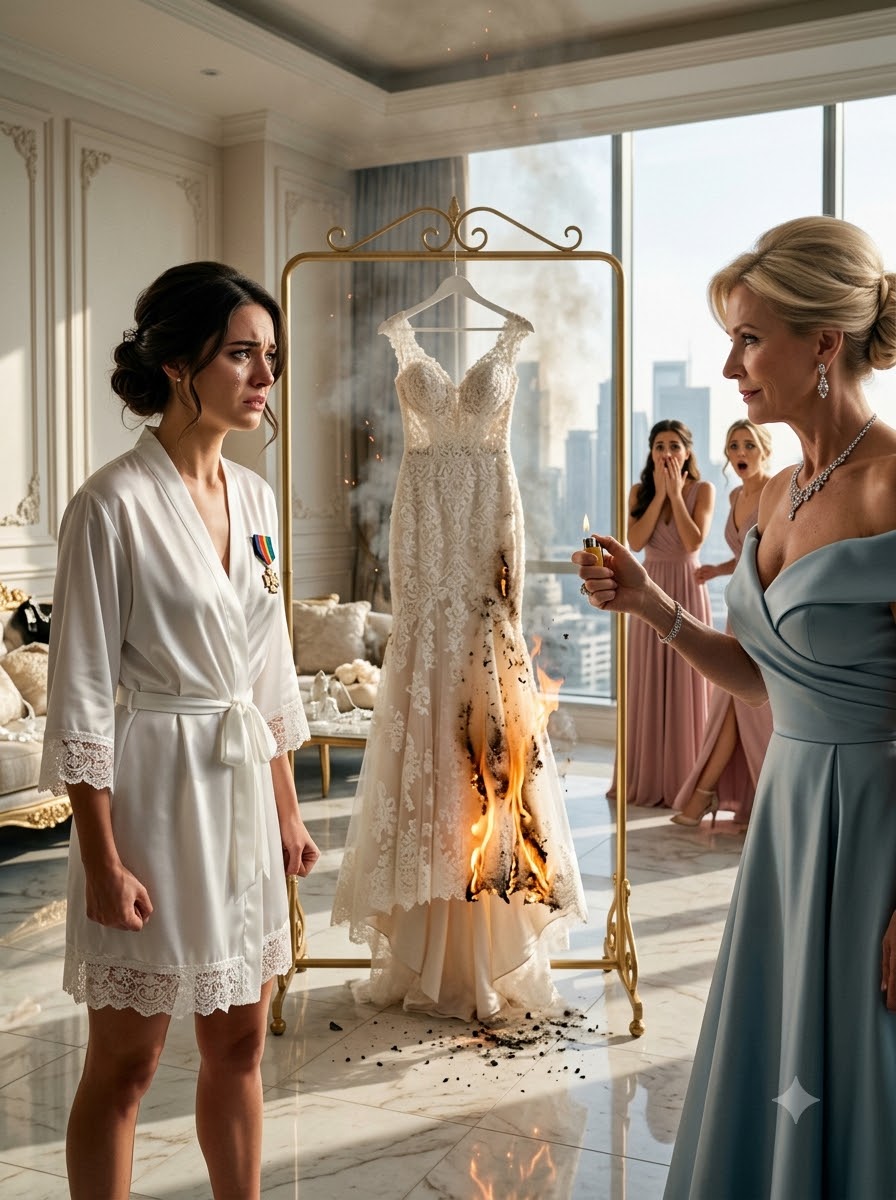
I gave him a small nod, leaving the decision to him.
He opened the envelope carefully and removed a simple card.
For several seconds, he studied what was written inside.
Then he turned it so I could read it.
There were only five words.
“I have started the therapy.”
I stared at the message.
There was no elaborate apology, no attempt to blame anyone else, and no emotional demand that Jason immediately restore their relationship.
Just five words.
They didn’t erase what Margaret had done. They didn’t mean she had suddenly become a different person, or that the years of manipulation and contempt could be forgotten.
But they suggested that she had taken one small step toward acknowledging the need for change.
I thought about the conversation Jason and I had shared in the hotel garden on our wedding night.
Forgiveness and trust were different things.
Trust would require time, consistency, and genuine accountability. It couldn’t be restored through a single card, no matter how hopeful its message seemed.
But every meaningful change had to begin somewhere.
Jason folded the card and slipped it into his jacket pocket.
When he looked at me, there was uncertainty in his eyes, but there was also something I hadn’t seen there before.
Hope.
I took his hand.
Neither of us needed to speak.
We understood that the road ahead with Margaret might be long, difficult, and unpredictable. She might continue therapy and gradually learn to accept responsibility for her actions. She might struggle, resist, or return to old patterns.
We couldn’t control those choices.
What we could control was how we responded.
We had established the boundaries our marriage needed, and we had learned that we could protect those boundaries together.
Whatever happened next, we would face it as partners.
As the gala drew to a close, Jason and I stepped away from the remaining guests and walked onto the hotel’s balcony.
It was the same place where we had stood together on our wedding night, looking out over the glittering Cleveland skyline.
The night was calm, and a cool breeze moved gently across my skin.
Below us, the city stretched toward the dark horizon, its buildings illuminated against the sky. Traffic moved along distant streets, and the lights reflected from the windows of the surrounding towers.
For a long while, we stood shoulder to shoulder without speaking.
Jason wrapped his arm around my waist and drew me closer.
“Did you ever think,” he murmured, “that one burned dress could lead to all of this?”
I smiled and rested my head against his shoulder.
The image of the phoenix appeared in my mind again, its golden wings spreading above a bed of flames.
I thought about Margaret standing in the bridal suite with the Zippo lighter in her hand, convinced that she had the power to destroy everything I valued.
I remembered the smell of burning satin, the horrified expressions of my friends, and the cold satisfaction on her face.
Then I thought about everything that had followed.
Jessica stepping between Margaret and my phone. My soldiers cheering from Germany. Jason running through the courtyard to reach me. Richard finally standing up to his wife. My bridesmaids working together to rescue the ceremony. My father waiting for me in his dress uniform, his eyes filled with pride.
I remembered the veterans saluting as I walked down the aisle, the promises Jason had made at the altar, and the heartfelt messages left on the board at our reception.
I thought of the Bronze Star he had recovered from the ashes and the quiet moment in the garden when he placed it back in my hand.
And now there was the Phoenix Project, a foundation initiative that might help women and families find opportunities after years of service and sacrifice.
All of it had grown from a moment that Margaret intended to be the end of my happiness.
I turned toward Jason.
“The fire only burned away what wasn’t meant to last,” I said softly.
He looked at me, waiting.
“The things that are truly built to endure, the things forged from honor, loyalty, and love, don’t disappear when they’re tested. They become stronger.”
He smiled, his eyes reflecting the lights of the city.
I reached for his hand and intertwined my fingers with his.
I had once believed that marrying into the Wilson family meant gaining their acceptance, adapting to their world, and proving that I deserved a place among them.
Now I understood how little that mattered.
I didn’t need to become someone else to be worthy of love. I didn’t need an expensive necklace, a famous family name, or a seat at an exclusive society gathering to establish my value.
My father’s pride had always been enough. My soldiers’ trust had always been enough. And the love Jason and I had built was stronger precisely because we had been forced to defend it.
The dress was gone, reduced to ashes and memory.
I would never recover the months I’d spent sewing it, nor could I undo the pain of watching it burn. Those losses were real, and I didn’t need to pretend otherwise.
But the life that followed had become richer and more meaningful than anything I could have imagined while sitting alone at my sewing machine.
In place of the ruined dress stood a legacy of resilience, a future shaped by service, and a marriage grounded in mutual respect.
I looked at Jason, my husband, my partner, and my battle buddy, and felt a deep certainty about the life we were building.
The strength of our marriage would not come from a promise that nothing difficult would ever happen to us. It would come from knowing that when hardship arrived, neither of us would have to face it alone.
We had already proved that to each other.
Jason leaned down and kissed my forehead. I closed my eyes, breathing in the cool night air and allowing myself to appreciate the quiet happiness of being exactly where I belonged.
For so long, Margaret had tried to convince me that I was unworthy of becoming part of her family.
But standing on that balcony, surrounded by the life we’d chosen to create, I finally understood something that made her judgment seem small and distant.
Belonging wasn’t something she had the power to grant or deny.
It was something we built through loyalty, integrity, and love.
And the strongest armor I would ever wear wasn’t a military uniform, a wedding gown, or even the medal I’d earned in service to my country.
It was the honor I had worked to earn, the people who had stood beside me, and the love I was willing to fight for
