

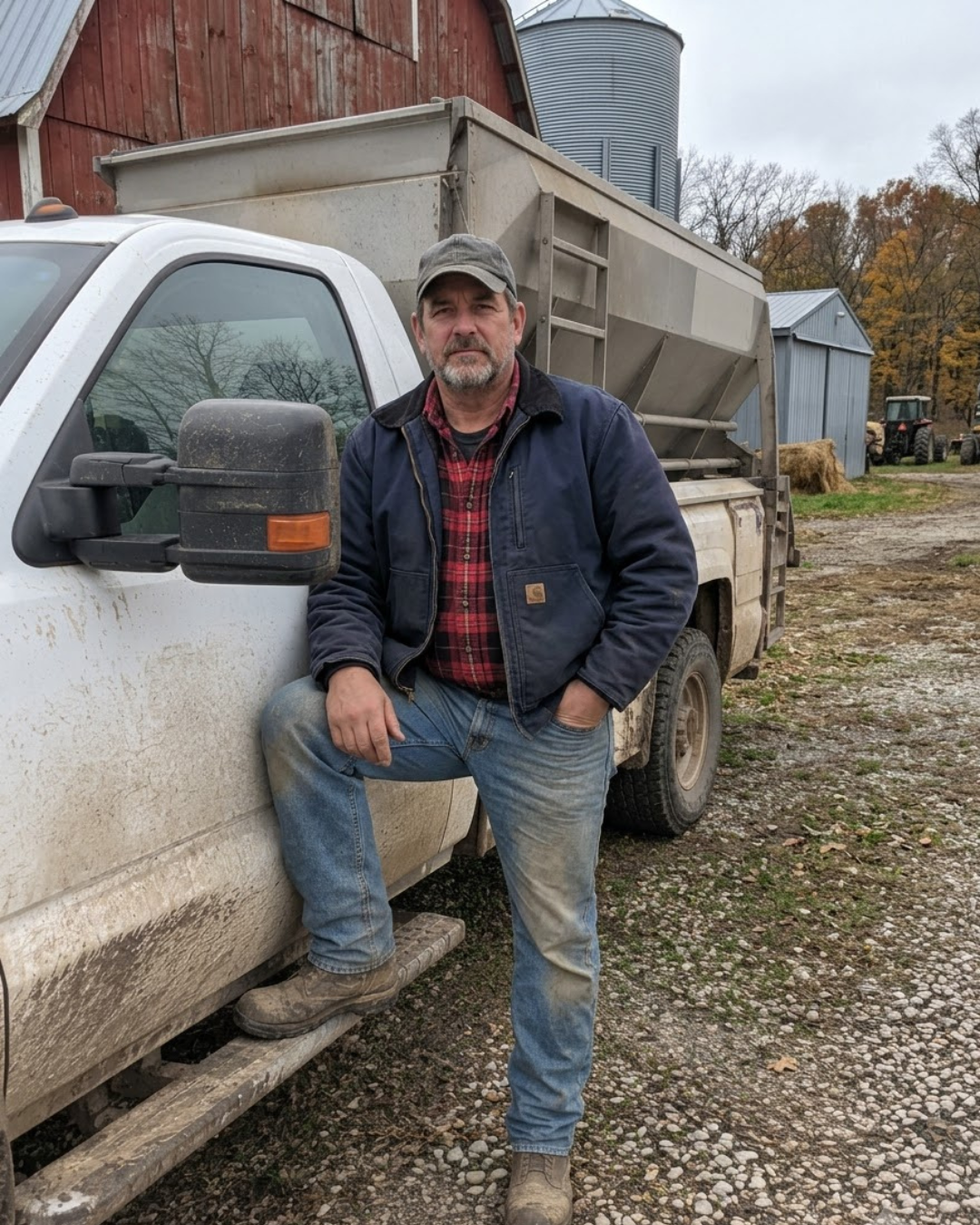
PART 1: Twenty-Two Years of Work, and All I Inherited Was an Old Truck
“To my son Wade,” the lawyer read, “the 1994 International feed truck, with the mixer box, and its title.”
Then he stopped.
I waited for him to turn the page, clear his throat, or continue reading.
He didn’t.
That was the entire inheritance my father had left me.
An old feed truck.
Not a single acre of land.
Not the house where I had grown up.
Not the shop where I had spent twenty-two winters repairing equipment.
Not even a small share of the farm I had worked beside him for more than two decades.
It was a Tuesday morning in late February, inside a small law office above the hardware store in St. Paul, Nebraska.
The radiator clicked against the cold. Downstairs, somebody was cutting a key, and the grinding sound came faintly through the floorboards.
Across the table sat my older brother, Phil.
He was fifty-six, dressed in a sport coat, with his reading glasses folded between his fingers.
He worked in insurance in Omaha.
He hadn’t driven a tractor in thirty years.
I was fifty-one.
Since childhood, I couldn’t remember going more than nine consecutive days without driving one.
Yet the sentence the lawyer had read immediately before mine had given Phil everything.
“To my son Phil, the home place, being the home quarter, the east eighty, and the creek pasture, with the buildings, the irrigation equipment, and the machinery.”
Four hundred acres.
The center pivot.
The farmhouse.
The machine shed.
The equipment.
Everything.
My father, Albert Kucera, had left the entire operation to the son who had spent most of his adult life away from it.
And to the son who had worked the land beside him for twenty-two years, he had left a thirty-year-old truck.
Our lawyer, Don Jensen, placed the will on the table and carefully squared the pages.
Don had known Dad since their childhood 4-H days.
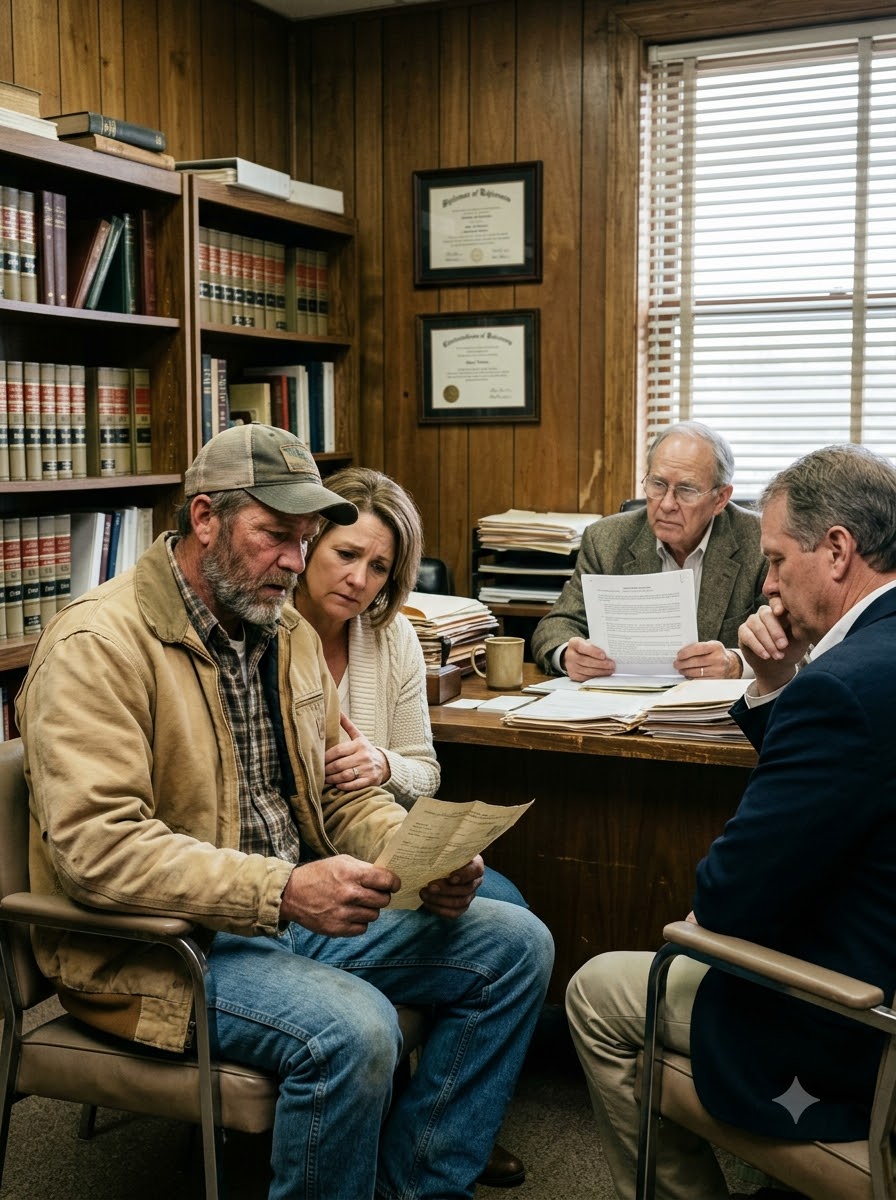
He was a decent man, and I knew he wasn’t responsible for what the document said.
“Wade,” he said. “He came in here in November, and he was in his right mind. I want you to hear that from me. He knew exactly what he was signing.”
“I don’t doubt it,” I answered.
“He didn’t say why. I asked him.”
I looked at Don.
“What did he say?”
Don rubbed his jaw.
“He said, ‘Write it the way I told you, Don.’”
I almost smiled.
That sounded exactly like my father.
Albert Kucera wasn’t a man who explained himself twice.
Sometimes he didn’t explain himself once.
My wife, Theresa, sat beside me.
Her hand rested on my knee beneath the table, pressing firmly, as though she were holding a gate closed against a strong north wind.
I stood.
I shook Don’s hand.
I thanked him because my mother had raised me to thank people, even when I had just heard something that made the room feel as though it were tilting.
Then I walked downstairs.
Outside, the temperature was twenty degrees.
A hard north wind blew down the street.
The sky was the dull gray of a galvanized stock tank.
Theresa followed me to our pickup.
She worked as a bookkeeper at the veterinary clinic in town. She had a practical mind, and she rarely spoke before she had worked through the numbers.
“Call a lawyer of your own, Wade,” she said. “Not Don. Somebody from Grand Island.”
“No.”
“Twenty-two years. You have twenty-two years in that ground.”
“I know how many years.”
“Then why not?”
I stared across the street.
I hadn’t fully understood my own answer until that moment.
“Because that’s his signature,” I said. “He’s three weeks in the ground. He can’t tell me what he meant. I’m not going to stand up in a courtroom and argue with a man who can’t answer back. Not him.”
Theresa watched me quietly.
Then she reached up and pulled my coat collar higher against the wind.
That was her way of accepting a decision she disagreed with.
And loving me anyway.
The hardware store door opened behind us.
Phil stepped outside.
He stopped on the sidewalk, his glasses still in his hand.
“Wade.”
I turned.
“I never asked him for this. I want you to know that. I didn’t know a thing about it till Don called me.”
“I know you didn’t.”
“I don’t know what he was thinking.”
“I don’t either.”
Phil opened his mouth.
For a second, I thought he might say something important.
Then he changed his mind.
He nodded once and walked toward his car.
I watched him go.
Looking back, I know that one more honest sentence from either of us could have saved four months of hurt.
But we were Albert Kucera’s sons.
And Albert Kucera’s sons had never been particularly good at saying the extra sentence.
That afternoon, I drove eleven miles to the home place.
I had one thing to collect.
The truck was parked in the north bay of the machine shed, exactly where Dad had left it on February second after feeding the calves.
He died the following night.
He had been sitting in his recliner with the cattle market report playing on television.
I found him the next morning when he didn’t come outside to the cattle lots.
The truck still sat with its nose facing out.
The wheels were straight.
It had once been white, but thirty winters had turned the paint chalky.
The doors still showed the faded outline of an old seed dealer’s decal.
It had a 466 diesel engine, a five-speed transmission with a two-speed axle, and a mixer box on the back.
The discharge chute had a dent from 2003, when Dad clipped a feed bunk and said something so colorful that Mom made him apologize to the dog.
I climbed into the cab.
His chore gloves lay on the dashboard.
Yellow leather turned brown with use.
Curled into the exact shape of his hands.
I sat behind the wheel and stared at them until my breath fogged the windshield.
His seed corn cap rested on the passenger seat.
Fencing pliers lay on the floor.
The cab smelled of diesel, ground corn, and peppermints.
Dad always kept peppermints in his shirt pocket to disguise the chewing tobacco he continued using after his doctor told him to stop.
The truck was plugged into the block heater.
It started immediately.
I unplugged it, coiled the cord the way Dad always had, and drove home at forty-five miles an hour.
His gloves stayed on the dashboard.
I didn’t touch them.
Theresa and I lived on seven acres along the Elba road.
We had bought the place when we married.
There was a house, a barn, and two small cattle lots.
I parked the truck beside the barn.
Theresa came outside.
She looked it over.
“Well,” she said. “It’s paid for.”
“It’s the only thing out there that is, probably.”
I meant it as a joke.
I had no idea I had just repeated the exact reasoning my father had written down months earlier.
The following morning, reality arrived.
I owned forty cows.
I had started the herd with six bred heifers Dad sold me at cost when I was twenty-nine.
Over the years, I built it slowly.
My cows spent summers on Dad’s creek pasture and winters grazing his cornstalks.
That was our arrangement.
I earned a wage for working the farm.
My cattle used his grass.
And I never once asked to inspect the farm’s financial records.
Now the grass belonged to Phil.
So did the stalks.
I hooked up the stock trailer and began moving my cows.
Eight at a time.
It was the middle of calving season, about the worst possible time to relocate cattle.
But I couldn’t bring myself to keep using land that no longer belonged to me.
Phil drove out from Omaha that Saturday.
He found me loading the fourth trailer.
He stood at the gate in a brand-new canvas coat.
“You don’t have to do this. Leave them where they are.”
“They’re not yours to feed, Phil.”
“I’m not asking you to pay.”
“I know you’re not. That’s the trouble with it.”
He placed both hands on the top rail.
His fingers were long, like our mother’s.
“What are you going to do for grass?”
“Rent some.”
“Wade.”
“I’ll rent some.”
I closed the trailer gate and drove away.
In the mirror, Phil remained at the fence.
Behind him stood the farmhouse.
The yellow kitchen curtain Mom had hung in 1988 was still in the window.
I rented a half section of hill pasture north of Elba from Mrs. Nielsen, a widow whose husband I had helped work calves for years.
Sixty-five dollars per cow-calf pair each month.
Five months.
Thirteen thousand dollars.
We shook hands across her kitchen table.
Before I left, she insisted I take a loaf of homemade rye bread.
“Your dad was hard,” she said. “But he was honest.”
“Yes ma’am,” I answered. “He was both.”
Then I went to the local co-op.
The manager, Jeff, had known me since Little League.
I asked whether he needed help for spring.
He didn’t ask what happened with the farm.
I’ll always remember that kindness.
“You still got your commercial license?”
“From when I hauled cattle for the Larsens.”
“Twenty-three an hour. I need a tender driver for the dry spreaders, and somebody who can run the feed mill when Kim’s out. You start Monday.”
Just like that, I had a new job.
After twenty-two years farming four hundred acres beside my father, I was hauling fertilizer to other men’s fields.
Every morning at five-thirty, I fed my own cattle using the old International.
The truck was far larger than I needed for forty cows.
But it worked.
And every morning, when I climbed into the cab, Dad’s gloves were waiting on the dashboard.
Sometimes I said good morning to them.
I knew how foolish that sounded.
I did it anyway.
As March turned into April, I kept waiting for Phil to call.
The planting season was approaching.
I knew every acre of that farm.
I knew which ground warmed slowly, which sections held moisture, and which parts of the center pivot needed attention.
Dad never planted until the soil reached fifty degrees at a depth of four inches at seven in the morning for three consecutive days.
He kept a thermometer hanging on a nail in the shop.
He also kept a little green notebook containing planter settings, seed populations, irrigation notes, well readings, and every troublesome detail about the pivot.
I had planted that ground twenty-two springs in a row.
Surely Phil would ask me to do it again.
But the phone remained silent.
Around April tenth, Theresa finally brought it up over supper.
“Call him,” she said. “Tell him you’ll put the crop in. He’d pay you. He’d be glad to.”
“He knows my number.”
“That’s pride.”
“Some of it is.”
“What’s the rest?”
I put down my fork.
“If I call him and offer, then I’m the hired man asking for work on my own father’s place. I planted that pivot twenty-two springs in a row. I’m not going to beg to plant it the twenty-third. If he wants me, all he has to do is ask. One sentence. I’d be in the field by dark.”
Theresa said nothing.
She stood and cut me another piece of pie.
That was how she told me she thought I was wrong but intended to let me discover it myself.
The soil reached planting temperature during the last week of April.
Our neighbor Butch Sedlacek began planting on the twenty-eighth.
He was seventy-three and had shared a fence line with Dad for forty-six years.
They had argued across that fence for almost every one of those years.
I was delivering fertilizer when Butch climbed down from his tractor.
“Anybody in your dad’s fields?” he asked.
“Not that I’ve seen.”
“You going to be?”
“Haven’t been asked.”
Butch looked at me for a long moment.
“Two of a kind,” he muttered.
Then he shook his head.
“No. Three of a kind. Him and the both of you.”
He spat into the dirt.
“It’s a wonder anything ever got said in that house.”
May first passed.
Then May fifth.
I drove past the home place twice a day.
Both fields remained untouched.
Last year’s cornstalks stood in the wind.
Blackbirds wandered between the rows.
On May ninth, two inches of rain fell.
Three days later, I came over the hill hauling eight tons of fertilizer.
And I saw a sixteen-row planter working in Dad’s pivot quarter.
It was being pulled by a tractor I didn’t recognize.
A pickup and seed trailer stood at the end rows.
The pickup had Kansas license plates.
I slowed down.
My stomach tightened.
The ground was still too wet.
I could see mud packing around the planter’s gauge wheels.
The tracks behind the equipment were shiny, the soil smeared instead of crumbling.
They were planting into wet ground that needed several more days to dry.
Any man who knew that quarter would have told them to wait.
I reached toward my turn signal.
For one moment, I almost drove down the lane.
I could have stopped them.
I could have explained the soil conditions.
I could have prevented a mistake that might cost thousands of dollars.
Then I remembered something.
Phil had hired strangers.
He had searched for somebody to plant our father’s land and looked right past me.
All the way to Kansas.
I lowered my hand.
I kept driving.
I wasn’t proud of that decision.
But it was the one I made.
That evening, I couldn’t eat supper.
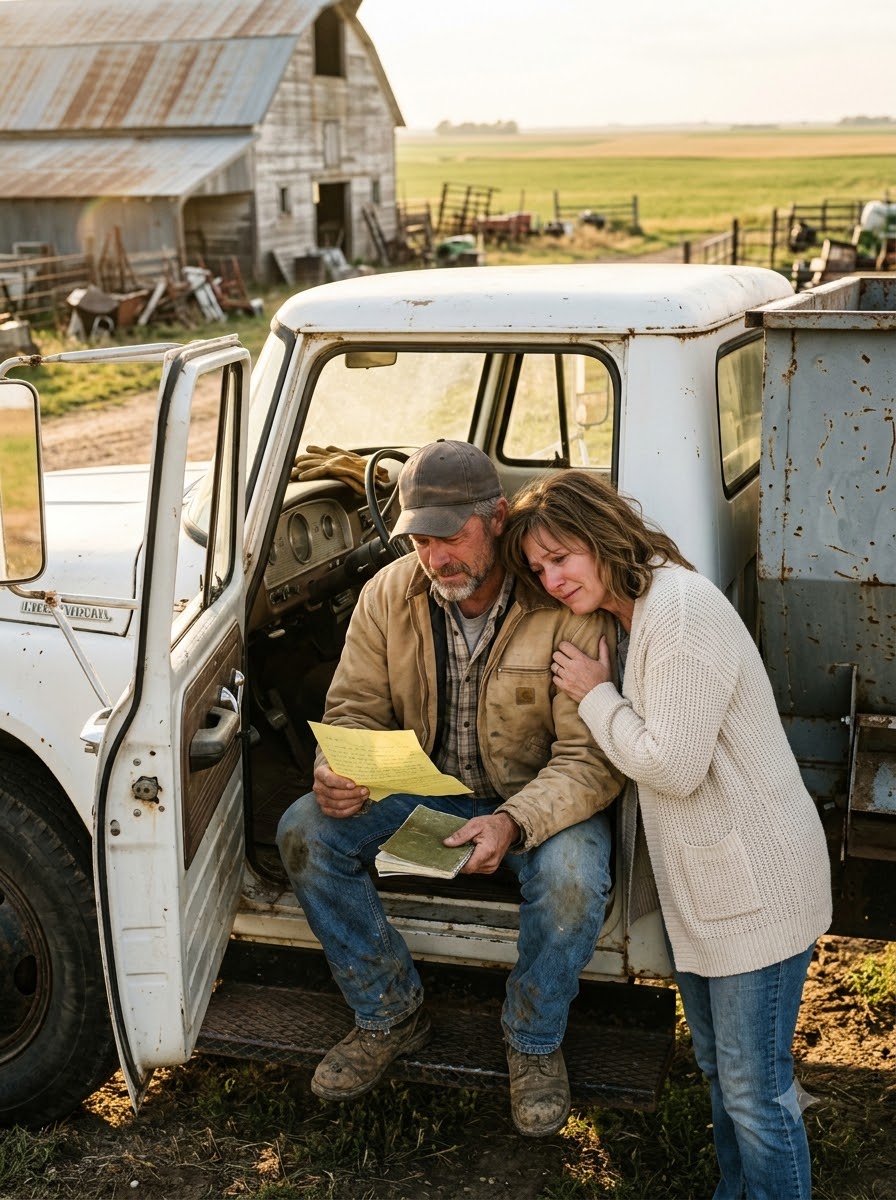
Theresa found me sitting in the feed truck with the driver’s door open.
“They put it in wet,” I said.
“Can it be fixed?”
“Some. Not by them.”
She stepped onto the running board and wrapped an arm around my neck.
We sat there for a long time.
Then she whispered something I couldn’t forget.
“He would hate this. Your dad. Not the corn. You two.”
“He’s the one that did it, Theresa.”
“I know he is. I still think he’d hate it.”
By the middle of June, the damage was visible from the county road.
And then something happened that neither Phil nor I expected.
Our father’s worst field became the very thing that finally forced my brother to come looking for me.
PART 2: The Secret Hidden Beneath the Passenger Seat
Good corn comes out of the ground like a church choir.
Every plant stands at nearly the same height.
The rows are straight.
The spacing is consistent.
The field looks as though somebody planned it carefully.
Because somebody did.
But the corn in Dad’s pivot quarter looked like a school photograph where half the children were standing and the others were sitting.
Some plants reached my knee.
Others were barely four inches tall.
There were empty stretches in the rows long enough for a grown man to lie down.
Then there were clumps where three plants struggled for the same space.
The wet planting had smeared the seed trenches.
When the ground dried, those trenches hardened like clay pots.
The roots couldn’t grow downward properly.
Instead, they spread sideways along the compacted walls.
Yellow streaks began appearing across the field.
Waterhemp was emerging between the rows because nobody had applied the necessary weed control ahead of planting.
And the center pivot hadn’t moved.
Not once.
It stood at the same angle where Dad had parked it the previous September.
The fifth tower had a flat tire.
Over on the east eighty, the hired crew had made another serious mistake.
They planted dryland corn at an irrigated population.
Thirty-two thousand seeds per acre on ground that could support only about twenty-four thousand in a good year.
If July turned hot and dry, every stalk would compete with its neighbors for water.
I could see the problems from the road.
But the farm belonged to Phil.
And Phil still hadn’t called.
What happened next was something I learned later.
Butch told me his version.
Phil told me his.
Their accounts matched.
It was Thursday evening, June eleventh.
Phil had driven out from Omaha after work, as he had been doing almost every week.
He stayed in his old bedroom and walked through fields he didn’t know how to read.
That evening, he stood at the edge of the pivot quarter wearing work boots so new the yellow was still visible in the laces.
Butch pulled his pickup onto the shoulder.
He got out and leaned against the fence.
For nearly a minute, he studied the corn without saying anything.
Then he spoke.
“Your dad would’ve said a blind mule plants straighter.”
Phil didn’t answer.
“He’d have said you could lose a hog in those skips. He’d have said whoever set that planter ought to be made to eat the seed tags.”
“I expect he would,” Phil replied.
“What’d that outfit charge you?”
“Twenty-eight dollars an acre. Plus seed.”
Butch made a quiet sound.
Then he looked back at the field.
“You know what else Albert would’ve said?”
“What.”
“He’d have said it’s the eleventh of June, and it isn’t lost yet. Corn’s forgiving if you get to it. That needs sprayed by Monday. It needs nitrogen put on beside the row. And that pivot needs to be walking before the Fourth of July, or you can forget the whole business.”
Phil looked toward the irrigation system.
“I don’t know how to start it.”
“I know you don’t.”
“I had a man out to look at it. He said the panel was throwing a fault, and he could come back in two weeks.”
“You don’t have two weeks.”
Phil removed his cap.
He ran a hand over his head.
Butch later told me the gesture looked so much like Dad that it startled him.
“There’s a man eleven miles from here,” Butch said, “who knows which tower sticks on that machine. And what to hit it with.”
“I know there is.”
“Then what in the world are you standing here talking to me for?”
Phil stared across the damaged corn.
Then he finally admitted what had been stopping him.
“Because I got the farm and he got a truck, Butch. How am I supposed to drive into his yard and ask him for anything?”
Butch thought about that.
Then he answered.
“The same way he’d have to drive into yours. Slow. With your hat in your hand.”
Before leaving, Butch mentioned something else.
He had offered to buy the east eighty from Dad twice.
The land bordered his own property, and he had always wanted it.
But Dad refused.
He said his father had purchased those eighty acres in 1961 with money earned raising hogs.
He wouldn’t be the one to sell them.
Butch told Phil the offer had never gone anywhere.
Then he drove home.
That same evening, I was working on the feed truck.
It was after eight o’clock, but the June sun was still shining.
I had a grease gun pressed against the driveline when I heard tires crunching over gravel.
I looked up.
Dad’s blue three-quarter-ton pickup was coming down my lane.
The taillight was still cracked.
For half a second, with the sunlight behind the windshield, I thought Dad was driving.
Then Phil stepped out.
His new boots were muddy to the ankles.
He walked toward the truck and stopped beside the running board.
His eyes moved to the windshield.
To the dashboard.
To our father’s gloves.
Then he took off his cap.
I had never seen Phil remove his cap to ask anybody for anything.
Not for money.
Not for help.
Not even during the hardest moments of our mother’s illness.
“Wade,” he said. “I need to ask you something.”
I wiped my hands on a rag.
“Go ahead.”
“I don’t know what I’m looking at out there.”
His voice remained steady, but I could hear how difficult the admission was.
“I know it’s bad. I don’t know how bad. And I don’t know what to do first. Would you come look at it?”
Four months.
I had waited four months for that question.
During those months, I had imagined what I would say if he finally asked.
Most of the speeches I rehearsed weren’t particularly kind.
But standing there, looking at my older brother holding his cap in both hands, I couldn’t remember a single one.
“Saturday,” I said. “I work till noon.”
He exhaled.
“I’ll pay you. Whatever you say.”
“You’ll pay the co-op for the spray and the nitrogen. That’ll be enough of a bill.”
I put the grease gun away.
“And Phil. I’ll look at it. I’m not saying anything more than that yet.”
“That’s fair.”
Then I asked the question that had been bothering me since May.
“Why Kansas?”
He turned his cap in his hands.
“Because they didn’t know me,” he said. “I couldn’t ask you. And everybody else around here would’ve known I hadn’t asked you.”
I stared at him.
It was an honest answer.
And it was almost identical to the reasoning I had given Theresa back in April.
Neither of us could bring ourselves to ask the other for help.
We had inherited more than Dad’s stubbornness.
We had inherited his silence.
“Saturday,” I repeated.
Phil nodded.
He glanced once more at the gloves on the dashboard.
Then he climbed into Dad’s pickup and drove away.
Saturday afternoon, I came home from the co-op shortly after noon.
I ate lunch standing at the kitchen counter.
Before heading to the farm, I needed to find Dad’s green notebook.
The pivot control panel was reporting a fault.
Dad had recorded every fault that machine had ever produced, along with the repairs he made.
I had searched the shop back in March while collecting my tools.
The notebook wasn’t there.
That left the feed truck.
Dad always kept his things beneath the passenger side of the bench seat.
His log chain.
Jumper cables.
Spare parts.
Anything he didn’t want his sons borrowing without permission.
For four months, I had driven that truck twice a day.
But I had never reached beneath that side of the seat.
It was still Dad’s side.
I hadn’t even moved his seed corn cap.
I climbed onto the running board and reached underneath.
My hand found the log chain.
The jumper cables.
A coffee can filled with cotter pins.
Then, against the back wall of the cab, I felt a zippered bank bag.
It was one of those deposit bags issued by the State Bank.
I pulled it out.
Inside was the green notebook.
And a sealed envelope.
A plain white envelope.
A flag stamp was fixed in the corner.
Across the front, in my father’s block handwriting, was my name.
Wade.
Our road.
Elba, Nebraska.
He had addressed it.
He had stamped it.
But he had never mailed it.
I sat on the running board in the afternoon sun.
Then I carefully opened the envelope with my pocketknife.
Inside was a single sheet torn from a yellow legal pad.
It was dated November ninth.
Four days before Dad visited Don Jensen to finalize his will.
I unfolded the paper.
And began reading.
Wade. I am no hand at this so I will say it plain.
The place is not clear. I borrowed on it in 2012 for the pivot. And again when your mother was sick. And again after the water in 2019. It is three hundred eighty-eight thousand dollars. The payment is thirty-eight thousand a year, and this place has not made thirty-eight thousand clear in six years. I have been paying the bank with the bank’s money. I never told you boys. I was ashamed.
I stopped.
Three hundred eighty-eight thousand dollars.
Dad had owed the bank nearly four hundred thousand dollars.
And I had never known.
I had worked beside him every day.
I knew the machinery.
I knew the fields.
I knew how many cattle we had and which fence posts needed replacing.
But I had never seen the books.
My hands began trembling.
I kept reading.
If I leave it to you, you will keep it. I know you. You will pay that bank until you are as old as I am, and Theresa will do without, same as your mother did, and you will never say a word. I will not do that to you.
I stared at the words.
Dad hadn’t believed I was unworthy of the farm.
He had believed I loved it too much to let it go.
And he had been afraid that love would destroy me financially.
I swallowed and continued.
Phil will sell it. He can count, and he does not love it. Do not hold that against him. I made him that way. I told him the summer he was nineteen that he was no farmer, and he believed me. He will clear the bank and there will be a good deal left, and he will split it with you fair. I would bet the place on it. I guess I have.
Then came the sentence that made my chest ache.
You get the truck because it is paid for, and it is the only thing out here that is.
I remembered what I had jokingly told Theresa the day I brought it home.
Almost the exact same words.
I read the final lines.
I ought to mail this. I will probably put it in the truck.
You were the best help a man ever had. I should have said so when it would have done you some good.
Dad.
I read the letter again.
Then I tried to read it a third time.
But the words had blurred.
Twenty-two years.
Twenty-two years of working beside him.
I had pulled calves with him in the middle of blizzards.
I had repaired equipment through freezing winter nights.
I had worked until my hands cramped and my back ached.
And never once had he told me I was the best help a man ever had.
Not when my calves topped the market.
Not after a successful harvest.
Not during the long nights when we worked together without speaking.
He had finally written it on a yellow legal pad.
Then he bought a stamp.
And when the moment came to send it, he lost his nerve.
So he tucked the letter beneath the passenger seat of the truck he intended to leave me.
Where he must have believed I would eventually find it.
It had taken me four months.
Because I couldn’t bring myself to reach across to his side.
Theresa came outside to see why I hadn’t left.
She found me sitting on the running board with the letter in my hand.
I gave it to her.
She read every word.
Then she sat beside me.
Our hips touched on the narrow metal step.
“He knew you,” she said quietly. “He knew just exactly what you’d do.”
“He could’ve told me.”
“No. He couldn’t. That’s the saddest thing in it.”
She folded the letter along Dad’s original creases.
“He could put a pivot on a quarter and pull a calf in the dark. And he could not say one kind sentence to your face. So he wrote it down. That’s something, Wade. For him, that’s just about everything.”
I lowered my head onto her shoulder.
A fifty-one-year-old man, sitting in his own yard on a Saturday afternoon, crying over a letter his father had been too stubborn to mail.
When I could finally move, I climbed into the cab.
I placed the green notebook on the seat.
I laid the envelope beside Dad’s gloves.
Then I drove the old International eleven miles back to the home place.
Forty-five miles an hour.
Exactly as I had driven it away four months earlier.
Phil was waiting beside the machine shed.
The big door was open.
He watched the truck come up the lane.
I could see him trying to understand why I had brought Dad’s old feed truck instead of my own pickup.
I stopped beside him.
Then I leaned across the bench seat and pushed open the passenger door.
“Get in.”
“Is something wrong?”
“Get in, Phil.”
He climbed up.
He had to move Dad’s seed corn cap to sit down.
He held it awkwardly on his knee.
I took the envelope from the dashboard.
“That was under your side of the seat. It’s addressed to me. But half of it’s yours.”
Phil put on his glasses.
He unfolded the letter.
I looked out through the windshield while he read.
A sparrow was building a nest above the shop door.
I counted the rungs on the grain bin ladder.
Twenty-three.
Then I heard Phil reach the bottom of the page.
He went back to the beginning.
When he finally spoke, his voice sounded nothing like the confident insurance salesman I had known all my life.
“He bet the place on me.”
“He did.”
“He thought I’d do right.”
“He was sure of it.”
Phil removed his glasses.
He pressed his fingers against his eyes.
Then he reached into his shirt pocket.
He pulled out a folded sheet of paper, worn soft along the creases.
He handed it to me.
And when I unfolded it, I discovered that my brother had been carrying his own secret for nearly four months.
PART 3: The Eighty Acres That Saved Everything
The paper Phil handed me was a page from a legal pad.
It was dated March first.
His handwriting was neat and precise, the handwriting of a man who spent his days working with numbers and contracts.
Down the left side, he had estimated what the farm might sell for.
Below that, he had subtracted the bank debt.
Then he drew a line.
The remaining amount was divided equally.
One half was labeled Phil.
The other was labeled Wade.
I stared at the page.
“Don told me about the note at the bank the day after he read the will,” Phil explained.
He looked toward the windshield.
“I thought you knew. You were out here every single day. I figured you’d known for years, and it was just one more thing nobody in this family was going to say out loud.”
“I never saw the books in my life.”
“I know that now.”
He looked down at the page.
“I was always going to split it. I had that written down before you’d hauled your last load of cows off this place. But I wanted to hand it to you after harvest. A check. Off a crop I’d put in on this farm myself. Just one time.”
He shook his head.
“I’m fifty-six years old. He told me when I was nineteen that I was no farmer. And I’ve been trying to hand that sentence back to him ever since.”
He paused.
“So I hired strangers. And I made a mess of his best field. And I proved him right.”
I looked at my older brother.
For most of my life, I had believed Phil was the fortunate one.
He had escaped the hard work.
He had built a comfortable career.
He had a pension.
He had never spent January mornings breaking ice in water tanks or July afternoons repairing irrigation equipment beneath a punishing sun.
But I had never understood what Dad’s words had done to him.
One sentence when Phil was nineteen.
One careless judgment.
And my brother had spent thirty-seven years trying to prove it wrong.
“He didn’t say it in there to be right,” I told him. “Read it again. He says he made you that way. That’s him owning it, Phil.”
Phil looked down at Dad’s letter.
Then he looked at me.
“He told you that you were the best help he ever had.”
“On a yellow tablet. Under a log chain.”
Phil laughed.
The sound broke halfway through.
I laughed too.
Then neither of us was laughing anymore.
We sat in Dad’s old feed truck, two gray-headed men with his gloves resting on the dashboard.
And we cried the tears we hadn’t managed to cry at his funeral.
Nobody saw us.
Except a sparrow building a nest above the shop door.
After a while, Phil wiped his face with his sleeve.
He placed Dad’s seed corn cap carefully on the dashboard beside the gloves.
Then he turned toward me.
“Show me what I’m looking at.”
We spent the next two hours walking the pivot quarter.
I used my pocketknife to dig up corn plants.
I showed him how the roots had spread sideways along the hardened seed trenches instead of growing downward.
I showed him the patches of waterhemp.
I explained that the weeds were still small enough to control if we acted quickly.
I pointed out the yellow streaks and uneven emergence.
Phil listened.
Really listened.
Not as an insurance salesman.
Not as the older brother who had inherited the farm.
But as a man trying to understand something he had spent most of his life believing he couldn’t do.
Then we went to the pivot.
I opened Dad’s green notebook.
There it was.
A note dated 2017.
Safety switch tower 5. Clean and reset.
We aired up the flat tire using the compressor in Dad’s pickup.
I cleaned the safety switch with a wire brush.
Phil stood beside the control panel.
I told him what to do.
He threw the lever.
For a moment, nothing happened.
Then the pivot groaned.
It shuddered.
The motors began moving.
And the irrigation system started walking across the field.
Water fell onto the crooked rows of corn.
Phil stood in the end rows, watching.
He looked like a man seeing rain for the first time.
We returned to the yard.
Then we lowered the tailgate of Dad’s blue pickup and sat on it.
That was where business had been settled on the Kucera farm for as long as I could remember.
Dad had negotiated cattle prices there.
He had discussed machinery repairs there.
He had argued about seed costs and rainfall there.
Now his two sons sat in the same place, trying to decide whether the farm had a future.
“I don’t want to sell it,” Phil said.
I turned toward him.
“I thought I did. But I’ve been out here every weekend since March. And I don’t.”
“You can’t keep it. Not with that payment. He’s right about that.”
“What would you do?”
I didn’t have to think.
“I’d do just exactly what he said I’d do. I’d keep it. And it’d bury me.”
Phil removed a pencil from his shirt pocket.
Then he turned Dad’s envelope over.
The back was blank.
“Butch Sedlacek told me Thursday he asked Dad twice for the east eighty.”
“He’s wanted it since I was in high school.”
“What’s dryland ground worth out here?”
“Laying right against a man who wants it? Five thousand an acre.”
Phil wrote down the calculation.
Eighty acres.
Five thousand dollars per acre.
Four hundred thousand dollars.
Below it, he wrote the debt.
Three hundred eighty-eight thousand dollars.
Then he drew a line.
We both stared at the numbers.
The answer was sitting in front of us.
“That clears the bank,” Phil said slowly. “All of it. With the eighty. Just the eighty.”
I looked toward the eastern fields.
Dad had refused to sell that land for decades.
Our grandfather had bought it in 1961 with money earned raising hogs.
It had become part of the family story.
Part of the pride attached to the farm.
“Dad wouldn’t sell it,” I said.
“Dad isn’t the one holding the pencil.”
Phil said it gently.
“Grandpa bought that eighty with hog money to make the place bigger. I think he’d let it go to keep the home quarter. I think he’d call that a fair trade.”
I thought about the east eighty.
I knew every slope.
Every low spot.
Every section where the soil changed.
It was good ground.
But it wasn’t the home quarter.
And it wasn’t the creek pasture.
“That leaves the pivot and the grass,” I said. “Free and clear.”
“In both our names. Half and half. The way I had it written down in March.”
Phil tapped the pencil against the envelope.
“You farm it. All of it. Your way. Your cows go back on the creek. You pay me a fair rent on my half, and I’ll put my rent right back into the place until the machinery’s caught up.”
I looked at him.
“That’s not much of a deal for you.”
“Wade. I sell insurance. I have a pension. I don’t need this farm to feed me.”
He turned toward the house.
The yellow curtain still hung in the kitchen window.
“I need it to be here. And I need to be let onto it.”
“Let onto it how?”
He took a long time to answer.
“Planting. One week, every spring. I want to drive a tractor on this place. And I want somebody who knows what he’s doing to tell me whether I did it right.”
I looked at him.
My older brother.
The man Dad had told at nineteen that he wasn’t a farmer.
The man who had spent thirty-seven years carrying that sentence.
All he wanted was one week every spring.
One chance to plant the ground he had grown up on.
One chance to hear someone tell him he had done it right.
I held out my hand.
Phil took it.
That was our agreement.
No complicated speech.
No argument.
Just two brothers sitting on the tailgate of their father’s pickup, with the numbers written on the back of an old envelope.
The legal paperwork would take until Christmas.
But the decision was made that afternoon.
That evening, we drove to Butch Sedlacek’s place.
He was sitting on his porch.
We explained everything.
The debt.
The east eighty.
Our plan to keep the home quarter and creek pasture.
Butch listened without interrupting.
When we finished, he nodded.
Five thousand dollars an acre was exactly what he had offered Dad.
He shook Phil’s hand.
Then mine.
“Took the two of you long enough,” he said.
“We had it under the seat of a truck,” Phil replied.
Butch never asked what that meant.
The farm wasn’t saved by a miracle.
It was saved by hard decisions and a great deal of work.
The corn wasn’t truly rescued.
It was nursed through the season.
The co-op sprayed the waterhemp Monday morning.
We applied nitrogen beside the rows that same week.
And the pivot kept moving through July.
We monitored the field carefully.
We repaired what could be repaired.
We accepted what couldn’t.
When harvest came in October, the pivot quarter averaged 171 bushels per acre.
Dad would have made 215.
Forty-four bushels lost on every acre.
The east eighty, which Butch allowed us to harvest one final time, produced ninety-four bushels per acre.
Phil rode beside me in the combine for every round.
When the yield monitor finally displayed the average for the pivot quarter, he stared at the number.
“That forty-four bushels,” he said, “is what my pride cost.”
Then he opened Dad’s green notebook.
He wrote down the yield.
The date.
And the loss.
In ink.
I watched him do it.
For the first time, I understood that he wasn’t trying to prove he was better than Dad.
He was trying to become the farmer Dad had once told him he couldn’t be.
And now he had someone willing to teach him.
The sale of the east eighty cleared the debt.
The remaining land stayed in the family.
The home quarter.
The pivot.
The creek pasture.
The buildings.
The machinery.
The farm that had nearly been lost beneath years of borrowing and silence.
My cows returned to the creek.
And Phil and I began doing something we had never truly done as adults.
We worked together.
Not because Dad ordered us to.
Not because the will demanded it.
But because we finally understood what each of us needed.
The following spring, Phil took a week of vacation from his insurance job.
He arrived during the last week of April.
The soil thermometer still hung on its nail in the shop.
I checked it at seven in the morning.
Fifty degrees.
Four inches deep.
Three mornings in a row.
Exactly the way Dad had taught me.
I set the planter.
Checked the seed population.
Inspected the equipment.
Then I put Phil in the tractor seat on the home quarter.
I climbed onto the step beside him.
The same way Dad had stood beside me when I was eleven.
Phil eased the tractor forward.
The planter lowered.
Sixteen rows began stretching behind us.
Straight lines running north toward the fence.
I watched the equipment.
Then I watched my brother.
He was concentrating harder than I had ever seen him concentrate on anything.
At the end rows, he slowed the tractor.
He looked over his shoulder.
Sixteen clean rows.
Straight as a string.
“Is that right?” he asked.
I smiled.
“That’s right. That’s just exactly right.”
He nodded.
He didn’t say anything else.
I looked away toward the pivot.
I wanted to give him a moment.
Because I knew what those words meant to him.
And I knew how long he had waited to hear them.
At noon, Theresa drove out with lunch.
Sandwiches.
Coffee in a thermos.
And an entire pie.
The three of us sat on Dad’s pickup tailgate.
The planter rested at the end rows.
Meadowlarks called from the fence posts.
Butch drove past on the county road.
He honked twice.
He didn’t stop.
He didn’t need to.
These days, I still feed my cattle every morning at five-thirty.
I still climb into that old International truck.
Phil keeps telling me we can afford something newer.
I keep reminding him that this one is paid for.
Dad’s gloves are still on the dashboard.
The leather remains curled into the shape of his hands.
His seed corn cap sits beside them now.
Exactly where Phil placed it the day we read the letter together.
The letter itself is safe inside the house.
Theresa put it in my mother’s Bible on the kitchen shelf.
She said something that important belonged indoors.
I agreed.
But the envelope with our calculations on the back is somewhere else.
The numbers Phil wrote.
The four hundred thousand dollars.
The three hundred eighty-eight thousand dollars.
The line beneath them.
The simple arithmetic that showed us how to save what mattered.
I put that envelope back inside the State Bank bag.
And I placed the bag beneath the passenger side of the truck seat.
Exactly where Dad had hidden his letter.
Sometimes I think about what would have happened if I had never reached under that seat.
Phil might have sold the farm.
I might have spent the rest of my life believing Dad valued twenty-two years of work less than an old truck.
My brother might have continued believing he had failed at the one thing he had always wanted to prove he could do.
And Dad’s last words to me might have remained hidden beneath a log chain until somebody eventually cleaned out the cab.
Instead, we found the truth.
Dad hadn’t left me the truck because he thought my work was worthless.
He left it because he knew I would sacrifice everything to keep the farm.
He knew I would work myself old trying to pay debts I didn’t even know existed.
And he couldn’t bear the thought of watching me repeat the same life of worry and sacrifice he had lived.
He trusted Phil to make the hard financial decision.
He trusted me to know how to keep the land productive.
He had understood both of his sons better than either of us realized.
But he had never learned how to tell us.
That was the tragedy of it.
Not the will.
Not the debt.
Not even the lost eighty acres.
It was the silence.
The years of things left unsaid.
The praise that never reached the person who needed it.
The apology that stayed trapped in a man’s throat until he could only write it down.
Dad had been a good farmer.
He had known the ground.
He had known the weather.
He had known how to pull a calf in a blizzard and repair an irrigation system in the dark.
But he had never known how to tell one son that he was proud of him or the other that he believed in him.
So he left a farm to one son.
A truck to the other.
And a letter neither of us knew existed.
It nearly broke us.
Then it brought us back together.
Every morning, when I climb into that truck, I still look at the gloves.
Sometimes I remember Dad’s hands on the steering wheel.
Sometimes I remember the sound of his voice telling me to check the planter again.
And sometimes I think about that final sentence.
You were the best help a man ever had. I should have said so when it would have done you some good.
I wish he had said it while he was alive.
I wish Phil had heard him admit that calling him no farmer at nineteen had been a mistake.
I wish we could have sat on the pickup tailgate together, all three of us, and talked about the debt before it became a secret.
But wishing doesn’t change what happened.
What I can change is what happens next.
When Phil comes out to plant, I tell him when he does something right.
When he makes a mistake, I show him how to fix it.
When he asks a question, I answer it.
And when he needs help, he asks.
We aren’t always good at talking.
We’re still Albert Kucera’s sons.
But we’re learning.
For four months, I refused to reach beneath the passenger side of that truck seat.
I told myself it was still Dad’s side.
That I had no business touching what belonged to him.
That the things he left behind should stay exactly where he put them.
Now I reach across whenever I need to.
Sometimes for the bank bag.
Sometimes for the seed corn cap.
Sometimes just to move something out of the way.
And every time I do, I remember what was waiting there.
A father’s confession.
A brother’s promise.
And the truth that saved our family farm.
It turns out there was room over there the whole time.
THE END
