

PART 1: The Little Girl in the Yellow Jacket
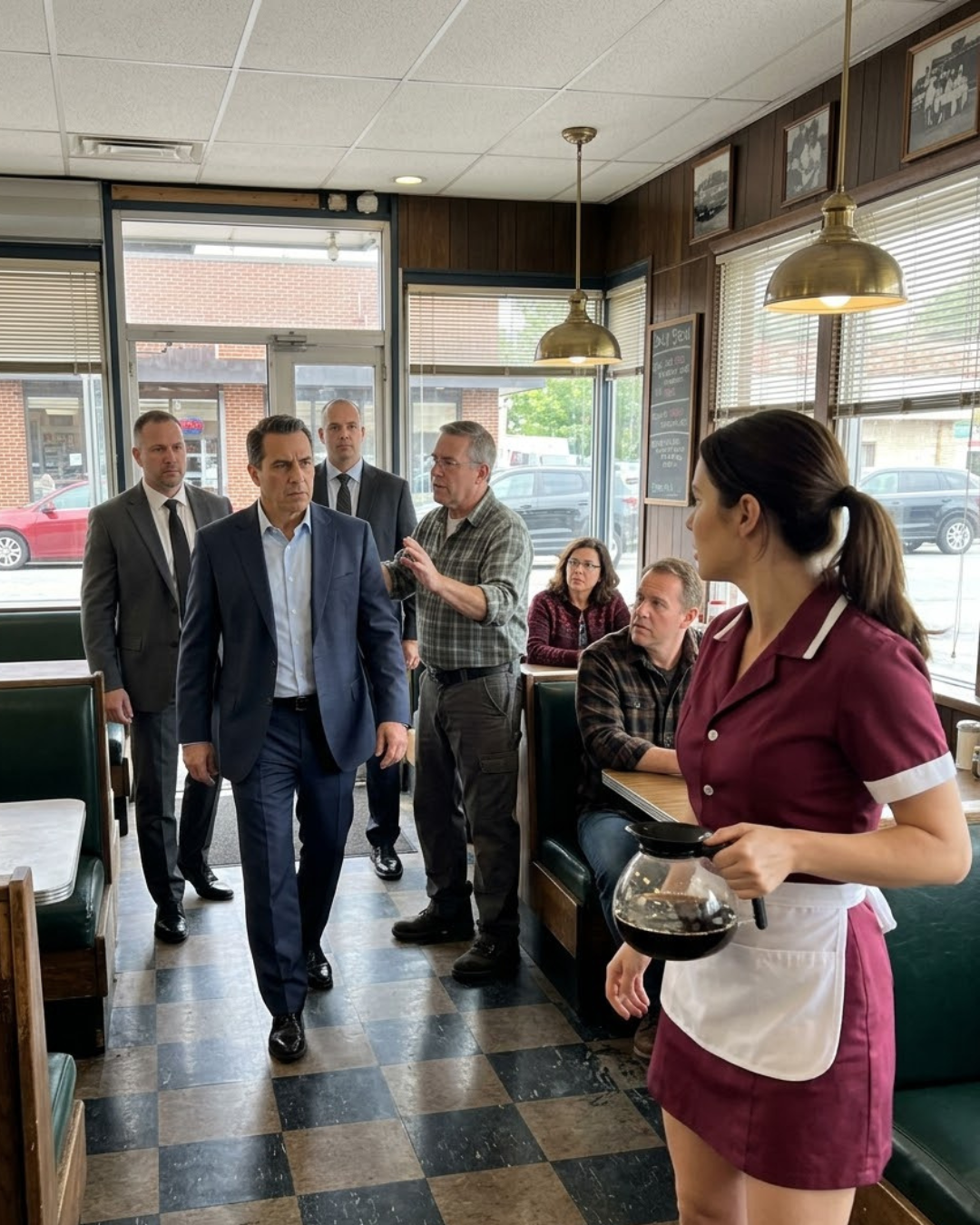
Rick’s voice cut through the breakfast rush at Waverly Diner so sharply that conversations stopped in the middle of sentences.
“You know she can’t pay, yet you keep serving her anyway?”
Thirty customers turned toward me.
Then their eyes shifted to the little girl sitting alone in the far corner booth.
She couldn’t have been older than ten. Her yellow jacket hung loosely from her narrow shoulders, and she clutched a faded backpack against her chest as though it were the only thing in the world she could trust.
An egg sandwich sat untouched on the plate in front of her.
Rick pointed at me.
“Do you want your wages docked?”
I felt my cheeks burn.
“She’s just a child, Rick.”
Behind him, Dany, another waitress, had already raised her phone. She was recording everything, barely hiding her satisfaction.
Rick loved humiliating employees in front of customers. He called it maintaining discipline. I called it making people afraid of losing the jobs they desperately needed.
“Not your problem,” he snapped. “No more freebies. Not one. If she eats, it comes out of your check.”
The little girl flinched.
That small movement hurt me more than anything Rick had said.
She grabbed her backpack and scrambled out of the booth. Her sandwich slid toward the edge of the plate.
“Wait,” I whispered.
But she was already running.
Her sneakers squeaked against the tile, and a flash of yellow disappeared through the glass entrance.
Rick folded his arms.
“In my office. Now.”
I followed him past the kitchen, my hands trembling beneath my apron.
On his desk lay a disciplinary notice.
Already printed.
Already prepared.
He had planned to punish me before confronting me in front of everyone.
“Sign it,” he ordered. “Unauthorized discounts. First and only warning.”
I stared at the paper.
“Rick, she’s trying to eat before school.”
“Parents should feed their own kids.”
He said it as though every child lived in a perfect home where someone waited in the kitchen with breakfast.
I wanted to tell him what I had noticed about that little girl.
How she always sat near the emergency exit.
How she watched the front door instead of looking at the menu.
How she whispered her order as though asking for food were something shameful.
But my rent was due.
My college tuition was due.
And the breakfast shift at Waverly Diner was the only job I had found that allowed me to attend night classes.
So I signed.
Rick leaned back in his chair.
“Don’t make me regret keeping you. Plenty of people would take your job tomorrow.”
I walked out without answering.
But as I returned to the dining room, my eyes went straight to the empty corner booth.
The egg sandwich was still there.
And for reasons I couldn’t explain, looking at that untouched food made me feel as though I had failed someone who had trusted me.
The little girl had been coming to Waverly Diner for two weeks.
Every morning at exactly seven.
Always alone.
Always wearing the same oversized yellow jacket.
She never asked for anything complicated.
“Egg sandwich, please.”
Those were usually the only words she spoke.
After eating, she would arrange crumpled bills and coins on the table, counting carefully with her small fingers.
Some mornings she counted twice.
Other mornings three times.
But she was almost always about two dollars short.
The first time it happened, I quietly accepted what she had and covered the difference.
The next morning, I added a small carton of milk.
She stared at it suspiciously.
“You didn’t order that,” I told her with a smile. “But growing bones need calcium.”
She looked from the milk to my face.
“Do I have to pay?”
“No, sweetheart.”
“Why?”
“Because I think you need it.”
For a moment, she seemed unsure what to do with that answer.
Then she whispered, “Thank you.”
The next morning, she returned.
And the next.

Eventually, I began paying the difference from my own wages before closing out each order.
Two dollars wasn’t much to some people.
To me, it mattered.
I was studying social work at night, hoping to graduate and eventually help children in foster care.
My apartment was tiny, my car was old, and my bank account rarely held enough money to make me comfortable.
But I could spare two dollars.
Especially for a child who looked as though she had learned to be afraid of asking for anything.
I understood that fear.
When I was eight years old, I entered foster care after my home life fell apart.
For months, I moved through unfamiliar rooms, surrounded by adults who spoke about my future as though I weren’t sitting right beside them.
Eventually, my aunt took me in.
She formally adopted me when I was twelve.
She gave me a home where kindness didn’t have to be earned.
But I never forgot the years before that.
I never forgot what it felt like to sit quietly and wonder whether the next adult who entered the room would help me or hurt me.
That was why I noticed the little girl’s eyes.
She was always watching the door.
Not impatiently.
Not hopefully.
Carefully.
As though she needed to know who might walk through it.
And now Rick had frightened her away.
That night, I lay awake in my studio apartment, listening to the radiator click against the wall.
I kept picturing her running out of the diner.
Had she eaten anything afterward?
Did she have somewhere safe to go?
Would she ever come back?
I didn’t even know her name.
I only knew her yellow jacket, her whispered order, and the way she counted coins with more seriousness than any child should have to.
By midnight, I had made a decision.
If she returned, I would buy her breakfast myself.
No discount.
No unpaid balance.
No excuse for Rick to punish either of us.
I would simply pay for her meal as another customer might.
Then I would ask whether she needed help.
Not in front of everyone.
Not in a way that made her feel embarrassed.
Quietly.
The way I wished someone had asked me when I was her age.
The next morning, I arrived early.
At seven o’clock, I looked toward the entrance.
No yellow jacket.
At 7:15, I checked again.
Nothing.
At 7:30, I found myself wiping the same clean counter while watching the sidewalk.
By eight, worry had settled heavily in my stomach.
Rick passed behind me.
“Stop staring out the window and do your job.”
I lowered my eyes and continued working.
But I couldn’t stop thinking about her.
Then, at 8:15, something happened that made every customer in Waverly Diner fall silent.
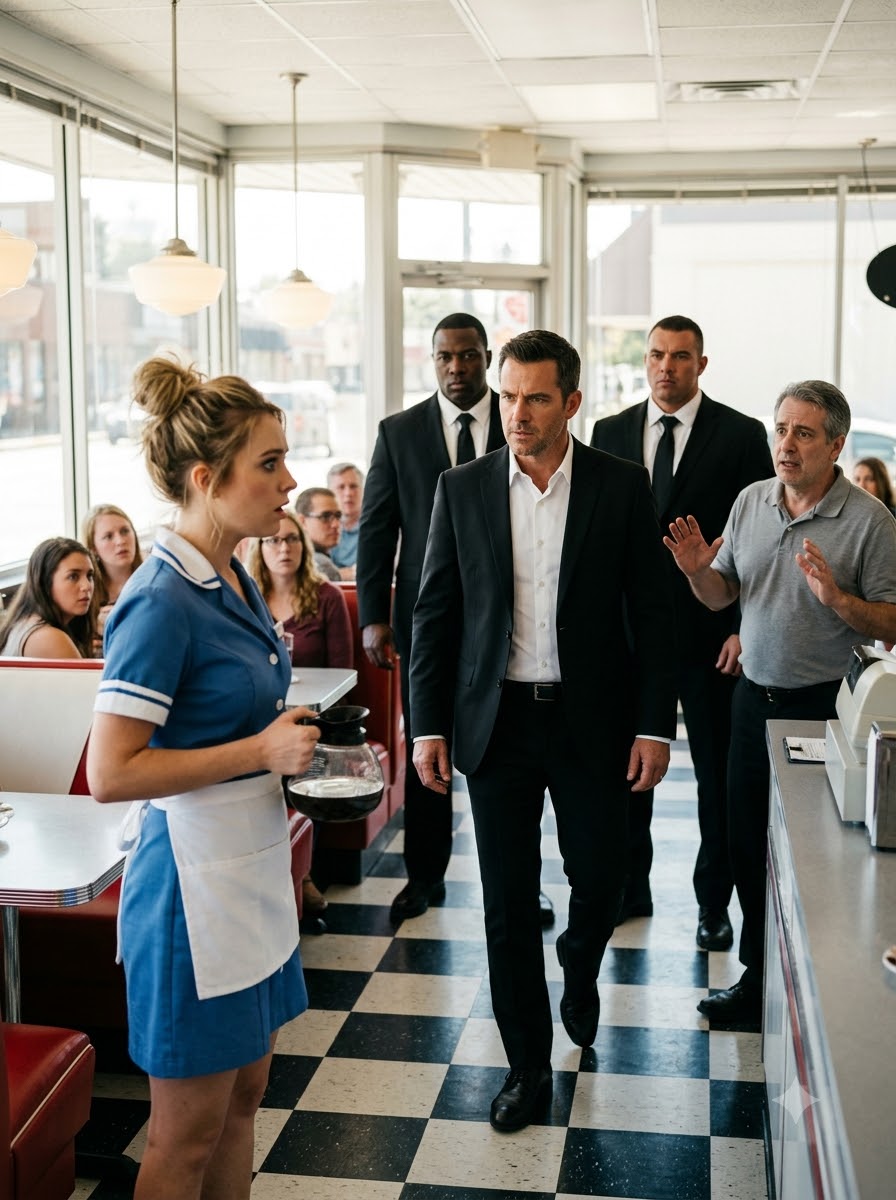
A polished black SUV stopped outside.
Two men in dark suits stepped onto the sidewalk.
They scanned the entrance, the windows, and the surrounding street with the alertness of professional security guards.
A third man opened the rear passenger door.
And a tall, distinguished man in a perfectly tailored black suit stepped out.
He looked to be in his mid-forties.
His dark hair was neatly styled, his expression serious, and his movements carried the quiet confidence of someone accustomed to entering rooms where everyone already knew his name.
Rick rushed forward so quickly he nearly stumbled over the entrance mat.
“Good morning, sir! Welcome to Waverly Diner. How may we help you?”
The stranger barely glanced at him.
His eyes traveled across the restaurant.
Past the customers.
Past the counter.
Past Dany, who stood frozen with a coffee pot in her hand.
Then his gaze stopped on me.
He spoke in a calm, unmistakably authoritative voice.
“I’m looking for the person who’s been helping my daughter.”
Nobody moved.
Rick blinked.
“Your daughter, sir?”
The man nodded.
“Ten years old. Yellow jacket. She’s been coming here for breakfast.”
My heart began pounding.
I slowly set down the coffee pitcher.
“That’s me,” I said. “I’ve been serving her.”
The stranger studied me.
And before I could say anything else, Rick stepped between us with an enormous smile.
“Mr. Fraser! I can assure you our establishment always welcomes children. In fact, I personally instructed Miss Sullivan to take special care of your daughter.”
Fraser.
Nathan Fraser.
I recognized the name immediately.
A billionaire businessman whose technology and infrastructure companies had made headlines across the country.
The man standing in front of me was one of the wealthiest people in the state.
And he was the father of the little girl I had been feeding for two weeks.
Nathan turned toward Rick.
“Really?”
Rick nodded eagerly.
“Absolutely, sir.”
Nathan’s expression hardened.
“Then perhaps you can explain why my daughter came home crying yesterday.”
Rick’s smile disappeared.
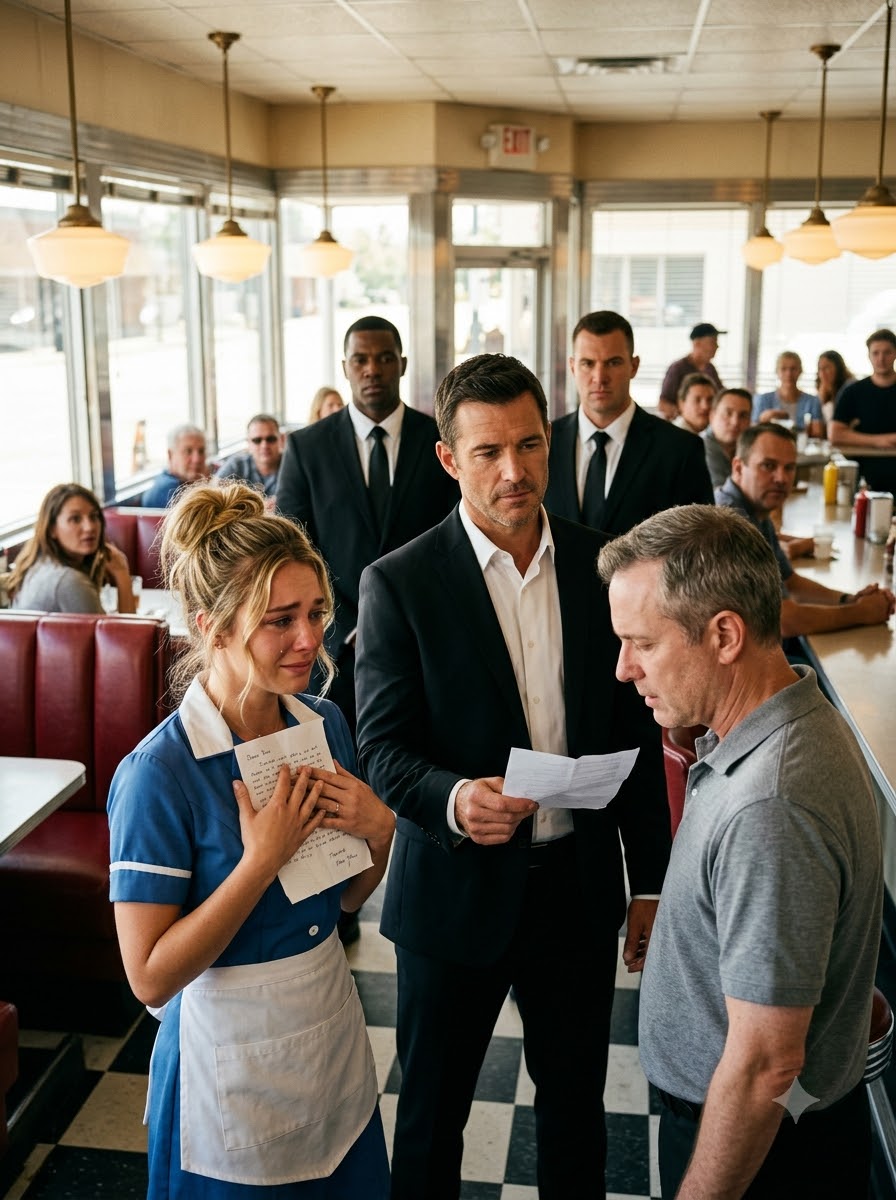
Nathan reached into his jacket and removed a folded sheet of paper.
He opened it slowly.
I recognized the document immediately.
It was my disciplinary warning.
The same warning Rick had forced me to sign.
Nathan looked directly at him.
“Tell me, Mr. Rick,” he said quietly, “why was the woman who fed my daughter punished for showing her kindness?”
And suddenly, the man who had humiliated me in front of thirty customers could not find a single word to say.
PART 2: The Man Who Came Looking for Me
The silence inside Waverly Diner was almost unbearable.
Rick stood in front of Nathan Fraser with his mouth slightly open, desperately searching for an explanation.
A few hours earlier, he had been the loudest man in the restaurant.
Now he could barely speak.
“Mr. Fraser,” he began, “there are certain policies we have to enforce—”
Nathan raised the warning notice.
“Who printed this?”
Rick swallowed.
“Well, as manager, I’m responsible for maintaining—”
“Who printed it?”
“I did.”
Nathan nodded once.
“And you gave it to Miss Sullivan yesterday?”
“Yes, but—”
“After she fed my daughter?”
Rick looked toward me.
I didn’t move.
“Yes,” he finally admitted.
Nathan folded the paper carefully.
“My daughter has been coming here every morning for two weeks. She has been paying for her breakfast with money given to her by her grandfather.”
Rick shifted uncomfortably.
“She was repeatedly short on payment, sir.”
“Because she is ten years old,” Nathan replied. “And because she has been worried sick about her mother.”
A murmur moved through the diner.
Nathan continued.
“This woman covered the difference herself. She bought my daughter milk. She made sure a frightened little girl had something warm to eat before school.”
His eyes narrowed.
“And your response was to humiliate her publicly.”
Rick’s face turned pale.
“I didn’t know whose daughter she was.”
The words escaped before he could stop them.
Nathan stared at him.
For a moment, I thought he might shout.
Instead, he spoke even more quietly.
“Would it have been acceptable if she were someone else’s daughter?”
Rick lowered his head.
No one laughed.
No one moved.
Even Dany had put away her phone.
Nathan glanced toward one of his security guards, who gave a slight nod.
“My team arrived before I did,” Nathan said. “They heard your employees discussing yesterday’s incident. I know exactly what happened.”
Rick attempted another smile.
“Perhaps we can discuss this privately, Mr. Fraser.”
“We can discuss your conduct with the owner,” Nathan replied. “I know her personally.”
Rick’s expression changed again.
Nathan turned toward me.
“Miss Sullivan, may we speak somewhere quiet?”
I nodded.
“Of course.”
We walked to the far corner booth.
The same booth where the little girl had sat every morning.
The same booth where she had counted her coins and watched the entrance.
Nathan sat across from me.
For a moment, he looked at the empty seat beside the window.
Then he said, “Her name is Ivy.”
“I didn’t know that.”
“I know.”
He rested his hands on the table.
“Ivy told me about you three days ago. I wanted to come sooner, but things have been complicated.”
I waited.
He took a slow breath.
“My wife has been in the hospital for six weeks.”
My heart tightened.
“I’m so sorry.”
“She’s recovering now,” he said. “But for a while, we didn’t know how things would turn out.”
He looked toward the window.
“I’ve been traveling between hospitals, specialists, and business obligations. My wife’s mother was supposed to help care for Ivy, but that arrangement became difficult.”
He paused.
“So Ivy stayed with her grandfather.”
“Your wife’s father?”
Nathan nodded.
“He loves her very much. But he’s elderly, and he didn’t fully understand her daily routine. He gave her money for food, and she started finding her own breakfast.”
I thought about the yellow jacket.
The backpack.
The way she always looked toward the door.
“She seemed frightened,” I admitted.
Nathan looked at me.
“How?”
“She watched the entrance constantly. Even while she was eating.”
He lowered his eyes.
“She’s been afraid something will happen to her mother while she’s away.”
My throat tightened.
“She never told me.”
“She didn’t want anyone to worry about her.”
He gave a sad smile.
“She’s very good at pretending she’s fine.”
I understood that more than I wanted to.
Nathan continued.
“She told me about this diner because she wanted me to know someone had been kind to her.”
I looked down at my hands.
“She didn’t have to do that.”
“She said you never embarrassed her when she couldn’t count the money correctly.”
I smiled faintly.
“She tried so hard to get it right.”
“She also told me you gave her milk.”
“Growing bones need calcium.”
Nathan looked at me.
For the first time since entering the diner, he smiled.
“Yes. She repeated those exact words.”
A warmth spread through my chest.
I had said that casually, without thinking.
I hadn’t imagined she would remember.
Nathan leaned forward.
“Miss Sullivan, can I ask you something personal?”
“Yes.”
“Why are you working here while attending night school?”
I blinked.
“How did you know about school?”
“My security team reviewed the basic employment information available to them. I hope you don’t mind.”
I hesitated.
“I’m studying social work.”
“What kind of work do you hope to do?”
“I want to help children in foster care.”
Nathan studied me.
“Why?”
I took a breath.
“Because I was one of them.”
His expression softened.
I told him about entering foster care when I was eight.
About the uncertainty.
The unfamiliar homes.
The fear of being a burden.
About my aunt taking me in and eventually adopting me.
“She gave me a real home,” I said. “But I remember what came before.”
I looked toward the empty place where Ivy usually sat.
“I remember being a child who couldn’t control what was happening around her. I remember adults talking about me instead of talking to me.”
My voice trembled slightly.
“I want to become the kind of adult who listens.”
Nathan remained silent for several seconds.
Then he asked, “How much tuition do you have left?”
I looked at him.
“What?”
“Your degree. How much is remaining?”
“I have a partial grant and a payment plan.”
“How much?”
I told him.
He nodded.
“I’d like to pay it.”
I stared at him.
“I’m sorry?”
“Your remaining tuition. All of it.”
My mouth opened, but nothing came out.
Nathan continued before I could object.
“This isn’t charity, Miss Sullivan.”
“It feels like an enormous gift.”
“Then let me explain why I’m offering it.”
He leaned back.
“My daughter has been through one of the most frightening periods of her life. I couldn’t always be beside her. And while I was trying to solve everything from hospital rooms and conference calls, you were quietly making sure she had breakfast.”
I felt tears gathering.
“You made her feel safe,” he said. “You gave her kindness without asking who her father was or whether she could repay you.”
He looked directly into my eyes.
“That matters more to me than you can imagine.”
I shook my head.
“I didn’t do it for money.”
“I know.”
“Then you don’t owe me anything.”
Nathan smiled gently.
“Perhaps not. But I know the value of investing in someone who wants to help children.”
I looked away.
For years, I had balanced classes, shifts, rent, and tuition payments.
I had calculated every expense.
Skipped meals.
Turned down invitations.
Wondered whether I would ever finish my degree.
And now a stranger was offering to remove the largest obstacle between me and the future I wanted.
All because I had bought a little girl breakfast.
“Mr. Fraser,” I whispered, “I don’t know what to say.”
“Then don’t say anything yet. Speak with your school. Make sure you’re comfortable with the arrangement.”
He reached into his jacket again.
This time, he removed a smaller folded piece of paper.
“Ivy asked me to give you this.”
He placed it in front of me.
The handwriting was large and slightly uneven.
I unfolded it carefully.
Dear Miss who gives me milk,
Thank you for my breakfasts. I counted wrong because I was worried about Mom and I’m sorry I couldn’t pay right. I told my dad about you. He’s good at saying thank you better than me. Thank you for not making it a big thing. I knew you weren’t going to say anything mean even though I was waiting to see if you would. You didn’t. That matters.
From Ivy
P.S. I know you got in trouble. I’m sorry about that. You shouldn’t have.
I read the letter twice.
Then I placed it on the table because my hands had started shaking.
I knew you weren’t going to say anything mean even though I was waiting to see if you would.
Those words struck something deep inside me.
I remembered being eight years old.
Sitting in unfamiliar living rooms.
Waiting to discover whether the adults around me would be kind.
I remembered testing every smile.
Every promise.
Every invitation.
Because when kindness has been unpredictable, even a gentle voice can feel like something you have to verify.
I wiped my cheeks.
“Is Ivy okay now?”
Nathan nodded.
“She’s visiting her mother today. My wife is well enough to have her with her for a while.”
“I’m glad.”
“She wanted to come here herself, but I told her I’d handle it.”
I smiled through my tears.
“She’s a wonderful little girl.”
“Yes,” Nathan said softly. “She is.”
He stood, and I stood with him.
He extended his hand.
“Thank you, Miss Sullivan.”
I shook it.
“Please call me Kate.”
“Kate,” he repeated. “My daughter is not easily impressed.”
He paused.
“She was impressed.”
For a moment, neither of us spoke.
Then he added, “I’ll have my office contact you about the tuition. And I’ll be speaking with the owner about how employees are treated here.”
“You don’t have to do that.”
“I know.”
His expression became serious again.
“But kindness should never be something a person gets punished for.”
He walked toward the entrance.
His security guards followed.
And just before leaving, Nathan stopped beside Rick.
“I suggest you consider what kind of manager you want to be,” he said.
Rick stood motionless.
The door closed behind Nathan Fraser.
The diner remained quiet.
Then someone near the counter began clapping.
Another customer joined.
Then another.
I looked around in disbelief.
People were smiling at me.
A woman near the window wiped her eyes.
An elderly man raised his coffee cup in my direction.
But I wasn’t thinking about their applause.
I was thinking about Ivy.
And the small letter in my hand.
I returned to work.
I refilled coffee.
Carried plates.
Cleared tables.
And finished the shift I had started.
Rick spent the rest of the morning locked in his office.
Dany avoided my eyes.
For the first time in eighteen months, no one shouted at me for moving too slowly.
When my shift ended, I sat alone in the break room and read Ivy’s letter again.
Then my phone vibrated.
An unfamiliar number appeared.
I opened the message.
This is Ivy. Dad let me use his phone. Mom is doing better today. She ate lunch. I told her about you. She said you sound like someone good. She’s right. — Ivy
I smiled.
Then I typed a reply.
I’m glad your mom is doing better. Tell her she raised someone good too.
Three dots appeared.
A new message arrived.
she says thank you and also she wants to know your name because she doesn’t want to just call you “the lady at the diner”
I laughed softly.
Sullivan, I typed. But you can call me Kate.
A moment later:
ok Kate. thank you for the egg sandwiches. I’ll come back sometime when I can pay right.
My eyes filled again.
I typed carefully.
You always paid right. The amount was just occasionally collaborative.
There was a longer pause.
Then Ivy replied.
dad says that’s a good way to put it. he also says he’s going to use that word in a meeting and see if anyone notices.
I laughed out loud.
For the first time in weeks, I felt something unfamiliar.
Hope.
But just as I slipped the phone into my pocket, the break room door opened.
Rick stood in the doorway.
His expression was nothing like the anger he had shown the previous morning.
“Kate,” he said stiffly. “The owner wants to speak with you.”
I stood slowly.
“About what?”
Rick glanced toward the front of the diner.
“About what happens next.”
PART 3: The Kindness That Changed Everything
For one terrible second, I thought I was about to lose my job.
Even after everything Nathan Fraser had said, I knew how quickly managers could twist a situation.
Rick had spent eighteen months reminding me that I was replaceable.
I followed him toward the front of the diner, still clutching Ivy’s letter.
A woman in her late fifties stood near the register.
I recognized her immediately.
Mrs. Eleanor Whitcomb.
The owner of Waverly Diner.
She rarely visited during breakfast service, but every employee knew her name.
She wore a simple navy coat and carried a leather handbag.
When she saw me, she smiled gently.
“Kate Sullivan?”
“Yes, ma’am.”
“Would you sit with me for a moment?”
We took a booth near the window.
Rick remained standing beside the counter.
Mrs. Whitcomb waited until we were seated before speaking.
“Nathan Fraser called me this morning.”
I nodded.
“He told me about his daughter.”
My fingers tightened around the letter.
“He also told me what happened yesterday.”
I looked down.
“Mrs. Whitcomb, I know there are rules about discounts, but I paid the difference myself. I never intended to—”
She raised her hand.
“Kate, I’m not here to punish you.”
I looked up.
She sighed.
“I’m here because I owe you an apology.”
I stared at her.
“For what?”
“For allowing an employee to be publicly humiliated in a business with my name on it.”
Across the diner, Rick shifted uncomfortably.
Mrs. Whitcomb continued.
“I spoke with several staff members. I reviewed the warning notice. And I learned this wasn’t the first time someone had been treated that way.”
I didn’t answer.
I didn’t need to.
She looked toward Rick.
“Effective immediately, Mr. Rick will no longer supervise the breakfast team while we conduct a formal review of his management practices.”
Rick opened his mouth.
“Eleanor, I think this is being blown out of proportion—”
“Rick,” she said firmly, “we will discuss this in my office.”
He fell silent.
Then she turned back to me.
“The warning notice has been removed from your employment record.”
My eyes widened.
“Really?”
“Yes.”
I let out a shaky breath.
“Thank you.”
Mrs. Whitcomb studied me for a moment.
“Why didn’t you tell me what was happening?”
I looked toward the kitchen.
“Because I needed the job.”
Her expression changed.
“I see.”
I swallowed.
“I didn’t want to cause trouble. I just wanted to make sure the little girl had breakfast.”
Mrs. Whitcomb reached across the table and touched my hand.
“That’s exactly the kind of person I want working here.”
For a moment, I couldn’t speak.
She continued.
“We’re going to review our policies so employees can discreetly assist customers facing temporary difficulties. There will be clear procedures, and no one will be expected to pay out of their own wages.”
I smiled.
“That would mean a lot.”
“And Kate?”
“Yes?”
“Please don’t ever believe your kindness made you a bad employee.”
I lowered my eyes.
Because for eighteen months, Rick had made me feel that way.
Too slow.
Too soft.
Too emotional.
Too willing to help people who couldn’t give anything back.
Now the owner of the diner was telling me that the very thing he criticized was something worth protecting.
After she left, I stood behind the counter for several minutes, letting the morning settle around me.
The diner looked exactly the same.
The red booths.
The silver coffee pots.
The chalkboard specials.
The draft beneath the emergency exit.
But something had changed.
I no longer felt quite so small inside it.
That evening, I contacted my college’s financial aid office.
Nathan Fraser’s office had already reached out.
They explained that he wanted to cover my remaining tuition through a formal educational sponsorship, with payments made directly to the school.
I asked questions.
A lot of them.
I wanted to understand the terms.
I wanted to make sure there were no obligations hidden behind the generosity.
There weren’t.
Nathan had asked for only one thing.
That I finish my degree and pursue the work I cared about.
When the financial aid counselor confirmed the arrangement, I sat at my kitchen table and cried.
Not loudly.
Not dramatically.
Just quietly, with my face in my hands.
For so long, I had been afraid that one unexpected bill would end my education.
Now I could finally imagine graduation without that fear sitting beside me.
Over the following weeks, life continued.
I still worked breakfast shifts.
I still attended evening classes.
I still came home tired.
But I began sleeping better.
Mrs. Whitcomb hired a new breakfast supervisor, a calm woman named Patricia who believed employees worked better when they weren’t afraid.
Rick eventually left the diner after the review concluded.
Dany became noticeably quieter.
And Waverly introduced a small community meal program funded through voluntary donations and the restaurant’s own budget.
Customers could contribute toward meals for people who needed them.
No public announcements.
No embarrassing questions.
Just food.
One morning, an elderly man quietly asked whether he could pay for an extra breakfast.
Patricia smiled.
“Of course.”
He placed a ten-dollar bill beside the register.
“For someone who needs it.”
I thought of Ivy.
And smiled.
A few weeks later, I received a photograph from Nathan.
Ivy was standing beside her mother in a hospital garden.
Her mother looked pale but happy, seated in a wheelchair with a blanket across her knees.
Ivy wore her yellow jacket.
But this time, she wasn’t clutching a backpack.
She was smiling.
A message accompanied the picture.
She’s improving every day. Ivy insisted you should see this. Thank you again for being there when we couldn’t.
I looked at the photograph for a long time.
Then I placed it beside Ivy’s letter on my desk.
They reminded me why I was studying social work.
Not because I believed I could fix every problem.
But because sometimes a person didn’t need someone to fix their entire life.
Sometimes they needed one adult to notice.
One adult to listen.
One adult who didn’t make kindness feel like a debt.
As the months passed, Ivy occasionally returned to Waverly Diner with her father or grandfather.
The first time she came back, she walked through the door wearing the same yellow jacket.
I spotted her immediately.
“Ivy!”
Her face lit up.
“Kate!”
She hurried toward me and wrapped her arms around my waist.
I hugged her gently.
“Look at you,” I said. “You’re getting taller.”
She grinned.
“It’s the calcium.”
Nathan laughed behind her.
I looked at him.
“She remembered.”
“She remembers everything,” he replied.
I led them to the corner booth.
Ivy slid into her usual seat.
But something was different.
She no longer kept watching the entrance.
She looked at the menu.
At her father.
At me.
Then she announced, “I’d like an egg sandwich, please.”
I smiled.
“Coming right up.”
“And milk.”
“Of course.”
Nathan reached for his wallet.
I raised an eyebrow.
“Mr. Fraser, I think we can handle the payment without an international financial transaction.”
He laughed.
Ivy giggled.
And for a few moments, the diner felt like the warmest place in the world.
Nathan’s wife eventually recovered enough to return home.
Ivy went back to living with both parents, and her morning routine became more ordinary.
She still visited the diner occasionally.
But now she came because she wanted to.
Not because she had to find breakfast alone.
That difference meant everything.
I graduated two years later.
When I walked across the stage to receive my bachelor’s degree in social work, I looked toward the audience.
My aunt was there, crying into a tissue.
Patricia sat beside her.
Mrs. Whitcomb had brought flowers.
And several rows behind them sat Nathan Fraser with his wife and Ivy.
Ivy waved so enthusiastically that I nearly laughed while accepting my diploma.
After the ceremony, she ran toward me.
“Kate! You did it!”
I knelt to hug her.
“I did.”
She looked at my graduation gown.
“Does this mean you’re going to help kids now?”
I smiled.
“That’s the plan.”
She considered this carefully.
“Good. Because you’re really good at it.”
I swallowed.
“Thank you, sweetheart.”
Nathan approached and shook my hand.
“Congratulations.”
“Thank you for making this possible.”
He shook his head.
“I helped with the tuition. You did the work.”
His wife stepped forward.
She had kind eyes and a warm smile.
“I’ve wanted to meet you properly for a long time,” she said.
I smiled.
“I’m glad you’re doing better.”
She took my hand.
“Ivy told me everything.”
I glanced at the little girl.
Her mother continued.
“She told me about the milk. The sandwiches. How you never made her feel embarrassed.”
Her voice softened.
“When I was in the hospital, I worried constantly about what she was going through. Knowing someone had treated her gently when she needed it most meant more than I can explain.”
My eyes filled.
“I didn’t do very much.”
“Yes,” she replied. “You did.”
She squeezed my hand.
“You made my daughter feel safe.”
That was when I began crying.
Not because of the diploma.
Not because of the tuition.
But because I remembered the little girl who had once sat alone in a drafty booth, counting coins while watching the door.
And I realized how much had changed.
A month after graduation, I began working with a nonprofit organization that supported children and families navigating foster care.
My days became filled with case meetings, home visits, paperwork, and difficult conversations.
Some days were exhausting.
Some cases stayed with me long after I returned home.
I quickly learned that good intentions were not enough.
Children needed reliable services.
Families needed practical support.
And social workers needed patience, training, and the humility to understand that no one could solve every problem alone.
But every time the work felt overwhelming, I remembered Ivy.
I remembered the yellow jacket.
And I remembered the simple question that had started everything.
Would I help a child who couldn’t pay for breakfast?
The answer had seemed obvious then.
It still did.
One afternoon, nearly a year into my new job, I returned to Waverly Diner.
The lunch rush had ended.
Patricia was behind the counter.
Mrs. Whitcomb sat near the window reviewing paperwork.
I ordered coffee and an egg sandwich.
Then I walked toward the corner booth.
The draft was still there.
The seat was still slightly worn.
The view of the front door hadn’t changed.
I sat down and took Ivy’s letter from my handbag.
The paper had softened at the folds.
I had read it so many times that I knew every word.
I knew you weren’t going to say anything mean even though I was waiting to see if you would.
I traced the handwriting with my finger.
When I was eight, I had spent so much time waiting for adults to disappoint me.
I had believed kindness was temporary.
That safety could disappear without warning.
That asking for help might make someone angry.
My aunt had taught me otherwise.
And without realizing it, I had passed a small piece of that lesson to Ivy.
Patricia approached with my coffee.
“Thinking about the old days?”
I smiled.
“A little.”
She set the cup down.
“You know, people still talk about what happened here.”
I laughed softly.
“I wish they wouldn’t.”
“Not the embarrassing part,” she said. “The good part.”
I looked up.
She gestured toward the small notice beside the register.
It explained the community meal program.
“Do you know how many meals have been covered through that program?”
I shook my head.
“More than eight hundred.”
I stared at her.
“Eight hundred?”
She nodded.
“Some are for children. Some are for older customers. Some are for people who’ve simply had a difficult week.”
I looked toward the notice.
“And nobody has to explain themselves?”
“Not unless they want to.”
My throat tightened.
Patricia smiled.
“People saw what happened to you, Kate. They decided this place should do better.”
I looked down at the letter.
I had never imagined that two dollars could lead to something like that.
Two dollars.
An egg sandwich.
A carton of milk.
And a decision not to turn away.
Later that evening, I visited my aunt.
We sat together on her porch while the sun dropped behind the trees.
I told her about the meal program.
About my work.
About Ivy.
She listened with the same patience she had shown me when I was a frightened little girl sitting in her kitchen for the first time.
Finally, she smiled.
“Do you remember what I told you when you first came to live with me?”
I thought for a moment.
“You told me I didn’t have to earn my place at the table.”
She nodded.
“That’s right.”
I looked toward the garden.
“I think I finally understand how much that mattered.”
My aunt reached for my hand.
“You understood it long before you could explain it.”
I smiled.
She squeezed my fingers.
“And now you’re helping other children understand it too.”
For a while, we sat in comfortable silence.
Then my phone vibrated.
A message from Ivy.
She had started middle school and was very proud of the fact that she no longer needed her oversized yellow jacket.
Kate, guess what? There’s a new girl in my class and she eats lunch alone. I asked her to sit with me today. She said yes. Dad says you’d be proud.
I read the message aloud.
My aunt smiled.
“What are you going to say?”
I typed slowly.
I am proud of you, Ivy. More than you know.
A reply arrived almost immediately.
I just remembered how you were nice to me when I was alone.
I stared at the screen.
And there it was.
The thing I had been trying to understand since that morning in the diner.
Kindness didn’t always end with the person who received it.
Sometimes it traveled.
From one frightened child to another.
From one ordinary breakfast to hundreds of meals.
From one adult who chose compassion to a little girl who learned how to offer it herself.
I had spent years believing I needed a degree, a professional title, and enough experience before I could make a meaningful difference.
Those things mattered.
But the first step had happened long before graduation.
It had happened in a diner.
With two dollars.
And a hungry little girl.
That night, I returned home and placed Ivy’s letter in a frame beside my diploma.
I stood looking at them for a long time.
One represented years of hard work.
The other represented a moment when I had simply followed my heart.
Both had changed my life.
I thought about Rick shouting in front of the customers.
About Dany recording my humiliation.
About the warning notice folded inside my apron.
And about the morning Nathan Fraser walked through the entrance with his security guards, looking for the person who had helped his daughter.
At the time, I thought he had come to change my life.
In some ways, he had.
He had helped me finish school.
He had defended me when I couldn’t defend myself without risking my job.
He had reminded me that compassion had value even when the world treated it as weakness.
But I understood something else now.
My life had begun changing before Nathan ever arrived.
It changed the first morning I looked at a little girl counting coins and decided that her hunger mattered more than the missing money.
I switched off the lamp.
Before leaving the room, I glanced once more at Ivy’s framed letter.
I smiled.
Because the greatest reward had never been Nathan Fraser’s wealth.
It had never been Rick’s embarrassment.
It had never been the applause of strangers.
It was knowing that a frightened little girl had walked into a diner expecting someone to be unkind.
And instead, she found someone who made her feel safe.
That was enough.
It had always been enough.
THE END.
