

Part 1: The Crooked Arch
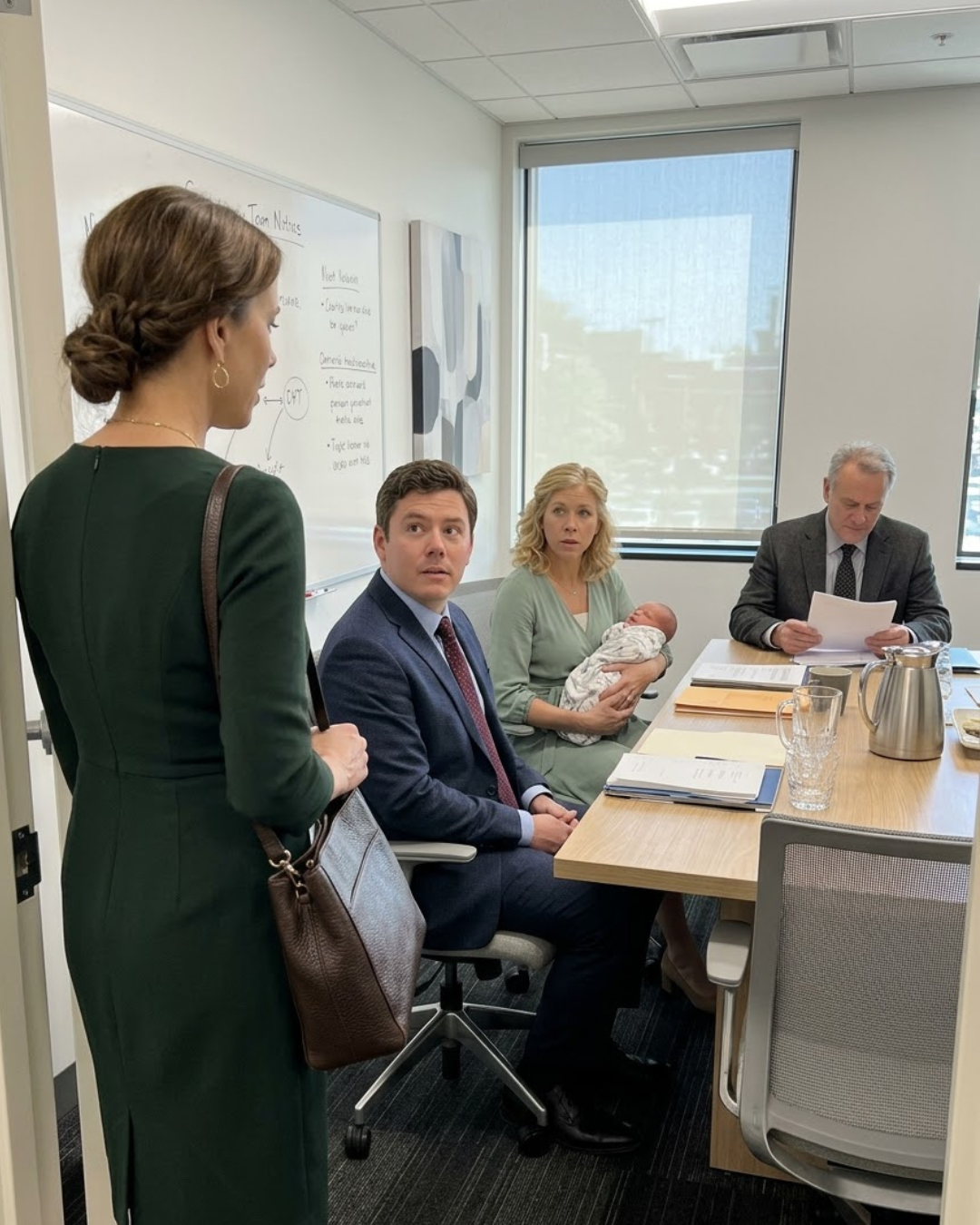
Two weeks after Margaret Caldwell died, I walked into the conference room at Harlan and Pierce in downtown St. Louis wearing a black dress I had already worn to too many funerals and carrying the kind of fatigue that settles behind your eyes after a loss, making every room seem painfully bright.
The conference room was aggressively ordinary.
Dull carpeting. Harsh fluorescent lights. A tray of untouched coffee that had already gone lukewarm. Behind the head of the table hung a framed print of the Gateway Arch, tilted slightly to one side, as though even the decorations had stopped trying to maintain appearances.
I expected grief and paperwork.
I expected the tedious machinery of probate, the process of dividing a person’s entire existence into assets, beneficiaries, and legal provisions.
I expected to hear formal language describing a woman who had been, despite her reserved nature, more alive than almost anyone I knew.
What I did not expect was to find my husband sitting beside his mistress.
Or to see their newborn son in her arms.
Ethan occupied the far end of the conference table, one arm draped across the chair beside him. He sat with the comfortable arrogance of a man convinced that the room belonged to him and everyone else was merely waiting to acknowledge it.
Beside him sat Lauren Whitaker.
For almost a year, I had tried not to make Lauren real in my mind.
As long as she remained a suspicion, an unfamiliar perfume, a receipt from a boutique hotel in Clayton, I could pretend my marriage was still standing. I could convince myself there was something left to save.
She wore pale blue, with soft curls framing her face and pearls at her ears. She looked rested, almost serene.
In her arms was a newborn wrapped in a gray knitted blanket.
The baby moved, opening one tiny fist against her chest.
My mind seemed to stop between seeing him and understanding what his presence meant.
“Why did you bring a baby?” I asked.
It was an absurd question, but it was the only one I could manage.
Lauren answered with astonishing composure.
“He’s Ethan’s son.”
She said it as casually as someone explaining where to park.
I turned toward my husband.
Ethan offered no denial.
No apology.
Not even the decency to look ashamed.
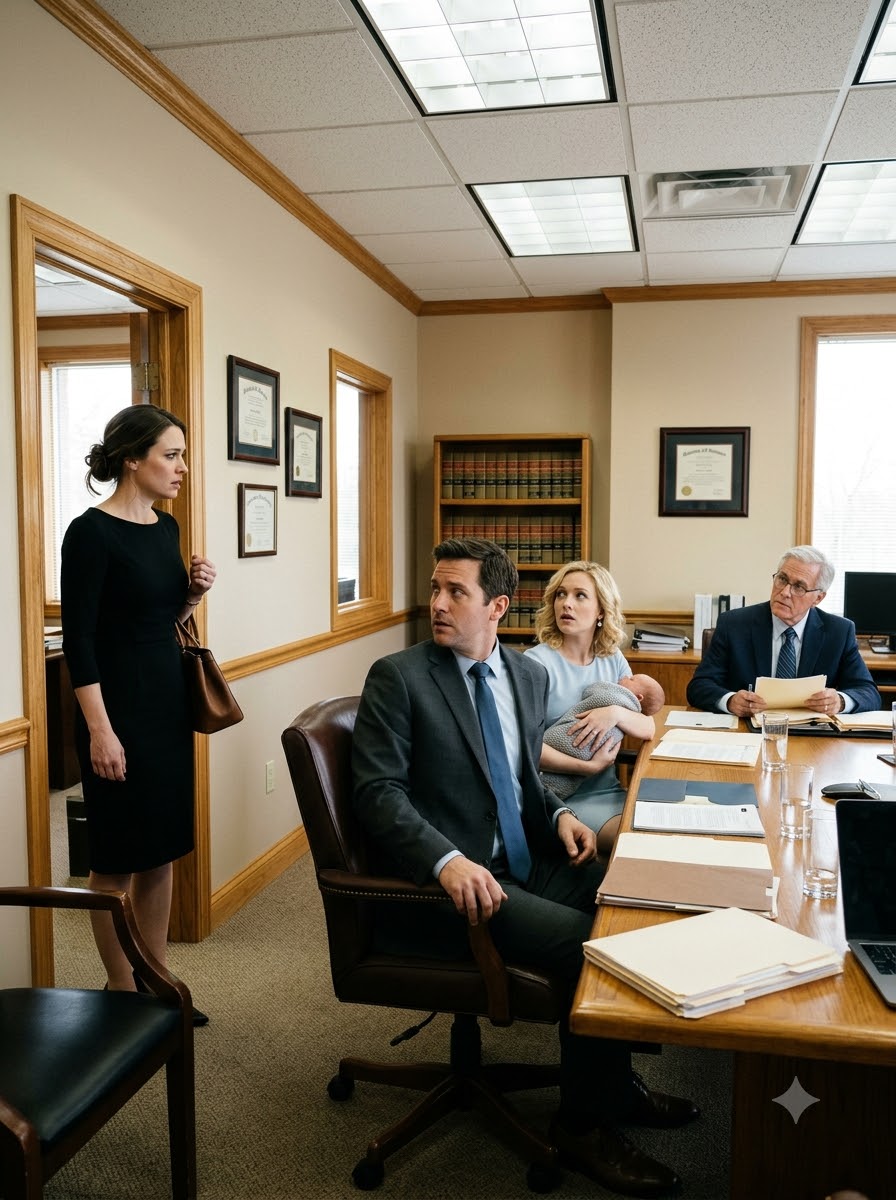
Instead, he regarded me with the same detached irritation he had worn for months whenever my questions threatened to inconvenience him.
“We didn’t want you hearing it from someone else,” he said.
I laughed once.
Not because anything was funny.
Because crying in front of them would have felt like handing them one final victory.
That was when James Harlan entered the room.
Margaret’s longtime attorney was a silver-haired man in a dark suit, with careful hands and the deliberate movements of someone who had spent decades handling documents capable of changing people’s lives.
He stopped when he saw the baby.
His surprise lasted less than a second, but it was enough to tell me he had not expected this particular display either.
Then he recovered.
“Margaret specifically requested that everyone be present,” he said.
He glanced toward Lauren.
“Including Miss Whitaker.”
Including.
That single word struck harder than Ethan’s announcement.
Margaret had known.
And suddenly, I began remembering everything I had misunderstood about my mother-in-law.
Margaret Caldwell and I had never enjoyed an easy relationship.
She was elegant, controlled, and almost ruthlessly composed. She possessed the sort of intelligence that did not need to announce itself because she was always watching more closely than anyone realized.
When Ethan and I married, I mistook her reserve for disapproval.
She never openly insulted me.
Instead, she asked precise questions and allowed silences to stretch until I filled them with my own insecurity.
At family dinners, she noticed everything.
How someone held a fork.
How they answered an uncomfortable question.
Whether an apology came too quickly.
Whether a compliment sounded rehearsed.
I spent years believing she was judging me.
Only later did I understand that Margaret was not cold because she lacked feeling.
She was cautious because she distrusted weakness, especially weakness concealed beneath charm.
And Ethan possessed more charm than anyone I had ever met.
He was handsome, socially effortless, and blessed with the kind of confidence that encouraged people to assume there must be substance beneath it.
When we first met, he made me feel chosen.
At the time, I was young enough to mistake being selected for being genuinely understood.
After we married, I discovered he preferred admiration to intimacy.
He loved being supported.
Praised.
Protected from consequences.
What he did not love was being questioned.
During our first year, his emotional distance seemed temporary.
By the second, it had become part of our marriage.
By the third, I was constantly editing reality into something I could tolerate.
I adjusted the story I told myself about Ethan the way someone straightens a crooked picture frame, over and over, until eventually they stop noticing the tilt.
I noticed his late meetings.
His second phone.
The way he turned the screen facedown whenever I entered a room.
I noticed perfume that was not mine.
And how simple questions about his schedule could transform him from affectionate to furious in seconds.
Once, I discovered a boutique hotel receipt folded inside his blazer pocket.
He told me a client meeting had run late.
Then he accused me of embarrassing us both by acting suspicious.
He lied so confidently that I began feeling foolish for being hurt.
As though my pain proved I was unreasonable rather than that something was wrong.
Margaret saw more than I did.
Or perhaps she saw exactly the same things and simply refused to excuse them.
The previous autumn, she had undergone surgery.
Her recovery was slow, and she needed assistance with appointments, medication, and everyday tasks.
Ethan visited when it suited him.
Usually, he stayed less than an hour.
I was the one who drove Margaret to medical appointments, collected her prescriptions, organized her medication, and sat with her through afternoons when her large house became unbearably quiet.
I helped her sort years of paperwork at the dining table of her brick home in Ladue.
For hours, we worked beside one another without much conversation.
We were two women who had not yet decided whether to trust each other, but who had stopped pretending that every silence needed to be filled.
Gradually, something changed.
Margaret did not become affectionate overnight.
She became attentive.
She asked whether I was sleeping.
She noticed when I lost weight.
She noticed the exhaustion on my face that Ethan had ignored for months.
Sometimes, I brought her tea and she accepted it without comment.
Other afternoons, she told me pieces of her past.
Her marriage had been more practical than romantic, a partnership built around competence and responsibility.
She had helped build Caldwell Restoration alongside her husband, learning commercial property management by observing him and studying every document she could find.
Eventually, she understood the business as well as he did.
He never publicly acknowledged that.
And Margaret never demanded recognition.
After her husband died, she raised Ethan alone.
She spoke about the difficulty of being a mother who valued discipline while raising a son who discovered early that charm could excuse almost anything.
She had spent years watching Ethan substitute confidence for competence.
It was a painful realization she rarely expressed aloud.
One afternoon, while we were organizing medical documents, she looked at me over her reading glasses.
“Is Ethan making your life difficult?”
I lied.
Not because I believed Ethan was innocent.
Because admitting the truth would have meant acknowledging that my marriage might already be beyond repair.
Margaret said nothing.
She simply returned to the papers.
A few weeks later, I entered her kitchen and found her standing at the window.
She wore the expression of someone who had finally reached a decision.
She asked for James Harlan’s telephone number, although she already had it.
Then, almost casually, she asked whether Ethan was still managing certain vendor accounts for Caldwell Restoration.
I assumed she was reviewing estate matters.
I had no idea she was already investigating.
And I certainly did not know what she had discovered.
Back in the conference room, Harlan opened a thick folder.
He adjusted his glasses.
Then he began reading Margaret’s final instructions.
“To my daughter in law, Claire, if you are hearing this, then Ethan has finally shown you who he really is.”
Everything changed.
Ethan’s back went rigid.
Lauren’s composed smile faltered.
And I stopped breathing.
Harlan continued.
Margaret had written that if Ethan chose to reveal his betrayal publicly, I deserved to know what she had already done to ensure I would never again believe myself powerless.
Six months earlier, she had discovered repeated discrepancies in Caldwell Restoration’s financial records.
She had also caught Ethan in several lies that were too carefully constructed to dismiss.
So she retained independent legal counsel.
And a private investigative firm.
The investigators uncovered Lauren Whitaker.
An apartment on West Pine.
The pregnancy.
And money Ethan had been quietly diverting from company accounts to finance a second life.
Lauren turned toward Ethan so quickly that the newborn stirred in her arms.
But Harlan had not finished.
He read the next sentence.
Margaret had also discovered that Ethan forged my authorization on a line of credit connected to our marital property portfolio.
Copies of the documents were in Harlan’s possession.
I felt the blood drain from my face.
My husband had not merely betrayed our marriage.
He had used my identity.
Then Harlan read Margaret’s warning.
If Ethan interrupted the proceedings, challenged the evidence through intimidation, or attempted to threaten anyone present, Harlan was instructed to forward the forensic audit and supporting documents to Caldwell Restoration’s board and the St. Louis County district attorney.
Ethan sprang to his feet.
His chair scraped loudly against the carpet.
“This is absurd. She was medicated. She was confused.”
Harlan did not raise his voice.
Instead, he reached into the folder.
He removed a flash drive and placed it on the table.
Margaret had recorded a video statement on the same day she signed the amended estate documents.
The recording had been witnessed, notarized, and supported by medical certification of her capacity.
If Ethan wanted to challenge her competence, Harlan explained, he could do so through the courts.
Lauren stared at my husband.
“Forged?” she whispered.
It was the first genuinely frightened sound I had heard from her all morning.
Harlan turned another page.
And then he announced what Margaret had done with everything Ethan believed he would inherit.
Part 2: The Inheritance He Never Owned
Margaret had not simply rewritten her will.
She had reorganized her estate.
Her residence in Ladue.
Her investment accounts.
And her controlling fifty-one-percent voting interest in Caldwell Restoration.
All had been transferred into a protected trust naming me as the sole beneficiary, with immediate acting authority upon Margaret’s death.
I stared at Harlan.
For several seconds, I could not comprehend what he was saying.
I had walked into that room believing I was about to lose the last remnants of my marriage.
Instead, Margaret had entrusted me with the things she had spent her life building.
Harlan continued.
Ethan had been removed from every management role, effective that morning.
His inheritance consisted of one dollar and his father’s watch.
Margaret had specifically explained that the dollar was intentional.
She wanted there to be no possibility of mistaking his exclusion for an oversight.
The silence afterward was extraordinary.
It was not peaceful.
It was the ringing stillness that follows an explosion, when everyone is trying to understand what has just been destroyed.
For a year, I had felt like an unwanted obstacle in my own marriage.
Ethan had behaved as though I were temporary, someone he could eventually move aside while his new life with Lauren arranged itself around the family fortune.
But Margaret had spent her final months watching him.
Investigating him.
And quietly preparing consequences he never imagined.
Harlan unfolded another page.
This section was addressed directly to Ethan.
Margaret wrote that she had spent too many years excusing the selfishness of a handsome, well-spoken man who believed everything he wanted should be handed to him.
She had watched him mistake inheritance for entitlement.
And loyalty for stupidity.
Claire, she wrote, had demonstrated more integrity during one difficult year than Ethan had shown in forty.
If Ethan was sitting beside Lauren and their child when the letter was read, Margaret considered that fitting.
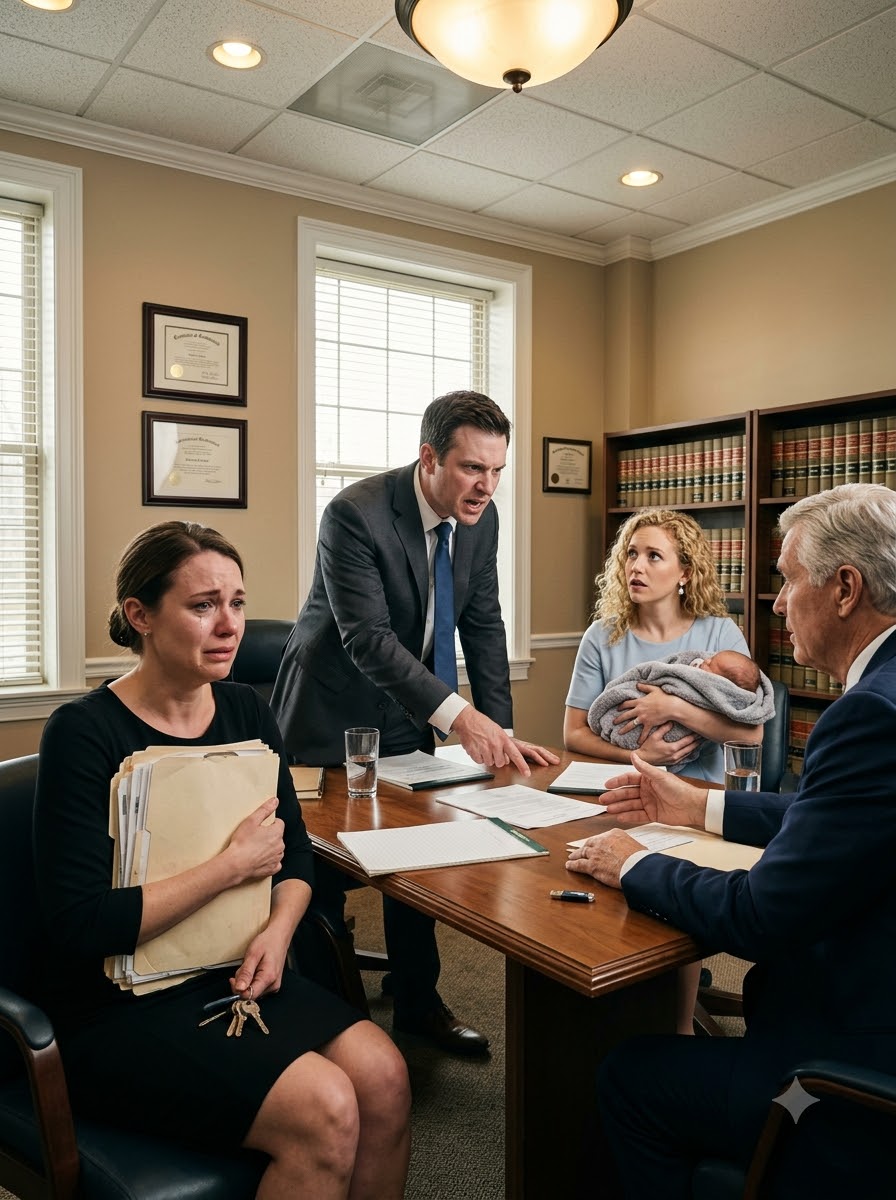
He had chosen to display his betrayal like a trophy.
She wanted witnesses present when he discovered the cost.
Lauren’s eyes filled with tears.
Not tears of sympathy for me.
Tears of panic.
She was discovering what I was discovering.
Ethan had lied to everyone.
To me about his affair.
To Margaret about the company.
To Lauren about the future he could provide.
The house, the wealth, the business, and the authority he had presumably promised her had never been his to offer.
And now they belonged to me.
Harlan slid a separate folder across the table.
My name appeared on its tab in Margaret’s elegant handwriting.
Inside were trust documents, deed records, corporate resolutions, account instructions, passwords, and a sealed envelope.
On the envelope, Margaret had written:
Open this alone.
A fresh key ring rested beneath the documents.
Attached was the address of the Ladue house.
There was also a locksmith authorization signed three days before Margaret died.
Ethan saw it.
And erupted.
He insisted I could not lock him out of his own house.
Harlan corrected him.
The property had never belonged to Ethan.
Margaret had refinanced and retitled it through the trust after discovering his attempts to use it as collateral.
If I wanted the locks changed, Harlan said, the work could be completed by noon.
For the first time in years, I looked at Ethan without feeling small.
His confidence had always seemed solid.
Now I realized how much of it depended on everyone accepting his authority without question.
Once that assumption disappeared, the rest of him seemed to collapse.
His anger looked frightened.
And fear was something he had never learned to conceal gracefully.
Lauren stood, holding the newborn against her shoulder.
“Did you tell me the truth about any of this?”
Ethan immediately began talking.
His mother had been vindictive.
Harlan was twisting her intentions.
The trust could be challenged.
Everything could still be resolved privately.
He spoke rapidly, as though enough words could rebuild what Margaret had dismantled.
Lauren stepped away.
Then stepped back again.
The baby began crying softly.
Watching her, I realized she had believed Ethan’s promises as completely as I once had.
Security escorted Ethan into the hallway when his voice grew too loud.
Before leaving, he looked at me.
His expression held anger, humiliation, fear, and something that almost resembled pleading.
It was the most honest expression I had seen on his face in months.
For the first time, he had encountered a boundary he could not charm his way around.
When everyone else left, Harlan sat beside me.
His professional composure softened.
He explained that Margaret had loved me in the only way she knew how.
Cautiously.
Belatedly.
But completely, once she decided I had earned her trust.
She regretted not telling me what she had discovered.
But she feared Ethan might destroy evidence or manipulate me into warning him before the necessary documents were finalized.
She wanted everything secured before he understood what was happening.
She had built the protection first.
Only then had she allowed the truth to emerge.
I took the envelope and drove to Margaret’s house alone.
The morning had begun with humiliation.
By the time I reached Ladue, I was feeling something far more complicated.
Relief mixed with grief.
Betrayal mixed with vindication.
And the strange disorientation of discovering that the person who had understood me best was someone I had spent years believing merely tolerated me.
I unlocked the front door.
The foyer smelled faintly of polished wood, old books, and the white roses Margaret always kept in the sitting room.
Sunlight entered through the transom window and stretched across the hardwood floor.
Everything was exactly as she had left it.
Her glasses rested beside a book in the sitting room.
A bookmark held the place she would never return to.
The dining table where we had sorted paperwork stood perfectly arranged.
I walked through the house slowly.
It felt less like visiting a property I had inherited and more like walking through the private thoughts of someone I had never fully understood.
Margaret had maintained order everywhere.
Not because she lacked warmth.
But because order had been her way of caring for the life inside those walls.
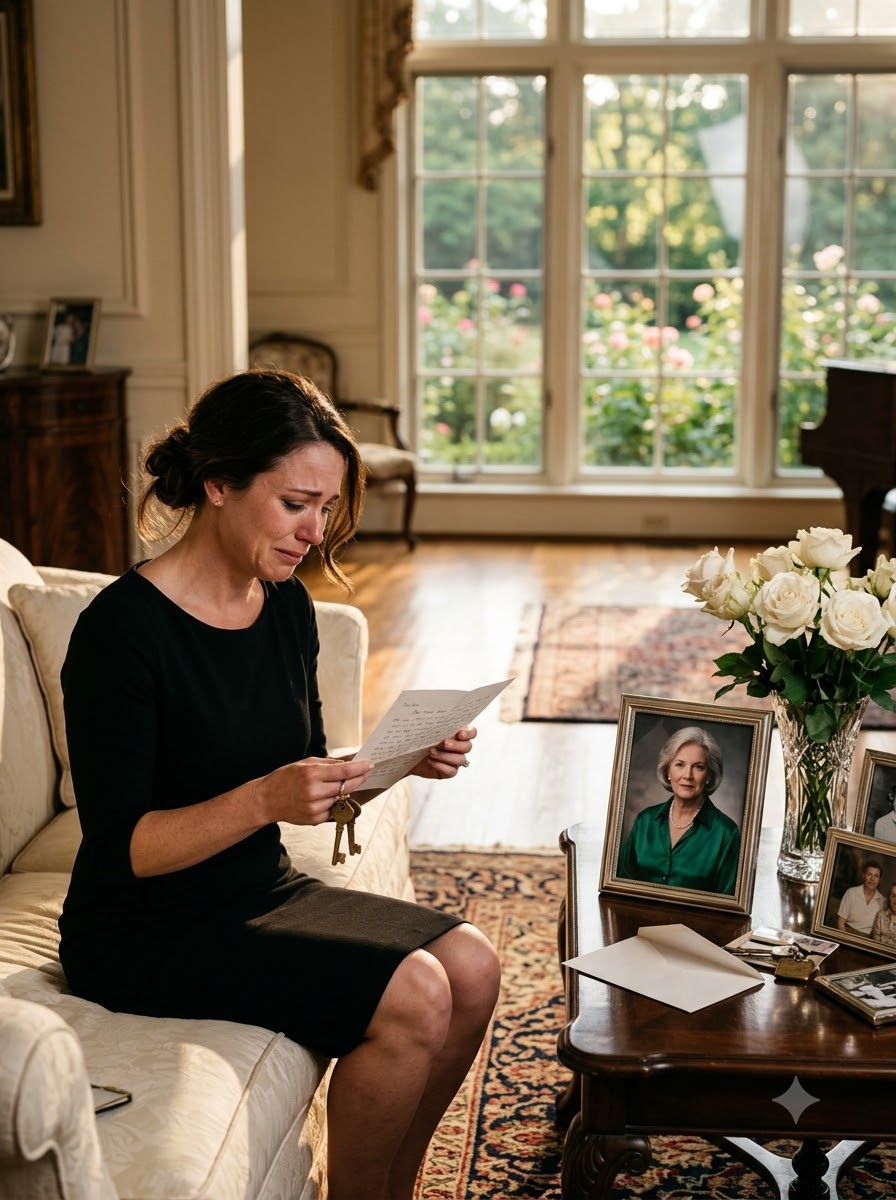
In the kitchen, I opened her letter.
Margaret apologized.
Not dramatically.
Not sentimentally.
She apologized with the precision that had defined her entire life.
She wrote that she had underestimated how much damage Ethan could cause before she was gone.
She admitted that reconciling her son’s behavior with the family she believed she had raised had been one of the hardest experiences of her life.
And she wrote that I had shown her more kindness during her illness than Ethan had shown her while she was healthy.
She had watched me endure months of cruelty without becoming cruel myself.
That, she explained, was why she trusted me.
The house was mine if I wanted it.
The company shares were mine if I chose to keep them.
Her only request was that I never again diminish myself to protect a man’s comfort.
I sat at her kitchen table and cried.
Not because Ethan had betrayed me.
I had been grieving that marriage for months.
I cried because the woman I thought had barely tolerated me had understood my pain more clearly than the man I married.
I cried because Margaret was gone.
Because I could never tell her that I finally understood.
Her silences had not always meant disapproval.
Sometimes they had meant she was listening.
Watching.
And deciding whom she could trust.
She had decided in my favor.
The realization was both heartbreaking and sustaining.
Within forty-eight hours, I filed for divorce.
Harlan recommended Patricia Song, an attorney experienced in complicated marital disputes and financial misconduct.
Patricia moved quickly.
She understood that once someone like Ethan realized his financial activities had been uncovered, evidence could disappear.
Caldwell Restoration’s board suspended Ethan pending an internal investigation.
Then the forensic audit was circulated.
What it revealed was worse than the isolated discrepancies Margaret had initially noticed.
There were shell vendor accounts.
Personal expenses charged to company cards.
Repeated transfers that appeared insignificant individually but collectively formed a systematic diversion of corporate funds.
Several transactions benefited Ethan.
Others were connected to Lauren.
Board members who had worked with Margaret for decades reviewed the findings.
They understood her judgment could be severe.
But never careless.
After the investigation, they voted Ethan out entirely.
The man who once believed he would inherit control of Caldwell Restoration no longer had a position in it.
Lawyers began calling.
So did people who had barely acknowledged me during the final months of my marriage.
Suddenly, they spoke with exaggerated politeness.
I recognized the change.
Power had shifted.
And people who had positioned themselves close to Ethan were attempting to reposition themselves without admitting why.
Lauren disappeared from his life faster than I expected.
I never learned whether shame or self-preservation drove her decision.
I heard she had moved in with her sister and was cooperating with separate legal counsel.
Ethan began calling me from unfamiliar numbers.
When I did not answer, he sent emails.
His messages moved through predictable stages.
Apology.
Anger.
Nostalgia.
Blame.
Then apology again.
He seemed unable to understand that his version of events was no longer the only one anyone believed.
I did not respond.
For years, I had waited for an explanation.
Now I understood that what I needed was an ending.
But as the divorce moved forward and the investigation into Caldwell Restoration deepened, I found myself returning again and again to Margaret’s letter.
One sentence remained with me.
Never again believe you are powerless.
I had inherited a house.
A controlling interest in a company.
And the ability to make decisions Ethan once believed would always belong to him.
Yet the most important thing Margaret left me was neither money nor property.
It was the knowledge that someone had watched me endure what Ethan did and had chosen to believe me.
And six weeks after the will reading, standing alone in Margaret’s garden, I finally understood why she had arranged for Lauren and the baby to be present that morning.
Part 3: The Woman Margaret Chose
It was early summer when I stood in Margaret’s garden with a pair of pruning shears in my hand.
The roses had begun blooming.
Margaret had maintained them with almost military discipline for decades, cutting away weak growth, removing damaged stems, and shaping each bush so that sunlight could reach the healthiest branches.
I remembered watching her work there during her recovery.
Even when she was tired, she refused to neglect the garden.
She had once told me that caring for something did not mean allowing everything to grow unchecked.
At the time, I thought she was talking about roses.
Now I was no longer certain.
The air smelled of damp earth and warm leaves.
Somewhere beyond the property, distant traffic hummed along the road.
Life continued outside the gates, indifferent to the upheaval that had transformed mine.
I cut one rose.
Then another.
The blades made a clean, decisive sound.
I imagined Margaret standing in the same place, tending these flowers while quietly preparing the legal and financial arrangements that would protect me after she was gone.
For weeks, I had been thinking about the will reading.
About Ethan arriving with Lauren and their newborn.
About the humiliation of discovering the affair had produced a child.
About Margaret’s letter.
And about the moment Harlan said she had specifically requested that everyone attend.
Including Lauren.
At first, I thought Margaret wanted Ethan embarrassed.
Perhaps she did.
But standing in the garden, I began to understand something deeper.
Margaret had not invited Lauren to humiliate me.
She had invited her to witness the truth.
Lauren needed to hear that Ethan had diverted company funds.
She needed to understand that the wealth he had promised was not his.
She needed to know that he had forged documents and used other people’s trust to finance his own ambitions.
And Ethan needed to hear those facts in a room where charm could no longer change the outcome.
Margaret had not arranged a spectacle simply to punish her son.
She had ensured that the truth could no longer be privately rewritten.
For years, Ethan had controlled what each woman knew.
He told me one story.
Lauren another.
His mother a third.
His colleagues whatever version made him appear most successful.
He maintained his position by keeping those stories separate.
Margaret brought everyone into the same room.
And allowed the documents to speak.
I carried the roses inside.
The house was quiet.
I placed them in the white vase Margaret had always used and arranged each stem carefully on the console table in the front hall.
One bloom at a time.
Turning them outward, exactly as I had watched her do.
When I finished, I stepped back.
For the first time since her death, the house felt less like a memorial.
It felt lived in.
I was beginning to understand that inheriting Margaret’s property did not mean preserving every room exactly as she had left it.
She had given me the right to decide what came next.
That included deciding what to keep.
What to change.
And what to leave behind.
The weeks after the will reading had been difficult.
The divorce proceedings required documents, meetings, financial disclosures, and conversations I wished I could avoid.
The company’s internal investigation was separate from my personal legal case, but Ethan’s misconduct affected both.
Patricia Song kept me focused.
She refused to let Ethan’s increasingly emotional messages distract us from the legal facts.
He had lied about the affair.
He had misrepresented his financial authority.
He had attempted to use property and corporate resources that did not belong to him.
And Margaret had taken lawful steps to protect her estate and the company she had helped build.
There was nothing romantic about the process.
No dramatic moment in which every wrong was instantly corrected.
Just paperwork.
Evidence.
Lawyers.
Decisions.
And the slow recognition that accountability often looks far less theatrical than the betrayal that made it necessary.
Some days, I was furious.
Other days, I missed the husband I thought I had married.
That was one of the most confusing parts.
I knew what Ethan had done.
I had seen the records.
I had heard Margaret’s letter.
I had watched Lauren recoil from him.
And still, sometimes, a memory surfaced without warning.
The way Ethan smiled when we first met.
The sound of his laugh at a dinner party.
A vacation photograph.
A quiet morning before everything began to unravel.
I had to remind myself that those moments could have been real without making the rest of our marriage healthy.
Love did not erase deception.
And happy memories did not require me to return to someone who had betrayed my trust.
Ethan continued attempting contact for a while.
Sometimes he sounded remorseful.
Sometimes furious.
Occasionally, he spoke as though the entire situation were a misunderstanding that could be resolved if I would simply sit down with him privately.
I never did.
Our attorneys handled the necessary communication.
Eventually, the calls became less frequent.
The emails stopped arriving every few days.
And I discovered that silence could be peaceful when it was no longer being used as punishment.
I began spending more time at Caldwell Restoration.
Not because I wanted to prove I could replace Ethan.
I did not.
Margaret had entrusted me with a controlling interest, but that did not automatically make me an expert in every part of the business.
I met with experienced managers.
Reviewed financial statements.
Asked questions.
Listened.
When I did not understand something, I said so.
It was a relief to work in an environment where asking questions did not automatically provoke accusations of disloyalty.
I remembered how Margaret had learned the business years earlier.
She watched.
She read.
She studied until she understood.
I began doing the same.
Some board members were surprised by my approach.
Perhaps they expected me to arrive determined to exercise authority simply because I possessed it.
Instead, I wanted to understand what I had inherited before deciding what needed to change.
Margaret had spent years building Caldwell Restoration.
I wanted to respect that work.
But I also wanted the company to become something that could survive without depending on the judgment of one extraordinary woman.
That meant stronger oversight.
Clearer financial procedures.
And fewer opportunities for someone like Ethan to exploit personal relationships for professional advantage.
It was slow work.
Necessary work.
The kind Margaret would have appreciated.
At home, I gradually began making small changes.
I moved a chair closer to the sitting-room window because I liked reading in the afternoon sunlight.
I replaced a rug that had always seemed too formal.
I began using the kitchen table for breakfast instead of preserving it as though it were part of a museum.
For a while, every change made me feel guilty.
Then I reread Margaret’s letter.
The house was mine if I wanted it.
She had not asked me to preserve her life.
She had asked me to live my own.
That distinction mattered.
I kept her books.
Her favorite white vase.
The photographs that told the history of the Caldwell family, including the ones in which Ethan appeared.
I did not need to erase him from every frame to acknowledge what he had done.
But I also made room for things that belonged to me.
My photographs.
My books.
My own routines.
For years, I had adapted myself to Ethan’s preferences.
The restaurants he liked.
The friends he approved of.
The subjects he considered worth discussing.
Even the way I expressed disappointment had been shaped by how he might react.
Living alone, I began noticing how often I still paused before making an ordinary decision.
As though someone might object.
Sometimes I caught myself preparing explanations for things no one had questioned.
Buying flowers.
Changing furniture.
Spending an afternoon reading instead of doing something productive.
It took time to stop hearing Ethan’s voice in those moments.
But gradually, the pauses grew shorter.
The house became mine in ways no deed could fully describe.
One evening, after returning from the garden, I found Margaret’s envelope on the kitchen counter.
It rested beside the coffee maker and a small pile of mail.
I had read her letter twice already.
I knew I would read it many more times.
Not because I had forgotten what it said.
Because some truths reveal new meaning after you have lived with them for a while.
I unfolded the pages.
Margaret’s handwriting was precise.
Even in her final months, she had refused to let her thoughts become vague.
She admitted where she had been wrong.
She explained why she trusted me.
She offered me the freedom to choose what to do with what she had left behind.
And she gave me one instruction I could no longer ignore.
Never again make yourself smaller to preserve a man’s comfort.
I thought about how many years I had spent doing exactly that.
How often I had swallowed a question because Ethan seemed irritated.
How frequently I had apologized for noticing something he wanted hidden.
How I had treated my own discomfort as an inconvenience that needed to be managed before it disturbed him.
Margaret had seen that pattern.
She had also seen something I had forgotten.
I was capable of surviving without Ethan’s approval.
Perhaps that was why her inheritance affected me so deeply.
The money and property were substantial.
The company shares gave me genuine authority.
But those things were not the source of the change inside me.
They were evidence that Margaret believed I could be trusted with responsibility.
She had watched me when I believed no one was paying attention.
She had seen me show up for medical appointments.
Sort prescriptions.
Sit quietly beside her.
Continue being kind while my own life was falling apart.
And she had decided those ordinary acts revealed more about character than Ethan’s charm ever had.
I remembered the framed print of the Gateway Arch in Harlan’s conference room.
How crooked it had looked.
How I had stared at it while trying not to cry.
At the time, the tilted frame seemed like a small, almost ridiculous detail.
Now I thought about all the things in my life I had spent years trying to straighten.
My marriage.
Ethan’s excuses.
The version of our family I wanted to believe existed.
I had kept adjusting the picture without questioning whether it belonged on the wall at all.
Margaret had understood something I hadn’t.
Some things cannot be repaired by making yourself more patient.
Some people do not become honest because you love them harder.
And sometimes the strongest thing you can do is stop arranging your life around someone else’s dishonesty.
I folded the letter carefully.
Then I returned it to its envelope.
Outside, evening settled over the garden.
The roses stood in the white vase, their petals opening toward the last of the sunlight.
I turned off the kitchen light.
Then I walked into the foyer and paused.
The house smelled of roses and polished wood.
For the first time, its quiet did not remind me that Margaret was gone.
It reminded me that I was still here.
The house was mine.
The company was mine to help guide.
And the future Ethan had assumed would eventually arrange itself around him was mine to shape.
Yet those were not the things I valued most.
What mattered was the sentence Margaret had left me.
Never again believe you are powerless.
I carried it with me the way some people carry a photograph.
Not in a frame.
But somewhere close to the heart, where it could continue doing its work.
I had walked into that conference room believing I was the last person to know the truth about my own life.
I had expected humiliation.
I had expected to sit through legal formalities while Ethan quietly prepared to replace me.
Instead, I discovered that the woman I had mistaken for cold and judgmental had been protecting me in the only way she knew how.
Margaret had chosen truth over blood.
Integrity over appearances.
And the daughter-in-law who had shown up when she needed someone over the son who believed her loyalty could never be lost.
I walked out of that office holding a new set of keys.
But the real inheritance was not something I could unlock.
It was the knowledge that being betrayed did not make me foolish.
That being underestimated did not make me weak.
And that another person’s dishonesty did not have to determine the rest of my life.
Ethan had spent years treating me as someone who could be ignored, deceived, and eventually erased.
Margaret saw something different.
And on the day I thought my entire life was being destroyed, she made certain I would finally see it too.
I was not powerless.
I had never been powerless.
I had simply spent too long believing the wrong person when he told me who I was.
And now, at last, I was free to decide for myself.
