

PART 1
The physical laws governing human behavior are remarkably similar to the principles of industrial freight management. I know this because for the past eight years, I have owned and operated a mid-sized logistics and pallet distribution warehouse on the industrial outskirts of the city. In logistics, everything is a calculation of load-bearing limits. A standard Grade-A wooden pallet can hold exactly 4,600 pounds of evenly distributed static weight before the structural integrity of the timber begins to groan. If you exceed that limit, or if you concentrate the load entirely onto a single weakened slat, you do not get a warning. You get a catastrophic collapse, a shower of splintered oak, and a massive liability on the warehouse floor. Human patience operates under the exact same physics. You can carry an astonishing amount of familial dysfunction, passive-aggression, and holiday-dinner narcissism, provided the weight is evenly distributed and occasionally offset by a stiff cocktail. But if you centralize that pressure onto a single, sharp point of absolute disrespect, the system will fail. And when it fails, the ensuing collateral damage is rarely polite.
The beer hit my scalp with the icy shock of a sudden winter rainstorm, dripping instantly down the nape of my neck and soaking into the collar of my cotton blouse. It was a cheap domestic lager, the kind that smells faintly of aluminum and bad decisions, and as it cascaded over my forehead, the laughter around the patio erupted hotter than the charcoal briquettes burning in the grill. I did not immediately move. I did not gasp, nor did I wipe the liquid from my eyes. I remained seated in my lawn chair, perfectly still, because experience has taught me that stillness is the most terrifying response you can offer an aggressor. The last man who mistook my silence for weakness had left a regulation hexagon cage with a shattered ego, a mild concussion, and a court-ordered medical suspension from the sport of mixed martial arts. But that was ten years ago, under the blinding arena lights. Today, the arena was my mother-in-law’s manicured suburban backyard, and the opponent was a thirty-four-year-old man wearing a salmon-colored polo shirt.
Derek, my brother-in-law, stood towering above me with an empty crushed can in his right hand and a grin so utterly devoid of consequence it belonged in a clinical textbook. He was bigger than my husband by roughly fifty pounds, an inflated mass of gym-cultivated hypertrophic muscle and the kind of cheap, swaggering confidence that is entirely subsidized by a lifetime of maternal bailouts.
“Oops,” Derek said, his voice dripping with theatrical mockery. “Guess the princess melted.”
From her wrought-iron patio chair, positioned strategically in the shade of a massive canvas umbrella, his mother, Diane, offered a delicate, musical little laugh. It was a sound calibrated to validate her eldest son while maintaining plausible deniability of her own malice. “Oh, Claire,” Diane purred, using my middle name because she knew I despised it. “Don’t be dramatic. It’s only a little beer. It’s a hot day, you should be thanking him for cooling you off.”
My husband, Ryan, shot up from his chair with such explosive velocity that the metal legs scraped a harsh, shrieking gouge into the stained mahogany deck. “Apologize to my wife,” Ryan demanded, his voice dropping into a low, dangerous register that I had only heard three times in our entire marriage.
The backyard went instantly, agonizingly quiet, save for the sizzling fat dripping from the rack of ribs on the Weber grill. Derek had spent the entire afternoon engaging in a relentless campaign of petty psychological warfare. He had called Ryan “whipped” for helping me carry the potato salad from the car. He had called me “soft” for politely declining to participate in a aggressively competitive game of lawn darts. He had loudly proclaimed to the captive audience of extended cousins and neighbors that I looked like the kind of frail, hypersensitive woman who would burst into tears if a door slammed too hard. Up until the beer incident, I had simply absorbed the commentary like a shock absorber taking a pothole. I wiped a stray drop of stale lager from my cheek with a paper napkin, my face an emotionless mask.
“Derek,” Ryan said, his hands balling into fists at his sides, his voice physically shaking with restrained fury. “I’m not going to say it again. Apologize to her. Right now.”
Derek laughed, a booming, arrogant sound, and stepped into Ryan’s personal space. Without a fraction of hesitation, he shoved my husband hard in the center of his chest. Ryan, caught off balance, stumbled backward, his heel catching the lip of a Yeti cooler. He went down hard, his elbow colliding with the wooden deck as a tidal wave of crushed ice and canned sodas spilled across the planks.
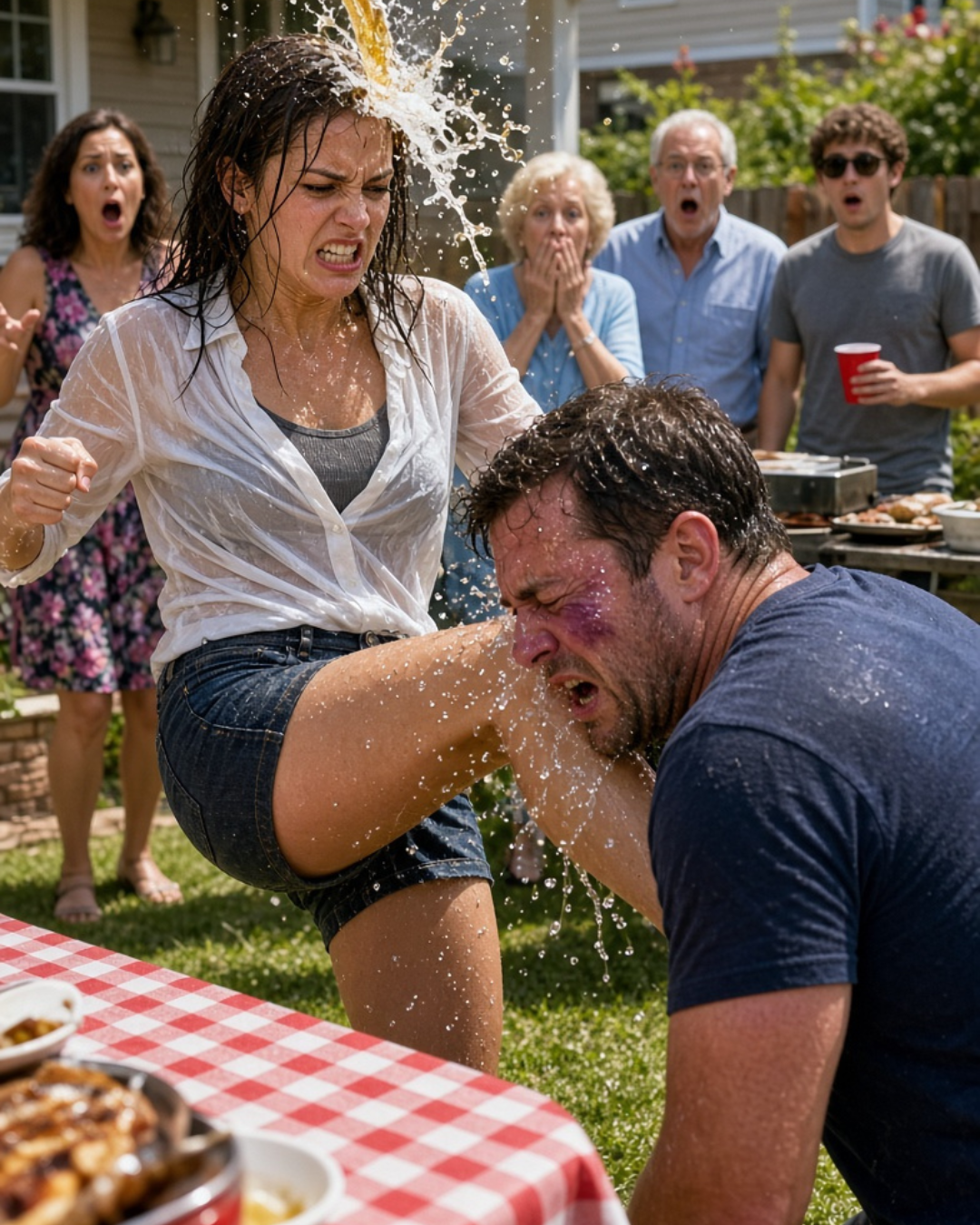
“Or what, little brother?” Derek sneered, flexing his shoulders under the tight salmon fabric. “What are you going to do about it?”
Ryan scrambled to his feet, ignoring the ice clinging to his jeans, and stepped forward again, closing the distance. “You do not touch me,” Ryan said quietly. “And you absolutely do not humiliate my wife.”
That was the precise moment Derek threw the punch. It was a sloppy, untelegraphed right hook, fueled by adrenaline and unchecked entitlement. It caught Ryan directly on the mouth. My husband’s head snapped violently sideways, the sharp crack of knuckles against teeth echoing across the silent yard. A bright line of crimson blood immediately welled up and spilled over his lower lip.
Something deep inside the architecture of my brain went entirely, profoundly still. It was not anger. Anger is erratic; it makes your hands shake and clouds your vision. It was not fear. Fear is a luxury afforded to people who do not know how to dismantle human joints. It was a pure, cold, vacuum-sealed stillness. It was the exact sensation that used to wash over me in the locker room right before the walk-out music hit, when ten thousand people were screaming for violence but the only sound in my universe was the slow, rhythmic cadence of my own breathing.
I stood up.
Derek, catching the movement out of his peripheral vision, turned and pointed a thick, meaty finger directly at my face. “Sit down, sweetheart,” he barked. “This doesn’t concern you. The men are talking.”
I did not look at Derek. I looked at Ryan. My husband was slowly wiping the blood from his mouth with the back of his hand, his eyes locked dead onto mine. He knew. From the day we met, long after my retirement from the circuit, Ryan was the only person in this entire family who knew the full extent of my previous career. He was the only person standing on that mahogany deck who understood with absolute certainty that the safest possible thing I could do for Derek’s continued ability to walk upright was to turn around and leave the yard. But Ryan didn’t ask me to leave. He just watched me.
Then, making the worst logistical miscalculation of his thirty-four years on earth, Derek reached out and grabbed my left wrist. His fingers clamped down with unnecessary, bruising force, attempting to jerk me back down into the lawn chair. His grin widened, displaying teeth that had been paid for by his mother’s premium dental plan. “What’s the matter?” he taunted, leaning in so close I could smell the stale hops on his breath. “You gonna cry now, princess?”
And that was the moment my sister-in-law, Marissa, who had been standing silently by the sliding glass doors, finally started screaming.
To understand the sheer magnitude of the error Derek had just committed, you must understand the operational hierarchy of the family I had married into, and the deeply unglamorous reality of my actual life. I do not come from a lineage of country club memberships, passive-aggressive garden parties, or generational wealth. I am thirty-two years old, and I run Midwest Freight & Pallet Solutions. We manage the unsexy, invisible nervous system of American commerce. My daily existence revolves around managing forklift maintenance schedules, negotiating diesel fuel surcharges, and ensuring that four hundred tons of industrial steel piping reach a manufacturing plant in Ohio before the assembly line grinds to a halt. In my world, excuses are a currency with zero purchasing power. If a truck’s axle snaps because the dispatcher overloaded the trailer, you do not blame the asphalt; you blame the mathematics. Accountability is absolute.
Diane’s family operated on a completely different system of physics. In their ecosystem, accountability was entirely subjective, dependent solely on where you ranked in Diane’s emotional feudal system. Derek was the undisputed Golden Child. He was a man who possessed the remarkable ability to fail upward, perpetually cushioned by his mother’s bottomless checking account and her aggressive revisionist history. When Derek flunked out of a mediocre state college after three semesters of academic probation, Diane framed it as a “brave pivot toward entrepreneurial ventures.” When Derek drunkenly backed his oversized, impeccably clean pickup truck through the neighbor’s vinyl fencing last Fourth of July, Diane blamed the neighbors for installing the fence too close to the property line, paid the $4,200 repair bill in cash, and never spoke of it again.
Ryan, my husband, was the designated scapegoat. He was an architect, quiet, brilliant, and entirely self-sufficient, which in Diane’s eyes made him a disappointment because he could not be controlled with money. And Marissa, the youngest sibling, was the emotional pack mule. Marissa was twenty-eight, painfully shy, and still living in the basement of Diane’s house, functioning as a combination of unpaid personal assistant, live-in maid, and emotional punching bag.
For three years, I had navigated this toxic supply chain with the detached professionalism of a logistics coordinator dealing with a problematic vendor. I ignored their little power games. I smiled politely through the fake concern Diane expressed about my “delicate nerves” and my “stressful, blue-collar little job.” I sat in silence when Diane deliberately invited Ryan’s ex-girlfriend to Christmas Eve dinner and declared it a “treasured neighborhood tradition.” I observed the way Derek routinely cornered female relatives at family functions, physically intimidating them with his size, daring them to make a scene so he could gaslight them for being hysterical. I absorbed it all, calculating the structural load, choosing my battles, and protecting my husband from the brunt of the dysfunction.
What they did not know, because Ryan and I had aggressively scrubbed my digital footprint when I transitioned into the corporate sector, was that before I was a logistics manager, I was Evelyn “The Quiet Storm” Carter. I had spent my early twenties in a world defined by the smell of canvas, the taste of mouthpiece plastic, and the brutal, unforgiving geometry of human joints. I was a former national mixed martial arts champion in the bantamweight division. I retired at twenty-four after a severe knee injury, took my fight purses, put myself through a business degree, and bought a failing warehouse. I traded the octagon for a forklift, and I had absolutely no desire to ever look back. I did not advertise my past. I viewed my training as an emergency backup generator: something you meticulously maintain in the dark, hoping you never have to turn the key, but knowing with absolute certainty that if the primary power grid fails, the generator will flawlessly ignite.
Derek’s hand, tightly wrapping around my radial bone, was the power grid failing.
“Derek, let her go!” Marissa shrieked, her voice tearing through the humid afternoon air.
Everyone on the patio froze, turning to look at the youngest sister. Marissa was standing trembling by the sliding glass door, her face entirely drained of color. In her shaking right hand, she held her smartphone extended outward, the screen glowing brightly in the shade. On the screen was a paused, high-definition video from YouTube. It was a clip from ten years ago. It showed me, a decade younger, my hair braided back into tight, severe cornrows, a gold championship belt secured tightly around my waist. In the paused frame, I was standing over the unconscious body of a heavily favored opponent while the referee waved off the fight and the ring announcer screamed my professional moniker into a microphone.
Derek blinked. He looked at the glowing screen of the iPhone, then slowly turned his head to look back down at me. The arrogant smirk on his face faltered, replaced by a momentary flash of profound cognitive dissonance. His brain, accustomed only to bullying the weak, was desperately trying to reconcile the image of the blood-spattered gladiator on the phone with the soaking wet, silent woman whose wrist he was currently trying to crush.
I did not break eye contact with him. I lowered my center of gravity by a fraction of an inch, grounding my feet against the wooden deck.
“You have three seconds to let go of my arm,” I said softly. My voice was no louder than a librarian’s whisper, but it carried the chilling, deadpan certainty of an incoming tax audit.
PART 2
He didn’t let go.
Men of Derek’s specific psychological profile never do. To a narcissist accustomed to unilateral dominance, a calmly stated boundary is not a warning; it is an appetizer. They process restraint as hesitation. They believe that a woman’s lowered voice is simply a biological request for permission to survive. His grip tightened, his knuckles turning white as he attempted to assert his physical superiority over the newly presented evidence of his imminent demise.
“One,” I said, my voice flat, devoid of any emotional inflection.
From her shaded throne, Diane suddenly stood up, her heavily ringed fingers clutching her pearl necklace. “Claire, stop this nonsense right now! You are embarrassing yourself in front of the entire neighborhood. Derek is just playing around.”
“Two.”
Derek scoffed, a nervous, breathy sound. He leaned in closer, attempting to use his bulk to shadow me. “You think some fake old internet video scares me, sweetheart? I’ve got fifty pounds on you. You’re nothing.”
“Three.”
In the business of physical combat, much like the business of moving freight, efficiency is everything. Wasted motion is wasted energy. I did not throw a punch. I did not execute a high-flying kick, nor did I engage in any dramatic, cinematic spinning maneuvers that look impressive on television but leave you vulnerable in reality. I simply applied the basic laws of physics.
I moved my body barely three inches, stepping slightly off the center-line of his aggression. Simultaneously, I executed a clean, razor-sharp rotation of my trapped wrist, turning my radius bone directly against the weakest point of his thumb. The grip broke instantly with a sickening pop of over-stressed cartilage. Before Derek’s brain could even register that his hand was empty, I slid my left hand up his forearm and pressed two fingers with pinpoint, pneumatic precision directly into the brachial plexus nerve cluster situated near his elbow joint.
I did not strike him. I simply introduced his nervous system to an overwhelming electrical overload.

His knees bent before his pride had the chance to process the humiliation. A sharp, involuntary gasp exploded from his lungs as his legs turned to liquid. His entire massive, gym-sculpted frame collapsed downward, folding like a poorly constructed cardboard shipping box under a hydraulic press.
As soon as he was on his knees, I released my hold entirely. I stepped back, creating exactly three feet of distance, and raised both of my hands into the air, palms open and visible, assuming a completely passive, non-threatening posture where every single person in the yard could see that I was no longer touching him.
Derek staggered wildly, his face flushing a violent, apoplectic shade of magenta. He scrambled backward, clutching his elbow as if it had been severed. “She attacked me!” he bellowed, his voice cracking with panic. “You all saw it! She assaulted me!”
“No,” Ryan countered loudly, stepping to my side. The blood from his split lip had stained his teeth, giving him a terrifying, feral look I had never seen before. “You assaulted me, and then you grabbed my wife. She just stood there.”
Humiliation is a toxic accelerant, and Derek was burning alive in it. Realizing that he was kneeling in front of the entire family while the woman he had been mocking stood over him untouched, his rationality completely vaporized. With a primal roar, he lunged upward off the deck, launching his entire two-hundred-and-twenty-pound frame at me, swinging a wild, looping right haymaker aimed directly at my jaw.
Marissa screamed again, burying her face in her hands.
If his first punch had been sloppy, this one was practically choreographed. I watched the kinetic chain of his movement start in his foot, travel up his hip, and transfer to his shoulder. I had a full two seconds to decide how to handle the freight. As his fist traveled through the air, I simply pivoted on my heel, slipping my head an inch to the left, allowing his knuckles to slice harmlessly through the empty space where my face had been a fraction of a second prior.
Using his own forward momentum against him, I reached out, caught his extended wrist, and guided him forcefully past me. I hooked my right leg behind his calf and applied a gentle downward pressure to the back of his neck.
Derek went airborne. He flew horizontally over the cedar planks, his trajectory completely out of his control, and crashed face-first into the center of the patio picnic table.
The impact sounded like a dropped pallet of canned goods. The wooden table groaned under the sudden dynamic load. Stacks of paper plates exploded into the air like confetti. A massive plastic bottle of Sweet Baby Ray’s barbecue sauce ruptured, splattering a thick, sticky red geyser across the back of his salmon polo shirt. His cheek pressed violently into a soaked pile of paper napkins, surrounded by half-eaten potato salad and grilled corn. I had neutralized a two-hundred-pound threat without throwing a single strike.
The entire family froze. The silence was absolute, broken only by the hiss of beer foam dying on the deck and Derek’s ragged, panicked breathing.
I stepped up to the table, leaned down slowly, and positioned my mouth right next to his ear. I spoke in a whisper calibrated so that only he could hear the exact parameters of his survival. “I could have shattered your elbow,” I murmured into the quiet. “I could have dislocated your shoulder, and I could have put you to sleep before you hit the wood. I chose not to. Remember the grace you were just given.”
Then, I stood up and stepped back.
Derek scrambled off the table, sending a bowl of coleslaw crashing to the deck. He staggered upright, his chest heaving, his face smeared with grease and absolute, unadulterated humiliation. He looked wildly around the yard, realizing that no one was rushing to help him. “You psycho!” he spat, pointing a trembling, sauce-covered finger at me. “You planned this! You came here looking for a fight!”
I almost laughed, the absurdity of the accusation breaking through my cold detachment. “You poured a can of beer over my head at your mother’s barbecue, Derek,” I said, gesturing to my soaking wet hair. “Planning wasn’t required. You provided all the necessary logistics yourself.”
Diane, finally breaking from her paralysis, rushed across the patio, her heels clicking frantically against the wood. she threw her arms around Derek, fussing over his sauce-stained shirt as if he had just returned from a war zone. “Look what she did to my son!” Diane shrieked, glaring at Ryan. “Your wife is an animal! She’s unhinged!”
Ryan stepped firmly in front of me, shielding me from his mother’s wrath. “Your son punched me in the face, Diane,” he stated, his voice ringing with absolute finality. “He assaulted me, and then he laid his hands on my wife. The only animal in this yard is wearing a pink shirt.”
Diane’s face hardened into a mask of pure, aristocratic entitlement. “Maybe if your wife knew her place in this family, Derek wouldn’t have to correct her behavior—”
“Careful,” I said, stepping out from behind Ryan. The single word cracked through the air like a bullwhip.
Diane blinked, genuinely startled by the sheer metallic force of the tone. She clamped her mouth shut, taking a half-step backward.
Derek, sensing that physical intimidation was no longer a viable currency, reached frantically into his pocket and pulled out his iPhone, leaving greasy fingerprints across the screen. “I’m calling the cops,” he declared, his voice trembling with a mixture of rage and triumph. “I’m having you arrested for assault. I’m going to tell them you went crazy and attacked me out of nowhere. Let’s see how your little warehouse business survives a felony charge.”
I looked at him, my expression utterly blank. “Do that,” I said.
His thumb hovered over the keypad, freezing in mid-air. He looked at me, confused by the complete lack of panic.
I raised my hand and pointed calmly toward the roofline of the house, specifically targeting the dark, shaded eaves directly above the sliding glass doors. “Your mother’s security cameras cover every square inch of this deck, Derek. They record in 4K resolution, and they capture audio.”
Diane’s expression twitched violently. A flicker of genuine panic crossed her eyes.
From the doorway, Marissa whispered, her voice barely audible, “Mom turned them off last week. She said she didn’t want the electric bill to go up.”
“No, Marissa,” I corrected, keeping my eyes locked on Derek. “She turned off the indoor cameras. The patio cameras operate on a completely separate circuit. They are wired directly into the main breaker. They are active, they are recording, and they back up to a secure cloud server every sixty seconds. Ryan installed them himself.” I paused, letting the silence hang. “He installed them specifically because after you got drunk and backed into the neighbor’s fence last Fourth of July, the insurance company threatened to drop your mother’s policy unless she proved she had exterior surveillance.”
Derek’s mouth fell open in horror. He slowly turned his head to look at the small, black, unblinking dome of the camera mounted beneath the gutter.
Next to me, Ryan calmly reached into his pocket, pulled out his phone, and tapped the screen twice. “I’m already downloading the encrypted footage to my local drive,” Ryan said, his voice entirely devoid of brotherly affection. “It’s crystal clear. Even catches the audio of you threatening me.”
For the very first time in his sheltered, subsidized existence, I watched the icy fingers of genuine consequence close around Derek’s throat. The fear that bloomed on his face was spectacular to witness.
But I wasn’t done. The structural integrity of the facade had cracked; it was time to bring down the building.
For three years, I had quietly absorbed the operational costs of their little games. I had cataloged the fake concern, the passive-aggressive dinner party seating arrangements, and the financial exploitation of my husband. What Diane and Derek entirely failed to realize was that managing logistics is not just about moving boxes; it is about risk mitigation. It is about understanding exactly where a system is vulnerable and preparing contingencies.
In addition to running my freight company, I had spent the last two years quietly leasing out the fourth bay of my warehouse to build out a passion project: a comprehensive self-defense academy. I did not teach people how to throw flashy jump kicks. I trained emergency room nurses, middle school teachers, single mothers, and female corporate executives in the brutal, pragmatic art of de-escalation, physical boundary setting, and survival. More importantly, I worked directly with two local, highly aggressive civil attorneys who frequently visited the academy to host seminars. They taught my students how to legally document harassment, preserve digital evidence, and construct airtight legal narratives before a situation escalated into a tragedy.
And Derek, functioning with the intellectual capacity of a defective forklift, had just escalated a physical assault against two people in front of twelve neighborhood witnesses, all under the unblinking gaze of a 4K audio-enabled surveillance camera.
The police arrived exactly eighteen minutes later.
When the two uniformed officers stepped through the side gate into the backyard, the tension was thick enough to require a chainsaw. Derek immediately activated the charm protocol that had undoubtedly saved him from a dozen DUI arrests in the past. He smoothed down his sauce-stained shirt, puffed out his chest, and approached the older of the two officers with an exasperated, boys-will-be-boys chuckle.
“Officer, thank God you’re here,” Derek said, shaking his head as if dealing with a petulant child. “Look, it’s just a massive misunderstanding. My sister-in-law here, she’s… well, she’s a little crazy. She’s some kind of retired cage fighter or something, and she just completely snapped. I made a joke, and she attacked me. Threw me right into the table. My mom can vouch for it.”
Diane stepped forward instantly, clutching her pearls. “It’s true, officer. The girl is unhinged. She came into my home and assaulted my son unprovoked. I want her removed from the property immediately.”
The older officer, a veteran who looked like he was mere months away from a pension and had zero tolerance for suburban melodrama, pulled out his notepad. He looked at Derek’s massive, uninjured frame, the barbecue sauce smeared across his back, and the complete lack of physical damage to his face. Then, he looked at me. My hair was plastered to my skull, reeking of cheap beer. My clothes were soaked. I was standing perfectly still, my hands open and visible. Then, the officer looked at Ryan. My husband was holding a bag of frozen peas against a deeply split, actively bleeding lower lip, surrounded by the shattered remnants of his own teeth. Finally, the officer looked at Marissa, who was sobbing silently by the door.
The visual calculus did not align with Derek’s narrative.
“Ma’am,” the officer said to me, his tone neutral. “Is this your husband with the facial laceration?”
“Yes, officer,” I replied calmly.
“Care to explain what happened?”
Before I could speak, Ryan stepped forward, holding his smartphone out. “Officer, I can save everyone a lot of time and taxpayer money. I am the homeowner’s son. I installed a hardwired security system on this property. I have the entire incident downloaded directly to my phone, from three different angles, with crystal clear audio. Would you like to review it?”
The officer’s eyes lit up with the profound relief of a man who just realized he wouldn’t have to spend three hours interviewing contradictory witnesses. “Absolutely, sir. Play it.”
No one spoke while the footage ran. The officer held the phone, his partner peering over his shoulder. The tiny speaker broadcasted the exact, damning sequence of events. The mocking laughter. The beer splashing over my head. Ryan’s demand for an apology. Derek’s aggressive shove. The sickening, undeniable crack of Derek’s fist colliding with Ryan’s mouth. Derek grabbing my wrist. My calm three-second countdown. And finally, the surgical, non-violent redirection of force that sent Derek flying into the potato salad.
When the video ended, the officer handed the phone back to Ryan. The silence in the yard was absolute.
Diane, her meticulously constructed reality collapsing around her, offered a weak, trembling defense. “Well… you know how it is, officer. Families fight. It was just boys being boys, and things got a little out of hand. There’s no need for anyone to get into trouble over a silly barbecue spat.”
The veteran officer looked at Diane with a gaze so flat and unimpressed it could have been used to level concrete. “Ma’am, families argue over the remote control. They don’t throw closed-fist punches that cause severe facial lacerations. That’s called battery.”
Derek’s arrogance finally cracked, revealing the panicked, entitled core beneath. He took a step back, holding his hands up defensively. “Wait, you can’t arrest me! Look at me! She threw me into a table! She embarrassed me in front of the whole neighborhood! If anyone goes to jail, it should be her!”
I stepped forward, my voice as calm and reflective as a sheet of glass. “Officer, I acted solely in self-defense, utilizing the minimum amount of force necessary to remove his hand from my person after issuing a verbal warning. I did not strike him. I simply redirected his momentum.” I paused, looking directly into Derek’s terrified eyes. “Furthermore, my husband and I wish to formally press criminal charges against Derek for assault and battery.”
Diane’s head snapped toward me, her eyes wide with a mixture of disbelief and sheer, unadulterated hatred. “You wouldn’t dare,” she hissed, abandoning the helpless old woman routine. “You will destroy this family. You will ruin his life!”
I met her glare, my posture unyielding. “I am not ruining anything, Diane. You raised a son and taught him that actions do not have consequences, that his violence would always be subsidized by your checkbook. He operated under the assumption that he was immune to the mathematics of accountability.” I gestured to the police officers who were now unclipping their handcuffs. “I am simply the auditor correcting the ledger.”
PART 3
Derek was arrested right there, standing in the middle of the spilled ice and crushed beer cans.
There was no dramatic shootout. There was no resisting arrest. When the physical reality of the steel handcuffs clicked around his wrists, all the gym muscle and bravado instantly evaporated, leaving behind a terrified, overgrown toddler. The police did not drag him; they simply escorted him down the driveway while the neighbors, who had been peering over the cedar fences, watched the spectacle with thinly veiled delight. Diane followed the officers to the cruiser, repeating, “This is ridiculous, you’re making a mistake, do you know who my husband was?” over and over again, like a malfunctioning animatronic reciting a prayer that had fundamentally stopped working.
Ryan stood beside me, his arm wrapped tightly around my shoulders. He removed the bag of frozen peas from his mouth, wincing as the cold air hit his swollen lip. “Are you okay?” he asked quietly, his eyes scanning my face for any sign of adrenaline crash.
I looked at him, at the blood drying on his chin, at the stale beer turning sticky against my scalp. I felt the solid, unshakeable foundation of my own boundaries holding firm. “I am perfectly fine,” I said. “Are you?”
“I think I need a dentist,” Ryan admitted with a half-smile. “But otherwise, I’ve never felt better.”
Diane, returning from the driveway after watching the police cruiser disappear around the corner, marched toward us with the furious energy of a deposed queen. “You,” she spat, pointing a trembling finger directly at my chest. “You have completely destroyed this family over one little mistake. You are dead to me. You are no longer welcome in this house.”
Before I could respond, a voice broke through the tension. It was Marissa. She stepped out from the shadow of the sliding door. Her hands were still shaking, but her voice held a strange, new resonance—the sound of a load-bearing pillar finally deciding to push back against the weight.
“No, Mom,” Marissa said, her words echoing loudly across the empty patio. “Derek destroyed this family the moment he put his hands on Ryan. You destroyed this family every single time you looked the other way and defended him. Claire didn’t break anything. She just finally turned on the lights.”
Diane stared at her youngest daughter, her jaw slack, looking at Marissa as though a piece of the furniture had just suddenly stood up and declared war. The betrayal, in Diane’s eyes, had changed sides.
We did not stay to watch the fallout. Ryan and I drove straight to the hospital.
That night, operating from the sterile, brightly lit confines of my home office, I treated the incident not as a family tragedy, but as a severe breach of protocol by a rogue vendor. I needed paper. Emotions fade, apologies are weaponized, and memories are manipulated, but a meticulously organized PDF file is eternal. I spent four hours filing everything into a secure digital dossier. I uploaded the police incident report number. I uploaded the high-definition witness statements, the hospital records of Ryan’s four stitches, and the dental x-rays showing a cracked incisor. I took brightly lit, high-resolution photographs of the dark purple, finger-shaped bruises that had blossomed around my left wrist. I organized the surveillance footage into chronological folders.
I did not post a single word on social media. I did not text Diane back. I did not make dramatic, sweeping threats to the extended family. Chaos is the oxygen of the narcissist. I did not need chaos. I needed a spreadsheet.
Three days later, the true cost of Derek’s logistical failure arrived.
Derek was employed as a senior security supervisor at the Grand Meridian, a luxury five-star hotel downtown. His job requirements strictly mandated exceptional restraint, impeccable judgment, and, crucially, a completely spotless record regarding physical violence. High-end hotels do not employ security guards who have pending, publicly accessible felony assault charges.

On Tuesday morning, an investigator from the hotel’s corporate HR department, having been automatically flagged by a background monitoring service regarding Derek’s arrest, contacted Ryan as the primary victim listed on the police report. Ryan, adhering strictly to the facts, simply provided the HR department with a secure link to the surveillance video and the police report.
By Wednesday afternoon, Derek was placed on unpaid administrative leave pending a formal review. By Friday morning, after the hotel’s legal counsel viewed exactly how Derek handled a mild verbal disagreement, his employment was officially and permanently terminated. His $72,500 annual salary was instantly reduced to zero.
The immediate loss of his income triggered a catastrophic failure in his personal supply chain.
On Friday night, my cell phone began to vibrate on the kitchen counter. Over the span of two hours, Diane called me exactly twenty-six times. She left fourteen voicemails, alternating between tearful begging, aggressive legal threats, and bizarre attempts at religious guilt. I sat at the kitchen island, sipping a cup of Earl Grey tea, watching the screen illuminate with her name, letting the silence do the heavy lifting.
On the twenty-seventh call, I answered.
“Claire?” Diane gasped, her voice ragged and breathless. “Thank God. You have to fix this. You have to call the hotel right now.”
“Hello, Diane,” I said smoothly. “I assume you are calling to inquire about Ryan’s dental surgery?”
“What? No! Who cares about a chipped tooth!” she shrieked, the mask slipping entirely. “Derek lost his job! They fired him because of your stupid little police report! You need to call his manager right now, today, and tell them the entire thing was a misunderstanding. You tell them you exaggerated the charges!”
“It was not a misunderstanding,” I replied, my voice holding the calm, mechanical rhythm of an automated customer service line. “It was a recorded assault. I will not commit perjury to protect your son from his own actions.”
“He could lose his apartment, Claire! He could lose his truck! He is going to lose everything over a stupid mistake at a barbecue!”
“He should have factored those assets into his risk assessment before he decided to punch my husband and physically assault me,” I stated plainly. “Actions carry invoices, Diane. The bill is simply coming due.”
Her voice dropped an octave, dripping with a venomous, quiet hatred. “You think you’re so incredibly smart, don’t you? Sitting in your little warehouse, calculating everyone’s worth. You think you’re better than us just because you used to be some violent thug fighting in a metal cage?”
“No, Diane,” I said, pausing to take a sip of my tea. “I don’t think I am better than you because I fought in a cage. I know I am better than you because when I had your son on his knees, entirely at my mercy, I possessed the restraint to stop when I could have kept going. You have never possessed restraint in your life.”
Dead silence echoed over the line. For the first time in sixty years, Diane had entirely run out of words.
“Do not contact my phone again,” I added softly. “If you wish to communicate regarding the pending criminal trial, you may do so through the district attorney’s office. Have a pleasant evening.”
I ended the call and blocked her number.
When an entity accustomed to absolute control realizes the levers of power have been permanently disconnected, their behavior does not immediately correct itself; it escalates into the realm of the absurd.
The following Tuesday, at 11:45 AM, Diane attempted a workaround. She bypassed my phone and drove her white Lexus SUV directly to Midwest Freight & Pallet Solutions. She marched onto the warehouse floor wearing a pastel cashmere sweater and designer sunglasses, entirely ignoring the heavy machinery warnings, the high-visibility vest requirements, and the bewildered expressions of my floor managers. She demanded to see me, shouting over the roar of three diesel forklifts, insisting that we were going to sit down “as a family” and resolve this issue right now.
I walked out of my glass-walled office, wearing steel-toed boots, a hard hat, and a clipboard detailing the routing schedule for six hundred tons of industrial rebar.
“Diane,” I said, my voice projecting clearly over the din of the machinery. “You are in a restricted loading zone. You are violating OSHA regulations.”
“I don’t care about your stupid warehouse rules, Claire!” she yelled, waving a manicured hand dismissively at a passing forklift driver who was staring at her in disbelief. “I am here to tell you that this little vendetta ends today. I have retained a lawyer for Derek. He says that if you don’t drop the charges, he will subpoena your medical records from your fighting days and prove you have a history of violence!”
I looked at her, genuinely impressed by the sheer, unadulterated delusion. “My history of sanctioned, regulated athletic competition is public record, Diane. So is the video of your son committing unprovoked battery. Now, you have exactly thirty seconds to vacate my facility before I have my foreman call the police and add trespassing to your family’s growing legal portfolio.”
She stared at me, realizing that her maternal authority held absolutely zero jurisdiction on a concrete floor smelling of diesel and grease. She turned on her heel and stormed out, her tires squealing as she exited the loading dock.
But the true escalation did not come from Diane. It came from Marissa.
Two weeks after the incident at the barbecue, Marissa showed up unannounced at our front door. It was a rainy Thursday evening. When I opened the door, she was standing on the porch, soaking wet, clutching a large, heavy cardboard bankers box to her chest. Her eyes were swollen red, the physical manifestation of weeks of crying, but underneath the exhaustion, there was a spark of desperate resolve.
“Marissa?” I asked, immediately stepping aside to let her in. “What’s going on? Are you hurt?”
She shook her head, walking into the living room and dropping the heavy box onto the coffee table with a dull thud. “I’m not hurt,” she whispered. “But I’m done. I finally looked.”
Ryan came into the room, holding a towel, and gently draped it over his sister’s shoulders. “Looked at what, Mari?”
Marissa reached into the box and pulled out a thick stack of credit card statements, bank ledgers, and past-due notices. “Derek asked me for a favor three years ago. He said he needed to build his credit to get his apartment, and asked if he could be an authorized user on one of my cards. Mom told me to do it. She said family helps family, and that I was being selfish if I didn’t support my brother.”
She took a shaky breath, tears spilling over her eyelashes. “I never checked the statements because Mom always collected the mail and told me she was handling the household finances. But after he got arrested… after he lost his job… the collection agencies started calling my cell phone. Claire, he maxed them out. All of them. He’s been using my name to pay for his truck modifications, his vacations, his bar tabs. And Mom knew. Mom was transferring small amounts from her account to pay the absolute minimums just to keep the lights on, but she never told me the principal was exploding.”
I felt the familiar, cold stillness wash over me again. “How much, Marissa?” I asked quietly.
She looked down at her hands. “Fourteen thousand, two hundred and thirty dollars. They told me my credit score is a 480. I can’t even rent an apartment of my own. I’m trapped there.”
In the business of logistics, when you uncover massive internal fraud, you do not cry. You do not yell. You execute a forensic audit and you call the authorities.
“Sit down,” I told Marissa, my voice shifting instantly from sister-in-law to project manager. I walked into the kitchen, poured her a glass of water, and returned to the living room. “You are not trapped. You are simply dealing with a localized structural failure, and we are going to rebuild the foundation.”
I spent the next three hours sitting beside Marissa on the couch, armed with a yellow legal pad, a calculator, and three different colored highlighters. We went through every single line item of the statements. We tracked every fraudulent charge, every unauthorized withdrawal, every signature Derek had forged. The audacity was breathtaking. He had funded his entire alpha-male lifestyle directly off the back of his sister’s credit, subsidized by his mother’s silent complicity.
The next morning, I connected Marissa directly with my lead corporate attorney. I paid the $2,500 retainer fee upfront, classifying it in my own mental ledger as an investment in family infrastructure.
By Friday afternoon, the lawyer had helped Marissa file a comprehensive police report for identity theft and credit card fraud. They placed a hard freeze on her social security number, immediately locked all compromised accounts, and drafted a formal, terrifyingly worded cease-and-desist letter to Diane, prohibiting her from contacting Marissa regarding financial matters.
That weekend, while Diane was attending a country club luncheon desperately trying to maintain appearances, Ryan and I drove a rented box truck to her house. In under forty-five minutes, we packed up Marissa’s entire basement bedroom, loaded it into the truck, and moved her into the spare guest room of our house.
When Diane returned home to an empty basement and a formal legal notice taped to her front door, the dynasty officially collapsed.
PART 4
The wheels of justice turn slowly, but when they are greased by irrefutable video evidence and detailed financial ledgers, they grind with terrifying efficiency.
The criminal assault case moved rapidly because Derek, in his infinite arrogance, had done the prosecution’s job for them. Faced with the 4K footage of the assault, the medical bills for Ryan’s teeth, and the sudden, looming reality of a parallel investigation into his felony credit card fraud against his sister, his expensive defense attorney advised him to surrender unconditionally.
To avoid a public trial that would have undoubtedly resulted in actual jail time, Derek accepted a brutal plea deal. He pled guilty to two counts of assault and battery. The judge, entirely unmoved by Derek’s sudden tearful apologies in the courtroom, handed down a sentence designed to completely dismantle his ego. He received three years of heavily monitored probation. He was mandated to complete a rigorous, six-month anger management and batterer’s intervention program. He was ordered to complete three hundred hours of community service, specifically assigned to picking up trash along the county highway in a bright orange vest. He was forced to pay full restitution for Ryan’s dental surgery, and he was slapped with a permanent, legally binding no-contact order protecting both Ryan and myself.
But the financial reckoning from Marissa’s fraud case was the fatal blow.
Because Derek had zero income and an eviction notice looming on his luxury apartment, he was forced to liquidate his assets to stay out of a prison cell. He sold his beloved, aggressively lifted pickup truck at a massive loss to pay his legal fees and to begin making lump-sum restitution payments to Marissa’s frozen accounts to avoid the secondary fraud charges. He moved back into Diane’s house, taking over the basement bedroom that Marissa had vacated.
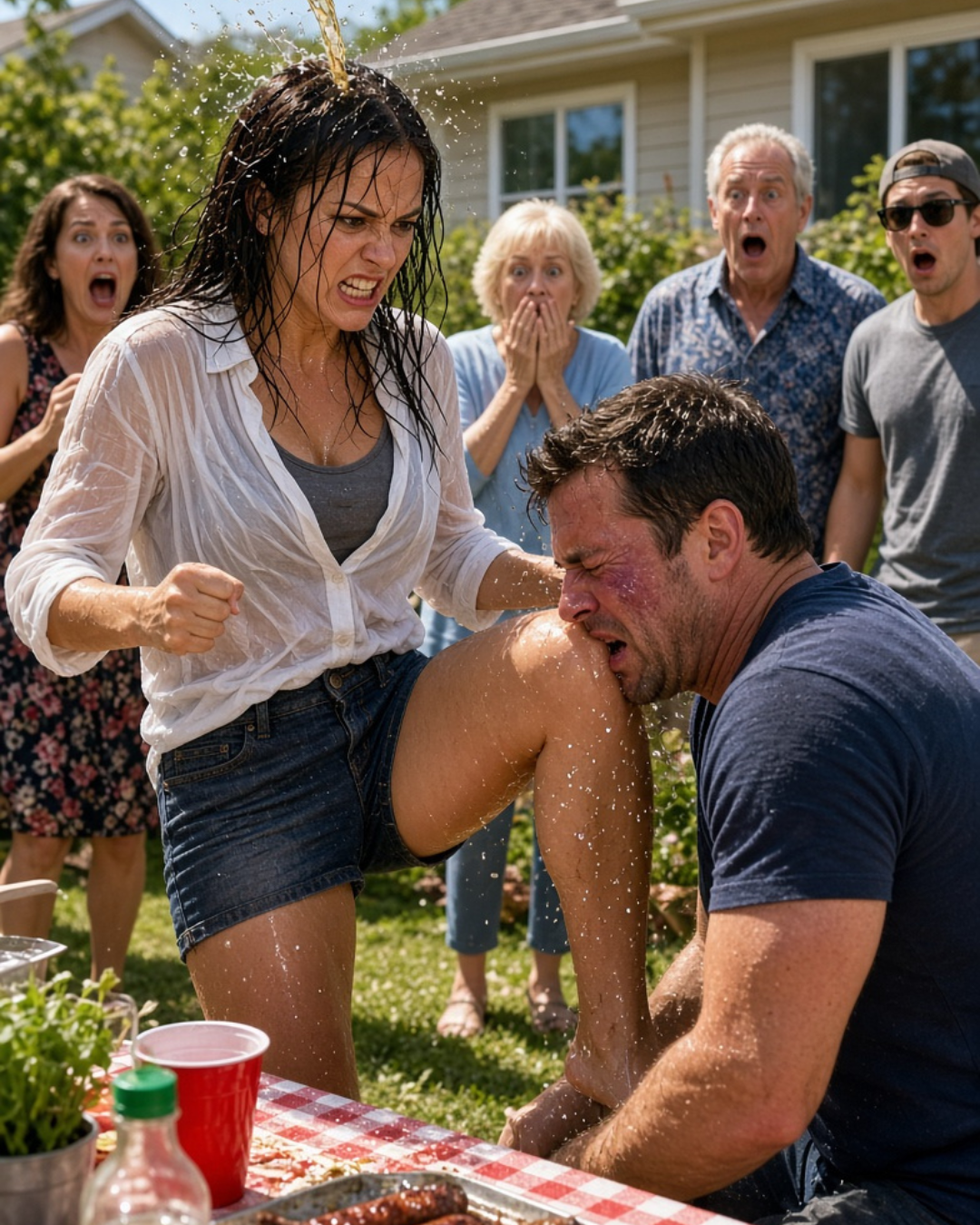
Diane’s perfectly curated, Facebook-ready reality shattered into a thousand jagged pieces. She could no longer host her lavish summer barbecues because she could no longer afford the catering, and more importantly, because half the neighborhood had witnessed her son get arrested and refused to attend. Her social standing at the country club evaporated as rumors of the arrest and the credit card fraud circulated through the gossip mill. The house, once loud with cruelty disguised as jokes, became hollow and quiet. She was left alone in the suburbs, functioning as the sole caretaker for a disgraced, unemployed thirty-four-year-old man who was legally prohibited from driving past my house.
Meanwhile, our side of the equation experienced a profound recalibration.
With Marissa living with us, she finally had the safety and space to breathe. Without the constant psychological weight of her mother and brother pressing down on her, she blossomed. She was not the frail, overly emotional girl Diane had convinced her she was; she was meticulously organized, deeply empathetic, and incredibly sharp.
Six months after the barbecue incident, I finalized the expansion of my warehouse. I walled off Bay 4, installed a pristine, competition-grade spring floor, hung heavy bags from the reinforced steel girders, and officially opened “The Quiet Storm Self-Defense & Empowerment Academy.”
I did not have to pay for marketing. The local news had gotten wind of the logistics manager/former MMA champion who had casually subdued an attacker at a family barbecue, and a reporter came out to do a profile. The resulting headline appeared on the front page of the Sunday metro section:
Former National Champion Opens Free Community Self-Defense Program Following Highly Publicized Assault Case
The article tactfully did not name Derek or Diane, citing the active restraining orders, but in our community, anonymity was impossible. Everyone knew exactly who the article was referencing.
The response was overwhelming. Women signed up by the hundreds. We had a waiting list within three days. Nurses who worked late shifts, teachers dealing with volatile classrooms, single mothers looking to reclaim their bodily autonomy—they all flooded through the warehouse doors. They came looking for permission to take up space, and I taught them the mechanics of leverage.
I hired Marissa as the full-time office manager and program coordinator. Given her newfound absolute mastery of spreadsheets and her deep, personal understanding of what it feels like to be financially and emotionally cornered, she was brilliant at the job. She handled the intake forms, managed the vendor contracts, and greeted every nervous woman who walked through the door with a warm, genuine smile that said, I understand, and you are safe here.
Ryan spent his weekends at the academy, happily installing new wall mats, fixing the plumbing in the locker rooms, and managing the IT infrastructure. Sometimes, I would catch him leaning against the doorway of the main mat room, watching me teach a group of fifty women how to properly execute a wrist-release. He would grin, the faint, silver scar on his lower lip stretching slightly, completely unbothered by the fact that his wife could dismantle a man twice her size.
Every time a woman walked into the academy with her shoulders hunched and her eyes cast downward, and walked out two hours later standing a fraction of an inch taller, looking the world dead in the eye, I felt a microscopic piece of my own residual anger heal. I was taking the toxic waste Derek and Diane had generated and recycling it into pure, structural steel.
It has been exactly one year since the incident with the beer.
In the logistics industry, a year is a significant metric. It is enough time to track seasonal shifts, analyze data trends, and verify whether a newly implemented system is actually sustainable. Our new system was flawless.
On a remarkably warm Saturday afternoon in late July, Ryan and I hosted a barbecue in our own backyard. It was a vastly different environment than Diane’s patio. There was no undercurrent of tension. There was no performative wealth. There were simply good friends from the warehouse, a few of the senior instructors from the academy, and neighbors who actually liked us.
Marissa was standing near the vegetable garden, holding a paper plate loaded with brisket, laughing loudly at a joke one of the forklift drivers had told. She looked entirely different. She wore bright colors now. Her hair was cut short, her posture was straight, and her credit score, meticulously rebuilt over the last twelve months, had just crossed the 720 mark. She was closing on her own small condominium next month.
I was standing by the grill, wearing a simple cotton dress. I had chosen to wear my hair down, letting it fall freely over my shoulders, exactly the way I had worn it on the day of Diane’s catastrophic barbecue. Only today, there was no cheap lager dripping from the strands. There was only the golden, late-afternoon sunlight filtering through the oak trees.
Ryan walked over, carrying a pair of stainless steel tongs. He bumped his shoulder gently against mine, handing me a plate of freshly grilled corn.
“Everything holding up?” he asked, his voice low and warm, slipping effortlessly into the vernacular of my trade.
I looked out across the yard. I looked at Marissa, free from the basement. I looked at the faces of people who had chosen kindness over the obligatory, toxic bonds of blood. I thought about Derek, currently spending his Saturday afternoon picking up fast-food wrappers on Interstate 95 in a fluorescent orange vest. I thought about the financial tuition we had paid—the legal retainers, the broken teeth, the hours of lost sleep—and I realized it was the best investment I had ever made.
When you remove a massive, uneven load from a structure, the structure does not just survive. It immediately begins to thrive. The foundation settles. The micro-fractures heal. The system recalibrates to a new, incredible capacity.
I took a bite of the corn, smiling as Ryan wrapped his free arm around my waist.
“The load is perfectly balanced,” I said, leaning my head against his chest. “I finally stopped letting small people make me feel small.”
