

Chapter 1: The General’s Order
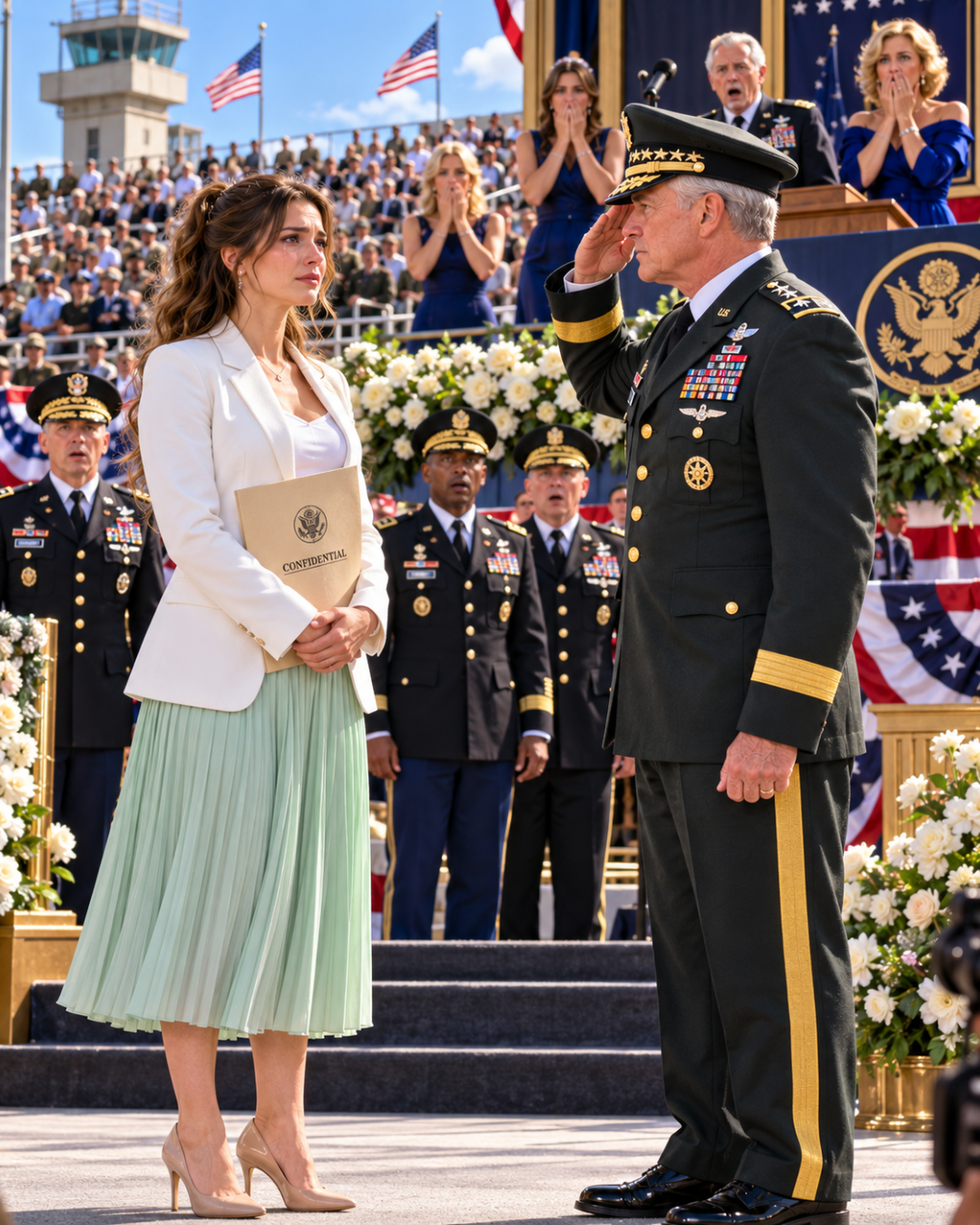
My brigadier general father-in-law ordered military police to remove me from the base in front of hundreds of people… until a four-star general arrived, looked straight at me, and whispered four words that turned the entire ceremony ice-cold.
“That’s Reaper Two.”
From that moment on, no one ever saw me the same way again.
The MPs began walking toward me before the final notes of the national anthem had even finished carrying across the parade field.
The brass still echoed through the brutal July heat. Waves of warmth shimmered above the asphalt beneath my heels. Somewhere behind me, a child’s tiny American flag snapped in the dry wind while hundreds of military families remained frozen, their hands still half-raised, unsure whether they should keep applauding or pretend they were not witnessing a woman being publicly thrown aside.
And standing right in the middle of it all was my father-in-law, Brigadier General Richard Calloway.
His finger was aimed directly at me.
“Get this woman off my base,” he ordered. “Now.”
At Fort Lincoln, Texas, a voice carrying that much authority never had to say something twice.
I remained where I was in a plain navy-blue dress, a sealed envelope clenched firmly between my fingers. My husband, Captain Ethan Calloway, stood twenty feet away in full dress uniform, his jaw tightened so hard that I could see a muscle jumping beside his cheek.
He did not take a single step toward me.
His mother dropped her eyes to the ceremony program lying across her lap.
His younger sister lifted her champagne glass and smiled as if this were the most entertaining moment of the entire day.
“She doesn’t have clearance,” Richard declared, making certain every officer near the reviewing stand heard him. “She is not welcome on this base. And she is no longer a member of this family.”
The first MP moved closer. He was young, probably somewhere in his mid-twenties, with PARKER stitched above the pocket on his chest and uncertainty plainly visible on his face.
I knew that expression well. Anyone who wears a uniform eventually learns it—the brief second when an order feels wrong, but the person giving it has enough rank to ruin your entire career.
I decided not to make him choose incorrectly.
“Sergeant,” I said evenly, “if you ask me to leave, I’ll leave. But today, I would not put your hands on me.”
Something changed behind his eyes.
It was not fear.
It was recognition.
There are certain kinds of voices people in the military never forget. Not the loud ones. The controlled ones. The voices that come from rooms where panic has consequences and hesitation can get people killed.
Richard heard it too, but men like him only respected authority when it carried more stars than their own.
“Listen to her,” he scoffed, turning toward the crowd. “Six years of this nonsense. She marries my son, and suddenly she thinks she belongs in military affairs.”
Several people shifted awkwardly in their seats.
Nobody laughed.
“She was a waitress before Ethan rescued her,” he went on. “Now she walks around acting like she’s important.”
I stayed silent.
My silence had always bothered him more than any argument ever could.
The truth was, Richard Calloway had never once asked where I vanished to during those long overseas consulting trips. He had never wondered why certain officials in Washington answered when I called. He had never questioned why I always picked a seat facing the entrance, or why I sometimes woke in the middle of the night with my hands already reaching for a weapon that was no longer beside me.
To him, I was nothing more than Claire Bennett Calloway.
The unwanted wife.
The woman his son should have abandoned years ago.
The envelope in my hand was dated 07/04, stamped by a command office, and signed in blue ink by a man Richard had spent his entire career trying to impress. I had never planned to open it in front of everyone. I had not come there to humiliate him.
Some families mistake silence for weakness. They never understand that restraint may be the last act of kindness you offer before the truth finally arrives.
Then a convoy of black SUVs rolled through the gate beside the reviewing stand.
My heartbeat slowed.
Four small flags fluttered from the hood of the lead vehicle.
Four stars.
The band faltered halfway through its transition. One last note shook through the air before disappearing into silence. Officers straightened automatically, their bodies reacting before their minds had even processed what had changed.
Richard turned toward the approaching vehicles, irritation flashing across his face before he quickly replaced it with the polished, professional smile he had practiced for years.
The rear passenger door opened.
General Thomas Shepard stepped out.
Four-star command authority.
The kind of man a brigadier general did not interrupt.
The kind of man who could make entire rows of officers stand straighter without saying a single word.
Richard moved forward to greet him.
General Shepard barely acknowledged him.
His eyes swept across the parade field, passing over the flags, the senior officers, and Ethan, who stood rigid and pale beneath the punishing sun.
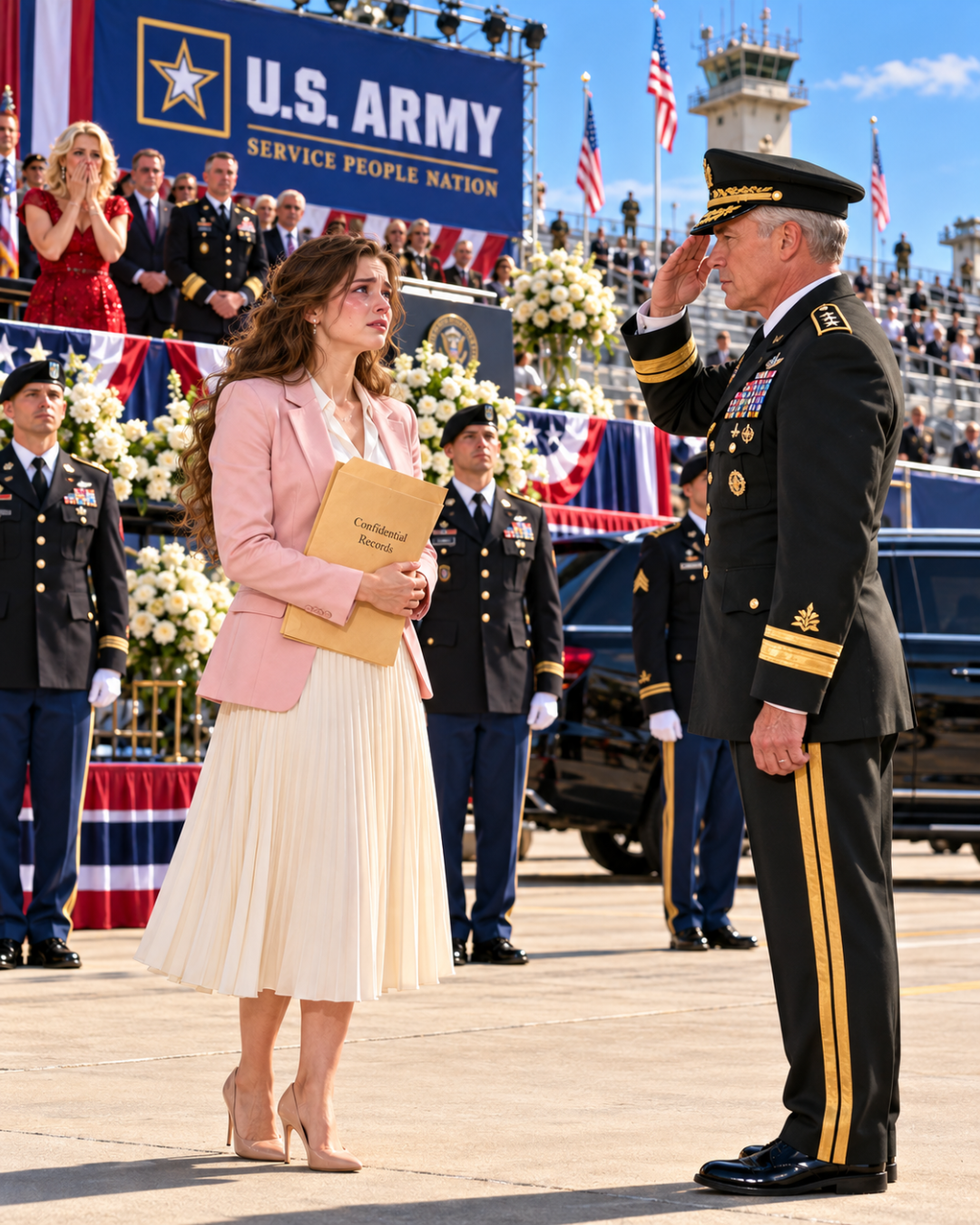
Then his gaze landed on me.
Everything changed.
The color drained from his face so fast that the crowd seemed to feel the shift before anyone understood what was happening. He stopped in his tracks. His hand dropped to his side. For one long, impossible second, it felt as though the entire field had forgotten how to breathe.
Then the four-star general walked straight past Richard Calloway.
The MPs stepped aside.
Ethan’s mouth fell slightly open.
Richard’s carefully controlled smile began to crack.
General Shepard stopped only inches in front of me. His eyes dropped to the sealed envelope in my hand before slowly lifting back to my face.
“No,” he whispered.
He was not talking to me.
He was talking to a ghost.
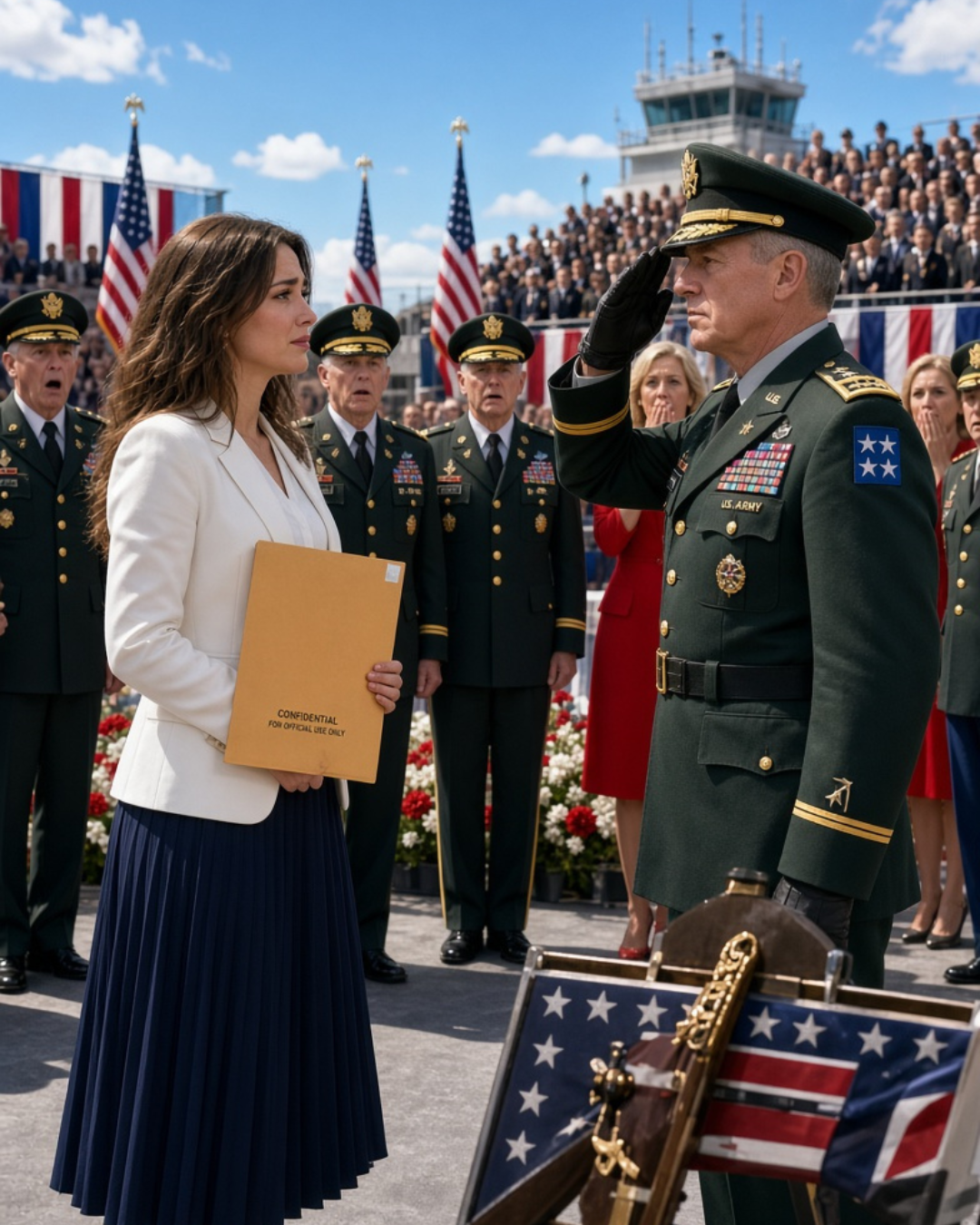
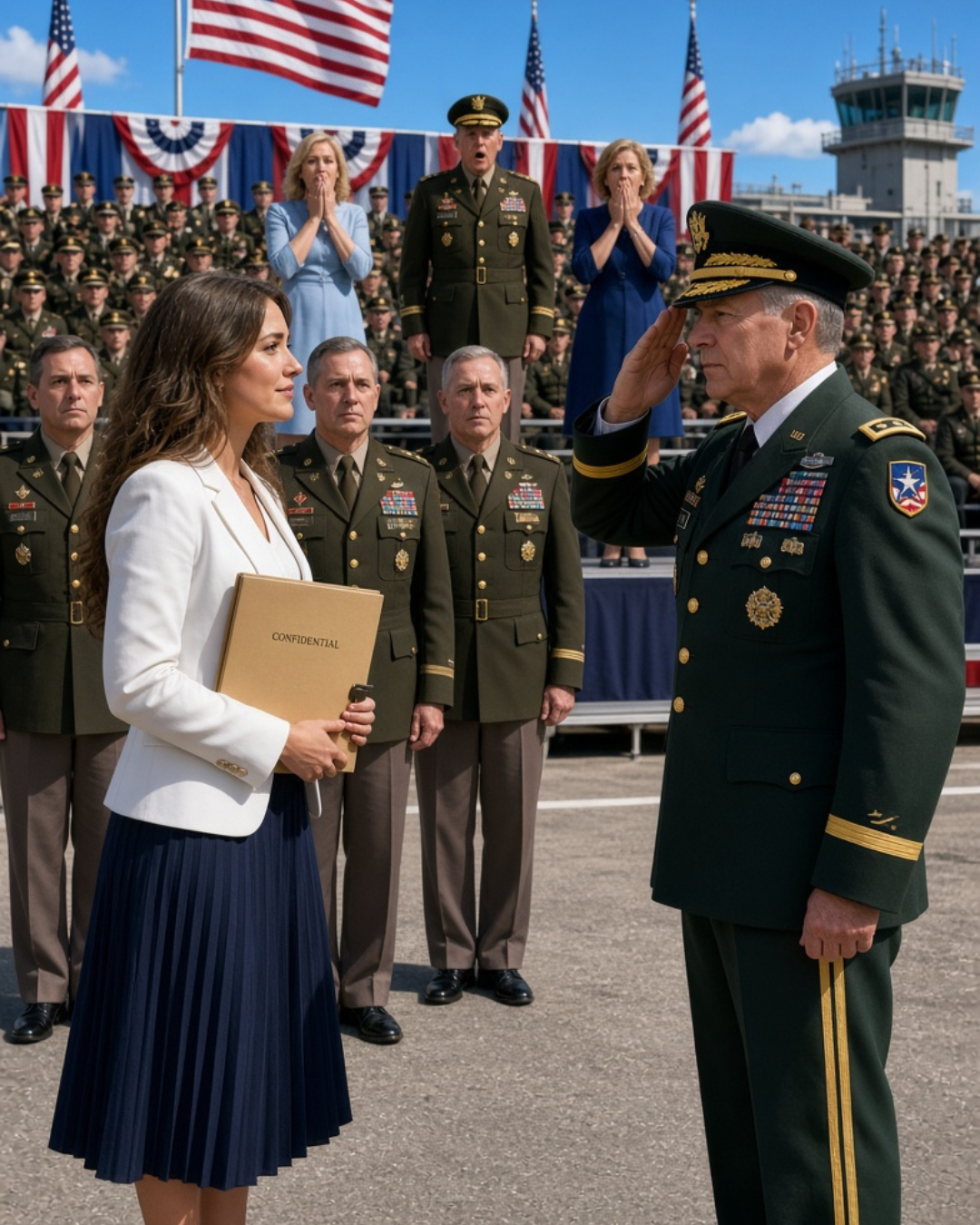
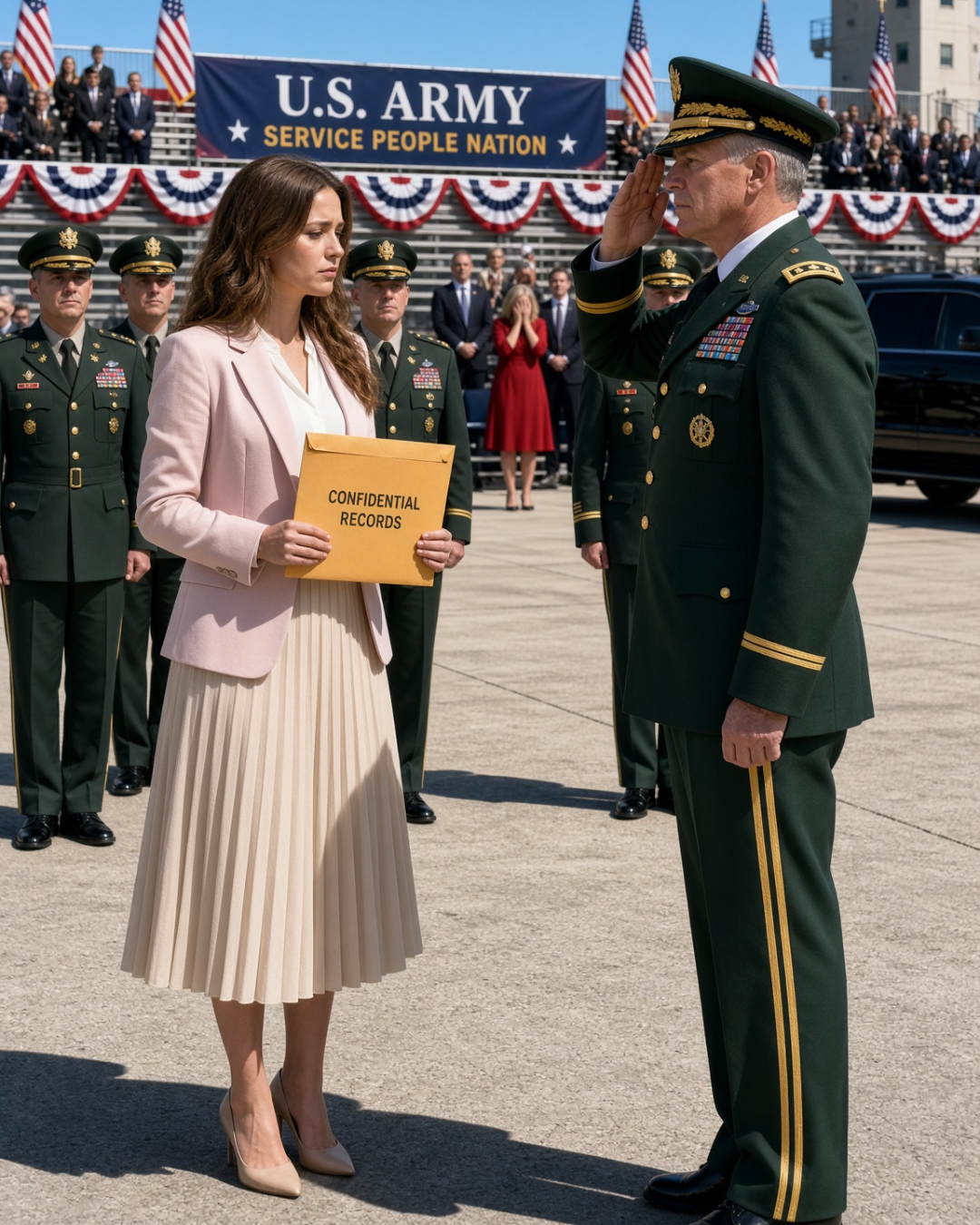
Then, in full view of hundreds of soldiers, commanders, spouses, children holding miniature American flags, and the family that had treated me like an embarrassment for six years, General Thomas Shepard snapped into a formal combat salute.
My father-in-law’s face went completely white.
The entire parade field fell silent.
And the four-star general spoke, his voice barely louder than a whisper—
“Reaper Two,” General Shepard whispered.
The words were quiet, but they carried across the silence with the force of a command.
No one moved.
The salute remained suspended between us, precise and unwavering. I could see the faint tremor in the general’s hand—not fear, exactly, but the strain of recognition pressing against years of discipline.
I returned the salute.
Not dramatically. Not for Richard’s benefit.
It was simply what the moment required.
General Shepard lowered his hand first. His eyes remained on mine.
“Ma’am,” he said, even more softly, “I was told you were gone.”
“I was,” I answered.
A murmur moved through the crowd like wind through dry grass.
Richard stepped forward, his expression tightening. “General, perhaps we should discuss this privately.”
Shepard finally looked at him.
That glance was not angry. Anger would have been easier to dismiss. It was measured, disappointed, and painfully familiar—as if Richard had just confirmed something the general had spent years hoping was untrue.
“We will,” Shepard said. “But not before I correct the record.”
Richard’s mouth opened, then closed.
The young MP, Parker, stood a few feet away, waiting for someone to tell him what to do. Shepard turned toward him.
“Sergeant, no one is removing Mrs. Calloway from this ceremony.”
Parker straightened. “Yes, sir.”
“And you will make certain no one interferes with her.”
“Yes, sir.”
The young man glanced at me once, apologetic and relieved, then stepped back.
Richard’s voice hardened. “General, this woman has no authorization to be on the installation. She was specifically barred from attending.”
“By whom?”
Richard hesitated.
That pause told the whole story.
“By me,” he said at last.
“Then your order was improper.”
A few officers lowered their eyes. Ethan remained frozen near the reviewing stand, caught between the uniform he wore and the family he had never learned how to challenge.
General Shepard turned to him.
“Captain Calloway.”
Ethan snapped to attention.
“Sir.”
“Your wife is here under my authority.”
Ethan’s eyes moved to me. Confusion had replaced the stiffness in his face, but beneath it I saw something more difficult: shame.
“Yes, sir.”
“And she has more right to stand on this field today than any of us.”
Richard took another step forward. “General, with respect, my son’s wife has no military record.”
Shepard’s attention returned to him.
“No,” he said. “She has a classified one.”
The silence that followed felt different.
This time, it was not uncertainty.
It was the sound of people realizing that the story they had accepted about me had been incomplete.
Richard looked at me as though he had never seen my face before.
I had spent six years watching him decide what I was worth. At first, I had tried to earn his approval. I learned the correct names of old commanders, attended ceremonies I did not understand, and remembered the anniversaries he cared about. I brought thoughtful gifts to his office and stood beside Ethan during dinners where every conversation became an examination.
Nothing worked.
Richard had made up his mind about me before he knew my middle name.
A waitress. An outsider. A woman who had somehow persuaded his son to marry beneath the family’s expectations.
The irony was that I had never wanted anything from the Calloways except a place where I did not have to explain myself.
Even that had been too much.
General Shepard turned to the reviewing stand. “Bring the command staff into the conference room.”
Richard stiffened. “This is my ceremony.”
“No,” Shepard said. “It is an Army installation, and today’s matter concerns its command integrity.”
The general’s tone never rose. He did not need it to.
Then he looked at me again.
“Do you still have the envelope?”
I nodded.
“Open it.”
My fingers tightened around the seal.
I had carried that envelope across three states, through airport security, and into the exact place where I had once been told I did not belong. I had imagined opening it privately, perhaps in a quiet office with Ethan beside me.
I had not imagined doing it while hundreds of people watched.
“Here?” I asked.
Shepard’s expression softened by a fraction. “Only if you’re ready.”
That was why I had trusted him years ago.
He never confused authority with permission.
I looked past him at Ethan.
His face was pale. His hands were at his sides, no longer pretending he could remain uninvolved.
“What happens if I open it?” I asked.
“The truth becomes official.”
“And if I don’t?”
“Then it remains yours.”
That answer hurt more than I expected.
For six years, the truth had remained mine. I had guarded it because I believed silence protected Ethan. I had told myself that his father’s contempt did not matter, that I did not need to defend a life I had chosen to leave behind.
But silence had not protected my marriage.
It had only allowed Richard to write the story for me.
I broke the seal.
The paper inside was thick, folded once, and marked with a classification stamp that made several officers glance at one another. At the top was the insignia of the Defense Intelligence Agency. Beneath it were my full legal name and a date from eight years earlier.
Claire Elizabeth Bennett.
The name looked strangely formal. Distant.
I read the first paragraph aloud.
“By authority of the Secretary of Defense, Claire Elizabeth Bennett is hereby recognized for sustained service in support of joint special operations and multinational recovery missions conducted under restricted-access protocols.”
A breath escaped from somewhere near the reviewing stand.
Richard’s eyes fixed on the page.
I continued.
“Her operational identity, designated Reaper Two, shall remain protected from public disclosure. All personnel are directed to treat associated records as compartmentalized and not subject to inquiry outside authorized channels.”
No one spoke.
The word “operational” settled over the field.
It did not explain everything. It was never supposed to.
A sealed record was not a story. It was a boundary.
But it was enough to show that I had not invented importance after marrying Ethan. I had not borrowed a uniform or pretended to understand a world I had never entered.
I had simply left one behind.
Richard’s voice sounded smaller when he asked, “What exactly did you do?”
I folded the letter.
“Work.”
“That is not an answer.”
“It is the only answer I’m permitted to give.”
His jaw tightened. “You expect people to believe this?”
“No,” I said. “I stopped expecting that a long time ago.”
Ethan finally moved.
He crossed the space between us slowly, as if approaching a conversation he had feared for years.
“Claire.”
I looked at him.
He had always said my name gently. Even during our worst arguments, even when his father’s remarks hung between us like smoke, Ethan had never been cruel. That had made everything harder.
Cruelty would have given me something simple to leave behind.
Instead, there had been love—real love, complicated by cowardice, silence, and the constant hope that tomorrow would be easier.
“I didn’t know,” he said.
“No.”
His eyes dropped to the envelope. “How long?”
“Before we met.”
“And you were… what? Attached to a unit?”
“Not exactly.”
“Were you military?”
I shook my head.
That seemed to unsettle him most.
“How can someone do that work without being in the military?”
“Sometimes the military needs people who are not in uniform.”
He looked toward General Shepard. “And my father knew?”
“I don’t know what he knew.”
Richard answered for himself. “I knew she had some government consulting history.”
I turned toward him.
“Consulting?”
His face shifted, not with embarrassment but with calculation. He was trying to fit the new information into a version of events he could still control.
“You told me you worked overseas,” he said.
“I did.”
“You never said anything about special operations.”
“You never asked.”
“I asked what you did.”
“You asked whether I had a respectable career.”
The words landed more quietly than an accusation.
His lips parted. For the first time since I had known him, Richard seemed unable to find the response that would place him above the conversation.
His wife, Margaret, rose from the reviewing stand.
She had remained silent through every insult, every dinner where Richard spoke over me, every family gathering where his daughter made jokes about my “mysterious little career.” But now she stepped down from the platform with a trembling hand pressed against the program she had been holding.
“Richard,” she said.
He turned sharply. “Not now.”
“Yes,” she replied. “Now.”
Everyone seemed surprised, including her.
Margaret looked at me. Her eyes were wet, though her voice remained steady.
“I knew there was more to Claire’s work.”
Richard stared at her. “What are you talking about?”
“She came to me the week before the wedding.”
I felt something tighten beneath my ribs.
“You knew?” Ethan asked.
Margaret nodded. “Not details. She told me there were parts of her past she could not discuss. She asked whether I could accept that.”
“And what did you say?” I asked.
“I said I could.”
The answer carried no pride. Only regret.
“Then why did you let him treat me like that?”
Margaret looked down.
Because there was no defense that could make the truth sound better.
“I thought,” she began, then stopped. “I thought if I challenged Richard publicly, he would make things worse for you. I told myself I was protecting the family from a larger conflict.”
“You were protecting yourself,” I said.
Her eyes met mine.
“Yes.”
The admission was so simple that it disarmed me.
Richard turned away, furious now—not at me, but at the loss of control spreading through the people around him.
“This is absurd,” he said. “We are discussing private family matters at a military ceremony.”
“No,” General Shepard replied. “We are discussing the misuse of authority to conceal a personal grievance.”
That ended the argument.
The command staff began moving toward the administration building. Officers who had been sitting in the front rows stood and followed, their faces solemn. The families remained seated, whispering among themselves. No one reached for a phone. No one laughed.
Parker approached me again.
“Ma’am?”
“Yes?”
“Do you need an escort?”
The question was careful. Respectful.
I almost smiled. “No, Sergeant. But thank you.”
He nodded, then glanced at the envelope.
“My uncle used to talk about a Reaper team,” he said. “Not much. Just that they saved people no one else could reach.”
I said nothing.
He seemed to realize he had crossed a line and immediately looked embarrassed.
“I’m sorry.”
“You don’t have to be.”
“Were you really—”
“Sergeant,” I said gently.
He stopped.
“Right. Sorry.”
I softened my voice. “Your uncle was probably proud.”
Parker’s expression changed. “He was.”
“Then remember that.”
He returned to his post.
Ethan stood beside me, close enough that our shoulders nearly touched but not quite.
“I should have stopped him,” he said.
I kept my eyes on the field. “Yes.”
“I should have stopped him years ago.”
“Yes.”
“I told myself it was easier to let him talk.”
“It was easier for you.”
“I know.”
That was the first honest thing he had said all morning.
I turned toward him. “Do you know what the hardest part was?”
His face tightened.
“Not that he called me a waitress. Not that he told people I was using you. Not even that he barred me from the base.”
“Then what?”
“That you watched.”
He flinched.
“I watched you choose silence every time,” I continued. “You never agreed with him, but you never stood beside me either. You would apologize later, privately, when no one else could hear. And then you would ask me to understand how difficult your father was.”
“I was afraid.”
“I know.”
“You don’t understand what he was like when I was growing up.”
“No,” I said. “I don’t. But I understand what he became when you kept giving him permission.”
Ethan looked at the ground.
For a while, neither of us spoke.
The field was beginning to empty. Children waved their flags as families gathered their belongings. The band members packed instruments into cases. The July sun still pressed against everything, but the unbearable heat had begun to break.
General Shepard waited near the administration building entrance.
Richard stood several yards away, surrounded by officers who no longer seemed certain whether to address him as commander or subject.
Before I followed Shepard inside, Margaret approached me.
“I’m sorry,” she said.
I believed her.
That did not make the hurt disappear.
“I know.”
“I should have spoken.”
“Yes.”
She nodded, accepting the answer.
Then she reached into her purse and removed a small envelope.
“I found this in Richard’s study two months ago,” she said. “I didn’t open it. I recognized your name, and I thought you might want it.”
My pulse changed.
The envelope was older than the one I had just opened. The paper had yellowed slightly at the edges. My name was written across the front in handwriting I did not recognize.
Claire Bennett.
Not Claire Calloway.
My maiden name.
“Where did it come from?” I asked.
“I don’t know. Richard keeps a locked drawer in his desk. He forgot the key one evening and left the drawer open. I saw this among several old files.”
“Why didn’t you give it to me before?”
She looked toward Richard.
“Because I was afraid of what it might reveal.”
I studied the envelope.
“You still are.”
“Yes.”
She placed it in my hand.
“Whatever it is,” she said, “you deserve to know.”
General Shepard called from the entrance. “Claire.”
I slipped the envelope inside my dress pocket.
Ethan noticed.
“What is that?”
“I don’t know.”
“Will you open it?”
“When I’m ready.”
He nodded, though disappointment crossed his features.
For the first time, I realized that he was going to have to learn what it felt like to stand outside a door I had closed.
Maybe that was necessary.
Chapter 2: The Secret Behind Reaper Two
Inside the administration building, the air-conditioning was so cold it raised gooseflesh along my arms. A staff officer led us down a quiet corridor into a conference room with no windows. Richard sat at one end of the table. Ethan took the chair beside him, then seemed to reconsider and moved to the opposite side.
Margaret remained near the door.
General Shepard sat across from me.
No one spoke until the door closed.
Then he placed both hands on the table.
“I owe you an apology.”
I shook my head. “You don’t.”
“I do. I signed the order that brought you back into the system.”
“You signed an order I requested.”
“I signed it without ensuring the people involved understood what they were being asked to do.”
“You could not have told them.”
“I could have told them enough.”
His eyes moved toward Richard.
“Your father-in-law was informed that a protected former operative would be attending today’s ceremony. He was told only that the attendance was authorized at the highest level.”
Richard’s face hardened. “You never said it was her.”
“You did not ask.”
“I asked whether there was a security concern.”
“And I told you there was.”
Richard looked at me. “You knew I would be here.”
“Yes.”
“You planned this.”
“No.”
The answer was immediate.
“I came because General Shepard asked me to deliver the envelope.”
Richard laughed without humor. “And you expected me to welcome you?”
“I expected nothing from you.”
That silenced him.
General Shepard opened a folder.
“The envelope Claire carried contains an appointment order. It authorizes her to serve as civilian liaison for an independent review board examining the Ridgeway extraction failures.”
Ethan frowned. “Ridgeway?”
Richard’s posture changed.
It was almost imperceptible. His right hand moved toward the table’s edge, then stopped.
I saw it.
So did Shepard.
“The review concerns a mission from eight years ago,” the general continued. “Several personnel were lost because operational intelligence was altered before it reached the field.”
Richard’s voice was suddenly flat. “That matter was investigated.”
“It was closed,” Shepard said. “That is not the same as resolved.”
“You’re reopening it?”
“I am.”
Richard looked at me.
“Why her?”
“Because she was there.”
The room seemed to contract.
Ethan turned toward me. “You were at Ridgeway?”
“I was part of the recovery team.”
Richard’s eyes narrowed. “You never mentioned—”
“You never asked,” I repeated.
But this time, the words did not feel like a defense.
They felt like a warning.
General Shepard’s gaze settled on me. “There is one more issue.”
He slid a thin document across the table.
At the top was a list of names.
Most meant nothing to me.
Then I saw the final entry.
My breath stopped.
Not because it was Richard’s name.
It wasn’t.
It was Ethan’s.
Beside his name was a date—the same date as the Ridgeway operation—and a notation written in red:
UNAUTHORIZED ACCESS: CALLOWAY, E.
Ethan stared at the page.
“I’ve never seen that,” he said.
Richard reached for the document, but Shepard placed a hand over it.
“No one touches it until Claire has read the attached statement.”
My fingers went cold.
General Shepard looked directly at me.
“The sealed record in Richard’s study is not about your past,” he said. “It is about what happened after Ridgeway.”
I pulled Margaret’s envelope from my pocket.
The handwriting on the front suddenly seemed familiar.
Not because I had seen it before.
Because it resembled Ethan’s.
I looked from the document to the old envelope in my hand.
The room had become very quiet.
Even the air-conditioning seemed to have faded into the background, leaving only the low hum of the lights above us and the faint rustle of paper beneath General Shepard’s palm.
Ethan was still staring at his name.
“I didn’t have unauthorized access,” he said.
His voice was controlled, but I could hear the uncertainty beneath it.
General Shepard did not answer immediately. He lifted his hand from the document and turned the page toward me.
Below Ethan’s name was a second notation.
ACCESS LOG CORRECTED BY AUTHORITY OF R. CALLOWAY.
Richard stood so quickly that his chair scraped against the floor.
“That is enough.”
“No,” Shepard said. “It isn’t.”
The general’s tone remained calm, but the room changed around it. Margaret closed the door fully and moved away from it, as if she understood that whatever happened next could not be undone by walking out.
Richard looked at Ethan.
“Your name was included because you were assigned to the communications section during that period. There was an administrative error.”
Ethan’s eyes remained on the page. “I was not assigned to communications.”
“You were a junior captain. You rotated through several departments.”
“I was with logistics.”
“You were near the operations center.”
“That is not the same thing.”
Richard’s mouth tightened.
I watched him carefully.
For years, I had believed Richard’s greatest flaw was arrogance. It was easier to call it that. Arrogance was a character defect; it required no investigation. But now I recognized something beneath it—an instinctive need to control the shape of every story before anyone else could examine it.
General Shepard opened another folder.
“Captain Calloway was stationed at Fort Mercer during the Ridgeway operation,” he said. “He was not part of the mission team. However, his access credentials were used to enter the operations archive two days before the extraction.”
Ethan looked up. “That wasn’t me.”
“I believe you.”
Richard’s gaze sharpened. “Then why is his name in the report?”
“Because the system recorded his credentials.”
“Credentials can be duplicated.”
“Which is why the matter was referred for review.”
“And you’re only raising it now?”
Shepard glanced at me. “The original review was compromised.”
Richard let out a slow breath.
“Compromised by whom?”
“That is what we are here to determine.”
I unfolded Margaret’s envelope but did not open it.
My hands felt strangely steady.
The handwriting on the front had seemed familiar because the letters leaned slightly to the right, with a narrow loop on the capital C and a firm downward stroke at the end of each name.
Ethan’s handwriting had the same habits.
But handwriting could be imitated. Memories could be shaped by fear.
I looked at him. “Did you ever give your access card to anyone?”
“No.”
“Did you lose it?”
“No.”
“Did anyone ask to borrow it?”
He thought for a moment. “Not that I remember.”
“Ethan,” Richard said, “you were exhausted during that deployment. You had a dozen people asking for assistance every day. You may have forgotten.”
“I would not forget handing over my credentials.”
Richard’s expression hardened. “You were not in a position to know everything that was happening.”
The words were ordinary, but they landed with unusual force.
Ethan turned toward him.
“What does that mean?”
“It means you were young.”
“I was twenty-eight.”
“You were still inexperienced.”
“I was responsible for a logistics chain supporting three field units.”
“And you made mistakes.”
“Did I?”
Richard did not answer.
General Shepard leaned back slightly. “Brigadier General Calloway, did you ever possess Captain Calloway’s access credentials?”
“No.”
“Did you authorize any officer or civilian to use them?”
“No.”
“Did you review the access logs after Ridgeway?”
“I reviewed the findings.”
“That was not my question.”
Richard’s eyes moved toward the closed folder.
“I was briefed.”
“By whom?”
“Colonel Vance.”
“Colonel Vance is deceased.”
“I am aware.”
The words settled between them.
I remembered Colonel Vance.
Not his face, but his voice.
Low, dry, and patient. He had been the first senior officer to trust my judgment during the Ridgeway recovery. He had also been one of the last people to speak to me before I left that world behind.
I had not known he was dead.
“What happened to him?” I asked.
Richard looked at me.
“Cancer.”
“When?”
“Three years ago.”
He said it too quickly.
General Shepard opened the folder and removed a photocopy.
“Colonel Vance left a statement before his death. It was sealed with the Inspector General’s office. We located it six weeks ago.”
He placed it on the table.
I read the first lines.
The statement was dated three years earlier. The writing was uneven, but the signature was unmistakable.
I cannot leave this matter unresolved. The official account of Ridgeway is incomplete. The intelligence failure was not caused by field personnel. The information was altered before transmission.
My chest tightened.
I remembered Ridgeway in fragments.
Rain on corrugated metal.
A broken radio.
The smell of wet earth and aviation fuel.
A young medic asking whether we had clearance to move the injured team.
And a voice over the satellite channel telling us to wait.
Wait.
That word had cost us time.
Not lives, as some reports had claimed. The people we went to recover survived, though two suffered injuries that ended their field careers. But the delay had created confusion, and confusion had been used afterward to hide the original mistake.
I had known the report was wrong.
What I had not known was who had changed it.
General Shepard watched me read.
“Colonel Vance believed the altered intelligence was connected to someone inside the command structure,” he said. “He did not identify that person in the statement.”
“Why not?”
“He wrote that he lacked sufficient evidence.”
Richard folded his arms. “Then we are building an entire investigation around suspicion.”
“No,” Shepard replied. “We are building it around records.”
He removed another page.
“This is the original transmission.”
I read it once, then again.
The timestamp was familiar.
The routing code was not.
“Someone changed the priority designation,” I said.
Ethan leaned forward. “What does that mean?”
“The request was marked routine instead of urgent. That would have delayed the response.”
“Could anyone in the operations center do that?”
“Anyone with the right permissions.”
Richard looked toward me. “You were a civilian contractor.”
“I was not part of the routing system.”
“But you had access.”
“Limited access.”
“Enough to alter the file?”
“No.”
The answer came from Ethan.
He had not looked at Richard. His eyes remained on the document.
“Claire didn’t have authority to change command routing.”
Richard turned toward him. “You seem very certain.”
“I read the operating procedures.”
“You read what she gave you.”
“I read what was available to everyone assigned to the review.”
“Then perhaps you remember that civilians were not supposed to be in the operations archive.”
“I wasn’t in the archive.”
I looked at him.
Ethan’s face had gone pale.
“How do you know that?” I asked.
He met my eyes.
“Because I was.”
The admission was quiet.
Richard’s expression changed.
Not surprise.
Recognition.
I felt the old envelope grow heavier in my hand.
“Tell me,” I said.
Ethan looked down again. “The night before the extraction, I received a message from Colonel Vance. He asked me to bring a set of logistics reports to the operations center.”
“Why?”
“He said he needed to verify fuel allocations.”
“Did he ask for your access card?”
“No.”
“Did you enter the archive?”
“Yes.”
“Did you see me there?”
His silence answered first.
Richard’s head turned toward him.
“You saw her?”
Ethan closed his eyes briefly.
“I saw Claire in the corridor outside the archive.”
My body went still.
I remembered that night.
I had been carrying a case of encrypted equipment toward the communications room. Someone had called my name from behind me. I had turned and seen a man in uniform standing beneath a fluorescent light.
I had not recognized him at first.
He had been thinner then, younger in the face, with rain darkening his hair.
Ethan.
We had known each other for less than a year.
We had been dating, but we had not yet told either family.
He had looked startled to see me. I had assumed he was surprised because my presence was unusual. I had smiled, asked whether he was lost, and continued down the corridor.
He had never mentioned seeing me.
“You knew where I worked,” I said.
“I knew you were attached to a government project.”
“That was not what I asked.”
He swallowed.
“I knew you were involved in the recovery operation.”
Richard pushed away from the table. “This is becoming ridiculous.”
Ethan turned on him.
“No. It’s becoming honest.”
The words were not loud, but they were the first words I had ever heard Ethan say to his father without apology.
Richard stared at him.
“You told me you were a consultant.”
“That’s what I was allowed to tell people.”
“You told me you were working with foreign partners.”
“I was.”
“You never said you were at Ridgeway.”
“You never asked about the operation.”
The exchange sounded painfully familiar.
My own words, returned to me from a different mouth.
General Shepard reached for the old envelope.
“Claire, open it.”
I looked at Margaret.
She stood beside the wall with both hands clasped in front of her. Her face held the exhausted sadness of someone who had waited too long to tell the truth and feared that truth might still be too late.
I broke the seal.
Inside was a single handwritten letter and a small memory card sealed in clear plastic.
The letter was from Ethan.
The date was eight years earlier—four months after Ridgeway, two weeks before our wedding.
I unfolded it.
Claire,
I stopped reading.
The room blurred for a moment, not from tears but from the shock of seeing his name beneath words he had never spoken to me.
I continued.
I know you told me not to ask questions about your work. I know why. But I also know what I saw that night, and I know my father has been asking about you.
My breath caught.
Ethan moved half a step toward me.
“I wrote that before we got married,” he said. “I never sent it.”
“Why?”
“Because I was afraid.”
“That answer is becoming inadequate.”
“I know.”
I read on.
He asked me whether you had access to the Ridgeway files. He asked whether I had seen you in the operations corridor. I told him I hadn’t. That was a lie.
My fingers tightened around the paper.
I don’t know what he wants, but I know he believes the investigation could damage his command. He said Colonel Vance was trying to make him look incompetent. He said you were part of a political effort to undermine him.
Richard’s face had gone rigid.
“Claire,” he said, “that letter is unverified.”
I kept reading.
I found a copy of the routing record in the archive. My access card was used to retrieve it. I did not retrieve it. I think someone copied my credentials. I think my father knows.
The page shook once in my hand.
I wanted to tell you before we got married. I wanted to ask you what really happened. But every time I tried, I saw the way you looked at me when you thought I was asking too much. I was afraid the truth would make you leave.
I looked at Ethan.
“Did you think I would leave because you asked me a question?”
“I thought you would leave because I had already failed you.”
“That was before we were married.”
“I was already failing you.”
The room seemed to lose its edges.
He had been carrying this letter for six years. Perhaps longer, if it had remained in Richard’s possession after Ethan abandoned the idea of sending it.
I returned to the page.
If I cannot tell you, I will at least leave you the evidence. The memory card contains a copy of the access log and the message I received from my father. I put it in an envelope and left it in the drawer of my desk. If anything happens to the file, you should know that I tried to preserve the truth.
The final line had been written more heavily than the others.
I love you. I am sorry that I have made love feel like another form of silence.
I lowered the letter.
No one spoke.
The memory card lay on the table between us.
General Shepard looked at Ethan. “Where did you get this?”
“I don’t know.”
“That is not an answer.”
“I wrote the letter. I put the card in my desk drawer at Fort Mercer. I checked the drawer the next morning, and it was gone.”
“Why didn’t you report it missing?”
“Because I was afraid the card would be traced to me.”
“You were an officer.”
“I know.”
“Why did you keep silent for six years?”
Ethan looked at me.
“Because after I couldn’t find the card, I convinced myself I had misunderstood everything. I told myself my father was difficult, not dangerous. I told myself Claire knew what she was doing and that if I stayed out of it, I would not make things worse.”
His voice broke slightly.
“Then we got married. Every year that passed made the truth harder to confess. And every time my father insulted her, I thought about telling him I knew he was lying. But I was afraid he would take it out on her.”
Richard’s face had darkened.
“You are accusing me of stealing your property?”
“I’m saying I don’t know what happened to it.”
“Your father had no reason to take it,” Margaret said.
Richard looked at her. “Stay out of this.”
She did not retreat.
“No. I have stayed out of it for long enough.”
General Shepard picked up the memory card.
“We can recover its contents in a secure environment.”
Richard stepped forward. “You cannot use a piece of unverified media as evidence.”
“We can verify it.”
“You are relying on the word of a disgruntled former operative and a junior officer who admits he was frightened.”
Shepard’s expression sharpened.
“Careful.”
Richard’s gaze moved to me. “She has been waiting years for an opportunity to punish this family.”
The accusation might once have hurt.
Now it sounded like desperation.
“You still think this is about punishment,” I said.
“What else would it be?”
“An answer.”
“You have one. You were a contractor. You did classified work. You married my son and kept secrets from him.”
“I kept secrets because I was required to.”
“And he kept secrets because he was afraid.”
Ethan looked down.
Richard spread his hands. “There. You see? This entire marriage was built on concealment.”
“No,” I said. “It was built on two people who believed silence could protect the people they loved.”
For the first time, Richard looked genuinely unsettled.
General Shepard placed the memory card into a small evidence sleeve.
“Brigadier General Calloway, until this review is complete, you will step away from all records related to Ridgeway.”
Richard stared at him. “You are removing me from command?”
“I am placing you on administrative leave from the review process.”
“That is not your authority.”
“It is.”
“On whose recommendation?”
“Mine.”
Richard’s hands curled at his sides, but he did not raise his voice.
Perhaps he understood that the room no longer belonged to him.
Ethan stood. “I’ll testify.”
Richard turned toward him.
“You have no idea what you are doing.”
“For once,” Ethan said, “I do.”
His father studied him for a long moment.
Then he looked at me.
“You think this will give you back the years you lost?”
“No.”
“You think exposing old mistakes will make you part of this family?”
“I was never asking to be part of your version of it.”
That answer left him with nothing.
General Shepard gathered the documents.
“We will reconvene tomorrow morning. Claire, I need you to remain available to the review board.”
“I will.”
“Ethan, you are not required to participate until counsel has reviewed the evidence.”
“I want to.”
Shepard nodded. “Then understand what that means. Once you give a formal statement, it may affect your career, your father’s career, and your marriage.”
Ethan looked at me.
“My marriage is already affected.”
The words were not meant as pressure. They were simply true.
I slipped the letter back into its envelope.
Margaret approached me after Shepard left the room.
“I never knew about the card,” she said.
“I believe you.”
“I saw Richard with a small envelope once. Years ago. He was standing in his study, reading something. When I entered, he put it away.”
“Did it look like this?”
She glanced at the old envelope.
“Yes.”
Richard remained near the table, facing the windowless wall.
I studied him.
“Why did you keep it?”
He did not turn around.
“I didn’t.”
“Then who did?”
His shoulders moved with a slow breath.
“I found it in Ethan’s desk after he left Fort Mercer.”
Ethan looked up. “You went through my desk?”
“I was your commanding officer.”
“You were my father.”
“I was both.”
“What did you do with it?”
Richard turned at last.
His face was tired now. Not humbled, not repentant—only tired.
“I read it.”
“And then?”
“I kept it.”
“Why?”
He looked at me, and something in his expression was almost honest.
“Because I thought you were going to destroy him.”
I felt an unexpected sadness.
“By telling him the truth?”
“By making him choose between you and his family.”
“He was allowed to choose his own life.”
“You had secrets.”
“So did you.”
His eyes shifted.
There it was.
Not proof, but a crack.
General Shepard had said the letter in Richard’s study concerned what happened after Ridgeway. Ethan’s letter had mentioned a message from Richard. The memory card might contain the missing connection.
I held up the evidence sleeve.
“Is the message from you?”
Richard said nothing.
Margaret closed her eyes.
Ethan’s voice was quiet. “Dad?”
Richard’s silence stretched.
Then he said, “I wrote to you because I was trying to protect you.”
“From what?”
“From Claire’s influence.”
The words sounded rehearsed, but the fear beneath them did not.
“You knew she was part of the recovery team,” Ethan said.
“I knew she had information that could damage the command.”
“Your command?”
“The Army’s.”
“That is not what you said in the letter.”
Richard’s face tightened. “You read it?”
“No.”
“Then you don’t know what I said.”
“Claire does.”
Richard looked at me.
I held his gaze.
“What did you write to Ethan?”
He did not answer.
Margaret stepped closer. “Richard.”
He lowered his eyes.
“I told him to stay away from the investigation.”
“Why?”
“Because it was political.”
“Was that true?”
“Yes.”
“Was that the only reason?”
His silence became an answer.
Ethan’s expression changed from anger to something quieter.
“You knew the report was altered.”
Richard rubbed a hand over his face.
“I knew there were discrepancies.”
“You knew.”
“I suspected.”
“You knew enough to hide the letter.”
Richard looked at his son.
“I knew enough to believe that if the truth came out, people would be hurt.”
“People were already hurt.”
“I was trying to keep the Army from tearing itself apart.”
“And you decided Claire should carry the blame?”
“I decided no one should carry it until I understood what had happened.”
“That is not what you did.”
Richard’s eyes moved to me.
“I made a mistake.”
The admission was small, almost lost beneath the cold hum of the room.
But it was the first time he had said it.
I expected relief.
Instead, I felt only the weight of everything that had come before.
“A mistake is forgetting an anniversary,” I said. “You made a decision every day for six years.”
His face tightened.
“I thought I was protecting my family.”
“You protected your reputation.”
He had no reply.
The door opened, and a staff officer entered to collect the documents. General Shepard had already left to arrange secure handling of the memory card.
Before I could leave, Ethan touched my arm.
I looked down at his hand.
He withdrew it immediately.
“I’m sorry,” he said.
“I know.”
“I don’t expect you to forgive me.”
“Good.”
His eyes lowered.
“But I’m not asking you to decide anything today.”
“That is the first considerate thing you’ve done in a long time.”
He nodded.
Margaret came to stand beside him.
Richard remained by the table, alone with the empty evidence sleeve.
As I reached the door, he spoke.
“Claire.”
I stopped but did not turn.
“There is something else.”
Ethan looked at him.
Richard’s voice was strained. “The message on the card may not be the one I sent.”
I turned slowly.
“What do you mean?”
“I wrote a message to Ethan. I did not write the one you described.”
“I haven’t described it.”
“No.”
His face had lost what little color remained.
“I know what I wrote. It was an order to report to my office. It did not mention you.”
“Then what did?”
He looked at the old envelope in my hand.
“The message I found with it was addressed to Ethan, but the signature was mine.”
“Was it?”
Richard’s eyes met mine.
“I don’t know.”
A chill moved through me despite the cold room.
General Shepard had said the review concerned records altered before transmission. Colonel Vance had left a statement pointing toward someone inside the command structure. Ethan’s credentials had been used. Richard had hidden the evidence, but he might not have created it.
Someone had written a message in his name.
Someone had taken Ethan’s access credentials.
Someone had placed the old envelope where Margaret would eventually find it.
I looked at the memory card sealed inside the evidence sleeve.
Then I looked at Richard.
“Who else had access to your office?”
He hesitated.
Only for a second.
But I saw the answer before he spoke.
“Your mother,” he said to Ethan.
Margaret’s face went pale.
Richard continued.
“Margaret had a key to the study.”
She shook her head. “Not to the locked drawer.”
“You knew the combination.”
“I did not.”
“You saw me enter it.”
“Once. Years ago.”
Ethan looked between them. “Why would Mom have access to the command files?”
“She didn’t.”
“Then why mention her?”
Richard’s gaze returned to me.
“Because she was not the only person with a key.”
I felt the old instincts return—not fear, not panic, but the precise stillness that came before a difficult decision.
“Who was?”
Richard’s answer came slowly.
“Your husband.”
Ethan stared at him.
“I never had a key to your study.”
“You did.”
“No.”
Richard moved to the table and opened a drawer beneath the folders. From inside, he removed a small brass key attached to a faded blue tag.
He placed it on the table.
The tag had one word stamped into it.
MERCER.
Ethan looked at it as though it belonged to someone else.
“I’ve never seen that.”
Richard’s voice dropped.
“It was found in the Ridgeway archive.”
I stepped closer.
On the reverse side of the tag, beneath a layer of scratched metal, were two initials.
C.B.
My initials.
No one spoke.
Then the staff officer returned, carrying a secure tablet.
“General Shepard needs this delivered to Mrs. Calloway immediately,” he said.
He handed it to me.
The screen showed a recovered audio file, timestamped eight years earlier.
The file name was simple:
REAPER TWO — FINAL TRANSMISSION
And beneath it, in the access log, the user who had opened the recording
Chapter 3: The Ridgeway Recording
The name beside the recovered audio file was not mine.
It was not Ethan’s.
It belonged to Richard Calloway.
For a moment, I could not make sense of what I was seeing. The letters blurred together, then sharpened again beneath the sterile light of the conference room.
USER: R. CALLOWAY
Richard moved closer.
“That is impossible.”
The staff officer held the tablet steady. “The system authenticated the credentials.”
“I never opened that file.”
“Perhaps someone used your account.”
“Who?”
The officer glanced toward General Shepard’s empty chair, then back at us. “I was instructed to tell Mrs. Calloway that the file must be reviewed in a secure setting.”
I looked at Ethan.
He was staring at the screen, but not with the confusion I expected. There was something else in his expression—a memory beginning to surface.
“What?” I asked.
He swallowed. “The blue tag.”
I looked at him.
“I’ve seen it before.”
Richard turned sharply. “Where?”
“At Fort Mercer. The night before Ridgeway.”
“What were you doing there?” I asked.
“I told you. Colonel Vance asked me to bring him logistics reports.”
“And the key?”
“I don’t know. It was hanging from a hook outside the archive office.”
Richard’s eyes narrowed. “You took it?”
“No. I remember seeing it because the tag had initials on it.”
“Mine,” I said.
Ethan nodded slowly. “I thought they were yours.”
I studied the key.
The metal was worn, the blue paint chipped at the edges. It looked ordinary, almost too ordinary to have carried so much consequence.
“What did you do after you saw it?” I asked.
“I went into the operations center. Colonel Vance was there.”
“Was anyone else?”
He hesitated.
“Your father.”
Richard’s face changed.
“I was in the corridor,” Ethan continued. “I heard them arguing. I couldn’t hear every word, but Colonel Vance said the routing record had been altered. Your father told him to stop reopening the matter.”
Richard shook his head. “That is not what happened.”
“What did happen?”
“Vance was upset. He had misread the report.”
“He said someone had changed the priority designation.”
“And I told him he had no proof.”
“Did you?”
Richard looked at me. “I told him to wait until we had facts.”
“That sounds reasonable,” I said.
His expression tightened.
“But you left out the part where you kept the evidence.”
“I secured it.”
“You secured it in your private study.”
“I was the commanding officer.”
“Not every document was yours to hide.”
He turned away.
The staff officer cleared his throat. “Mrs. Calloway, General Shepard is waiting in the secure review room.”
I handed the tablet back.
“Tell him we’re coming.”
The officer nodded and left.
Margaret had not moved. She watched her husband with an expression that seemed to contain twenty years of questions.
“Richard,” she said quietly, “what did you do with the original recording?”
“I didn’t know there was a recording.”
“Then why did you look so afraid when Claire saw the file?”
“I’m not afraid.”
“You are.”
He faced her.
“I am trying to understand what someone did with my credentials.”
Margaret held his gaze. “You always say that when you don’t want to answer.”
The words were gentle, but they carried a history.
Richard lowered his eyes.
Ethan stepped toward me. “I want to hear the audio.”
“We all do.”
“I mean before the board hears it.”
I considered him.
The old version of me might have refused simply to make him feel what it was like to be excluded. But that was not what I wanted anymore. I did not want revenge. I wanted the truth to exist in the open, where no one could quietly reshape it.
“We’ll hear it together,” I said.
We followed the staff officer through a second security door and into a small room lined with soundproofing panels. General Shepard sat behind a console, accompanied by two civilian investigators and a woman from the Inspector General’s office.
The woman introduced herself as Mara Ellis.
She did not look at Richard with suspicion or at me with admiration. Her manner was practical, respectful, and reassuringly ordinary.
“The audio file is authentic,” she said. “The timestamp is consistent with the Ridgeway archive. We have not altered it.”
“Who recorded it?” I asked.
“That is unclear. The file was embedded in a transfer package created under General Calloway’s credentials.”
Richard sat stiffly. “I did not create it.”
“We are aware.”
Mara touched the console.
“Before we play it, I need everyone to understand that the recording may contain operational information that remains restricted. We will discuss only what is necessary to establish the sequence of events.”
I nodded.
The room darkened as the audio began.
At first there was only static.
Then rain.
Not the soft sound of rain against a window, but hard, uneven drops striking a metal roof. Somewhere in the background, equipment hummed.
A man spoke.
Colonel Vance.
“Confirm the route.”
A second voice answered. “The extraction team is ready. We are waiting on priority clearance.”
The recording crackled.
Then my own voice entered.
“Clearance received. Move them now.”
I closed my eyes.
I had not heard that voice in eight years.
It sounded younger than I remembered. Tired, but firm.
A third voice spoke.
“Negative. The request has been downgraded to routine.”
“That’s incorrect,” I said. “We have wounded personnel.”
“Command has amended the priority.”
“Who authorized that?”
No answer.
The audio shifted. Footsteps. A door opening.
Then Ethan’s voice.
“Claire?”
The memory came back whole.
The corridor. The rain. His startled face.
I heard myself say, “What are you doing here?”
“Colonel Vance asked me to bring him the logistics reports.”
“Then stay clear of the operations channel.”
“I heard them say the route was downgraded.”
“You heard correctly.”
“Can I help?”
“You can find out who changed it.”
A pause.
“I’ll try.”
“You have no authority in this room.”
“I know.”
The recording continued for several seconds. Then another voice entered.
Richard’s.
“Captain Calloway, step outside.”
Ethan did not answer.
Richard repeated himself.
“Now.”
The sound moved, as though whoever held the recorder had followed them into the corridor.
Richard’s voice became quieter.
“You were never authorized to be in this section.”
“Colonel Vance asked me to bring the reports.”
“Then give them to him and leave.”
“What happened to the priority request?”
“That is not your concern.”
“It affects the people waiting for extraction.”
“You are not in command here.”
“No, sir.”
“Then stop behaving as though you are.”
Silence.
Then Richard said, “And stop asking questions about Claire Bennett.”
My eyes opened.
Ethan’s breath caught beside me.
The recording continued.
“She has a protected assignment,” Richard said. “You have no clearance to discuss her work.”
“I wasn’t asking about her work.”
“You are engaged to her.”
The sound of movement suggested Ethan had stepped back.
Richard’s voice softened.
“Listen to me. Whatever she tells you, you do not become involved in this investigation. It will damage your career, and it will damage hers.”
“Why?”
“Because she is not what you think she is.”
“Neither are you?”
A long silence followed.
Then Richard said, “Give me your access card.”
“I can’t.”
“That was not a request.”
“I’m assigned to logistics.”
“You are assigned to obey your commander.”
The recording ended.
For several seconds, no one spoke.
Richard sat with his hands clasped tightly in front of him.
Ethan looked as though he had been forced to meet a younger version of himself and found no way to defend him.
Mara stopped the playback.
“The recording confirms that General Calloway knew Claire was involved in the recovery operation and attempted to prevent Captain Calloway from asking questions,” she said. “It does not prove that he altered the routing request.”
“No,” I said. “But it proves he knew it was altered.”
Richard’s voice was low. “I did not change the request.”
“Then who did?”
Mara brought up a second file.
“This is the access audit recovered from the memory card.”
A sequence of entries appeared.
The first showed Ethan’s credentials entering the archive.
The second showed Richard’s credentials accessing the command routing system.
The third showed a temporary administrator account opening the original transmission.
The user name was not a person.
It was a code.
I recognized it immediately.
“Vance-Admin,” I said.
Mara nodded. “That account was assigned to Colonel Vance’s executive assistant.”
“Who was that?” Ethan asked.
Mara looked at Richard.
Richard’s face had gone still.
“Lieutenant Commander Daniel Vale,” he said.
I remembered him.
A quiet man with silver-rimmed glasses who had handled schedules, reports, and private correspondence for Colonel Vance. He had been present during the first review of Ridgeway, but he had resigned soon afterward.
“Where is he now?” I asked.
“Retired,” Mara said. “Living in Colorado.”
“Did he have access to the general’s office?”
“Yes.”
“Could he have used Richard’s credentials?”
“Possibly.”
Richard shook his head. “Vale had no reason to do that.”
“Did he know about the altered routing request?” I asked.
“He was Vance’s assistant.”
“Then yes.”
Mara tapped another entry.
“There is something else. The file was copied after the review closed. The copy was made from an external device.”
“To whom?” Ethan asked.
“We don’t know.”
The answer should have left us no closer to certainty, but it did the opposite. The mystery no longer pointed only toward Richard. It widened into a chain of decisions made by frightened people, each one protecting a fragment of reputation, each one assuming there would be time later to correct the record.
There had not been.
I looked at Richard.
“Why did you keep Ethan’s letter?”
He rubbed his thumb against the edge of the table.
“Because I was afraid he would give it to you.”
“That is not the whole answer.”
“No.”
He breathed out slowly.
“After Ridgeway, Colonel Vance told me the routing change had come through my office. He suspected Vale. I confronted him, and he denied it. I should have reported the discrepancy immediately.”
“But you didn’t.”
“I thought I could resolve it internally.”
“You couldn’t.”
“No.”
His admission was barely audible.
“I was being considered for promotion,” he continued. “The command was already under review. If I reported an unverified breach, the operation would be frozen, personnel would be removed, and every family connected to the deployment would be dragged through an investigation.”
“That still does not explain hiding the evidence.”
“I told myself I was preserving the chain of command.”
“Were you?”
He looked at me.
“No.”
The room remained quiet.
Richard’s voice weakened. “I was protecting my career. I knew that if the routing failure became public before I understood it, I might lose command. I thought I could find the person responsible and correct the report afterward.”
“And when you couldn’t?”
“I buried it.”
Ethan stared at him.
“You let Claire carry the uncertainty.”
“I did not know she was involved in the recovery.”
“You knew enough to keep me from asking.”
Richard closed his eyes briefly.
“I believed she had been sent to examine the command’s failures. I thought she would use you to gain access.”
I almost laughed, but there was no humor in me.
“I had access to everything I needed. I did not need your son.”
“I did not understand that.”
“You did not try.”
“No.”
The word seemed to break something in him.
Mara gathered the files. “The review will continue. We will contact Commander Vale and obtain a formal statement. General Calloway, you will remain available and will not access any related records.”
Richard nodded.
There was no argument left in him.
General Shepard looked toward Ethan and me.
“You are both free to leave for today.”
Ethan rose, but I remained seated.
“General,” I said, “what happens to the original mission report?”
“It will be corrected if the evidence supports it.”
“And the people who were blamed?”
“Their records will be amended.”
It was not enough to restore lost years, but it was something real. A line in a file could not erase the strain carried by families or return trust to people who had spent years wondering whether they had failed.
Still, truth did not need to undo the past to matter.
It needed to stop the past from controlling the future.
Chapter 4: The Truth and a New Beginning
Outside, the sun had begun to descend. The parade field looked entirely different without the ceremony. Chairs were stacked along the edge, flags folded, the brass section gone. The great open space felt quieter than it had that morning.
Ethan walked beside me without touching me.
At the base entrance, we stopped.
“I can arrange a room for you,” he said. “Or a car. Whatever you need.”
“I can arrange those things myself.”
“I know.”
The answer was not defensive.
I looked at him.
He had spent the day losing the story he had told himself about his family. I had spent it watching the truth become official. Neither of us knew what remained after that.
“Do you want to come with me?” he asked.
The question was careful.
“Where?”
“Anywhere you are going.”
I studied his face.
“Why?”
“Because I don’t want to lose you.”
“That is not enough.”
“I know.”
He looked toward the empty field.
“I want to learn how to be honest with you even when honesty makes my life harder. I want to stop asking you to carry the cost of my fear. And I want to understand that loving you does not mean protecting me from consequences.”
I said nothing.
“I’m not asking you to forgive me today,” he continued. “I’m not asking you to stay because we have history. I’m asking whether there is any part of you that believes we could build something different.”
The honest answer arrived slowly.
“There is.”
Hope flickered across his face, but I raised a hand.
“That does not mean we return to the way things were.”
“I understand.”
“It means we start somewhere else. Carefully.”
He nodded.
“Counseling,” I said. “Separate from your family. And you tell me everything you remember about Ridgeway, even if it makes you uncomfortable.”
“I will.”
“No private apologies that disappear when your father enters a room.”
“I will not do that again.”
“And if we rebuild this marriage, your father does not get to decide what place I have in it.”
Ethan looked back toward the administration building.
“He never should have.”
“No,” I said. “He shouldn’t have.”
For a moment, we stood beneath the base flag, listening to the wind move through the trees beyond the road.
Then Ethan held out his hand.
Not to claim me.
Not to pull me closer.
Simply offering a choice.
I looked at it before taking it.
His fingers closed around mine with careful restraint.
Across the field, Margaret emerged from the building. She walked slowly, carrying a small paper bag.
“I brought you something,” she said.
Inside was a glass bottle of water and a wrapped sandwich.
It was such an ordinary gesture that my throat tightened.
“You must be hungry,” she added.
“I am.”
She gave me the bag, then glanced at Ethan.
“Your father is meeting with counsel.”
“Will he tell them the truth?” Ethan asked.
Margaret looked toward the building.
“I don’t know.”
“That must be difficult.”
“It is,” she said. “But difficulty is not an excuse to remain silent.”
Her gaze moved to me.
“I’m going to speak with the board tomorrow.”
“You don’t have to.”
“I know.”
She reached into her purse and handed me another folded paper.
“What is this?”
“A letter I wrote to you six years ago.”
I looked at her.
“I never sent it,” she said. “I wrote that I was sorry for not defending you. Then I decided an apology would only make me feel better if I sent it, and I was too ashamed to do that.”
“You can keep it.”
“I don’t want to anymore.”
I unfolded the page.
The words were simple. No excuses, no attempt to explain Richard, no request for forgiveness.
Just an acknowledgment that she had seen what happened and chosen comfort over courage.
I folded it again.
“Thank you for giving it to me.”
She nodded, tears bright in her eyes.
“I don’t expect you to call me Mom.”
“I won’t.”
A small, surprised smile touched her face.
“But you may call me Margaret,” I added.
“I would like that.”
She embraced me then, carefully, giving me enough room to step away.
I did not.
Her arms were warm, and for the first time in years, the family name around me did not feel like a locked door.
That evening, Ethan and I stayed at a small hotel outside the base.
We did not solve our marriage in one conversation.
We talked until midnight, stopped when one of us needed silence, and began again when we were ready. He told me about the years he had spent trying to keep peace between his father and everyone else. I told him how lonely it had been to be loved privately and abandoned publicly.
There were no dramatic promises.
Only specific ones.
He would answer difficult questions.
I would stop pretending that pain became smaller simply because I could survive it.
We would not confuse marriage with endurance.
The following morning, the review board released a preliminary finding.
The Ridgeway routing request had been altered by Commander Vale using an administrative account. The alteration was unauthorized. Richard had not made the change, but he had known about the discrepancy, withheld evidence, and influenced the internal review to protect his command.
The report also confirmed that my actions during the recovery had prevented further delay and that the original account had unfairly minimized the role of the civilian team.
No one called me a hero.
That was not what I wanted.
My name was simply corrected.
Sometimes that was the most honest form of recognition.
Commander Vale arrived two days later and gave a statement confirming that he had changed the routing designation under pressure from a senior aide who feared the extraction would expose an intelligence failure. Vale had copied the recording and the access logs because he believed someone would eventually need proof. He had never intended for the evidence to disappear. He had trusted the wrong person to preserve it.
That person had been Richard.
Richard resigned his command before the review concluded.
He did not ask me to defend him.
He did not blame Vale, Shepard, or me.
A week later, he requested a private meeting.
I almost declined.
Then I decided that closure did not require affection, but it sometimes required hearing the final words directly.
We met in a quiet office at Fort Lincoln.
He looked older than he had at the ceremony. The authority in his posture had gone, leaving behind a man who no longer knew which parts of himself remained when no one was obliged to obey him.
“I was wrong about you,” he said.
“Yes.”
“I thought you were trying to take Ethan away from us.”
“I was never trying to take him anywhere.”
“I know that now.”
“You could have known then.”
“Yes.”
He looked down at his hands.
“I cannot repair what I did.”
“No.”
“I can stop defending it.”
“That would help.”
He nodded.
“I am sorry.”
I believed him.
It did not erase the years, but it gave them a truthful name.
“I accept your apology,” I said. “That is not the same as offering you closeness.”
“I understand.”
“And if you want a relationship with Ethan, you will have to build it without asking him to choose between us.”
“I will.”
“Good.”
He rose.
At the door, he paused.
“Reaper Two,” he said.
I looked at him.
“I understand now why Shepard saluted you.”
“You never needed to understand the details.”
“No,” he said. “I needed to understand that a person’s value is not reduced by what they are permitted to say.”
It was the wisest thing I had ever heard him say.
Months later, Ethan and I returned to Fort Lincoln together.
Not for a ceremony.
For the dedication of a small memorial to the Ridgeway recovery teams. The corrected report had been released, and the names of those who served had been restored to the record.
There were no cameras.
No reviewing stand.
No crowd waiting for someone to be honored or cast aside.
Just a stone wall, a few folding chairs, and families standing quietly beneath a mild autumn sky.
Ethan stood beside me in uniform.
This time, when he reached for my hand, he did not look around first.
General Shepard spoke briefly. Margaret sat in the front row. Richard was not there.
When the names were read, mine was not announced as Reaper Two.
It did not need to be.
The people who had been there knew.
Afterward, a young officer approached me. He could not have been more than twenty-five.
“Ma’am,” he said, “may I ask you something?”
“If it’s within the rules.”
He smiled nervously. “How do you know when it’s time to tell the truth?”
I glanced at Ethan.
He was speaking with Margaret near the memorial, listening more than talking.
“Sometimes,” I said, “you tell it because someone has finally made it safe to hear. And sometimes you tell it because staying silent is no longer protecting anyone.”
The officer nodded.
“What if the truth changes everything?”
“It will.”
“That sounds frightening.”
“It can be.”
He waited.
“But the life built around a lie is already changing,” I said. “You only get to choose whether you face that change with honesty.”
The officer thanked me and left.
I looked at the names carved into the stone.
For years, I had believed leaving the past behind meant refusing to look at it.
I understood now that healing was different.
Healing meant looking directly at what happened, naming what it cost, and deciding that the truth would not be used to imprison the future.
Ethan came to stand beside me.
“Ready?” he asked.
I nodded.
We walked away from the memorial together.
Not as the perfect military family Richard had once imagined.
Not as two people pretending silence had never hurt them.
As two imperfect adults choosing, day by day, to speak before distance became permanent.
And somewhere behind us, beneath the quiet autumn wind, the names on the stone remained exactly where they belonged.
THE END.
