


PART 1
The human body does not necessarily respond to the loss of an essential synthetic immunosuppressant with dramatic convulsions or agonized screams. Its collapse can be far quieter and more methodical.
Imagine a financially exhausted municipal transportation system struggling through an unbearable August heatwave. First, the routes serving the outer neighborhoods are suspended. Then the communication lines fail. Eventually, the central cooling equipment enters an emergency cycle, producing a low mechanical vibration that seems to travel through every surface.
That was how my body began shutting down.
I understood systems like that better than most people.
For eleven years, I had worked in forensic medical billing, building my career around the uncomfortable truth that enormous amounts of money could disappear into the administrative machinery supposedly designed to keep people alive.
I founded Barrett Reconciliation Services myself.
My company specialized in identifying inflated hospital charges, including absurdities such as seventy-four-dollar fees for ordinary non-sterile nitrile gloves.
I investigated billing irregularities, challenged unjustifiable expenses, and stripped away profit margins that depended on patients never examining their statements.
Numbers were my language.
I understood financial margins, hidden liabilities, and the extraordinary creativity people displayed when disguising their own greed.
I had also learned that declarations of unconditional love sometimes concealed costs no one wanted to itemize.
After selling my business for a substantial eight-figure amount, I purchased a spacious, single-story ranch house in a heavily wooded, peaceful suburb of Baton Rouge.
I wanted privacy.
I wanted quiet.
Most importantly, I wanted to stop spending my life cleaning up other people’s financial disasters.
That desire was one reason I agreed to finance my younger brother Julian’s master’s degree in Art Administration in Paris.
It was not an act of overwhelming sisterly devotion.
I regarded the expense as the price of keeping his disorderly, demanding personality on another continent.
Peace, I had discovered, was sometimes worth an extraordinary premium.
Then my immune system began attacking my own body.
The diagnosis was acute inflammatory demyelinating polyneuropathy, commonly abbreviated AIDP.
The condition damaged the protective myelin surrounding the nerves responsible for carrying signals between my spinal cord and my limbs.
During severe episodes, my legs became almost completely unresponsive.
They did not merely ache or feel exhausted.
They became impossibly heavy, as though someone had replaced them with sacks of wet sand and disconnected them from the rest of my nervous system.
My treatment involved monthly intravenous infusions costing approximately five thousand dollars each.
The medication was kept under carefully controlled conditions inside a specialized refrigerated unit on my kitchen counter.
Without treatment, I risked worsening weakness and potentially life-threatening complications.
When the flare-ups became difficult to manage, my mother Margaret and father Arthur moved into the guest wing.
Margaret described their arrival to members of her church as a loving Christian mission to rescue their suffering daughter.
The reality was considerably less noble.
She occupied my home, assumed control over household decisions, and began spending my money with the confidence of someone who believed the property belonged to her.
Arthur, meanwhile, perfected his lifelong talent for remaining present without taking responsibility.
Margaret hired a live-in housekeeper named Maria.
She paid Maria generously using my accounts, then treated her as though the wages entitled Margaret to complete control over the woman’s life.
I allowed the arrangement to continue.
Not because I approved of it.
Because my illness had exhausted me, and confronting my mother demanded strength I couldn’t always summon.
I permitted her to portray herself as a martyr.
I tolerated her use of my debit cards.
I told myself the inconvenience was temporary.
That fragile arrangement ended when Julian’s supposed graduation approached.
Margaret announced that she and Arthur would travel to Paris for sixty-eight days.
According to her, they needed to support Julian as he entered the international art world.
She had not asked whether I could manage alone.
She had not discussed alternative care.
She had simply made the decision.
On the morning of their departure, my legs were already losing sensation.
My morning medication was twelve hours overdue.
A familiar tingling sensation had begun spreading upward from my calves.
I was lying in my master bedroom when I heard Margaret speaking to Maria in the kitchen.
The hardwood floors carried her voice with unsettling clarity.
She used the same cold, managerial tone she reserved for correcting service employees.
“The three glass bottles in the counter unit,” Margaret instructed Maria in the kitchen. “Take them out. Throw them in the garage trash. Empty her emergency water jugs into the sink. We are not leaving provisions that encourage her theatrics.”
My breathing faltered.
Theatrics.
That was what she called my illness.
Maria sounded frightened.
“Mrs. Barrett,” Maria’s voice wavered, thick with a heavy Spanish accent and genuine fear. “What about the girl? She can’t walk to the sink if the legs go. The doctor said the medicine—”
Margaret interrupted sharply.
“The girl is thirty-eight years old,” Margaret snapped, the sound of her heavy diamond rings clinking against the granite countertop. “She plays this sick, attention-seeking routine every single time Julian has an achievement that requires the family’s focus. Put her in the back laundry room. Lock the deadbolt from the outside. Do you understand me, Maria? You do not open that door until I email you from Paris.”
A wave of dread spread through me.
It was different from the numbness caused by my condition.
This was fear.
Pure and immediate.
I attempted to swing my legs over the side of the bed.
Nothing happened.
Below my knees, my body would not respond.
Then I heard the front door close.
Arthur had already gone to the waiting car.
He had escaped before the situation required him to make a moral decision.
A short time later, Maria entered my bedroom.
Tears ran down her cheeks.
She refused to look directly at me.

Without explaining herself, she pulled me toward the edge of the mattress.
My legs dragged uselessly.
I tried to resist, but I lacked the strength.
Maria hauled me across the Persian rug, through the hallway, and toward the laundry room near the carport.
The room was a windowless concrete enclosure measuring roughly eight by ten feet.
It had no insulation.
The previous owner had used it to store a deep freezer.
Even in the morning, Louisiana’s heat had begun warming its exterior walls.
“Maria,” I rasped, my tongue heavy, my heart hammering against my ribs. “The cold box. I will write you a check for ten thousand dollars right now. I’ll double your salary.”
She continued moving me.
“Mrs. Barrett said no,” Maria whispered, her voice greasy with shame. “She said if I help you, she will call immigration on my sister. I am so sorry. I am so sorry.”
She lowered me onto the rough floor.
I couldn’t stand.
I couldn’t crawl quickly enough to reach the doorway.
As Maria turned away, her hand briefly brushed my shoulder.
Something small and hard, wrapped in a thin towel, slipped inside my collar and settled against my ribs.
Then the solid-core birch door closed.
The brass deadbolt slid into place with a heavy metallic sound.
A moment later, the electrical power to the wing was disconnected.
The ventilation fan stopped.
The thin line of light beneath the door disappeared.
I was alone inside a dark concrete room that was growing hotter by the minute.
I had no medication.
No water.
No functioning ventilation.
And my mother had ordered that the door remain locked until she contacted Maria from Paris.
The darkness seemed almost physical.
It pressed against my face and filled every corner of the room.
I rolled onto my side, dragging my unresponsive legs across the concrete.
My hands searched inside my shirt for the object Maria had hidden.
My fingertips encountered hard plastic.
I pulled it free.
It was an old prepaid flip phone from my hurricane emergency supplies.
Maria had kept it instead of throwing it away.
Despite her fear of Margaret, she had managed to give me one possible way out.
I pressed the power button.
The small screen lit up, casting a pale blue glow across the concrete walls.
I looked at the battery indicator.
It was blinking red.
Two percent.
My hands trembled as I calculated how much time remained.
Perhaps a minute.
Possibly less.
Calling emergency dispatch seemed obvious, but in my deteriorating state I feared I would lose the connection before explaining where I was and how to reach me.
I imagined the delay while questions were asked, responders were dispatched, and someone attempted to enter the locked room.
I was terrified that the phone would die before I could make anyone understand the urgency.
So I dialed someone who knew my family, knew the property, and would not hesitate to break a door.
My Aunt Clara.
She was Margaret’s older sister, although their personalities could hardly have been more different.
Clara had retired from dispatching freight trains.
She drove a heavy-duty diesel truck, smoked unfiltered cigarettes, and approached most human problems with either indifference or immediate legal aggression.
She despised Margaret.
More importantly, she was not someone who waited for permission to damage property when a life was at stake.
I held the phone against my ear.
Sweat ran down my forehead.
The room was already approaching eighty-five degrees.
The first ring sounded.
Then the second.
“Speak,” Clara barked, her voice raspy with morning coffee and irritation.
“Clara. It’s Elena,” I choked out, talking as fast as my parched throat would allow. “Laundry room. Deadbolt locked. Breakers off. Margaret left for Paris. Battery dying. Bring a drill.”
The screen flickered.
Its blue glow weakened.
“I’m putting my boots on,” Clara’s voice cracked through the tiny speaker. “I’ll be there in—”
The phone died.
The screen turned black.
The connection vanished.
I pressed the power button repeatedly.
Nothing.
In a moment of helpless anger, I struck the phone against the concrete.
It accomplished nothing.
The darkness returned.
All I could hear was my own uneven breathing.
The heat continued building.
Louisiana’s late-spring humidity made the room feel suffocating.
Without the ventilation fan, the concrete enclosure trapped warmth and moisture like an oven.
The air smelled of old dust, damp surfaces, and sweat.
After ten minutes, my mouth felt painfully dry.
By twenty minutes, the tingling had climbed toward my hips.
I feared the weakness would continue spreading.
The possibility of losing the ability to breathe terrified me more than the heat.
I lowered myself flat against the floor, pressing my cheek to the concrete in search of whatever coolness remained.
Outside, cicadas buzzed.
I tried to concentrate on their sound.
Had Clara heard enough?
Did she remember where the laundry room was?
Would she know which door Margaret had locked?
My thoughts became increasingly difficult to organize.
The darkness behind my closed eyes seemed filled with shifting colors.
Around thirty minutes after the call, breathing required more effort.
My chest felt weighted down.
I had to concentrate on every breath.
A strange detachment settled over me.
I began thinking about my own death as though it were another financial entry waiting to be reconciled.
Margaret had finally found a way to eliminate the expense she considered me to be.
Then a vibration traveled through the floor.
At first, I thought I was imagining it.
But the sound grew louder.
High-pitched.
Metallic.
Violent.
Something was cutting through the door.
And whoever stood on the other side was not waiting for Margaret’s permission.
The shriek of a carbide-tipped hole saw ripped through the brass locking mechanism.
I forced my eyes open.
Blue and orange sparks flashed through the narrow gaps around the door.
The room briefly illuminated in violent bursts.
The smell of heated metal and ozone overwhelmed the stale air.
CRACK.
The lock broke apart.
A heavy boot struck the center of the door.
The solid panel flew inward and slammed against the concrete wall.
Sunlight flooded the room.
I recoiled from its brightness.
Aunt Clara stood in the doorway.
She wore faded jeans and steel-toed boots.
An industrial Makita drill smoked in her right hand.
Behind her, the red emergency lights of an ambulance flashed against my windows.
“Jesus Christ,” Clara muttered, dropping the drill and rushing forward. “Paramedics! Get in here now! Bring the ice packs!”
Within seconds, emergency responders surrounded me.
Someone fitted an oxygen cannula beneath my nose.
Another inserted an IV into my hand.
Cool saline began flowing into my body.
“Blood pressure is tanking,” a paramedic yelled. “Let’s get her on the board. One, two, three—lift!”
They lifted me from the floor.
The last thing I remember clearly was Clara standing near the ruined door.
Her expression contained a fury I had never seen before.
I spent the next forty-eight hours in the intensive care unit at Our Lady of the Lake Hospital.
Doctors administered several liters of fluid and emergency intravenous immunoglobulin treatment.
My body struggled through the consequences of the episode.
For two days, I drifted in and out of medicated sleep.
On the third morning, sensation began returning to my toes.
It was a small improvement, but it felt extraordinary.
As soon as my hand was steady enough to hold a pen, I demanded the paperwork necessary to leave.
My attending physician strongly objected.
“You need at least another week of observation, Ms. Barrett,” the doctor pleaded, holding his clipboard like a shield.
“I don’t have a week,” I rasped, my voice sounding like dry gravel. “I have a hostile corporate takeover to dismantle.”
I signed the discharge documents against medical advice.
An hour later, I sat in a wheelchair beside my hospital bed.
Clara had purchased scrubs for me from the gift shop.
Across from me sat my attorney, Marcus, balancing an iPad on his knees.
Marcus specialized in property and estate litigation.
He was particularly skilled at untangling family trusts and dismantling fraudulent financial arrangements.
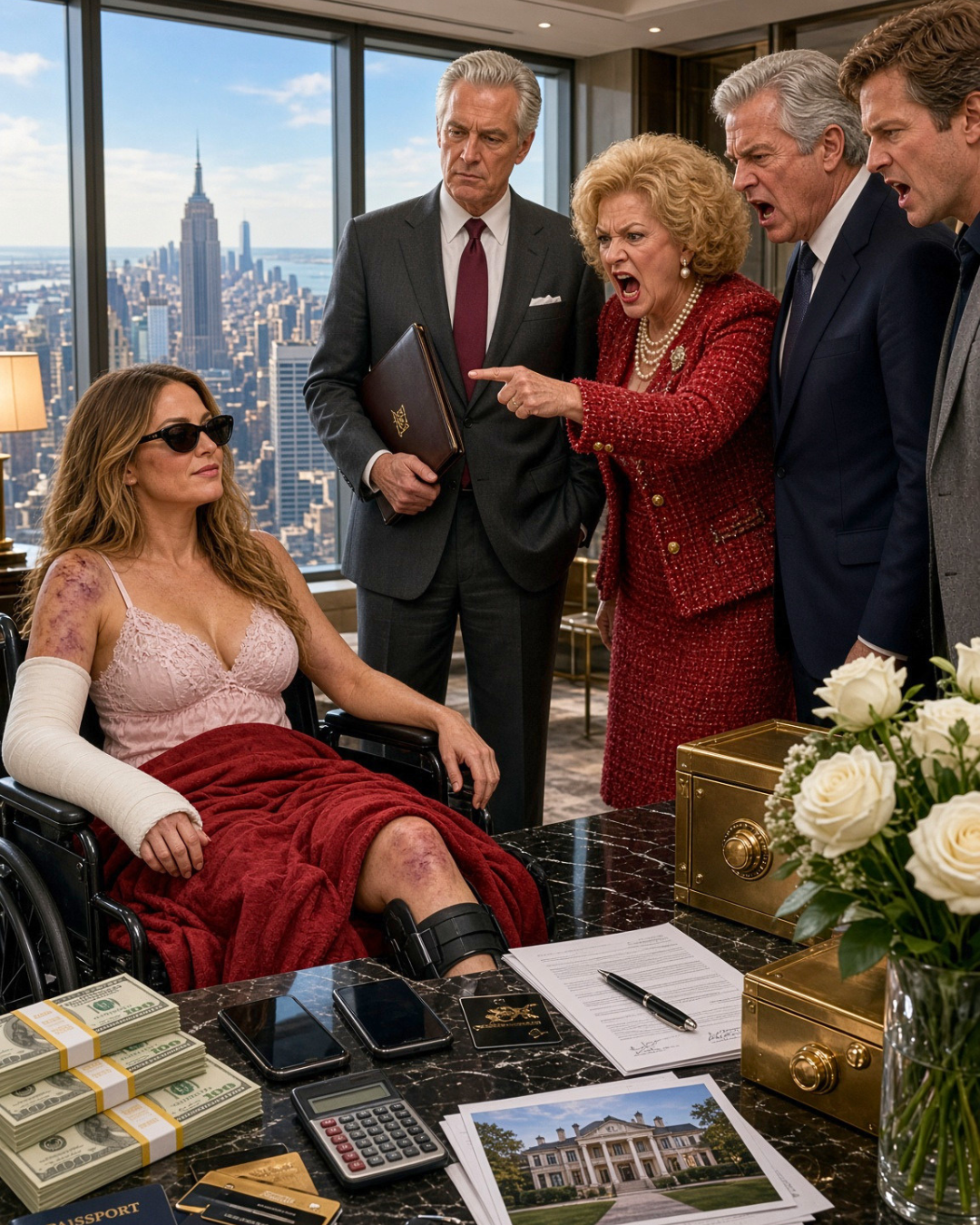
He dressed in expensive custom suits and possessed a remarkable ability to pursue legal remedies without becoming distracted by sentimental appeals.
I paid him accordingly.
“They landed in Paris roughly seventy hours ago,” Marcus said, tapping his screen, pulling up the forensic monitors I had authorized him to place on my accounts. “They checked into a luxury boutique hotel on the Rue de Vaugirard. Your mother has already charged a fourteen-hundred-dollar linen blazer, three dinners at Michelin-starred restaurants, and a private car service to your authorized emergency card.”
Clara leaned against the hospital window.
“She always did love spending blood money.”
I studied the transactions reflected in Marcus’s glasses.
“Let it clear,” I said, my eyes fixed on the digital ledger reflecting on Marcus’s glasses. “Every swipe is documented. The higher the aggregate unauthorized balance, the easier the statutory threshold for grand larceny. But look deeper, Marcus. I don’t care about the dinners. Look at Julian’s accounts. The tuition drafts.”
Marcus opened the account history.
He traced the routing information and enlarged a particular transfer.
His expression changed.
“That’s… highly anomalous,” Marcus murmured, the lawyer in him waking up.
“What is it?” I asked, leaning forward, the IV line pulling painfully at my wrist.
“The twelve-thousand-dollar draft you authorized last month for his semester tuition. It didn’t go to the French Ministry of Higher Education.”
Marcus continued following the transaction.
“It was routed through a tertiary banking clearinghouse in Cyprus. Then it was deliberately fragmented into four different shell accounts, all registered under an LLC called Le Renard Rouge.”
I stared at the screen.
“The Red Fox? That’s not a university.”
Marcus did not answer immediately.
He took out his phone and stepped into the hallway.
Through the closed door, I could hear him speaking quietly to someone.
Ten minutes later, he returned.
The expression on his face had become unreadable.
And I understood that whatever he had discovered was going to change everything.
