

PART 1
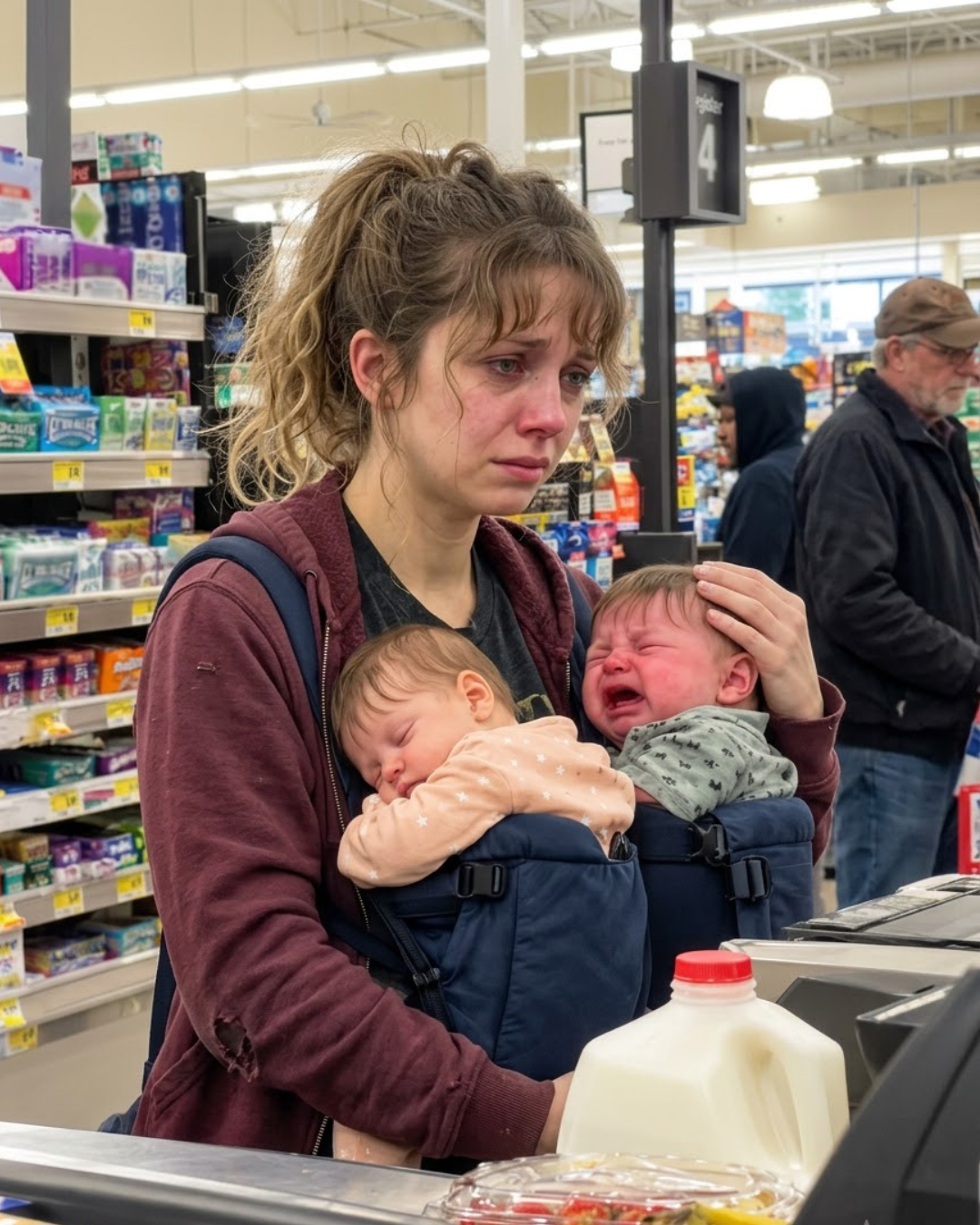
The young mother’s debit card failed on her first attempt.
She gave me an awkward, apologetic smile and tried the payment again.
When the terminal displayed DECLINED for the second time, her expression crumbled.
The man standing behind her, wearing a camouflage baseball cap, let out a loud, impatient sigh.
Farther back in the line, someone muttered, “This is ridiculous.”
One of the two babies secured against her chest was screaming, his tiny face flushed red.
She looked up at me, struggling to hold back tears.
“I’m sorry,” she whispered. “Could you take the diapers off the bill?”
I checked the amount on my register.
She needed just $8.42 more.
Eight dollars and forty-two cents.
At that moment, I had no way of knowing that paying those few dollars would uncover something my family had been searching for since my childhood.
Something that had been missing for twenty-two years.
To explain how it happened, I need to start at the beginning of that Friday.
My name is Rachel Hale. I’m thirty-four, and for the past six years, I’ve worked as a cashier at Hollis Market in Millbrook.
It’s the kind of small town where strangers attract attention and everybody seems to know something about everybody else’s life.
That morning, my alarm went off at six.
I hit the snooze button and lay in bed, staring at the water stain spreading across my ceiling.
If I tilted my head, the stain looked a little like a rabbit.
I’d been meaning to have someone inspect the roof for almost two years.
But whenever I managed to save a little money, another expense appeared.
From downstairs came the familiar sounds of my mother making breakfast.
The kettle whistled.
An old country song played quietly.
A kitchen chair scraped against the floor.
At thirty-four, I was still living with my mother.
There was a time when I would have felt embarrassed admitting that.
But after my father died, Mom and I had become each other’s closest companions.
We weren’t simply sharing a house.
We were helping each other survive.
I put on my green Hollis Market uniform and went downstairs.
“Morning, Rae,” Mom greeted me.
She sat at the kitchen table with a cup of coffee, the electricity bill spread out before her, and a pencil tucked behind her ear.
Whenever I saw that pencil, I knew the numbers weren’t looking good.
“How much?” I asked.
She took off her glasses.
“More than I expected. Especially for October.”
I sat down and examined the bill.
She was right.
“I can take another shift,” I offered.
“Rachel, you’re already working six days a week.”
“Then I’ll make it seven.”
She gave me a stern look.
“Don’t even think about it. You’re going to wear yourself out.”
“Dad used to work seven days sometimes.”
Her expression softened.
Mentioning Dad always brought a particular silence over her.
It wasn’t only sadness.
It was as though she had suddenly heard someone she loved speaking from a great distance.
“Your father,” she finally said, “was the most stubborn man I ever knew. He never understood when it was time to rest.”
“I remember.”
“And you’ve inherited every bit of that stubbornness.”
“I know that too.”
She smiled and reached across the table to squeeze my hand.
Her fingers were cold, as they usually were in the morning.
“Go to work before you’re late. And take a banana. You never eat properly.”
I took the banana.
I didn’t eat it, of course.
It remained on the passenger seat of my car all day, slowly turning brown.
My car was a battered 2009 Honda with a crack across the windshield and a check-engine light that had been glowing for so long I’d practically forgotten what the dashboard looked like without it.
When I turned the key, the engine made an alarming grinding noise.
“Please,” I whispered to the dashboard. “Not today.”
It finally started on the third try.
I gave the dashboard an appreciative pat.
During the drive, I did what I always seemed to be doing.
I added up expenses in my head.
Electricity.
Food.
Mom’s prescriptions.
Insurance.
The inevitable repair bill for my Honda.
Thursday was still several days away, and that was when my next paycheck would arrive.
According to my banking app, I had exactly sixty-one dollars.
I’d checked the balance twice.
Millbrook has one traffic light, two churches, a hardware store, and a diner called Patty’s that has served the same Tuesday meatloaf special for as long as anyone can remember.
And then there’s Hollis Market.
Working behind a checkout register in a town that small teaches you to notice things.
You see when a regular customer suddenly stops buying her favorite ice cream.
You notice when someone begins choosing the least expensive version of everything.
You learn about births, layoffs, illnesses, and struggles people rarely discuss openly.
Sometimes the groceries tell you more than the customer does.
I reached the market shortly before seven.
Lori was already there.
She was sixty-three, had worked at Hollis longer than I’d been alive, and considered herself the town’s unofficial newspaper.
“You look exhausted,” she announced.
“Lovely to see you too, Lori.”
“Those shadows under your eyes are practically luggage.”
“How flattering.”
She laughed and passed me a cup of coffee.
“Drink this. Mike says the delivery truck is running late, and we’re short on stockers.”
Our manager, Mike Delgado, was a large man with a gray beard and reading glasses that seemed permanently perched on his forehead.
He often sounded irritated, even when he wasn’t.
But I’d seen him quietly pay for groceries when customers didn’t have enough money.
During one snowstorm, he’d driven almost an hour to return medication a coworker had forgotten.
He was generous.
He just didn’t enjoy anyone noticing.
“Hale,” he called when he spotted me. “Register three. Lori’s covering two.”
“Understood.”
I went to my register, counted the cash drawer, wiped down the conveyor belt, and checked the receipt paper.
Then I looked at the small photograph taped beneath the scanner.
My father stood beside his enormous blue Peterbilt truck, arms folded across his chest, grinning as though somebody had just told him an excellent joke.
His baseball cap sat pushed back on his head.
He wore his familiar brown work jacket.
And around his wrist was a silver watch with a dark dial and an old leather strap.
Mom had given him that watch for their tenth wedding anniversary.
She’d saved almost an entire year to buy it.
It was the one expensive possession Dad had ever allowed himself.
He died when I was twelve.
Black ice had formed on Route 9 during a March night.
Dad was driving home ahead of schedule because he wanted to see us.
I kept the photograph at my register because of something he always told me.
Whenever I complained about how unfair life could be, he would crouch beside me and say:
“Rae-bug, you can’t make the whole world right. But you can make the next ten minutes better for somebody.”
For six years, I’d touched that photograph before serving my first customer.
That morning was no different.
“Morning, Dad,” I whispered.
Then the automatic doors opened, and the workday began.
At first, Friday seemed perfectly ordinary.
Mrs. Kowalski came in for cat food and prune juice.
The Jensen boys purchased energy drinks and beef jerky.
Emma Tate’s mother bought supplies for her daughter’s seventh birthday and proudly showed me a photograph of a homemade unicorn cake.
One side was noticeably taller than the other.
“It’s beautiful,” I told her.
“It’s a complete mess,” she laughed.
“Then it’s a beautiful mess.”
By lunchtime, I’d managed only a handful of crackers.
By three, my feet were aching.
And by five, the after-work rush had begun.
The aisles filled with tired shoppers.
Lines formed at the registers.
People became increasingly impatient.
At 6:40 that evening, a young woman entered the store.
I noticed her immediately because I didn’t recognize her.
She looked completely worn out.
Her long braids were gathered with a plain elastic band. She wore a baggy gray sweatshirt and jeans faded nearly white at the knees.
Across her chest was a black baby carrier.
Inside were two infants.
Twins.
They couldn’t have been more than four or five months old.
One slept with his mouth slightly open, a tiny hand resting against his mother’s shirt.
The other was crying furiously.
She gently bounced as she walked.
“I know, sweetheart. I know. Mama’s almost finished.”
She wasn’t pushing a cart.
Instead, she held a few items in her hands.
When she joined my line, four customers were ahead of her.
I watched her study the products she was carrying.
Then she checked her phone.
Then she examined the items again.
Her lips moved as she silently calculated.
I knew that look.
I’d worn it myself over breakfast.
Behind her stood Dale Pruitt, who owned an auto repair shop near the edge of town.
Dale wasn’t a bad person, but he had very little patience.
He carried a frozen pizza and a case of beer, and the baby’s crying was clearly getting on his nerves.
Eventually, the young woman reached my register.
“Good evening,” I said warmly. “Did you find everything you needed?”
“Yes, thank you.”
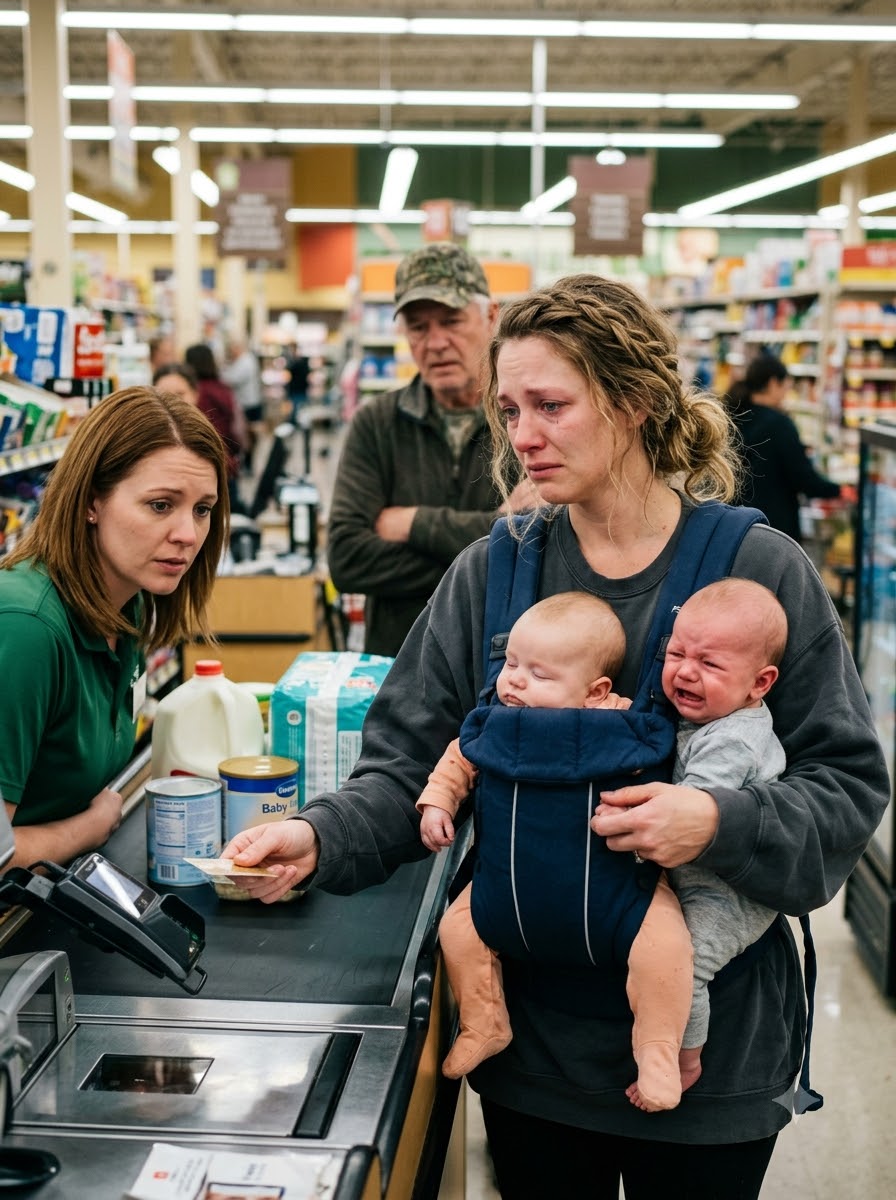
She placed three things on the conveyor belt.
A gallon of milk.
A container of baby formula.
And a package of size-two diapers.
They were the cheapest diapers in the store.
That was all she was buying.
I glanced at the infants.
“They’re adorable. Are they twins?”
She offered a tired smile.
“Yes. This noisy one is Noah. And the sleepy one is Eli.”
“Hello, Noah. Sounds like you’re having quite a day.”
Noah answered with an even louder scream.
His mother winced and managed a small laugh.
“He’s hungry, needs changing, and isn’t particularly happy with me.”
“Well, he’s certainly got powerful lungs.”
“Just like his father.”
Something shifted in her face.
For a moment, she seemed to withdraw into herself.
I didn’t ask about it.
I scanned the three items and told her the total.
She tapped her card.
The terminal beeped.
DECLINED.
“Oh,” she murmured. “That can’t be right. Could I try again?”
“Of course.”
She tried again, her fingers visibly shaking.
The payment failed a second time.
Dale let out a long sigh behind her.
“You’ve got to be kidding,” he complained. “It’s Friday night.”
Someone farther down the line called, “Can’t you open another checkout?”
The young woman’s face turned scarlet.
She searched through her diaper bag while trying to soothe Noah.
Finally, she found a wallet containing a library card, a folded paper, and a few coins.
She counted the coins twice.
Then her shoulders sagged.
“I’m sorry,” she whispered. “Would you mind removing the diapers?”
I looked at the amount on my screen.
Without the diapers, she could pay for the milk and formula.
With them, she needed another $8.42.
Eight dollars and forty-two cents.
Some people spend that much on a drink without thinking about it.
But I’d watched families struggle over even smaller amounts.
I’d seen customers return bread.
I’d watched children put birthday treats back on shelves.
And I remembered standing beside Mom years earlier as she quietly removed a package of chicken from our groceries because we couldn’t afford the full total.
Now a young mother stood in front of me with two babies, forced to decide between feeding them and buying diapers.
I thought about the sixty-one dollars in my account.
The electricity bill.
Mom’s prescriptions.
The grinding noise from my Honda.
There were plenty of reasons to protect every cent.
Then my hand brushed the photograph beneath my scanner.
Dad’s words returned to me.
You can make the next ten minutes better for somebody.
I reached into my pocket.
“Don’t worry,” I told her. “I’ll cover the difference.”
She looked up sharply.
“What? Oh, no. You really don’t have to.”
But I’d already tapped my debit card.
The terminal chimed.
APPROVED.
The receipt began to print.
Tears immediately gathered in her eyes.
She covered her mouth.
“I can’t let you do that. I don’t even know when I could pay you back.”
“You don’t need to,” I assured her. “Please. Take your groceries home and take care of those little boys.”
I put the diapers in her shopping bag.
For a few seconds, she couldn’t move.
Dale shifted impatiently behind her, then seemed to think better of speaking when he saw her tears.
The woman continued looking at me.
Then her eyes drifted toward the side of my register.
Toward the photograph.
Toward my father.
Her expression changed so suddenly that I almost asked whether she was feeling ill.
All the color drained from her face.
Her hand stopped moving against Noah’s back.
Her lips parted.
She stared at the photograph as though she had seen someone who was supposed to be impossible to find.
“Ma’am?” I asked gently. “Are you all right?”
She didn’t respond.
Her gaze remained fixed on Dad’s face.
“Is something wrong?”
She blinked and looked from the picture to me.
It seemed as though she was comparing our faces.
“Is that…”
She stopped speaking.
At that exact moment, Noah began crying harder.
His brother woke and joined in.
The line behind her was growing restless.
Another customer complained.
Whatever she had intended to say disappeared.
“I’m sorry,” she said quickly. “Thank you. Thank you so much.”
“Of course.”
She gathered her groceries and headed for the doors.
Then she turned back.
“You really don’t understand what you’ve done for me.”
Her voice trembled.
“Especially today.”
“It’s only a few dollars.”
“No,” she said firmly. “It’s not just a few dollars.”
She thanked me again before walking outside.
At the doors, she looked over her shoulder one final time.
Not at me.
At my father’s photograph.
Then she was gone.
Dale stepped forward with his pizza and beer.
I scanned the items.
“Thirty-one dollars and sixteen cents.”
He handed me cash.
As I returned his change, he hesitated.
“That was decent of you,” he muttered.
“She needed help.”
He nodded.
“Yeah. She did.”
He tucked the money into his pocket and left.
Near the entrance, he stopped briefly and looked toward the parking lot before shaking his head and walking out.
The rest of the evening passed in a haze of customers and receipts.
There were coupons to process, an obviously fake identification card presented by a teenager, and a broken pickle jar that made the store smell like vinegar.
Yet I kept remembering the woman’s reaction to the photograph.
It hadn’t seemed like casual interest.
She had recognized something.
Or someone.
Shortly before closing, Mike approached to count my drawer.
“Lori says you bought something for a customer,” he remarked.
“Only a few dollars.”
He grunted.
“You know employees aren’t supposed to do that.”
“I know.”
He finished counting, wrapped a rubber band around a stack of bills, and closed the drawer.
“Go home, Hale. You look exhausted.”
When I reached my car, the banana on the passenger seat had turned almost black.
I threw it away.
At home, Mom was waiting with chamomile tea and a crossword puzzle.
She always stayed awake until I returned, no matter how many times I asked her not to.
“There’s potato soup on the stove,” she said.
“Thanks, Mom.”
I filled a bowl and sat across from her.
After a few spoonfuls, I realized just how hungry I was.
“Long day?” she asked.
“Very.”
She studied me for a moment.
“Something happened.”
“How do you always know?”
“Because I’m your mother. Tell me.”
So I told her about the stranger and her twins.
About the rejected card.
About the impatient customers.
And about the $8.42.
I didn’t mention how little money remained in my account.
Mom already understood our situation.
When I finished, she was silent for a while.
Then a sad smile appeared on her face.
“Your father used to do things like that constantly.”
“I know.”
“No, sweetheart. I mean constantly.”
She leaned back in her chair.
“We’d be worried about the mortgage, and he’d come home telling me he’d bought gasoline for someone stranded at a truck stop.”
She shook her head affectionately.
“One December, he gave away his winter coat to a young hitchhiker outside Pittsburgh.”
“I never heard that story.”
“I was furious. He came home freezing. I told him he couldn’t possibly rescue every stranger he met.”
She looked at me.
“Do you know what he said?”
I answered softly.
“You can’t make the whole world right, but you can make the next ten minutes better for somebody.”
Her eyes glistened.
“He told you that too?”
“All the time.”
She picked up her pencil.
“That stubborn man.”
I smiled.
“I know.”
“I miss him,” she whispered.
“Me too.”
I went upstairs close to midnight, but I couldn’t sleep.
I lay staring at the rabbit-shaped water stain, replaying the young woman’s reaction.
She had looked at Dad’s photograph with unmistakable recognition.
But how could she have known him?
He had died twenty-two years earlier.
She appeared to be somewhere in her mid-thirties.
That meant she would have been a teenager when he died.
And I was almost certain she wasn’t from Millbrook.
Perhaps she had simply been overwhelmed.
Perhaps I was reading too much into it.
Eventually, my thoughts returned to the night we lost Dad.
The phone ringing at two in the morning.
Mom answering.
The sudden change in her voice.
The terrible silence afterward.
I remembered the funeral and the truck drivers who came from several states.
Some stood at the back of the church, openly crying.
Then I remembered his watch.
After the accident, the police had returned his possessions in a clear plastic bag.
His wallet.
His wedding ring.
His keys.
A few sunflower seeds.
A crumpled receipt from a diner.
But the watch wasn’t there.
Mom had called the police, the hospital, and the towing company.
Nobody knew where it had gone.
We assumed it had been thrown from the truck during the crash.
That spring, after the snow melted, Mom and I searched the roadside ditch for hours.
We never found it.
She almost never spoke about the watch afterward.
But I knew how much it meant to her.
She’d saved for nearly a year to buy it.
She had even engraved a message on the back.
Dad had worn it every day.
Then it had vanished.
I finally fell asleep imagining that old silver watch lying somewhere beside Route 9, hidden beneath wet leaves.
I didn’t know that by the following morning, I would be holding it in my own hands.
