


PART 1
I had spent seventeen years watching my son grow into a thoughtful, caring young man, and I couldn’t have been prouder of the person he was becoming. But one morning, a phone call from my closest friend left me questioning everything I believed about him.
It began on an otherwise unremarkable September morning.
Sunlight streamed through our kitchen windows, illuminating the wooden countertops while I stood at the sink. Behind me, my seventeen-year-old son, Lucas, was searching through the pantry for what must have been the third time in ten minutes.
“Mom, did you hide the granola bars again?” Lucas asked, his voice echoing from somewhere behind the tall boxes of cereal.
At thirty-nine, I had come to appreciate the simple comfort of peaceful mornings. Lucas was growing taller every day, but his gentle nature had remained unchanged since childhood.
“They are on the second shelf, right where they always are,” I replied, turning around to smile at him. “Who on earth eats four granola bars before noon anyway?”
“Gwen likes the chocolate chip ones because the hospital food tastes utterly awful,” Lucas said casually, packing the snacks into a plastic bag with the exact same careful attention he had once applied to his favorite childhood Lego sets.
I watched him carefully arrange the snacks in his bag, feeling that familiar warmth of pride.
Lucas had always been considerate of other people. He worked hard at school, stayed away from trouble, and seemed instinctively drawn toward anyone who needed kindness. Even as a little boy, he was the one who noticed a classmate sitting alone and invited them to join his friends.
A year earlier, when he started dating Gwen, I had been almost embarrassingly excited.
Gwen was the daughter of Brenda, my closest friend. Brenda and I had known each other for more than ten years, and our children had practically grown up together in Maplewood, the quiet suburban neighborhood we called home.
The evening I learned they had become a couple, I immediately called Brenda.
“I cannot believe they are finally holding hands!” Brenda had giggled over the phone that night. “We have been waiting for this moment since they were five years old!”
We had certainly hoped for it.
I still remembered the first time Lucas reached for Gwen’s hand during a summer barbecue in our backyard. Brenda and I had exchanged knowing glances, pretended we hadn’t seen anything, and escaped into the kitchen, where we laughed like teenagers.
There was something wonderful about watching two children we had loved for years discover their feelings for each other.
They were happy, comfortable together, and clearly devoted to one another.
For a while, everything seemed perfect.
Then, four months earlier, Gwen received a devastating cancer diagnosis.
The news shattered the ordinary rhythm of both families.
Only weeks before, Gwen and Lucas had been discussing college applications, debating prom decorations, and making plans for their weekends. Suddenly, Gwen’s life revolved around hospital appointments, medical tests, and exhausting treatments.
Instead of spending afternoons with friends, she often sat in a reclining hospital chair, pale and tired, with an intravenous port in her chest.
Watching her suffer was heartbreaking.
Lucas took it particularly hard.
I could see the helplessness in his eyes whenever he returned from visiting her. He wanted desperately to make things better, yet there was no simple solution to the pain Gwen was enduring.
But he never distanced himself.
He didn’t stop visiting because the hospital frightened him. He didn’t complain when their dates became afternoons spent beside a hospital bed.
Instead, he adapted.
After school, he drove to St. Vincent Medical Center, bringing Gwen whatever food she could tolerate. He helped her keep up with assignments, found movies that made her smile, and stayed with her until she was ready to sleep.
Sometimes he came home looking completely exhausted.
Still, the next afternoon, he went back.
“Are you going to St. Vincent Medical Center again today?” I asked him gently, even though I already knew the answer.
“She is having a really rough week with her new treatment,” Lucas said, carefully zipping his bag. “I promised her I would be there by four o’clock sharp.”
I nodded, wrapping my fingers around my coffee mug.
“Tell Brenda I said hello, please. I texted her yesterday afternoon, but she barely wrote back to me.”
For a moment, Lucas stopped moving.
His hand remained on his backpack zipper as he looked toward me.
“She is just really exhausted, Mom.”
“I know, baby,” I replied softly, watching him head toward the front entrance.
I understood that Brenda was struggling.
For weeks, her messages had grown shorter. Conversations that once lasted for hours had been reduced to a few words, sometimes nothing more than a thumbs-up emoji.
At first, I worried that I had said something wrong.
Eventually, I reminded myself that Brenda was living through every mother’s worst nightmare.
Between the chemotherapy appointments, constant uncertainty, and sleepless nights, she probably had very little energy left for ordinary conversations.
I couldn’t expect her to behave as though everything were normal.
Lucas came over and kissed the top of my head before picking up his keys.
That small gesture always touched me. He had grown into a tall teenager, yet he still showed affection in the same uncomplicated way he had when he was little.
“Drive carefully out there,” I reminded him as he opened the front door.
“I always do, Mom, don’t worry,” he called back with a small smile.
I watched from the window as he climbed into his old blue sedan and drove away beneath the trees lining our street.
Once the car disappeared, the house seemed unusually still.
Looking back, I realize that I had already sensed something changing between our families.
I simply didn’t understand what it was.
Over the following weeks, Gwen’s condition became increasingly difficult to witness.
Her treatments were beginning to work on her body in ways that were painful and frightening. She grew weaker, and eventually her hair started falling out.
At first, she tried to make jokes about it.
She smiled when visitors came, insisting that she was managing.
But Lucas could tell that losing her hair was affecting her far more deeply than she wanted anyone to know.
I was worried about Gwen, worried about Brenda, and increasingly concerned about how much emotional pressure Lucas was carrying.
Then one evening, he came home looking completely different.
I was sitting on the living room couch, folding clean towels, when I heard him approaching.
His footsteps sounded slower than usual.
I glanced up.
The laundry basket slipped from my hands and landed on the floor, scattering clothes across the rug.
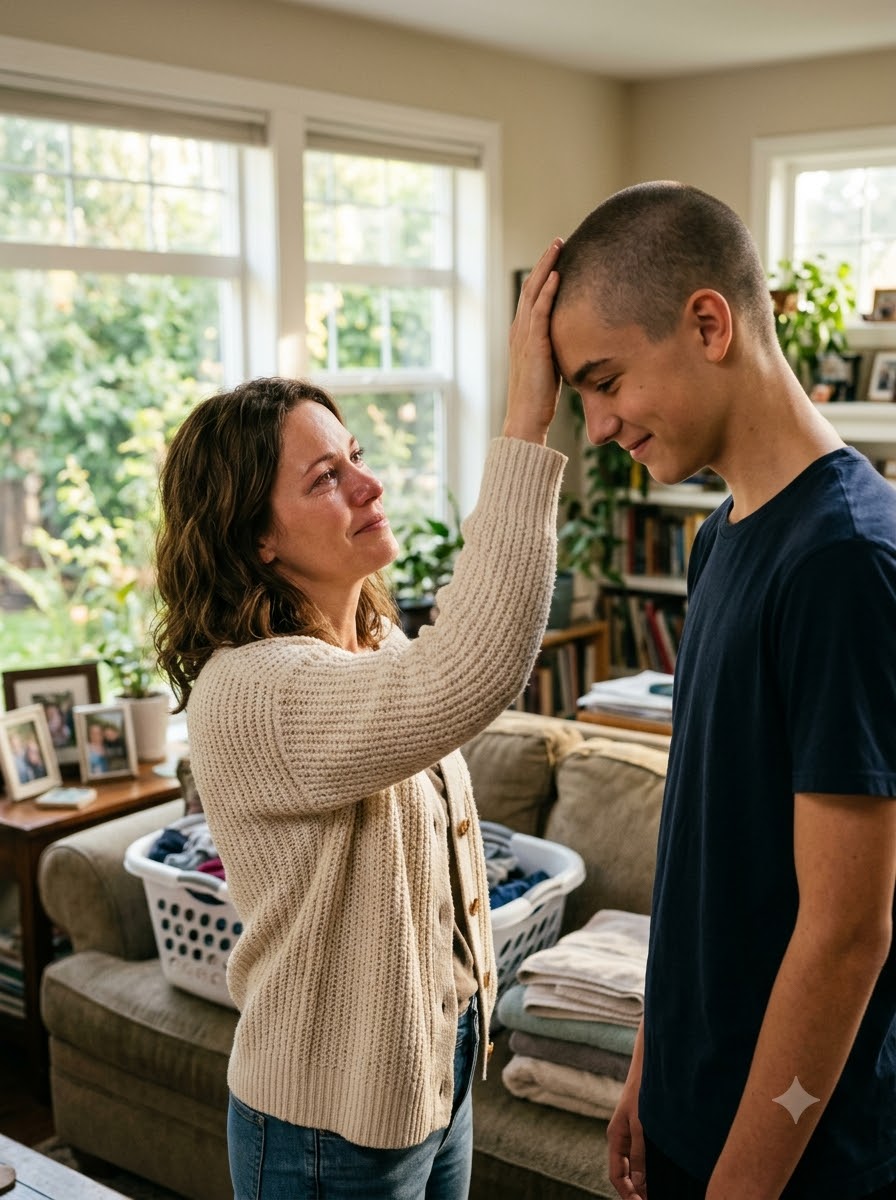
Lucas stood in front of me with his head completely shaved.
His thick brown hair was gone.
Under the warm light of the living room, his smooth scalp made him look so unfamiliar that I stared at him for several seconds before speaking.
“Lucas!” I breathed out in shock as he stepped closer to me. “What on earth did you do to your head?”
He rubbed his scalp and gave me an embarrassed little smile.
“I knew you were going to freak out a little bit, Mom.”
“A little bit?” I gasped, stepping forward to touch his cool skin where his thick brown hair used to be. “Honey, your hair is totally gone! Why would you do this?”
Lucas stood still while I examined his head.
Then his expression softened.
“Gwen is losing her hair in large clumps now, Mom. She tried to laugh it off, but I caught her crying in the bathroom when she thought I was getting coffee.”
My surprise faded immediately.
I lowered my hand, feeling my throat tighten.
Until that moment, I had been thinking about his missing hair.
Now I was thinking about Gwen, a seventeen-year-old girl facing something no child should have to endure.
“I just wanted her to know that her beauty is not tied to her hair,” Lucas explained quietly. “I wanted her to see that she does not have to go through any of this nightmare alone.”
For a few moments, I couldn’t find the words to answer him.
I had raised Lucas to treat people with kindness, but this was something he had chosen entirely on his own.
He had seen someone he loved struggling with her appearance and decided to stand beside her in the most visible way he could.
It was a small sacrifice compared with everything Gwen was experiencing, but the thought behind it overwhelmed me.
“You are such a good kid, Lucas,” I said, my voice catching in my throat. “You are a truly wonderful young man.”
He looked slightly uncomfortable with the praise and shrugged.
“I am going to head upstairs to sleep now because tomorrow is going to be a long day.”
“Are you seeing Gwen after school tomorrow?” I asked, wiping my eyes.
“Yeah, Coach Miller gave me permission to skip afternoon practice,” he answered before walking up the stairs.
I watched him disappear toward his bedroom.
Then I looked down at the towels scattered around my feet.
I had never felt prouder of him.
In a world where teenagers were often criticized for being selfish or careless, my son had quietly demonstrated an extraordinary amount of compassion.
I thought his decision to shave his head was one of the kindest things I had ever witnessed.
I had no idea that he had been planning something much bigger.
The following afternoon, I was sitting at the kitchen island when my phone began vibrating against the granite countertop.
Brenda’s name appeared on the screen.
I immediately smiled.
I assumed she was calling to tell me how Gwen had reacted to Lucas’s shaved head.
I answered cheerfully.
“Hey, Brenda!” I said warmly. “Did Lucas arrive at the room yet? I almost dropped my laundry basket when I saw his new look last night!”
But Brenda didn’t laugh.
Her voice sounded distant and unusually cold.
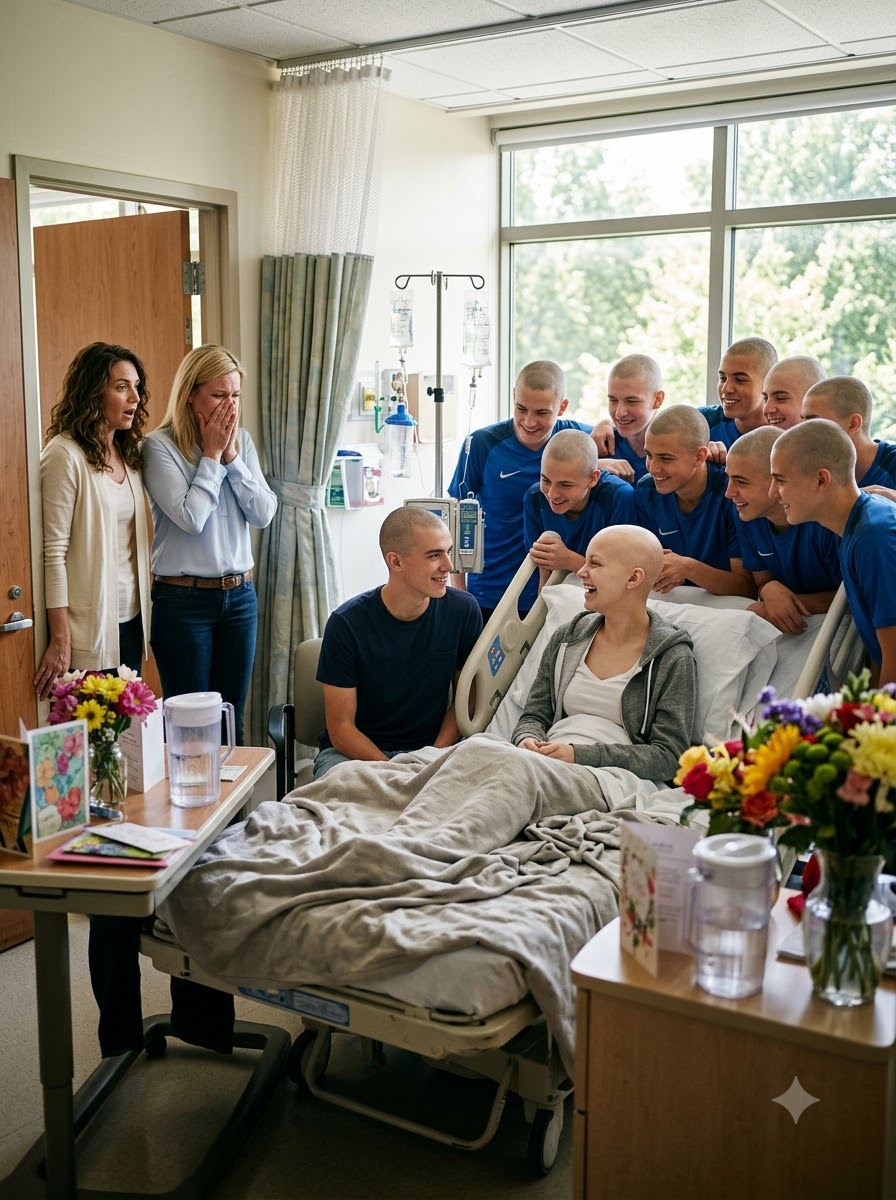
“Rachel,” Brenda interrupted, her voice flat, cold, and strangely distant. “You need to get down to the hospital right now and see what your son did.”
