

PART 1: THE SURGEON IN HANDCUFFS
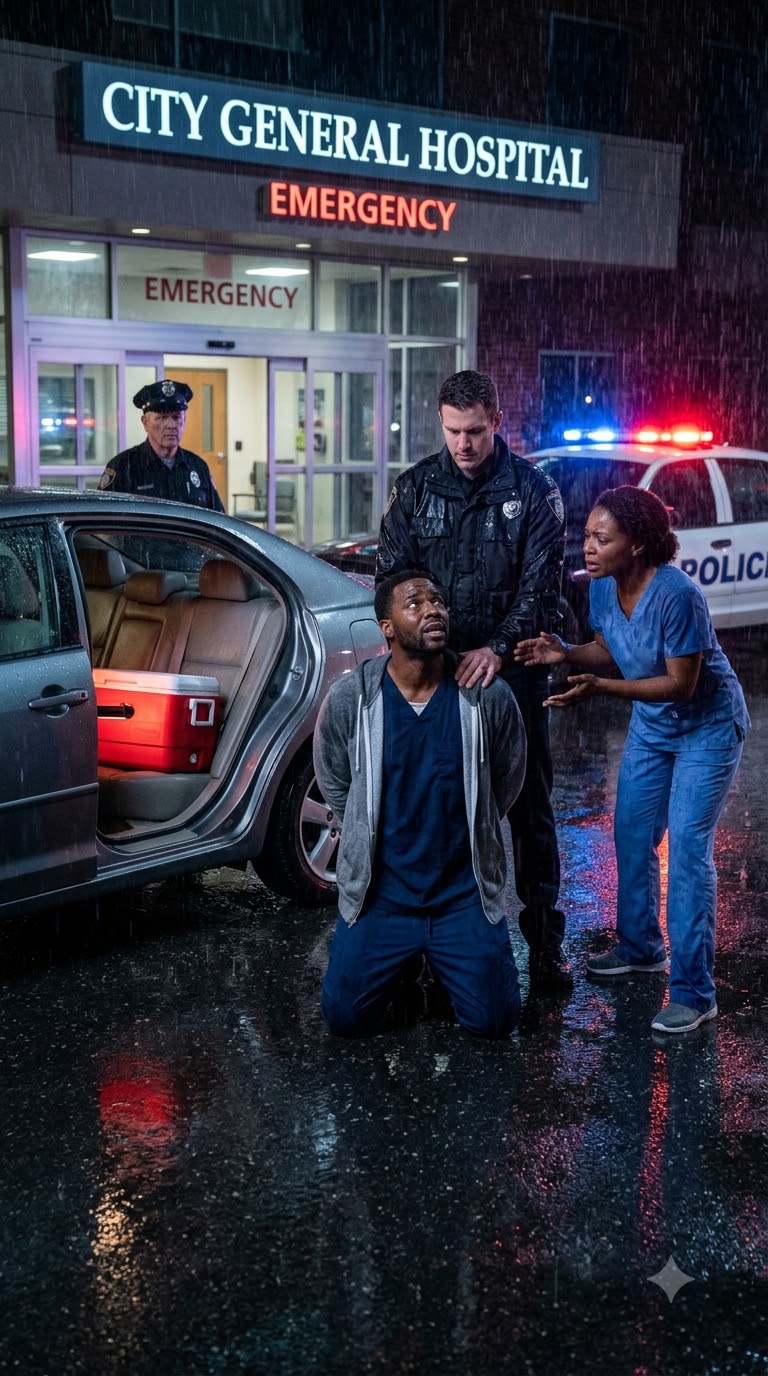
A Black surgeon who had just spent ten exhausting hours saving a patient’s life found himself kneeling on rain-soaked pavement outside the hospital where he had worked for fifteen years.
His wrists were locked in handcuffs.
His gray sweatshirt was drenched.
A police officer stood above him, refusing to listen.
Less than ten feet away, a specialized medical cooler rested inside an aging gray sedan.
Its digital warning indicator was changing color.
The container held donor heart tissue urgently needed for a transplant procedure at another hospital across the city.
Every passing minute threatened its viability.
The surgeon had explained everything.
He had offered his hospital identification, the transplant authorization, and a direct telephone number to verify his story.
The officer refused to check.
Instead, he looked at the old vehicle, the hooded sweatshirt, and the Black man behind the wheel.
He decided that was enough.
Then a dark SUV pulled up.
A woman wearing bloodstained surgical clothing hurried out and demanded that the handcuffs be removed.
The officer challenged her authority.
The surgeon raised his head.
His eyes met hers.
“My wife.”
Another vehicle arrived seconds later.
Police Chief Robert Harrison stepped onto the pavement.
He heard those two words.
He recognized the woman.
Then he looked at the handcuffed surgeon.
His expression went pale.
The woman was his daughter.
And the man kneeling in the rain was his son-in-law.
But the chief’s embarrassment was not the greatest danger that night.
Inside the medical cooler, a clock was still running.
And another patient was waiting for a chance to survive.
The rain had begun shortly after sunset.
It was not a violent storm, only a persistent autumn drizzle that soaked clothing and made every road shine beneath the streetlights.
Traffic moved through the city with a soft hiss.
Headlights stretched into blurry reflections across the pavement.
Inside Riverside Metropolitan Hospital, the evening continued with its usual urgency.
Elevators carried patients between floors.
Nurses checked monitors.
Technicians transported equipment.
Families waited in uncomfortable chairs, hoping for news.
And on the fourth surgical floor, Dr. Michael Carter was completing one of the most demanding operations of his career.
Michael was forty-three years old.
He had been a cardiac transplant surgeon at Riverside for fifteen years.
He was respected for his skill, his discipline, and his remarkable ability to remain composed when an operation became dangerous.
Residents sometimes found him intimidating.
He expected precision.
He disliked excuses.
But nurses trusted him because he never confused authority with the need to humiliate someone.
When something went wrong, he became quieter.
His instructions grew shorter.
His concentration sharpened.
That evening, he had spent nearly ten uninterrupted hours in Operating Room Four.
The patient was a sixty-eight-year-old state senator suffering from severe cardiac complications.
The surgical team had prepared for a difficult procedure.
Even so, the operation became more dangerous than anticipated.
Twice, the senator’s heart stopped.
The first interruption was brief.
The team restored the rhythm and continued.
The second lasted long enough for a junior resident to begin wondering whether they would lose the patient.
Michael did not shout.
He did not panic.
He continued directing the team, making adjustments and watching the monitors.
His hands remained steady.
Finally, the heart resumed a strong, consistent rhythm.
The resident stared at the monitor in disbelief.
Then he turned toward Michael.
“I don’t know anybody else who could have gotten him through that.”
Michael peeled off his gloves.
“Then you don’t know enough surgeons.”
The resident laughed uncertainly.
Michael was too exhausted to join him.
His shoulders hurt.
Sweat had soaked the collar of his scrubs.
His fingers trembled slightly now that the sustained concentration was over.
When the nurse confirmed the patient was stable, Michael released a long breath.
For the moment, the senator would live.
That was what mattered.
His mother, Denise Carter, worked as a nurse’s aide.
They lived in a small apartment above a laundromat, where the pipes rattled during winter and the walls offered little protection from the cold.
Denise regularly worked double shifts.
Even after returning home exhausted, she sometimes checked on elderly neighbors who had no one else to help them.
When Michael was eleven, he asked why she continued working after her shift had ended.
“You’ve already worked all day.”
Denise sat down and removed her shoes.
“Being tired doesn’t make somebody else less sick.”
He remembered that answer long after childhood.
It followed him through medical school, years of debt, residency, and countless nights spent in hospital corridors.
Michael could have built a far more lucrative career elsewhere.
Private institutions recruited him.
One offered a signing bonus large enough to purchase a house.
Another promised fewer emergency calls and significantly better compensation.
He declined.
Riverside was a public hospital.
It served wealthy donors and uninsured patients, politicians and people who had nowhere else to go.
Michael believed his responsibility was the same regardless of the patient’s financial circumstances.
When colleagues asked why he remained there, he usually answered:
“A heart doesn’t beat differently because somebody has better insurance.”
That philosophy shaped his entire career.
It also explained why, on a rainy evening after ten hours in surgery, he was still willing to accept another responsibility.
The hospital maintained several vehicles for senior physicians and important visitors.
Michael shook his head.
“I have my car.”
The administrator smiled.
“That thing still runs?”
“Most days.”
Michael drove a gray sedan that was more than twenty years old.
The paint had faded.
One hubcap was missing.
A narrow crack ran along the bottom of the windshield.
The engine occasionally made a noise that concerned everyone except Michael.
His wife had repeatedly suggested replacing it.
Michael always promised he would think about it.
Then another shift would begin, another patient would need him, and the conversation would be forgotten.
He pulled a gray hooded sweatshirt over his blue scrubs.
It was old but comfortable.
After ten hours beneath operating-room lights, he cared little about how he looked.
He collected his belongings and headed toward the exit.
Before he reached the elevator, the transplant coordinator hurried toward him.
“Michael.”
He turned.
“We have a problem.”
A scheduled courier had failed to arrive.
Specialized donor heart tissue, transported earlier from another state, needed to reach St. Catherine Transplant Institute across the city.
A patient there was already being prepared for surgery.
The tissue could not remain in transit indefinitely.
Michael asked the only question that mattered.
“How long?”
“Thirty-five minutes maximum from now.”
“No backup courier?”
“Twenty-five minutes away.”
Michael examined the sealed medical cooler.
Its sensors monitored temperature and transport conditions.
A digital display confirmed the preservation environment remained stable.
He reached for the handle.
“I’ll drive it.”
The coordinator hesitated.
“You just finished ten hours.”
“So?”
“You’re exhausted.”
Michael lifted the cooler.
“The tissue doesn’t care.”
At 8:51 p.m., he placed the container in the passenger seat of his sedan.
He fastened the seat belt around it and checked that the seals remained secure.
The contrast was striking.
A highly specialized medical transport system, representing enormous expense and years of scientific development, sat beside a cracked dashboard in a car with faded upholstery.
Michael checked his watch.
Thirty-five minutes.
He started the engine.
Then he drove out of Riverside’s parking garage into the rain.
Michael knew the fastest route to St. Catherine.
He took the hospital perimeter road, hoping to save several minutes.
The cooler’s indicator remained green.
He kept his speed controlled, aware that sudden braking could disturb the container.
Then flashing red and blue lights appeared behind him.
Michael glanced into the rearview mirror.
A police cruiser.
His first reaction was frustration.
Not because he believed he had done anything wrong.
Because he had no time to waste.
He signaled and pulled over.
He checked the cooler.
Still green.
Then he placed both hands visibly on the steering wheel.
An officer approached with a flashlight.
His name was Tyler Grant.
Thirty-seven years old.
Eleven years with the city police.
Tyler swept the flashlight across the car.
He noticed the worn upholstery.
The cracked windshield.
The driver’s hooded sweatshirt.
The medical container.
And the fact that the man behind the wheel was Black.
He knocked against the window.
“Step out.”
Michael lowered the glass.
“Officer, I’m a physician at Riverside Hospital.”
Tyler remained expressionless.
“I said step out.”
“I understand.”
Michael spoke carefully.
“I’m transporting time-sensitive donor tissue to St. Catherine.”
Tyler directed the flashlight toward the passenger seat.
“What’s in the box?”
“Donor heart tissue.”
Tyler looked at him skeptically.
“Seriously?”
“Yes.”
Michael gestured slightly toward Riverside.
“I just left Riverside.”
He began reaching toward the identification lanyard beneath his sweatshirt.
“My hospital ID is here.”
Tyler’s voice sharpened.
“Hands where I can see them.”
Michael immediately returned his hands to the wheel.
“Of course.”
Tyler studied the cooler.
Its seals and electronic display meant nothing to him.
“What are you doing driving around with a human heart?”
“It is tissue, not an intact heart.”
Michael kept his tone professional.
“It is for a transplant procedure.”
Tyler’s expression grew more suspicious.
The explanation sounded complicated.
Perhaps too complicated for what Tyler had already decided was happening.
Michael recognized the doubt.
“Call Riverside.”
He supplied the transplant department’s extension.
“Ask for transplant coordination.”
Tyler did not reach for his radio.
“Get out.”
“Officer, every minute matters.”
“Out.”
Michael glanced at the container.
“If I step out, may I secure the container first?”
Tyler moved one hand toward his belt.
“Are you refusing an order?”
“No.”
Michael slowly opened the door.
Cold rain struck his face.
He stepped out with his hands visible.
A second patrol officer had arrived.
Officer Hannah Reed was thirty-three and had spent seven years on patrol.
She approached the passenger side.
Unlike Tyler, she immediately noticed the blue surgical pants beneath Michael’s sweatshirt.
She also saw the hospital lanyard and the specialized cooler.
Riverside stood less than a quarter mile away.
Hannah looked toward her colleague.
“Maybe we should verify the ID.”
Tyler ignored her.
Michael stood beside the open driver’s door.
“Can I place the cooler securely on the hood?”
Tyler pointed at the pavement.
“Knees.”
Michael stared at him.
“What?”
“Knees.”
“Officer—”
“Down.”
For a moment, Michael looked toward the container.
The indicator remained green.
He understood that arguing might delay him further.
He also knew that physical resistance could make the situation far worse.
Slowly, he began lowering himself.
Tyler seized his arm.
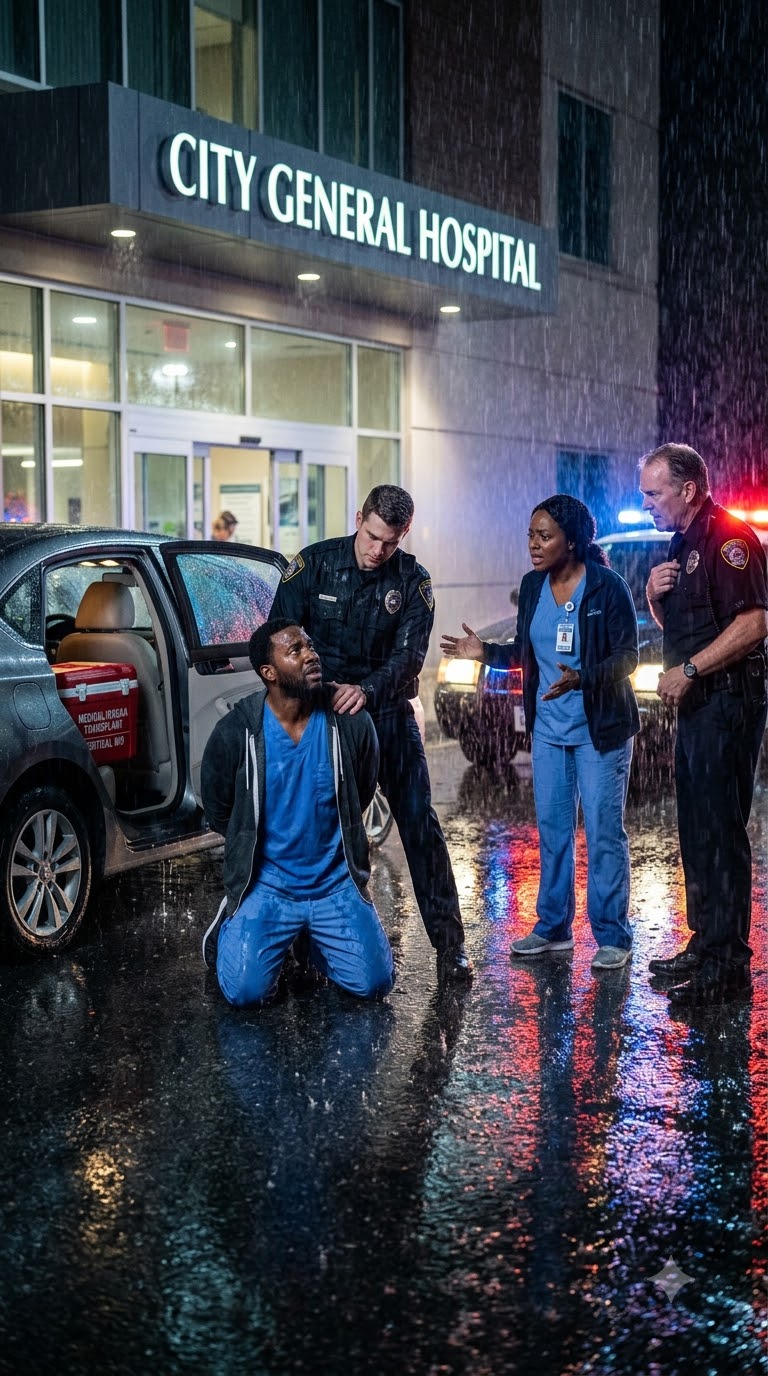
He turned Michael around and fastened handcuffs around his wrists.
The metal tightened.
Michael found himself kneeling on wet asphalt.
Only minutes earlier, those hands had helped keep a man’s heart beating.
Now they were restrained behind his back.
Rain ran down his face and soaked his sweatshirt.
Across the road, a young couple stopped beneath an awning.
One raised a phone.
A second person began recording.
Others gathered near the hospital entrance.
Employees leaving work.
Visitors.
People waiting for transportation.
Soon a dozen strangers were watching.
Tyler questioned Michael.
Michael answered.
His name was Michael Carter.
He was a cardiac transplant surgeon.
He worked at Riverside Metropolitan Hospital.
He was transporting tissue to St. Catherine.
Tyler radioed the identification information.
Then added:
“Possible suspicious transport.”
Hannah turned toward him.
“Suspicious based on what?”
Tyler offered no answer.
Michael remained still.
He had treated patients who arrived in police custody.
He knew how easily an incident could be described afterward using words such as aggressive, resistant, or uncooperative.
He did not want to provide an excuse for further escalation.
So he controlled his breathing.
He kept his voice low.
He tried to focus on the patient waiting across town.
But the minutes continued passing.
Hannah crouched beside the open passenger door.
Fine rain drifted into the car.
She examined the cooler.
The display was green.
Then it changed.
Amber.
Hannah frowned.
“Tyler.”
He did not respond.
“Tyler, this thing just changed color.”
Michael heard her.
For the first time, urgency broke through his controlled expression.
“Please check the label.”
Hannah leaned closer.
She found the hospital logo, transport authorization, barcode, patient reference details, and transplant coordinator information.
The documentation appeared official.
She turned toward Tyler.
“This looks real.”
He barely examined it.
“Anybody can print something.”
Michael raised his head.
“Call the number.”
Tyler looked down at him.
“Stay quiet.”
Before Michael could answer, a voice came from the gathering crowd.
“That man is a doctor.”
An elderly man stepped forward carrying an umbrella.
His name was George Whitman.
He was seventy-one.
Three years earlier, George had suffered a major heart attack in a grocery-store parking lot.
Michael Carter had performed the operation that saved him.
George recognized the surgeon immediately.
“That’s Dr. Carter.”
Tyler turned sharply.
“Step back.”
George continued.
“He saved my life.”
“Sir, step back.”
“I know that man.”
Tyler pointed toward the sidewalk.
“Back.”
George reluctantly retreated.
But his words had changed the atmosphere.
People began whispering.
Someone asked:
“You sure that’s him?”
George answered without hesitation.
“I spent six weeks seeing that face during follow-ups.”
“Yes.”
“That’s him.”
Hannah looked toward Michael.
She was increasingly certain the surgeon had been telling the truth from the beginning.
Then the police radio crackled.
“Unit 214, urgent callback requested from Riverside Metropolitan transplant department regarding a medical courier stop.”
Tyler heard it.
Hannah heard it.
Michael heard it.
Tyler reached toward the radio and lowered the volume.
Hannah stared.
“Did you just turn that down?”
“I’m handling the stop.”
“They’re calling about him.”
“We don’t know that.”
“They said medical courier.”
Tyler’s expression hardened.
Michael spoke from the pavement.
“Please.”
Tyler looked at him.
“Every minute reduces tissue viability.”
“Stay quiet.”
Another transmission followed.
“Unit 214, Riverside reports urgent donor transport, Dr. Michael Carter. Confirm status.”
Hannah stepped closer to Tyler.
“That is him.”
Still, the handcuffs remained in place.
The crowd grew.
A nurse leaving Riverside recognized Michael and stopped abruptly.
“Oh my God.”
She hurried toward the officers.
“That’s Dr. Carter!”
Other hospital employees emerged.
A technician recognized him.
Then another nurse.
Someone mentioned the operation that had just taken place.
“He just operated on Senator Walsh.”
The information spread quickly.
The man kneeling in the rain was not merely a doctor.
He was the surgeon who had just saved a state senator’s life.
Tyler’s posture changed.
He had heard the radio confirmation.
He had seen the documents.
He had listened to witnesses.
But he still refused to release Michael.
The encounter had become a matter of pride.
Letting Michael stand would mean acknowledging that the detention had been a mistake.
Tyler seemed more determined to defend his original assumption than to examine the evidence.
Then tires cut across the wet pavement.
A dark SUV stopped near the curb.
The driver’s door opened.
A woman in her early forties stepped out.
Her dark hair was tied back.
She wore surgical clothing, and dried blood marked one sleeve.
Her hospital badge swung from a lanyard as she hurried toward the gathering crowd.
Dr. Sarah Harrison.
Head of Emergency Medicine at Riverside.
She looked past the officers.
Saw Michael.
Saw the handcuffs.
Saw him kneeling in the rain.
Then she noticed the cooler.
Its warning indicator was amber.
Sarah’s expression changed.
“What is happening?”
Tyler turned toward her.
“Ma’am, stay back.”
Sarah continued forward.
“Remove those cuffs.”
Tyler squared his shoulders.
“Who are you?”
Sarah met his eyes.
“I am Dr. Sarah Harrison.”
She pointed toward the hospital.
“I run the emergency department inside that hospital.”
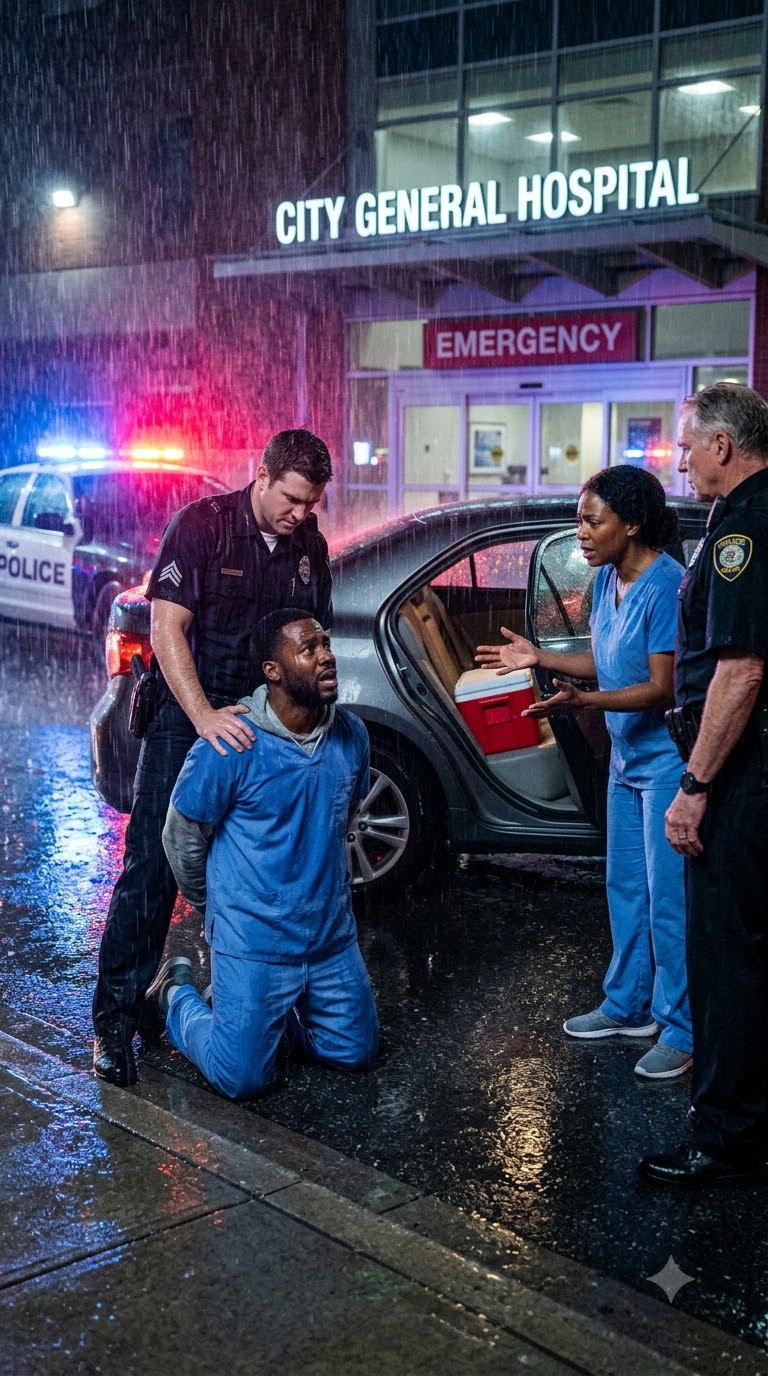
Then she indicated the cooler.
“And that man is transporting cardiac tissue under hospital authorization.”
Tyler did not move.
Sarah repeated her demand.
“Take the cuffs off.”
“Ma’am, this is an active police—”
“Did you verify his hospital credentials?”
Tyler hesitated.
“Did you call transplant coordination?”
He said nothing.
“Did you verify the chain-of-custody label?”
Tyler glanced toward Hannah.
Sarah understood.
“You didn’t.”
Tyler attempted to justify himself.
“He was initially uncooperative.”
Michael slowly raised his head.
Rain ran down his cheeks.
His eyes met Sarah’s.
For the first time since the stop began, his expression softened.
“My wife.”
Sarah looked toward him.
“I know.”
But someone else had just heard those words.
A black police SUV pulled up behind the patrol cars.
Chief Robert Harrison stepped out.
He had spent thirty years in law enforcement and seven as the city’s police chief.
He had been summoned because an encounter outside Riverside was escalating.
There was a crowd.
A possible medical emergency.
Hospital administrators were becoming involved.
Robert expected to restore order.
Instead, he heard the restrained man say:
“My wife.”
He looked at Sarah.
His daughter.
Then at Michael.
His son-in-law.
And he stopped walking.
For several seconds, Robert Harrison could only stare.
He had met Michael twice at family dinners.
He knew Michael was a physician.
He knew his daughter loved him.
But he had never taken much time to understand his work.
Now his own officers had forced that man onto his knees.
Sarah broke the silence.
“Dad.”
Tyler turned toward the chief.
Robert looked at his daughter.
Then at Michael.
Finally, he faced Tyler.
His voice was controlled.
“What is the probable cause?”
And for the first time that night, Officer Tyler Grant seemed uncertain what to say.
