

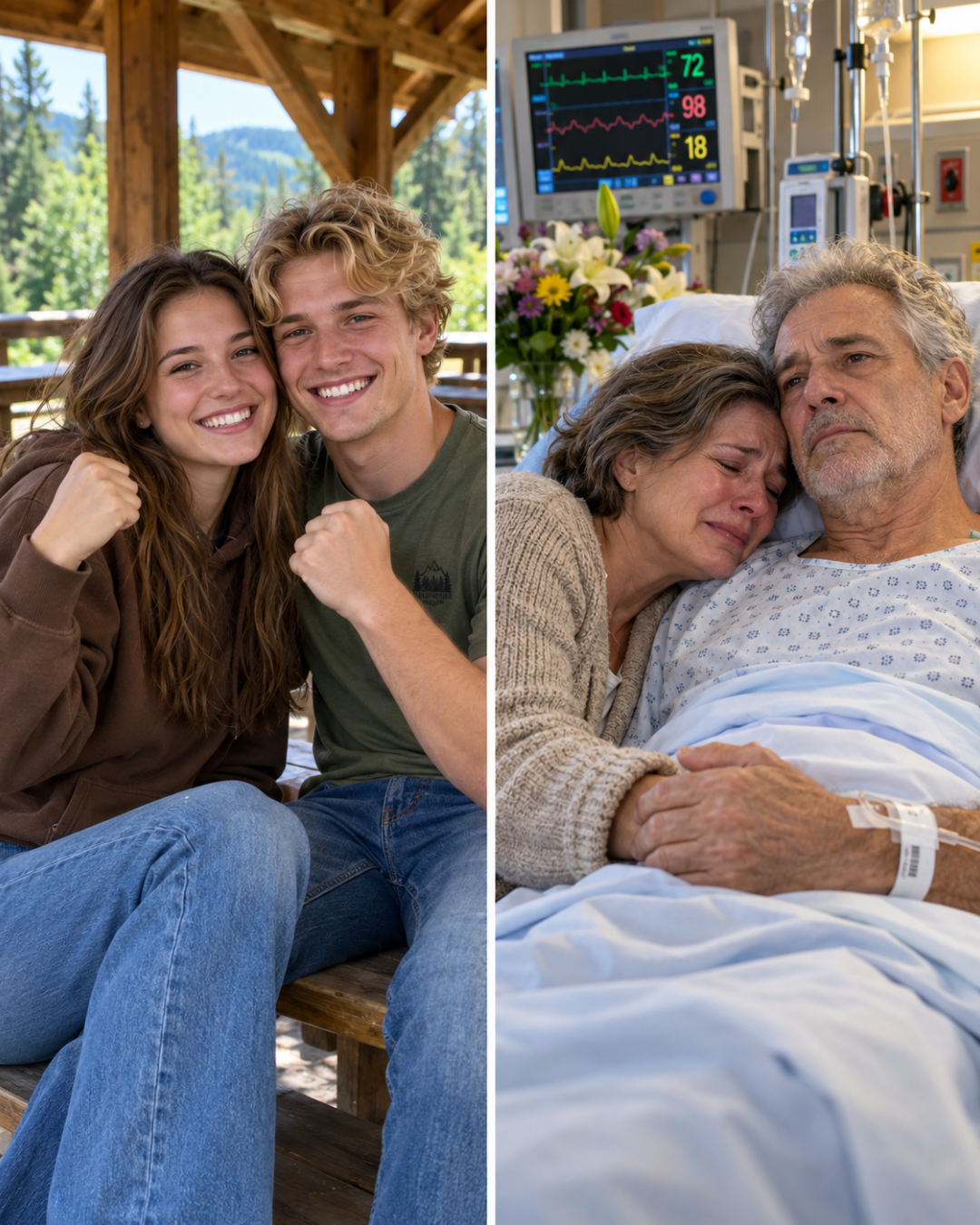
PART 1
For most of my life, I had convinced myself that certain people were meant to remain in the past, regardless of how deeply you once wished they could be part of your future.
Then, after forty-one years of silence, a familiar voice spoke my name through a telephone receiver, breaking through decades of carefully maintained acceptance.
The hospital room was located at the far end of a brightly illuminated corridor.
I stood outside its heavy door with one hand pressed against the cool wooden surface, struggling to understand how I had ended up there.
Forty-one years had passed since I had last seen Douglas in person.
Four decades had gone by since his final handwritten letter, the one in which he asked me never to contact him again because he wanted to protect the life he was beginning with someone else.
Now his adult son, Lucas, stood beside me, straightening his jacket.
“He has been asking if you are here yet.”
I turned toward him.
Lucas had inherited his father’s remarkable blue eyes, eyes I could recognize even after so many years.
“Is he awake right now?”
Lucas nodded wearily.
“He has been fighting to stay awake just to see you.”
Those words nearly made me turn around.
I was sixty years old.
I had spent nearly my entire adult life learning how to live without Douglas.
Yet forty minutes earlier, the old landline in my childhood kitchen had rung, bringing him back into my world.
Now I was standing outside a hospital room, preparing to see the man who had broken my heart.
I gently opened the door.
Douglas lay in a narrow hospital bed, looking far thinner and more fragile than the confident young man I remembered.
His dark hair had turned silver, and deep wrinkles marked his familiar face.
But despite the years and the illness, I recognized him immediately.
His tired eyes moved toward me.
“Hannah,” he whispered, his voice trembling with emotion.
My throat tightened so much that I couldn’t answer.
I stepped farther into the room.
Beside his bed stood a small wooden chair.
Something familiar rested on its cushion.
When I saw it, I gasped and stopped moving.
To understand why, I have to go back to when Douglas and I were seventeen.
We were inseparable best friends.
We weren’t officially dating.
We were simply Douglas and Hannah, two teenagers who seemed to face the world together.
I went out with other boys, and Douglas occasionally took girls from town to the movies.
I even attended senior prom with a boy from my biology class.
When my date’s car broke down in the driveway, Douglas ended up driving us.
Everyone in our small town thought we were being ridiculous.
They were convinced we would eventually realize we belonged together.
We always laughed whenever anyone suggested it.
My mother, Brenda, frequently watched us sitting at the oak kitchen table, arguing over history homework.
She would dry her hands on her apron and say, “One day, the two of you are going to figure this whole thing out.”
Douglas would grin up at her.
“Figure what out, Brenda?”
She would smile knowingly.
“You know exactly what I am talking about.”
Douglas would glance at me, and I would roll my eyes.
“We are just good friends, Mom,” I would insist every single time.
At the time, that was the only truth either of us was willing to acknowledge.
I was terrified that admitting romantic feelings might cost me my closest friend.
Looking back, I believe Douglas felt the same way.
So we kept our relationship comfortably within the boundaries of friendship.
Everything changed one summer evening when we were nineteen.
We had both endured terrible dates that night.
Mine had spent two hours talking about his collection of cars.
Douglas’s date had left early after they argued about a movie ticket.
Later, we met at our old high school football stadium.
The gates were unlocked, so we slipped inside, crawled beneath the wooden bleachers, and settled onto the damp grass.
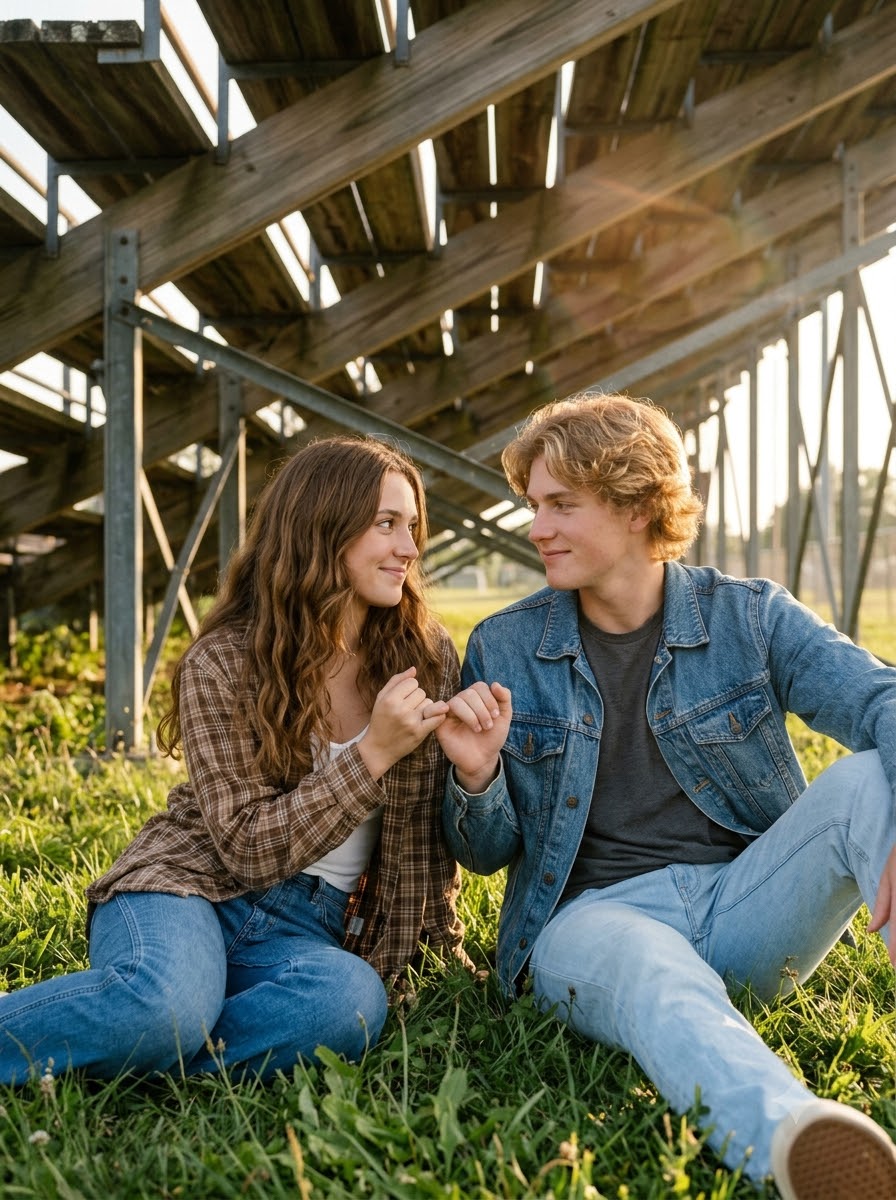
Douglas leaned against a metal support beam.
“We are completely terrible at this.”
“At dating in general?” I asked with a soft chuckle.
“At choosing the right people,” he corrected, looking up at the dark sky above us.
I laughed quietly and rested my chin on my knees.
For a while, neither of us spoke.
Then Douglas turned toward me.
“What if we never manage to get it right, Hannah?”
“We will survive either way,” I reassured him gently.
He continued, sounding unusually serious.
“What if we both end up completely single forever?”
I studied his face in the moonlight.
Douglas extended his right hand, holding out his pinky finger.
“If we are both still single at sixty, we will stop being complete idiots and find each other,” he stated firmly.
I stared at his hand.
“Douglas, you are being ridiculous.”
“I am entirely serious right now,” he replied, refusing to lower his hand.
“Why specifically sixty?” I questioned with a half smile.
“Because if we have not figured our lives out by then, we obviously need all the help we can get,” he answered softly.
I wrapped my pinky around his.
“It is a deal.”
He smiled.
“It is a deal.”
For one quiet moment, neither of us released the other’s hand.
I wanted to tell him how much he meant to me.
I wanted to admit that my feelings had already become something deeper than friendship.
But I remained silent.
Two months later, Douglas left to attend university three states away.
During our first semester apart, we exchanged long handwritten letters almost every week.
He described his untidy roommate, who never washed dishes.
I wrote about my part-time position at the downtown library and the demands of my college courses.
I complained about cafeteria meals.
He made fun of the pretentious students in his political science classes.
Throughout that first year, I knew more about his daily life than many people living in his dormitory.
Eventually, however, his blue envelopes began arriving less frequently.
Weekly letters became fortnightly ones.
Soon, I heard from him only once a month.
I assumed university was keeping him busy.
My own life was changing too.
I was working hard toward becoming an elementary school teacher, making new friends, and occasionally accepting dinner invitations.
Still, whenever anything important happened, Douglas remained the first person I wanted to tell.
During his second year away, he began mentioning a nursing student named Theresa.
He described her as witty and intelligent, someone who challenged his opinions.
He even wrote that he was certain I would like her.
That was when I finally understood what I had refused to admit for years.
I was in love with Douglas.
Completely and undeniably.
I sat on my bedroom floor with his letter in my lap and cried.
That night, I began writing him a response.
Page after page, I confessed my feelings and admitted that I believed I had loved him for years.
But when I finished, I tore every page into pieces.
If Douglas had found happiness with Theresa, I couldn’t bear the thought of interfering.
I decided to remain his friend.
In the middle of summer 1986, his final letter arrived.
Something felt wrong before I opened it.
Douglas usually began his letters with a ridiculous joke.
This one had no cheerful greeting.
“Ruthie,” the note began using his old nickname for me, “Theresa and I are getting married this coming August.”
I sat motionless at the kitchen table.
I read the words repeatedly.
He explained that they were planning a small wedding and that Theresa’s family was helping them settle into a neighborhood.
Then the letter took a painful turn.
Douglas asked me never to write or call him again.
He explained that Theresa knew how close we had once been.
He wanted to begin his marriage without anything from the past creating difficulties.
He said our friendship meant too much to risk turning it into something that might hurt another person.
The letter ended with three lines.
“I hope you have a truly wonderful life, Hannah. I am so sorry. Douglas.”
I cried for weeks.
But I respected his wishes.
I never wrote back.
I didn’t call him.
I didn’t visit his family home.
Over the years, occasional news reached me through people we both knew.
I learned that Douglas and Theresa had a son.
I heard that he had established a successful career in municipal planning.
Eventually, even those scattered updates stopped.
I never married.
I dated several good men and experienced meaningful relationships, but none became a marriage.
Whenever neighbors asked why I had remained single, I offered a simple explanation.
“I just never happened to meet the right man,” I would say with a warm smile.
It wasn’t entirely true.
I had met the man I wanted when I was seventeen.
Last Tuesday, I turned sixty.
I now live alone in the house where I grew up, having purchased it after my parents passed away.
Returning there had given me a sense of comfort.
On my birthday evening, I ate dinner alone and cut myself a slice of store-bought vanilla cake.
At exactly nine seventeen, the old kitchen telephone began ringing.
Almost nobody used that number anymore.
I nearly ignored it.
Instead, I wiped my hands on a napkin and lifted the receiver.
“Hello?”
A man’s deep voice answered.
“Is this Hannah?”
“Yes, this is she,” I replied, growing slightly confused.
“My name is Lucas,” the man explained carefully. “I am Douglas’s son.”
I sank into the nearest chair.
“Douglas’s son?”
“Yes,” Lucas confirmed softly.
“Has something happened?” I managed to whisper.
He hesitated.
“My father desperately wants to speak with you. He does not have much time left.”
I gripped the receiver.
Before I could respond, I heard movement on the other end.
Then a faint, familiar voice spoke.
“Hannah,” he breathed out softly.
Tears filled my eyes.
“Douglas? Is that really you?”
He gave a weak laugh.
“You actually remembered my voice after all these years.”
“Of course I remembered,” I replied, wiping my eyes. “I remember every detail.”
Forty-one years seemed to disappear.
Then his voice faltered.
“Hannah, I need you to listen to me carefully before I die,” he whispered.
I closed my eyes.
“What is it?”
“I was completely in love with you on the night we made that silly promise under the bleachers,” Douglas admitted softly.
I couldn’t move.
“Douglas…” I breathed out.
“And I had already gone out and bought the engagement ring,” he added, his voice breaking.
I opened my eyes.
“What ring are you talking about?”
“The ring I was planning to give you right before I left for college,” he explained weakly.
I stood so suddenly that the kitchen seemed to tilt.
“Then why on earth did you marry someone else?”
I heard him crying quietly.
“That is the exact truth I have spent forty miserable years wishing I could explain to you.”
His voice became weaker.
“I need you to come here right now, Hannah.”
“Douglas, I do not know if I can,” I stammered, overwhelmed by the sudden revelation.
“Please come to the community hospital,” he pleaded, his breathing growing increasingly uneven. “There is one item you must see with your own eyes. Once you see it, you will finally understand why I walked away from you.”
I reached for my coat.
“Tell me where you are.”
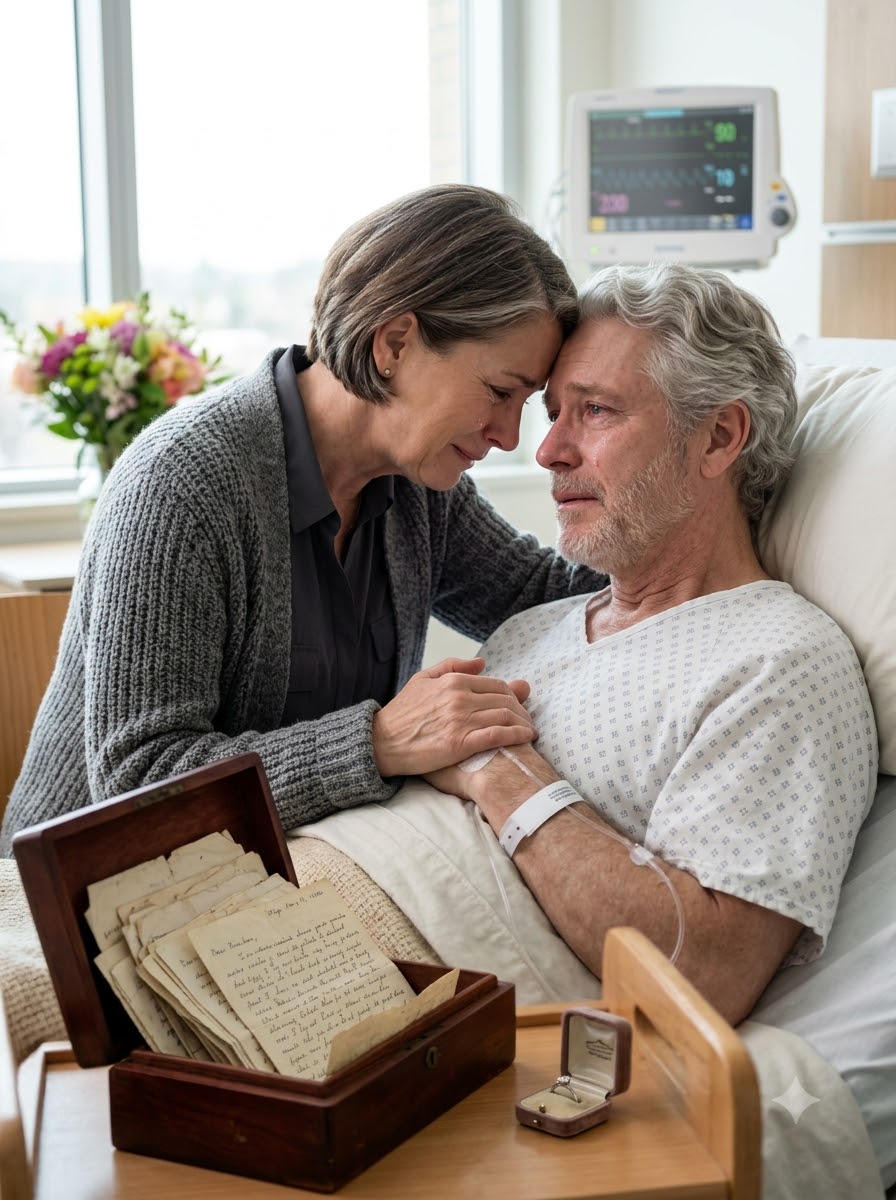
Forty minutes later, I entered his hospital room.
Douglas looked up and offered a fragile smile.
“Hey there, Ruthie,” he whispered using his pet name.
I began crying.
“Hey, you big idiot.”
Then I looked toward the wooden chair beside his bed.
And the object resting there made my heart stop.
