

The captain’s announcement came through the cabin speakers, his voice carrying a faint tremor that most passengers dismissed as routine fatigue.
“Folks, this is Captain Evans. We’re experiencing a minor technical issue. Please remain seated with your seat belts fastened.”
Most of the passengers focused on the word minor.
Pauline Sanders focused on the engine.
She had spent enough years around aircraft to know that machines had their own language.
The vibration beneath her shoes had changed.
The low, steady pulse coming from the port engine had developed an irregular rhythm. It was subtle enough that nobody else appeared to notice, but Pauline felt it immediately.
Then came the second warning.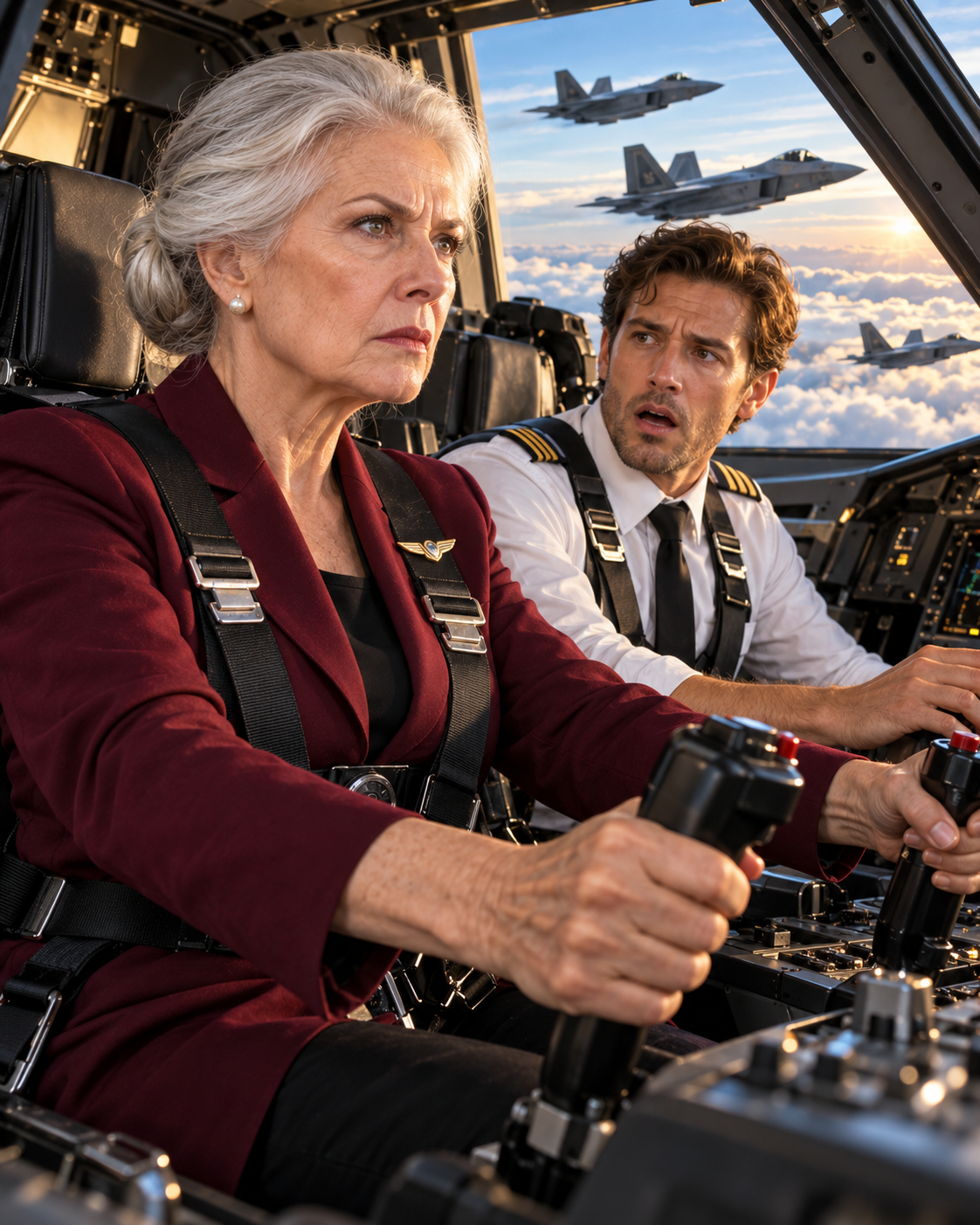
The aircraft was beginning to pull slightly to the left.
She looked toward the wing.
Something was wrong.
Pauline unfastened her seat belt and rose.
A young flight attendant named Chloe hurried toward her.
“Ma’am, the captain asked everyone to remain seated.”
“The port engine compressor is stalling,” Pauline said calmly. “He’s losing thrust symmetry.”
Chloe stared at her.
Then she gave Pauline the same gentle, patient smile people often gave elderly passengers they assumed were frightened, confused, or disoriented.
“The pilots are professionals. They have it under control.”
“They don’t,” Pauline said. “I need to speak to the first officer.”
Before Chloe could answer, the cockpit door opened.
First Officer Mark Jensen stepped into the aisle.
He looked pale.
Sweat had collected along his forehead, and the muscles around his jaw were tight.
His eyes moved toward Pauline.
All he saw was an elderly woman with gray hair and a bright red jacket standing in the aisle.
He didn’t see the hands.
Those hands had once manipulated experimental controls at speeds where a single hesitation could mean catastrophe.
They had once guided prototype aircraft through darkness, mechanical failures, violent turbulence, and instrument malfunctions when the aircraft designers themselves weren’t sure whether the machine could survive.
Mark saw a grandmother.
He didn’t recognize a pilot.
“Ma’am,” he said, forcing calm, “everything is fine. Please return to your seat.”
Pauline studied him for two seconds.
“Your autopilot just disengaged. You’re hand-flying now, and you’re struggling.”
The color drained from his face.
Because she was right.
Behind the cockpit door, Captain Evans had lost consciousness.
The port engine was deteriorating rapidly.
The aircraft was drifting toward restricted airspace.
And Mark, despite his training, was beginning to lose control of the situation.
Yet even with hundreds of lives depending on him, his pride remained louder than his judgment.
“What do you know about flying?” he snapped. “What’s that little pin on your jacket? Something from a cereal box?”
Pauline glanced down at the tarnished silver dart attached to her lapel.
For a moment, the crowded passenger cabin disappeared.
She was young again.
She could smell hot desert air.
She could hear jet engines screaming across a Mojave runway.
She remembered engineers standing behind a glass wall, watching her bring an experimental aircraft home after multiple systems failed.
She remembered landing alone while warning lights flashed across the cockpit.
She remembered the silence afterward.
And she remembered the first time someone had called her Widow 6.
Then the aircraft lurched hard.
Passengers cried out.
A drink cart rolled sideways.
Someone grabbed an armrest.
The overhead compartments rattled.
Pauline’s expression changed.
The gentle grandmother disappeared.
The test pilot returned.
“You can arrest me on the ground. But first, you need to get us there. Let me in the cockpit.”
Chloe looked at Mark.
Then she looked at Pauline.
“Let her try.”
Mark stared at both women.
For several seconds, he seemed unable to decide whether his pride or his fear was going to win.
Another violent shudder ran through the aircraft.
That decided it.
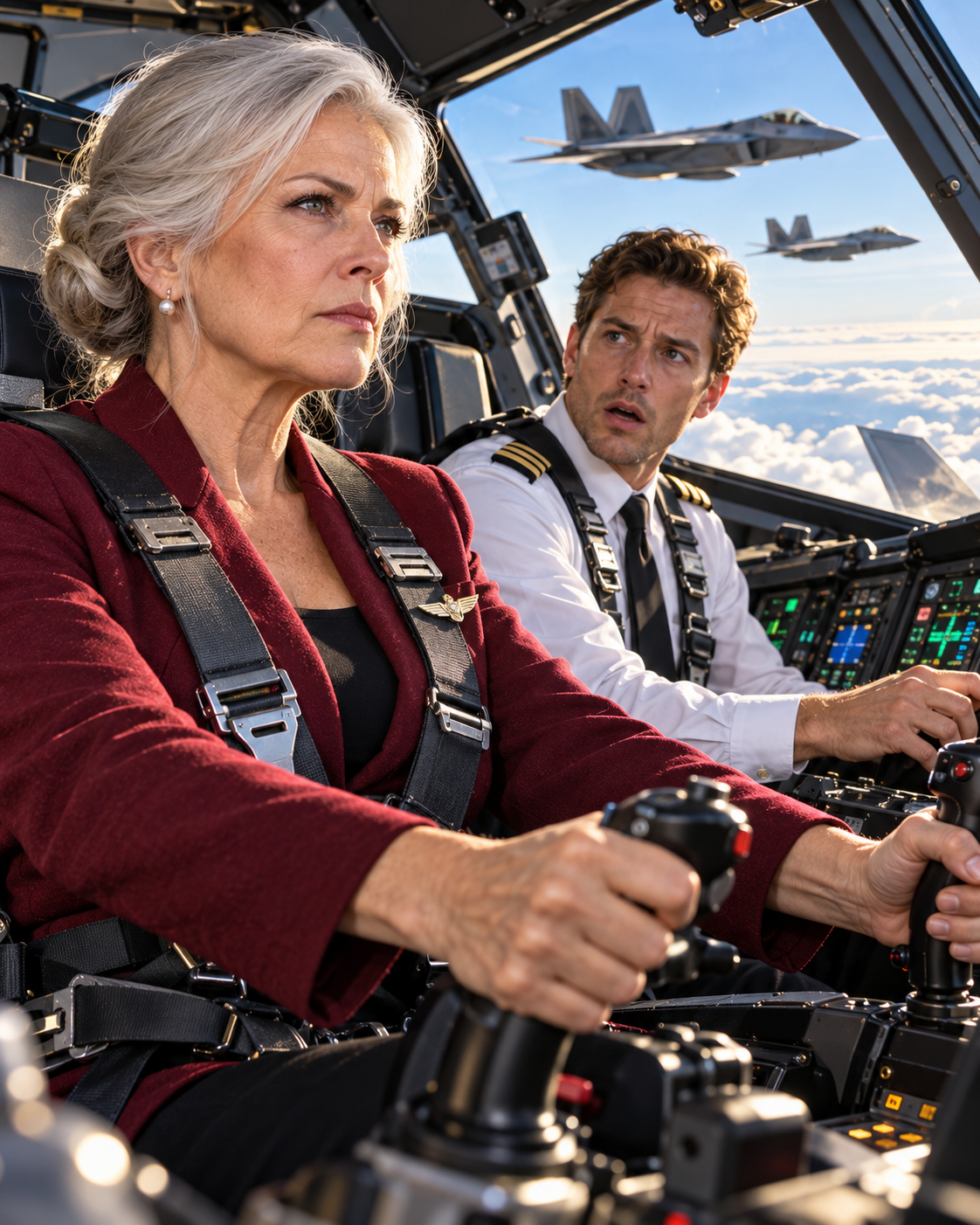
Pauline lowered herself into the captain’s seat.
Her hands moved across the controls with an ease that immediately unsettled Mark.
She didn’t search.
She didn’t hesitate.
She simply knew where everything was.
“Give me the flight controls.”
Mark swallowed.
Pauline adjusted the aircraft’s attitude, carefully compensating for the asymmetric thrust.
“Declare an emergency.”
Mark reached for the radio.
“This is Flight 728 declaring an emergency. We have an engine failure and an incapacitated captain.”
Pauline glanced at the instruments.
“Not an engine failure yet,” she said. “Compressor instability. If you keep pushing it, then it becomes an engine failure.”
Mark stared at her.
“How did you—”
“Watch the pressure.”
He looked.
The readings were deteriorating exactly as she had predicted.
Pauline made another adjustment.
“Now.”
Mark transmitted the emergency call.
The aircraft began turning toward Nellis Air Force Base.
For the first time since the crisis began, the movement was smooth.
The cabin quieted.
Passengers didn’t understand what was happening, but they could feel the difference.
The aircraft no longer seemed to fight the controls.
Pauline was flying.
Then a voice came over the radio.
“Havoc 1, we have you in sight.”
Mark looked toward the window.
Two F-35s were approaching from the horizon.
They moved with astonishing precision, one sliding into position ahead of the aircraft while the second remained slightly behind and below.
Several passengers pressed against the windows.
Phones appeared.
Whispers traveled through the cabin.
Pauline listened to the radio.
“Havoc 1,” the fighter pilot said over the radio. “State your qualifications.”
Pauline answered without hesitation.
“I have a few thousand hours in everything from a T-38 to a YF-23. My old call sign was Widow 6.”
The radio went silent.
The fighter pilot didn’t answer immediately.
Mark looked at Pauline.
She remained completely calm.
Then the voice returned.
“Widow 6… ma’am, holy cow.”
The second fighter pilot came onto the frequency.
“Confirm that identification.”
Pauline smiled faintly.
“Depends who’s asking.”
The fighter pilot laughed once, almost in disbelief.
“Ma’am, this is Havoc 2. My instructor used your flight-test reports.”
Mark’s mouth fell open.
Chloe looked at Pauline as though she had suddenly become someone entirely different.
Inside Nellis command, officers began pulling up her file.
One of them stared at the screen.
Then another officer leaned over his shoulder.
“What did you find?”
The first officer slowly shook his head.
“You’re not going to believe this.”
The file contained photographs from decades earlier.
A young woman stood beside experimental aircraft, wearing a flight suit and an expression that seemed almost identical to the one Pauline wore now.
The name at the top read:
PAULINE SANDERS.
Below it was an old designation.
TEST PILOT.
SPECIAL FLIGHT OPERATIONS.
CALL SIGN: WIDOW 6.
One of the officers whispered, “She flew the YF-23?”
“She evaluated it.”
“She’s still alive?”
“Apparently she’s sitting in the left seat of that airliner.”
Another officer looked at the aircraft’s flight path.
“Then somebody better tell that crew to listen to her.”
Back inside the aircraft, Pauline remained focused.
“Mark.”
“Yes?”
“Reduce power on the port engine.”
Mark hesitated.
“What if we lose it completely?”
“We’re going to lose it eventually. The question is whether we lose it on our terms.”
He followed her instruction.
The vibration changed.
Pauline watched the instruments.
“Good.”
Mark stared at her.
“You knew.”
“I suspected.”
“How?”
Pauline looked at him.
“Because machines repeat themselves.”
The words seemed strange to him.
Then the port engine gave another violent shudder.
The cabin lights flickered.
A warning alarm sounded.
The passengers froze.
Pauline didn’t.
“Engine two is gone.”
Mark immediately reached for the controls.
“I’ve got it.”
“No.”
Pauline’s voice was sharp.
“You’re watching the wrong instrument.”
Mark looked at her.
She pointed.
“Trim.”
He adjusted it.
The aircraft stabilized.
For several seconds, nobody spoke.
Then Chloe’s voice came over the cabin intercom.
“Ladies and gentlemen, we’re continuing our emergency approach. Please remain seated and follow the crew’s instructions.”
Her voice was trembling.
Pauline looked toward the cockpit door.
“Chloe.”
“Yes?”
“Come here.”
Chloe stepped inside.
Pauline pointed toward the passenger cabin.
“Make sure everyone understands that the aircraft is under control.”
Chloe nodded.
Then she hesitated.
“Are we going to land?”
Pauline looked at her.
“Yes.”
There was no dramatic pause.
No false reassurance.
Just certainty.
“Yes.”
Chloe returned to the cabin.
Mark watched Pauline.
“You really think we can do this?”
Pauline adjusted the controls.
“I don’t think.”
She looked at the runway appearing in the distance.
“I calculate.”
The F-35s moved closer.
“Havoc 1 to Widow 6.”
Pauline pressed the transmit button.
“Go ahead.”
“You want us to escort you all the way in?”
Pauline glanced at the fuel gauge.
“Negative. Maintain position until we’re established.”
“Copy.”
A pause.
Then:
“It’s an honor, ma’am.”
Pauline didn’t respond immediately.
Her eyes remained fixed on the runway.
The aircraft descended.
The cabin became silent.
Passengers held hands.
Some prayed.
Others stared through the windows at the two gray fighters flying beside them.
Mark’s breathing became faster.
Pauline noticed.
“Slow down.”
“What?”
“Your breathing.”
Mark inhaled.
Then exhaled.
Pauline kept her eyes ahead.
“Flying is easier when you’re not fighting yourself.”
Mark nodded.
The runway grew larger.
Pauline adjusted the nose.
“Gear down.”
Mark lowered the landing gear.
The indicators turned green.
“Flaps.”
He followed her instructions.
The aircraft descended through the final approach.
Then a gust pushed them sideways.
Mark instinctively reached for the controls.
Pauline caught his wrist.
“Don’t chase it.”
She waited.
The aircraft drifted.
Then Pauline made one smooth correction.
The nose aligned with the runway.
“Now.”
The wheels touched down.
The aircraft bounced once.
Then settled.
Reverse thrust engaged.
The remaining engine screamed.
Pauline kept the aircraft straight.
Emergency vehicles waited on both sides of the runway.
Fire crews stood ready.
The aircraft slowed.
Slower.
Slower.
Finally, it stopped.
For several seconds, nobody moved.
Then the cabin erupted.
People cried.
Some laughed.
Some applauded.
Chloe covered her face with both hands.
Mark simply stared at Pauline.
The two F-35s flew overhead one final time before breaking away.
Pauline removed her hands from the controls.
She looked at Mark.
“You did fine.”
Mark swallowed.
“I almost got us killed.”
“You almost did.”
He lowered his eyes.
“I should have listened to you.”
“Yes.”
Pauline stood.
She checked on Captain Evans, who had regained consciousness with the help of the emergency medical team.
Then she stepped into the passenger cabin.
Hundreds of eyes followed her.
The same people who had watched an elderly woman stand in the aisle now looked at her differently.
One man near the front whispered, “Who is she?”
A woman answered through tears.
“Apparently, a legend.”
Pauline shook her head.
“No.”
Everyone nearby turned toward her.
She smiled gently.
“Just an old pilot.”
A young boy sitting beside his mother raised his hand.
Pauline laughed.
“You don’t have to raise your hand.”
“Were those real fighter jets?”
Pauline nodded.
“Yes.”
“Did you fly them?”
Pauline paused.
“Not those.”
The boy looked disappointed.
Pauline smiled.
“But I flew a few things that were almost as interesting.”
That earned a laugh from the people nearby.
Outside, military personnel approached the aircraft.
Among them was a senior Air Force officer.
He stopped when he saw Pauline.
For a moment, he simply stared.
Then he smiled.
“Widow 6.”
Pauline sighed.
“I was hoping that name had finally died.”
The officer shook his head.
“Not a chance.”
He extended his hand.
Pauline accepted it.
“General Carter.”
“Pauline.”
He glanced toward the aircraft.
“You saved a lot of people today.”
Pauline looked back at the passengers.
“No.”
She glanced toward Mark.
“He did.”
Mark looked surprised.
Pauline continued.
“He made the decision to let me in.”
The general studied her.
Then nodded.
“That matters.”
Mark approached.
“Pauline.”
She turned.
“I owe you an apology.”
“You do.”
He looked embarrassed.
“I judged you because of your age.”
Pauline said nothing.
“I thought you were confused.”
“I know.”
“I even threatened to have you arrested.”
“I remember.”
Mark lowered his head.
“I was arrogant.”
Pauline looked at him for a long moment.
Then she said quietly:
“You were scared.”
Mark looked up.
Pauline continued.
“Fear makes people defensive. Pride makes them dangerous. Learn the difference.”
Mark nodded.
“I will.”
Pauline started walking away.
Then Mark called after her.
“Wait.”
She turned.
“What happened to Widow 6?”
Pauline smiled.
“She retired.”
Mark looked toward the sky.
“Apparently not.”
Pauline laughed.
“No.”
She looked at the two F-35s disappearing into the distance.
“Apparently not.”
Weeks later, the story became national news.
But Pauline refused every interview.
She didn’t want television appearances.
She didn’t want awards.
She didn’t want anyone calling her a hero.
When reporters finally discovered her old flight records, they learned that she had been one of the most respected test pilots of her generation.
She had flown aircraft that had never entered ordinary service.
She had helped engineers understand why certain prototypes behaved unpredictably.
She had survived emergency landings that had become case studies.
Her name appeared in technical reports that most people would never read.
But Pauline had never considered herself extraordinary.
She believed test pilots had one job.
Bring the machine home.
That’s all.
Three months after the emergency, Pauline received a letter.
Inside was a photograph.
Two F-35s flying beside the airliner.
On the back, someone had written:
FOR WIDOW 6.
Pauline placed the photograph on her kitchen table.
Then came a knock at the door.
She opened it.
Mark stood outside.
He was holding a small box.
Pauline raised an eyebrow.
“What is that?”
“I wasn’t sure you’d accept it.”
“Then why bring it?”
“Because I thought you should see it.”
He opened the box.
Inside was a restored silver flight pin.
The same style of dart Pauline had worn during the emergency.
She stared at it.
“Where did you get this?”
“From Nellis.”
Pauline touched it carefully.
“You shouldn’t have.”
“They insisted.”
She looked at him.
“And you?”
Mark smiled.
“I insisted too.”
Pauline held the pin in her palm.
For a moment, she remembered the young woman she had once been.
The runway.
The prototypes.
The failures.
The impossible landings.
The years when nobody wanted to believe a woman could belong in the cockpit of an experimental aircraft.
She looked at Mark.
“You know, there was something I learned a long time ago.”
“What?”
“The aircraft doesn’t care who you are.”
Mark listened.
“It doesn’t care if you’re young or old. Male or female. Famous or unknown.”
She closed her fingers around the pin.
“It only cares whether you know what you’re doing.”
Mark smiled.
“I’ll remember that.”
Pauline looked toward the sky.
A distant aircraft crossed above the neighborhood.
She watched it disappear beyond the clouds.
Then she smiled.
“Good.”
She handed the pin back to him.
“Now go become the pilot you should have been that day.”
Mark stared at her.
Then nodded.
“Yes, ma’am.”
He walked away.
Pauline closed the door.
For the first time in decades, she looked at the old flight jacket hanging in her closet.
The red jacket was still there.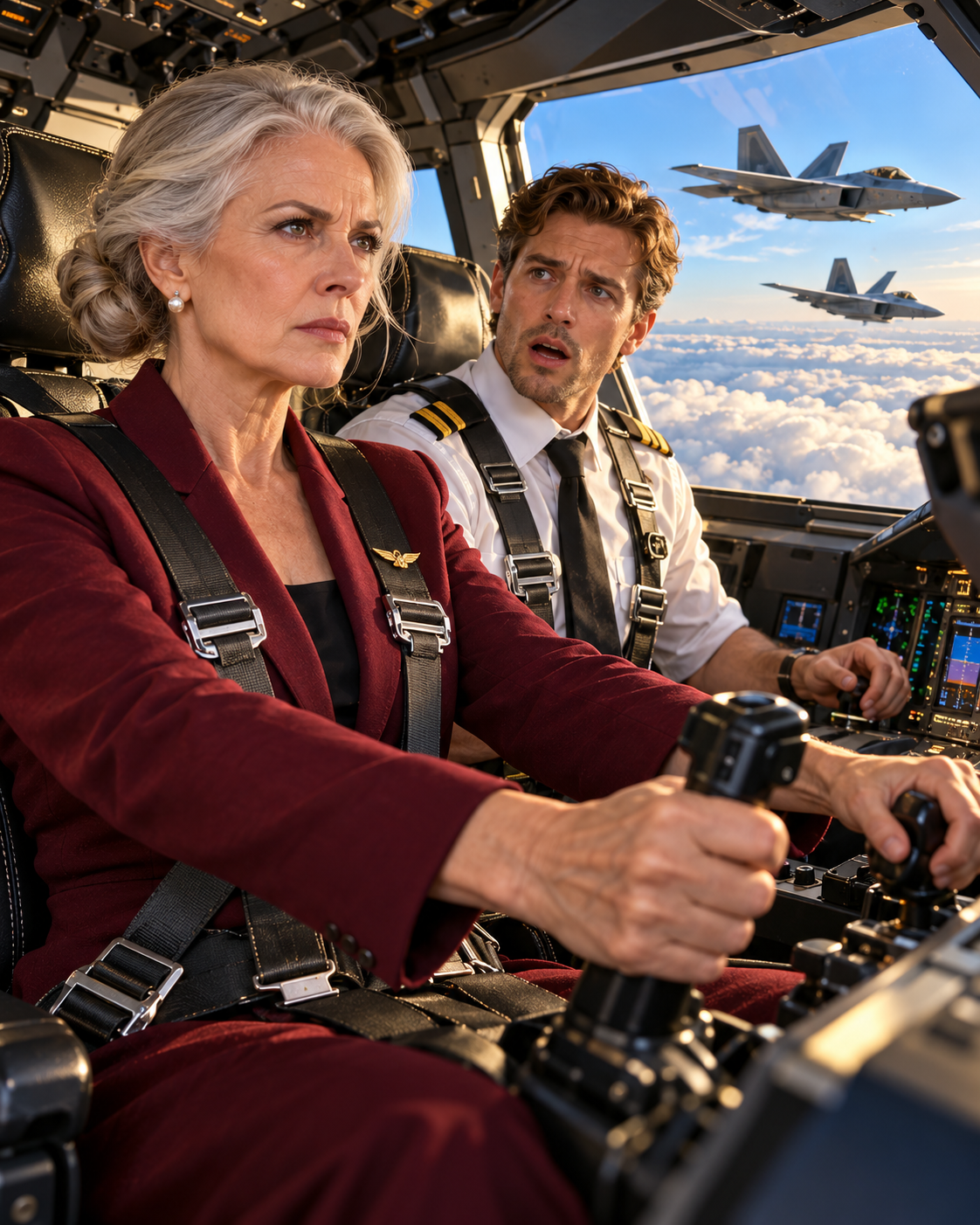
The silver pin was missing.
But the memories weren’t.
She walked to the window.
Far overhead, another jet passed through the blue afternoon sky.
Pauline listened to the distant sound of its engines.
She smiled.
Then, almost to herself, she whispered:
“Still got it.”
And somewhere far away, two F-35s continued their patrol beneath the same endless sky.
Widow 6 had finally come home.
But the legend had never really retired.
