

THE PRICE OF BLOOD AND HONEY
CHAPTER 1: THE MIRAGE IN THE DESERT
For one thousand and twenty-two days, my life was defined by the crisp snap of starched Egyptian cotton, the sharp sting of lemon disinfectant, and the relentless, blinding heat of the Persian Gulf sun.
I worked as the executive housekeeping supervisor at The Al-Mirqab Grand, a towering structure of polished marble and tinted glass that rose like an arrogant silver needle above the white heat of Doha, Qatar. In a world filled with oil sheikhs, visiting diplomats, and high-fashion jet-setters, perfection was not something to strive toward—it was simply the minimum requirement. If an imported crystal carafe had even one fingerprint, it was replaced. If a thread came loose along the edge of a five-hundred-dollar pillowcase, it was burned. I learned to run my fingertips across the tops of armoires and window lintels, searching for the invisible dust carried by the desert shamal and catching every microscopic imperfection before anyone else noticed it.
I lived like an ascetic in a windowless studio inside the worker dormitories of the industrial district. I survived on cold lentils, canned tuna, and flatbread from the previous day. While my coworkers spent their stipends wandering through the air-conditioned maze of the Villaggio Mall, I saved every riyal I could, counting down to the twenty-eighth of every month.
Payday.
On the twenty-eighth, I would walk through the midday furnace to the exchange house, wiping the salt from my eyes, and wire four thousand five hundred dollars straight to Florida.
To my husband, Mark Vance.
Mark and I had met six years earlier at an art opening in Sarasota. I was catering canapés, while he was charming potential clients for his new boutique logistics company. He had teeth that flashed white against his perpetual coastal tan, hair the color of toasted hazelnuts, and a voice that wrapped around you like an expensive cashmere cardigan. When my father suddenly died from a cerebral hemorrhage, Mark held me on the beach until my sobs disappeared into the surf. When my mother, Rose Morales, fell down our porch steps and shattered her pelvis in two places, requiring extensive double-pin reconstructive surgery, Mark immediately took charge with calm, reassuring authority.
“Don’t put her in one of those state warehouses, Elena,” he had urged me, clasping my trembling hands inside his warm, dry palms. We were sitting in the fluorescent waiting room of the rehabilitation clinic. “You’ve seen those facilities. They let old people wither away in their own filth. My mother, Brenda, was an auxiliary nurse for twelve years. Heather is taking community college classes online and has all the time in the world. We’ll bring Rose into our house in Palmetto Grove. We’ll make her bedroom a sanctuary.”
I had cried with gratitude. But even then, I knew love couldn’t cover the cost of motorized hospital beds, targeted neuromuscular therapy, blood thinners, and attendants around the clock. Mark’s company had suffered serious cash-flow problems after a maritime contract collapsed. We were sinking beneath Rose’s growing medical expenses.
So when an international hospitality headhunter offered me forty-two hundred dollars a month tax-free, along with room, board, and performance bonuses for an overseas contract in Qatar, I didn’t hesitate. I packed two suitcases, kissed my mother’s papery forehead while she drifted through a post-surgical haze, and left for the desert.
“It’s only for twenty-four months, baby,” Mark had promised at the airport gate, kissing my chapped lips. “We’ll treat her like a queen. When you come home, the debts will be gone, your mom will be walking again, and we can finally start our own family.”
Twenty-four months became thirty. Then thirty-two. Every time my contract approached renewal, Mark came up with another catastrophic expense: specialized orthopedic injections that our supplemental insurance wouldn’t cover, an automated mechanical hoist for the bath, custom dietary infusions shipped from a homeopathic clinic in Atlanta.
“It’s working, El,” he would tell me during grainy WhatsApp voice calls, his voice crackling across seven time zones. “She stood up yesterday. Brenda had her out on the back patio drinking fresh peach tea. But the physical therapist says if we stop the deep-tissue stimulation now, the scar tissue will freeze her joint forever. We just need six more months. Can you do six more months?”
I took double shifts. I supervised seventy floor-maids across twenty-eight stories. I swallowed my exhaustion with cheap instant coffee.
Every Sunday, Mark sent evidence.
There was Mom, sitting upright beside a sunlit window overlooking the swaying palms in their Fort Myers backyard. She wore a thick gray cardigan, her silver hair brushed into a neat chignon, her lips parted in what appeared to be a frail, peaceful smile.
A month later, another photograph: Mom beside the same window, a turquoise fleece throw draped around her shoulders.
Two months later: Mom wearing a floral blouse, framed by the same cream-colored curtains as afternoon sunlight fell across her cheekbones.
But whenever I asked for a live video call, there was always an obstacle.
“She just drifted off, sweetie. You know the pain meds knock her out cold by seven.”
“The hurricane damaged the fiber-optic line on our block; our bandwidth can barely handle audio.”
“Mom’s having an anxious day, Elena. Seeing you through a screen confuses her—she thinks you’re trapped inside the phone. The doctor said we have to avoid sensory agitation.”
I wanted so badly to believe him that I willingly helped blind myself to the warning signs. I ignored the tight knot forming beneath my ribs every time I sent another wire.
Until eight days ago.
It was three in the morning in Doha. Outside my dormitory window, the Persian Gulf lay flat and black as obsidian. My phone buzzed on the nightstand—not the long musical ring of an ordinary call, but the short chime of an incoming multimedia message.
It was an audio file from Mom’s old cellphone number—a phone Mark had told me was permanently disconnected after she dropped it into a basin of water eighteen months earlier.
I pressed my ear against the tiny speaker.
The recording lasted exactly three seconds.
There was no greeting. No background music. Only the harsh, wet sound of ragged breathing, followed by a violent wooden crash—like a chair being kicked against floorboards. Then came a voice, raspy, strangled, and filled with an animal terror that chilled the sweat on my neck:
“Elena… the papers… don’t sign anything—”
A muffled grunt cut her off. The line went dead.
Five seconds later, the message disappeared from my screen. A gray system notification appeared: This message was deleted by the sender.
My hands shook so badly that the phone slipped from my grip and struck the bare linoleum. Before I could retrieve it, the screen lit up again.
It was Mark calling.
I answered and pressed the phone to my ear. “Mark?”
“Elena?” His voice was perfectly measured—a light chuckle mixed with sleepy exasperation. “Did you just get some weird glitch from my cloud backup? I was cleaning out an old drive to free up space for Mom’s medical charts, and I think some corrupt sound files synced automatically.”
“That was Mom,” I said, my heart pounding against my ribs like a trapped bird. “Mark, that was my mother’s voice. She was crying. Someone was hurting her.”
Mark sighed, slowly and patiently, making me feel suddenly childish. “Elena, honey. Listen to me. Take a breath. Your mother has been deteriorating mentally for three months. I didn’t want to tell you because I know how hard you’re working over there, but her cognitive decline has accelerated. She gets paranoid. She hides things. Last night she tried to strike Brenda with a plastic cup because she thought Brenda was trying to steal her wedding ring.”
“She said ‘don’t sign anything,’ Mark! What was she talking about?”
“She was hallucinating, Elena!” His tone sharpened, the gentle veneer falling away for a moment and exposing the hard, cold iron beneath it. “She doesn’t know where she is half the time! Don’t turn this into a tragedy from three thousand miles away. You’re exhausted. You’re stressed. Leave the caregiving to the people who are actually on the front line while you’re safe in an air-conditioned hotel.”
He hung up.
I remained in the darkness for ten minutes, listening to the hum of the dormitory refrigeration unit. Then I picked up my phone and called Clara Benitez, a prominent elder-law and civil litigation attorney in Miami whose business card a wealthy expatriate guest had given me two years earlier.
“Clara,” I whispered into the darkness. “I need an emergency retainer agreement. And I need you ready to drive across the state line to Lee County.”
Thirty minutes later, I walked into the HR office of The Al-Mirqab Grand, placed my company security badge on the desk, surrendered my end-of-contract completion bonus, and booked the next direct flight to Miami International. CHAPTER 2: THE HOUSE ON PALMETTO GROVE
The thick, humid heat of Southwest Florida struck me the instant I stepped outside the terminal, carrying the smells of brackish water, decaying mangroves, and exhaust. It was a suffocating swamp-like atmosphere, completely different from the dry, mineral heat of the Arabian Peninsula.
I had rented an ordinary silver sedan and paid in cash. I drove across Alligator Alley with both hands fixed at ten-and-two on the steering wheel, my knuckles white, the speedometer holding around eighty miles an hour. An empty overnight bag sat beside me, while inside the front mesh pocket of my canvas backpack was a tiny high-resolution surveillance camera connected to an auxiliary battery pack, its wide-angle pinhole lens looking through the fabric like a glossy spider’s eye.
I arrived at Palmetto Grove at exactly nine-thirty that morning.
The neighborhood looked like a postcard of gated suburban wealth. Carefully manicured St. Augustine lawns glowed bright green beneath automated sprinklers, while tall royal palms moved gently in the Gulf breeze. When I turned into the driveway of number 412, I had to look twice at the brass numbers.
The modest pale-yellow stucco ranch house I had left three years earlier was gone. In its place was a freshly painted two-story addition with charcoal trim, custom hurricane shutters, and a stamped-concrete driveway. Beneath the portico sat a polished black German sports sedan I had never seen before, its chrome wheels shining in the morning light.
My stomach seemed to drop into an endless void.
During thirty-four months, I had sent Mark one hundred and fifty-three thousand dollars. Every dollar was supposedly being used for round-the-clock physical therapists, orthopedic medications, specialized organic meal deliveries, and private medical equipment.
I followed the paver walkway to the front door. It was solid mahogany with frosted glass inserts. I didn’t knock. I pulled my old brass house key from my key ring, inserted it into the newly installed deadbolt, and held my breath.
It didn’t fit.
The cylinder was completely different.
A flash of red anger cut through the exhaustion clouding my mind. I pressed my thumb against the illuminated video doorbell and held it there until the mechanical chimes echoed repeatedly through the house.
Ten seconds later, the deadbolt clicked.
The door opened, revealing my sister-in-law, Heather Vance. She wore silk lounge pants and held an insulated tumbler of iced coffee. Her hair was professionally highlighted, and her fingernails were painted a flawless crimson.
The moment she saw me, the tumbler tipped in her hand, spilling brown liquid across the white stone foyer.
“Elena?” she squeaked, the color draining from her face so quickly that her spray tan looked like dried mud. “What… what are you doing here? You’re not supposed to be back until the winter!”
“Where is my mother, Heather?”
“She’s… she’s out!” Heather stammered, stepping backward and trying to pull the door closed. “Brenda took her to… to a clinic in Naples! For her hip therapy! You should have called, we would have picked you up from the airport—”
I didn’t argue.
I didn’t raise my voice.
I simply lowered my shoulder, forced the heavy mahogany door against its frame, and stepped inside.
The interior left me breathless.
The low-ceilinged living room I remembered had been transformed into a huge great-room layout. An eighty-five-inch OLED television hung above a new linear electric fireplace. Cream-and-taupe Italian leather sectionals filled the space. On the marble kitchen island sat a three-thousand-dollar commercial espresso machine. Against the wall stood a glass display cabinet packed with designer handbags and crystal decanters.
My mother-in-law, Brenda Vance, sat on a leather stool at the island. She was dressed in an expensive linen caftan, calmly spreading butter over an artisanal brioche.
Around Brenda’s neck, catching the recessed ceiling lights, hung a heavy oval gold pendant with an emerald-cut sapphire—an heirloom my grandfather had smuggled out of Havana sixty years earlier, an heirloom that had belonged around my mother’s neck since she was sixteen.
Brenda froze, her butter knife suspended in the air.
“Elena?”
“Nice necklace, Brenda,” I said, my voice dangerously calm and completely flat. “I see my hard-earned tips from Doha bought you quite the lifestyle upgrade.”
Before Brenda could find a response, the garage door opened, and Mark walked inside. He wore tailored linen shorts and a polo shirt, carrying a pair of titanium golf clubs.
“Heather, who was at the—”
He stopped.
The golf bag slipped from his hand and crashed against the polished porcelain tile.
“Elena?” His lips parted, his handsome face frozen in complete shock. He blinked as though trying to make an unwanted phantom disappear in the Florida heat. “You… your contract doesn’t expire for another two months. What happened? Were you fired?”
“I asked for my mother,” I said, moving toward him as my boots clicked sharply against the tile. “Where is she, Mark?”
Mark quickly composed himself. He stepped forward with his arms open, wearing that familiar, intoxicating smile of deep affection.
“Baby, calm down. First of all, welcome home. You should have told me you were landing! Brenda was just about to tell you—Rose is at an inpatient center in Sarasota this week. They’re doing an intensive clinical trial on her spinal reflex—”
Thump.
The noise was faint and muffled by several layers of drywall, but there was no mistaking it. It came from directly above us, toward the back of the second-story addition.
Then came a rhythmic scraping sound.
Scrape.
Thump.
Scrape.
Mark’s jaw twitched.
Heather immediately dropped her iced coffee into the sink with a loud clatter.
“I thought you said she was in Sarasota, Mark,” I whispered.
“Elena, wait!” Mark lunged toward me and grabbed my wrist. “Don’t go up there! We have a tenant! We’re renting out the bonus room to an elderly gentleman to help pay for Mom’s—”
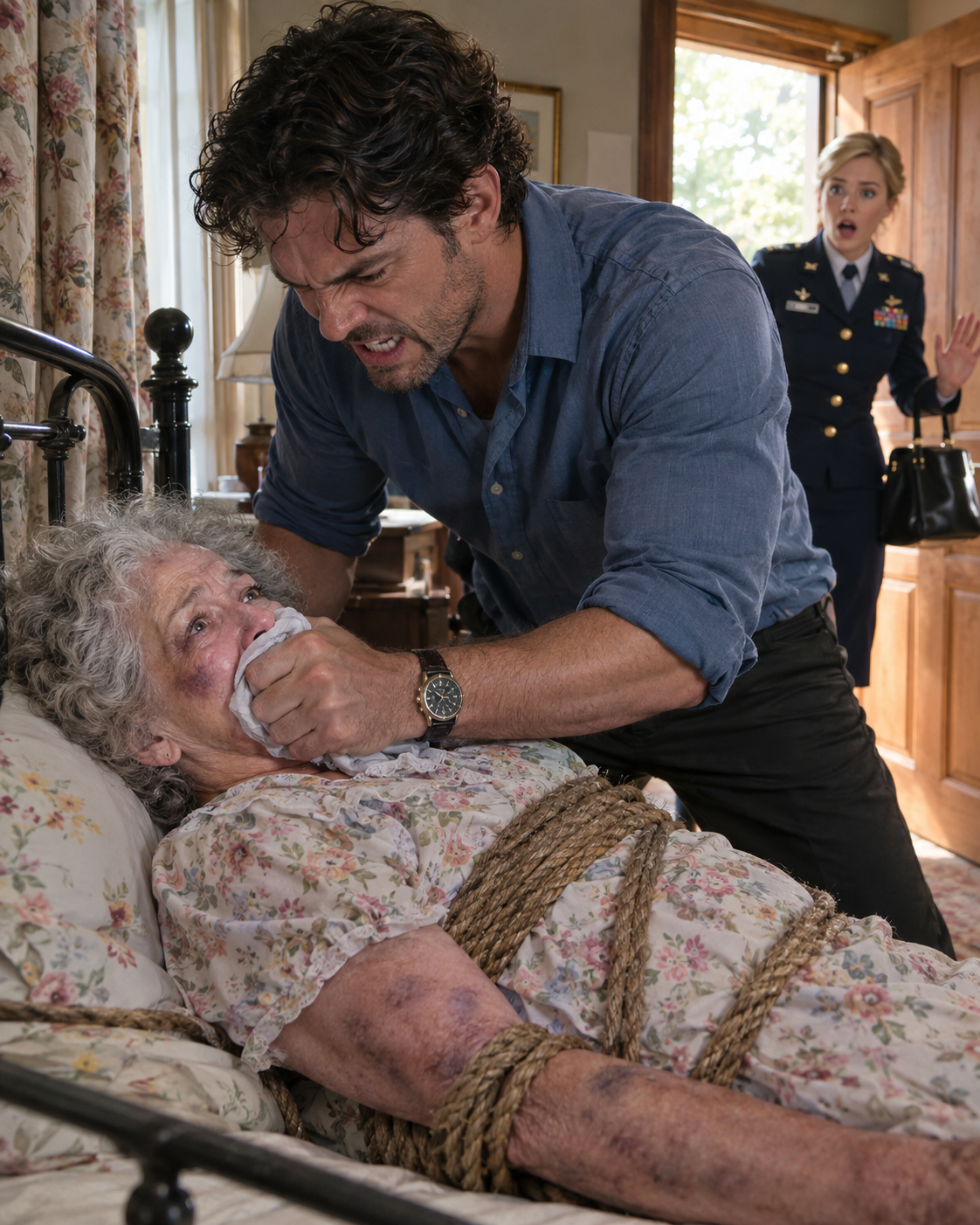
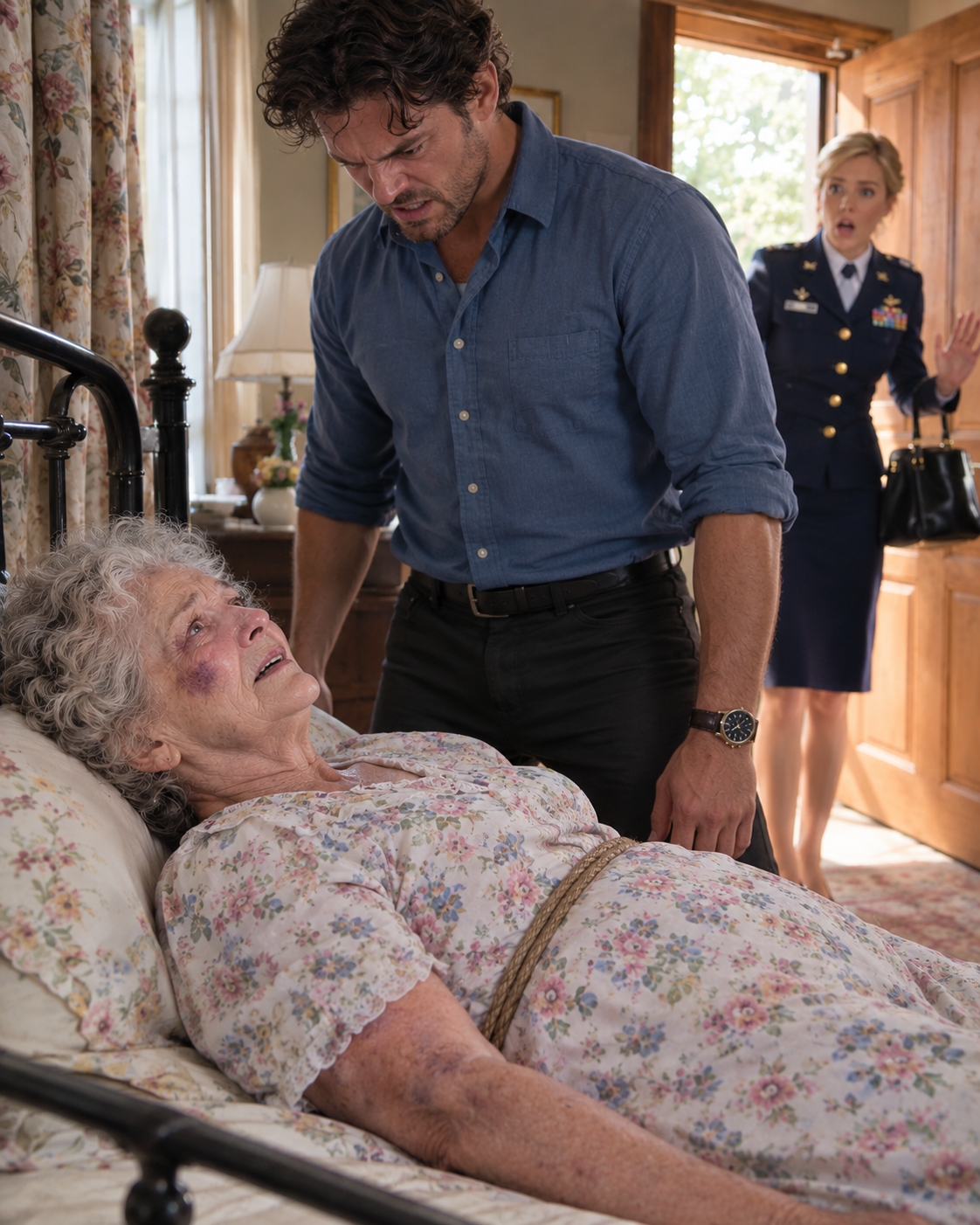
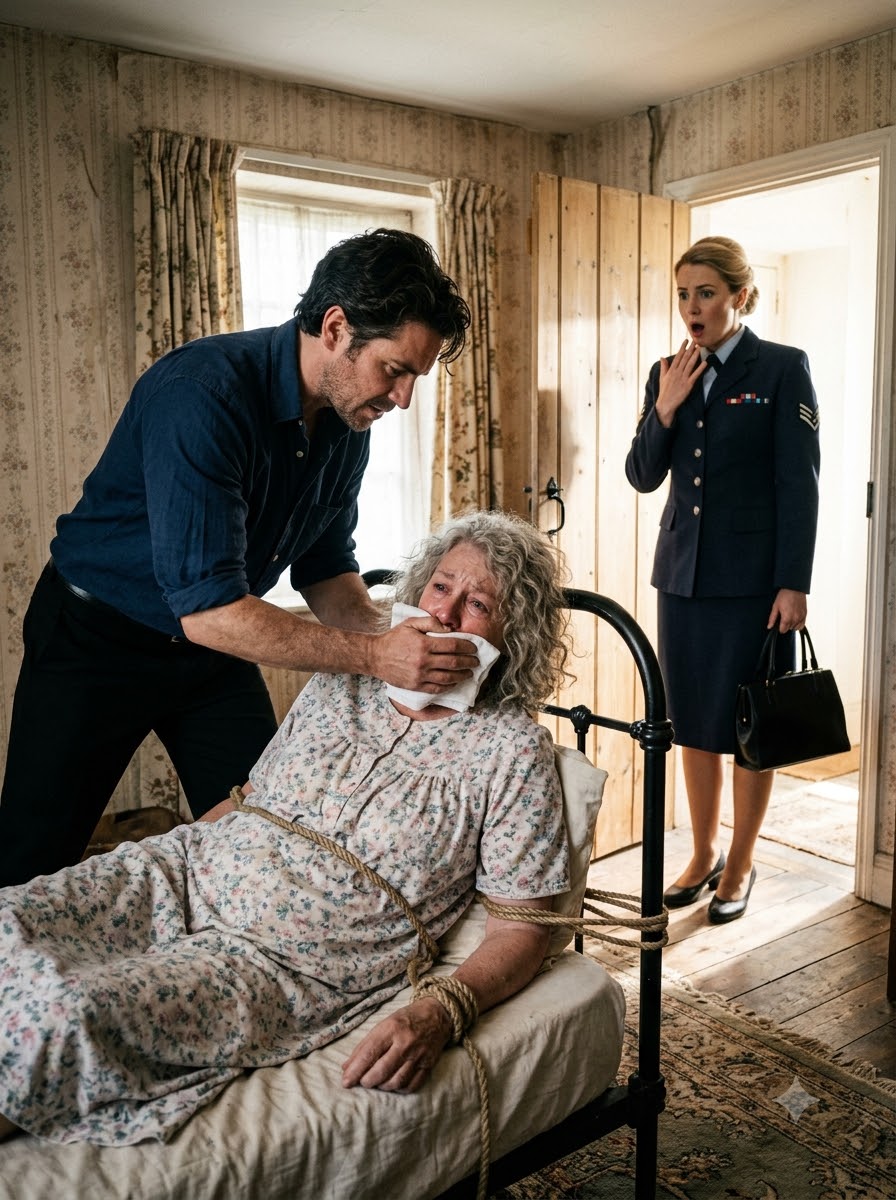
I tore my arm from his grip with a force that surprised both of us, spun around, and rushed up the open staircase.
“Elena, stop!” Mark shouted behind me, the gentle-husband facade breaking apart into raw, panicked aggression. “Heather, grab her bag! Don’t let her go through the rooms!”
I reached the second-floor landing.
The hallway was covered in plush charcoal wool carpeting. Three doors stood along it: one open to a gleaming master suite, another leading to a guest bathroom that smelled of lavender, and a third at the far end.
A huge six-drawer oak dresser had been wedged directly in front of that third door.
It hadn’t simply been placed there.
It had been deliberately forced between the door and the frame, preventing it from opening outward. From behind the wood came the sound of a dry, whistling cough I would have recognized anywhere in the world.
I threw myself against the oak dresser with everything I had.
The heavy furniture shrieked across the floorboards and moved six inches.
“Elena, get away from that door!” Mark stormed up the stairs, his eyes wide and bloodshot with rage. “You don’t understand the medical situation! You have no legal authority to intervene!”
I ignored him.
I lowered my shoulder and pushed the dresser another foot until it cleared the frame. Then I turned the brass knob and slammed the door open.
The smell struck me first—a suffocating mixture of ammonia, rotting skin, mildew, and stale sweat.
And then I saw my mother. CHAPTER 3: THE CAGE IN THE CORNER
The room was a windowless box, carved from what appeared to be an unfinished storage attic. The only illumination came from a single, unshaded twenty-watt bulb hanging from an exposed yellow wire in the ceiling. The drywall had never been painted, its seams covered with peeling brown tape. There was no air-conditioning vent, only the suffocating, humid stillness of Florida summer air trapped beneath an asphalt roof.
At the center of the room stood a single rust-stained hospital cot with a thin mattress wrapped in plastic, its edges yellowed and cracked.
My mother lay on that cot, little more than a skeleton covered in gray skin.
The silver hair she had always kept brushed into immaculate waves had become a greasy, tangled mass of dreadlocks stuck against her scalp. Her cheeks had sunk so deeply that her cheekbones seemed ready to break through the flesh. She wore an oversized men’s undershirt marked with brown stains.
Two torn bedsheets were tied around her waist and secured to the iron bedframe, knotted so tightly that the cotton had cut into her skin, leaving inflamed purple-black bruises across her abdomen.
On a shaky plastic stool beside her sat an open container of tap water covered with a layer of dust and a paper plate holding three pieces of moldy white bread. A cockroach moved across the nightstand before vanishing into a crack in the wall.
“Mom…” The word escaped my throat not as speech, but as a wet, broken sob.
The woman on the bed recoiled. She drew her knees toward her chest as far as the restraints allowed, using two trembling, skeletal arms covered in purplish bruises to shield her face.
“I didn’t take it,” she rasped, her voice a dry, gravelly whisper that barely reached across the tiny room. “Brenda, please… I didn’t touch the phone… please don’t shut the vents…”
“Mom! It’s me! It’s Elena!”
I dropped onto my knees on the filthy floor and wrapped my arms around her frail, trembling body. She weighed almost nothing. My bright, fiery mother, who had once danced salsa while rolling out empanada dough, now felt like a bundle of brittle twigs covered in parchment.
The instant my skin touched hers, her trembling stopped.
Slowly, painfully, she lowered her hands. Her sunken, cloudy eyes blinked beneath the dim glow of the bare bulb as she searched my face.
“Elena?” she breathed. Her lips were cracked and leaking clear fluid. “My baby? You… you’re real? You’re not the fever?”
“I’m here, Mom. I’m right here. I’m taking you out of this place right now.” I reached toward the knots around her waist, my fingers pulling desperately at the twisted, filthy sheets. “God, what did they do to you? What did they do to you?!”
“Elena, don’t!” Rose suddenly hissed with startling urgency. Her claw-like fingers closed around my wrist with unexpected strength.
I stared at her in shock. “Mom, I have to untie you—”
“No! Not yet!” Her eyes darted toward the open doorway, where Mark’s heavy footsteps were pounding along the hallway. “Look under the mattress first! Elena… look under the plastic! Now!“
Behind me, Mark appeared in the doorway, his chest rising and falling heavily, his face twisted into a frightening expression of panic and malice.
“Elena, get away from her!” he barked as he stepped into the room. “She’s medically quarantined! She has a resistant strain of MRSA! If you touch those restraints, you’re violating her physician-ordered safety protocol!”
Without responding, I slid my hand beneath the cracked plastic mattress.
My fingertips touched a thick, cold layer of smooth polyethylene.
I pulled.
A heavy, legal-sized clear waterproof pouch emerged from the narrow space between the foam core and the iron springs.
Mark saw the pouch.
Every muscle in his face went still. The color drained from his features until his lips looked almost leaden.
“Put that down, Elena,” he whispered, his voice dropping into a chillingly quiet register that made the fine hairs on my arms rise. “You don’t know what you’re touching. Put it down, and let’s go downstairs and talk like civilized people.”
I stood, clutching the plastic pouch against my chest.
Through the transparent vinyl, an official state seal shimmered beneath the weak light.
And underneath it, printed in crisp, unmistakable black letters, was an insurance policy portfolio from Sovereign Mutual Financial.
The insured person listed on the cover sheet was: Elena Morales Vance.
The primary and sole beneficiary was: Mark Vance.
And the policy’s active execution date was stamped: July 14th—exactly forty-eight hours from today. CHAPTER 4: THE PAPER GUILLOTINE
I did not scream. I did not let the envelope fall. Instead, an eerie, glacial calm settled through my entire nervous system—the same cold, unwavering focus that had carried me through crises in hundred-room hotel corridors while VIP guests shouted in five different languages.
I ripped open the waterproof pouch.
Inside was an entire second life, carefully constructed while I had been thousands of miles away, scrubbing tiles and inspecting bed linens.
The first document was a General Durable Power of Attorney, prepared under Florida state statutes. My name was printed across it, along with my Social Security number and an exact imitation of my signature—the loop of the E, the sharp upward slash of the M. Next to it was the rubber stamp of a notary public registered in Charlotte County, dated fourteen months earlier.
Underneath were three dozen bank wire confirmation slips from the Doha Exchange.
Every four-thousand-five-hundred-dollar transfer I had sent to cover Mom’s supposed “inpatient neuro-rehabilitation” had been rerouted the instant it reached our joint account. The money went directly into an LLC called Vance Coastal Holdings, registered under Mark and his sister Heather. From there, the funds had been spent without restraint: thirty-two thousand dollars on an inground heated pool; eight thousand on Heather’s European ski trip; four thousand on country club initiation fees; and twenty-five thousand dollars toward the German sports car sitting in the driveway.
Not one dollar had gone to a physician. Not a single cent had paid for heart medication or physical therapy.
Then I turned my attention to the insurance policy.
It was a five-million-dollar accidental death and dismemberment portfolio with an international travel rider. It covered catastrophic illness, vehicular trauma, and unexpected cardiac events occurring either overseas or within forty-eight hours of repatriation.
Tucked inside the policy jacket was a folded sheet of paper—a printed email exchange between Mark and a mobile life-insurance notary operating out of Cape Coral.
Mark: “My wife is returning from her overseas contract on the evening of July 13th. She will sign the policy’s final wet-ink verification on the morning of the 14th. Please bring the hard-copy counter-signature forms to the house at 11:00 AM.”
Broker: “Understood, Mr. Vance. Please remind Mrs. Vance that she must provide her original passport and her physical signature before the supplemental underwriting rider takes full legal effect. Once verified, the policy cannot be contested for any cause of death other than self-harm.”
According to the itinerary Mark thought I had booked, I was supposed to return tomorrow evening.
He had not planned for me to arrive today. He had not expected me to enter without warning while the cage remained locked and the final pieces of his carefully arranged performance were still being put into place.
“Elena…” Mark took a slow, measured step toward me, keeping his hands low and open like someone approaching a frightened animal. “Listen to me for one second. The insurance… that was an investment hedge. My business went under during the supply-chain collapse. We were going to lose the house. I had to show liquid assets to the bank to keep the mortgage from defaulting! I never intended—”
“Where is her medicine, Mark?” I asked. My voice sounded strangely empty, as though all the humanity had been drained from it.
“What?”
“Her heart medication. Her beta-blockers. Her anti-inflammatory infusions. Where are they?”
From the cot, Rose released a wet, rattling breath. “No medicine… Elena… he stopped giving me the pills… in January. He said… he said medicine was for people with a future.”
Mark’s face jerked with anger. “Shut up, Rose! Shut her up, Elena, she’s completely senile! She has vascular dementia!”
“You didn’t buy medicine,” I said, turning through the bank receipts in my hands. “You used my wire transfers to renovate your kitchen. You bought leather sofas. You gave your mother my grandmother’s emerald sapphire pendant. And then, when you realized the money from Doha was going to run out when my contract ended… you took out a five-million-dollar policy on my life.”
Mark went completely still.
The desperate expression disappeared from his face, replaced by a blank, lifeless stare that made him seem like someone I had never known.
“You don’t know how hard it was,” he muttered, his words spilling out in a dark, poisonous hiss. “Stuck here taking care of a drooling, incontinent old woman while you were living it up in five-star suites in the Middle East! You think four grand a month covers the insult of having to wipe your mother’s backside?! You abandoned her, Elena! You abandoned us! You bought your way out with dirty hotel money!”
“I worked eighty hours a week so she could live!” I shouted, my fury finally breaking through my composure like a dam splitting apart. “And you locked her in an attic to rot!”
Then, from somewhere down the hallway, the ripping of fabric and harsh clattering erupted through the stairwell.
“Mark!” Heather’s voice shrieked from the foyer below, high-pitched and frantic. “Mark, get down here! The money isn’t in her luggage! Her bank cards aren’t here! And look what I found in her front backpack pocket!”
Mark’s eyes widened. He looked toward the staircase, then back at me, his hands slowly tightening into fists.
“What did you bring into this house, Elena?” he growled.
I held his gaze, reached into my back pocket, and pulled out my cell phone. Then I raised the screen directly in front of him.
A live-streaming dashboard filled the display. In the upper-right corner, a small red dot blinked beside an active transmission indicator: Uploaded to Cloud Storage / Remote Server: Benitez Legal Associates.
“Everything you’ve said since I stepped onto the driveway,” I whispered. “Every word. Every confession. Every look at my mother’s bruises.”
Mark’s mouth fell open.
For three seconds, he stood frozen in complete and unmistakable disbelief.
Then, from the driveway outside, the sharp, two-tone chirp of an approaching vehicle rang through the open window. CHAPTER 5: THE MOBILE NOTARY
It wasn’t the police.
Downstairs, the front-door chime sounded again—two quick, professional rings.
“Mark!” Heather yelled, her voice bordering on hysteria. “There’s a guy in a suit with a leather briefcase on the front porch! He’s asking for Mark Vance!”
Mark suddenly lunged toward me, trying to seize the clear plastic pouch from my hands. I pivoted away, stepping backward toward the cot and keeping the iron frame between us.
“Touch me,” I said, raising my phone, its wide-angle camera aimed directly at his face, “and the battery charges will include aggravated assault in the presence of an incapacitated vulnerable adult. Clara Benitez is already monitoring this stream from her office in Coral Gables. Try it.”
Mark’s hands remained suspended in the air, trembling. His breathing was heavy and labored. “You’re ruining our lives, Elena. For what? For an old woman who won’t last another six months anyway?!”
“Get out of my way,” I said.
I didn’t wait for him to respond. I reached down, seized the edge of the cloth restraint around my mother’s hip, and pulled with everything I had. The cheap sheet ripped apart with a sharp tear.
“Elena…” Rose whimpered, gripping my jeans with both hands. “Don’t let them take me back to the dark…”
“Nobody is ever locking you in this room again, Mom. I swear it on my life.”
I loosened the second knot, freeing her fragile waist. Then I carefully lifted her legs over the side of the cot. Her feet were swollen, purple, and cold as stone; she had no shoes, only ragged socks whose heels were completely worn through.
“Mark!” Brenda’s voice joined Heather’s from the bottom of the stairs. “Mark, come down here right now! He says he’s from Precision Notary Services! He says you scheduled an emergency pre-verification appointment!”
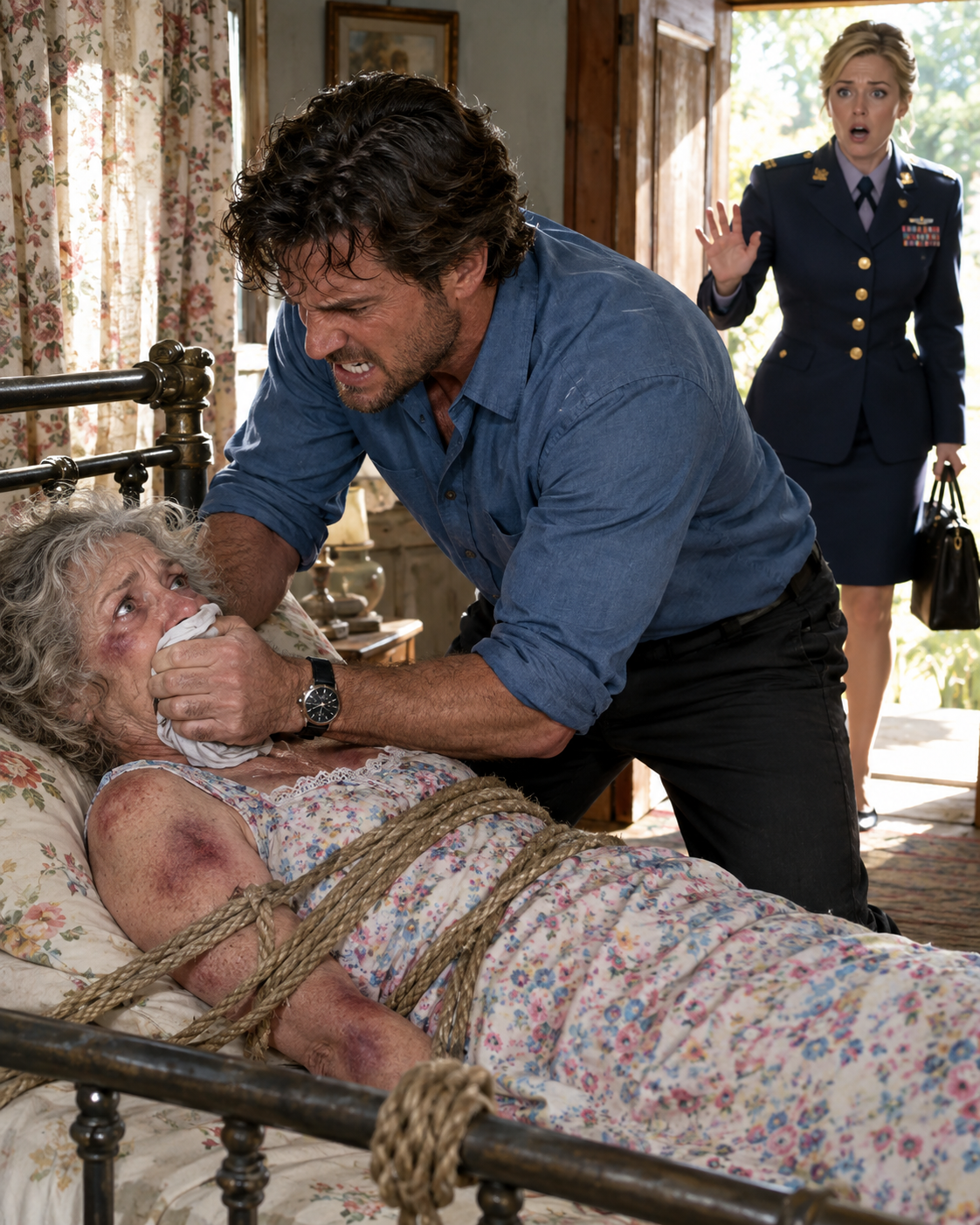
The notary had arrived ahead of schedule.
Mark retreated into the hallway, his expression shifting rapidly through terror, guilt, and desperation. He spun around and hurried down the stairs.
I didn’t follow him immediately. Instead, I took the fleece throw blanket from the dusty nightstand, wrapped it around my mother’s shaking shoulders, and lifted her into my arms. She weighed less than eighty pounds. Her hollow head rested against my shoulder, while the traces of her dry tears dampened the collar of my shirt.
I carried her out of the attic room, past the heavy dresser that had functioned as her prison gate, and onto the second-floor landing overlooking the great room.
Below us, everything was descending into chaos.
A short, bald man in a gray polyester suit stood in the foyer, holding a blue leather folio and an embossed notary stamp. Behind him, Heather was gripping my canvas backpack, frantically picking at the coin-sized camera lens she had pulled from its front pocket.
Brenda stood beside the marble island with both hands pressed against her cheeks, sobbing uncontrollably.
“Mr. Vance?” the notary was saying, looking confused as Mark stumbled down the stairs, disheveled and wild-eyed. “I received your urgent text message asking to bump the appointment up to this morning. You said Mrs. Vance had arrived on an early charter flight and was ready to execute the signature verification for the Sovereign Mutual underwriter?”
Mark opened his mouth.
Nothing came out.
He looked like a man standing on the trapdoor of a gallows, waiting for the lever to drop.
“Mrs. Vance is right here,” I called from the landing.
The notary looked upward.
His eyes settled on me standing at the top of the stairs, holding a starving, bruised, seventy-one-year-old woman in my arms while keeping a plastic pouch filled with forged legal documents tucked against my side.
“Wait… are you Elena Morales Vance?” the notary asked, narrowing his eyes through his bifocals. “Mr. Vance provided a copy of your passport… but he told me you were resting in the master bedroom after a private flight from Miami.”
“I flew commercial from Qatar, sir,” I said, walking down the stairs one slow, deliberate step at a time, never taking my eyes off Mark. “And I have never seen you before in my life. I have never applied for a life insurance policy through Sovereign Mutual. I have never authorized my husband to act as my power of attorney.”
The notary quickly stepped backward toward the open front door, instinctively clutching his leather briefcase like a shield. “I… I think there has been a terrible misunderstanding. I was hired via a third-party broker platform—”
“Don’t leave, sir,” I commanded as I reached the bottom of the stairs. “Because the officers pulling into the driveway are going to need your statement as an accessory to attempted corporate fraud.”
Outside, the peaceful morning in the neighborhood was shattered by the piercing wail of emergency sirens. CHAPTER 6: THE FALL OF THE HOUSE OF VANCE
Blue and red strobe lights swept across the white foyer walls, painting them in violent, rotating bands of color.
Two marked Fort Myers police cruisers and an emergency medical transport van tore onto the perfectly manicured lawn, their tires ripping through the pristine St. Augustine grass before stopping just inches from the black German sports sedan.
Mark completely lost control.
He turned sharply and sprinted toward the kitchen, heading for the sliding glass doors that opened onto the patio and the canal beyond.
“Mark, don’t!” Heather shrieked.
He never reached the glass.
The heavy mahogany front door burst open, and four uniformed officers rushed inside, sidearms drawn and held at low-ready.
“Fort Myers Police! Nobody move! Stay where you are!”
Mark froze in front of the commercial espresso machine, throwing his hands above his head as his chest rose and fell rapidly. “It’s a domestic dispute! Officers, it’s a misunderstanding! My wife is having an emotional breakdown—”
“Down on the floor! Now!” the lead officer, a broad-shouldered veteran with graying temples, ordered as he advanced with his taser drawn.
Mark hesitated and glanced toward the backyard.
Then the click of the taser being disengaged sent him immediately to his knees. Within moments, his face was against the cold porcelain tile, his wrists secured behind his back with a loud mechanical snap.
Two paramedics hurried past the officers, emergency jump-kits swinging at their sides.
“Over here!” I yelled, carefully lowering my mother onto the cream-colored sectional sofa. “She’s seventy-one! Severe malnutrition, deep dehydration, stage-two pressure sores on her sacrum, and deep contusions from ligature restraints on her waist!”
The female paramedic dropped to her knees beside Rose. She immediately placed an oxygen mask over her face and wrapped a blood pressure cuff around her skeletal arm.
“Her pulse is thready, eighty-four over fifty,” the paramedic called out to her partner. “Get the IV started, normal saline, wide open. We need the transport stretcher now.”
Rose’s fingers trembled against my arm.
Through the clear oxygen mask, she looked toward the paramedic before slowly raising her bruised hand and pointing directly at Brenda, who was shrinking behind the kitchen island.
“She… took my food,” Rose whispered, her voice carrying through the plastic mask. “She told me… nobody was coming for me.”
A sharp-eyed woman in plainclothes entered the living room behind the patrol officers. She was the lead detective.
Behind her came Clara Benitez, carrying a sleek leather briefcase and somehow looking immaculate despite the four-hour drive across the state.
“Elena,” Clara said as she approached and placed a reassuring hand on my shoulder. “I brought the jurisdiction injunction from the Eleventh Judicial Circuit. We have an emergency protective freeze on all shared accounts.”
The detective looked from Clara to me and pulled a small spiral notebook from her pocket.
“I’m Detective Alvarez, Special Victims and Elder Crimes. Who called nine-one-one?”
“I did,” I said, handing her the waterproof plastic pouch. “And everything you need to see is in this folder—along with the continuous cloud recording that has been uploading to Ms. Benitez’s firm for the last forty minutes.”
Detective Alvarez opened the pouch.
She went through the forged power-of-attorney documents, the forged notary slips, the bank statements documenting the rerouting of one hundred and fifty-three thousand dollars, and finally, the Sovereign Mutual life insurance policy.
Her expression hardened.
She slowly looked around the room: the eighty-five-inch OLED television, the designer handbags displayed inside the glass case, the gold sapphire pendant hanging from Brenda’s neck, and the bruised, starving woman being transferred onto a gurney by paramedics.
“Detective,” the notary stammered from the doorway, raising both hands. “I had no idea! I’m an independent contractor! Mr. Vance submitted the digital identification package online! I was just hired to witness the final physical execution!”
“You stay right there, sir,” Alvarez said coldly.
Then she turned toward the two patrol officers restraining Mark on the floor.
“Get him up.”
They pulled Mark to his feet.
His polo shirt was torn, and his hair was plastered against his sweaty forehead.
“Elena!” Mark pleaded. His voice broke into a desperate, pitiful whine as he stared at me. “Elena, baby, please! I did it for us! The logistics company went bankrupt… we had three hundred thousand dollars in merchant cash advances hanging over our heads! The collectors were threatening to take the house! If we got the insurance payout, we could have started over! We could have had the life we always talked about!”
“You locked my mother in an attic to die of thirst,” I said, staring directly into his eyes. “So you could buy a sports car and play golf.”
“She was old, Elena!” he screamed, his face contorting into a furious, spitting snarl as the officers began pulling him toward the door. “She was already half-dead! What difference did it make?!”
A stunned gasp moved through the room.
Even Heather stared at her brother with sudden, horrified disbelief, stepping away from him as though she could no longer bear to stand near him.
“Mark Vance, you are under arrest for first-degree elder abuse, neglect of a vulnerable adult causing great bodily harm, grand theft, criminal forgery, and attempted grand larceny via insurance fraud,” Detective Alvarez recited in a cold, measured cadence.
Then she turned toward Brenda, who was crying into her hands.
“Take off the necklace, ma’am,” the detective said.
“What?” Brenda gasped.
“Take off the sapphire pendant. It’s stolen property from an incapacitated victim. Officers, arrest Heather Vance and Brenda Vance as co-conspirators in elder exploitation and receiving stolen property.”
“No! Please! I just did what Mark told me!” Heather shrieked as an officer pulled her arms behind her back and snapped the handcuffs around her manicured wrists. “He said Elena would never find out! He said she was never coming back from Doha!”
I stood silently as they were escorted out through the front door, one after another, into the blinding Florida sunshine.
The neighbors had already gathered along the sidewalk. Lawn mowers sat idling as people stared, mouths open, watching the golden boy of Palmetto Grove and his family being placed into three separate police cruisers.
I turned back toward the gurney.
The paramedics were wheeling Mom toward the open doorway. Just before they crossed the threshold, Rose reached out with her free hand, weakly waving through the air until her fingers found mine.
“Elena…” she whispered through the plastic mask.
“I’m right here, Mom,” I said, walking beside the stretcher and holding her cold, fragile hand between both of mine. “I’m not leaving your side again.” CHAPTER 7: THE ROOM WITH AN OPEN DOOR
Recovery did not come in days.
It came in millimeters.
For three weeks, my mother remained in the intensive care wing of Tampa General Hospital. Her refeeding protocol required constant monitoring to prevent cardiac arrest caused by electrolyte shock. Her kidneys, pushed dangerously close to complete failure by severe dehydration, gradually began functioning again under continuous intravenous therapy. A team of wound-care specialists treated and redressed the deep pressure sores that had eaten into her hips.
Every morning, I sat beside her bed, peeling fresh oranges, reading newspaper articles aloud, and brushing her hair until the silver strands once again gleamed like polished silk.
The legal consequences came down on the Vance family with the unstoppable force of an avalanche.
Clara Benitez acted without hesitation. Within seventy-two hours of the arrests, a civil court judge granted an emergency lis pendens on the Palmetto Grove property, froze every bank account connected to Mark and Heather’s fraudulent LLC, and issued permanent lifetime restraining orders.
The criminal case never reached a jury.
Confronted with forty hours of cloud-stored video evidence, testimony from the independent insurance notary, four years of forensic banking records, and the devastating physical evidence documented by the hospital trauma unit, Mark’s court-appointed attorney advised him to accept a plea agreement.
He pleaded guilty to aggravated elder abuse, financial exploitation of an incapacitated adult, and organized scheme to defraud.
He received a twenty-two-year sentence in the Florida State Department of Corrections.
Brenda and Heather pleaded down to lesser charges of accessory to financial exploitation and failure to report vulnerable adult neglect. They were sentenced to seven and five years respectively, followed by ten years of strict probation and mandatory restitution.
Under the state’s civil restitution laws, the renovated Palmetto Grove house, the German sports sedan, the high-end espresso machine, and even the eighty-five-inch OLED television were sold through a court-ordered auction.
Every cent recovered—two hundred and eighty-four thousand dollars after the mortgage lien was paid—was placed into an irrevocable trust established exclusively for Rose Morales.
Four months after that morning of sirens, I signed a lease for a bright, two-bedroom garden apartment in Bayshore, overlooking the open blue waters of Hillsborough Bay.
The apartment was everything that attic room had never been: warm cream-colored walls, oversized windows spilling Florida sunlight across pale bamboo floors, broad hallways built for easy movement, and a private screened balcony overflowing with terracotta pots of blooming yellow hibiscus, lavender, and sweet basil.
I accepted a remote position as a regional hospitality consultant for a boutique hotel development group in Tampa. I earned half of what I had made in Doha, but I was living in a kind of wealth no number on a bank statement could ever measure.
On the first Sunday evening in our new home, the salty Gulf breeze pushed the white sheer curtains into soft, dancing waves.
I was in the kitchen chopping fresh cilantro and simmering black beans for dinner when I heard the familiar, rhythmic clack-slide, clack-slide of a walker moving down the hallway.
I stepped out of the kitchen and wiped my hands on a tea towel.
Mom was standing beside the front door.
She wore a soft turquoise dress that brought out the warmth in her hazel eyes. Her cheeks had filled out again, and her hair was neatly pinned back, crowned by the restored gold-and-sapphire pendant Clara Benitez had recovered from the police evidence locker.
She was staring at the heavy brass deadbolt.
“Mom?” I asked softly, my heart skipping a beat. “Are you okay? Do you need some water?”
She didn’t turn around right away.
Instead, her frail, spotted hand reached toward the brass deadbolt, her thumb resting over the locking mechanism.
“Elena?” she called quietly.
“I’m right here, sweetie.”
“Can you unlock the door for a second?”
A sudden burst of panic tightened my chest—an echo of the nightmare that still visited my sleep.
But I pushed it down.
I walked over, reached past her shoulder, turned the brass deadbolt with a quiet click, and opened the heavy door wide.
Beyond it, the outdoor breezeway stretched toward the manicured garden courtyard. The scent of jasmine floated from the lawn, while the evening sky shifted into brilliant shades of peach and violet.
Rose remained there for a long time.
She leaned comfortably against the padded handles of her walker, tilted her head back, and breathed in the fresh, unobstructed evening air.
She watched two mourning doves flutter onto the courtyard grass.
She watched a neighbor pass with a golden retriever, giving them a gentle wave as they went by.
For five full minutes, she said nothing.
She simply stood there and allowed the open horizon to touch her face.
Then she turned toward me and smiled.
It was the first genuine, radiant smile I had seen on her face in more than three years.
“Okay,” Mom said, patting my hand where it rested against the doorframe. “You can close it now.”
I pulled the door closed and gently slid the deadbolt back into place.
“I just wanted to make sure,” Mom whispered, her eyes shimmering with quiet, crystalline tears, “that I could ask to open it whenever I wanted.”
I had no words.
I couldn’t answer.
I lowered myself onto the hallway bench beside my mother, wrapped my arms around her waist, and buried my face against her soft, lavender-scented shoulder.
And for the first time since I stepped off that airplane from Doha, I finally allowed myself to cry—not from fear, not from the crushing pain of betrayal, but from the deep, unshakable realization that the doors were unlocked, the night was over, and we were finally home.
