

The alarm went off at five in the morning. For once, I didn’t hit snooze.
I reached over, switched it off before it could beep again, and quietly slipped out of bed. Daniel was still sleeping beside me, one arm covering his face, breathing deeply.
I pulled on yesterday’s gray sweatshirt, quietly crossed the old wooden floor, avoided the board near the door that always creaked, and headed downstairs.
The house was still dark.
Outside the kitchen window, the lake looked like a sheet of black glass.
No wind. No birds.
Only the quiet hum of my mother’s old refrigerator.
My mother’s kitchen.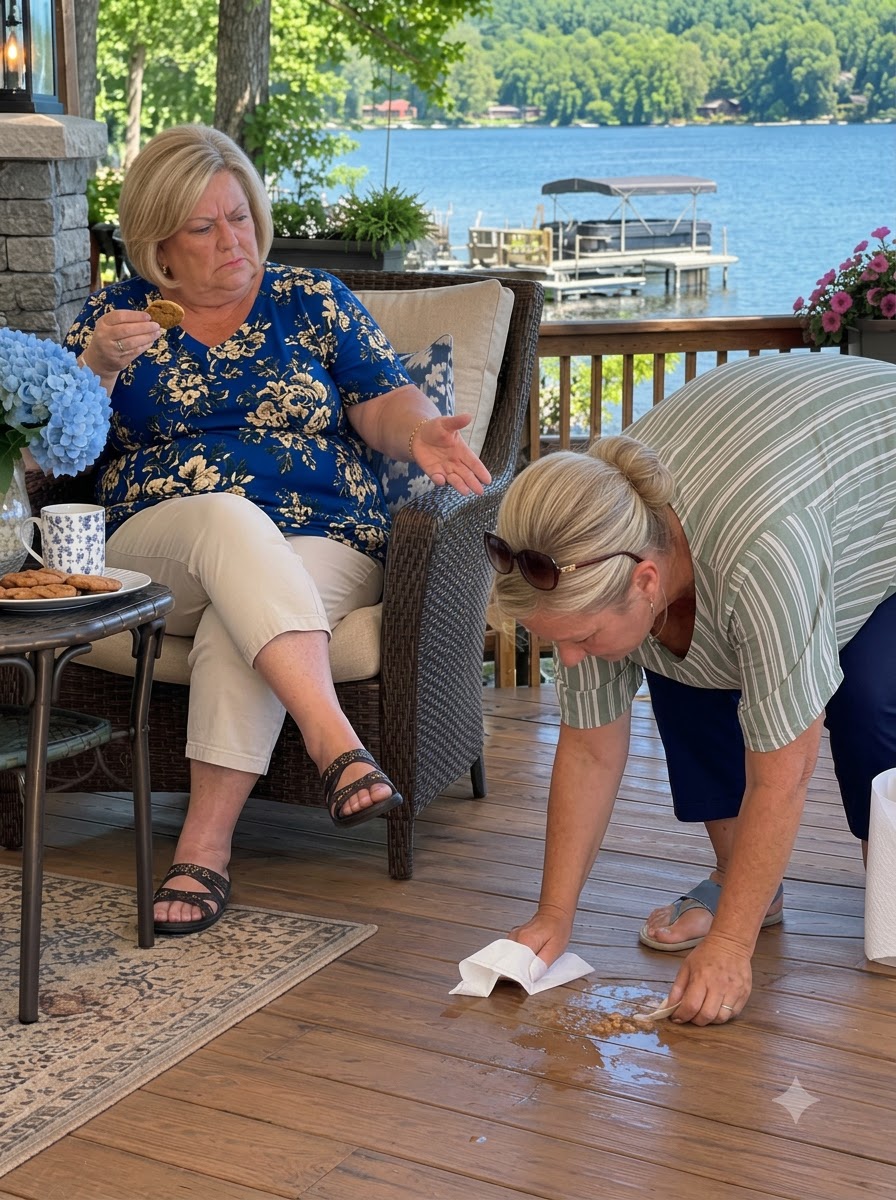
That meant far more to me that morning than it had a week before.
Mom owns a little cabin by the lake.
Nothing luxurious.
Two stories.
Cedar siding.
A green metal roof.
A screened porch.
A wooden deck overlooking the water.
Three bedrooms upstairs and one bathroom everyone complains about sharing.
The kitchen still has orange countertops from the late seventies, and the living-room couch is older than I am.
My father bought the place the year I was born.
He paid for it after saving money from years of overtime at the paper mill.
He used to say it was the only thing he ever bought that became worth more to him every year.
Dad died when I was nineteen.
A heart attack.
Right there on the dock while fishing.
Afterward, Mom almost sold the cabin. She couldn’t bear being there.
For two summers, she stayed away completely.
Then one June morning, she called me.
“I think I’m going to open the lake house.”
And she did.
She has spent every summer there since.
It belongs to her now.
She pays the taxes.
Repairs the roof.
Maintains the dock.
Plants every flower around the property.
Two summers ago, she climbed a ladder and painted all the shutters blue by herself.
I yelled at her for a week for doing it without help.
“Your father always wanted blue,” she told me.
That was Mom.
Daniel and I got married that spring.
May.
Small church ceremony.
Barn reception.
String lights.
Taco truck.
Nothing fancy.
That summer was the first time our families really spent extended time together.
And the first time Daniel’s parents, Susan and Richard, visited the lake cabin, Mom was more nervous than I had ever seen her.
She called me every night for a week.
“What do they like to eat?”
“Mom, normal food.”
“Does Susan drink tea or coffee?”
“Coffee, I think.”
“Any allergies?”
“Not that I know of.”
“What kind of pillows does Richard prefer?”
“Mom. I have absolutely no idea what kind of pillow my father-in-law likes.”
That didn’t stop her.
She drove into the city and bought brand-new sheets for the guest room.
Four-hundred-thread-count.
Pale blue.
New towels.
Fluffy white ones.
She even prepared a little basket in the bathroom with miniature soaps, lotions, and a candle.
Like a hotel.
She scrubbed the entire cabin.
Washed every window.
Had the carpets professionally cleaned.
When I arrived the Friday before everyone else, I found her on her knees scrubbing baseboards with a toothbrush.
“Mom, what are you doing?”
“I want everything to be nice.”
“It is nice. It’s a lake cabin. Nobody expects perfection.”
She sat back on her heels.
“They’re family now.”
I looked at her.
“You married Daniel,” she continued. “So in a way, we’re all family now. I want them to feel welcome.”
I didn’t know what to say.
So I got on the floor and helped her scrub.
That summer, the weather stayed beautiful.
Warm.
Clear.
Sunny almost every weekend.
So we came to the cabin constantly.
Me and Daniel.
Susan and Richard.
Mom.
And every weekend slowly became the same.
Mom got up at six every morning.
Before everyone else.
I would hear her downstairs.
Coffee brewing.
Pan on the stove.
Old country music playing softly from the radio.
She cooked breakfast for everyone.
Bacon.
Eggs.
Pancakes.
French toast.
Or her blueberry muffins from scratch.
Then she cleaned everything.
Every pan.
Every fork.
Every plate.
Then she stripped beds.
Washed towels.
Hung them outside.
Then she drove nearly forty minutes round-trip to the larger grocery store because Susan didn’t like the mayonnaise sold at the little store near the lake.
Susan only ate avocado-oil mayonnaise.
The expensive kind.
Eleven dollars a jar.
Mom learned that the first weekend when Susan took one bite of chicken salad and said,
“Oh. Is this regular mayonnaise?”
Mom drove into town the next morning.
She bought three jars.
Then she made lunch.
Cleaned lunch.
Made dinner.
Cleaned dinner.
Salmon.
Pot roast.
Chicken piccata.
Homemade pasta.
And every Saturday night, peach cobbler.
Why?
Because Richard mentioned once that he liked peach cobbler.
Mom remembered.
Of course she did.
Then around ten every night, she went to bed exhausted.
And at six the next morning, she started again.
Susan’s weekends looked slightly different.
She arrived Friday evening.
Walked through the cabin saying,
“Oh, this is so cute.”
Every single weekend.
As though she were seeing it for the first time.
Then she went straight outside.
There was one large lounger with a striped cushion in the center of the deck.
Best view of the lake.
Susan claimed it almost immediately.
Sunglasses.
Iced tea.
Phone.
And that was basically her weekend.
All summer, she never once offered to help.
Not once.
Eight weekends.
She never carried a plate to the sink.
Never chopped an onion.
Never wiped a countertop.
Never folded a towel.
She wouldn’t even bring her coffee mug back inside.
Every morning, it sat on the side table next to her chair.
By noon, it would leave a ring on the wood.
Mom would come out, pick it up, wipe the table, and carry the cup inside.
At first, Susan would say,
“Thanks, Maggie.”
Without looking up from her phone.
By July, she stopped saying that too.
That bothered me more than almost anything.
Mom could spend two hours preparing a meal, place the plate directly in front of Susan, and Susan would simply begin eating.
No thank you.
No acknowledgment.
As though dinner had appeared by itself.
I brought it up to Daniel once.
We were lying in bed at the cabin with the lights off.
“Your mom never helps.”
“I know.”
“She doesn’t even say thank you anymore.”
“I know.”
He was quiet.
“She’s always been like that. At home Dad does most things. Mom plans. She decides. But she doesn’t really do.”
“This isn’t her house.”
“I know.”
“Should I say something?”
Daniel thought for a long time.
“I don’t know.”
That was his honest answer.
“I don’t know what saying something would do.”
So I let it go.
For a while.
Then came the flower boxes.
That Saturday, Mom had gotten up at five-thirty.
Before breakfast.
She had spent weeks building six wooden flower boxes in her garage.
She painted them blue to match the shutters.
Then planted bright red geraniums in every one.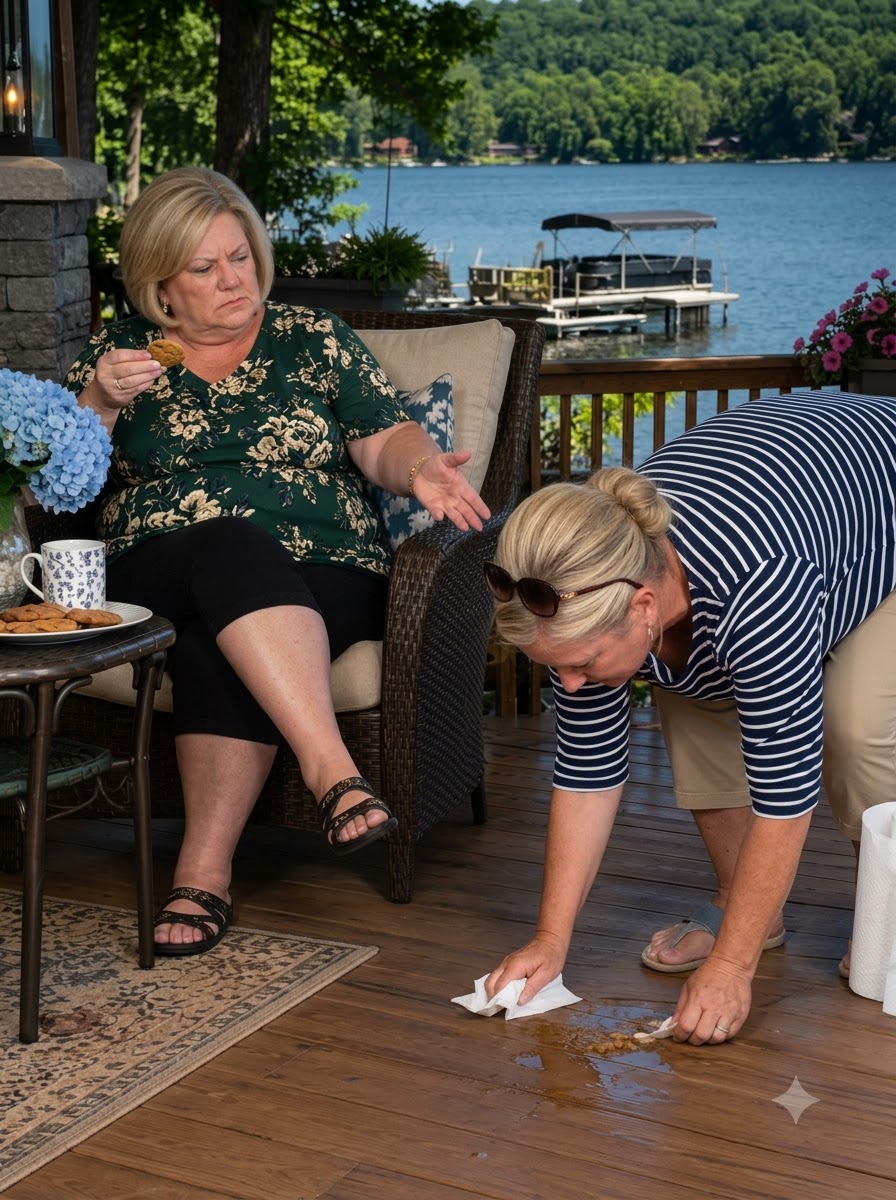
She had been excited about them for weeks.
On the drive up, she showed me pictures.
The boxes drying in her garage. The flowers at the garden center. The bags of soil.
“Your father always said red geraniums looked cheerful,” she told me. “Like they were having a party.”
That morning, she arranged all six boxes along the railing of the deck.
Blue boxes.
Bright red flowers.
The blue lake stretching behind them.
It looked beautiful.
“Mom, they’re gorgeous.”
She smiled proudly.
Then Susan stepped outside.
White linen cover-up.
Oversized sunglasses.
Iced tea.
She went directly to her lounger.
Sat down.
Stretched out.
Then she noticed the flowers.
Her brow furrowed.
She lowered her sunglasses.
“Oh. No.”
My mother stood in the doorway with a tray of blueberry muffins in her hands.
Susan pointed toward the railing.
“These are all wrong here.”
Mom froze.
“I’m lying right here,” Susan said. “They block my whole view of the lake. I can’t see anything. Don’t do that again.”
Don’t do that again.
In my mother’s house.
About my mother’s flowers.
From my mother’s chair.
With my mother’s breakfast sitting right in front of her.
I stood there with my coffee, completely stunned by what I was hearing.
Mom said,
“Oh. I didn’t think of that. I’m sorry.”
Then she put down the muffin tray.
And moved the flowers.
All six.
One at a time.
Heavy wooden boxes packed with soil.
She carried them to the far end of the deck.
Behind the grill.
Next to the trash cans.
Susan never got up.
Never offered to help.
Never said,
“Oh, forget it. Leave them.”
She simply watched.
When Mom finished moving the final box, Susan slipped her sunglasses back on.
“That’s much better. Thanks, Maggie.”
It was the first thank-you I had heard from her in weeks.
I knew my mother.
She was gentle.
Sometimes too gentle.
She was the kind of woman who apologized to furniture after bumping into it.
She would put up with almost anything to avoid conflict.
Especially if she believed that conflict could somehow affect me.
She would have moved those flower boxes a hundred times.
She would have driven into town for expensive mayonnaise a hundred times.
She would have collected Susan’s coffee cup every morning forever.
And she would never complain.
Because she didn’t want problems between me and my new family.
That was exactly why I couldn’t keep pretending nothing was wrong.
But I also knew yelling at Susan wouldn’t solve anything.
If I confronted her in front of everyone, she would go home and tell them Daniel’s new wife had attacked her for no reason.
Her sister.
Her church friends.
Her book club.
And I would spend the next thirty Christmases sitting across from a woman who believed I hated her.
So I said nothing that Saturday.
Not at breakfast.
Not at lunch.
Not during dinner.
I watched Mom prepare food for Susan.
Serve Susan.
Clean up after Susan.
Then I watched my exhausted mother go to bed at ten.
I went upstairs and set my alarm for five.
Daniel watched me.
“What are you doing?”
“Getting up early.”
“Why?”
“I’m fixing something.”
He sat up.
“This is about the flowers?”
“It’s about the whole summer. The flowers were just the final straw.”
He stared at me.
“What are you going to do?”
“I don’t know yet. But I’m done watching my mother exhaust herself every weekend while your mom spends the whole time in that lounger.”
I looked at him.
“Are you going to be angry with me?”
Daniel thought for a moment.
Then shook his head.
“No.”
He lay back down.
“Honestly, I should’ve done something myself weeks ago.”
At 5:07 the next morning, I knew what I was going to do.
An old dry-erase board.
About two feet by three feet.
Mom had used it when I was a child.
Grocery lists.
Weather.
Little messages.
Good luck on your swim test.
Dad caught a big one.
It had been blank for years.
I carried it over to the kitchen table.
Propped it against the fruit bowl.
Found a black marker.
Then, across the top, I wrote:
WEEKEND JOBS
I divided up the work.
Daniel: breakfast cleanup.
Richard: grocery run.
Me: lunch.
Susan: breakfast.
Then I made a dinner rotation.
Saturday.
Sunday.
Different people responsible for each night.
Susan got Saturday.
Finally, beside Mom’s name at the bottom, I wrote:
Mom: enjoy your house.
I underlined your twice.
I stood there looking at the board.
Part of me wondered if I had taken things too far.
Maybe I should erase it.
Go upstairs.
Pretend nothing had happened.
Then I heard slippers behind me.
Mom was standing in the doorway.
Pink fuzzy robe.
Gray hair sticking up.
Reading glasses resting on her head.
“What are you doing? It’s five in the morning.”
“Fixing something.”
She walked closer.
Pulled her glasses down.
Read the board.
Her expression changed before she even reached the second line.
“No.”
“Mom—”
“No. Take that down.”
“It’s your house.”
“They’re guests.”
“They’ve been guests almost every weekend for two months.”
She lowered her voice. “You cannot give invited guests chores. That’s not how you treat people.”
I looked at her.
“Is telling the woman who owns the house where she can put her own flowers how you treat a host?”
Her lips tightened.
“She didn’t mean anything.”
“You moved all six flower boxes behind the trash cans.”
“It wasn’t a big deal.”
“Then put them back.”
Mom fell silent.
She looked through the kitchen window toward the deck.
The flowers were still tucked away beside the grill.
I knew that look.
She wasn’t thinking about the flowers.
She was measuring the discomfort.
What would Susan think?
Would Susan complain?
Would Daniel be upset?
Would my marriage become uncomfortable?
Would everyone think Mom had created a problem over flowers?
She had spent her whole life doing that calculation.
“I’m not letting you start a fight with your mother-in-law because of me.”
“I’m not starting anything.”
I looked at her.
“I’m ending something.”
She reached toward the eraser.
I picked up the entire board.
“One day, Mom. Please. Just try one day where everyone takes care of themselves and you don’t take care of anyone.”
“But I like taking care of people.”
“I know.”
I softened my voice.
“But liking to care for people is different from being treated like everyone’s maid.”
The moment I said maid, her expression changed.
I knew I had hurt her.
I opened my mouth to apologize.
Then footsteps sounded upstairs.
Someone was awake.
Mom stared at the board.
“Oh, Lord.”
I placed it back on the table.
Right where everyone would see it.
Mom froze.
Then she did something I had never seen her do.
She pulled out a kitchen chair.
And sat down.
She didn’t touch the coffee machine.
Didn’t open the refrigerator.
Didn’t reach for the eggs.
She simply sat there in her pink robe, her hands folded in her lap.
Like a guest.
She looked terrified.
Fifteen minutes later, Susan came downstairs.
Already dressed for the deck.
White cover-up.
Sandals.
Sunglasses.
Hair perfect.
She walked directly toward the coffee maker.
No good morning.
Nothing.
The coffee maker was empty.
Cold.
Clean.
Susan opened one cabinet.
Then another.
Then another.
“Is the coffee not on?”
Mom’s hand automatically rose from her lap.
Toward the coffee maker.
I gently touched her wrist.
She stopped.
Susan turned.
Saw Mom sitting at the table.
Doing absolutely nothing.
“Oh.”
She looked genuinely confused.
Then she noticed the board.
She read it.
Then read it again.
Then laughed.
“What is this?”
“Weekend jobs.”
“I can see that.”
She tilted her head.
“I’m breakfast?”
“You’re breakfast.”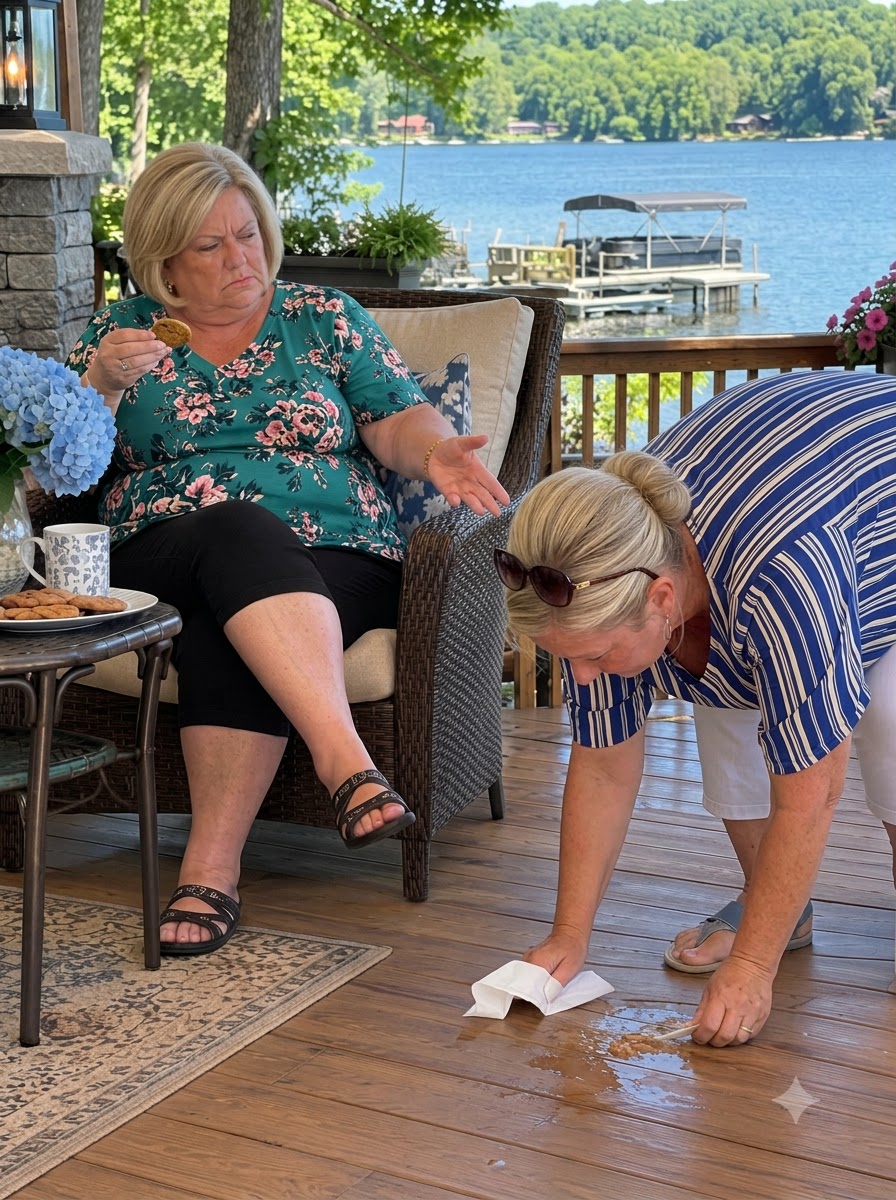
Her smile disappeared.
“You’re serious?”
“Very.”
She stared at me.
“Your mother invited us here.”
Before I could answer, Daniel came downstairs.
T-shirt.
Pajama pants.
Hair everywhere.
He stopped at the bottom of the stairs.
Read the board.
Looked at me.
Then looked at his name.
Daniel: breakfast cleanup.
Susan turned toward him.
“Apparently, I’m making breakfast.”
She said it as though she expected him to laugh.
He hesitated for half a second.
Then said,
“Okay.”
Susan stared at him.
“Okay?”
“Yeah.”
Daniel pointed toward the board. “I’ll clean afterward.”
Susan crossed her arms.
“When people stay at my house, I don’t hand them a chore list.”
Just then, Richard came downstairs wearing his fishing hat and a T-shirt that said WORLD’S OKAYEST GOLFER.
Daniel looked at his mother.
“No, Mom. You don’t.”
He paused.
“Because Dad does the grocery shopping at your house. I usually make breakfast when I’m there. And everybody clears the table after dinner.”
Then he added,
“Everybody except you.”
Susan turned toward Richard.
Richard looked like he desperately wanted to go back upstairs.
He shrugged.
“I do usually shop.”
“That isn’t the point, Richard.”
But that was exactly the point.
Susan loved presenting herself as a natural hostess.
And technically, she did host.
She chose the menus.
The flowers.
The music.
The seating arrangements.
She organized everything beautifully.
Other people handled the actual work. Richard shopped.
Daniel cooked.
Richard’s sister washed the dishes.
Susan stood in the middle with a wineglass, accepting compliments.
For a moment, I watched that realization cross through the kitchen.
Then Mom tried to save everyone.
“I can just make some eggs.”
She stood.
“No.”
I said it firmly.
Maybe too firmly.
Mom sat back down.
Susan gave me a look I knew she would remember for years.
I held her gaze.
Then she opened the refrigerator.
“Fine.”
She stared inside.
“Where are the eggs?”
By nine, breakfast was over.
Nobody had starved.
The cabin was still standing.
Susan made scrambled eggs and toast.
The eggs were dry.
The toast was burned around the edges.
She couldn’t find the butter.
Or the frying pan.
Or the spatula.
Even though she had watched Mom use every one of them every weekend for two months.
Three times, Mom tried to get up.
Three times, I said,
“Sit down.”
And every time, she sat.
She hated every second of it.
After breakfast, Susan stood and headed toward the deck.
Her dirty plate stayed on the table.
Pure habit.
Daniel looked at the plate.
Then looked at her.
“Mom.”
Susan stopped.
She followed his gaze.
Then turned around.
Picked up the plate.
Carried it to the sink.
Set it down harder than necessary.
Then walked outside.
I thought I would feel victorious.
I didn’t.
Mostly, I felt exhausted.
And Mom looked miserable.
She sat at the table, staring at the dishes as though someone had tied her hands together.
By lunchtime, I realized Susan wasn’t the only one having trouble with the new arrangement.
Mom followed me around the kitchen while I cooked.
“You cut those tomatoes too thick.”
“They’ll survive.”
“I can make the dressing.”
“I’ve got it.”
“The good salad bowl is underneath. Not that one. That one is for chips.”
“Mom.”
“You should spin the lettuce first or it’ll—”
“Mom.”
She stopped.
Then she asked something I’ve never forgotten.
“What am I supposed to do?”
Not,
Can I help?
Not,
Do you need anything?
What am I supposed to do?
As if she genuinely didn’t know who she was when nobody needed something from her.
“Go sit on the deck.”
“And do what?”
“Whatever you want.”
She looked completely lost.
“I don’t know what I want.”
“Then go figure it out.”
Twenty minutes later, she came downstairs wearing gardening jeans and an old T-shirt.
She carried a mystery novel I had given her for Christmas.
She had never opened it.
Mom went outside.
Sat in a plastic chair beside the flower boxes.
Opened the book.
And spent about forty-five minutes reading the same page.
Later that afternoon, I went upstairs to get a sweater.
As I passed the guest room, I heard Susan talking to Richard.
“This is exactly what I was trying to prevent.”
I stopped.
Richard said something too quietly for me to hear.
Then Susan said,
“She told me herself, Richard. She said it’s getting harder. Cleaning. Shopping. Driving. Everything. And now everyone is treating her like she can’t handle her own house.”
I knocked.
The room went silent.
Susan opened the door.
“What are you talking about?”
She stared at me.
“Excuse me?”
“You said my mother told you this place was becoming too difficult. What did she tell you?”
Susan glanced at Richard.
Then back at me.
“She didn’t tell you?”
“No.”
I went downstairs.
Mom was still on the deck.
Still sitting beside her flowers.
Still holding the same book.
“Mom, did you tell Susan the lake house was becoming too much for you?”
Mom sighed.
“Oh, honey. It wasn’t a secret.”
“What exactly did you say?”
“Nothing important. We were talking.”
Susan had followed me downstairs.
She stood in the doorway.
“You told me the first weekend in June that taking care of the house was wearing you out.”
Mom frowned. “I said I get tired more easily. I’m sixty-eight.”
“You also said grocery trips were annoying. Opening the house every weekend took a lot of energy. And your back had been bothering you since you fell off the ladder painting the shutters.”
I turned toward Mom.
“You fell off the ladder?”
She stared down at her book.
“It was a little fall.”
“Mom.”
“I landed in the hydrangeas.”
I turned back toward Susan.
“So your solution was to do absolutely nothing?”
Her expression hardened.
“No.”
She stepped onto the deck.
“My solution was not to make her feel like she was incapable of managing her own life.”
I laughed.
“By leaving coffee cups everywhere?”
“You don’t understand.”
“Then explain it.”
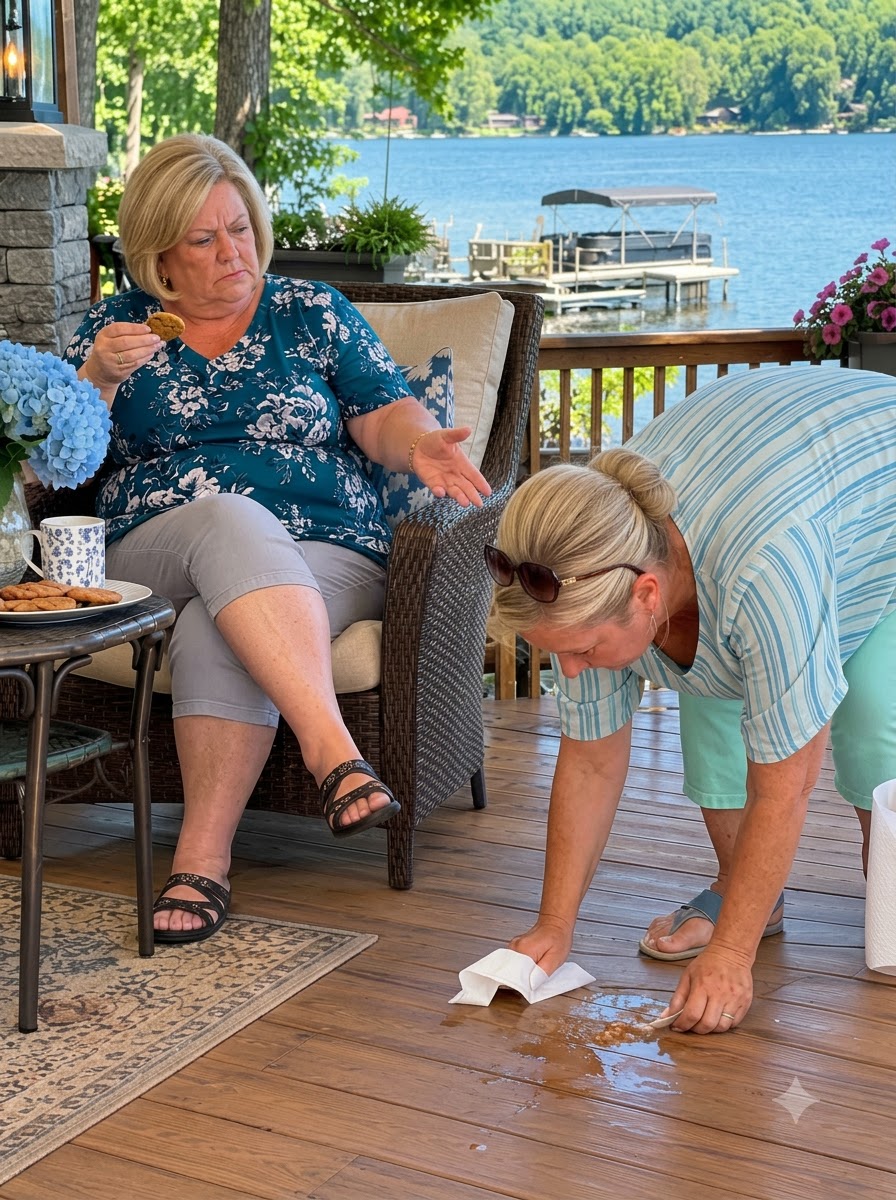
Susan fell silent.
Then she pulled one of the plastic chairs closer and sat across from Mom.
“When my mother got older, my siblings and I started helping her.”
She paused.
“At least, that’s what we called it.”
Her voice was different now.
“We carried everything for her. Told her not to cook. Told her not to clean. Every holiday, if she stood up, someone immediately said, ‘Mom, sit down. We’ve got it.’”
Susan stared down at her hands.
“We thought we were taking care of her.”
Nobody said anything.
“Then one Thanksgiving, the last one before she died, I brought her coffee in the living room.”
Susan swallowed.
“She looked at me and said, ‘Susie, all of you have made me feel useless.’”
Mom lowered the book.
Susan’s eyes were wet now.
“She said we had decided she was old before she was. Every time we told her to sit down, she heard that nobody needed her anymore.”
Her voice cracked slightly.
“That she didn’t have any purpose anymore.”
Her mother died four months later.
“And I never got to apologize.”
The deck fell silent.
“So when Maggie told me this house was becoming harder but also kept saying how much she loved having everyone here, I thought I understood.”
Susan looked at Mom.
“I thought, I’m not going to make the same mistake. I’m going to let her host. Let her feel needed.”
I looked at her.
“So you thought letting her wait on you constantly was helping her?”
“I thought letting her host the way she wanted was helping.”
And for one uncomfortable moment, I almost understood.
A woman traumatized by the feeling that she had taken away her own mother’s independence.
A woman determined not to make the same mistake again.
She had simply gone too far in the opposite direction.
Almost understandable.
Then I remembered the flowers.
“What does any of that have to do with leaving your coffee cup on the deck every morning?”
Susan said nothing.
“Or making her drive forty minutes because you don’t like her mayonnaise?”
Still nothing.
“Or telling her where she can put her own flowers in her own house?”
Susan’s expression shifted.
Mom looked down.
“Maybe the first weekend, you genuinely thought letting her cook made her feel needed.”
I nodded.
“Maybe the second weekend too.”
Then I looked directly at Susan.
“But that isn’t why you eventually stopped saying thank you.”
Susan opened her mouth.
Then closed it.
She had no answer.
We sat there in silence.
Finally, Mom spoke.
“I do like it.”
I turned toward her.
“I like cooking for everyone. I like the bedrooms being full. I like hearing people moving around in the morning.”
She looked toward the lake.
“When your father died, this house became so quiet.”
Her voice softened.
“For two summers, I couldn’t even come here.”
She looked back at us.
“Now it isn’t quiet anymore. And I love that.”
Susan’s shoulders relaxed.
Too soon.
Mom continued.
“But I suppose I got carried away.”
“With what?”
Mom gave a small, embarrassed laugh.
“Trying to make everybody want to come back.”
At first, I didn’t understand.
Then everything fell into place.
“You got married,” Mom said. “Suddenly you had this whole new family. Daniel’s parents. His relatives. People I didn’t know.”
She swallowed.
“I wanted everything to be easy for you.”
She looked at me.
“I wanted them to like coming here.”
A pause.
“I wanted them to like me.”
Suddenly, the entire summer looked different.
The new sheets.
The new towels.
The little hotel basket.
The special mayonnaise.
The peach cobbler.
Every meal.
Every coffee cup.
Every unnecessary trip to the store.
Mom hadn’t simply been serving them because she couldn’t say no.
She had been auditioning.
Trying to earn a place inside my new family.
“The sheets,” I said.
Mom smiled tiredly.
“The sheets.”
“The expensive mayonnaise.”
“Susan likes it.”
“The peach cobbler every Saturday because Richard once said he liked peach cobbler.”
Richard looked up.
“You make that every week because of me?”
“You said you liked it.”
Richard looked horrified.
“I was just being polite.”
Mom stared at him.
Then she started laughing.
For some reason, we all almost did. But once her laughter faded, she said quietly,
“Every time your cars pulled into the driveway, I thought I had done something right.”
Susan went pale.
“Maggie, I thought you genuinely enjoyed all this.”
“I do enjoy taking care of people.”
Mom looked directly at her.
Then she said the sentence I still remember.
“I like taking care of people, Susan. I don’t like being taken for granted. Those are not the same thing.”
Nobody said anything after that.
Susan stared toward the far corner of the deck.
Toward the six blue boxes filled with red geraniums.
At five that afternoon, Susan walked into the kitchen.
She stopped in front of the chore board.
Her name was beside Saturday dinner.
For a moment, I expected another argument.
Instead, she turned toward Mom.
“What were you planning to make tonight?”
Mom began to stand.
I gave her a look.
She sat back down.
“Chicken. Roasted potatoes. Green beans. The chicken is already marinated.”
Susan sighed.
“Where are the potatoes?”
Dinner wasn’t amazing.
Susan overcooked the chicken.
The potatoes were still firm in the middle.
The green beans needed salt.
She asked where everything was.
The baking sheet.
Oil.
Pepper.
Oven mitts.
But somewhere in the middle of cooking, something changed.
She stopped asking Mom.
She started opening the cabinets herself.
Looking.
Learning.
At one point, she found the spatula hanging beside the refrigerator.
The same spatula she hadn’t been able to find at breakfast.
She held it up.
“Huh.”
At dinner, everyone ate Susan’s dry chicken and crunchy potatoes.
Daniel smiled.
“This is good, Mom.”
“No, it isn’t.”
Richard shrugged.
“It’s fine.”
“It’s edible.”
Mom took a bite.
Chewed carefully.
Then smiled.
“It’s very good, Susan. Thank you.”
Susan looked at her.
“You’re welcome, Maggie.”
After dinner, Mom automatically reached for the plates.
Thirty years of habit.
But Susan got there first.
“Leave those. I’ll do it.”
Mom smiled.
Then caught herself.
“Don’t tell me to sit down either.”
Susan froze.
I almost laughed.
She corrected herself.
“Right. Sorry.”
Then she asked,
“Maggie, would you like to help me with the dishes?”
Mom thought.
Really thought.
Then said,
“No.”
Susan nodded.
“Okay.”
And carried the plates into the kitchen herself.
That night, I found Mom outside beside the flowers.
Moonlight covered the lake.
I sat beside her.
“I’m sorry for what I said this morning.”
“About being everyone’s maid?”
“Yes.”
“It was a little mean.”
“I know.”
She smiled faintly.
“But also a little true.”
We sat quietly.
Then Mom said,
“Your father would’ve hated watching me all summer.”
I smiled.
“He always said I would give away my own shoes if someone complimented them.”
She laughed.
“He used to steal dish towels from me just to make me stop working.”
She looked out across the lake.
“Once I found one in his tackle box three years after he died.”
I took her hand.
“I miss him.”
“I know.”
The next morning, I went downstairs at seven.
Mom was sitting at the table.
Pink robe.
Coffee.
Mystery novel.
She had made it to page eighty-four.
The kitchen was quiet.
And in the sink sat one coffee cup.
Rinsed.
Upside down.
Susan’s.
She had made her own coffee.
Carried her cup in from the deck.
Rinsed it herself.
Mom and I noticed.
Neither of us said anything.
Mom simply smiled and went back to reading.
Richard handled the grocery run that morning.
When he returned, he had regular mayonnaise.
“Susan said it’s fine.”
Then he held up a second jar.
Avocado-oil mayonnaise.
“I bought one anyway.”
Before leaving Sunday afternoon, Susan found Mom outside.
I stayed close enough to hear.
“Maggie.”
Mom looked up. “I’m sorry about the flowers.”
Mom said nothing.
“I shouldn’t have told you to move them. It’s your house.”
Susan paused.
“It was rude.”
Mom looked at her.
“Yes. It was.”
And Susan accepted that.
No excuses.
No explanations.
No,
I didn’t mean it.
No,
You misunderstood.
Just acceptance.
Then she glanced toward the geraniums.
“They really are beautiful.”
Mom smiled.
“I know.”
A few minutes later, Susan walked through the kitchen on her way to the car.
The dry-erase board had already been wiped clean.
She stopped.
Picked up the marker.
And wrote:
Susan — Saturday breakfast.
Then she left.
On her way to the car, she passed the big lounger.
She stopped.
Looked at it.
Then looked at the six flower boxes tucked near the trash cans.
She walked over.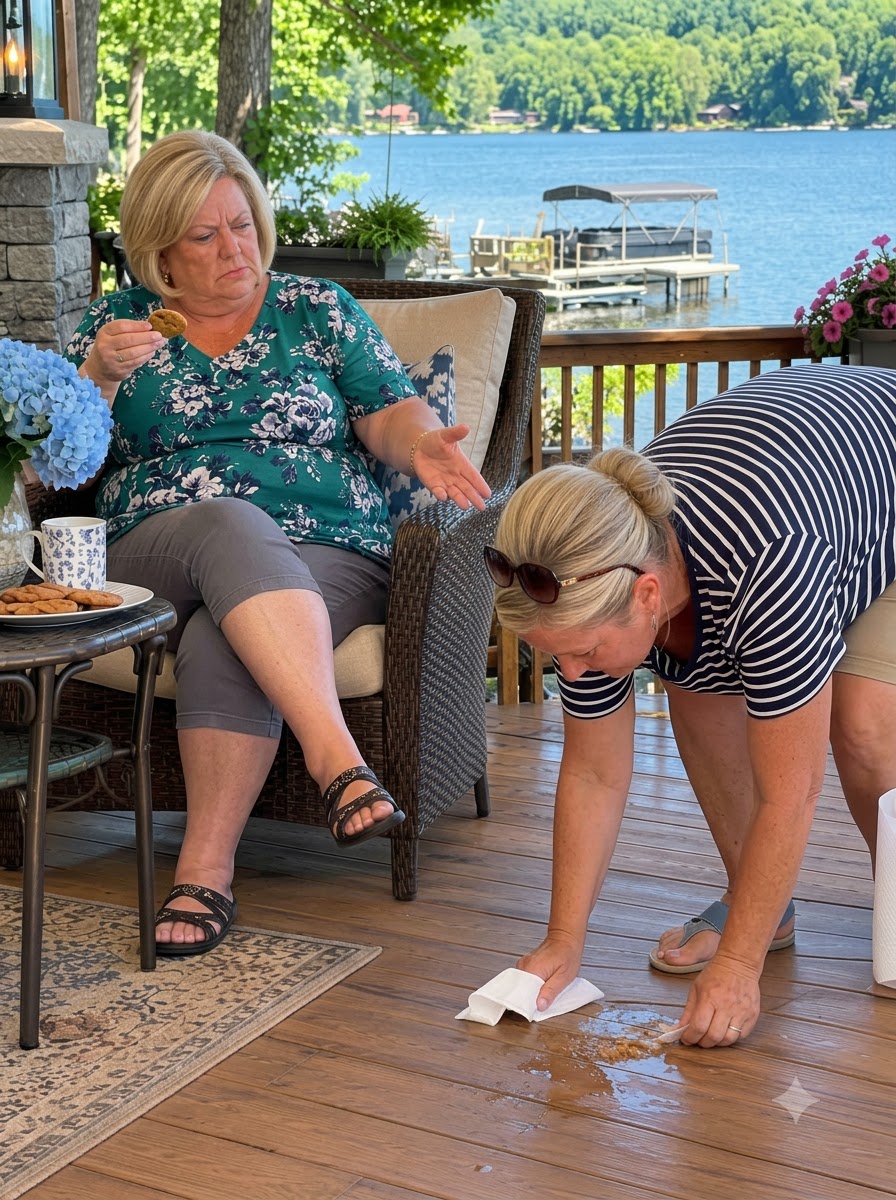
Picked up one box with both hands.
Carried it across the deck.
Set it back on the railing.
Exactly where Mom had originally placed it.
Then she went back for another.
And another.
All six.
By the end, she was breathing hard, with dirt on her white cover-up.
Mom stood in the doorway watching, one hand over her mouth.
Susan looked at the big lounger.
The geraniums now blocked part of its view.
She said nothing.
Instead, she grabbed a plastic chair from the other side of the deck.
Moved it to a spot where she could see around the flowers.
Sat down for one quiet minute.
Looked at the lake.
Then walked to the car.
Mom noticed.
So did I.
I had set my alarm for five because I thought I needed to teach my mother-in-law a lesson.
And maybe I did.
But she wasn’t the only person who changed that weekend.
Mom stopped treating every visit like an audition.
The following Saturday, Susan cooked breakfast.
Her scrambled eggs were less dry.
She proudly told us she had watched a video.
The weekend after that, Mom and Susan cooked dinner together.
Mom taught her how to make pot roast.
They argued about garlic.
“More.”
“That’s already a lot.”
“More, Susan.”
Susan added more.
It was excellent.
Susan started carrying her own plate.
Every meal.
Without reminders.
She began asking instead of assuming.
“Maggie, would it be okay if I use the kayak?”
“Do you mind if I finish the coffee?”
She began doing enough work to understand how much invisible labor Mom had been doing all summer.
At the end of August, when we closed the cabin for the season, Susan got down on her knees and scrubbed the bathroom floor.
Nobody told her to.
When she finished, she stood up and rubbed her knees.
“Good Lord. You do this every week?”
“Every week.”
Susan stared at Mom.
“You’re either a saint or completely crazy.”
“Probably both.”
They laughed.
And I learned something too.
Defending my mother didn’t mean I had to fight every battle for her.
It didn’t require yelling at Susan.
Or making a scene.
Or ruining the next thirty Christmases.
Sometimes, I simply needed to create enough room for Mom to finally say no.
Then step back.
And let her say it herself.
We returned to the lake last weekend.
First weekend of a new summer.
The geraniums were already there.
Six blue boxes.
Bright red flowers.
The dry-erase board stood on the kitchen table.
At the top, in Mom’s handwriting, it said:
WEEKEND JOBS.
Five names underneath.
Breakfast.
Lunch.
Dinner.
Groceries.
Cleanup.
Rotating assignments.
And at the bottom, beside her own name, Mom had written:
Maggie: Sunday breakfast. And enjoy my house.
She underlined my twice.
The geraniums stayed exactly where she planted them.
All summer.
And every morning, when Susan carried her coffee outside, she walked right past the large striped lounger.
She chose the plastic chair at the end of the deck.
The one where she could see the whole lake.
Past the flowers.
Past the little red party Mom had planted there.
