

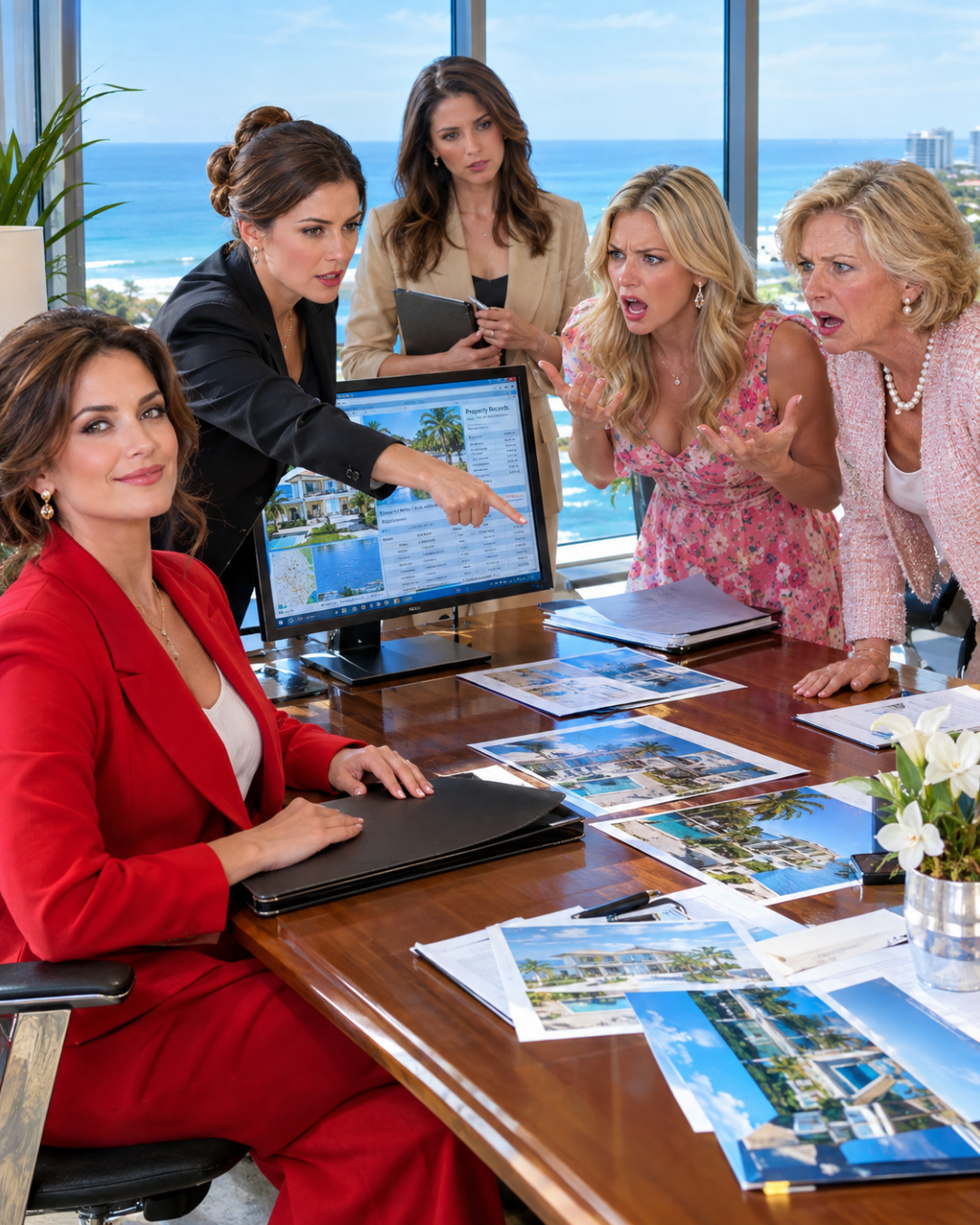
My sister laughed that my $3 million beach house was “free money” and immediately began planning wedding upgrades while a realtor measured rooms I had slept in only the night before. Mom called me a squatter and insisted the property belonged to “the family.” I let them arrange the title meeting. Then the closing agent opened the county records, looked straight at me, and asked the one question Marissa had never considered asking…
“Nobody has really lived here in years,” my sister Marissa announced, gesturing with one manicured hand across my living room. “At this point, selling it is basically free money.”
I was sitting only twelve feet from her.
I had slept upstairs the previous night.
Ocean air drifted through the open windows, stirring the linen curtains and bringing the crisp scent of the Atlantic through the room. My coffee had already turned cold as I sat in my father’s old armchair while Claire Whitmore, the real estate agent Marissa had hired, typed notes into her tablet.
“The location is extraordinary,” Claire said. “Oceanfront homes along this stretch have been listing above three million dollars, depending on condition and improvements.”
Mom appeared from the kitchen almost instantly.
“Three million?”
Marissa seized her fiancé Caleb’s arm.
“I told you this would finally pay off.”
Caleb smiled broadly.
“Three million changes the wedding conversation completely.”
Apparently, it did.
Within half a minute, they were already talking about Harbor Crest Resort, the larger reception terrace, a full seafood dinner, upgraded flowers, and the honeymoon package they had previously decided cost too much.
Mom smiled.
“Your father would have loved seeing you married somewhere beautiful.”
I took another drink of cold coffee.
My father, Thomas Hale, truly had loved that house.
That part was true.
He purchased it in 1998, when the road was quieter and oceanfront cottages had not yet become investments people discussed according to price per square foot.
I was Noah, his younger child.
Marissa was four years older than me.
As children, she loved the beach house for parties, pictures, and summers spent with friends.
I loved it during February.
Dad and I would visit when the beach stood empty, repair whatever the salt had corroded, eat canned soup, and listen to the wind pressing against the windows.
After he died two years earlier, I began spending even more time there.
Apparently, nobody in my family had noticed.
Claire raised her eyes from the tablet.
“Before anyone makes commitments, I need to verify ownership, confirm title, and make sure there are no estate or occupancy issues.”
Marissa opened a cream-colored folder.
She had arrived prepared.
“Dad bought the house in 1998. He died a little over two years ago. His estate went through probate.”
Claire studied several documents.
“And this property was distributed through the estate?”
“That’s correct,” Marissa said.
Without the slightest hesitation.
I watched her over the rim of my coffee cup.
The strange thing about a confident lie is that sometimes the person saying it does not realize she is lying.
For years, Marissa had heard everyone call it “Dad’s beach house.”
Dad died.
So the beach house became family property.
That was the full extent of her legal reasoning.
Mom moved closer.
“There is one complication.”
Claire waited.
“Our youngest son stays here occasionally.”
She motioned toward me without actually looking at me.
“He’s always been a little unsettled.”
That caught my attention.
Marissa sighed.
“He drifts in and out. We don’t even know where he lives half the time.”
Caleb laughed.
“He calls it remote work. Looks more like permanent vacation.”
“Minimalist lifestyle,” Mom added. “No real office. No roots.”
I lowered my cup.
They had decided what kind of person I was years ago.
I wore jeans rather than suits.
I drove an eleven-year-old sedan.
My work happened on a laptop.
Therefore, according to my family’s version of reality, I remained the younger son who had never completely gotten his life started.
They had no idea my consulting firm employed eight full-time contractors and served three corporate clients.
They did not know the SUV behind the detached garage belonged to me because I almost never drove it around them.
And they certainly had no idea how much money I had poured into maintaining that house.
Property taxes.
Insurance.
A replacement roof.
Foundation repairs.
Storm shutters.
Electrical improvements.
Five uninterrupted years of utility bills.
Claire glanced toward me.
“Are you saying there is a tenant?”
“Not exactly,” Marissa said.
Then she smiled.
“More like a family squatter.”
My jaw tightened.
I stayed silent.
Claire’s expression grew more cautious.
“Occupancy can affect a sale.”
“Oh, Noah won’t be a problem.”
Marissa laughed.
“He barely owns enough to fill a car.”
That nearly made me smile.
Claire moved around the room, examining the windows and the original beams.
“Assuming title is clean, I could possibly have photography scheduled next week.”
Marissa clapped her hands once.
“Next week?”
“Potentially.”
Caleb slipped an arm around her.
“Then we should visit Harbor Crest tomorrow before somebody takes the June date.”
“June is expensive,” Mom said.
“Not when you’re selling a three-million-dollar house.”
That was when I finally said something.
“This house isn’t abandoned.”
Marissa’s expression shifted immediately.
“Here we go.”
I gestured toward the ceiling.
“The beams are original cypress. The west wall was rebuilt after the storm using the old framing pattern. The floors are heart pine. If a staging company starts replacing things because they look dated, you could damage the value.”

Claire seemed interested.
“You know the property well.”
“Unfortunately,” Marissa interrupted, “Noah thinks emotional attachment makes him an expert.”
Mom crossed her arms.
“This house needs to benefit the family instead of functioning as Noah’s private vacation cabin.”
“What does one single man need five bedrooms for?” Marissa asked.
I met her eyes.
“How often do you think I’m here?”
She shrugged.
“Who knows?”
That response told me everything I needed to know.
She had never bothered wondering.
The next morning, Marissa and Caleb toured Harbor Crest.
I knew because she uploaded twelve photos to the family group chat.
Outdoor ceremony overlooking the water.
Champagne wall.
Imported floral arch.
Late-night oyster bar.
She included the prices next to several of the choices.
Mom responded with heart emojis.
By that evening, they had placed refundable holds on two upgrades and a less-refundable deposit on the larger terrace.
I said nothing.
To Claire’s credit, she proceeded more cautiously.
She emailed Marissa explaining that she would not officially list the property until the preliminary title work had been completed.
Marissa forwarded the email to me with a single sentence.
Please don’t complicate this.
I stared at her message for several moments.
Then I replied:
I won’t.
Three days later, Claire asked everyone to meet at the office of a local title company.
Marissa treated the meeting like an early closing celebration.
She arrived in a cream dress with Caleb beside her.
Mom brought a legal pad covered with numbers.
From my seat, I could make out several labels.
Wedding.
Taxes.
Mom.
Marissa.
There was even a line marked Noah.
Apparently, they had already determined how much money from my own house I was entitled to receive.
The title agent was Ellen Price.
She appeared to be in her late fifties, with silver-blond hair and the calm expression of someone accustomed to watching people learn that property records were indifferent to family narratives.
Claire sat next to her.
I chose a chair near the far end of the table.
Marissa leaned toward Caleb and whispered, “Once this is cleared, we can sign the Harbor Crest upgrade.”
Ellen opened the file.
“Before we discuss listing authority, I need to clarify the ownership history.”
Mom leaned forward.
“Our attorney already handled Thomas’s estate.”
“Yes,” Ellen said. “I reviewed the probate docket.”
Marissa smiled toward me.
Not obviously.
Just enough for me to notice.
Then Ellen continued.
“The reason this property does not appear as an estate asset is because Mr. Thomas Hale did not own the full title at the time of his death.”
Something shifted inside the room.
Mom frowned.
“What does that mean?”
Ellen turned her computer slightly toward us.
“There is a recorded deed dated January 14, 2019.”
Marissa leaned forward.
“To whom?”
Ellen looked straight at me.
“To Noah Hale.”
Nobody said a word.
She continued.
“Thomas Hale transferred the property to Noah Hale while retaining a lifetime right of occupancy and use. Upon Thomas’s death, that retained interest ended. The current recorded owner is Noah.”
Marissa actually laughed.
“No.”
Ellen showed no reaction.
“That is what the county records show.”
“Noah stays there. He doesn’t own it.”
Claire lowered her eyes toward her notes.
Ellen opened another document.
“The deed was properly recorded more than five years ago. I also have the later filing documenting Thomas Hale’s death and the termination of his retained life interest.”
Mom’s face had turned white.
Marissa spun toward me.
“What did you do?”
I folded my hands together.
“Nothing today.”
“You stole Dad’s house?”
“No.”
“You manipulated him?”
“No.”
Caleb was no longer smiling.
Ellen spoke before Marissa could continue.
“Ms. Hale, unless you have evidence challenging the recorded title, you do not currently have authority to list or sell this property.”
Marissa stared at her.
“What about probate?”
“The house was not in probate because it was no longer an estate-owned asset.”
Mom finally turned toward me.
For the first time all week, there was no condescension in her expression.
Only confusion.
“When were you planning to tell us?”
I looked around the table.
At the wedding calculations.
At Marissa’s folder.
At the imaginary distribution of money they had already spent inside their heads.
Then I gave her the honest answer.
“When one of you finally asked who owned the house.”
FULL STORY CONTINUATION
Marissa shoved her chair backward so violently that it hit the wall.
“This is insane.”
For a moment, nobody responded.
She turned toward Mom.
“You knew about this?”
“No.”
Mom’s voice was barely more than a whisper.
Then Marissa faced me.
“You let us plan all of this knowing you had some secret deed?”
“I let you hire a realtor for property you never checked.”
“That is not the same thing.”
“No. It isn’t.”
Caleb finally broke his silence.
“Marissa, did you actually see anything showing the house belonged to you?”
She stared at him.
“Dad owned it.”
“That isn’t what I asked.”
Hearing the question from him irritated her more than hearing it from me ever could have.
“Why are you suddenly interrogating me?”
“I’m trying to understand.”
She turned toward Ellen.
“There has to be more to this.”
“There is,” I said.
Every face turned toward me.
Six years earlier, we had nearly lost the house.
Not through a legal dispute.
Practically.
A powerful coastal storm had damaged the roof, flooded part of the lower floor, and compromised a section of the west wall.
Insurance paid for some of the damage.
Not enough.
Dad was already struggling with medical expenses and reduced retirement income.
There was still a mortgage balance on the property, and the carrying costs had become increasingly difficult.
He called a family meeting.
Marissa barely remembered it.
I remembered every second.
Dad explained that the house required major repairs.
Mom said selling it made sense.

Marissa agreed.
“It’s just a house,” she had said.
At the time, she was newly married to her first husband and living three states away. Oceanfront property values had not yet climbed anywhere close to where they were now.
I refused to let the house be sold.
So Dad and I reached an agreement.
I paid the remaining mortgage balance.
I covered the storm restoration expenses insurance would not.
I assumed responsibility for taxes, insurance, maintenance, and repairs.
In exchange, Dad transferred the property to me while retaining the legal right to use the house for the remainder of his life.
Keeping that right had been his idea.
Insisting on it had been mine.
I wanted him to understand that as long as he wanted the place, it would remain his home.
We hired an attorney.
There was an appraisal.
There were banking records.
There were invoices.
Nothing about the deed had been hidden.
It had remained publicly recorded in the county land records since 2019.
Marissa shook her head.
“Dad would have told me.”
“He probably thought you remembered telling him to sell it.”
Her face flushed red.
“That is cheap.”
“It’s also true.”
Mom stared down toward the table.
“I remember the storm discussion.”
I waited.
She rubbed two fingers together, one of her old nervous habits.
“I remember Thomas saying Noah was going to handle the property.”
“Handle it?” Marissa snapped. “That doesn’t mean give it away.”
Ellen intervened.
“I think it is important to distinguish family interpretation from recorded ownership.”
Marissa glared at her.
Ellen remained perfectly composed.
“The title company is not determining whether anyone likes the transaction. I am telling you what the documents establish.”
Caleb leaned farther back in his chair.
“How much did Noah pay?”
I told him.
Between paying off the mortgage and covering restoration expenses during the first two years, it had been slightly more than $430,000.
Then came all the ongoing expenses.
I did not tell them the complete amount.
I knew exactly what it was.
I simply saw no reason to reduce my relationship with Dad to an invoice.
Mom stared at me.
“You had that kind of money in 2019?”
The question should not have irritated me.
But it did.
Not Is that what you did for your father?
Not Is that why the house survived?
You had that kind of money?
“I did.”
Marissa laughed in disbelief.
“From what?”
“My business.”
“What business?”
I nearly smiled.
“The one you’ve been calling remote work for eight years.”
Silence.
Claire lowered her eyes, possibly to hide her expression.
Marissa continued staring at me.
“You’re seriously telling me you own a company?”
“I own a consulting firm.”
Caleb asked, “The supply-chain one?”
That surprised me.
I turned toward him.
He shrugged.
“I searched your name once.”
Marissa turned sharply toward him.
“You knew?”
“I knew he had a firm. I didn’t know about the house.”
My sister looked personally offended that information about my life had somehow existed without first passing through her.
I stood up.
Claire collected her papers.
“Given what we now know, there will obviously be no listing unless Noah chooses to list.”
“I don’t,” I said.
It was the first decision involving my own property that anyone in my family had actually bothered asking me to make.
The meeting ended.
At least, the professional part did.
The family part continued outside in the parking lot.
Marissa followed me out.
“You humiliated me.”
I unlocked my car.
“No.”
“You sat there while I talked about the wedding.”
“Yes.”
“You watched us put deposits down.”
“Yes.”
Her voice grew louder.
“You could have stopped me.”
I turned around.
“Marissa, you were planning to sell my house.”
“You knew what I believed.”
“I knew what you assumed.”
“What is the difference?”
“A lot.”
Mom had reached us by then.
“Noah, she’s your sister.”
I looked at her.
That sentence had carried an extraordinary amount of responsibility in our family.
She’s your sister.
Meaning give her your room.
Take her to the airport.
Lend her money.
Do not embarrass her.
Never contradict her publicly.
Help pay for the wedding.
Pretend she had not called you a squatter inside your own house.
“What do you want me to do with that information, Mom?”
She blinked.
“The wedding plans are already in motion.”
“Then Marissa and Caleb should make plans they can afford.”
Marissa stared at me as though I had slapped her.
“Dad would have wanted to help with my wedding.”
“Probably.”
That was true.
Dad adored Marissa.
He absolutely would have wanted her wedding to be beautiful.
Then I added, “He also would not have sold my house to pay for it.”
Tears filled her eyes.
For a second, enough of the anger disappeared that I could see what lay beneath it.
Fear.
The wedding had already expanded beyond their original budget.
Not disastrously.
But enough to matter.
Marissa and Caleb had been arguing about expenses even before the beach house entered the equation.
Once she persuaded herself that a $3 million sale was coming, every remaining restraint disappeared.
The house had not created her sense of entitlement.
It had simply removed her caution.
Caleb gently touched her elbow.
“We need to call Harbor Crest.”
She pulled her arm away.
“No.”
“Yes.”
“We’re not canceling everything.”
“I didn’t say everything.”

“You heard Claire. The house is worth over three million.”
I could hardly believe she had said it again.
I stared at her.
“So?”
She faced me.
“So you could still help.”
There it was.
The ownership records had changed.
Her expectations had not.
“How much?”
She hesitated.
Mom answered instead.
“They only need about eighty thousand more for everything they planned.”
I laughed.
I genuinely could not stop myself.
Not cruelly.
Only out of complete disbelief.
Marissa’s expression hardened.
“You think this is funny?”
“No. I think it’s remarkable that ten minutes after learning the house is mine, you’ve moved directly from selling it without permission to asking me for eighty thousand dollars.”
“It would be nothing compared to the value of the property.”
“To you.”
Caleb quietly said her name.
She ignored him.
“You don’t even use all of it.”
“The house?”
“Yes.”
“What percentage of a home does someone need to occupy before you consider ownership valid?”
“Stop twisting everything.”
“I’m not.”
Mom stepped between us.
“Your father always wanted you two to take care of each other.”
That sentence reached deeper.
Dad had said things like that.
Especially toward the end.
But caring for one another and paying for one another’s fantasies were not the same thing.
“I’ll take care of Marissa if she is sick,” I said. “I’ll come if she needs me. I’ll help in an emergency. A seafood tower and an upgraded terrace are not emergencies.”
Caleb covered his mouth with one hand.
Marissa glared at him.
“Are you laughing?”
“No.”
He absolutely was.
They left in separate cars.
I returned to the beach house.
For the first time since they had shown up with Claire, the place felt peaceful again.
I went from room to room locking the windows.
Not because I thought Marissa would break into the house.
Because I needed to restore some sense of order.
Upstairs, I discovered one of her wedding brochures sitting on the dresser in Dad’s old bedroom.
Harbor Crest.
The picture showed white flowers, golden chairs, candles, and a sunset edited so perfectly that it hardly seemed real.
I placed it inside a drawer.
Then I phoned a locksmith.
Both Marissa and Mom still had old family keys.
They had always used them freely when Dad was alive.
That arrangement was finished.
Two days later, the locks were replaced.
I installed exterior cameras as well and changed the alarm code.
Again, not because I thought my family posed a danger.
Because access should come with permission.
For years, everyone had treated the beach house as a shared family resource because Dad welcomed all of us there.
After his death, nobody stopped long enough to recognize that hospitality and ownership were not the same thing.
Marissa discovered the changed locks first.
She texted:
Seriously?
I answered:
Yes.
She wrote:
You’re becoming unbelievably selfish.
I nearly responded.
Then I realized there was nothing new left for me to say.
So I set the phone aside.
The wedding became the next family emergency.
Harbor Crest allowed them to remove most of their upgrades, although part of one deposit was lost.
They returned to the smaller terrace.
Reduced the flowers.
Canceled the oyster bar.
Removed twenty-three guests from the list.
Their honeymoon became four nights rather than ten.
Something surprising happened during that process.
Caleb relaxed.
I only learned that months afterward.
He had hated how expensive the wedding was becoming but continued agreeing because Marissa interpreted every hesitation as evidence that he was not excited about marrying her.
When the imagined beach-house money disappeared, reality became an explanation neither of them could argue against.
He called me once.
I nearly ignored it.
“Noah, I’m not calling to ask for money.”
“Good opening.”
He laughed.
Then his tone became serious.
“I’m sorry.”
“For what?”
“I took pictures of your house like it was inventory.”
I appreciated his choice of words.
Your house.
Not the house.
“I believed what Marissa told me.”
“You had no reason not to.”
“I probably had a few.”
That was honest.
He paused.
“I also wanted the bigger wedding. So I didn’t ask many questions.”
I understood that more than he probably realized.
People often avoid investigating information when believing it benefits them.
“Are you two okay?”
“We’re figuring it out.”
And they did.
They married in June.
I received an invitation.
For almost a month, I could not decide whether I wanted to attend.
Then an envelope arrived in my mailbox.
No dramatic message.
Only a proper invitation.
My name.
No plus-one.
No mention of money.
I went.
Dad would have wanted that as well.
The wedding was beautiful.
Smaller than Marissa had originally imagined.
Probably better because of it.
There was seafood, though no tower.
The terrace overlooked the harbor.
Mom started crying before Marissa had even reached the end of the aisle.
I sat in the third row.
Nobody said anything about the beach house.
During the reception, Marissa approached while Caleb spoke with relatives.
“Thank you for coming.”
“You’re my sister.”
She gave me an exhausted smile.
“That sentence sounds different when you say it now.”
“It probably should.”
She glanced toward the dance floor.
“I really did think Dad still owned the house when he died.”
“I know.”
“I wasn’t trying to steal from you.”

I considered her words.
“I believe you didn’t know it was mine.”
Her shoulders lowered slightly.
“But?”
“But once I said the house wasn’t abandoned, you didn’t ask why.”
She looked down.
“You called me a squatter.”
“I know.”
“You said I barely owned enough to fill a car.”
“I know.”
“You planned how to spend the sale money before Claire had even verified title.”
Her eyes filled with tears.
“I was excited.”
“I know.”
And that was the strange part.
I really did know.
Marissa was not some criminal mastermind.
She was my older sister.
A woman overwhelmed by wedding pressure who had spent most of her life assuming family assets would eventually reorganize themselves around whoever happened to have the greatest immediate need.
For years, that person had usually been her.
“I’m sorry,” she said.
I nodded.
“I believe you.”
She looked at me hopefully.
Forgiving someone did not mean pretending nothing had happened.
“I’m still changing the locks.”
To my surprise, she laughed.
A genuine laugh.
“Fair.”
Our relationship did not magically become perfect afterward.
Real families rarely transform because someone offers one sincere apology beside a dance floor.
Mom was more difficult.
For months, she maintained that the real problem was Dad failing to communicate clearly enough.
She wanted the story to be about paperwork.
That was easier than admitting she had helped reduce me to the unsuccessful son because that version of me made dismissing my wishes easier.
One Sunday, she came to the beach house by herself.
She rang the doorbell.
That mattered.
Mom had never rung it before.
I opened the door.
She carried a small cardboard box.
“I found these.”
Inside were Dad’s old maintenance notebooks.
Years of records.
Roof inspections.
Paint colors.
Appliance serial numbers.
Contractor estimates.
Near the end of the final notebook was an entry dated shortly after the 2019 deed transfer.
Dad had written:
Noah took over the house today. I kept lifetime use because the boy insisted. Says as long as I’m alive, it is still home. He saved this place when selling would have been easier.
Below it:
Diane thinks I should divide everything evenly someday. I understand why. But equal is not always the same as honest. Marissa did not want this house when it was expensive to save. Noah did.
Mom had already read the entry.
I could tell.
She lowered herself into Dad’s old armchair.
For a while, neither of us spoke.
Eventually she said, “I thought he was favoring you.”
“He wasn’t.”
“I know that now.”
I looked toward the ocean.
“I paid for it, Mom.”
“I know.”
For the first time, she said those words without adding any qualification.
She touched the notebook.
“I also didn’t know your business was doing so well.”
I almost laughed.
“You never asked.”
She winced.
“I suppose I didn’t.”
No.
They had asked when I planned to get a real office.
When I would stop moving around.
When I intended to settle down.
When I might meet someone.
They asked questions intended to compare my life against the version they expected me to live.
They rarely asked what my real life actually contained.
Mom apologized that afternoon.
Not perfectly.
She told me she had worried about me for years and eventually started confusing worrying about me with actually knowing me.
That was close enough to the truth for me to accept.
Marissa returned to the house for the first time nearly a year later.
She called beforehand.
Then she rang the bell.
Another small change.
We walked together toward the beach.
By then, she was pregnant.
Only twelve weeks.
She had not told Mom yet.
“You’re first,” she said.
I lifted an eyebrow.
“Why?”
“Because you can keep your mouth shut.”
“Apparently one of my defining traits.”
She laughed.
We sat down on the sand.
After some time, she asked, “Do you ever think about selling?”
“The house?”
“Yes.”
“Sometimes.”
She looked genuinely surprised.
“You’d sell it?”
“If I stopped wanting it.”
“But Dad—”
“Dad gave it to me because he trusted me to decide what happened to it. Keeping it forever out of guilt would still be letting someone else decide.”
She thought about that.
Then she nodded.
“I think I’m finally starting to understand why you were so angry.”
“I wasn’t angry because you wanted the money.”
“What then?”
“You looked at a place I had spent years protecting and saw something unused because you didn’t see me.”
She became quiet.
That had been the part that truly hurt.
Not three million dollars.
Not Harbor Crest.
Not the realtor.
My family had walked through rooms filled with my clothes, my work, my groceries, my tools, and years of repairs I had financed, then decided that nobody really lived there.
Because in their minds, I barely counted as somebody.
That changed.
Not immediately.
But eventually, it changed.
I stopped hiding my success just to make family gatherings more comfortable.
When my old sedan finally died, I bought a newer car.
I invited Mom to visit the small city office my firm opened.
At a Christmas dinner, Marissa met two of my contractors and spent ten minutes looking embarrassed after realizing they called me their boss.
I enjoyed that more than I probably should have.
The beach house remains mine.
According to Claire, its market value has risen again. She eventually became the agent I call whenever I need a serious opinion about coastal real estate.
She never listed the house.
She did help me rent it once to a film crew for three days.
Marissa thought that was hilarious.
“You’re finally making free money.”
I stared at her.
She froze.
Then we both burst out laughing.
Dad’s armchair remains beside the bay window.
The west wall still follows its original framing pattern.
The heart-pine floors still creak beside the stairs.
And now, when people come to visit, they knock.
That might be the smallest difference.
It might also be the one I appreciate most.
For years, my family believed stability had to mean a suburban mortgage, an office cubicle, a spouse, children, and a car purchased according to schedule.
My life did not look like that.
So they confused different with unfinished.
The county records corrected one misunderstanding.
Everything else required more time.
I had never been the family squatter.
I had never been wandering through somebody else’s home.
I had been standing inside the life I created the entire time.
They simply needed to stop deciding what to do with it long enough to finally see me.
