

PART 1
“You’re here to clean, Lucía, not to raise my children.”
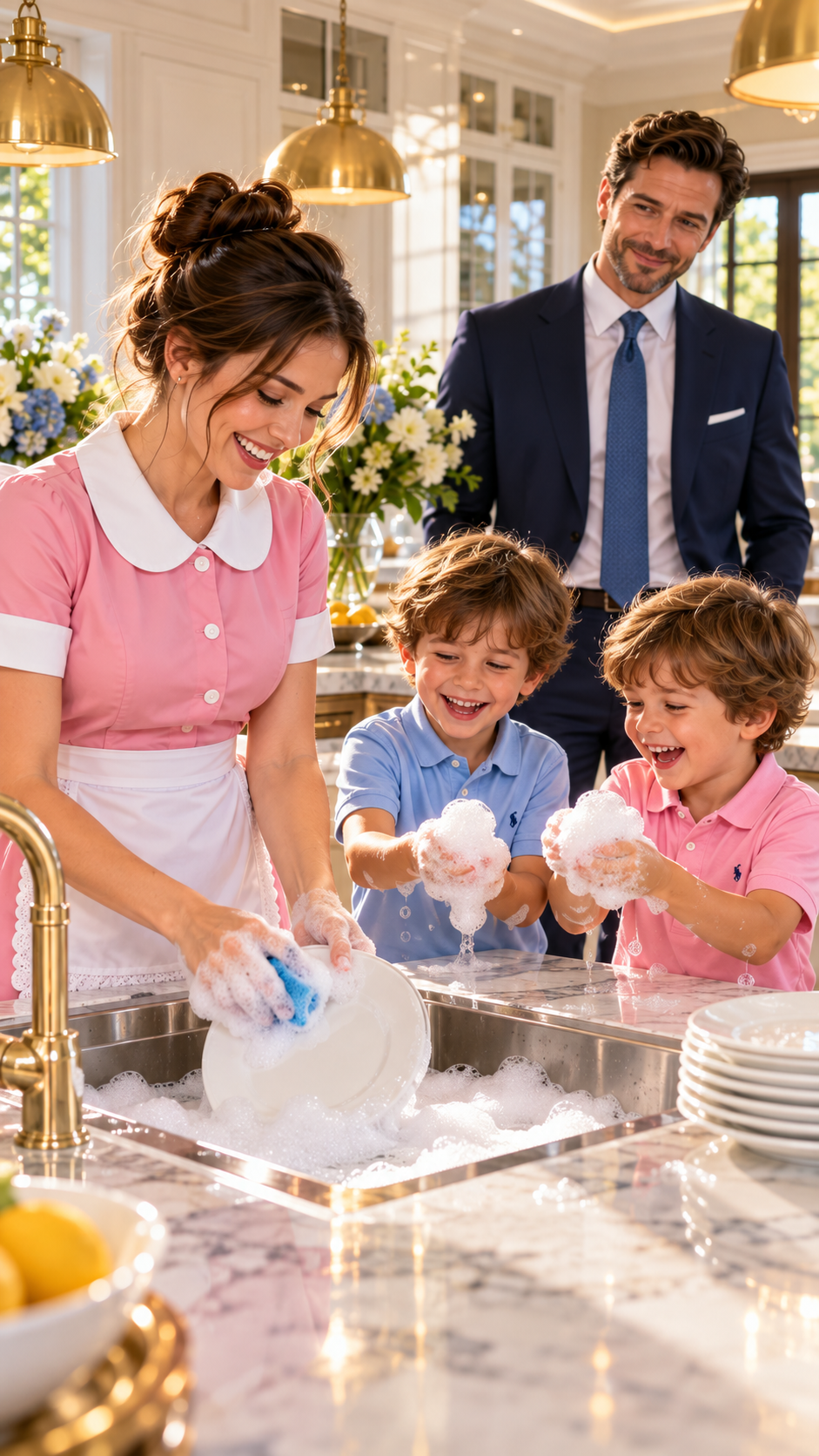
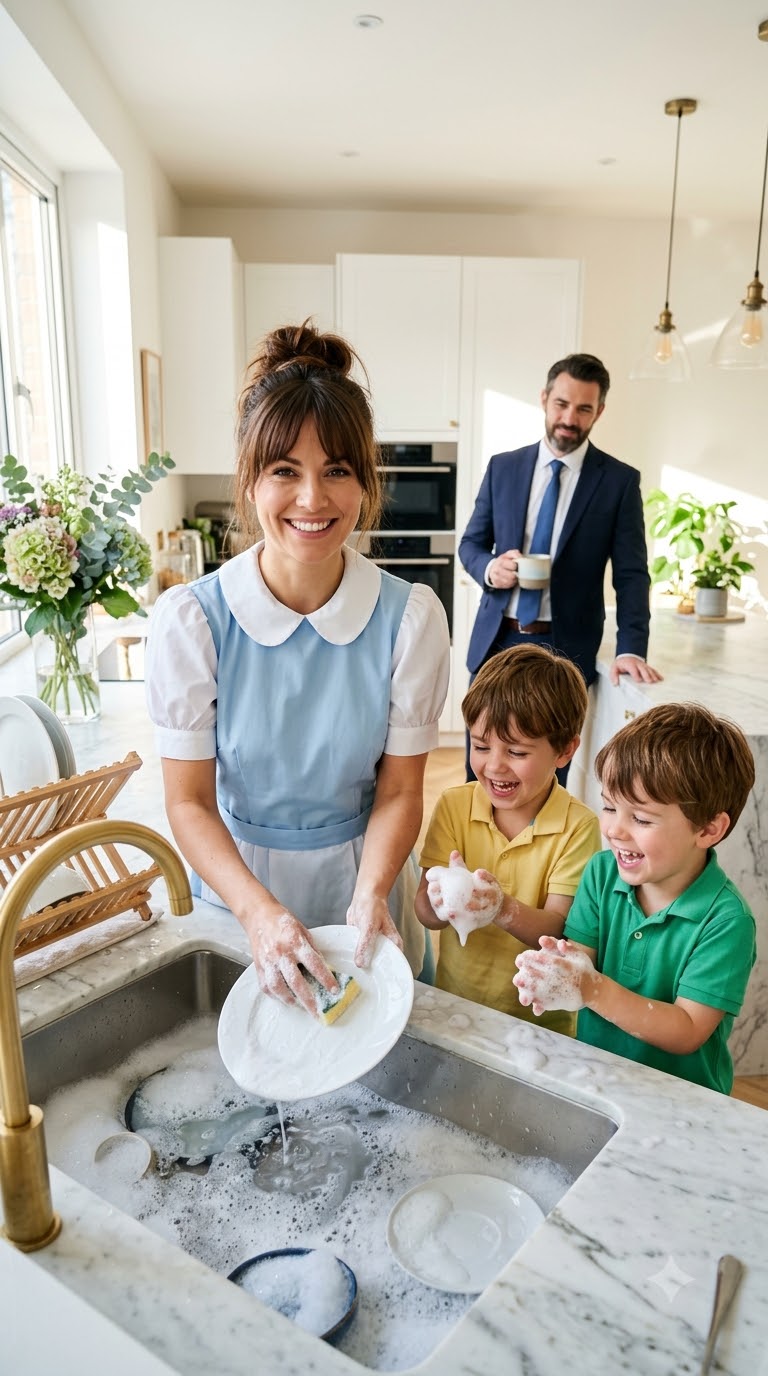
That was the first thing I said when I walked into the kitchen and found Mateo and Julián, my 5-year-old twins, with their hands covered in soap suds, laughing in front of the sink. I was coming home from an unbearable day in Monterrey: an investment was at risk, 3 meetings had ended badly, and the school had called because my sons were isolating themselves, not eating well, and complaining of stomachaches.
Lucía, the woman who had worked in my home for 8 months, didn’t argue. She simply set down the plate she was holding and dried her fingers on her apron.
“They wanted to help me, Mr. Alejandro.”
“That’s what they have activities, teachers, and schedules for.”
Mateo stopped smiling. Julián lowered his hands. In less than 10 seconds, I had turned a kitchen full of bubbles into the coldest place in the house. Even so, I was convinced I was doing the right thing. Ever since Valeria, my wife, died 3 years earlier, I had learned to solve everything with order. If something hurt, you found the best doctor. If something went wrong, you fixed it. If something was frightening, you controlled it.
“Go to your room,” I ordered.
They both obeyed without protesting.
Lucía held my gaze for only a moment.
“They needed to laugh today.”
It bothered me that she said it so calmly.
“You don’t decide what my children need.”
I ate dinner alone that night. The house was spotless, just the way I liked it, but from the hallway I heard Julián crying. I went to his room and found him hugging a pillow.
“What’s wrong?”
“My tummy hurts.”
“The doctor said you’re fine.”
Mateo spoke from the other bed, almost in a whisper.
“When we play with Lucía, it doesn’t hurt as much.”
I felt an uneasiness I couldn’t explain. Not because I believed Lucía had some secret remedy, but because my sons had just told me something no medical test had managed to show me: when they were alone, they got worse.
The next morning, Julián touched his stomach again during breakfast. Lucía asked permission to sit with them for 5 minutes. I agreed, more out of exhaustion than conviction. They sat on the living room floor. She did nothing extraordinary. She asked them to breathe slowly, asked what they missed about their mother, and then listened without correcting them.
An hour later, I received a call from the school psychologist.
“Mr. Montenegro, they participated more today. We saw them calm for the first time in weeks.”
When I hung up, I went looking for Lucía.
“How do you know how to do that with them?”
She clasped her hands before answering.
“Because my son also stopped talking after he lost his father.”
Then she added something that left me defenseless:
“Your children aren’t sick the way Samuel was sick, Mr. Alejandro. But they are hurt.”
PART 2
That night, I sat beside my sons’ beds. Julián took my hand.
“Are you going to stay?”
“For a while.”
I didn’t know that answer would come back to haunt me.
Over the next few days, I tried to change, but I made the same mistake under a different name: I hired a private therapist to come every day, with exercises, schedules, and goals. I thought that if the problem was emotional, all I had to do was organize their emotions too.
The boys obeyed.
And they got worse.
Mateo stopped talking during the sessions. Julián began waking up crying. One afternoon, Mateo became dizzy during an exercise and ended up on the floor, doubled over in pain. I fired the therapist that very moment.
That night, while looking for a blanket in the closet, I found a box belonging to Valeria. Inside were drawings, photographs, and a letter I had never seen. I recognized her handwriting before I even read the first line.
“If one day I’m not here, don’t turn fear into distance. Our children don’t need you to be perfect. They need to know they can find you.”
I cried sitting on the floor, the letter in my hands.
The next morning, I went looking for Lucía.
“I was wrong. I want you to spend time with them again, the way you used to.”
She didn’t smile.
“I can be there for them, but you have to be there too.”
“I don’t know how to do it the way you do.”
“Neither did I,” she replied. “When my husband died, Samuel and I learned together. You don’t need to imitate me. You need to stop hiding behind what you can afford.”
I nodded.
I thought I had finally understood.
3 nights later, Mateo woke up screaming in pain, and Julián began trembling, unable to catch his breath.
Lucía came into the room, looked at them, and said with a firmness that allowed no argument:
“To the hospital. Now.”
PART 3
On the way to the emergency room, I felt the fear I had kept locked away for 3 years come rushing back. I held Mateo against my chest while Julián sat beside Lucía in the back seat. The lights of Monterrey passed beyond the windows, long and blurred. All I could think about was the night they called to tell me Valeria had been in an accident.
When we arrived, the doctors repeated the tests and ruled out any obvious physical emergency. The pain was real. They also explained that after a significant loss, some children can express anxiety and grief through physical symptoms, while still needing to be monitored for possible medical causes.
I felt guilty.
“Did I cause this?” I asked.
The doctor shook his head.
“I’m not saying that. I’m saying your children need medical care and also an environment where they can talk, play, feel safe, and not carry what they’re feeling all by themselves.”
They stayed under observation that night.
At 3 in the morning, Mateo opened his eyes.
“Dad, I’m scared.”
I moved closer.
“I’m here.”
“I don’t want you to leave like Mom did.”
I felt as if I couldn’t breathe.
“I’m not leaving.”
Mateo looked at me with a seriousness that didn’t belong on the face of a 5-year-old.
“You used to leave before.”
I couldn’t defend myself because he was right. I came home every day, paid for everything, asked about their homework, kept track of appointments, and chose their schools. But I was almost always looking at a phone, answering an email, or thinking about the next meeting. I had confused physical presence with companionship.
Lucía approached the bed, but this time she didn’t take my place.
“You stay,” she told me. “I’m here if you need help.”
I sat beside Mateo and placed his hand over mine. I didn’t promise him that nothing would ever hurt again. I didn’t tell him to be strong. I simply told him a story about the time his mother and I got lost while driving toward Santiago and ended up eating the worst cabrito of our lives in a place where no one knew how to give us directions.
Mateo smiled faintly.
From the other bed, Julián murmured:
“Mom got mad because you didn’t want to ask.”
I laughed. It was true.
They both fell asleep.
The next morning, I received a call from the office. A business partner told me they needed my authorization to close a deal I had spent months preparing.
I looked at my sons.
“Not today.”
“Alejandro, if you don’t sign, we could lose a significant amount of money.”
“Then we’ll lose it.”
I hung up.
I didn’t abandon my company. I simply accepted that not everything urgent was important, and that my sons couldn’t keep receiving whatever was left of me.
That same day, Lucía fell asleep in a chair. When she got up to get coffee, I saw something small fall from her bag: a worn blue thread bracelet with a knot in the middle.
“Whose is that?”
She picked it up carefully.
“It belonged to Samuel.”
“Is your son okay now?”
“Much better. He lives with me again. My sister helped me when I had to work.”
She looked at the bracelet.
“My grandmother made it for him when he was going through a difficult time. There’s nothing special about it. We would just give it to him when he was scared and tell him, ‘As long as you have this, remember that someone will come back for you.’”
She handed it to me.
“If you want, you can give it to them.”
I held it between my fingers. It was a cheap object, almost weightless. And yet it reminded me of Valeria’s letter: that they needed to be able to find me.
That afternoon, when Julián became anxious again, I tied the bracelet around the rail of his bed.
“Is it magic?” he asked.
“No.”
“Then what is it for?”
I sat beside him.
“To remind me that I have to stay.”
Julián seemed to think about my answer.
“Then it’s your bracelet.”
I laughed with tears in my eyes.
“Maybe it is.”
Over the next 2 days, their symptoms gradually began to ease. The doctors recommended follow-up appointments with pediatrics and child psychology, flexible routines, play, and space for them to talk about their mother without feeling as though they were breaking me.
That last part was the hardest.
I had spent 3 years avoiding Valeria’s name. I had put away her photographs. I had changed some of the furniture. Without ever saying it aloud, I had forbidden sadness from sitting at our table.
One night, Mateo asked me:
“Do you miss Mom too?”
For a second, I almost gave him my usual answer: “Of course, but we have to move forward.”
I didn’t.
“Every day.”
“Does it hurt?”
“Yes.”
Julián sat up.
“In your tummy?”
“Sometimes here.”
I touched my chest.
They both came closer. The 3 of us stayed there, holding one another, without trying to fix anything.
On the fourth day, the doctors talked about discharging them if they remained stable. Lucía smiled when she heard the news, but I noticed how exhausted she was.
“Go home,” I told her. “Get some rest. I’ll stay tonight.”
“Are you sure?”
“No. But I’m staying anyway.”
It was the first time she laughed with me.
That night, Julián woke up crying. I was alone with them.
“Dad.”
“I’m here.”
“Are you leaving?”
I awkwardly lay down on the couch beside his bed and reached out one hand.
“No.”
“Until I fall asleep?”
“Until after.”
The next morning, Lucía found me asleep with Mateo resting on my shoulder. She set 2 coffees on the table and smiled.
2 days later, we went home.
The first thing I did wasn’t check my emails or call the office. I opened the living room windows. Then I went into the kitchen with the boys.
“What should we do?” I asked.
Mateo looked at the sink.
“Can we wash dishes?”
Lucía, who was putting some things away, froze.
“Only if you promise not to flood the kitchen,” I said.
Julián smiled.
“We don’t promise.”
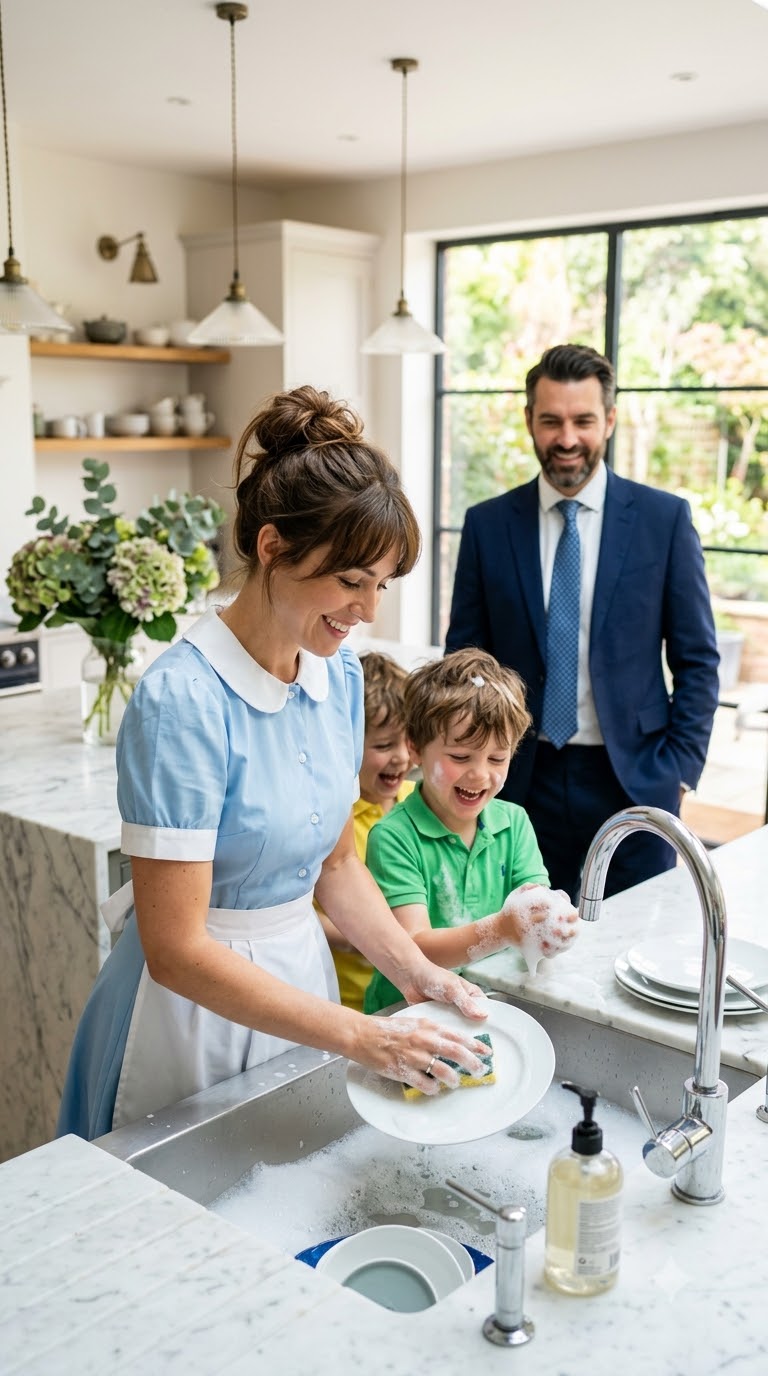
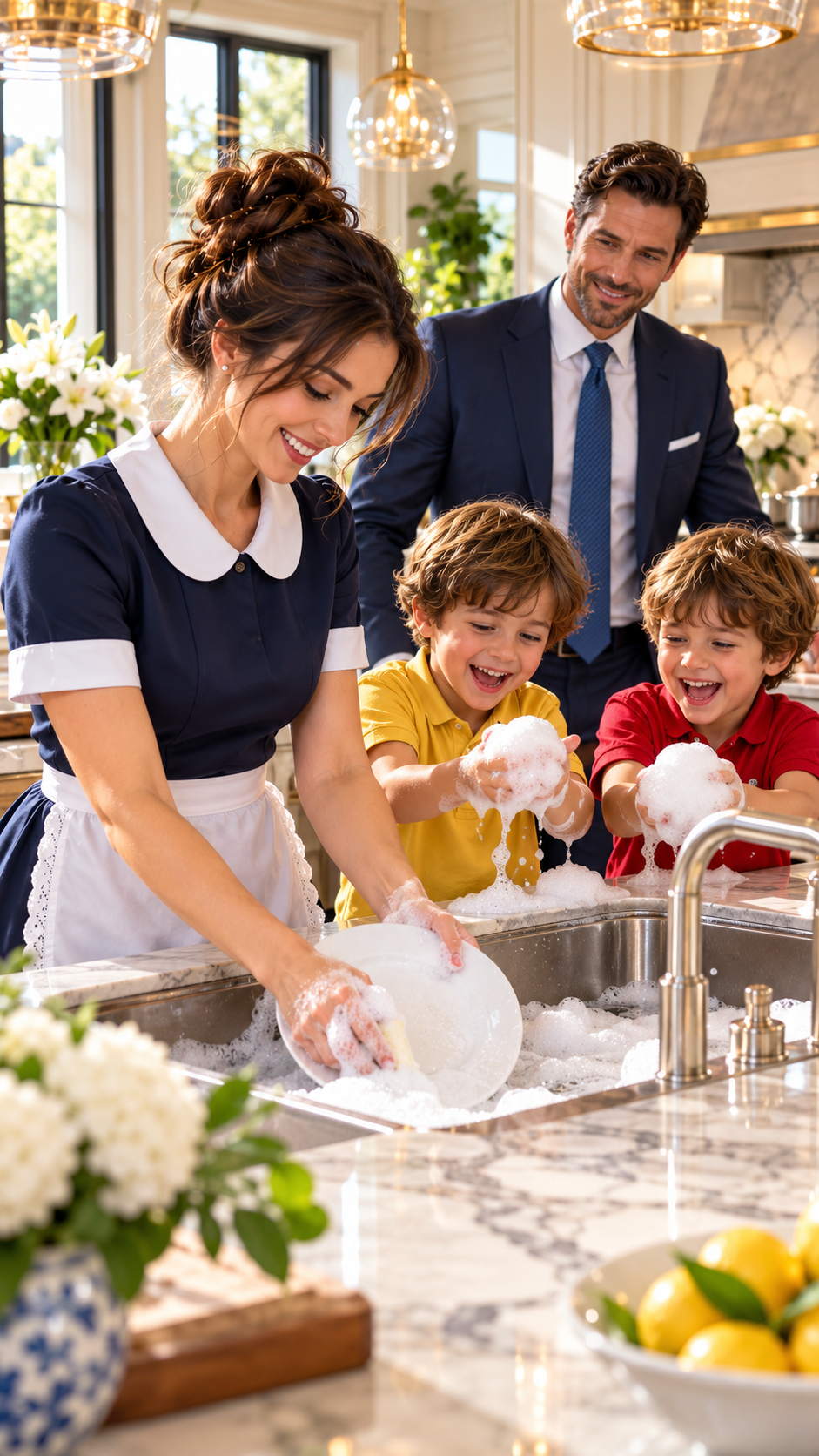
The 3 of us ended up with soap suds on our sleeves. Lucía tried to keep a straight face, but she couldn’t. She laughed just as she had that first afternoon.
The difference was that this time, I wasn’t standing in the doorway looking at the mess as if it were a threat.
I was in the middle of it.
The following weeks weren’t perfect. Sometimes Mateo still felt pain before school, and Julián asked about his mother. But I no longer disappeared.
I reorganized my work. I kept 2 afternoons free every week and banned meetings during dinner. I didn’t sell the company or suddenly become a different man. I was still demanding, still reviewed contracts, and still believed in discipline. I simply stopped using it as a hiding place.
I also changed Lucía’s situation.
“I don’t want you doing 2 jobs for the salary of 1 anymore,” I told her one afternoon.
I formally offered her a position caring for the boys during part of the day, with better hours and better pay, and hired someone else to handle the cleaning. Lucía accepted on one condition.
“I don’t want them to depend on me to be okay.”
“Neither do I.”
“Then we have to teach them that they can trust more than one person. You, me, the psychologist, their family.”
She was right.
My sister Claudia began visiting us more often. I also met Samuel, who ended up playing soccer with my sons. That was when I understood that Lucía hadn’t come into our lives to “save us.” She was a mother who had suffered, received help, and decided not to look away from someone else’s pain.
Months later, I found the blue bracelet in a kitchen drawer.
“Don’t you use it anymore?” I asked.
Mateo shook his head.
“We don’t need it anymore.”
“Why?”
Julián answered as he finished his glass of milk:
“Because now we know where you are.”
I couldn’t say anything.
That night, I took out Valeria’s box and placed it on the table. For the first time since her death, we looked at the photographs together. I told them stories I had avoided for years: how their mother laughed, how badly she sang in the car, how angry she got when I came home late.
The boys talked too.
We cried.
And no one got sick from crying.
Before going to bed, I tied the blue bracelet to the handle of a drawer beside the kitchen door. Not as an amulet.
As a visible promise.
Months earlier, I had walked into that same kitchen furious because there were soap suds on the floor and my sons were laughing with the woman who worked in my home.
Now, when I heard their laughter from the hallway, I no longer asked who had lost control.
I walked in, set my phone on the table, and asked:
“Is there room for one more?”
