

The first message I opened said, Harrison, your kids are on my porch. Your parents left two hours ago. Please call me the second you read this.
My son Wyatt was seven. My daughter Harper was five.
And the two people I had trusted to look after them while I was unconscious had driven away and left them by themselves.
My hands trembled as I called Martha.
She picked up immediately.
“Harrison, they’re safe now.”
I closed my eyes. “What happened?”
Martha told me she had been watering her lawn when she noticed my parents’ SUV pulling away from their house. She assumed Richard and Brenda were taking the children somewhere.
An hour later, she heard crying.
She discovered Harper sobbing on the concrete steps while Wyatt held her hand and promised everything would be okay.
The door was locked.
There was no adult inside.
My parents had left my children outside in the afternoon heat while I lay unconscious following surgery.
In that moment, the entire structure of my family finally became clear.
My name is Harrison. I’m thirty-two, a structural engineer, and my career is built around understanding pressure. I calculate load limits, identify stress points, and determine how much weight a foundation can withstand before it fails.
Somehow, I had never applied those same principles to my own family.
My wife, Chloe, and I have two children. Wyatt is seven, serious and protective. Harper is five and still climbs into my lap whenever she gets tired.
Chloe is a marketing executive who has carried our household through some of my most difficult years.
But in the family that raised me, I was always the fixer.
Broken pipe?
Call me.
Furniture needed moving?
Call me.
Dead car, extra holiday table, confusing paperwork—whatever went wrong, I was useful. That was my role.
My younger brother Preston had another role.
He was the one everyone protected.
Preston is twenty-six and calls himself an entrepreneur, although most of his ventures begin with our parents funding them and end with our parents paying for the consequences.
The difference between us had existed long before I knew how to describe it.
Family plans revolved around Preston. My achievements could always be recognized later, assuming there was time.
I became independent because competence was the easiest way to avoid needing my parents. Richard and Brenda interpreted that independence as proof that I needed less.
Preston’s dependence became evidence that he deserved more.
That pattern followed us into adulthood.
Every crisis Preston created was urgent. Every responsibility I handled became proof that I could take on another.
I convinced myself it no longer mattered because I had Chloe and our children.
I was wrong.
Family patterns wait for the next generation.
As a child, I spent years pretending the favoritism didn’t hurt.
At sixteen, I pitched a perfect game in our high school baseball championship.
I threw the final strike.
The crowd erupted.
I looked toward my parents’ seats.
Empty.
Later, I found out Preston had thrown a tantrum over limited-edition basketball shoes. My parents drove him two hours to a specialty mall and missed my entire game.
At my university graduation, where I received the highest academic honors, they arrived an hour late because Preston had overslept and Mom refused to leave without him.
When Chloe and I got married, we paid for the wedding ourselves.
Six hundred dollars.
A backyard barbecue.
Simple and beautiful.
Mom complained about the humidity for two hours, then insisted on leaving early because Preston was bored.
One month later, my parents took out a second mortgage to buy him a luxury sports car for his twenty-first birthday.
Eventually, I stopped asking them for anything.
That became my defense.
If I expected nothing, maybe they couldn’t disappoint me.
Then my back took that choice away.
Four years earlier, a steel beam shifted at a commercial construction site and struck across my lower body.
I kept working.
I went through physical therapy.
I took medication.
I learned how to stand without showing how much I was hurting.
But the damage continued getting worse.
By spring, pain shot down both legs like electricity. Some mornings, simply tying my shoes took minutes.
Then one evening Harper cried and reached for me.
I couldn’t lift her.
That scared me more than the pain.
My orthopedic surgeon reviewed my scans and told me the deterioration had progressed enough that I needed spinal fusion surgery soon.
Unfortunately, the surgery fell during the same week Chloe had to fly to Seattle for the biggest advertising presentation of her career.
She immediately offered to cancel.
“No.”
“Harrison, you’re having spinal surgery.”
“You have spent months on this.”
“So?”
“So I can call my parents.”
Even saying it felt strange.
I almost never asked them for help.
But this wasn’t just about me.
I needed someone to watch Wyatt and Harper for roughly six hours during the surgery and early recovery.
So I called Mom.
She immediately used the warm tone she always adopted whenever she had a chance to feel needed.
“Of course, sweetheart. Don’t worry about anything.”
She promised cookies.
Board games.
Lunch.
Dad would be there too.
Because I’m an engineer—and because surgery makes every possible failure feel real—I prepared carefully.
I bought a thick blue manila folder.
Inside, I placed emergency numbers, pediatrician information, allergy lists, copies of the kids’ insurance cards, Chloe’s travel details, my hospital information, and Martha’s number as a nearby backup.
I thought I was creating a safety net.
Tuesday morning arrived gray and cold.
Every step toward my parents’ house sent pain through my spine.
Dad answered the door wearing a bathrobe.
Mom hugged Harper.
Then her phone buzzed on the kitchen counter.
She read the message.
For one second, her expression changed.
Then she slipped the phone into her pocket and smiled.
Later, I learned it was Preston.
At the time, I simply kissed my children goodbye.
“Dad will see you later.”
Wyatt nodded.
Harper carefully wrapped her arms around my waist because she knew my back hurt.
I drove myself to the hospital.
In pre-op, fluorescent lights hummed overhead as a nurse inserted my IV.
The anesthesiologist told me to count backward from ten.
My final clear thought was simple.
My children are safe.
When I woke, pain consumed everything.
My lower back felt like it had been stitched with fire. My legs were numb and heavy. The recovery room was cold, and every sound seemed painfully sharp.
Then I noticed my phone.
Fourteen missed calls.
Every single one was from Martha.
I read the messages.
Then I called her.
She told me what had happened.
My children had been alone long enough for five-year-old Harper to cry and seven-year-old Wyatt to decide that comforting her was his responsibility.
I thanked Martha.
Then she told me something even worse.
Wyatt had repeatedly tried the locked front door before taking Harper down the sidewalk for help. He remembered Martha lived nearby because that morning I had told them where to go if something went wrong.
My seven-year-old had followed the emergency plan better than the two adults entrusted with keeping him safe.
That contrast made my anger almost clinical.
This wasn’t confusion about timing.
It wasn’t a quick errand that accidentally lasted too long.
MY PARENTS HAD CONSCIOUSLY DECIDED WYATT AND HARPER COULD BE LEFT ALONE BECAUSE PRESTON’S FITTING MATTERED MORE.
I called Dad.
He answered on the third ring.
Classical music played in the background.
Glasses clinked.
He sounded completely relaxed.
“Where are my children?”
“Oh, relax, Harrison.”
“They’re at Martha’s house because you abandoned them. Where are you?”
Dad sighed as though I were the one causing an inconvenience.
“Your brother needed his suit fitted.”
For a moment, I wondered if I had heard him correctly.
“What?”
“It’s a custom Italian cut. Preston has an important networking event tonight. He can’t look cheap. We needed to put the deposit on the credit card.”
I stared at the hospital ceiling.
“You left my children alone for a suit fitting?”
“They’re fine. Stop being so dramatic.”
My spine burned.
My children had been frightened and left outside with the door locked.
Yet my father was telling me Preston’s clothes mattered more than their safety.
Something inside me stopped negotiating. “Do not ever contact my children again.”
I ended the call.
The nurses wanted me to stay in the hospital.
I insisted on being discharged as soon as they were legally able to release me, signed the paperwork with an unsteady hand, and arranged for a private car.
By the time I arrived home, I could barely move without putting most of my weight on my cane.
Martha was sitting in my kitchen.
Wyatt had prepared a peanut butter sandwich for Harper.
My seven-year-old looked at me, doing his best to seem brave.
That nearly shattered me.
Despite the pain, I carefully lowered myself onto my knees and pulled both children into my arms.
“I’m sorry.”
Wyatt whispered, “It’s okay, Dad. I took care of her.”
“No,” I told him. “You should never have had to.”
I held them close until Harper stopped trembling.
Later that night, after the children were asleep, I sat at the kitchen table and opened Preston’s social-media page.
There it was.
A heavily edited photo taken inside a luxury tailor.
Preston stood in front of a mirror wearing a dark wool suit.
Behind him, Mom and Dad were seated on a velvet couch, each holding a crystal glass of sparkling wine.
The caption read: Mom and Dad funding the $1,000 look for the new empire.
I checked the timestamp.
1:00 p.m.
At that exact time, my five-year-old daughter had been crying outside a locked house while her brother was trying to comfort her.
I saved the photograph.
For the first time, I had evidence against my own parents.
Then I looked at the blue folder I had put together to keep my children safe.
It had started as an emergency plan.
Now it was going to become evidence.
For the first time in thirty-two years, I wasn’t trying to make my parents understand what they had done.
I was deciding how much access they would have after doing it.
CHAPTER 2
Wednesday morning, I hired a residential security contractor.
He replaced every exterior lock. New brass deadbolts were installed, the garage keypad was reset, and the old access code was gone.
I watched from my cane.
Under normal circumstances, taking security precautions against my parents would have seemed ridiculous.
Not anymore.
They had already proven that their access to my family meant nothing whenever Preston wanted something more.
Thursday, I went to Wyatt and Harper’s elementary school.
The walk from the parking lot to the office tugged painfully at my incision, but I wanted to take care of this myself.
I asked for the authorized pickup list.
Richard and Brenda were still listed.
I took a black pen and crossed out both names.
Then I listed Martha Gable as our primary emergency contact after Chloe and me.
The administrator asked whether there was a custody issue.
“No,” I said. “There is a safety issue.”
That was enough.
Friday, I met with Donovan, a senior family and estate attorney.
I brought the same blue folder.
By then, it held the children’s emergency information, Martha’s messages, Preston’s social-media photo, hospital records confirming the date and time of my surgery, and my notes from the calls that followed.
I gave Donovan three instructions.
First, rebuild our estate plan so Richard, Brenda, and Preston could never control our children or property if Chloe and I died.
Second, remove my parents from every remaining medical role.
Third, formally notify them that they could no longer enter our property without permission.
Donovan showed no emotional reaction.
He simply went through the paperwork.
We revised my will.
Strengthened the trusts protecting Wyatt and Harper.
Named Chloe’s older sister as guardian if anything happened to both of us.
Removed my parents from any contingent medical authority or hospital access.
I also removed Mom as a contingent beneficiary on my life insurance.
Donovan prepared formal trespass notices.
None of it felt like revenge.
It felt like correcting a design flaw after discovering the foundation had failed inspection.
For years, I assumed blood automatically created trust.
Tuesday proved otherwise.
From that point forward, trust required evidence.
Chloe returned late Friday on a red-eye from Seattle.
She set her luggage inside the front door, noticed my cane, and gently wrapped her arms around me.
Then came the question I had been dreading.
“Where were the kids when they left?”
I told her everything.
Martha finding Harper crying.
Wyatt holding her hand.
Dad explaining Preston’s Italian suit.
The photograph marked with the one-o’clock timestamp.
Chloe sat quietly at the kitchen table.
I handed her the blue folder.
She went through the updated school contacts, trust documents, medical directives, and trespass notices.
Then she looked up.
“You did all this while recovering from spinal surgery?”
“I needed to know they couldn’t do it again.”
She took my hand.
“Good.”
One word.
No lecture about forgiveness.
No demand that I calm down.
No suggestion that my parents deserved another opportunity before our children deserved protection.
Then she asked if Richard and Brenda knew.
“Not yet.”
Sunday dinner was their usual routine.
They came almost every week without calling.
I knew exactly when they would discover that the old arrangement was gone.
And this time, I had no intention of making that realization comfortable.
CHAPTER 3
At exactly six Sunday evening, my parents’ SUV pulled into the driveway.
I watched from the front window.
Mom stepped out carrying a casserole dish.
Dad followed.
Preston came last, looking down at his phone.
They walked toward the house as if nothing had changed.
Mom took the familiar silver key from her purse and pushed it into the new deadbolt.
It didn’t turn.
She tried again, harder.
Nothing.
Dad shook the handle and pounded on the door.
I opened it without moving aside.
Mom forced a smile.
“Harrison, darling, your lock is broken. We brought dinner.”
“The lock isn’t broken.”
Her smile disappeared.
“It’s doing exactly what it was designed to do.”
Behind them, Preston sighed.
“Oh, here we go.”
I ignored him.
Mom tried to look past me into the hallway.
“Let us inside.”
“No.”
Dad’s face reddened.
“This is ridiculous.”
I reached behind the door and took out the blue folder.
The first document I pulled out was the updated school registry.
“You are no longer authorized to pick up Wyatt or Harper.”
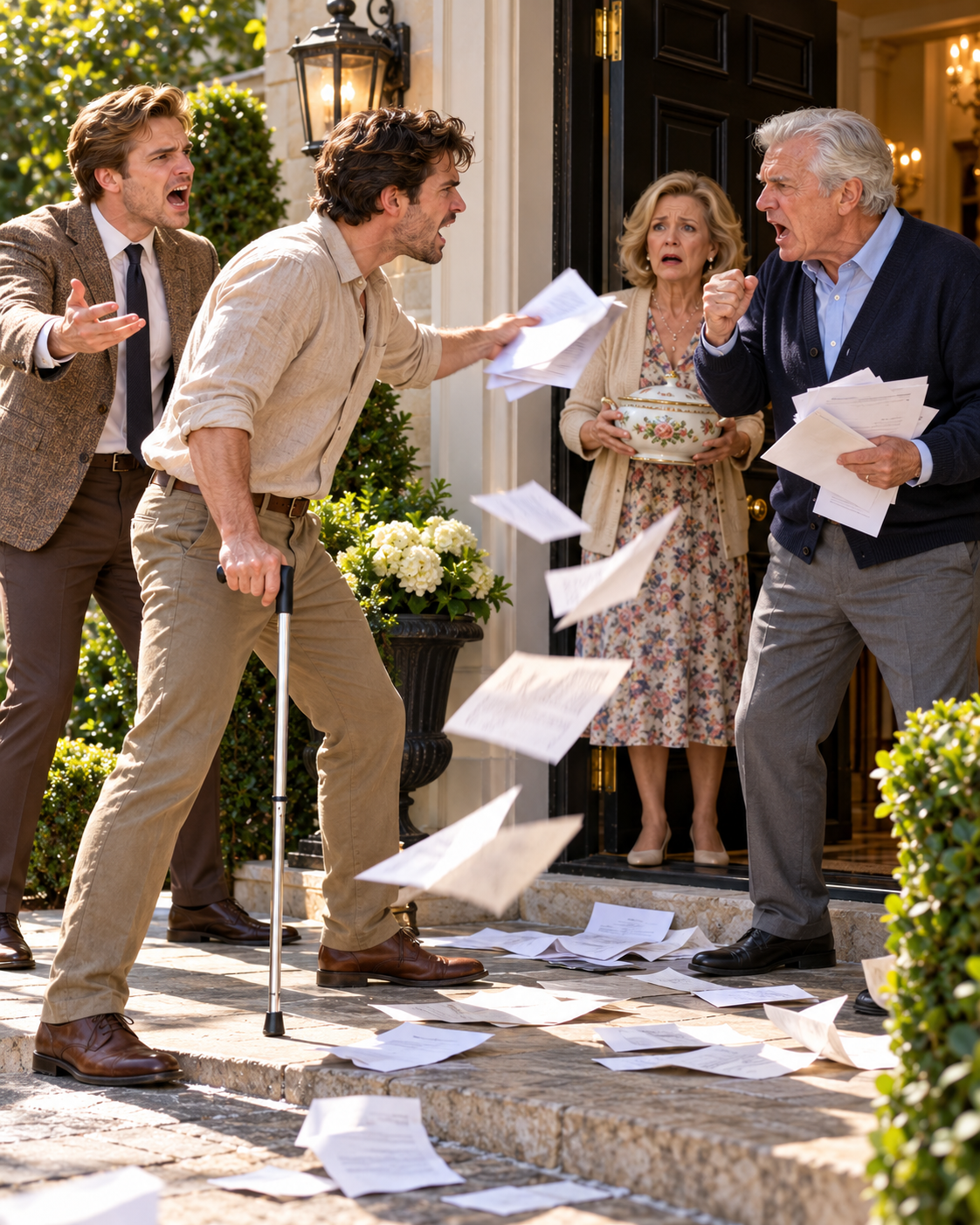
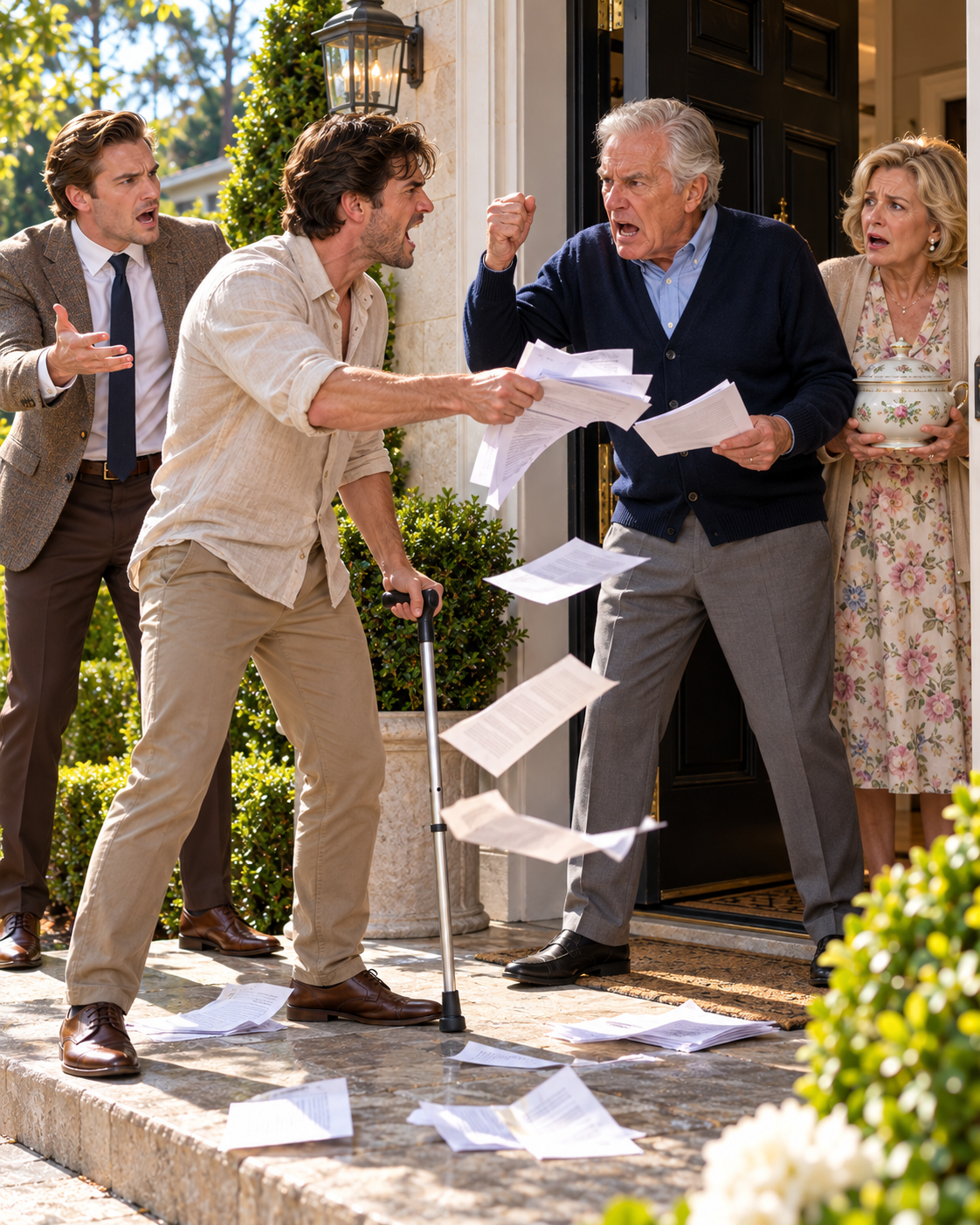
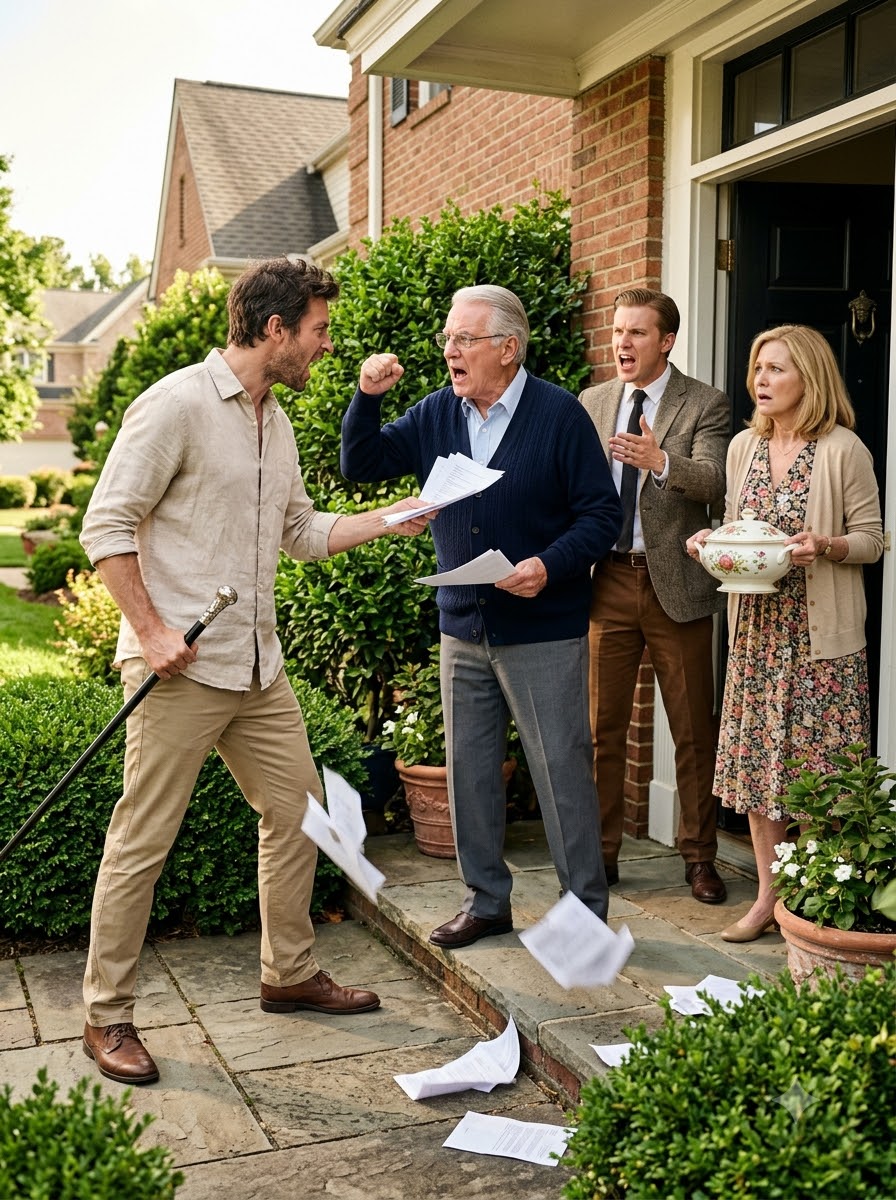
Mom stared.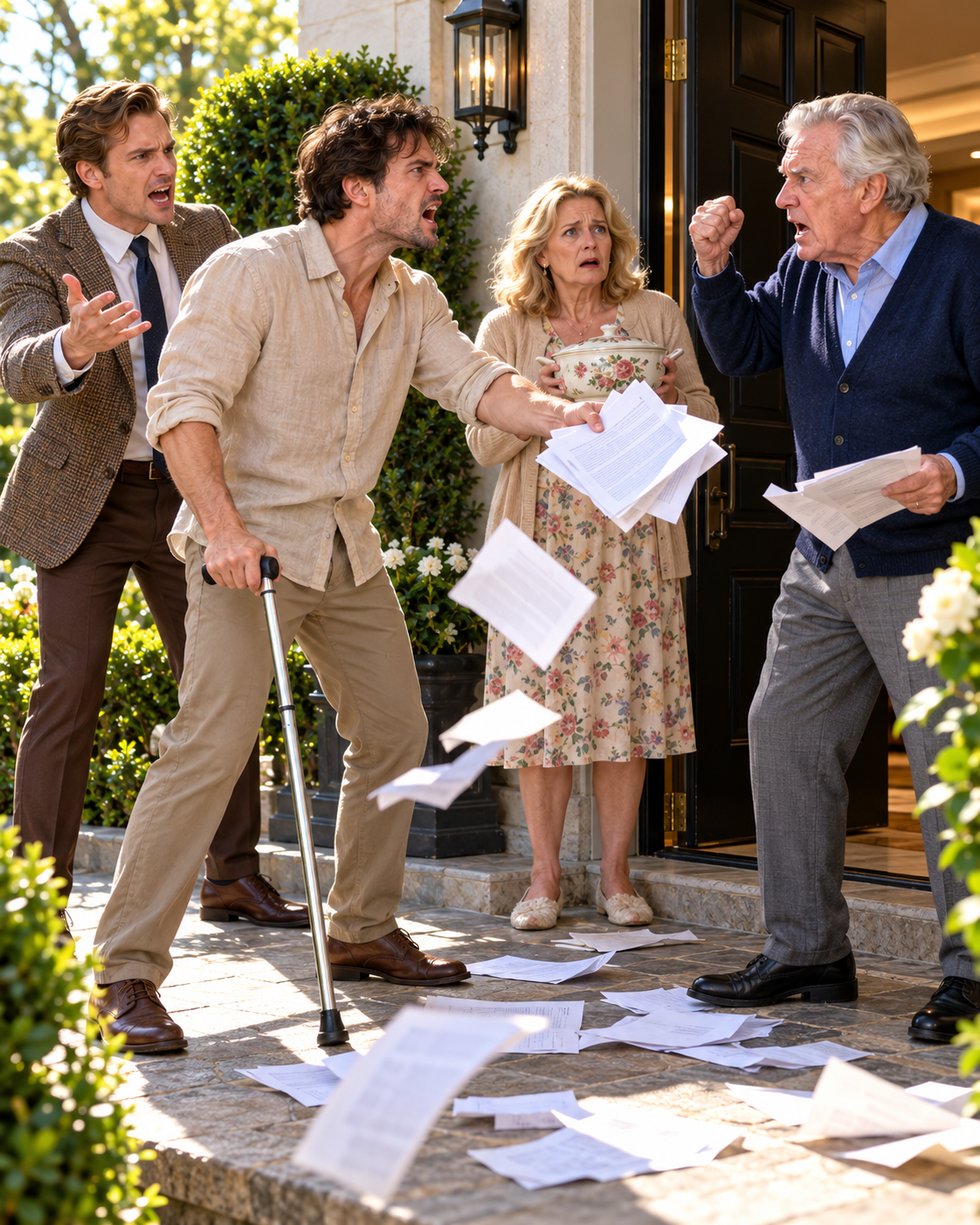
“What?”
“You are not an emergency contact anymore.”
“Harrison, we are their grandparents.”
“You left them alone.”
Preston rolled his eyes.
“It was a couple hours. I had a fitting. Get over it.”
I finally turned toward him.
“You are twenty-six years old. Two children were left outside because Mom and Dad decided you needed company buying a suit.”
“It was for an important networking event.”
I turned back to my parents.
“You no longer have any role in our estate planning, guardianship, or medical decisions. Chloe’s sister is guardian if anything happens to us.”
Mom’s hands started trembling around the casserole dish.
“You can’t erase us because of one mistake.”
“One mistake would have been forgetting sunscreen. You knowingly drove away and left a seven-year-old and five-year-old without an adult.”
Dad stepped closer.
“We thought they would stay in the backyard.”
“You locked the house.”
His mouth closed.
I pulled the printed photograph from Preston’s page.
The Italian suit.
My parents drinking sparkling wine.
One o’clock. I held it out toward Dad.
“At the exact time Harper was crying on a concrete porch, you were sitting in a tailor’s shop drinking while Preston showed off a thousand-dollar suit.”
Dad looked away.
I went on.
“You chose fabric over the safety of your grandchildren.”
Mom’s face crumpled.
“I am your mother. I gave you life.”
“I know.”
“You owe me some respect.”
“I owe my children safety.”
She started crying.
The old Harrison would have immediately softened.
That was how our family functioned.
Whenever they became upset after being confronted, their pain became my responsibility.
Not anymore.
“You wanted Preston to be the center of your life,” I said. “You have that now.”
Mom shook her head.
“Don’t say that.”
“You have your golden child. But you do not have unsupervised access to mine.”
Dad called me cruel.
Preston muttered that I had lost my mind.
I didn’t fight with either of them.
Instead, I handed Dad the trespass notice.
“This property is private. Do not come here uninvited again.”
Mom looked at me as if I had become someone she no longer recognized.
Maybe I had.
Or maybe I had finally stopped playing the version of Harrison they found useful.
“Please,” she said.
I looked at all three of them.
“Do not ever put my children in danger again.”
Then I stepped backward and closed the door.
The new deadbolt secured itself with one clean click.
For the first time, having a locked door between my parents and me felt less like losing something and more like keeping something safe.
CHAPTER 4
After that confrontation, I expected to feel guilty.
Instead, I slept.
Not comfortably—my back made sure of that—but without the familiar fear that disappointing my parents meant I had done something unforgivable.
Recovery became our focus.
My surgeon was pleased with the fusion.
Every week, I walked a little farther—first around the house, then down the sidewalk with Chloe beside me.
Wyatt and Harper watched closely.
They had seen me come home hunched over a cane after the adults responsible for their safety had disappeared.
So Chloe and I made their world predictable again.
School.
Dinner.
Bedtime.
Saturday pancakes.
Martha remained our emergency contact.
Harper waved toward her porch whenever we passed by in the car.
One day, Wyatt asked if Martha was “officially family now.”
Chloe answered, “She showed up when it mattered. That counts for a lot.”
My parents stayed away.
A few messages came through.
Mom said I had overreacted.
Dad claimed Preston’s fitting took longer than expected and they thought the children were safe.
I didn’t argue over either explanation.
The locks, school records, legal documents, and boundaries already spoke for themselves.
Two months after surgery, Chloe and I sat together in the backyard as the sun went down.
My spine was healing well.
Wyatt and Harper ran through the grass chasing fireflies. Harper stumbled while laughing, quickly got back up, and continued running.
For the first time in years, peace no longer depended on me taking responsibility for someone else’s behavior.
Through relatives and neighbors, I eventually learned what happened with Preston.
His networking event never became the opportunity he had imagined.
The thousand-dollar suit didn’t build an empire.
He kept relying on Mom and Dad financially, maxed out their credit cards, and eventually forced them to downsize.
Years earlier, I might have stepped in with payments, refinancing, or money transfers.
I did nothing.
Their finances were theirs.
Preston was theirs.
My responsibility existed within my own fence.
Sometimes Dad’s words from the tailor’s shop still come back to me.
Your brother needs this custom Italian suit more than you need to complain.
What stayed with me was how ordinary his voice had sounded.
There had been no hesitation because, inside our family system, his decision seemed completely normal.
Preston needed something.
Everyone else could wait.
That rule had shaped my childhood.
I simply hadn’t realized how dangerous it could become until my children were the ones being made to wait.
Wyatt should never have been responsible for protecting Harper.
Harper should never have had to wonder whether an adult was coming back.
That was the boundary.
Not favoritism.
Not childhood resentment.
Safety.
I still love the parents I wished Richard and Brenda could have been.
But love does not require access.
Biology does not automatically create trust.
Trust is earned through what someone does when a vulnerable person depends on them.
Martha passed that test.
My parents didn’t.
Finally, the engineer in me understood.
When a structure fails at a critical load point, you don’t paint over the crack and pretend the foundation is still safe.
You remove the dangerous load.
Then you reinforce what remains.
That evening, Harper ran toward me with a firefly cupped between her palms.
“Dad, look.”
I carefully leaned forward.
“I see it.”
She opened her hands.
The tiny light floated up into the dusk.
Wyatt ran after it.
Chloe squeezed my hand.
Our home didn’t need to become an impenetrable fortress.
It only needed to be a place where our children knew the adults responsible for them would always choose their safety first.
For the first time in thirty-two years, I knew exactly where my load-bearing walls belonged.
