

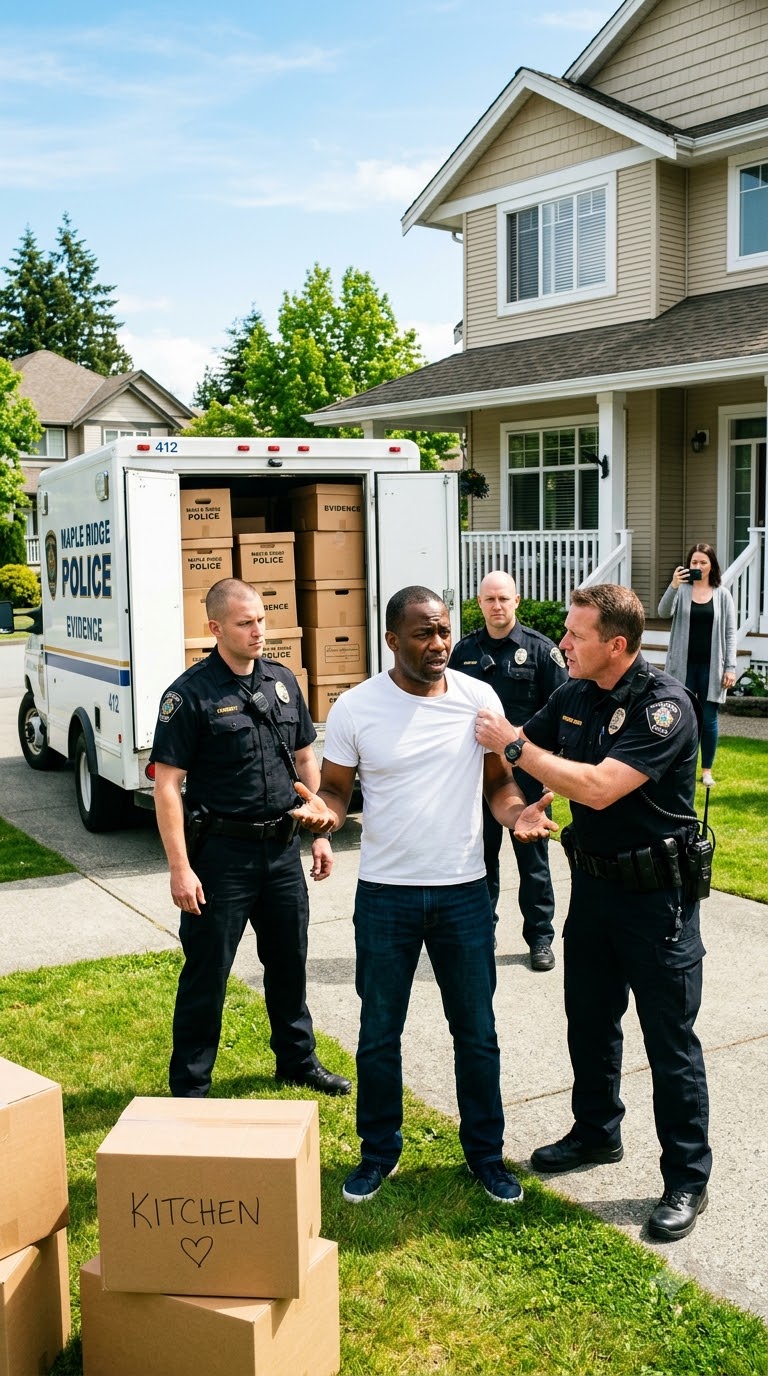
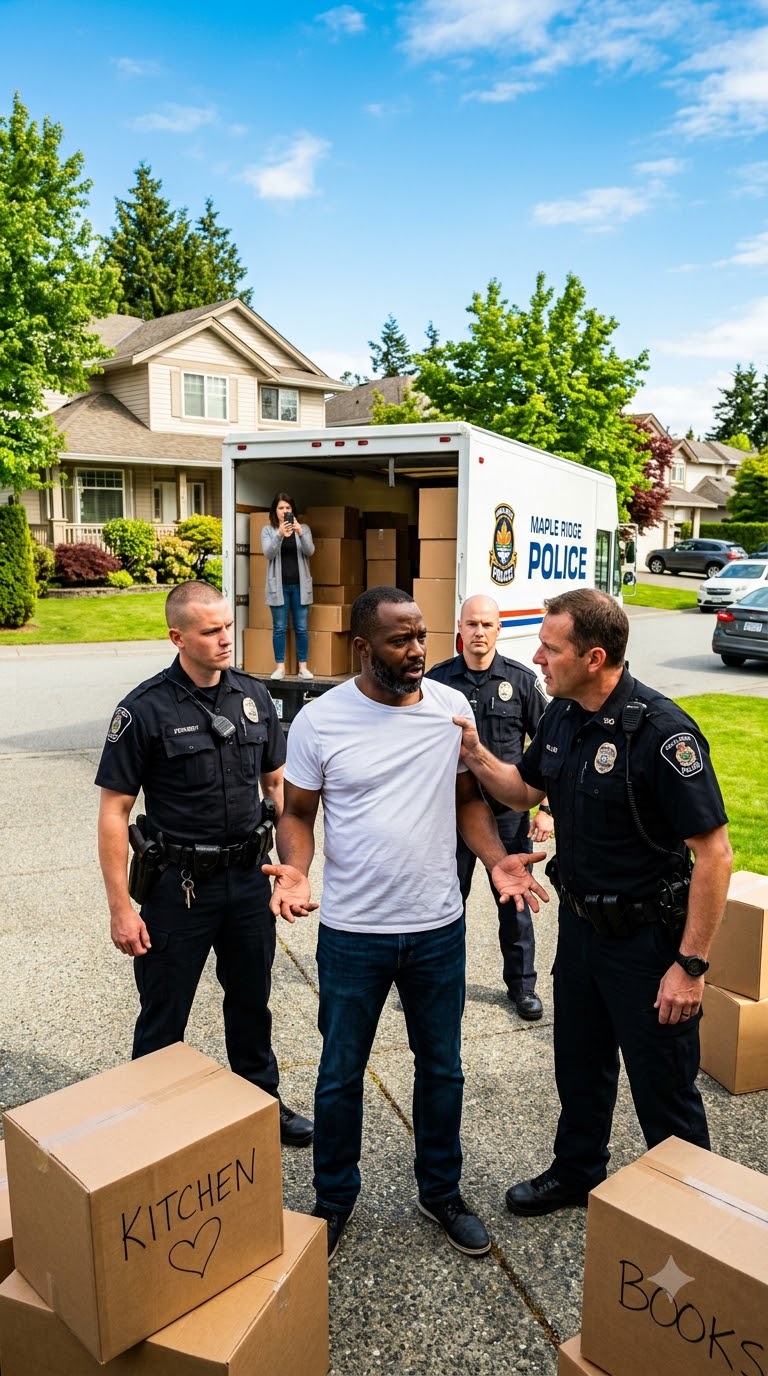
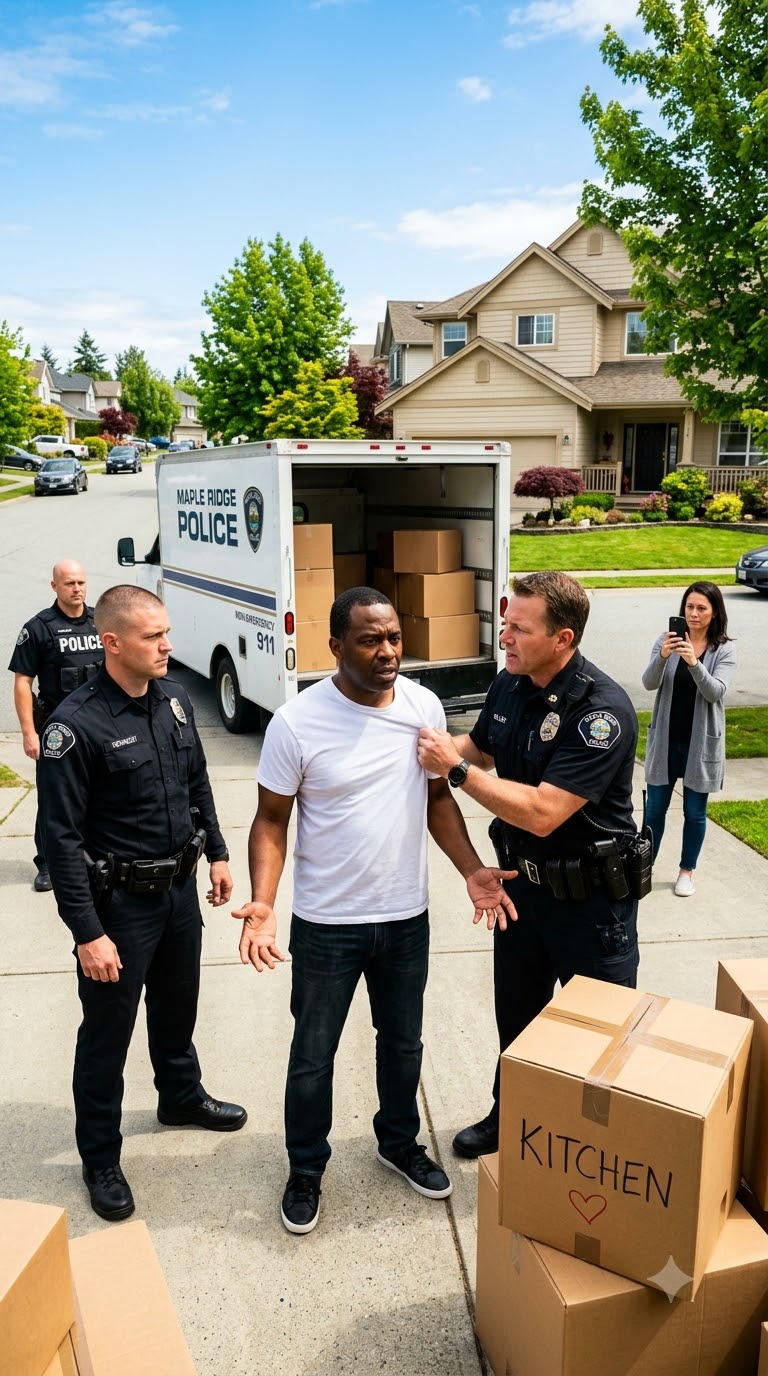
“We got a call. Suspicious person. Unloading stuff into a house that ain’t his.” “There’s been a mistake, officer. I own this home. I have the paperwork inside. I can show you.”
“You really expect me to buy that? You’re awfully confident for somebody under investigation.” “I don’t have anything to worry about. I haven’t done anything wrong.” Officer Petrov’s jaw tightened.
Every calm answer felt less like cooperation and more like a challenge to his authority. Rather than admit the situation might be different than he’d assumed, he called for more officers as backup. “He won’t cooperate. Thinks he’s better than the rest of us.” “I haven’t refused a single thing. Ask me anything. I’ll answer.”
“We don’t need your permission to ask. Maybe it’s time somebody taught you some respect.” The cops believed they were putting an arrogant suspect in his place. None of them realized they were surrounding their newly appointed captain. Mackie Rogers ran like he always ran.
Steady. Easy. Like the street belonged to him just as much as anyone else. It was 7:00 in the morning, and the sun was still low and soft over Maple Ridge.
Big houses. Trimmed lawns. The kind of neighborhood where people paid a lot of money to feel safe. In one week, Mackie and his wife, Darlene, would move into a house three blocks from where he stood now, catching his breath at a stop sign.
He wasn’t just moving into this neighborhood. He was about to run the whole police department that patrolled it. Captain Mackie Rogers, sworn in already, starting Monday. But nobody here knew that yet.
He heard the engine before he saw the car. A slow roll. Tires crunching over old leaves. He glanced over his shoulder and saw a patrol car easing up beside him, matching his pace.
The window came down. “Where are you headed?” the officer asked. His name tag read Petrov. He had the kind of voice that already sounded annoyed, like Mackie had interrupted something important just by existing.
“Just running,” Mackie said. He kept jogging in place, breathing easy. “Morning workout.” “You live around here?”
“Not yet. Moving in next week.” Petrov’s eyes narrowed, like the answer didn’t sit right with him. “You got some ID on you?” Mackie didn’t stop moving his feet.
He didn’t raise his voice. He didn’t do anything but answer plain and calm. “I do. Mind telling me why you’re asking?” “Because we’ve had reports,” Petrov said, “of somebody who doesn’t belong out here.”
There it was. Mackie had heard that line before. Different city, different badge, same old song. Somebody who doesn’t belong.
He knew exactly what that meant and exactly what it didn’t mean. It didn’t mean a crime. It meant a look, a color, a feeling somebody had when they saw a Black man jogging through a neighborhood they thought was theirs. Mackie reached into the small pocket on his running shorts and pulled out his ID, slow and easy.
Hands where Petrov could see every inch of the movement. He held it out. Petrov snatched it more than took it. He studied it a beat too long, like he was hoping it would say something worse than Mackie Rogers.
Then he keyed his radio and read the information to dispatch, watching Mackie the whole time like he expected him to bolt. Dispatch came back clean. No warrants. No record.
Nothing. Petrov’s jaw worked side to side. He was looking for a reason, any reason, and Mackie wasn’t giving him one. “You always this calm when a cop pulls you over?” Petrov asked.
There was something ugly underneath the question. Like calm was the wrong answer. Like calm was an insult. “I don’t have a reason not to be,” Mackie said.
“I haven’t broken any laws, have I?” Petrov didn’t answer that. He just stared, jaw tight, like Mackie had said something disrespectful just by asking a simple question back. “You can go,” Petrov finally said, shoving the ID back through the window instead of handing it to him.
“Appreciate it,” Mackie said. He meant it plainly, with no sarcasm hiding in it. He tucked his ID away and started jogging again, easy as before. Like the whole thing hadn’t rattled him one bit.
Because it hadn’t. He’d been stopped before. He’d learned a long time ago that some men needed you scared, needed you shaking or angry or begging. It gave them something to push against.
Mackie never gave them that. He just stayed steady and let his steadiness be the only answer they got. Behind him, Petrov sat in his cruiser for a long moment, not moving. He watched Mackie’s back get smaller down the road.
That easy jog never broke stride. Mackie never looked back. He never gave Petrov so much as a glance over the shoulder. That was the part that ate at him.
Not that Mackie had talked back. Not that Mackie had broken any rule. It was that Mackie hadn’t been afraid. Not for one second.
Petrov had held all the power that morning. The badge, the gun, the radio, the whole department behind him. It hadn’t mattered. This man had looked at all of it and stayed calm.
Like none of it touched him. Petrov gripped the wheel hard enough to whiten his knuckles. “We’ll see how calm you are next time,” he muttered to the empty car. Then he pulled away from the curb.
Already thinking about it. Already turning it over like a stone he couldn’t stop touching. He didn’t know it yet, but there would be a next time. It was coming faster than he thought.
The moving truck sat in the driveway with its back door open like a big metal mouth. Mackie carried another box up the walk while Darlene directed him from the porch. “Careful with that one,” she said. “Dishes.”
“I got it,” Mackie said, smiling despite the sweat running down his back. It was a good kind of tired. The kind that came from building something new. One week ago, he’d been jogging past this house as a stranger.
Today it was his. He set the box down inside the door and turned back for another load. That was when he saw the cruiser. It rolled up slowly, the same way it had the week before.
Mackie felt something tighten in his chest before he even saw the name on the badge. But he already knew. Petrov. The officer stepped out of his car like he owned the whole street.
He didn’t rush. He walked with his thumbs hooked in his belt, chin up, taking his time crossing the lawn like he wanted Mackie to watch him coming. “We got a call,” Petrov said. “Suspicious person.”
“Unloading stuff into a house that ain’t his.” Mackie set down the box in his hands, slow and deliberate. “This is my house.” “That’s what they all say.”
Mackie felt the old familiar tightness settle into his shoulders. Not fear. Fatigue. The kind that came from doing this dance too many times before.
“I signed the papers three weeks ago. I can show you.” “Show me your hands first,” Petrov snapped. “Where I can see them.” Mackie raised his hands, palms out, patient.
“They’re right here. They’ve been right here the whole time.” Petrov stepped closer, close enough that Mackie could smell the coffee on his breath. “You think this is funny? Standing there all calm, like you got nothing to worry about?”
“I don’t have anything to worry about,” Mackie said evenly. “I haven’t done anything wrong.” Something flickered across Petrov’s face. Something dark and familiar.
This was the same man from the jog. The same calm. The same refusal to flinch. It lit a fuse in him that had been sitting there for a week, waiting for a match.
“You know what I think?” Petrov said, voice rising now, loud enough that a neighbor two doors down stepped out onto her porch to watch. “I think you like showing off. I think you like acting like you’re better than the rest of us.” He stepped closer.
“Well, you ain’t.” “Sir, I haven’t raised my voice once,” Mackie said. “I haven’t moved. I’ve answered every question you asked me.”
“Don’t ‘sir’ me,” Petrov barked, and his hand dropped to his belt, resting there like a threat. “I ask the questions. You don’t get smart with me.” From the doorway, Darlene appeared, drawn by the shouting.
“What’s going on out here?” “Ma’am, step back inside,” Petrov ordered without even looking at her. “This is our house,” Darlene said, her voice sharp now, protective. “I said step back.”
Mackie kept his eyes on Petrov. He kept his voice level, even as everything in him wanted to push back harder. He knew better. He’d trained officers his whole career on exactly this.
How a man’s temper could turn a nothing call into a tragedy in 60 seconds flat. He wasn’t about to become somebody’s statistic on his own front lawn. “Officer,” Mackie said carefully, “you can call whoever you need to call. Check the deed.”
“Check my ID. I’m not going anywhere, and I’m not resisting anything. But you need to understand you have no legal reason to be doing this.” That was the wrong thing to say, even though it was true.
Petrov’s face went red. Being told he was wrong, calmly, by a man who wouldn’t break was too much for him. “Non-compliant,” Petrov muttered, and his hand went to his radio. “I haven’t done anything,” Mackie said again, steady and unmoved.
“Dispatch, I need backup,” Petrov said into his radio, eyes locked on Mackie the entire time, like he was daring him to say one more word. “Non-compliant male, refusing to identify himself. Send units.” Mackie felt his stomach drop.
Not from fear. From disbelief. He hadn’t refused anything. He’d answered every question.
Now, because he wouldn’t shake, wouldn’t shrink, and wouldn’t perform the fear Petrov seemed to need from him, backup was coming. Darlene stood frozen in the doorway, her phone already rising in her hand. Mackie lowered his own hands slightly, keeping them open and visible. He braced for what was coming next.
The sirens came before the cars did. Three of them, rising and falling in the quiet morning air, getting louder until they turned onto the street one after another and screeched up to the curb. Doors flew open. Three officers stepped out fast, hands already near their belts.
One of them, younger, with tired eyes, was the first to reach the driveway. His name tag read Bishop. Within seconds, Mackie was surrounded. Four officers now.
Petrov stood in front of him. Two unnamed officers fanned out to his sides. Bishop hung back near the truck, uncertain, watching the scene like he wasn’t sure what he’d walked into. “This the guy?” one of the officers asked, hand resting on his holster.
“Yeah,” Petrov said. There was something ugly in his grin now, something that hadn’t been there a minute ago. Having backup changed him. Made him bigger.
“Won’t cooperate. Thinks he’s better than the rest of us.” “I haven’t refused a single thing,” Mackie said, keeping his hands raised and his voice level. “Ask me anything. I’ll answer.”
“We don’t need your permission to ask,” Petrov snapped. He stepped in close, closer than before, close enough to grab. His hand shot out and closed around the collar of Mackie’s shirt, yanking him half a step forward. “Maybe you need somebody to teach you a little respect. That work for you?”
The words hit the quiet street like a slap. Darlene, still in the doorway, gasped and raised her phone higher, recording everything now. Her hand was shaking but steady enough to keep the frame locked on her husband. Mackie didn’t fight the grip.
He didn’t pull away. He kept his hands up. He kept his voice calm even with Petrov’s fist twisted in his shirt. “I haven’t done anything to disrespect you.”
“I’ve asked you to check the deed. I’ve told you my name.” “Shut up,” Petrov said. The two unnamed officers moved closer.
They boxed Mackie in from both sides now, a wall of navy blue and badges. Bishop still hadn’t moved from where he stood by the truck. His jaw was tight. His eyes darted between Petrov and Mackie like he was watching something he didn’t want to be part of.
Mackie, even with his heart hammering, moved slowly and carefully. He reached down, not fast, not sudden, giving every officer time to see exactly what his hand was doing. He set his phone down on top of a moving box near the porch steps. He angled it just right, screen facing outward, recording.
He’d done it without a word, without drawing attention, the way a man does something he’s planned for a long time. Across the street, unnoticed by all of them, a small camera mounted above a neighbor’s front door blinked quietly. It was already capturing the whole driveway in its frame. “Hands behind your back,” Petrov ordered, reaching for the cuffs on his belt.
“On what charge?” Mackie asked, still calm, though there was steel under the calm now. “Tell me the charge.” “Disorderly conduct,” Petrov said, though it wasn’t true, and everyone standing there could feel that it wasn’t true.
“Resisting.” “I haven’t resisted anything,” Mackie said. “You know that. Everyone standing here knows that.”
Petrov pulled the cuffs free, the metal catching the morning light. “Turn around.” Mackie held his ground, hands still raised, eyes locked on Petrov’s. There was no fear in them.
Only a kind of tired, steady certainty, like a man who had seen this exact moment before and knew exactly how it was supposed to end and refused to let it. “Last chance,” Mackie said quietly. “Check who I am before you do this.” Petrov laughed, short and mean.
He looked at the other officers like he wanted them to laugh too. “Oh, we got a comedian? You threatening me?” “No,” Mackie said. “I’m giving you a chance.”
“Turn around.” The cuffs opened wider in Petrov’s hand. Behind him, Bishop finally took a step forward, opening his mouth like he might say something. Then he closed it again, saying nothing at all.
Darlene’s voice cracked from the porch. “Mackie!” “It’s okay,” Mackie called back, not taking his eyes off Petrov. “Just keep recording.” Petrov reached for Mackie’s wrist.
Petrov’s fingers closed around Mackie’s wrist. “Captain Mackie Rogers,” Mackie said, loud and clear, cutting through the moment like a blade. “Badge number 4412. Sworn in three days ago.”
“I start Monday as the new commanding officer of this precinct.” The driveway went dead silent. Petrov’s hand froze on Mackie’s wrist, the cuffs still dangling from his other fingers. For a second, nobody moved.
Even the birds seemed to have gone quiet. “That’s a lie,” Petrov said, but his voice had lost its edge. It came out smaller than he meant it to. “Check my jacket pocket,” Mackie said, still not lowering his hands and still not raising his voice.
“Left side. Slow. I’ll tell you exactly what you’re about to find.” Petrov didn’t move. One of the unnamed officers stepped forward instead.
He reached carefully into Mackie’s jacket like he was defusing something dangerous. He pulled out a leather case and flipped it open. A badge. A photo ID.
The words “Captain” and “Rogers” were stamped clean and official beneath Mackie’s picture. The officer’s face drained of color. He held it out toward Petrov like it was burning his fingers. “No,” Petrov said, shaking his head.
He stared at the badge like it might disappear if he refused to believe it. “No, this ain’t— This can’t be right. Nobody told us. Nobody said anything about a new captain moving in.”
“Would it have mattered?” Mackie asked quietly. Petrov didn’t answer. He was still holding the cuffs. He was still gripping Mackie’s wrist.
Then he seemed to realize it. He let go so fast it was like Mackie’s arm had turned to fire. Bishop, still near the truck, looked like he might be sick. He’d gone pale.
His mouth was slightly open, staring at the badge in his fellow officer’s hand like it had rewritten everything that had just happened in front of him. The other unnamed officer took a full step back, putting distance between himself and Petrov like proximity itself was now a liability. “Sir, I— We didn’t know,” Petrov stammered. “There was a call, a report.”
“We were just responding to—” “There was no call,” Mackie said. “You made that up. Same as you made up the reason you stopped me last week while I was jogging.” He looked directly at him.
“I remember you, Officer Petrov. I remember exactly how that went too.” Petrov’s face twitched at that. Something flickered behind his eyes.
The memory landed. The shame of it caught up to him in front of his own men. “Sir, I think there’s been some kind of misunderstanding,” Petrov tried again. His voice shifted now.
Softer. Reaching for something friendlier. “We can straighten this all out. No harm done, right? Nobody got hurt.”
Mackie looked at him for a long moment before answering. “You had four officers surround an unarmed man in his own driveway. You put your hands on me. You said you were going to teach me respect.”
“That happened. It doesn’t stop being true because you found out who I am.” “I was doing my job,” Petrov said. Something ugly crept back into his voice now, defensive instead of afraid.
“You can’t blame me for doing my job.” “This wasn’t your job,” Mackie said. “This was you deciding I needed to be put in my place.” His eyes stayed on Petrov’s.
“That’s not the same thing. You know it.” Petrov’s jaw worked. For a second, Mackie watched something happen behind the man’s eyes.
Not remorse. Not shame. Calculation. He could see Petrov doing the math.
Already working out how bad this could get for him. Already looking for the angle that would let him walk away clean. “Look,” Petrov said slowly. “Let’s not make this bigger than it has to be.”
Mackie lowered his hands for the first time since the cruisers arrived, calm and unhurried. “I’ll decide how big this is.” Petrov’s mouth opened, then shut again. He looked at the other officers, searching for support.
He found none. Bishop wouldn’t meet his eyes. The other two were already backing toward their cars, eager to be anywhere else. Petrov straightened his jacket and forced something like composure back into his face.
He turned toward his cruiser without another word. But as he walked away, Mackie caught the exact moment his fear turned into something colder. Something calculating. A man deciding, right there in real time, how he was going to survive this and what he was willing to say to make sure he did.
The other officers didn’t linger. Bishop climbed back into his cruiser without a word, his hands shaking slightly on the wheel. The two unnamed officers followed him. Engines started one after another.
Tires rolled slowly and quietly off the curb, like men trying not to draw attention to themselves. Petrov was the last to leave. He stood by his open car door for a moment, looking back at the house, at Mackie, at Darlene still standing in the doorway with her phone lowered but not put away. Something passed over his face.
Not an apology. Nothing close to one. Just a man deciding what story he was about to tell. He reached in and grabbed his radio.
“Dispatch, this is Petrov,” he said, his voice smoothing out, professional now, like the last ten minutes hadn’t happened at all. “Wrapping up that call on Ridgeline Drive. Subject was uncooperative at first. Verbal command was used to gain compliance.”
“No further action needed.” Mackie stood on his own driveway and listened to every word of it. Uncooperative. Verbal command.
Two lies wrapped up neat and official, already becoming part of the permanent record before Mackie had even caught his breath. No mention of four officers. No mention of a hand on his collar. No mention of the words “teach him respect,” spoken loudly enough for a neighbor two doors down to hear.
Petrov slid into his cruiser and pulled away without looking back. His taillights shrank down the quiet street until they turned the corner and disappeared. Darlene came down off the porch steps slowly, her arms wrapped around herself despite the warm morning. “Mackie.”
“I heard it,” he said. “He’s already lying. Right now. On the radio for everybody to hear.”
“I know.” Mackie bent down and picked up his phone from the moving box. He checked the screen. Still recording.
Still capturing every second. Time-stamped and safe. He stopped it and slid it into his pocket like he was putting away something fragile. “We have him,” Darlene said.
“We have all of it. Why aren’t you calling someone right now?” Mackie looked down the empty street where Petrov’s cruiser had vanished. He didn’t answer right away.
He was thinking about Monday. About walking into that precinct as the man in charge. About the officers who would look to him to set the tone for how the whole department ran. He didn’t know yet how deep this went.
Whether Petrov was one bad man or a symptom of something bigger. Starting his first day with an accusation before he even understood the terrain felt like the wrong first move. “Not yet,” he said finally. “Mackie.”
“I want to see what happens,” he said, turning to face her. “I want to see if the department does the right thing on its own. If Petrov’s report gets questioned.” He paused.
“If anybody checks his body camera. His history. Anything. I want to know what kind of place I’m about to run before I start tearing it apart.”
Darlene studied him for a long moment. The way she always did when she was deciding whether to push back or trust him. “And if they don’t? If nobody checks anything?”
“Then I’ll already have everything I need,” Mackie said quietly. “It’ll mean a lot more coming out then than it would right now.” She didn’t like it. He could see that in the tight set of her jaw.
But she nodded anyway because she’d known this man long enough to trust the way his mind worked, even when it moved slower than her instincts wanted it to. “I’m backing up every video tonight,” she said. “All three angles. Yours, mine, and I’m calling the neighbor about that doorbell camera before she deletes anything by accident.”
“Good,” Mackie said. “Keep copies somewhere safe. Somewhere nobody but us can touch.” She nodded again, already pulling out her phone to start the process.
Her fingers moved fast and sure. Mackie turned back toward the house. Toward the boxes still waiting to be carried in. Toward the life he and Darlene were supposed to be building today.
But his mind wasn’t on furniture anymore. It was on Monday morning. On roll call. On the look that was going to cross Officer Petrov’s face the first time he had to stand up and salute the man he’d just tried to break.
He watched the empty street for a moment longer. Quiet and still now. Like nothing had happened at all. “He just wrote the first page of his own personnel file,” Mackie murmured.
Then he walked back inside to finish unpacking his new life. Three days passed quietly. Mackie spent the weekend finishing the unpacking, hanging pictures, and learning the creak of the floorboards in his new house. He didn’t hear anything from the department about the incident in his driveway.
No call. No report. No follow-up. It was as if Friday morning had simply been swallowed whole, filed away and forgotten before it ever had a chance to matter.
Monday came fast. Mackie arrived at the precinct before six, dressed in his new uniform for the first time. The fabric was still stiff. The captain’s bars caught the light on his collar.
He walked through the front doors of the building he was about to run, past officers who had no idea who he was yet, past a front-desk sergeant who did a double take at the bars before scrambling to stand. Roll call started at 6:30 sharp. The room was long and plain. Rows of folding chairs faced a podium.
Fluorescent lights hummed overhead. Officers filed in with coffee cups and half-awake faces, chatting in low voices and settling into seats out of habit rather than assignment. Mackie stood near the podium, watching the room fill. Waiting.
Petrov walked in near the front of the pack, laughing at something one of his buddies said, loose and easy like Friday morning had never happened. He dropped into a seat in the front row without looking up. Bishop came in a few minutes later, quieter. His eyes scanned the room before he found a seat near the back.
As far from Petrov as he could get without making it obvious. The outgoing lieutenant stepped up to the podium and cleared his throat. “Morning, everybody. Before we get into assignments, I want you all to meet somebody.”
He gestured toward Mackie. “This is Captain Mackie Rogers. He’s taking over as commanding officer effective today. Some of you will be working directly under him starting this week.”
Mackie stepped up to the podium and looked out over the room, letting his eyes move slowly across every face. Most of the officers straightened in their seats, some out of respect, some out of simple habit at the sight of new brass. His eyes reached the front row. Petrov’s coffee cup stopped halfway to his mouth.
His face went through three expressions in the space of two seconds. Confusion. Recognition. Then something close to horror.
He managed to set the cup down and force his features still. Mackie held his gaze on him for exactly one beat longer than necessary. “Officer Petrov,” Mackie said, calm and even, giving nothing away to the rest of the room. “Good to see you again.”
A ripple of confused glances passed through the officers nearby. None of them understood the weight behind those five plain words. None of them knew what had happened in a driveway three days earlier. But Petrov knew.
The men sitting closest to him could see something was wrong, even if they couldn’t name it. “Yes, sir,” Petrov managed, his voice tight. “Stand up, officer,” Mackie said. “You’re supposed to stand when introduced to your new commanding officer, aren’t you?”
It wasn’t a trick. It wasn’t cruel. It was standard protocol, plain and simple. But everyone in that room understood on some instinctive level that Mackie wasn’t asking.
Petrov rose slowly from his chair, jaw tight, and offered a stiff salute that looked like it cost him something to give. Mackie returned it, brief and professional. Then he moved on to addressing the room. He laid out expectations for his first week, his voice steady and clear.
He gave the whole precinct no reason to think anything unusual had just happened. But in the back row, Bishop sat frozen, staring at the floor. His stomach twisted with guilt he hadn’t fully named yet. He’d been there.
He’d seen the collar grab. Heard the words “teach him respect.” Watched Petrov reach for the cuffs. He’d said nothing.
Done nothing. Just stood there like the rest of them until the badge came out and changed everything. Roll call ended a few minutes later. Officers filed out toward their assignments.
Some were already forgetting the strange moment between the new captain and Petrov. Petrov didn’t forget. The second he was out of Mackie’s sight, he pulled two officers aside near the lockers. His voice dropped low and fast, already spinning the story he needed people to believe.
By Wednesday, the story had legs. Mackie heard the first version of it secondhand, passed along by a sergeant who clearly didn’t realize what he was repeating. Something about a new captain who’d gotten stopped by a patrol officer and used his badge to settle a score. Something about a man who couldn’t take being questioned like anybody else.
A man who needed the whole department to know he outranked them now. By Thursday, the story had grown teeth. Mackie caught pieces of it in the break room. Conversations stopped a beat too late when he walked in.
Glances slid away instead of meeting his eyes. He didn’t need to hear the whole thing to know where it was coming from. Petrov hadn’t wasted any time. Mackie thought about confronting it head-on.
Standing up at the next roll call and telling every officer in that room exactly what happened on his driveway. But he stopped himself. Not out of fear. Out of strategy.
A man defending himself sounded desperate. A man gathering proof sounded dangerous. Mackie intended to be the second kind. That afternoon, alone in his new office with the door shut, he opened the personnel database.
He typed in one name. Petrov, Denver. The file loaded slowly, the way old systems always did. Mackie sat back and waited.
He drummed his fingers once against the desk before the records filled the screen. He read carefully. Line by line. No shortcuts.
Ten years on the force. Average performance reviews. Nothing special. Nothing terrible.
Then, buried three pages down, two entries made Mackie go still. Citizen complaint: excessive force during traffic stop, filed four years earlier. Status: resolved, no action taken. Citizen complaint: improper conduct, racial bias alleged, filed two years earlier.
Status: resolved, no action taken. Mackie leaned closer to the screen and read the resolution notes attached to each. Both were thin. A few lines each.
Vague language about insufficient evidence and conflicting accounts. No mention of witness interviews. No mention of any real investigation at all. Two complaints.
Two dismissals. Two men or women somewhere in this city who had lived through exactly what Mackie had lived through on his own driveway and who had been told, in so many words, that it didn’t matter enough to look into. This wasn’t one bad morning. This was a pattern.
Somebody along the way had made sure it never went any further than a filing cabinet. Mackie copied the file details into a private notebook, writing by hand instead of trusting a screen he didn’t fully understand yet. Names. Dates.
Case numbers. He wanted a record that existed outside any system Petrov or anyone protecting Petrov might be able to touch. He thought about the officers who signed off on those resolutions. Somebody had reviewed those complaints and decided they weren’t worth pursuing.
Somebody had made Petrov’s problem disappear. Not once, but twice. If that person was still around, still holding power in this department, then Mackie wasn’t just dealing with one dishonest officer anymore. He closed the file and sat back.
He stared at the ceiling for a long moment, letting the weight of it settle. That evening, he came home to find Darlene in the kitchen, dinner half made, the smell of garlic filling the air. She took one look at his face and set down the knife she was holding. “What happened?”
Mackie pulled out a chair and sat down heavily, rubbing a hand over his jaw. “Petrov’s got two prior complaints, both buried. Both dismissed without any real investigation, near as I can tell.” Darlene leaned against the counter, arms crossed.
“So this isn’t new for him.” “No,” Mackie said. “It’s not.” He looked down at the table.
“And somebody let it slide. Twice.” “Yeah.” Darlene was quiet for a moment, studying him the way she always did when she could see him working something out in his head before he said it aloud. “So what does that mean?”
Mackie looked up at her. There was something steady and hard in his eyes now. Something that hadn’t been there before he’d opened that file. “It means this isn’t just about one bad cop anymore,” he said.
“It means somebody in this department has been protecting him. I need to find out who before I decide what to do next.” Darlene turned back to the stove. But she didn’t pick the knife back up right away.
“Be careful, Mackie. If somebody’s been covering for him this long, they’re not going to like you digging.” “I know,” he said quietly. “That’s exactly why I have to.” The following Monday, Mackie called Officer Sam Bishop into his office.
He kept it simple on the schedule. A routine check-in, the kind every new captain did with officers on his shift. Nothing beside Bishop’s name hinted at what Mackie actually wanted to talk about. Bishop knocked twice before stepping inside.
His shoulders were tight. His eyes darted toward the chair across from Mackie’s desk like it might be a trap. “Have a seat,” Mackie said, gesturing. His voice was easy and professional.
Bishop sat, perched on the edge of the chair like he wasn’t planning to stay long. “How long you been on the force?” Mackie asked. “Six years, sir.” “You like the work?”
Bishop blinked, clearly thrown by the question. “I— Yes, sir. Most days.” Mackie nodded, flipping open a folder on his desk.
He scanned it without any real urgency. “Your reviews are solid. Good marks from your last two supervisors. You’ve got a clean file.” “Thank you, sir.”
“I like to know the men and women working under me,” Mackie said, looking up now and meeting Bishop’s eyes directly. “Not just their file. Who they are. What they’re made of.”
Bishop shifted in his seat. Mackie watched the movement carefully. Small. Involuntary.
The kind of thing a guilty man couldn’t quite stop his body from doing. “I appreciate that, sir,” Bishop said, his voice a little too fast. Mackie let a silence sit between them. Unhurried.
Comfortable on his end, even if it clearly wasn’t on Bishop’s. He wasn’t going to bring up the driveway. Not directly. Not yet.
He wanted to see what Bishop would do with the space he was given. “You’ve got good instincts,” Mackie said finally. “I can tell that much just from watching you at roll call.” He paused.
“You notice things. You think before you act.” Bishop’s jaw tightened. For a second, Mackie thought he might actually say something.
Might finally let the guilt sitting behind his eyes spill out into words. His mouth opened slightly. Then he closed it again. “Thank you, sir,” he said instead.
Quiet. Defeated in some small way he probably couldn’t name himself. Mackie studied him for a moment longer. Then he closed the folder.
“That’s all I needed. Thanks for coming in.” Bishop stood fast, like he’d been given permission to escape. He was almost to the door before Mackie spoke again. “Bishop.”
He stopped with his hand on the frame, not turning around. “Whatever you’re carrying,” Mackie said quietly, “it gets heavier the longer you hold on to it, not lighter.” Bishop didn’t answer. He walked out without a word.
Mackie watched the door close behind him, patient, willing to let the seed sit and grow on its own time. That afternoon, Mackie filed a formal request for an Internal Affairs review of the incident at his own home. He cited only what already existed on record. Petrov’s radio log claiming a non-compliant male.
And the fact that four officers had responded to a call that, by Mackie’s own account, never should have escalated at all. He didn’t mention the videos yet. He wanted to see how the department handled a request built on nothing but suspicion and a paper trail before he showed his hand completely. The case landed on the desk of Lieutenant Robert two days later.
Robert was a small, sharp-eyed woman who’d built a reputation over 15 years for not caring whose name was attached to a case. She read through Mackie’s request twice before calling him down to her office. “You’re saying four officers responded to a call for a non-compliant male,” Robert said, tapping the paper in front of her. “And that man turned out to be you.”
“That’s right.” “And you’re not telling me everything.” Mackie almost smiled. “No, I’m not.”
“Not yet.” Robert leaned back in her chair, studying him the way she probably studied every officer who walked through her door, looking for the crack in the story. “I don’t work off half a picture, Captain.”
“Rank doesn’t buy you a pass on that. I need corroborating sources. Real ones. Not just your word against his.” “I understand,” Mackie said.
“I’ll follow this wherever it goes,” Robert said. “But I need more than a captain’s account to move it.” Mackie nodded slowly, already thinking about the phone in Darlene’s dresser drawer. The doorbell footage sitting untouched on a neighbor’s account.
The two buried complaints written in his own handwriting in a notebook at home. “You’ll get what you need,” he said. “In time.” Word traveled fast in a building full of people trained to notice things.
By the end of that week, news of the Internal Affairs review had reached Deputy Mayor Roy Cole, carried to him through a captain’s assistant who happened to golf with Cole’s chief of staff on weekends. Cole didn’t waste any time. He picked up the phone and called Chief Ellen Hollander directly. “You want to explain to me,” Cole said, no greeting and no small talk, “why there’s a review open on four of your officers involving the new captain?”
Hollander sat up straighter in her chair, gripping the phone a little tighter than she needed to. “It’s routine, Roy. Standard procedure whenever there’s a use-of-force complaint.” “It’s not routine if it gets out,” Cole said.
“Do you understand what this looks like? Four white officers surrounding a Black captain outside his own house? In an election year?” He didn’t wait for her answer.
“You think the papers won’t eat that alive?” “I’m aware of the optics,” Hollander said. “Then handle it quietly,” Cole said. “Slow it down.”
“Let it lose steam. The union’s already nervous about morale after the last round of reforms. You push this too hard, too public, and you’ll lose their support heading into November.” Cole’s voice stayed hard.
“That support keeps this department funded, Ellen. Don’t forget that.” Hollander didn’t answer right away. She was staring at the wall of her office.
At the framed photo of herself shaking hands with the mayor the day she was sworn in as chief. Promising reform. Promising accountability. Promising a department the whole city could trust.
“I’ll handle it,” she said finally. Then she hung up before Cole could say anything else. She sat alone in her office for a long moment after that, the quiet pressing in around her. Because Cole didn’t know the whole truth.
He thought this was simply about protecting the department’s image. He didn’t know that Hollander’s exposure went deeper than that. Much deeper. Four years ago, before she was chief, before any of this, Hollander had been a supervising lieutenant reviewing citizen complaints.
She remembered the file. Petrov, Denver. Excessive force during traffic stop. She remembered reading it.
She remembered the thin evidence. She remembered making a judgment call that it wasn’t worth the department’s time or resources to pursue. Two years after that, a second complaint had landed on her desk. Racial bias this time.
She’d made the same call again. Quick. Clean. Filed away.
She’d told herself both times that she was protecting a good officer from an unfair system. That citizens complained about police all the time and most complaints amounted to nothing. She’d believed it. Mostly.
Or she’d wanted to. Now that same officer had four backup officers behind him, humiliating a captain on his own front lawn. An Internal Affairs review was quietly threatening to pull every thread of it back to her own signature on two old files. She picked up her desk phone and called down to Robert’s office.
“I want status updates on the Rogers review before anything moves forward,” Hollander said. “Every request for footage, every witness interview, it comes through me first.” Robert, on the other end, hesitated. “That’s not standard, Chief.”
“It is now,” Hollander said, and hung up. Over the following days, Robert’s investigation slowed to a crawl. Requests for body-camera footage disappeared into unexplained delays. A meeting with two of the responding officers got pushed back.
Then pushed back again. Robert filed complaint after complaint about the bottleneck, frustrated and unable to understand where the resistance was coming from. Mackie felt it too. Every time he checked in on the review’s progress, he got the same vague answer.
Still processing. Still under review. Should have something soon. Nothing ever moved.
He didn’t yet know Hollander’s name was attached to any of it. He only knew something in the system had closed around the investigation like a fist. Quiet. Deliberate.
That night, alone in her office long after everyone else had gone home, Hollander opened an old email account she rarely touched anymore. She scrolled back four years. Then two. Until she found the threads.
Her own words typed out in black and white, recommending both of Petrov’s complaints be closed without further action. Her cursor hovered over the delete button. She thought about her daughter. About the mortgage on the house she’d bought the year she made chief.
About the ceremony where the mayor had pinned her badge and called her the future of the department. She clicked delete. Both threads vanished, one after the other, gone from the account as if they’d never existed at all. But somewhere on a backup server she’d forgotten about, one the department’s IT policy required for every official account, the emails remained untouched.
Waiting. Robert didn’t give up easily. That wasn’t in her nature. When the body-camera requests kept disappearing into delay after delay, she stopped asking politely.
She started demanding answers on paper, forcing every stall tactic into writing and building a trail of her own that couldn’t be quietly buried the way the rest of this seemed to be getting buried. It was that stubbornness that finally cracked something open. Digging through the records that did come through, Robert noticed a mismatch that nobody had caught before. Petrov’s radio log, timestamped the morning of the incident, said, “Subject resisted. Verbal command used to gain compliance.”
But his official written report, filed two full days later, told a slightly different story. One that mentioned a physical altercation attempt and aggressive posturing that didn’t appear anywhere in the radio log at all. Two accounts. Two days apart.
Two different stories from the same officer about the same six minutes. Robert brought the discrepancy straight to Hollander’s desk, laying both documents side by side. “These don’t match, Chief. Not even close.”
“Either he lied on the radio or he lied in the report. Either way, that’s a problem I can’t sit on anymore.” Hollander stared down at the papers for a long moment. She’d been slow-walking this review for over a week now.
Burying it under procedure and delay. But a documented contradiction like this, sitting in Robert’s hands, already written up and already timestamped, wasn’t something she could make disappear without raising exactly the kind of suspicion she was trying to avoid. She made a decision. Choosing the smaller fire over the larger one.
“Suspend him,” Hollander said. “Pending full review.” The order came down that same afternoon. Mackie was in his office when word reached him.
Not from Hollander directly, but from a sergeant who stuck his head in the doorway, unable to keep the news to himself. “Captain, you’re not going to believe this. They’re pulling Petrov’s badge right now. Whole shift’s watching.”
Mackie walked out to see it for himself. Petrov stood in the middle of the bullpen, surrounded by officers who’d stopped whatever they were doing to watch. His badge and service weapon lay on the front desk in front of him like evidence at a trial. His face was pale.
His jaw was clenched tight. Humiliation radiated off him in waves as two senior officers walked him through the paperwork. Bishop stood near the back of the room, watching the whole thing unfold. A strange mix of relief and dread twisted through his chest.
Relief because some part of him believed justice was finally landing where it belonged. Dread because he knew exactly what Petrov would think the moment he looked around the room. Somebody had talked. Bishop hadn’t said a word.
Not officially. Not yet. Mackie watched from the doorway of his office without saying anything. Without gloating.
Without giving the room any performance to remember. He simply observed. A small, careful part of him allowed himself something close to hope. That evening, he sat down with Darlene in the kitchen and told her everything.
“They suspended him,” Mackie said. “Pending review. Robert found a contradiction in his own paperwork, and Hollander had no choice but to act on it.” Darlene set down her fork slowly, studying his face.
“That’s good news.” “It’s something,” Mackie said. “You don’t sound convinced.” Mackie rubbed a hand over his jaw, thinking it through aloud.
“I don’t know Hollander well enough yet to know if she did the right thing because it was right or because the paperwork left her cornered. Those aren’t the same thing. I still don’t know who buried those two old complaints.” He looked away.
“That person’s out there. Still in the building. Still with something to protect.” “But Petrov’s out,” Darlene said.
“That’s real. That happened.” “It’s not perfect,” Mackie said quietly. “But it’s something.” Darlene looked at him for a long moment.
Her expression was harder to read than usual. Something cautious sat behind her eyes. She’d seen enough in her years married to a man in this line of work to know that systems rarely gave up their worst men without a fight. And that the fight had a way of coming back stronger the moment it looked defeated.
“I hope you’re right,” she said finally, though her voice didn’t carry the same relief Mackie was letting himself feel. “I really do.” She reached across the table and squeezed his hand once. But she didn’t smile.
Later that night, long after Mackie had drifted off, she lay awake staring at the ceiling. Unable to shake the feeling that this hadn’t ended at all. That somewhere out there, people with far more power than a single suspended officer were only just beginning to move. Darlene’s instincts were right.
Four days after Petrov’s suspension, the police union filed a formal grievance on his behalf. Mackie heard about it before he even made it to his office. A union representative was waiting in the hallway with a thick folder under his arm, requesting a meeting with Hollander before the morning shift had even started. The argument was simple.
It was built to work. Petrov’s body camera, the union claimed, had malfunctioned during the exact window of the incident. Eleven full minutes of dead footage. No audio.
No video. Nothing but a black screen where the truth should have been. Without that footage, the union argued, the department was left with nothing but conflicting personal accounts. No hard evidence.
Reasonable doubt. Mackie sat in the meeting where Hollander laid it out. He watched her deliver the decision with the flat, practiced calm of someone who had already made peace with what she was about to say. “Without footage and without any officer willing to contradict Petrov’s account on record,” Hollander said, not quite meeting Mackie’s eyes, “I don’t have grounds to sustain a suspension.”
“He’s being reinstated, effective immediately. Back pay included.” “His radio log and his written report don’t match,” Mackie said, keeping his voice level even as something hot rose in his chest. “Robert flagged that herself.”
“A discrepancy isn’t proof of wrongdoing,” Hollander said. “I need more than that, Captain. You of all people should understand how these things work.” Mackie understood exactly how these things worked.
That was the problem. He left the meeting and learned within the hour that the trouble hadn’t stopped there. A message arrived from the city clerk’s office. His official confirmation before City Council, the final formal step to lock in his captaincy, had been pushed back.
“Pending further review of the recent incident,” the notice read, citing public interest and due diligence. Language that sounded procedural and meant nothing except delay. Deputy Mayor Roy Cole’s fingerprints were all over it, even if his name wasn’t on the paper. Mackie sat with the notice for a time.
He understood the shape of what had just happened. Petrov had been reinstated. Mackie’s own confirmation, the thing that made his authority real and permanent, was now hanging by a technicality invented by the very people supposed to be protecting the city he’d been hired to serve. He went looking for Bishop that afternoon.
He hoped the suspension and its quiet unraveling might have shaken something loose. He found Bishop alone near the lockers and asked plainly whether he’d be willing to give Robert a formal statement about what he’d seen in the driveway. Bishop’s face went tight with fear. “Sir, I— I can’t.”
“If I say something and Petrov comes back full strength, which looks like it’s happening anyway, he’ll know it was me. Guys already look at me differently since he got suspended.” Bishop swallowed.
“I got a family, sir. I can’t be the guy who ends a fellow officer’s career.” “You’d be the guy who tells the truth,” Mackie said quietly. “I know how that sounds,” Bishop said, shame written plainly across his face.
“I do. I’m sorry, Captain. I really am. But I can’t.”
He walked away before Mackie could say anything else. Mackie let him go, understanding the fear even as it cost him the one piece he needed most. Without Bishop, Robert’s investigation had nowhere left to go. She told Mackie as much herself.
Frustration was heavy in her voice. “I’ve got a discrepancy and a suspicion. That’s not enough to reopen anything, especially not against a decision the chief’s already made.” She shook her head.
“I’m sorry, Captain. My hands are tied until somebody gives me a second source.” That night, Mackie came home heavier than he’d felt in weeks. He sat at the kitchen table without eating.
He ran through everything that had happened. The reveal. The roll call. The buried complaints.
Robert. The suspension. Now this. All of it undone in the span of a single afternoon by a broken camera and a union with more leverage than the truth.
“They reinstated him,” he told Darlene. “And now they’re stalling my confirmation. Cole’s behind it. I know he is.” Darlene sat down across from him.
She was quiet for a long moment, watching her husband carry the exhaustion of a system he’d spent his whole career trying to fix from the inside. “You never showed anyone the footage,” she said finally. “Not officially. You were trying to give them a chance to be honest on their own.”
“I know,” Mackie said. “Maybe it’s time,” Darlene said, holding his gaze steady. “Maybe it’s past time.” They stayed up late that night.
They sat together at the kitchen table with the lights low and three phones lined up in front of them like witnesses waiting to testify. Mackie opened his own recording first, the one he’d propped on the moving box that morning weeks ago. The footage was steady. Clear.
It caught everything from a low angle. Petrov’s hand closing around his collar. The words “teach him some respect” ringing out plain as day. The four officers boxing him in on his own driveway.
Mackie had watched it once before, the night it happened. But seeing it again now, with everything that had come since, made his jaw tighten in a way it hadn’t the first time. “There’s no room to argue with that,” Darlene said quietly, watching over his shoulder. Next was her footage.
Filmed from the doorway. A different angle that caught something Mackie’s phone had missed. The exact moment Petrov reached for his cuffs. The exact second his voice rose loudly enough for the whole street to hear.
Between the two recordings, there was no gap left for doubt. No shadow of a claim that anything had been misunderstood or exaggerated. “And the doorbell camera,” Mackie said. “You said the neighbor still has it?”
Darlene nodded, already pulling up a message thread. “I talked to her yesterday. She hadn’t even thought to check it until I asked.” She scrolled.
“Said her system saves footage for 30 days before it clears out on its own. We’re inside that window. She’s sending it over tonight.” True to her word, a notification chimed on Darlene’s phone 20 minutes later.
A video file. Wide-angle. Capturing the entire driveway from across the street. It was the widest view of the three.
It showed all four officers at once. Bishop standing frozen near the truck. The full shape of what four grown men had done to one unarmed man on a quiet residential street. Mackie watched all three side by side.
Timestamps synced within seconds of each other. Together, they told a story no radio log or written report could twist or explain away. Petrov’s claim of a physical altercation attempt wasn’t anywhere in any of the footage. His story about a broken camera meant nothing when three other angles existed that had never been broken at all.
“This is everything,” Mackie said, sitting back. “This is enough.” “Enough for what, exactly?” Darlene asked. Her eyes stayed on him.
“You’ve been protecting this department from itself for weeks now, giving them chance after chance to do this the right way on their own. Hollander had her shot. She caved to the union instead.” Darlene leaned forward.
“Cole’s stalling your confirmation instead of standing up for you. How many more chances are you planning to give them?” Mackie didn’t answer right away. He sat with the question.
Turning it over. Feeling the last thread of patience he’d been holding on to finally give way. He thought about roll call. About the sight of Petrov forced to stand and salute him.
He thought about the two buried complaints sitting in his handwritten notebook. He thought about Bishop’s fear-filled apology near the lockers. About Robert telling him plainly that her hands were tied without a second source. He thought about Hollander’s flat, practiced voice explaining away a suspension she’d only ever made under pressure.
And about a confirmation hearing sitting frozen behind a wall of manufactured procedure. Every one of those moments had been the system’s chance to do right without being forced. Every one of them had failed. “They had their chance to be honest,” Mackie said finally.
Quiet and certain. “Now it’s evidence.” Darlene reached across the table and took his hand. Mackie looked at the three screens.
“I’m taking all three files straight to Robert tomorrow. Not through Hollander. Not through anyone who can slow it down or bury it in another delay.” His voice stayed steady.
“Straight to Robert. On the record. With everything synced and time-stamped, so there’s no room left for anyone to argue about what happened.” “What about Bishop?” Darlene asked.
“He’s scared, Mackie. He’s not going to volunteer anything on his own.” “He won’t have to volunteer,” Mackie said, something steady and sharp settling into his voice. “Once Robert sees his face clear as day in that doorbell footage, standing right there while it happened, he won’t have a choice left to make.”
“The truth is already going to be sitting in front of him. All he’ll have to do is stop denying it.” Darlene studied her husband’s face for a long moment. She saw something in it that had been building for weeks finally settle into place.
Not anger, exactly. Resolve. Clean and unshakable. “Then let’s get some sleep,” she said.
“Tomorrow’s a big day.” Mackie gathered the three phones carefully, backing up every file one more time before setting them aside for the morning. He walked into Robert’s office the next morning before the building had fully woken up. Three files were loaded onto a department laptop.
Timestamps synced. Nothing left to chance. Robert looked up from her desk, surprised to see him standing there so early. “Captain, didn’t expect—”
“I have what you asked for,” Mackie said, setting the laptop down in front of her. “Corroborating sources. Three of them.” He walked her through them in order.
His own footage first. Then Darlene’s. Then the wide-angle doorbell recording that caught the whole driveway at once. Robert watched all three without interrupting.
Her expression hardened with every passing minute. Her pen tapped once against the desk when Petrov’s voice came through clearly on the audio, saying the words “teach him some respect” like it was nothing at all. “This isn’t anywhere close to what’s in his written report,” Robert said when the last video ended. “Physical altercation attempt. Aggressive posturing.”
“None of that happened. Not even close.” “No,” Mackie said. “It didn’t.” Robert sat back, jaw tight, already thinking several steps ahead.
“And the body-camera excuse doesn’t hold up either. Not with three other angles catching the exact same 11 minutes clean.” She looked up at him. “Chief Hollander signed off on his reinstatement based on that excuse.”
“I know,” Mackie said quietly. Robert didn’t say anything else about Hollander directly, but something passed over her face. A private calculation Mackie recognized from his own investigation days. The moment a case stopped being about one bad officer and started being about who let him stay that way.
“I need Bishop,” Robert said. “He’s in this footage clear as day. If he corroborates the timeline officially on record, this becomes airtight.” She closed one file.
“Without him, it’s still strong. But it’s stronger with a fifth voice in the room.” “He’s scared,” Mackie said. “He’s not going to come forward on his own.”
“He won’t have to come forward,” Robert said, standing and reaching for her jacket. “I’m bringing him in.” Bishop was pulled from his shift 20 minutes later. Confusion and dread were written plainly across his face.
He was walked into a small interview room where Robert sat waiting, the laptop already open on the table between them. “Sit down, Officer,” Robert said, not unkindly but leaving no room for argument. Bishop sat. His eyes flicked nervously toward the laptop screen.
Robert turned it around and pressed play. Bishop watched himself standing near the moving truck. Frozen. Watching Petrov grab Mackie’s collar and say those words.
He watched his own face on the doorbell footage. Watched himself do nothing while it happened. Watched the whole thing from an angle he hadn’t even known existed. His hands began to shake in his lap.
“I have three video sources,” Robert said, “that directly contradict Officer Petrov’s written report. I have Captain Rogers’s testimony.” She looked at Bishop.
“What I don’t have, officially, on record, is yours. You’re right there in every single frame.” Bishop stared at the frozen image of himself on the screen for a long moment. Something broke loose behind his eyes.
“He said we were teaching him respect,” Bishop said, his voice cracking. “That’s exactly what he said. I heard it.” He swallowed hard.
“I’ve heard it every night since it happened, over and over. I didn’t say anything because I was scared of what would happen to me if I did.” “Say it again,” Robert said gently, sliding a recorder across the table. “On the record this time.”
Bishop took a shaking breath. Then he told it all. Petrov’s exact words. The fabricated call for backup.
The false radio report. Everything he’d carried silently for weeks. Then, almost as an afterthought, something that made Robert go very still. “There’s something else,” Bishop said.
“I heard some of the older guys talking months back, before any of this happened. Said Petrov had two other complaints that got buried a long time ago.” Bishop looked down.
“Said the lieutenant who reviewed them, the one who’s chief now, made them disappear quietly. Both times.” Robert’s pen stopped moving. She looked up slowly.
“You’re saying Chief Hollander buried Petrov’s prior complaints herself?” “That’s what I heard,” Bishop said. “I don’t know for sure, but that’s what people said.” Robert sat back.
The full shape of the case settled into place in front of her. No longer a single officer’s bad morning, but a chain of protection running straight up through the department’s chain of command. “Thank you, Officer,” Robert said, turning off the recorder. “That took courage.”
Bishop didn’t look like he felt courageous. He looked like a man who’d finally set down something heavy. Exhausted and hollow all at once. Robert closed the laptop.
Then she looked at Mackie, who’d been standing quietly by the door the entire time. “This isn’t just enough to move it forward,” Robert said. “This is enough to move it public.” The confirmation hearing had been sitting on the City Council calendar for two weeks.
Delayed once already at Deputy Mayor Roy Cole’s insistence. Buried under the vague language of pending review. Mackie walked into the council chambers that morning knowing exactly what Cole intended to do with it. Use the unresolved incident as an excuse to stall his appointment indefinitely.
Or worse, sink it altogether. He didn’t know Robert was planning to make sure that never happened. The chamber filled slowly. A handful of reporters sat near the back.
Drawn by nothing more than routine interest in a new captain’s confirmation, unaware of what they were about to witness. Council members took their seats along the raised bench. Cole sat near the front, composed, a folder of prepared remarks in front of him. Chief Hollander arrived a few minutes later and took a seat off to the side.
Her expression was carefully neutral. Petrov was there too, seated near the back, called as a witness should any questions arise about the incident that had delayed the confirmation. The council chair opened the floor. Cole rose first, as expected.
He launched into a carefully worded statement about due diligence and unresolved questions surrounding the department’s newest captain. Language built to sound responsible while doing nothing but stall. Before Cole could finish, Robert stood from her seat in the gallery. “If the council will allow it,” she said, her voice cutting clean through the room, “Internal Affairs has completed a full investigation into the incident in question.”
“I have findings I believe are directly relevant to this hearing.” The council chair, caught off guard but unwilling to refuse an active Internal Affairs report in a public session, waved her forward. What followed took less than 15 minutes. It ended everything.
Robert laid it out plainly. The three synced video sources showing Petrov grabbing Mackie’s collar and saying the words “teach him some respect.” The written report that didn’t match the radio log. The body-camera excuse that collapsed the moment three other angles proved the footage existed cleanly the whole time.
She played a short clip for the council. Petrov’s voice rang out clear and ugly in the quiet chamber. Then she read Bishop’s recorded statement aloud. Word for word.
Including the detail about two prior complaints buried years earlier by a lieutenant who now sat as chief of police. The room went dead silent. Hollander’s face drained of color. Every head in the chamber turned toward her.
Reporters’ pens were already moving fast across their notepads. Cole tried to interject. Tried to steer the hearing back toward procedure. But the council chair cut him off, demanding Robert continue.
Two uniformed officers, called in by Robert ahead of time, moved quietly toward the back of the room. Petrov tried to stand. Tried to leave. They reached him before he made it three steps.
They informed him he was under arrest for falsifying an official police report. He didn’t fight it. He looked, in that moment, small in a way he’d never allowed himself to look in front of Mackie. Hollander sat frozen at first.
Then, with a kind of quiet dignity Mackie hadn’t expected, she rose from her seat. “I’ll be submitting my resignation effective immediately,” she said, her voice unsteady but clear enough to carry. “I made a decision years ago that I should not have made.” She looked toward the council.
“I compounded it more recently by protecting an officer who never deserved it. The council and this department deserve better than what I gave them.” She walked out without waiting for a response. Her heels echoed sharply against the marble floor.
Cole remained seated. His prepared folder was useless now in front of him. His obstruction of the investigation’s earlier requests had already entered the public record through Robert’s report. Reporters were already turning their attention toward him.
Murmuring among themselves. Questions forming that he wouldn’t be able to dodge for long. The council chair, visibly shaken by what had just unfolded in her chamber, looked toward Mackie. “Captain Rogers,” she said.
“Given what we’ve just heard, I don’t see any further grounds for delay. Is there any objection to moving directly to a vote on the confirmation?” No one raised a hand. The vote came fast.
Unanimous. Each council member’s eye landed steady and clear across the chamber. Mackie stood in the gallery, feeling something settle in his chest that had been tight and waiting for weeks. He looked toward the back of the room.
Petrov was being led out in handcuffs. Hollander’s seat sat empty. Cole wouldn’t meet anyone’s eyes anymore. Robert caught Mackie’s gaze across the room and gave him a small, tired nod.
It was over. Not clean. Not easy. But over.
Every piece of it had been built from something Mackie had planted weeks earlier, waiting patiently for the moment it would finally matter. A week passed before the department held the formal ceremony. It gave the city time to settle. Hollander’s resignation made headlines for a few days, along with Cole’s obstruction and Petrov’s arrest.
By the time Mackie stood backstage in the precinct’s largest meeting room waiting to be called out, the story had mostly moved from front pages to quiet conversation among the officers who’d lived through it. The room was full. Every officer on shift had been asked to attend. A few council members were there.
A reporter or two had been invited by the city’s press office. Darlene sat in the front row, dressed sharply, her eyes finding Mackie the moment he stepped out from behind the curtain. An interim chief, appointed just days earlier while the city searched for a permanent replacement, stood at the podium. He spoke briefly about accountability.
About rebuilding trust. About the kind of leadership the department needed going forward. Mackie listened without much reaction. He was aware that words like these had been said before by other people in other rooms and hadn’t always meant much.
What mattered was what came next. “Officer Bishop,” the interim chief said, “would you step forward?” A ripple of surprise moved through the crowd. Bishop rose from his seat near the back.
Uncertain. Glancing toward Mackie as if checking whether this was really happening. Mackie gave him a small nod. Bishop walked up onto the small stage.
His hands trembled slightly as he approached. “Captain Rogers requested that Officer Bishop have the honor of pinning his new captain’s badge,” the interim chief explained to the room. “Given his role in bringing the truth of this matter to light, the department agreed it was fitting.” Bishop took the badge from the small velvet box.
His fingers were unsteady. He pinned it carefully to Mackie’s chest. Up close, Mackie could see the exhaustion still sitting behind Bishop’s eyes. The weight of weeks spent carrying guilt he hadn’t been ready to name until Robert forced the truth out of him.
“Thank you,” Mackie said quietly, just between the two of them, “for finally saying it.” “I should have said it that day,” Bishop said, voice low. “Instead of after.” Mackie looked at him.
“You said it. That’s what matters now.” The room applauded as the badge settled into place. Mackie turned to face the crowd. He let the moment sit for a second before he spoke.
He kept his remarks short. He talked about the officers in the room, most of whom had nothing to do with what happened on his driveway. Officers who deserved a department that didn’t let two bad decisions define what all of them stood for. He talked about accountability.
Not as a word for press conferences. As something that had to happen even when it was uncomfortable. Even when it cost people careers and reputations they’d spent years building. He didn’t dwell on Petrov’s name.
Or Hollander’s. Or Cole’s. He let their absence from the room speak for itself. After the ceremony ended and the crowd began filing out, Robert found him near the door.
A folder was tucked under her arm. “Wrapping up the last of the paperwork,” she said. “You’ll want to see this.” She handed him a printed copy of the original dispatch log.
The one filed the morning of the incident. Still sitting untouched in the system. Exactly as Petrov had dictated it weeks earlier. “Subject resisted. Verbal command used to gain compliance.”
“Nobody’s corrected it,” Robert said. “Technically, it’s still wrong. I can push to have it amended if you want.” Mackie read the line twice.
He felt something steady settle in his chest instead of the anger he might have expected weeks earlier. “Leave it,” he said. Robert raised an eyebrow. “You sure?”
“It’s not accurate.” Mackie handed the folder back. “Everyone who needed to know the truth already knows it.” He looked toward the room behind them.
“It’s in Bishop’s statement. It’s in the video. It’s in the record now, permanent, where it can’t be buried again.” Robert listened.
“That log was never about the truth to begin with. It was about what a man wanted people to believe before the truth caught up to him.” Mackie paused. “Let it stay wrong.”
“It’ll remind people what dishonesty looks like right next to the record that proves it.” Robert studied him for a moment. Then she nodded and tucked the folder back under her arm. Darlene was waiting by the door when Mackie finally stepped outside.
The evening air was cool against his skin. The new badge caught the last light of the sun. “How’s it feel?” she asked, slipping her hand into his. Mackie looked back once at the building behind them.
Then out toward the street. Toward the quiet driveway three blocks away where all of this had started. “Like the truth finally weighs more than the lie,” he said. They walked to the car together.
For the first time in weeks, neither of them looked back.
