

The black muscle car had been parked at the curb for exactly six minutes when the Federal Supervisor looked at his watch.
Nothing about the street appeared unusual.
Cars moved through the intersection.
Pedestrians crossed beneath traffic lights.
Delivery trucks stopped beside restaurants.
A city bus hissed at the corner and pulled away.
The Federal Supervisor leaned against the front quarter panel of the car and scanned the reflections in the storefront windows rather than looking directly at the building across the street.
He wore a fitted white button-down shirt with the sleeves rolled to his forearms, dark trousers, and a heavy silver watch.
No visible badge.
No tactical vest.
No radio clipped to his shoulder.
To anyone passing by, he looked like a muscular man waiting beside an expensive car.
That was intentional.
Three blocks away, agents were already in position.
Two sat inside an unmarked van.
Another waited inside a coffee shop.
A fourth was pretending to read something on a tablet from a bench near the intersection.
Two more were inside the target building.
The Federal Supervisor had spent eight months preparing for that afternoon.
The investigation had started with stolen evidence.
Then cash.
Then narcotics.
Then weapons connected to cases that mysteriously collapsed after property disappeared from storage.
At first, investigators suspected individual theft.
A corrupt employee.
One bad officer.
Maybe two.
Then financial records showed something larger.
Evidence disappeared from several precincts.
Money moved through shell companies.
Confidential case information reached people who should never have had access to it.
Witnesses changed statements after receiving anonymous visits.
Informants vanished.
Search warrants were compromised hours before agents arrived.
Someone was selling more than stolen property.
Someone was selling the system itself.
The FBI had eventually identified a broker operating out of a private security company downtown.
That broker allegedly connected criminal crews with compromised public employees.
Police officers.
Evidence technicians.
Court contractors.
Private investigators.
Maybe prosecutors.
Nobody knew how far the network reached.
That uncertainty explained the secrecy.
Local police leadership knew almost nothing about the operation.
Only one senior liaison had been briefed.
Even he had received only partial information.
The Federal Supervisor had insisted on that.
He had learned early that leaks usually entered through familiarity.
People trusted colleagues.
Colleagues trusted friends.
Friends mentioned things to spouses.
Spouses mentioned things at dinner.
Soon an operation disappeared before it started.
So that afternoon, almost nobody knew.
The federal team was waiting for a transfer.
A man inside the target building was supposed to exchange a flash drive containing stolen investigative files for two hundred thousand dollars.
Agents wanted the buyer.
They wanted the seller.
More importantly, they wanted the person above both.
The Federal Supervisor checked his watch again.
Six minutes, twenty-three seconds.
His earpiece remained nearly invisible beneath his collar.
A quiet voice came through.
“Target One moving.”
The Federal Supervisor did not react.
Across the street, a man in a gray jacket exited the building carrying a leather portfolio.
He walked toward a parking garage.
The Federal Supervisor watched him through the reflection of a parked SUV.
“Copy.”
Another voice.
“Target Two still inside.”
The Supervisor replied quietly.
“Hold.”
A horn sounded behind him.
He ignored it.
Then came something unexpected.
A police siren.
Not distant.
Close.
The Federal Supervisor turned his head.
A marked patrol cruiser appeared at the far end of the block.
Lights flashing.
Speed too high.
The Supervisor’s expression changed immediately.
“Who called local?”
No answer.
The cruiser accelerated.
The Federal Supervisor straightened.
“Control, identify that unit.”
A pause.
“Negative. Not ours.”
The cruiser crossed two lanes.
Drivers scattered.
A taxi swerved.
Someone on the sidewalk shouted.
The Federal Supervisor stepped away from the muscle car.
The patrol cruiser did not slow.
It came directly toward him.
“What the hell?”
The cruiser jerked toward the curb.
Metal struck metal.
The front corner of the police vehicle slammed into the rear quarter panel of the black muscle car.
The impact shoved the parked car sideways.
Its front tire jumped against the curb.
Glass trembled in nearby storefronts.
Pedestrians scattered.
The Federal Supervisor stepped backward, more shocked than frightened.
His earpiece erupted.
“Supervisor, status?”
“Hold positions.”
The driver’s door of the police cruiser flew open.
A city Police Officer emerged.
White male.
Late thirties.
Heavy build.
Angry before he had even taken three steps.
The second Officer came out from the passenger side.
“You!”
The Lead Officer pointed.
“Hands where I can see them.”
The Federal Supervisor stared at the damaged rear side of his car.
Then at the Officer.
“You just rammed my vehicle.”
“Hands up.”
The Supervisor raised both hands slightly.
Not surrender.
Compliance enough to slow the moment.
“Officer, listen carefully.”
“Turn around.”
“I need you to stop escalating.”
The Lead Officer moved closer.
“Turn around now.”
The Supervisor glanced across the street.
Target One had stopped near the garage entrance.
He was watching.
This was bad.
Very bad.
The federal operation was becoming visible.
The Supervisor kept his voice calm.
“You are interfering with an active operation.”
The Officer laughed.
“Sure I am.”
“I need your supervisor here immediately.”
“You don’t make requests.”
The Federal Supervisor looked at the second Officer.
“You.”
The second Officer hesitated.
“Call your Sergeant.”
The Lead Officer stepped forward.
“I said turn around.”
The Supervisor lowered his voice.
“This is your last easy chance to slow this down.”
The Officer grabbed his arm.
The Supervisor twisted instinctively.
Not an attack.
A trained release.
The Officer lost his grip.
His expression changed from anger to humiliation.
“Don’t touch me again.”
The Federal Supervisor looked straight at him.
“You grabbed me.”
The Officer lunged.
This time he used both hands.
One struck the Supervisor’s shoulder.
The other reached for his wrist.
The Federal Supervisor pivoted.
The Officer stumbled against the side of the damaged muscle car.
The second Officer rushed forward.
“Stop resisting.”
“I am not under arrest.”
The Lead Officer grabbed the Supervisor’s shirt.
Fabric tightened across his shoulder.
The Supervisor caught the Officer’s wrist.
“Let go.”
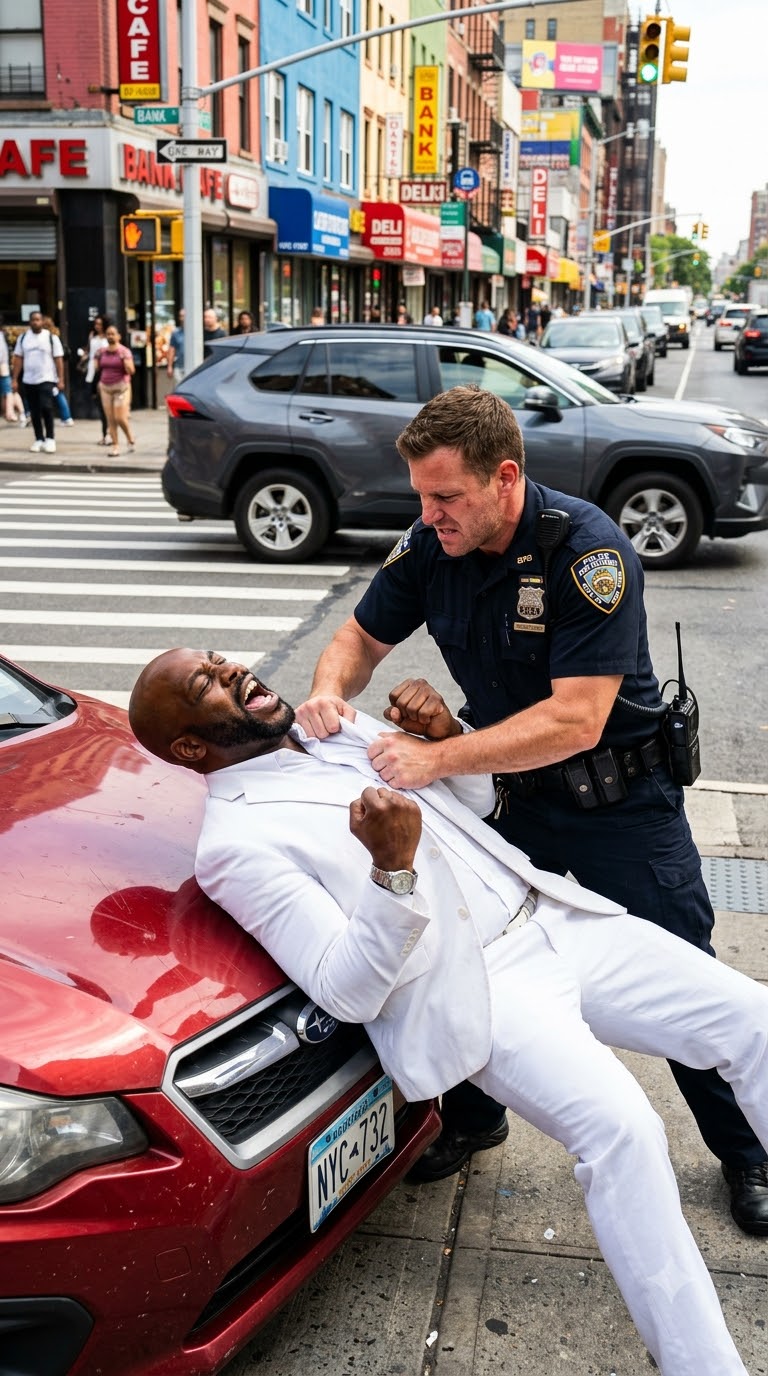
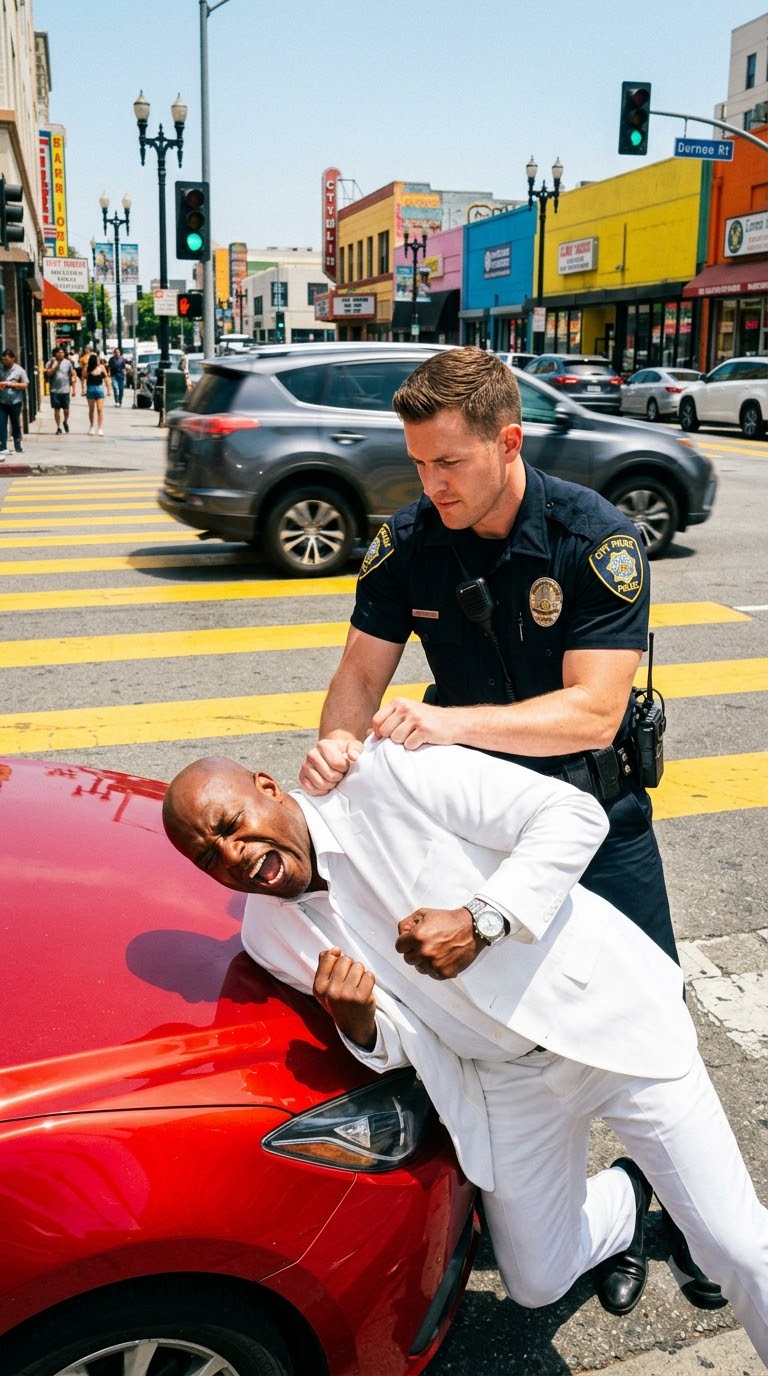
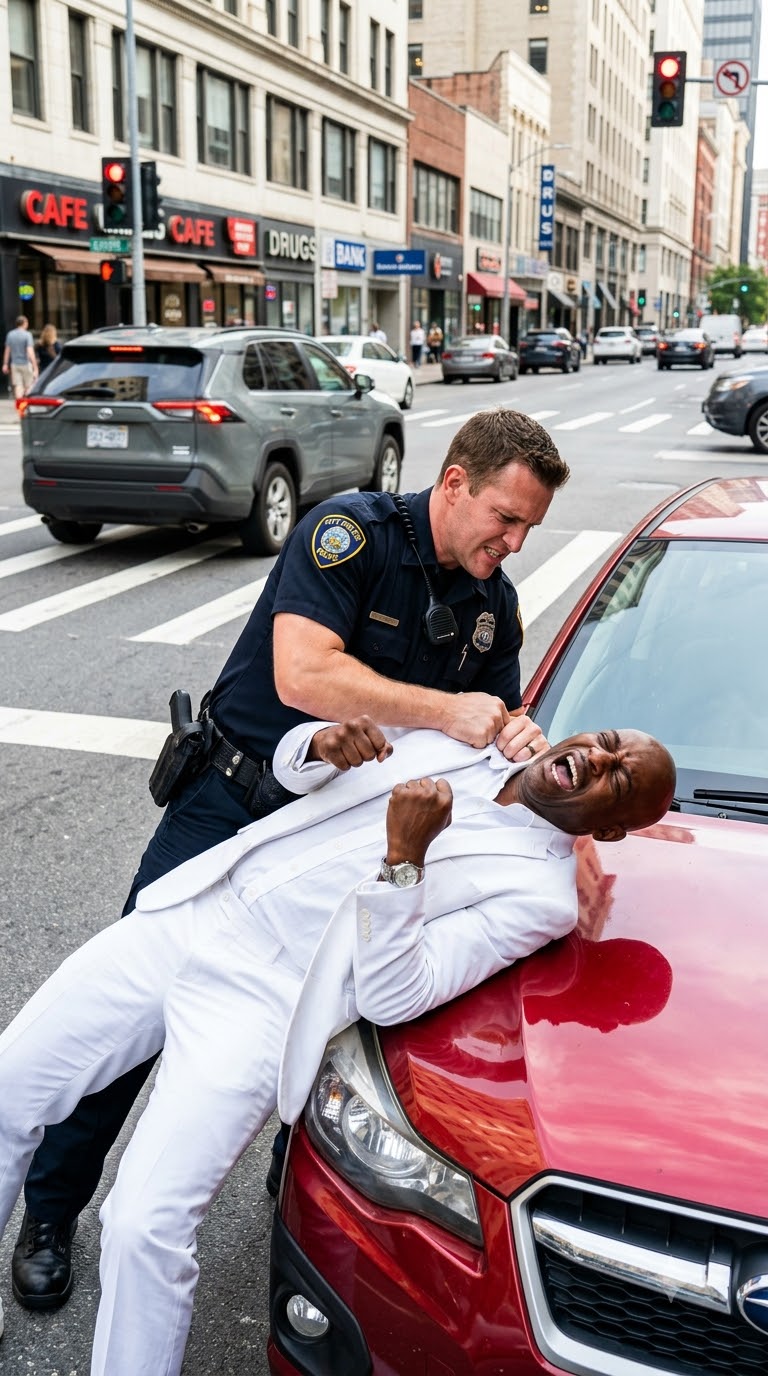
The Officer shoved him against the hood.
The impact dented the metal slightly.
The Supervisor’s face hardened.
Through his earpiece:
“Team moving.”
He spoke sharply.
“Negative.”
The Lead Officer heard him.
“Who are you talking to?”
The Supervisor did not answer.
The Officer reached toward his collar.
The Supervisor slapped the hand away.
The Lead Officer swung.
Not a clean punch.
More of a furious shove with a closed hand.
The Supervisor ducked.
Caught the Officer by the forearm.
Turned.
The Officer’s momentum carried him across the hood of the patrol cruiser.
He landed chest-first.
No blood.
No serious injury.
But the humiliation was complete.
The second Officer moved behind the Supervisor.
The Federal Supervisor felt the approach before seeing it.
He turned.
Blocked a grab.
Stepped back.
“Enough.”
The second Officer drew his baton halfway.
The Supervisor’s eyes locked on it.
“Do not.”
The Officer froze for half a second.
The Lead Officer pushed himself off the cruiser.
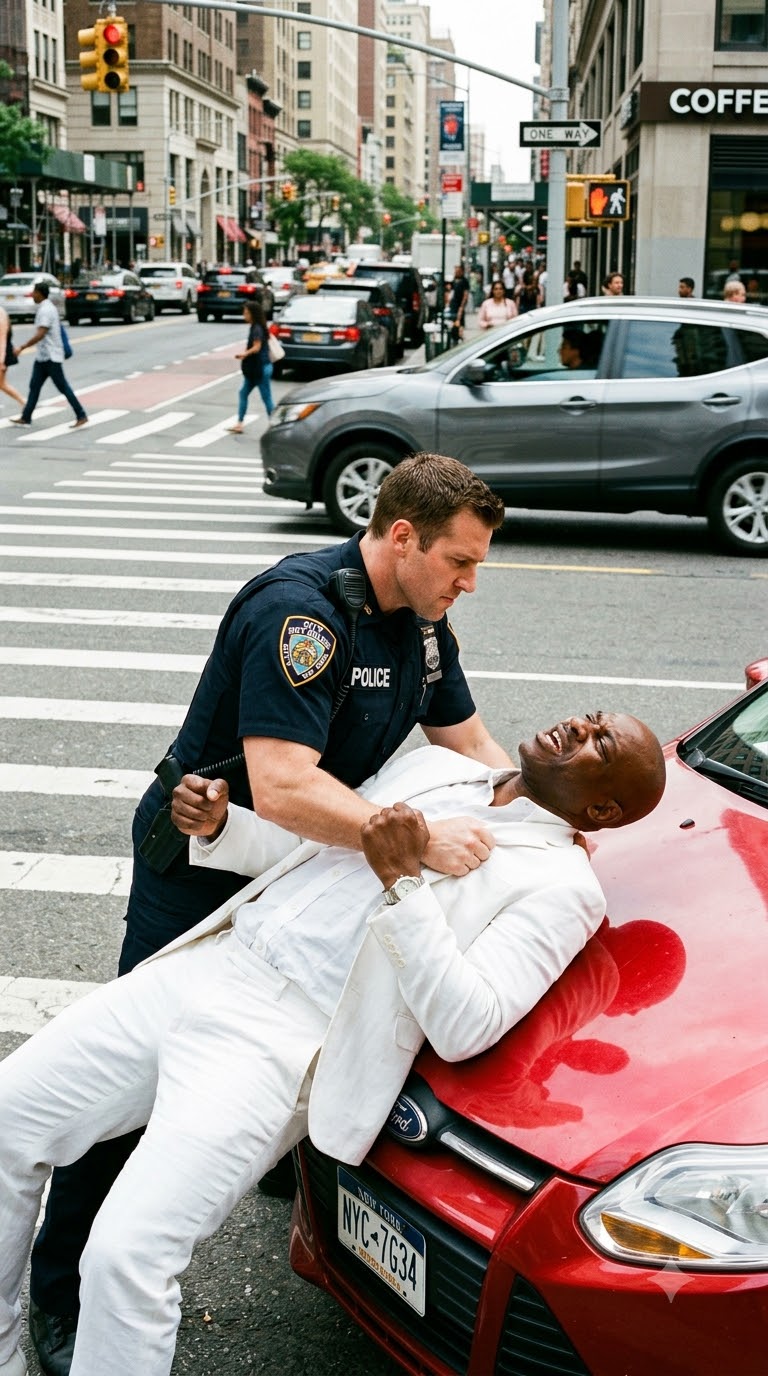
His face was red.
“You’re done.”
The Federal Supervisor looked past him.
Something moved inside the target building.
Target Two was exiting.
The man carried a black briefcase.
The entire operation was unraveling.
The Supervisor spoke into his concealed microphone.
“Freeze the street.”
That command changed everything.
At the far end of the avenue, three black SUVs surged forward.
One came from a parking garage.
Another from a side street.
The third appeared behind traffic.
Their speed immediately drew attention.
They converged on the intersection.
Tires screamed.
The first SUV stopped sideways across two lanes.
Doors opened.
Federal agents spilled out.
Dark jackets.
Badges visible.
Weapons holstered but hands ready.
The Lead Officer stared.
“What the hell?”
A female FBI Agent ran toward them.
“Back away from him.”
The Lead Officer looked between her and the Federal Supervisor.
“This guy assaulted an officer.”
The FBI Agent did not slow.
“Back away now.”
The second Officer stepped away first.
The Lead Officer did not.
“He resisted detention.”
The FBI Agent reached them.
She looked at the Federal Supervisor’s torn shirt.
Then the damaged muscle car.
Then the patrol cruiser.
Her face went cold.
“What happened?”
The Lead Officer pointed.
“He refused commands.”
The Federal Supervisor said nothing.
The FBI Agent turned toward the Officer.
“Did you ram his vehicle?”
“It was a tactical stop.”
“Based on what?”
The Lead Officer hesitated.
The Federal Supervisor finally spoke.
“That is a good question.”
The Officer glared.
The FBI Agent looked at him.
Then delivered the line that changed the entire street.
“Officer, that is the FBI field supervisor running the operation you just crashed into.”
Silence.
Not just between them.
The street itself seemed to pause.
The Lead Officer’s face drained.
The second Officer looked at the Federal Supervisor as though the man had physically changed.
He had not.
Same torn white shirt.
Same watch.
Same controlled expression.
Only context had changed.
The Lead Officer recovered first.
“He should’ve identified himself.”
The Federal Supervisor’s voice remained quiet.
“You never gave me the chance.”
“You could’ve said FBI.”
“I said active operation.”
“That could mean anything.”
“You rammed a stationary car.”
The Officer looked toward his patrol vehicle.
Then toward the growing crowd.
Phones were everywhere now.
People recording.
The FBI Agent glanced toward the target building.
“Supervisor.”
The Federal Supervisor turned.
Target Two was running.
“Go.”
Two agents sprinted across the street.
The man with the briefcase ran toward the parking garage.
Another federal vehicle cut him off.
Agents converged.
The Federal Supervisor watched for two seconds.
Then looked back at the local officers.
Something bothered him.
Not the collision.
Not even the fight.
Timing.
The police cruiser had arrived at the exact moment Target One exited.
That was too precise.
He looked at the Lead Officer.
“Who sent you?”
The Officer frowned.
“What?”
“Who dispatched you?”
“We got a call.”
“From who?”
“Suspicious person.”
The Federal Supervisor’s expression changed.
“What description?”
The Officer hesitated.
“Male.”
“Keep going.”
“Large build.”
“Keep going.”
“Standing beside a black vehicle.”
The Supervisor looked at the street.
Hundreds of men could fit that description.
“What was he supposedly doing?”
The Officer’s mouth tightened.
“Potential vehicle theft.”
The Supervisor looked at his car.
“You believed I was stealing the car I was leaning against?”
“We were told the vehicle might be stolen.”
“Plate check?”
The Officer said nothing.
The FBI Agent stepped closer.
“You checked the plate before contact?”
The second Officer looked away.
The Supervisor saw it.
“You didn’t.”
The Lead Officer said:
“We didn’t have time.”
“You had time to ram it.”
The Officer clenched his jaw.
The Federal Supervisor looked toward the patrol cruiser.
“Give me the dispatch number.”
The Lead Officer shook his head.
“This is a local matter.”
The FBI Agent almost laughed.
“No. It stopped being local when you drove into a federal operation.”
The Federal Supervisor raised one hand.
“Don’t argue.”
He looked at the second Officer.
“What was the call number?”
The younger Officer gave it.
The Lead Officer shot him a look.
Too late.
The FBI Agent typed into her phone.
“Control, pull city dispatch event 4417.”
A voice answered through her earpiece.
“Working.”
The Federal Supervisor looked toward the target building again.
Agents had detained Target Two.
Target One remained under surveillance.
The immediate operation might survive.
But something larger was wrong.
Two minutes later, federal control answered.
“Supervisor.”
“Go.”
“The city call does not exist in public dispatch.”
The Federal Supervisor looked at the Officers.
The Lead Officer’s expression changed.
The second Officer frowned.
“What do you mean?”
The FBI Agent asked:
“No CAD entry?”
“Negative.”
The Federal Supervisor looked directly at the Lead Officer.
“Who sent you?”
The Officer shook his head.
“We got it over radio.”
“From dispatch?”
“Yes.”
“Channel?”
The second Officer answered.
“Three.”
Federal control interrupted.
“City Channel Three has no corresponding transmission in archived feed.”
The second Officer stared.
“That’s impossible.”
The Federal Supervisor’s voice became colder.
“No.”
“It’s deliberate.”
The Lead Officer took one step backward.
The FBI Agent noticed.
“So someone called your cruiser directly?”
The Officer did not answer.
The Federal Supervisor approached slowly.
“Who sent you?”
The Lead Officer looked at the crowd.
Then the FBI agents.
Then his partner.
His confidence disappeared.
“I got a message.”
“From who?”
“Watch commander.”
The second Officer looked shocked.
“You told me dispatch called us.”
The Lead Officer snapped:
“Shut up.”
The Federal Supervisor’s eyes narrowed.
There.
That was the first real crack.
The second Officer stepped away from his partner.
“You said vehicle theft.”
“I said shut up.”
The FBI Agent moved between them.
“No.”
She pointed toward the Lead Officer.
“You’re done giving him orders.”
The Federal Supervisor looked at the second Officer.
“What did he tell you before you arrived?”
The younger Officer swallowed.
“He said stolen car.”
“Anything else?”
“That the driver might run.”
“Anything else?”
The Officer hesitated.
“He said not to let him leave.”
The Supervisor nodded.
“Did he identify me?”
“No.”
“Did he show you a warrant?”
“No.”
“Did he run the plate?”
“No.”
The Lead Officer said:
“He’s twisting this.”
The Federal Supervisor turned.
“Then untwist it.”
Silence.
“Who was the watch commander?”
The Lead Officer named him.
The Federal Supervisor and FBI Agent looked at each other.
Both recognized the name.
Not because the Watch Commander was a suspect.
Because he had appeared once in a peripheral financial report.
One small connection.
A private security company.
The same company tied to the target building.
The Federal Supervisor felt the entire investigation widen.
“Get Internal Affairs.”
The FBI Agent nodded.
“And federal public corruption.”
The Lead Officer stepped forward.
“Hold on.”
The Supervisor looked at him.
“You rammed my car.”
“You put your hands on me.”
“You disrupted a federal operation.”
“And now the call that supposedly sent you here doesn’t exist.”
The Officer’s voice became defensive.
“I followed orders.”
The Federal Supervisor nodded.
“That may be the most important thing you’ve said.”
The Lead Officer looked confused.
The Supervisor continued.
“Because now I want to know whose.”
The agents separated the two city Officers.
Nobody arrested them immediately.
That frustrated the crowd.
Several people shouted that the police Officers should be cuffed.
The Federal Supervisor ignored them.
He understood something the crowd did not.
Handcuffs felt satisfying.
Evidence mattered more.
If the Officers were part of the corruption network, arresting them too early could warn everyone above them.
If they were manipulated into the scene, treating them as conspirators could destroy cooperation.
The Federal Supervisor wanted facts.
The Lead Officer surrendered his department phone.
The second Officer surrendered his too.
Their vehicle computer was photographed and isolated.
Dispatch logs were preserved.
Body camera footage was secured.
The patrol cruiser itself became evidence.
So did the damaged muscle car.
The Federal Supervisor hated that part.
He looked at the crushed rear panel.
The FBI Agent stood beside him.
“You really liked this car.”
He stared at the damage.
“I liked it more before the police redesigned it.”
She almost smiled.
Then her expression turned serious.
“We have the briefcase.”
“What’s inside?”
“Cash.”
“Flash drive?”
“Yes.”
“Targets?”
“Both secured.”
The Supervisor nodded.
“So the operation survived.”
“Barely.”
He looked toward the city Officers.
“No.”
She followed his eyes.
“It got bigger.”
At FBI field offices across the city, analysts began working before the street had cleared.
The first question was simple.
Who sent the Lead Officer the message?
The department phone contained an encrypted messaging application approved for supervisory communication.
One message had arrived fourteen minutes before the collision.
Intercept black coupe at Mercer and Fifth.
Possible stolen vehicle.
Driver may flee.
Stop immediately.
The sender ID belonged to the Watch Commander.
But digital forensics found something strange.
The message had not originated from the Commander’s registered device.
It had been sent through a desktop access portal.
Someone logged into his account remotely.
The login came from inside police headquarters.
That meant three possibilities.
The Watch Commander used another terminal.
Someone borrowed his credentials.
Or someone deliberately framed him.
The Federal Supervisor refused to choose before evidence.
By evening, the operation site had been processed.
The two city Officers were interviewed separately.
The second Officer cooperated immediately.
He explained that the Lead Officer received the message, accelerated toward the location, and said they needed to stop a stolen vehicle before it left.
The younger Officer had asked whether dispatch had confirmed.
The Lead Officer said yes.
That was false.
The younger Officer admitted something worse.
He said the Lead Officer intentionally struck the black car.
Not accidentally.
“He said pin it.”
The investigator asked:
“Those exact words?”
“Yes.”
“Why didn’t you object?”
The younger Officer looked ashamed.
“I thought we were stopping a stolen vehicle.”
“You still thought crashing into a parked car was necessary?”
The Officer looked down.
“No.”
“Then why did you let it happen?”
Silence.
Finally:
“Because he was senior.”
The Federal Supervisor read that transcript later.
He circled one sentence.
Because he was senior.
That line bothered him more than the collision.
Organizations often imagined misconduct as one person making terrible decisions.
But misconduct frequently survived because everyone around that person deferred.
Rank.
Experience.
Confidence.
Volume.
People mistook certainty for correctness.
The Lead Officer gave a different story.
He claimed the message looked authentic.
He said he believed the car was stolen.
He said the Federal Supervisor acted aggressively.
He said striking the car was necessary to prevent escape.
Investigators asked why the car had been stationary.
He said it could have moved.
They asked why he never ran the plate.
He said urgency.
They asked why he told his partner dispatch had confirmed the call.
He said he believed it had.
They asked why no radio transmission existed.
He said technical failure.
They asked why he grabbed the Supervisor before establishing probable cause.
He became angry.
Then asked for an attorney.
That was his right.
The interview stopped.
The Federal Supervisor spent that night at the office.
He did not go home.
He sat in a glass conference room at 1:20 a.m., white shirt replaced with a plain dark sweater, reviewing timelines across three screens.
Target movement.
Police cruiser GPS.
Phone logs.
Building surveillance.
Dispatch records.
Federal communications.
The city patrol cruiser had left its assigned sector eleven minutes before the collision.
That meant it was already moving toward downtown before the message supposedly arrived.
The Supervisor leaned closer.
“Again.”
An analyst replayed the map.
11:41:08.
Cruiser begins moving south.
11:44:17.
Encrypted message arrives.
11:52:03.
Collision.
The Supervisor pointed.
“They were already headed toward us.”
The FBI Agent beside him nodded.
“So the message wasn’t the beginning.”
“No.”
“It was cover.”
The room became quiet.
That changed the case.
Someone expected the Officers to go there before the official-looking instruction appeared.
The Lead Officer had likely been contacted through another channel.
Personal phone.
In-person instruction.
Maybe prearranged signal.
Investigators obtained emergency preservation orders for his personal accounts.
By sunrise, they found a second phone.
Not physically.
Digitally.
Cell tower records showed another device traveling almost exactly with the patrol cruiser.
The device was registered to a prepaid account.
Burner.
The Federal Supervisor looked at the analyst.
“Can we tie it to him?”
“Location correlation is strong, but not enough alone.”
“Calls?”
“Two.”
“To who?”
“One number belongs to the private security company.”
The room changed instantly.
The same company.
Again.
The Supervisor stood.
“Preserve everything.”
The FBI Agent nodded.
“We need a warrant.”
“We’ll get one.”
By 8:15 a.m., a federal magistrate approved targeted records.
By noon, investigators had confirmation.
The burner phone communicated with an employee inside the private security company seven times during the previous month.
That employee worked under the broker already arrested in the downtown operation.
The Lead Officer was no longer simply an aggressive cop responding badly.
He was connected.
The next question became whether he knew the Federal Supervisor’s identity.
Investigators discovered a photograph on the burner phone.
Grainy.
Taken from across a parking lot two days earlier.
The Federal Supervisor getting out of the same black muscle car.
A message beneath the image read:
This is the one.
The FBI Agent stared at the screen.
“He knew exactly who he was stopping.”
The public corruption prosecutor nodded.
“Maybe not name.”
“But target.”
The Federal Supervisor read the message silently.
His anger changed.
Until then, the collision felt personal only in a physical sense.
His car.
His body.
His operation.
Now it became intentional.
Someone had selected him.
Why?
To scare him?
Delay him?
Compromise the operation?
Maybe all three.
Another message appeared.
If he moves before 1400, stall him.
No arrest unless necessary.
Make it look local.
The Federal Supervisor read it twice.
“Make it look local.”
That explained everything.
The fake stolen-vehicle message.
The uniformed response.
The collision.
The sudden aggression.
They did not need to arrest him.
They needed to create chaos.
Five minutes of confusion.
Ten if possible.
Enough time for the broker to abort the exchange.
Enough time for targets to escape.
But the plan failed because federal teams closed the street quickly.
The attackers underestimated how prepared the operation was.
The Federal Supervisor looked toward the analyst.
“Who sent that?”
“Security company employee.”
“Directly to the Lead Officer?”
“Yes.”
“Then we have conspiracy.”
The prosecutor held up one hand.
“We have evidence supporting it.”
The Supervisor nodded.
“Right.”
That distinction mattered.
Evidence first.
Conclusion second.
The Lead Officer was suspended before sunset.
The department issued a short statement.
Officer removed from field duties pending joint investigation.
No names.
No dramatic language.
The internet provided enough drama.
Videos of the collision had already spread.
One clip showed the patrol cruiser smashing into the black car.
Another showed the Lead Officer forcing the Federal Supervisor against the hood.
A third captured the moment black SUVs arrived.
The most viral clip ended with the FBI Agent shouting:
“That’s the FBI field supervisor.”
Millions watched.
Most viewers believed the twist ended there.
It did not.
The real story had barely started.
Federal agents executed warrants at the private security company the next morning.
Computers.
Phones.
Financial records.
Access cards.
Employee schedules.
One locked office contained a whiteboard with abbreviated names.
Some looked meaningless.
Others matched police units.
A city property clerk.
A courthouse maintenance supervisor.
A tow-company owner.
An assistant district attorney.
Investigators did not assume everyone listed was corrupt.
Some could be targets.
Clients.
Contacts.
Victims.
But the network was larger than expected.
The FBI expanded the team.
The Federal Supervisor was temporarily removed from direct operational command because he had become a witness and potential victim.
He hated that.
His supervisor explained:
“You cannot lead an investigation into people who attacked you.”
“I can separate emotion.”
“I believe you.”
“Then let me work.”
“No.”
The Federal Supervisor leaned back.
“You realize I built this case.”
“Yes.”
“And now I sit outside it.”
“You become a witness.”
The Supervisor looked away.
His boss continued.
“That protects the case.”
The Federal Supervisor understood.
He still hated it.
For the first time in years, he experienced an investigation from the other side.
Interview rooms.
Evidence receipts.
Requests to recount the same moment repeatedly.
Questions that felt obvious.
Then repetitive.
Then invasive.
What exactly did the Officer say before first contact?
Which hand grabbed you?
When did you identify the operation?
How much force did you use?
Did you strike the Officer?
Did you hear your agents approaching?
Did you have any prior interaction with local police?
Did you know the Lead Officer?
Had you ever seen him?
The Federal Supervisor answered everything.
He corrected investigators when their wording became stronger than his memory.
One interviewer asked:
“When the Officer punched you…”
The Supervisor interrupted.
“I wouldn’t call it a clean punch.”
“What would you call it?”
“A closed-hand shove or attempted strike.”
“Did it contact you?”
“Glanced.”
“Did it hurt?”
“Not significantly.”
The investigator nodded.
The Supervisor added:
“Use what happened.”
“Don’t improve it.”
That attitude strengthened the case.
The Lead Officer’s attorney later argued that federal agents exaggerated the street confrontation.
Body camera footage contradicted that.
The Federal Supervisor remained controlled.
He repeatedly warned the Officer.
He asked for a supervisor.
He did not initiate physical contact.
He used defensive movements only after being grabbed.
That mattered.
So did something else.
The Lead Officer’s body camera captured a whisper just before exiting the patrol car.
The younger Officer asked:
“Is that him?”
The Lead Officer answered:
“Yeah.”
Investigators replayed it dozens of times.
That exchange destroyed the claim that they believed they were randomly stopping an unknown car thief.
The second Officer heard it during his follow-up interview.
His face changed.
“I didn’t remember that.”
The investigator asked:
“What did you think he meant?”
“At the time?”
“Yes.”
“I thought he meant the vehicle description.”
“And now?”
The Officer looked down.
“I don’t know.”
The investigator waited.
The younger Officer eventually said:
“I think he knew who we were looking for before we got there.”
That admission did not make the younger Officer innocent.
He had still participated in unnecessary force.
He had still drawn his baton.
He had still trusted his senior partner instead of questioning a dangerous situation.
Internal Affairs opened a separate review into his actions.
But federal prosecutors saw a difference.
One Officer appeared part of the plan.
The other appeared manipulated by hierarchy and bad information.
Both could be accountable.
Not necessarily in the same way.
That distinction became central.
Three weeks after the collision, the Watch Commander was cleared of sending the fraudulent message.
Someone had used his credentials.
But investigators discovered why his account was vulnerable.
His password was taped beneath his keyboard.
Literally.
A small label.
Six characters.
One capital letter.
One number.
The Federal Supervisor stared at the photograph.
“You’re joking.”
The analyst shook her head.
“No.”
A multimillion-dollar department security system compromised by a piece of tape.
The Watch Commander received discipline for security violations.
But forensic evidence showed he was not part of the corruption network.
The person who used his credentials was.
A civilian technology contractor.
That contractor serviced police communication systems and also worked part-time for the private security company.
Another bridge.
Another quiet connection between official infrastructure and private criminal activity.
The contractor was arrested.
He cooperated within seventy-two hours.
Fear moved faster than loyalty.
His information cracked the network open.
He described an informal service.
Criminal defendants paid brokers.
Brokers paid insiders.
The insiders provided information.
Evidence status.
Officer schedules.
Search warrant dates.
Vehicle plates.
Surveillance locations.
Confidential informant identities.
Sometimes they altered records.
Sometimes they simply delayed response.
Small actions.
Five minutes.
Ten minutes.
A missing report.
A camera turned away.
A door left unlocked.
Enough to change outcomes.
The Federal Supervisor listened to the contractor’s recorded interview.
One line stayed with him.
“Nobody had to do something huge.”
That was the brilliance of the system.
And the horror.
A corrupt network did not need every participant committing spectacular crimes.
One person provided a password.
Another ignored a camera.
Another mislabeled evidence.
Another sent patrol officers to the wrong place.
Each action looked small.
Together, they could destroy cases.
The contractor explained the street plan.
The broker learned a federal operation might occur downtown.
He did not know exact details.
Then surveillance identified the Federal Supervisor.
Someone photographed his car.
The Lead Officer, already receiving payments for information, was asked to delay him if he appeared near the security office.
No murder.
No kidnapping.
No dramatic ambush.
Just disruption.
Make it local.
Create a street argument.
Maybe tow the car.
Maybe detain the man.
Anything to create enough confusion for the broker to leave.
The Lead Officer agreed.
That was why the patrol car began moving before the fake dispatch message.
He had already received the instruction through the burner phone.
The fraudulent dispatch was created afterward so his partner would believe the stop was legitimate.
The contractor said:
“He wasn’t supposed to hit the car.”
The interviewer asked:
“What was he supposed to do?”
“Box it in.”
“Why did he ram it?”
The contractor shrugged.
“He gets excited.”
The Federal Supervisor paused the recording.
He stared at the screen.
“He gets excited.”
That carelessness could have injured pedestrians.
Could have killed someone.
The plan had been corrupt.
The execution had been reckless.
The prosecutor later charged the Lead Officer with conspiracy, obstruction of justice, civil-rights violations, falsification connected to official communications, and additional offenses tied to prior incidents discovered during the investigation.
He pleaded not guilty.
That was expected.
The contractor pleaded guilty.
The private security broker did too after months of litigation.
Then came the larger shock.
Evidence connected several previously failed criminal cases to the network.
One involved a weapons trafficking investigation.
Another involved stolen pharmaceuticals.
Another involved armed robbery.
In each, law enforcement had believed suspects were unusually lucky.
They were not lucky.
They had information.
The department reopened internal reviews.
Federal prosecutors reevaluated cases.
Defense attorneys requested records.
Judges ordered disclosure.
Nobody knew how many prosecutions might be affected.
The Federal Supervisor watched from the edge.
That was the hardest part.
The street confrontation became famous.
But he cared less about that with each week.
The damaged car was eventually repaired.
His bruises disappeared.
His shirt was replaced.
The operation mattered more.
The network had corrupted trust.
Every legitimate Officer now carried the burden of public doubt.
Every defendant connected to compromised evidence had questions.
Every victim of a case that failed deserved answers.
The city Police Chief requested a private meeting with the Federal Supervisor.
They met at the FBI office.
No cameras.
No press.
The Chief was a Black woman in her fifties with more than thirty years in law enforcement.
She sat across from him.
“I owe you an apology.”
The Supervisor shook his head.
“You didn’t ram my car.”
“My department did.”
“An Officer did.”
She looked at him.
“That distinction matters.”
“Yes.”
“But so does institutional responsibility.”
The Supervisor nodded.
She continued.
“We missed signals.”
“Everyone misses signals.”
“We missed too many.”
He said nothing.
The Chief slid a folder across the table.
Complaint histories.
The Lead Officer had accumulated eleven use-of-force complaints in six years.
Most were found within policy.
Three included allegations that he escalated before confirming facts.
Two involved unnecessary vehicle contact.
One involved an illegal search claim settled civilly without admission.
The Supervisor looked through them.
“Why was he still working street patrol?”
The Chief did not defend it.
“Because individually, each case was explained.”
The Supervisor looked up.
“There’s the problem.”
“I know.”
She nodded.
“We looked at incidents.”
“Not patterns.”
Exactly.
The same weakness that protected the criminal network.
Everyone evaluated pieces separately.
Nobody assembled the whole.
The Chief announced reforms a month later.
Early-warning systems would flag repeat force complaints.
Supervisors would review vehicle-contact incidents automatically.
Dispatch records would require cryptographic verification for certain high-risk assignments.
Officer-to-officer emergency messages could no longer substitute for logged dispatch without later validation.
Contractor access would be restricted.
Administrative passwords moved to hardware-based authentication.
No tape under keyboards.
That became an unofficial joke.
The Federal Supervisor did not laugh much.
Because behind every reform was a failure that had already happened.
The Lead Officer’s trial began nearly a year after the street collision.
The prosecution did not begin with the viral video.
That surprised people.
They began with phone records.
The burner device.
The private security employee.
The fake dispatch message.
GPS.
Credential misuse.
Payments.
Only after building the conspiracy did they show the collision.
The jury saw the patrol cruiser leave its sector before any supposed call.
They saw the photograph of the Federal Supervisor on the burner phone.
They read:
This is the one.
Then:
Stall him.
Make it look local.
Finally, they watched body camera footage.
The Lead Officer shouting.
The Federal Supervisor warning him.
The grab.
The struggle.
The SUVs arriving.
The FBI Agent yelling:
“Get off him.”
The defense argued the Lead Officer believed he was protecting public safety.
The prosecutor asked one question.
“If he believed that, why did he need a fake dispatch message?”
That question sat in the courtroom.
The defense had explanations.
None satisfied the jury.
The Lead Officer was convicted on multiple charges.
Not every charge.
The jury rejected one count where evidence did not meet the required standard.
The Federal Supervisor respected that.
A jury was not there to punish a bad man for everything imaginable.
It was there to decide specific allegations.
Proof mattered.
The younger Officer faced no federal conspiracy charge.
Internal Affairs suspended him and required retraining after finding he used poor judgment, failed to question an unjustified collision, and escalated without adequate legal basis.
He later requested transfer from patrol.
Months after the trial, he wrote the Federal Supervisor a letter.
Not an email.
A handwritten letter.
The Supervisor almost threw it away.
Then read it.
I keep replaying that day.
I told myself I was following my senior officer because he knew more than I did.
The truth is I stopped thinking because following was easier.
I don’t expect forgiveness.
I wanted you to know I understand that now.
The Federal Supervisor read those lines twice.
Then placed the letter in a drawer.
He never responded.
Not from cruelty.
Because forgiveness was not something he could manufacture on demand.
Understanding the mistake mattered.
Change afterward mattered more.
The city eventually settled the property-damage claim for the car.
The Federal Supervisor refused a larger personal settlement tied to confidentiality.
He did not want silence.
His attorneys handled it.
He rarely discussed the amount.
People cared too much about numbers.
He cared about the record.
The collision had happened.
The reports should say so.
The use of force happened.
The video should remain preserved.
The conspiracy happened.
The public deserved an accurate explanation once cases concluded.
Two years after the incident, the FBI closed the larger corruption investigation.
Twenty-one people faced charges across federal and state systems.
Not all were police.
That mattered.
The scandal was not “police versus FBI.”
It was compromised people inside multiple institutions exploiting trust.
Some Officers helped uncover it.
Some became witnesses.
Some were victims of stolen credentials.
Some were corrupt.
The Federal Supervisor repeatedly corrected reporters who tried to simplify the story.
One interviewer asked:
“Was this proof that local police can’t be trusted?”
The Supervisor answered:
“No.”
The reporter seemed surprised.
He continued.
“It is proof that trust without verification creates vulnerability.”
“Some local Officers helped us build the case.”
“Others compromised it.”
“If you reduce everyone to one category, you learn nothing.”
That answer was less exciting than the headline.
It was more accurate.
The black muscle car remained with him.
Friends told him to sell it.
Too many memories.
Too much attention.
He refused.
The repaired rear quarter panel looked perfect.
Almost.
Under certain light, he could see a slight difference in the paint.
He liked that.
Not enough for anyone else to notice.
Enough for him.
A reminder.
Three years after the confrontation, the Federal Supervisor drove downtown again.
Same street.
Same intersection.
Different assignment.
He parked near the curb.
Stepped out.
White shirt.
Dark trousers.
No visible badge.
A patrol cruiser passed.
Slowed.
The Supervisor watched it through the windshield.
The Officer inside looked at him.
Then at the car.
Then continued.
Nothing happened.
The Federal Supervisor smiled.
Ordinary.
That was good.
He walked toward a coffee shop.
Inside, the FBI Agent from the original street confrontation waited at a table.
She had been promoted.
So had he.
Neither mentioned titles much.
She looked through the window toward the muscle car.
“You still drive that thing?”
“Yes.”
“Thought you’d learn.”
“Learn what?”
“To buy something boring.”
He sat.
“Never.”
She smiled.
Then placed a folder on the table.
He looked at it.
“What’s this?”
“Training review.”
He frowned.
“You invited me for coffee to discuss training?”
“Yes.”
“That’s hostile.”
She laughed.
The report examined interagency coordination failures from the incident.
One recommendation proposed mandatory challenge protocols for officers receiving sensitive assignments outside normal dispatch.
Another required confirmation before high-risk vehicle contact unless immediate danger existed.
The Supervisor read quietly.
The FBI Agent asked:
“What do you think?”
He pointed to one sentence.
“This.”
She leaned closer.
The line read:
Rank does not replace verification.
The Supervisor nodded.
“Keep that.”
“Why?”
“Because that’s the whole thing.”
The Lead Officer followed corrupt instructions.
The younger Officer followed the Lead Officer.
The Watch Commander used weak security because nobody challenged routine.
Contractors accumulated access because convenience became normal.
Investigators once treated complaints individually because the system did not force pattern review.
At every level, someone assumed another person knew better.
Rank does not replace verification.
Neither does confidence.
Neither does familiarity.
Neither does a badge.
The FBI Agent looked at him.
“You realize people still think the story is just you throwing a cop over a hood.”
The Supervisor sighed.
“I did not throw him.”
“You redirected momentum.”
“Correct.”
She smiled.
“That will definitely improve the legend.”
He shook his head.
The viral version had become ridiculous over time.
Some people claimed five Officers attacked him.
There were two.
Some claimed he knocked both unconscious.
He did not.
Some claimed twenty FBI vehicles arrived.
There were three SUVs at first.
Some claimed the Police Officer knew his exact identity before striking him.
Evidence showed he knew the Supervisor was the person he had been instructed to delay, but not necessarily his title.
Stories inflated.
The Supervisor hated that.
The real facts were powerful enough.
An Officer intentionally drove into a parked vehicle.
Used force before establishing lawful grounds.
Had been sent through corrupt channels.
Tried to obstruct a federal operation.
A network existed behind him.
That was enough.
No embellishment needed.
Later that year, the department invited the Federal Supervisor to address a joint academy class.
City police recruits.
Federal trainees.
Transit officers.
State investigators.
He almost declined.
Public speaking was not his favorite part of the job.
Then he accepted.
The room held nearly two hundred people.
The viral street video played before he entered.
He hated that too.
When he reached the podium, everyone expected a dramatic story.
He gave them something quieter.
He placed both hands on the podium.
“Most of you have seen the video.”
Several people nodded.
“You saw a police cruiser hit a car.”
“You saw an Officer grab me.”
“You saw federal agents arrive.”
“You saw a confrontation.”
He paused.
“That isn’t the part I want you to remember.”
The room became still.
“I want you to remember the first thirty seconds before the fight.”
“He did not verify the plate.”
“He did not verify the dispatch.”
“He did not establish what crime had occurred.”
“He did not ask who I was.”
“He did not ask why I was there.”
“He had a conclusion before he had facts.”
The Supervisor looked across the room.
“That is where the failure started.”
“Not with the shove.”
“Not with the collision.”
“Earlier.”
“When certainty replaced investigation.”
He looked toward the police recruits.
Then the federal trainees.
“This is not a lesson about one uniform.”
“It is a lesson about authority.”
“Every one of you will eventually have enough authority that people may obey you even when you are wrong.”
That line changed the room.
“The question is what you do with that.”
“Do you reward people who challenge your assumptions?”
“Do you verify information that feels convenient?”
“Do you slow down when everyone around you is getting faster?”
“Do you distinguish resistance from confusion?”
“Disagreement from threat?”
“Urgency from recklessness?”
He paused.
“Because badges do not make facts true.”
Silence.
He continued.
“And federal credentials don’t either.”
Several heads lifted.
“If I walk into a room and tell you something that doesn’t make sense, you are allowed to ask me to explain.”
“Professional challenge is not insubordination.”
“Verification is not disrespect.”
“Accountability is not betrayal.”
He looked at the class.
“The worst systems are not always full of bad people.”
“Sometimes they are full of decent people who stopped asking questions.”
Nobody clapped immediately.
The Supervisor preferred that.
He wanted them thinking.
Then the applause began.
Slow.
Then louder.
He left without staying for photographs.
Outside, his car waited in the parking lot.
He walked toward it.
A young Police Recruit followed him out.
“Sir.”
The Supervisor turned.
The Recruit looked nervous.
“Can I ask something?”
“Go ahead.”
“If you could go back to that street, what would you do differently?”
The Supervisor thought.
He could say nothing.
He could say he would identify himself faster.
He could say he would avoid the physical confrontation.
He could say he would park somewhere else.
But none felt true.
Finally:
“I would notice the timing sooner.”
The Recruit frowned.
“The timing?”
“The cruiser arrived at exactly the wrong moment.”
“I was focused on the Officer.”
“I should have been asking who benefited.”
The Recruit nodded slowly.
The Supervisor continued.
“When something makes no sense, don’t only ask what happened.”
“Ask who needed it to happen.”
The Recruit smiled.
“I’ll remember that.”
The Supervisor opened the driver’s door.
Then added:
“But don’t turn that into paranoia.”
The Recruit laughed.
“Right.”
“Evidence first.”
“Always.”
He got into the car.
The engine started.
For a second, he saw the original street scene again.
Blue lights.
Metal impact.
Angry face.
Hands grabbing.
Black SUVs racing toward him.
Then it disappeared.
He pulled onto the road.
The city moved around him.
Normal traffic.
Normal noise.
People going home.
The incident had changed careers.
Destroyed a corruption network.
Exposed procedural weaknesses.
Reopened cases.
Produced convictions.
Forced reforms.
But the Federal Supervisor eventually understood something simpler.
The most dangerous part of that afternoon was not that the Officers did not know who he was.
People loved telling the story that way.
They picked the wrong man.
They attacked an FBI supervisor.
Big mistake.
But that framing bothered him.
Because what if he had been nobody important?
What if he had simply been a mechanic?
Accountant?
Teacher?
Delivery driver?
Unemployed father?
College student?
A man standing beside his own car?
Would the collision have been less wrong?
Would grabbing him without establishing facts have become acceptable?
Would ignoring verification somehow matter less?
No.
His title did not create his rights.
His federal position did not make unjustified force more unjustified.
The badge in his pocket was not what transformed bad conduct into bad conduct.
That truth became the part of the story he repeated most.
Years later, another interviewer asked him about the famous confrontation.
The interviewer smiled.
“They really picked the wrong guy, didn’t they?”
The Federal Supervisor looked at him.
Then answered:
“No.”
The interviewer blinked.
“What do you mean?”
“They picked a person without knowing the facts.”
“That was the mistake.”
The interviewer tried again.
“But because you were FBI…”
The Supervisor shook his head.
“You’re missing it.”
“If I had been anyone else, they still would have needed legal justification.”
“They still should have verified the call.”
“They still should not have rammed a stationary vehicle based on an unconfirmed message.”
“They still should not have treated questions like threats.”
His voice remained calm.
“The lesson cannot be ‘be careful because the person might be powerful.’”
“The lesson is ‘be careful because the person is a person.’”
The interviewer went silent.
That clip never became as viral as the fight.
The Federal Supervisor expected that.
Nuance rarely traveled as fast as impact.
But among the people who mattered, the lesson stayed.
Inside the police department, supervisors began asking officers to state the factual basis of unusual high-risk stops before approving them.
Inside federal teams, liaison protocols improved.
Contractor permissions were audited.
Cross-agency communication became more traceable.
Officers were encouraged to challenge orders that lacked legal or factual grounding.
Some hated the extra steps.
Good systems often felt inconvenient.
That was the price.
One afternoon, nearly six years after the original incident, the Federal Supervisor passed the same intersection again.
He was no longer the field supervisor from the viral video.
He had moved higher.
More paperwork.
Fewer street operations.
More responsibility.
He stopped at the red light.
Across the corner, the private security office had become a restaurant.
People sat outside eating lunch.
No one there knew what once happened upstairs.
The Supervisor looked toward the curb where his car had been hit.
A delivery van occupied the space.
The light changed.
He almost drove through.
Then he pulled over.
Not for nostalgia.
He simply wanted coffee.
He entered the café.
Ordered black coffee.
Waited.
Behind him, two city Police Officers walked inside.
The Supervisor noticed them automatically.
Old habits.
One Officer looked familiar.
Older now.
Different haircut.
The younger partner from the original collision.
The man recognized him too.
Both froze.
For a moment, neither spoke.
Then the Officer approached.
“Sir.”
The Supervisor nodded.
“Officer.”
Years had passed since the letter.
They had never met again.
The Officer looked toward the floor.
“I didn’t know if you’d remember me.”
“I remember.”
The cashier placed the coffee down.
The Supervisor picked it up.
The Officer said:
“I left patrol.”
“I heard.”
“I work training now.”
That surprised him.
“What do you teach?”
“Decision-making.”
The Federal Supervisor almost smiled.
The Officer noticed.
“I know.”
They stood quietly.
Then the Officer said:
“I use the video.”
The Supervisor looked at him.
“Which part?”
“The beginning.”
“The approach.”
The Officer continued.
“I stop it before the collision.”
“I ask recruits what information we actually had.”
The Supervisor said nothing.
“They usually start telling me what they think happened.”
“I make them separate that from what they know.”
The Federal Supervisor finally smiled.
“Good.”
The Officer nodded.
“I tell them I failed that test.”
No excuse.
No request for forgiveness.
Just fact.
The Supervisor respected that.
The second Officer waited several feet away, giving them space.
The former partner continued.
“I know the letter didn’t need an answer.”
“I wasn’t looking for one.”
“I know.”
The Federal Supervisor took a sip of coffee.
Then said:
“You learned something.”
“Yes.”
“Teach it accurately.”
“I do.”
“Then we’re good.”
The Officer looked surprised.
The Supervisor did not explain further.
He left the café.
Outside, sunlight reflected across parked cars.
He walked toward the black muscle car.
Still there.
Still his.
He ran one hand across the repaired rear quarter panel.
From most angles, the damage was invisible.
He opened the door.
Before getting inside, he looked down the street.
Six years earlier, a police cruiser had raced toward him because someone inside a corruption network needed chaos.
The people involved believed chaos would protect them.
Instead, it exposed them.
One fake message led to a burner phone.
The burner phone led to a security company.
The security company led to compromised credentials.
The credentials led to evidence theft.
The theft led to cases.
The cases led to a network.
One bad decision did not merely fail.
It pulled a hidden structure into daylight.
People called that irony.
The Federal Supervisor called it evidence.
He got into the car.
Started the engine.
Then drove away.
No sirens followed.
No convoy arrived.
No one grabbed him.
No one needed to know who he was.
And that, more than the viral confrontation or the convictions or the dramatic moment when federal SUVs flooded the street, felt like the right ending.
Because a normal person standing beside a normal car on a normal street should not need a hidden badge to be treated lawfully.
A title should never be the thing that makes restraint matter.
And the most important question was never whether the Officers had chosen the wrong target.
It was why they had decided they did not need the truth before taking control.
