

At 9:18 on a Wednesday morning, twelve sheriff’s deputies surrounded Naomi Carter’s house.
By 9:21, two of them were at the back fence.
By 9:23, one stood beside the detached garage.
By 9:24, Captain Russell Dane raised a loudspeaker and ordered her to come outside with her hands visible.
Naomi stood in the hallway, barefoot, holding a coffee mug she had stopped drinking five minutes earlier.
She was forty-three years old.
Black.
A former Army logistics officer.
Currently a procurement compliance analyst for a federal transportation agency.
And she knew enough about warrants to understand what was missing.
Paper.
Nobody had shown any.
No deputy had approached the door with one.
No federal agent had identified himself.
No one had called her attorney.
No one had explained what crime she was suspected of committing.
Instead, twelve armed deputies were positioned around her property in Westfield, Georgia, while three marked cruisers blocked the street and neighbors gathered across the road with phones in their hands.
Captain Dane’s voice boomed through the morning air.
“Ms. Carter, open the front door. We have authority to secure federal property believed to be inside.”
Naomi set the coffee mug down.
She picked up her phone.
Hit record.
Then looked at the digital clock on the microwave.
“Time is 9:25 a.m.,” she said calmly. “Twelve county deputies are surrounding my residence. No warrant has been displayed. No federal agent is visible. Captain Russell Dane claims authority to recover federal property.”
Her voice sounded steadier than she felt.
That was training.
Not courage.
There is a difference.
Naomi had spent ten years in Army logistics, including two deployments, before leaving active duty.
She had never been a special operator.
Never kicked down doors.
Never carried secret codes in her head.
What she did understand was process.
Inventories.
Chain of custody.
Documentation.
Who signed what.
When.
Why.
People underestimated paperwork until paperwork became the only thing standing between truth and a lie.
Outside, Sheriff Allen Mercer stepped into view.
He was sixty-one.
Silver hair.
Tailored uniform.
The kind of man who looked comfortable at fundraisers.
He raised one hand toward the deputies as though calming a dangerous scene.
“Ms. Carter,” he called, “we want to resolve this peacefully.”
Naomi walked to the living-room window but stayed behind the curtain.
“Then show the warrant.”
Mercer looked toward Dane.
Dane answered through the loudspeaker.
“You are interfering with an active investigation.”
“That is not a warrant.”
A neighbor across the street laughed.
Mercer’s face tightened.
Naomi saw it.
Then saw someone else.
Eleanor Price.
Seventy-two.
Retired federal magistrate judge.
Naomi’s next-door neighbor.
She stood in her front yard wearing gardening gloves and holding pruning shears.
Eleanor looked from the cruisers to Naomi’s house.
Then at Mercer.
“Sheriff,” she called.
Mercer pretended not to hear.
Eleanor walked closer to the property line.
“I asked whether you have a warrant.”
Dane lowered the loudspeaker.
“This is an active operation, ma’am.”
Eleanor smiled without humor.
“I spent twenty-eight years signing federal search warrants. That was not my question.”
A few neighbors moved closer.
Phones rose higher.
Good.
Naomi kept recording.
At 9:28, Dane ordered two deputies to check the side gate.
Naomi narrated.
“At 9:28, deputies are attempting access to the east side of the property. No warrant presented.”
She opened a cloud backup app and sent the video automatically to her sister, her attorney, and a private storage account.
Then she texted Eleanor.
KEEP RECORDING.
The reply came immediately.
ALREADY AM.
Naomi moved through the house.
Not frantically.
Deliberately.
She closed the blinds.
Locked the back door.
Checked the garage feed.
Her father’s old desk sat in the study.
He had died eleven months earlier.
Colonel Isaiah Carter.
Retired Army procurement officer.
Thirty-two years of service.
The house had been his before it became hers.
He had built the back deck.
Repaired the floors.
Planted the magnolia tree.
And left behind six metal filing cabinets full of papers Naomi had barely touched.
That detail mattered.
Because three weeks earlier, Naomi had received a strange voicemail.
A man who did not identify himself asked whether she had “finished sorting Colonel Carter’s records.”
She ignored it.
Two days later, someone opened the mailbox and left everything inside untouched.
Then a car she did not recognize sat across from the house for three evenings.
Naomi reported it.
Nothing happened.
Now twelve deputies were outside claiming stolen federal property was inside.
Her stomach tightened.
Maybe the papers were why.
She called her attorney.
Voicemail.
Of course.
She left a message.
“This is Naomi Carter. County deputies are surrounding my home. Sheriff Allen Mercer and Captain Russell Dane are present. They claim authority to recover federal property. No warrant has been shown. I am recording everything.”
She ended the call.
Then opened her work phone.
Not a secret line.
Not a Pentagon number.
Something more ordinary.
Her agency’s Office of Inspector General emergency duty desk.
Naomi had used the number exactly once before, for a contractor who attempted to destroy audit records.
She dialed.
A woman answered.
“Inspector General duty desk.”
“My name is Naomi Carter. Employee ID 4417.”
“Go ahead.”
“I have county law enforcement at my residence claiming they are here to recover federal property. They have not shown a warrant. My late father was a retired Army procurement officer. I believe they may be targeting records connected to him.”
Pause.
“Are you in immediate danger?”
“Twelve armed deputies outside. No shots. No forced entry yet.”
“Are you recording?”
“Yes.”
“Do not interfere physically. Do not consent to a search without proper documentation. We’re verifying whether any federal agency has requested local assistance at your address.”
Naomi breathed.
“Thank you.”
“Stay on the line.”
Outside, Dane shouted,
“Final warning.”
Eleanor answered from next door.
“Final warning based on what authority?”
Dane turned.
“Ma’am, return to your home.”
“No.”
“Then move back.”
“I’m on my property.”
The old judge was enjoying herself now.
Naomi almost smiled.
Then her phone line clicked.
The OIG duty officer returned.
“Ms. Carter.”
“Yes.”
“We have no federal warrant request associated with your address.”
Naomi closed her eyes.
There it was.
“Any federal recovery action?”
“None we can locate.”
“Can you notify the appropriate authorities?”
“We already are.”
“Who?”
“State bureau investigators and the Department of Justice inspector liaison. We are also placing a preservation request on local dispatch and body-camera records.”
That mattered.
More than sirens.
More than black SUVs.
Preservation.
Records could not quietly disappear.
Naomi raised her voice for the recording.
“At 9:34, federal Inspector General duty desk confirms no known federal warrant or recovery action at this address.”
Outside, deputies shifted.
One looked at another.
Dane raised the loudspeaker.
“Ms. Carter, stop making phone calls and open the door.”
Naomi stared at the window.
That sentence chilled her more than the weapons.
Stop making phone calls.
Not open the door.
Not cooperate.
Stop reaching people outside their control.
She recorded it.
At 9:36, two deputies moved toward the utility panel on the side of the house.
Eleanor shouted,
“What are you doing?”
One deputy stopped.
Dane barked,
“Continue.”
Naomi called through the closed window.
“If you cut power without a warrant, it will be documented.”
Dane stared toward the house.
Then signaled.
The deputies stopped.
Good.
Someone was thinking.
Naomi checked the backyard camera.
One deputy stood near the basement window.
Another photographed the detached garage.
Then a vehicle pulled up at the end of the block.
Not police.
A white sedan.
Naomi’s daughter, Keisha.
Twenty years old.
College journalism major.
Home for the week.
Naomi’s heart jumped.
A deputy stopped the car.
Keisha stepped out immediately with her phone raised.
“That’s my house.”
“You need to stay back.”
“My mother is inside.”
“Stay behind the line.”
“Under what authority?”
Naomi nearly laughed despite herself.
Eleanor had been teaching her too much.
Keisha began recording.
The street was becoming a problem for Mercer.
Not tactically.
Visually.
Neighbors.
A retired judge.
A journalism student.
Phones everywhere.
The sheriff approached Keisha.
“We’re conducting a lawful operation.”
Keisha said,
“Show me the warrant.”
Mercer’s jaw tightened.
Same question.
Everywhere.
Naomi’s OIG contact remained on the line.
“State investigators are fifteen minutes out.”
Naomi whispered,
“They may force entry before then.”
“Do not physically resist.”
“I know.”
“Document.”
“I am.”
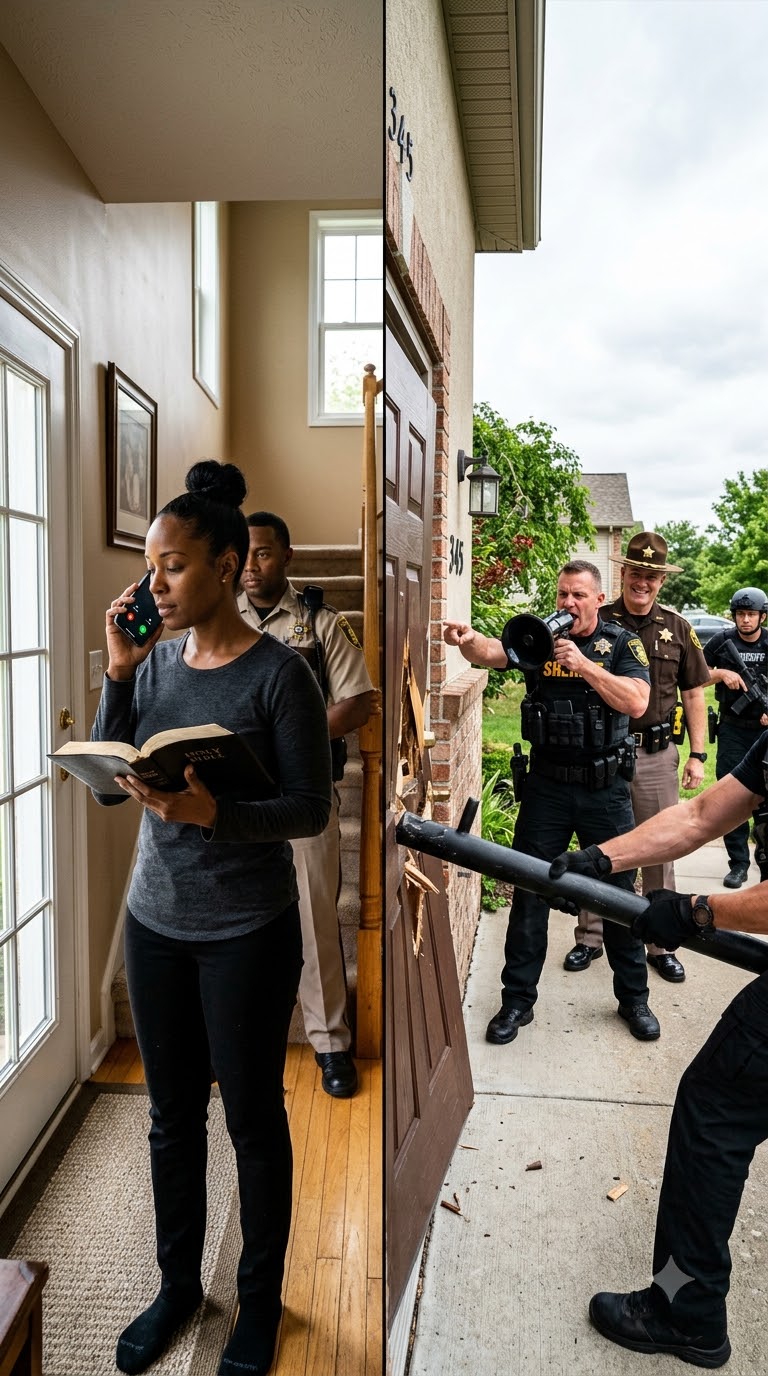
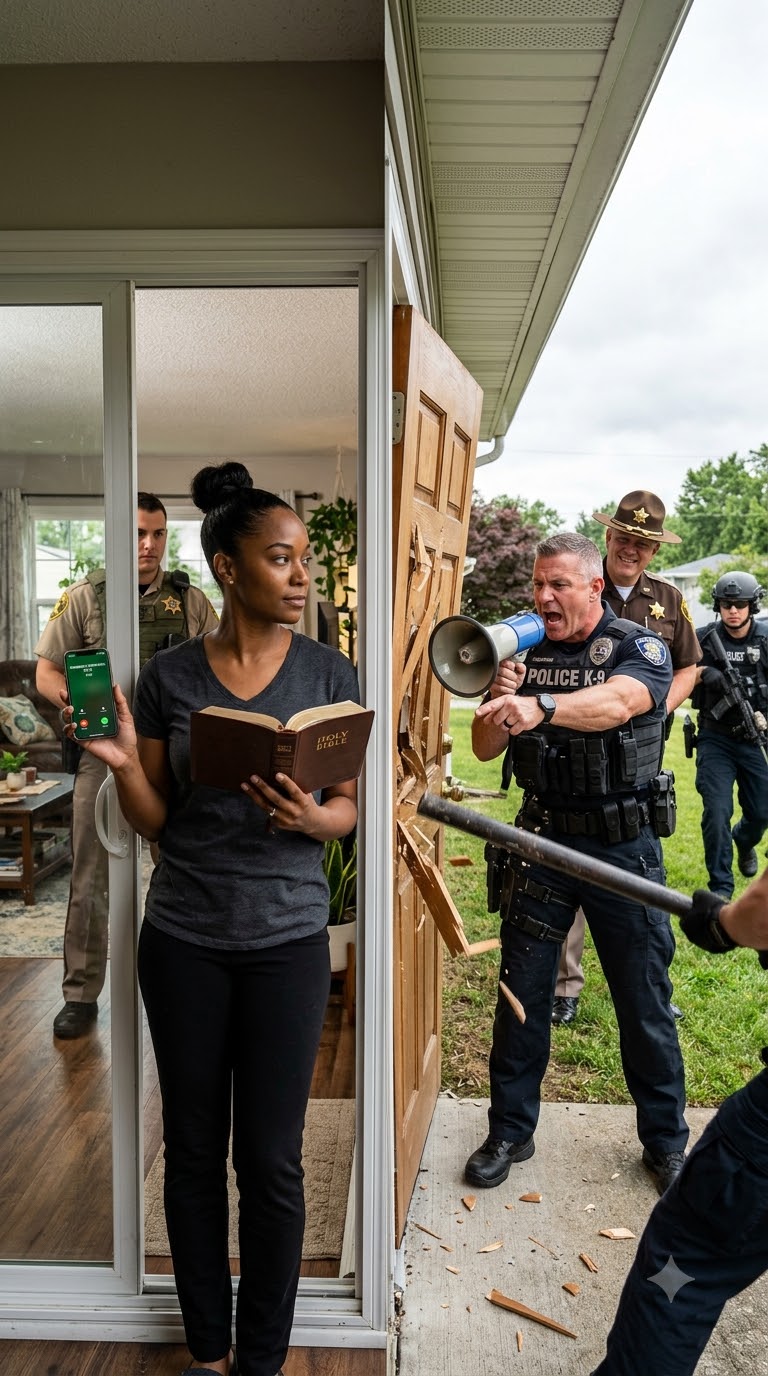
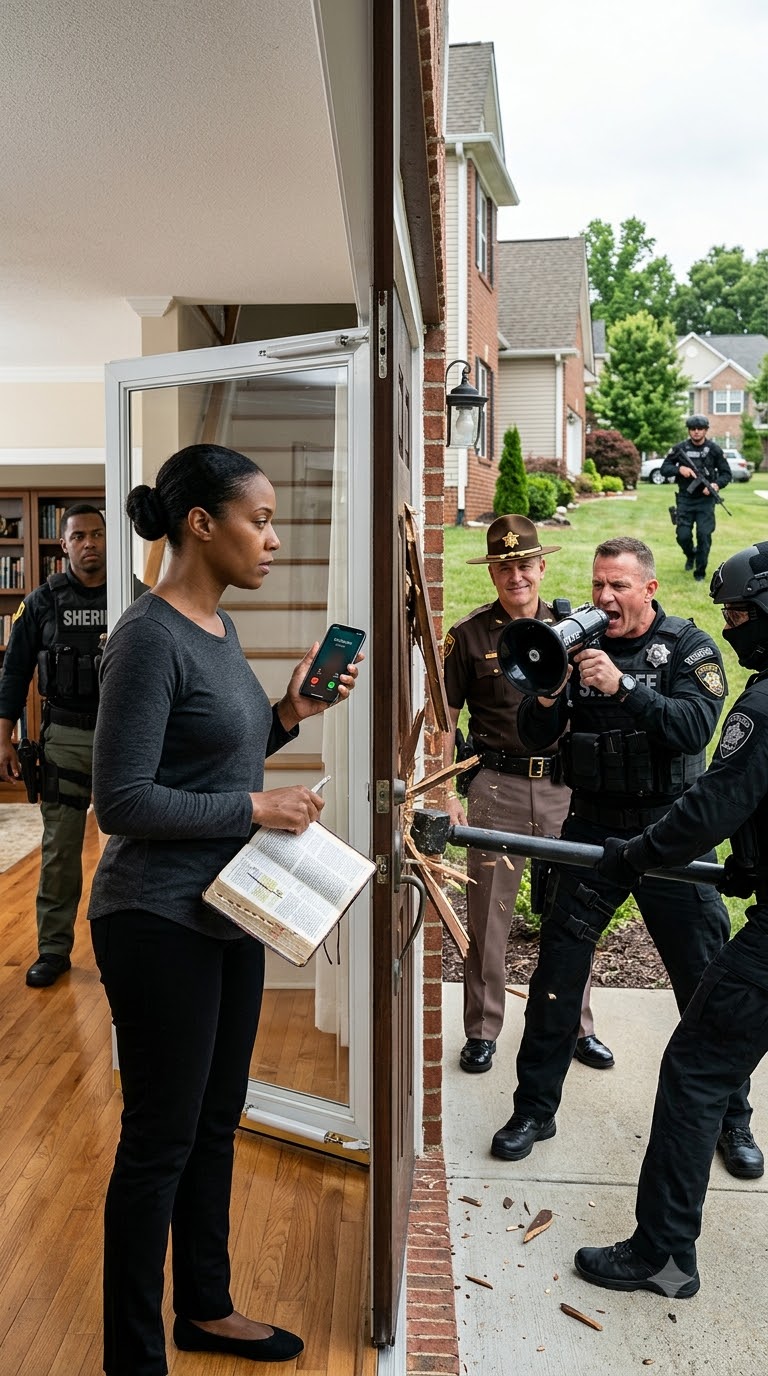
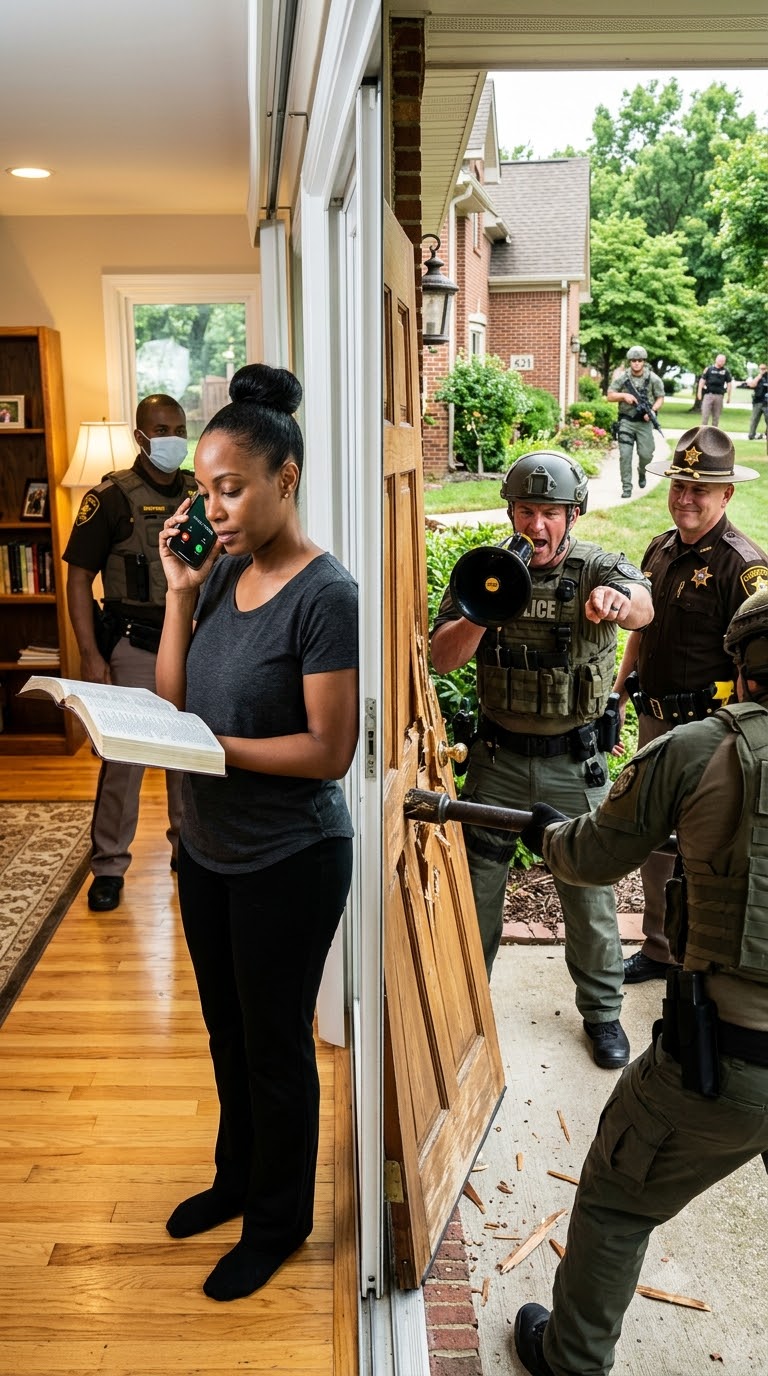
At 9:41, Dane ordered a battering ram brought from one cruiser.
Naomi’s mouth went dry.
She narrated anyway.
“At 9:41, Captain Dane has ordered a breaching tool brought to the front door. No warrant has been displayed.”
Across the street, neighbors began shouting.
“Where’s the warrant?”
“Show the paper.”
Eleanor stepped to the edge of her lawn.
“Captain Dane, if you breach without judicial authorization, every person here will be a witness.”
Dane looked at Mercer.
Mercer looked furious.
Not at Dane.
At the crowd.
Then his phone rang.
He answered.
Listened.
His posture changed.
Not collapse.
Correction.
He walked several feet away.
Dane watched.
Mercer covered the phone and said,
“Hold.”
The deputy carrying the battering ram stopped.
The street went quiet.
Mercer listened again.
Then looked toward Naomi’s house.
Then toward Eleanor.
Then toward the end of the block.
Three unmarked sedans turned onto the street.
Blue lights hidden in the grille.
Georgia Bureau of Investigation.
Behind them came two federal SUVs.
No dramatic convoy.
No helicopters.
No tactical team.
Investigators.
People with folders.
That was worse for Mercer.
A woman in a dark suit stepped out of the first sedan.
Special Agent Carla Mendoza.
She walked directly toward the sheriff.
“Sheriff Mercer?”
“Yes.”
“GBI Office of Professional Standards.”
She showed credentials.
A second man joined her.
“Department of Justice Office of Inspector General liaison.”
He showed his badge.
Dane lowered the loudspeaker.
The deputies became very still.
Mendoza asked,
“Who is incident commander?”
Mercer answered,
“I am.”
“Show me the warrant.”
Silence.
Eleanor laughed once.
Could not help it.
Mendoza glanced toward her.
Eleanor covered her mouth.
“Sorry.”
Not sorry.
Mercer said,
“We received credible information involving stolen federal materials.”
Mendoza asked,
“From whom?”
“Confidential source.”
“Where is the written authorization?”
“Emergency circumstances.”
“What emergency?”
Mercer did not answer.
The DOJ liaison spoke.
“No federal agency has requested this operation.”
Dane stepped forward.
“We were told otherwise.”
“By whom?”
Dane looked at Mercer.
There.
Small.
But everyone saw it.
The first crack.
Mendoza said,
“All deputies hold position.”
Then louder.
“No one enters the residence. No one leaves scene without being identified and interviewed.”
Mercer’s face hardened.
“You do not command my department.”
Mendoza nodded.
“Correct.”
Then held up a document.
“But I have a state preservation order covering dispatch logs, body cameras, incident communications, and any paperwork supporting this operation.”
The DOJ liaison added,
“And federal interest now attaches to any claim that this was a federal recovery action.”
Mercer stopped arguing.
Inside, Naomi exhaled for what felt like the first time in twenty minutes.
The duty officer said,
“Ms. Carter, state investigators are on scene?”
“Yes.”
“Do not open the door until credentials are verified.”
Naomi looked toward Eleanor.
Then called her.
“Can you verify?”
Eleanor smiled.
“With pleasure.”
She walked to Mendoza.
Inspected the credentials.
Asked for badge numbers.
Called a number on the GBI public directory.
Verified employment.
Then walked to Naomi’s porch.
“Legitimate.”
Naomi opened the door.
The neighborhood erupted.
Not cheering.
Relief.
Keisha ran forward.
A deputy moved to block her.
Mendoza said,
“Let her through.”
Keisha reached the porch and hugged Naomi hard.
“You okay?”
“Yes.”
“You’re shaking.”
“I know.”
Eleanor stepped up.
“So am I.”
“You don’t look like it.”
“I was a judge.”
“That’s most of the job.”
They laughed.
The sound broke the tension.
Then Mendoza got serious.
“Ms. Carter, we need to understand why they believed federal property was inside.”
Naomi looked toward the study.
“I think I know where to start.”
She led Mendoza, the DOJ liaison, and Eleanor inside.
Keisha followed only after asking permission.
Good.
The study smelled like paper and cedar.
Isaiah Carter’s filing cabinets lined one wall.
Naomi pointed.
“My father’s records.”
Mendoza asked,
“Have you reviewed them?”
“Some.”
“Anything classified?”
“Not that I know of.”
“Anything marked sensitive?”
“Yes.”
“Can you show us?”
Naomi opened the second cabinet.
Procurement memos.
Contract summaries.
Old correspondence.
Most unclassified.
Some labeled FOR OFFICIAL USE.
Nothing a county sheriff should be recovering on his own.
Then Naomi noticed something.
The bottom drawer was open.
She had left it closed.
She crouched.
No forced entry.
But the lock was scratched.
Fresh.
Eleanor saw it.
“Was that like that before?”
“No.”
Mendoza knelt.
“Don’t touch.”
Keisha started recording.
Mendoza photographed it.
Then asked,
“Who has access to your house?”
“Me.”
“Keisha when she’s home.”
“My sister has a spare key.”
“Anyone else?”
“No.”
Naomi looked toward the window.
“Unless someone came in before today.”
The possibility changed the investigation.
Mendoza ordered a forensic team.
Not because of conspiracy.
Because possible unauthorized entry plus an apparent warrantless operation required evidence.
The team arrived an hour later.
They found partial prints near the cabinet.
A faint shoe mark on the basement stair.
A cut section in the old alarm wire.
Someone had been inside.
Days earlier.
Maybe weeks.
That meant the morning operation might not have been about entering.
It might have been about legitimizing something already taken.
That was worse.
The next discovery came from dispatch.
The original call requesting the operation had not come from a federal agency.
It came from Captain Dane.
He told dispatch the sheriff had received “federal intelligence” that stolen procurement records were at Naomi’s address.
No federal case number.
No agency contact.
No warrant.
Nothing.
Mendoza interviewed Dane separately.
At first he defended the operation.
Then changed.
Not dramatically.
Slowly.
He said Mercer told him a federal contact wanted the documents recovered before they could be “moved.”
Dane asked for paperwork.
Mercer said there was no time.
Why obey?
Because Mercer was sheriff.
Because Mercer had promoted him.
Because Mercer said the county attorney was aware.
The county attorney was not.
That fact arrived by noon.
By one, Mercer had retained counsel.
By two, he was no longer giving interviews.
By three, the GBI had taken custody of the department’s operation files.
Naomi sat in Eleanor’s kitchen with Keisha, drinking tea she did not want.
Her house was still being processed.
Keisha stared at her laptop.
“This is insane.”
Naomi nodded.
“I want to publish.”
“No.”
“Mom.”
“No.”
“People need to know.”
“They will.”
“When?”
“When investigators can preserve evidence before the internet turns every rumor into evidence.”
Keisha looked frustrated.
“You always say documentation matters.”
“It does.”
“I have documentation.”
“You have one day.”
Keisha closed the laptop.
“Fine.”
Eleanor smiled.
“She got that from you.”
Naomi sighed.
“I know.”
That evening, the story reached local news anyway.
Not from Keisha.
Too many neighbors had filmed the street.
Headline:
SHERIFF’S OFFICE SURROUNDS HOME WITHOUT WARRANT; STATE INVESTIGATION OPENED.
Good.
Accurate.
No secret conspiracy claims.
No dramatic language.
Naomi appreciated that.
The next morning, federal investigators returned.
Not with sirens.
With subpoenas.
They had begun reviewing Isaiah Carter’s old procurement records.
What they found was not a stolen-weapons ring.
Nothing cinematic.
Something more common.
Contract fraud.
Isaiah had spent his final years tracking irregular payments tied to emergency vehicle equipment purchases.
A private vendor called Meridian Tactical Supply had billed counties and military-adjacent programs for equipment that was overpriced, duplicated, or never delivered.
Most contracts were old.
Some involved federal grant money.
One county appeared repeatedly.
Westfield.
Sheriff Mercer’s county.
Isaiah had documented concerns years earlier.
He sent copies to oversight offices.
The investigation stalled after his retirement.
Then two years ago, a renewed federal audit began examining Meridian.
Mercer apparently learned Isaiah’s surviving records might include copies of correspondence that had not been produced in discovery.
Not classified material.
Evidence.
That distinction explained everything.
The sheriff did not need the documents because they were secret.
He needed them because they were ordinary.
Emails.
Invoices.
Payment schedules.
The kind of records that survive when people assume no one will care.
The forensic team found that one folder was missing.
Naomi knew because her father had indexed every drawer.
Folder 6C.
Meridian subcontractors.
Gone.
Keisha whispered,
“So they got it.”
Naomi shook her head.
“Maybe.”
Then remembered her father.
Backups.
Always backups.
She searched the study.
Not hidden compartments.
Not secret walls.
Something Isaiah would actually use.
The old scanner.
She opened the computer connected to it.
Offline.
Password hint:
KEISHA BIRTHDAY.
Keisha laughed.
“Granddad had terrible security.”
“Good for us.”
Inside the scans folder were PDFs.
Thousands.
Including 6C.
Complete.
Keisha looked at Naomi.
“He scanned everything.”
“Of course he did.”
They handed the files to investigators.
No chase.
No gunfight.
No storage-unit ambush.
Just data.
That was enough.
The federal audit expanded.
Meridian executives were interviewed.
Bank records subpoenaed.
Three county officials named.
Then Mercer.
Payments had moved through a consulting company owned by his brother-in-law.
Not huge.
Enough.
Dane was not financially involved.
That mattered.
His failure was different.
He followed an unlawful order because hierarchy felt safer than questioning it.
The GBI suspended him pending review.
Mercer stepped aside temporarily.
Then resigned two weeks later.
No dramatic arrest on television.
That came months afterward, when a federal grand jury returned charges related to grant fraud, obstruction, and conspiracy to conceal records.
The illegal operation at Naomi’s house became part of the obstruction case.
Not the whole case.
Part.
That was more believable.
More dangerous.
Systems rarely collapse because of one cinematic act.
They collapse because small acts finally connect.
Mercer’s defense argued he sincerely believed federal property was at risk.
Prosecutors produced messages.
One from Mercer to Dane at 8:11 that morning:
GET THE CARTER FILES BEFORE AUDIT TEAM MOVES.
Another:
NO PAPER. WE DON’T HAVE TIME.
Another:
IF SHE RESISTS, CALL IT PRESERVATION.
Naomi read those messages months later.
Then sat quietly for a long time.
Keisha asked,
“You okay?”
“No.”
“Angry?”
“Yes.”
“Scared?”
“Yes.”
“Still?”
Naomi nodded.
“Especially still.”
People expected fear to end when danger became evidence.
It does not.
Sometimes evidence makes the danger more real.
The trial took more than a year to begin.
During that year, Westfield changed.
Not magically.
Messily.
Interim sheriff.
Policy review.
County commission hearings.
Arguments.
Union concerns.
Budget fights.
Body-camera preservation rules strengthened.
Emergency operations now required written legal review unless an immediate threat to life existed.
Any claimed federal-assistance operation required agency verification through dispatch.
Simple.
Obvious.
Late.
Dane eventually returned to duty at a lower rank after discipline and retraining.
Some residents hated that.
Naomi did not celebrate it.
He had made a serious decision.
He also cooperated.
Accepted discipline.
Testified truthfully.
People can be accountable without being permanently frozen at their worst decision.
Mercer’s case ended differently.
He pleaded guilty to obstruction and federal program fraud.
Meridian executives also entered pleas.
The county recovered part of the money.
Not all.
Never all.
Isaiah Carter’s name was cleared of old accusations that he had been obsessive about the contract irregularities.
That mattered most to Naomi.
Not because he had been called crazy publicly.
He had not.
But people inside agencies had dismissed him.
Difficult.
Persistent.
Unable to let go.
Turns out sometimes persistence is what records need.
At a county hearing, officials proposed naming a compliance conference room after him.
Naomi declined.
“Why?”
a commissioner asked.
“My father hated conference rooms.”
The room laughed.
Naomi continued.
“If you want to honor him, fund records retention and independent audit staffing.”
That got less applause.
Good.
Useful things often do.
Keisha wrote her senior journalism project about the case.
Not about her mother as a hero.
About institutional assumptions.
How an undocumented claim of “federal authority” moved through dispatch, command, and tactical deployment because people trusted rank instead of verification.
She interviewed Dane.
That surprised Naomi.
“You’re talking to him?”
“Yes.”
“Why?”
“Because he’s part of the story.”
“What did he say?”
Keisha looked at her notes.
“That he knew something felt wrong.”
Naomi became quiet.
“Then why did he do it?”
Keisha answered,
“He said, ‘I thought questioning the sheriff in front of deputies would destroy command.’”
Naomi nodded.
“And?”
“He said, ‘I learned that command was already broken if a legal question could destroy it.’”
That was good.
Painful.
Useful.
Eleanor Price loved the quote.
“Put that in the first page.”
Keisha rolled her eyes.
“You’re not my editor.”
“I was a judge.”
“That’s not editing.”
“It’s close.”
“No.”
They argued for ten minutes.
Normal.
The neighborhood returned to normal too.
Grass grew back where deputies had stood.
The front door never needed repair because the ram never hit it.
Naomi kept the security cameras.
Not because she was afraid.
Because she liked records.
Mercer’s old house sold.
Dane moved to another precinct.
Eleanor kept gardening.
And every once in a while someone drove slowly past Naomi’s house because they had heard the story.
She hated that.
One afternoon, a teenager walking home from school stopped.
“Ms. Carter?”
“Yes?”
“Is this the house?”
She sighed.
“What house?”
“The sheriff raid house.”
“No.”
The boy looked confused.
Naomi smiled.
“It’s my house.”
He understood.
“Sorry.”
“It’s okay.”
He kept walking.
That answer mattered to her.
Her home had existed before the siege.
It deserved to exist after.
The part nobody expected was what happened to Captain Dane.
For months, people in Westfield treated him as either a coward or a victim.
Both descriptions were too simple.
He had followed an unlawful operation.
That was true.
He had also been lied to by Mercer about federal authority.
Also true.
He had failed to stop once the missing paperwork became obvious.
True again.
During the disciplinary process, Dane asked to speak with Naomi.
Her attorney advised against it.
Naomi almost agreed.
Then she changed her mind.
Public building.
Recorded meeting.
Her lawyer present.
No surprises.
Dane arrived without a uniform.
That mattered more than Naomi expected.
He looked smaller in a gray suit.
Not physically.
Institutionally.
He sat across from her.
For several seconds, neither spoke.
Finally Dane said,
“I’m sorry.”
Naomi waited.
He continued.
“I kept telling myself I was following a lawful order.”
“Were you?”
“No.”
“Did you know that then?”
Dane looked down.
“I knew I hadn’t seen a warrant.”
“That wasn’t my question.”
He nodded.
“No.”
“Then what did you know?”
“That something was wrong.”
Naomi leaned back.
“Why keep going?”
He took a long breath.
“Because the sheriff had already briefed everyone.”
“Because twelve deputies were already there.”
“Because I had repeated the federal-property claim over the radio.”
“And because stopping would have meant admitting in front of everyone that I didn’t know what authority we actually had.”
Naomi stared.
There it was.
Not corruption.
Pride tied to command.
Dane continued.
“The longer it went, the harder it felt to be the first one to say stop.”
Naomi thought about that.
Then asked,
“What would’ve happened if Judge Price hadn’t started questioning you?”
“I don’t know.”
“What if the investigators arrived ten minutes later?”
“I don’t know.”
“What if someone hit the door?”
Dane closed his eyes.
“I don’t know.”
That answer mattered.
People often want certainty after mistakes.
The honest answer is sometimes worse.
I don’t know.
Naomi said,
“That’s what scares me.”
Dane nodded.
“Me too.”
He did not ask forgiveness.
Good.
He asked if she objected to him returning to duty after discipline.
Naomi frowned.
“Why are you asking me?”
“I don’t know.”
“That’s not mine to decide.”
“You were the one inside the house.”
“Yes.”
“And you were the one outside.”
He looked at her.
“Yes.”
“Then your return is about whether the department believes you can act differently next time.”
Dane looked surprised.
“You don’t want me fired?”
Naomi thought carefully.
“I want systems that don’t depend on whether one captain has courage at 9:41 on a Wednesday morning.”
That answer stayed with him.
When Dane returned months later, he was no longer captain.
Sergeant.
No tactical command.
Some people called that humiliation.
He did not.
He told Keisha during her interview,
“Rank made it easier for me to confuse being decisive with being correct.”
She asked,
“Do you miss command?”
Dane smiled.
“Sometimes.”
“Would you want it again?”
“Not yet.”
That was probably the best answer he could have given.
The department’s reforms were tested sooner than anyone expected.
A year after Naomi’s siege, deputies received a late-night call about a storage unit supposedly containing stolen federal equipment.
Different sheriff.
Different command staff.
The caller used impressive language.
Classified.
Federal.
Urgent.
Old procedure might have sent units immediately.
New procedure required verification.
Dispatch asked for an agency contact and case number.
The caller provided both.
The federal number turned out to be real.
The case number did not.
Dispatch contacted the agency directly.
No operation.
No stolen equipment.
No tactical deployment.
The entire incident ended with two phone calls and a fraud report.
Keisha heard about it while working on her journalism project.
She called Naomi.
“You know what happened?”
“What?”
“No raid.”
Naomi laughed.
“That usually isn’t news.”
“This time it is.”
Keisha explained.
Naomi sat quietly afterward.
No raid.
Nobody surrounded a building.
Nobody ordered anyone outside.
No elderly judge needed to challenge a sheriff.
No federal investigators had to arrive.
No one became a headline.
That was the outcome Naomi wanted more than vindication.
She called Eleanor.
The retired judge answered on the fourth ring.
“You’re interrupting Jeopardy.”
“Sorry.”
“You don’t sound sorry.”
Naomi told her.
Eleanor became quiet.
Then said,
“Good.”
“That’s all?”
“What do you want, fireworks?”
Naomi laughed.
“No.”
“Then good.”
Simple.
The best institutional lesson from Naomi’s worst morning was a future event that never happened.
That was difficult to celebrate.
Necessary anyway.
Two years later, Naomi found one last file in her father’s old desk.
Not hidden.
Misfiled.
A handwritten note clipped to a stack of invoices.
Isaiah’s handwriting.
If they ever come asking for records, make them put the request in writing.
Naomi laughed so hard she cried.
Keisha found her.
“What?”
Naomi handed her the note.
Keisha read it.
“Granddad was dramatic.”
“No.”
Naomi wiped her eyes.
“He was a procurement officer.”
“Same thing.”
They laughed.
Then Naomi framed the note.
Not his medals.
Not his photograph in uniform.
The note.
Because that was the lesson.
Not secret phone numbers.
Not hidden weapons.
Not powerful friends arriving in black SUVs.
Writing.
Verification.
Records.
Questions.
The morning twelve deputies surrounded Naomi Carter’s house, the sheriff believed force would make uncertainty disappear.
He believed uniforms could substitute for paperwork.
He believed saying “federal property” loudly enough would become federal authority.
He believed a woman alone inside a house would choose fear over procedure.
He was wrong.
Not because Naomi had more power.
She did not.
Not because she knew someone at the Pentagon.
She did not.
Not because the neighborhood rescued her.
They could not.
He was wrong because enough people insisted on the same simple question.
Where is the warrant?
The retired judge asked it.
Naomi asked it.
Her daughter asked it.
The investigators asked it.
Eventually the court asked it.
And there was never a good answer.
That absence became the beginning of every other answer.
Years later, when Naomi spoke to new federal compliance analysts, someone always wanted the dramatic part.
“What did it feel like seeing investigators arrive?”
She would shrug.
“Relief.”
“Were you scared?”
“Yes.”
“Did your military training take over?”
“Some.”
“What saved you?”
That answer never changed.
“Documentation.”
People laughed because they thought she was joking.
She never was.
The siege ended before anyone broke down her door.
The corruption case ended years later.
But the thing Naomi remembered most happened in the middle.
Captain Dane had ordered the battering ram forward.
Neighbors were filming.
Mercer was pushing for entry.
Then one phone call reached the right oversight desk.
Not because Naomi had secret access.
Because a public employee knew the number she was supposed to call when authority stopped matching procedure.
That difference mattered.
Real systems should not depend on secret heroes.
They should depend on ordinary safeguards that ordinary people can reach.
That was what Westfield eventually built.
And that was why, years later, when a deputy claimed federal authority during another county operation, dispatch asked for the agency case number before the first cruiser moved.
No headlines.
No viral video.
No confrontation.
Just verification.
Naomi heard about it from Keisha and smiled.
“That’s the ending.”
Keisha frowned.
“To your story?”
“No.”
“To the problem.”
That was better.
