

Chapter 1: The Black Ice at 10:43
The asphalt of Interstate 71 north of Wilmington did not look treacherous; it looked varnished. It possessed that dead, oil-slick sheen peculiar to southwestern Ohio in mid-November, when the rain hangs stubbornly at thirty-three degrees—refusing the dignity of snow, yet cold enough to turn the crown of the highway into greased slate.
I was traveling at fifty-two miles an hour in the center lane of my Honda CR-V, nursing a travel mug of lukewarm black coffee, eager to put a three-hour budget reconciliation meeting in Dayton behind me.
Then the steering wheel went limp in my hands.
It was an eerie, weightless sensation, as if the front axle had severed all connection to the earth. The rear tires stepped out to the right with a sickening, sickeningly smooth lateral glide. I tapped the brake—just a feather touch—and counter-steered toward the slide.
It was too much. The chassis snapped back like a pulled bowstring.
The dark world spun ninety degrees. Headlights from an oncoming tanker blazed across my driver-side glass, accompanied by the brassy, terrifying bellow of an air horn. I remember bracing my left palm against the steering boss, my teeth clacking together as the front driver-side quarter panel pulverized itself against the galvanized steel of the median guardrail.
The side curtain airbags erupted with a thunderous pop, flooding the cabin with the acrid, metallic smell of burnt talcum and sodium azide.
For several seconds, there was no sound except the rhythmic, mocking scrape of the windshield wipers, dragging back and forth across a spiderweb of safety glass. Scritch. Slap. Scritch. Slap.
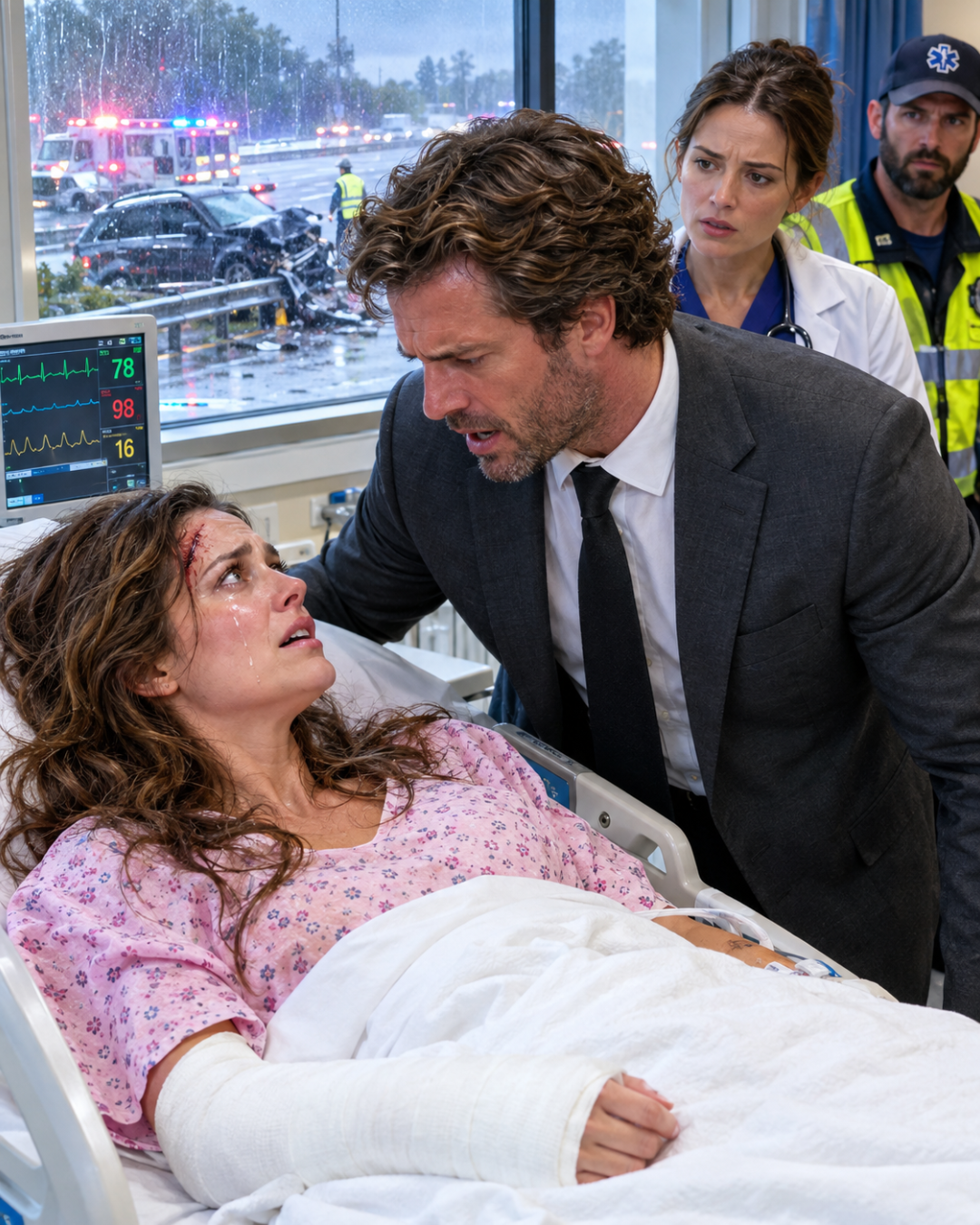
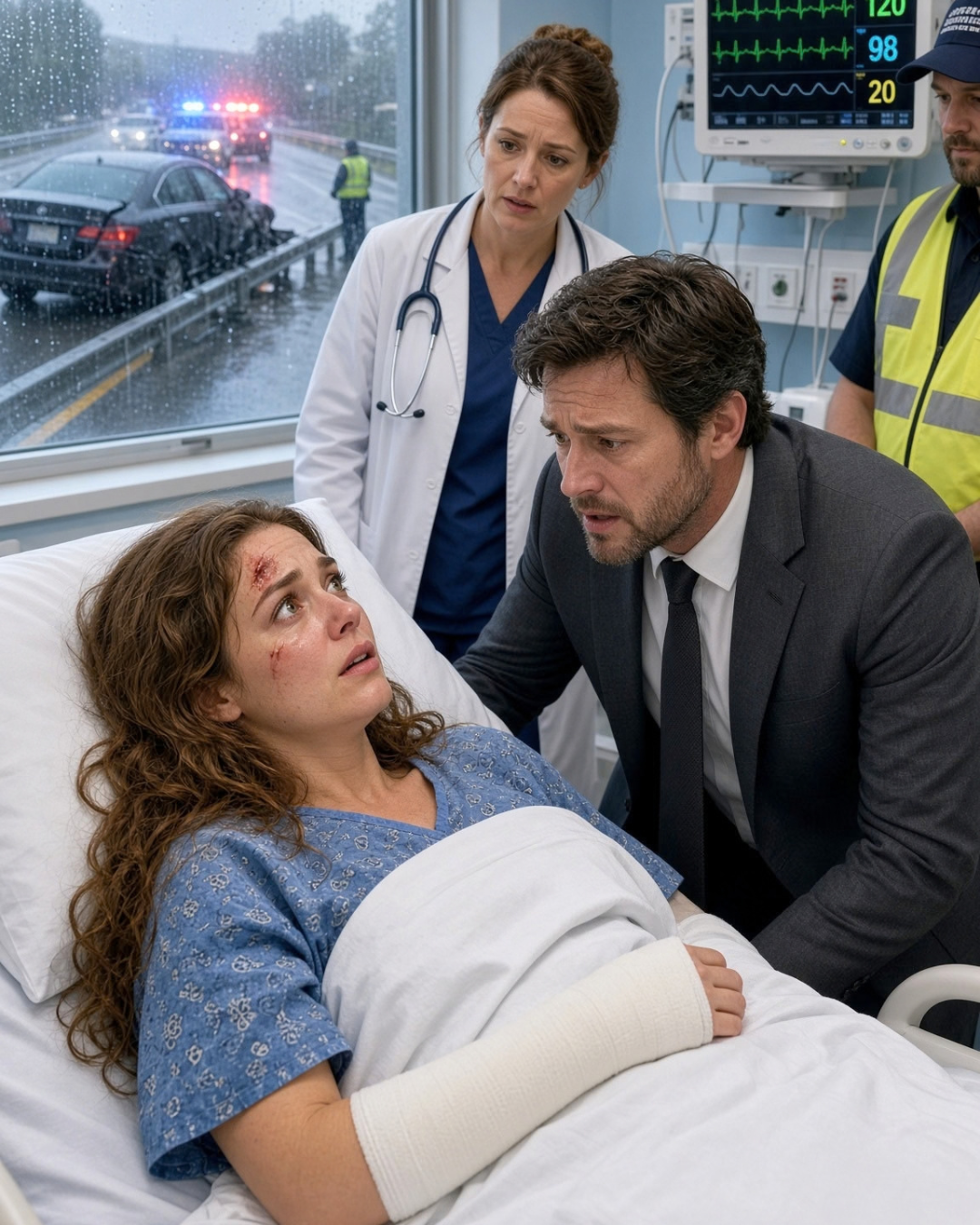
A hot ribbon of liquid crawled down the ridge of my left eyebrow, dripping into the corner of my eye with the heavy salt taste of copper. When I tried to draw a breath, something jagged shifted beneath my fourth rib, driving the air from my lungs in a sharp, involuntary hiss. My left wrist was already swelling inside the wool cuff of my sweater, pulsing with a deep, sickening heat that warned me against attempting to move my fingers.
Yet my mind was obstinately clear. I knew my social security number. I knew the exit for State Route 73 was two miles behind me. And, governed by seventeen years of unexamined domestic reflex, I reached into the cracked center console with my trembling right hand and retrieved my phone.
At 10:47 PM, I hit speed dial one.
Mark Mercer answered on the fifth ring, his voice saturated with the thick, irritated phlegm of a man interrupted while watching cable news in a warm recliner.
“What?”
Not Are you home? Not Did you make it past Lebanon? Just that single, blunted syllable he had taken to using whenever my existence required him to mute the television.
“Mark,” I wheezed, the pain in my flank turning my voice into a stranger’s rasp. “Mark, I wrecked. On seventy-one. I hit the barrier.”
A pause stretched across the line, long and hollow. In the background, I could hear the tinny cadence of a pharmaceutical commercial.
“Are you serious, Diane?”
“Yes,” I gasped, resting my forehead against the deflated nylon of the airbag. “The car is bad. My wrist… I think it’s broken, Mark. It’s swelling up fast.”
“Did you call the highway patrol?”
“Not yet,” I replied, the confession tasting bitter even as it left my lips. “I called you first.”
I had believed, with the stubborn simplicity of a woman who had stood beside the same man through three job transitions and a gallbladder removal, that this was the natural order of human affection. You call your partner because they are your anchor to the living room carpet.
Over the receiver, Mark released a long, wet sigh of profound inconvenience.
“Diane, I swear to God, I do not have the bandwidth for this tonight.”
The cold air rushed through the ruptured seam of the driver’s door, smelling of ozone and wet grass. “What did you say?”
“I am sick of the perpetual crisis,” he snapped, his voice dropping into that clipped, clinical cruelty he usually reserved for customer service representatives. “You stay down in Dayton until all hours, you drive like an idiot in the slush, and now you want me to get dressed, scrape the truck, and drive forty miles in the freezing rain to listen to you panic. Call someone who cares, Diane. I’m done with you.”
The call terminated with a dull electronic tone.
I sat in the dark, the screen glowing against my knees, staring into the dashboard wreckage. For four seconds, my mind scrambled to build a scaffold of excuses. He’s exhausted. He’s taking those muscle relaxers for his sciatica. He thought I meant a fender bender in a parking lot. The brain will perform acrobatic miracles to avoid acknowledging that the foundation beneath its house has rotted into gray dust.
Then a double-trailer freight truck roared past in the right lane, throwing a wall of muddy gray slush across my hood. The CR-V shuddered violently on its bent suspension, the impact jolting my cracked ribs until tears spilled over my eyelashes.
Survival, sharp and cold as a razor, cut through the shock.
I wiped the blood from my eye with the sleeve of my coat and dialed 911.
The dispatcher’s voice was a lifeline of steady, maternal urgency. She told me to leave my seatbelt latched. She told me not to attempt to cross four lanes of sixty-mile-an-hour traffic in the dark. And she remained in my ear until an enormous diesel tractor-trailer pulled onto the shoulder twenty yards behind my crumpled bumper, its yellow hazard flashers painting the wet guardrail in strokes of gold.
A heavy-set man in an oil-stained fluorescent rain parka jumped down from the cab, carrying two heavy-duty road flares. He didn’t ask what my insurance deductible was. He planted the flares thirty yards back to push traffic into the far lanes, then came up to my shattered passenger window, shielding his eyes against the sleet.
“Paramedics are two miles out, ma’am,” he shouted over the wind. “My name’s Leon Watkins. I’m right here behind your bumper. Nobody’s hitting this car tonight.”
He stood in thirty-degree slush for twenty-two minutes, his breath billowing like steam from a boiler, guarding a woman whose husband was currently watching television twenty miles to the north.
When the state troopers and the ambulance finally arrived, the scene fragmented into bright, clinical splinters: the metallic snap of a cervical collar; a paramedic slicing my wool sleeve open with heavy trauma shears; the smell of rubbing alcohol and warm rubber inside the ambulance bay; the rhythmic clatter of the stretcher wheels crossing the threshold of OhioHealth Grant Medical Center in downtown Columbus.
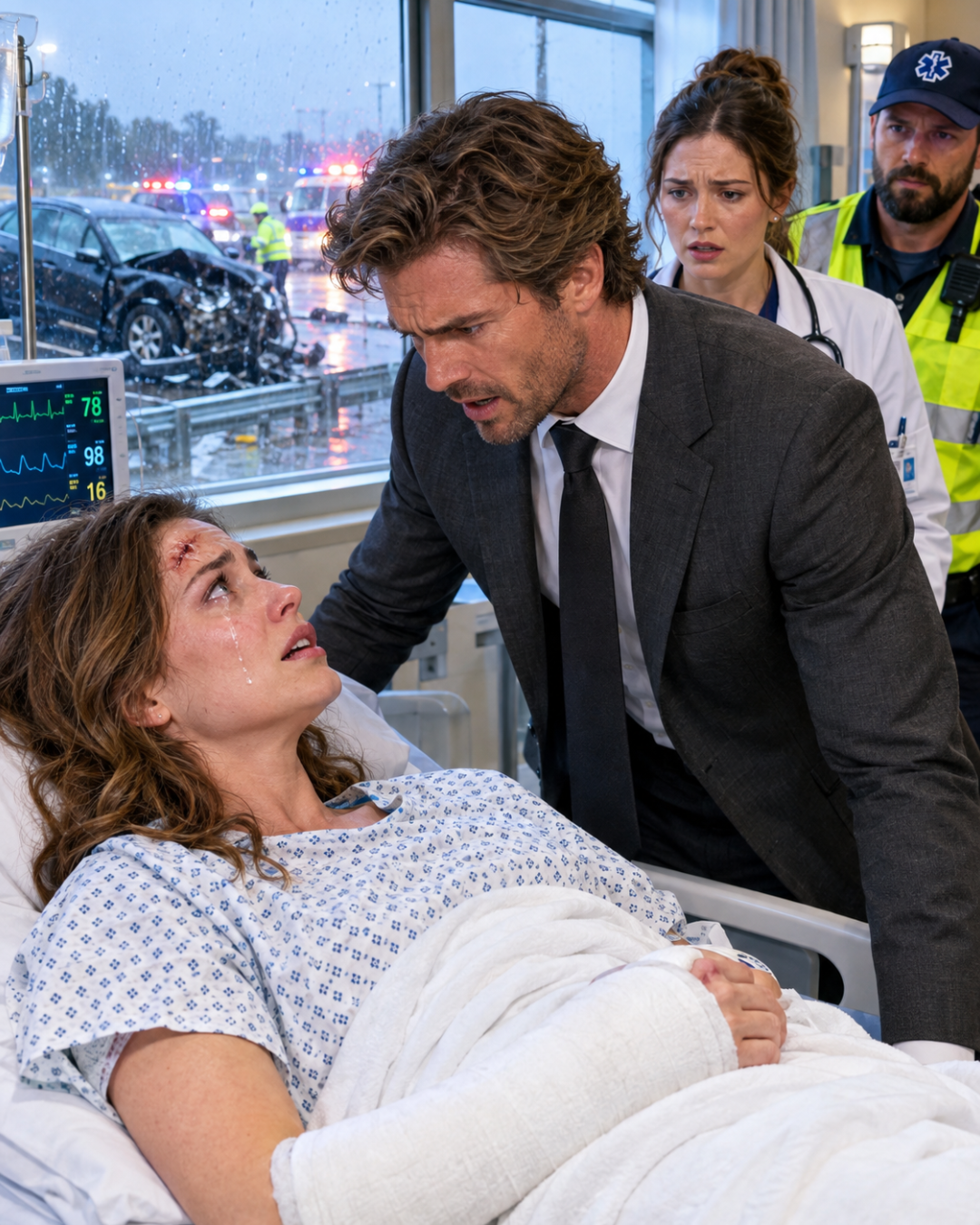
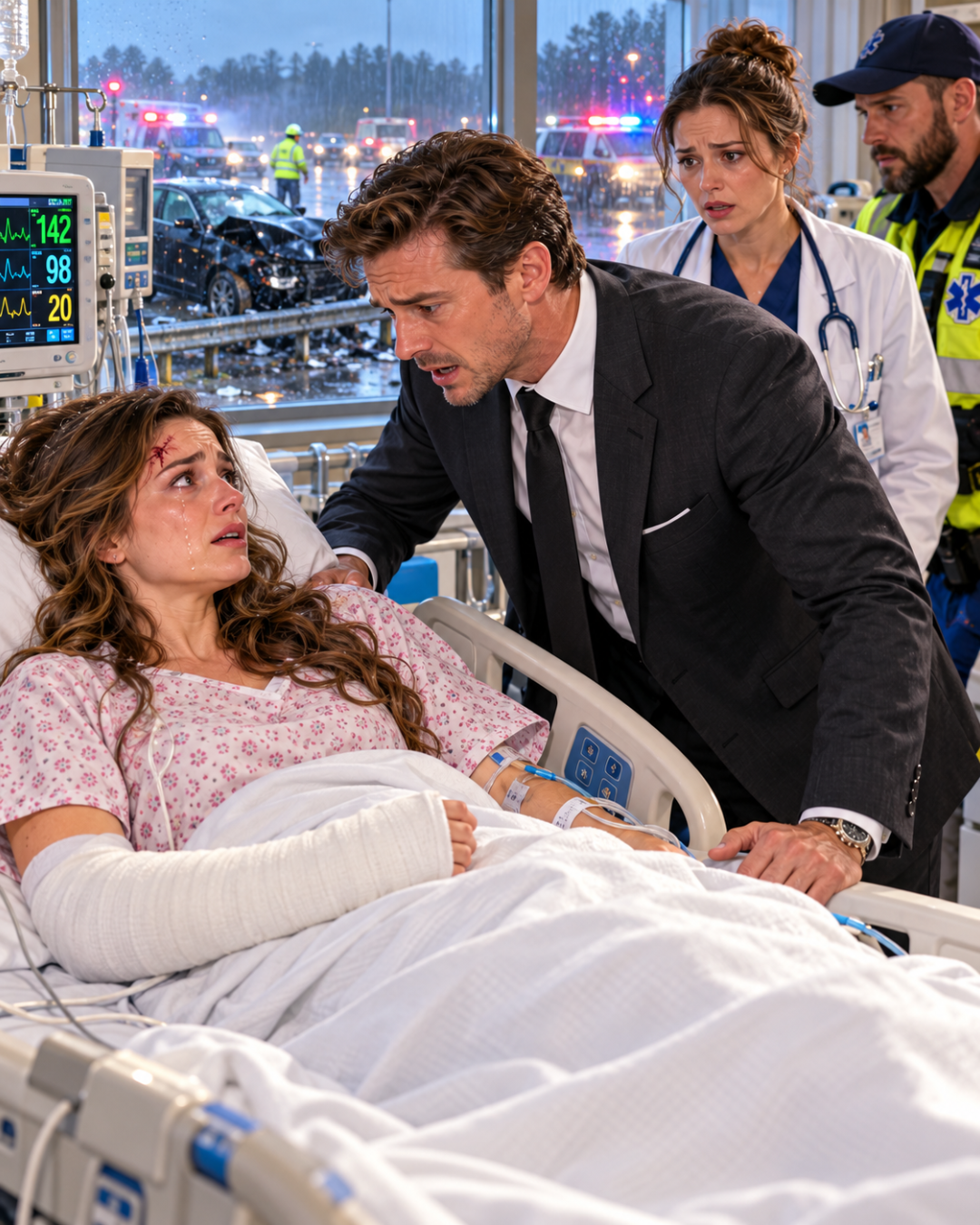
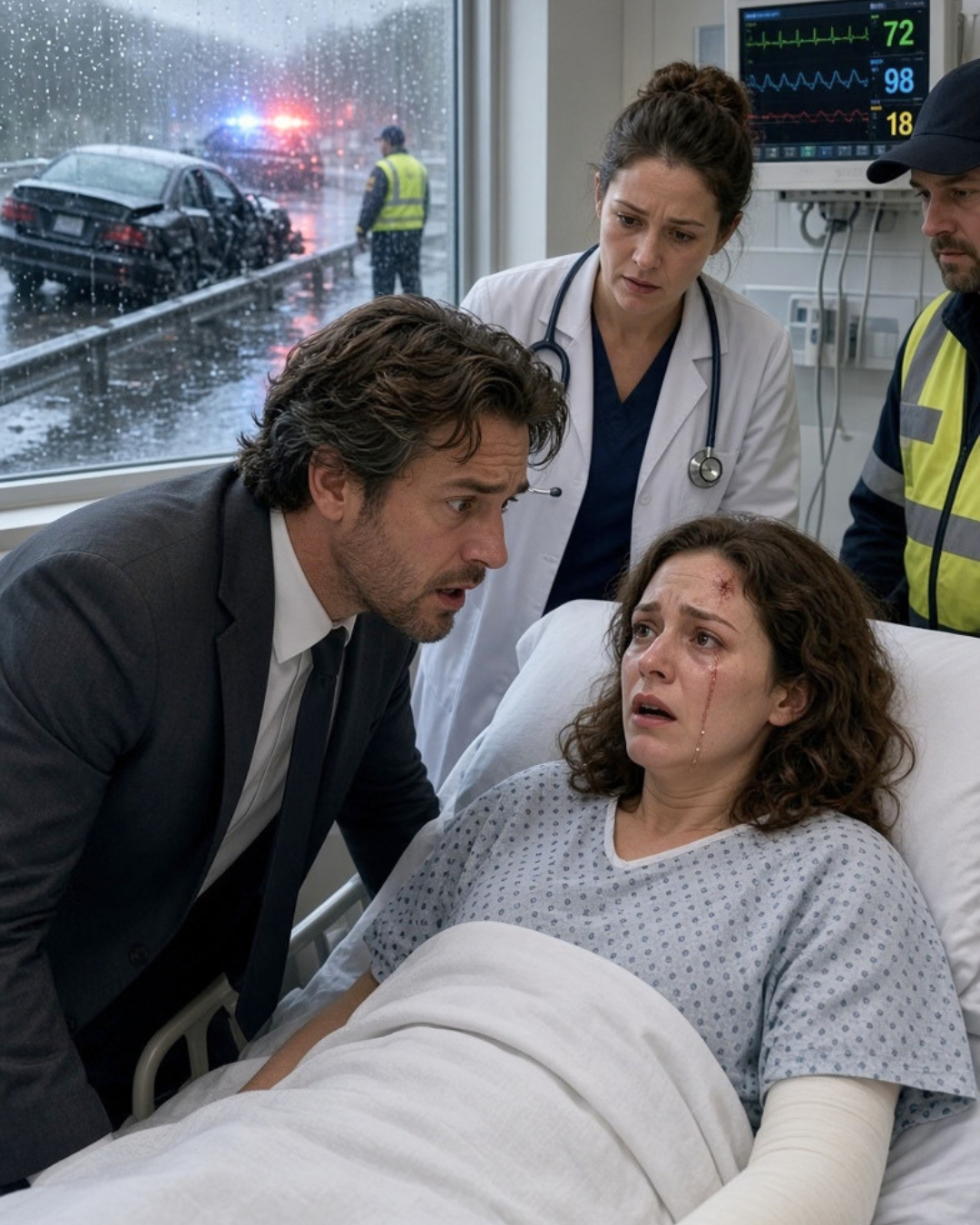
By three in the morning, the physicians had set my left radius in plaster, stitched the three-inch laceration along my hairline, and taped my ribs.
A night nurse with silver hair and comfortable clogs adjusted my intravenous line and glanced toward the waiting room doors. “Is your husband on his way, Mrs. Mercer? We can validate his parking if he comes in through the south deck.”
I looked at the plastic identification bracelet circling my right wrist.
“No,” I whispered. “He isn’t coming.”
“Is there someone else we should contact?”
I closed my eyes, picturing my daughter, Rachel, asleep in her apartment ninety miles away in Cincinnati, unaware that her mother had spent the night bouncing off highway steel. And then I pictured Mark, sitting in our kitchen in Dublin, entirely untroubled by my absence.
“Not yet,” I said.
Because lying there in that narrow hospital bed, watching the rain streak the third-floor glass, a terrifying realization had taken hold in my chest. If my head injury had been two inches deeper—if I had lapsed into an unresponsive coma on that highway shoulder—Mark Mercer would have held the sole legal authority to turn off my respirators, liquidate my bank accounts, and assume absolute control over the two-family rental home my father had spent thirty years maintaining on Lake View Avenue.
At 8:12 AM, I ignored the throbbing in my skull, lifted the receiver of the bedside phone with my good hand, and dialed my personal attorney, Helen Price.
Chapter 2: The Loop in the ‘D’
Helen Price was sixty-one years old, possessed a voice that sounded like river gravel being turned with a spade, and did not believe in greeting people with pleasantries before nine in the morning.
“You sound like you’ve been run over by a cattle car, Diane,” she said, the background noise of her German Village office rustling with paper.
“I spun out on seventy-one near Wilmington,” I told her, my voice small and tight against the hospital pillow. “Broken wrist. Two ribs. Stitches.”
“My God. Are you at Riverside?”
“Grant. Downtown.”
“What do you need? Flowers or an injunction?”
“I need to revoke Mark’s medical power of attorney,” I said, the words coming out with a terrifying, clinical precision. “And his durable financial authority. And whatever documents we signed six years ago that grant him survivorship administration over Lake View.”
Helen went completely silent. I had known her since my father, Arthur Miller, died of mesothelioma nine years earlier. Dad had been a cautious, suspicious man who spent thirty years working maintenance for the municipal water district, salting away every overtime check into low-fee index funds and the brick duplex on Lake View Avenue. He had retained Helen specifically because she handled estate planning like an engineer building a retaining wall against potential floods.
“Diane,” Helen said slowly. “Are you asking me to draft these revocations because you’re having a fight with your husband, or because you believe he is a hazard to your person?”
“He told me to call someone who cared while I was bleeding against a median barrier,” I answered, staring at the ceiling tiles. “And then he hung up on me.”
“I will be there in thirty minutes,” Helen said. “Do not sign a single piece of paper they put in front of you unless it is stamped with an OhioHealth medical consent seal. Understood?”
“Understood.”
“And Diane?” Helen’s voice dropped into a lower, darker octave. “Those papers Mark brought home three weeks ago. The ones for Tyler’s maintenance partnership. You didn’t happen to sign those before you went to Dayton, did you?”
“No. I told him I wanted you to review the covenants first. He got furious, snatched the folder off the counter, and walked out.”
A long, heavy exhalation hissed through the receiver. “Don’t leave that bed until I get there.”
Helen arrived carrying an oversized leather portfolio and two paper cups of cafeteria black coffee. She wore a tailored charcoal wool trousers suit that looked as though it could repel shrapnel. Before she touched a document, she made me state the day of the week, the name of the governor of Ohio, and my daughter’s birthdate, ensuring my concussion hadn’t compromised my legal competence.
Only then did she produce the statutory revocation forms.
“We can strip his healthcare proxy and your living will immediately,” Helen explained, her pen scratching across the forms with swift, decisive strokes. “We appoint Rachel as your primary surrogate, with me as the administrative alternate. We revoke the durable financial power. That leaves your separate assets secure.”
“And Lake View?”
“Lake View was deeded to you as an individual inheritance,” Helen said firmly. “Mark has no statutory claim to the fee simple title, provided the rental proceeds were never commingled with your joint household checking account. Which, thanks to your father’s paranoia and my persistent badgering, they never were.”
She paused, capping her Montblanc rollerball with a sharp, definitive click.
She opened her leather folio, extracted a slim legal folder, and flipped it open across the movable tray table over my knees.
“This came through the clerk’s registry this morning,” Helen murmured. “A contact of mine at Buckeye Commercial Lending flagged it after I ran an informal lien inquiry on your name at eight-thirty.”
I looked down at the document. It was an application for a three-hundred-and-fifty-thousand-dollar commercial line of credit, submitted on behalf of Mercer & Sons Property Solutions LLC—a business entity registered to Mark’s thirty-one-year-old son, Tyler Mercer.
Tyler was Mark’s child from his brief first marriage in the early nineties. He was an amiable, chronically underemployed young man who possessed a lethal combination of boundless entrepreneurial enthusiasm and zero financial literacy. He had already burned through a landscaping firm, a mobile auto-detailing franchise, and fourteen thousand dollars of Mark’s personal retirement savings.
Halfway down the third page, in the section designated for Pledged Real Estate Collateral, sat the parcel identification number for 1442 Lake View Avenue.
And beneath the declaration of owner authorization, stamped with a digital notary seal, was my name.
Diane M. Mercer.
I stared at the black ink. The signature slanted upward at thirty degrees, mimicking the hurried cursive I had used for thirty years. The loop on the capital D was wide and generous; the terminal stroke of the r tailed off into a confident line.
It looked remarkably like my signature. It looked like my signature if someone had traced it over an old electric bill with a lightbox.
“Helen,” I whispered, the paper vibrating in my uninjured hand. “I didn’t sign this.”
“I know you didn’t,” Helen replied without looking up from her legal pad. “Your D always has a sharp, pinched flat spot at the base where you lift the ballpoint before making the bowl. Your father did the exact same thing. Whoever sat down with this document tried to make it look pretty. They gave you schoolteacher handwriting.”
My stomach dropped through the mattress.
“Mark took the folder off the kitchen table three weeks ago,” I said, the room suddenly feeling violently bright. “He told me it was just for background asset verification. He told me it was just to show the bank that the family had resources.”
“It isn’t an asset verification, Diane,” Helen said with cold, merciless clarity. “This is an unrecorded third-party hypothecation agreement. If Tyler defaults on his commercial equipment leases—which, based on his corporate history, he would do before the first frost—the private lender has the contractual right to foreclose on the fee simple title of your father’s building.”
“Can they take it?”
“Not anymore,” Helen said, her mouth hardening into an icy smile. “I transmitted a formal Affidavit of Forgery and Adverse Claim to the underwriting department twenty minutes before I walked through the hospital revolving doors. The funding has been frozen indefinitely. The lender’s legal counsel is currently pulling the origin records.”
She leaned in, resting her manicured forearms on the metal rail of my hospital bed.
“The financing package is dead, Diane. But Tyler had already put down a non-refundable forty-thousand-dollar cash deposit on three commercial hydro-jetting rigs, drawn from a hard-money bridge loan that Mark personally co-signed. If this closing doesn’t happen by five o’clock on Friday, that money is forfeited to the liquidator.”
A sudden, sharp rap sounded against the heavy wooden door of the private room, followed by the squeak of rubber-soled shoes against linoleum.
The handle turned with a violent, impatient jerk.
Chapter 3: The Price of a Sovereign Name
Mark stood in the open doorway, his wet navy windbreaker unzipped to reveal an unironed Oxford shirt. His gray hair was plastered to his forehead by the Columbus drizzle, and his jaw was set with that dark, aggressive rigidity he assumed whenever he had decided someone else was responsible for his misery.
He didn’t look at the white plaster cast encasing my forearm. He didn’t look at the butterfly bandages pulling the skin above my left eye together.
He stepped inside, kicking the door shut behind him with the heel of his work shoe.
“What the hell did you tell Buckeye Lending, Diane?”
I sat perfectly still, my good hand resting on top of Helen’s manila folder. Across from me, sitting deep in the shadow of the privacy curtain beside the window, Helen didn’t move an inch. She simply watched him with the unblinking, detached gaze of a tax auditor watching a gambler reach for a deck of cards.
“Good morning, Mark,” I said, my voice coming out raspy and low.
“Don’t give me that saintly tone,” he barked, crossing his arms over his chest. “I just spent forty-five minutes on the phone with Tyler’s financing officer. They received a legal challenge from some pit-bull firm claiming the collateral authorization was fraudulent. They’ve suspended the entire credit facility! Tyler is down at the equipment yard right now, sitting in his car, having a panic attack because the distributor is threatening to re-list the trucks!”
“The authorization was fraudulent, Mark,” I said evenly.
Mark flinched, his eyes darting toward the curtain before snapping back to me. “We talked about this! You agreed to help him get on his feet!”
“I told you I would let Helen review the documents,” I reminded him. “You snatched the papers off the island, called me a bureaucrat, and walked out of the house. Did you or did you not forge my signature on page four of that application?”
Mark’s face flushed an ugly, mottled crimson. “Nobody forged anything! You’ve supported Tyler for a decade! You gave him six thousand dollars when his transmission blew! You paid his rent when the nursery went under! You’ve always treated him like your own son! It was an administrative formality, Diane! You would have signed it the minute you read the final covenants!”
“I would have signed over my dead father’s duplex as collateral for a commercial drain-cleaning startup?”
“It’s one building!” he roared, slamming his open palm against the foot of the metal bed. The sudden shock traveled through the springs, jarring my broken ribs with a white-hot spike of agony that forced a strangled gasp from my throat. “It’s an old brick shell that brings in twenty-two hundred dollars a month! Tyler had a chance to build a real enterprise! A six-figure income! And you’re sitting here playing legal games because you’re still pissed off about a phone call!”
“Step back from the bed, Mr. Mercer.”
The voice was not loud, but it possessed the density of pig iron.
Helen Price rose from behind the curtain, stepping into the wash of daylight. She stood with her arms crossed, her legal glasses resting against her collar, her expression entirely devoid of human sympathy.
Mark took half a step backward, his eyes widening with that sharp, involuntary dread common to men who realize they have raised their voice in front of an authorized court reporter.
“Helen,” he stammered, his posture collapsing an inch. “This is a private domestic conversation between my wife and me. It doesn’t concern you.”
“Everything involving Diane’s separate property concerns me,” Helen said smoothly, walking around the foot of the bed until she stood squarely between Mark and my pillows. “And given that you have just uttered a direct verbal admission of felony uttering and instrument forgery in the presence of an officer of the Ohio State Bar Association, I would strongly advise you to keep your hands off the furniture and your voice below sixty decibels.”
“A felony?” Mark sneered, though the tremor in his hands betrayed him as he shoved them into his coat pockets. “She’s my wife. We have joint survivorship.”
“You had survivorship,” Helen corrected, tapping the freshly executed documents on the tray table. “As of eight-forty-five this morning, you hold no power of attorney, no healthcare proxy, no testamentary authority, and no right of curtesy over the estate of Arthur Miller. If my client’s heart stops in the next five minutes, her daughter Rachel makes the clinical decisions. You are a legal stranger to this chart, Mr. Mercer.”
Mark looked at me, his mouth twisting into an expression of profound, disgusted pity.
“You’re really doing this?” he whispered. “Seventeen years of marriage, and you bring a lawyer into a hospital room to gut me because I lost my temper on the phone during a bad week?”
Before I could answer, the door swung open again.
My daughter, Rachel, stepped into the room, her duffel bag slung over one shoulder, her Cincinnati commute written in the dark exhaustion beneath her eyes. Behind her came Carol Jensen, our retired neighbor from Dublin, carrying a plastic shopping bag containing my house keys, a fresh toothbrush, and an assortment of clean cardigans.
Rachel took one look at Mark standing over my bed, dropped her duffel to the floor, and stepped directly into his personal space.
“Get out,” Rachel said.
“Rachel, honey, you don’t know the whole story—” Mark began, raising both palms.
“I heard the voicemail, Mark,” Rachel said, her voice shaking with a fury so cold it made the room feel sub-zero. “Mom’s phone was recording while it bounced around the floorboard after the impact. I listened to what you said while she was bleeding against the concrete.”
Mark stared at her, the blood draining from his lips until they looked like tallow.
“You have five seconds to walk through that door,” Rachel added, stepping aside just enough to clear the threshold, “or I’m walking down to the security desk and telling the sheriff’s deputy that you’re harassing a patient under post-surgical observation.”
Mark stood frozen for a beat, looking between the four women in the room—his wife in plaster, her attorney with a fountain pen, his neighbor holding a toothbrush, and his stepdaughter whose car he had once driven three hours to jump-start in a college parking lot.
He didn’t apologize. He didn’t look back at the bed.
“You’re going to kill Tyler’s future, Diane,” he spat toward the wall. “Remember that when you’re sitting alone in that big house.”
The heavy oak door swung shut behind him, the latch catching with a dry, hollow snap that echoed through the quiet room like a gavel falling on an empty bench.
Chapter 4: The Westerville Tribunal
The ambush was orchestrated for Sunday afternoon at the split-level ranch home belonging to Mark’s older sister, Janice Mercer, in Westerville.
Janice had telephoned three times on Friday, her tone swinging wildly between sisterly concern and veiled intimidation. Mark is beside himself, Diane. Tyler’s business partner is threatening litigation over the deposit. We just need a quiet family clearinghouse so everyone can hear the truth without lawyers billing five hundred dollars an hour to stir up hatred.
Helen had advised me to stay home. “You don’t attend an execution where the executioner provides the tea, Diane,” she had warned me over the phone.
“I’m not attending an execution, Helen,” I had replied, adjusting the sling over my aching left shoulder. “I’m delivering a closing argument.”
Carol drove her all-wheel-drive Subaru through the slush, parking along the curb outside Janice’s house at twenty minutes past two. Rachel sat in the rear, holding a manila folder containing six identical copies of the Buckeye Commercial Lending credit packet.
Inside the living room, the atmosphere was thick with the scent of cinnamon potpourri and generational defensiveness.
Around the sectional sofa sat the jury: Janice; her husband Bob; Mark’s older brother Greg; and sitting near the brick hearth, his elbows propped on his knees and his head buried in his hands, sat Tyler.
Mark was leaning against the dining room archway, holding a mug of coffee. When I walked in, my coat draped awkwardly over my cast and my forehead bruised from temple to cheekbone, he cleared his throat and stepped toward the center of the braided rug.
“Thank you for coming, Diane,” Mark began, assuming the grave, managerial cadence of a team leader addressing a minor production error. “We all know you’ve been through a terrifying physical ordeal. A concussion can warp a person’s perspective. It makes you hyper-vigilant; it makes you emotional. But we are a family. We have weathered bad seasons before, and we don’t throw seventeen years of domestic stability into the gutter over a failure of communication.”
Janice nodded solemnly from the sofa, patting Tyler’s shoulder. “That’s right. Tyler has worked twenty hours a day on this acquisition, Diane. He put down forty thousand dollars of his own hard-earned sweat equity.”
I didn’t sit down. I stood beside the grandfather clock in the foyer, resting my good hand on the back of a ladder-back dining chair.
“I have three questions,” I said, my voice cutting through the humid air of the living room with the flat, unadorned precision of a surveyor’s tape.
Mark waved his hand dismissively. “Diane, let’s not turn this into a deposition—”
“Question one,” I said, holding up a single finger on my right hand. “Did I ever give you verbal or written permission to offer 1442 Lake View Avenue as secondary collateral for Tyler’s commercial loan?”
Mark’s jaw set into stone. “We discussed the asset requirements on three separate occasions.”
“Did I say yes?”
“You said you’d look at the paperwork!” he snapped.
“That is a no,” I said. “Question two. Did I sign the borrower authorization form submitted to Buckeye Lending on January eighteenth?”
Silence settled over the living room. Janice shifted her weight on the sofa, the leather creaking beneath her thighs. Greg looked down at his boots.
Tyler slowly lifted his head from his palms. His face was gray, his eyes ringed with dark circles, his youthful face looking aged by ten years.
“Dad?” Tyler whispered, the word carrying a fragile, terrifying innocence across the room. “You told me she signed it while she was at her scrapbooking retreat in Mansfield.”
Mark didn’t look at his son. He kept his eyes locked on mine, his pupils tiny black beads of defiance. “I handled the paperwork so the loan wouldn’t miss the January rate lock, Tyler! It was a formality! Diane has always been part of this family!”
“And question three,” I continued, reaching into Rachel’s folder and extracting my smartphone. “What did you tell Tyler when he asked if I had consented?”
Mark took an aggressive step toward me. “Diane, put that damn thing away—”
“Sit down, Mark,” Bob said from the sofa. It was the first time his brother-in-law had spoken all afternoon, his voice sharp and disgusted.
I pressed play on the voice memo application.
The audio had been captured by my phone’s background accessibility logger, recorded thirty seconds before the crash when Mark had called me while I was leaving the Dayton parking garage. He had failed to disconnect the line properly after telling me he didn’t care what time I got home, leaving the connection open while his phone sat on our kitchen counter.
The room filled with the scratchy, ambient hiss of our Dublin kitchen.
Then came Mark’s voice, clear and loud: “Once the notary stamp clears on the Lake View title, we’re bulletproof. The bank doesn’t audit spousal signatures unless there’s a default.”
Then came Tyler’s voice, hesitant, reeking of doubt: “Dad… she actually agreed to this, right? She knows her building is on the line?”
And then Mark, cold and impatient: “I told you I have it handled, Tyler. Stop asking questions like a child and sign the purchase orders.”
The recording clicked off.
The silence in Janice’s living room was absolute. Even the ticking of the grandfather clock seemed to drop an octave, each mechanical stroke sounding like an axe striking dry wood.
Tyler slowly pushed himself up from the hearth. He was six-foot-one, with his father’s broad shoulders and heavy frame, but at that moment he looked small, shattered, and utterly hollow.
He walked over to the dining room archway and stood twelve inches from Mark’s chest.
“You lied to me,” Tyler whispered, his voice cracking down the middle. “You told me she wanted to invest in me. You told me she was proud of the business model.”
“I was trying to save you from being a laborer your whole life!” Mark shouted, his composure shattering into frantic, desperate pieces. “I was trying to give you an asset! My father never gave me a damn nickel! He threw me out on the street at nineteen and told me to figure it out! I swore to God I wouldn’t leave you behind!”
“You didn’t help me, Dad,” Tyler said, two large, ugly tears tracking down his stubbled cheeks. “You used me to steal from Diane. And you made me an accomplice.”
Tyler turned around, walked into the foyer without picking up his jacket, pulled open the front door, and walked out into the freezing Ohio rain.
Mark watched the door bounce shut, then turned his gaze back to the room, looking for a single sympathetic face among his siblings. Janice was staring at the carpet, her arms wrapped around her stomach as if she were nauseated. Greg wouldn’t lift his eyes from the floorboards.
Finally, Mark’s gaze landed on me.
“You satisfied?” he hissed, his lips white with rage. “You destroyed my relationship with my son. You destroyed his business. Are you happy now?”
I looked at him—really looked at him—for the first time since my car hit the steel barrier on seventy-one.
I saw a fifty-five-year-old man whose entire moral existence was built upon a foundation of terrified, unacknowledged vanity. A man who would commit a federal banking crime rather than admit to his son that he didn’t have the money to back his promises.
“At ten-forty-seven on Tuesday night,” I said, my voice steady, quiet, and entirely devoid of heat, “I called you from the side of an interstate with blood running into my eye and my wrist crushed against the wheel.”
Janice gasped softly from the sofa.
“You didn’t ask if I was alive,” I continued, holding his stare until he was forced to drop his chin. “You told me to call someone who cared, and then you hung up on me.”
I reached over, zipped my coat with my good hand, and turned toward the front door.
“I took your advice, Mark,” I said, my hand resting on the brass knob. “I called someone who cared. I called my lawyer. I called my daughter. And now, I’m calling the moving company.”
Chapter 5: What Remains in the Quiet
Divorce after seventeen years does not look like a theatrical courtroom triumph; it looks like four months of legal bookkeeping, two industrial shredding bins, and endless discussions regarding the resale value of a nine-year-old snowblower.
Mark and I agreed to list the Dublin house in early April.
We split the equity down the center, to the penny, after satisfying the remaining mortgage balance. We divided the household furniture through a series of itemized spreadsheets managed by Helen’s paralegal.
At one point in May, Mark’s litigation attorney spent three billable hours demanding ownership of our stainless-steel Italian espresso machine—a three-hundred-dollar wedding gift from my cousin in Cleveland.
Helen called me on a Tuesday morning while I was unpacking boxes in my new apartment.
“Do you want the espresso machine, Diane?” she asked, her voice dry as parchment.
“Does Mark know how to descale the boiler?” I asked.
“I doubt he knows how to find the water reservoir.”
“Let him have it,” I laughed, the sound coming out clean and light from my chest. “Let him spend seventy dollars on specialty descaling powder every six weeks. It will be the most educational relationship he’s had in twenty years.”
I leased a two-bedroom corner apartment on the second floor of a brick complex in Dublin, three miles from the river. It lacked the sprawling yard of our marital home, and the kitchen counters were ordinary laminate rather than granite, but it had four large southern-facing windows that filled the living room with clean, pale sunlight from dawn until late afternoon.
On my first night sleeping there alone, around three-thirty in the morning, I woke suddenly to a total absence of sound.
I lay beneath the quilt, my breath shallow, waiting for the familiar tightening in my stomach—waiting to hear Mark’s heavy footsteps pacing in the kitchen, or the sharp, resentful sigh he gave whenever he looked at the checkbook on the counter.
There was nothing.
Only the low, steady hum of the refrigerator motor, and the soft rustle of spring leaves against the balcony rail outside.
A house without malice is an extraordinarily quiet place. I pulled the blanket to my shoulder and went back to sleep.
In late June, I met Tyler for lunch at a diner near Polaris.
He was working as an assistant logistics manager for an aggregate trucking company in Delaware County—a steady, unglamorous job that paid twenty-six dollars an hour and provided basic health insurance. He had lost eleven thousand dollars of his initial earnest money on the equipment contracts, but he had negotiated a structured settlement with the vendor that kept him out of bankruptcy court.
He looked leaner, his hair cut short, his eyes clear and direct.
“I haven’t spoken to him since February, Diane,” Tyler said, staring down into his mug of iced tea. “He called on my birthday last week. Left a voicemail saying he was proud of how I handled the pressure. I deleted it.”
“You don’t have to carry his guilt for him, Tyler,” I told him gently, resting my healed left wrist on the table between us.
“I know,” he sighed, shaking his head. “I just… I spent my whole life thinking he was the only person who had my back. It makes you feel like an idiot when you realize the person protecting you was using you as a shield.”
“You aren’t an idiot,” I said. “You were a son who wanted to believe his father was an honest man. That isn’t a crime. That’s just being human.”
We didn’t hug when we parted in the asphalt lot. We shook hands—a firm, adult grip that acknowledged a shared survival—and he promised to text me when he finished his supervisory certification in the fall.
Two weeks later, on a brilliant Sunday in July, Rachel and I drove sixty miles down Interstate 71 to a truck stop diner outside Washington Court House.
We sat in a corner vinyl booth with Leon Watkins and his wife, Brenda. Leon was wearing clean denim and a trucker’s cap from an independent freight cooperative. He looked slightly embarrassed by the large, ribbon-tied gift basket Rachel had assembled, containing local honey, artisan cured meats, and a gift card for four hundred gallons of diesel fuel.
“You didn’t have to do all this, ma’am,” Leon said, waving his broad hand over the table. “Any driver with half an eye would have dropped those flares. You don’t leave a car sitting dead in the travel lanes on seventy-one. That’s just basic highway sense.”
I looked across the table at his weathered, honest face—a face that had spent thirty years watching the dark roads of the Midwest unwind through an eighteen-wheeler’s windshield.
“Not everybody stops, Leon,” I said quietly, the memory of that wet November asphalt flickering behind my eyes for a brief, harmless second before vanishing into the sunlight. “Believe me. I know.”
Leon studied my face for a moment, his gray eyes softening with an understanding that required no explanation. He dipped his head once, touched the brim of his cap, and slid the diesel card into his shirt pocket.
My father, Arthur Miller, used to sit on the porch of the Lake View duplex on Sunday mornings with a brass ruler and a pencil, checking the alignment of every hinge he replaced. Whenever a salesman or a tenant tried to rush him through a signature, Dad would take his wire-rimmed reading glasses from his pocket, wipe them slowly with his handkerchief, and say, “A man who wants you to sign fast is always selling you his mistake.”
I used to think that was just the stubborn eccentricity of an old union worker who had lived through the Depression.
Now I know it was the greatest inheritance he ever left me.
Mark Mercer thought he was abandoning a woman who was too weak to navigate an icy median without his permission. He believed that seventeen years of domestic habit had rendered me incapable of reading the ledger of my own life.
He was mistaken.
The accident on Interstate 71 didn’t break my marriage. It simply turned on the headlights, illuminating the wreckage that was already sitting in the road.
Mark told me to call someone who cared.
So I did.
I called the people who showed up in the rain with flares. I called the daughter who drove through the night without asking questions. I called the lawyer who charges five hundred dollars an hour to protect an old man’s legacy.
And finally, sitting alone in a sunlit kitchen with my name on the lease and the deadbolt locked from the inside, I remembered how to care for myself.
