

PART 1
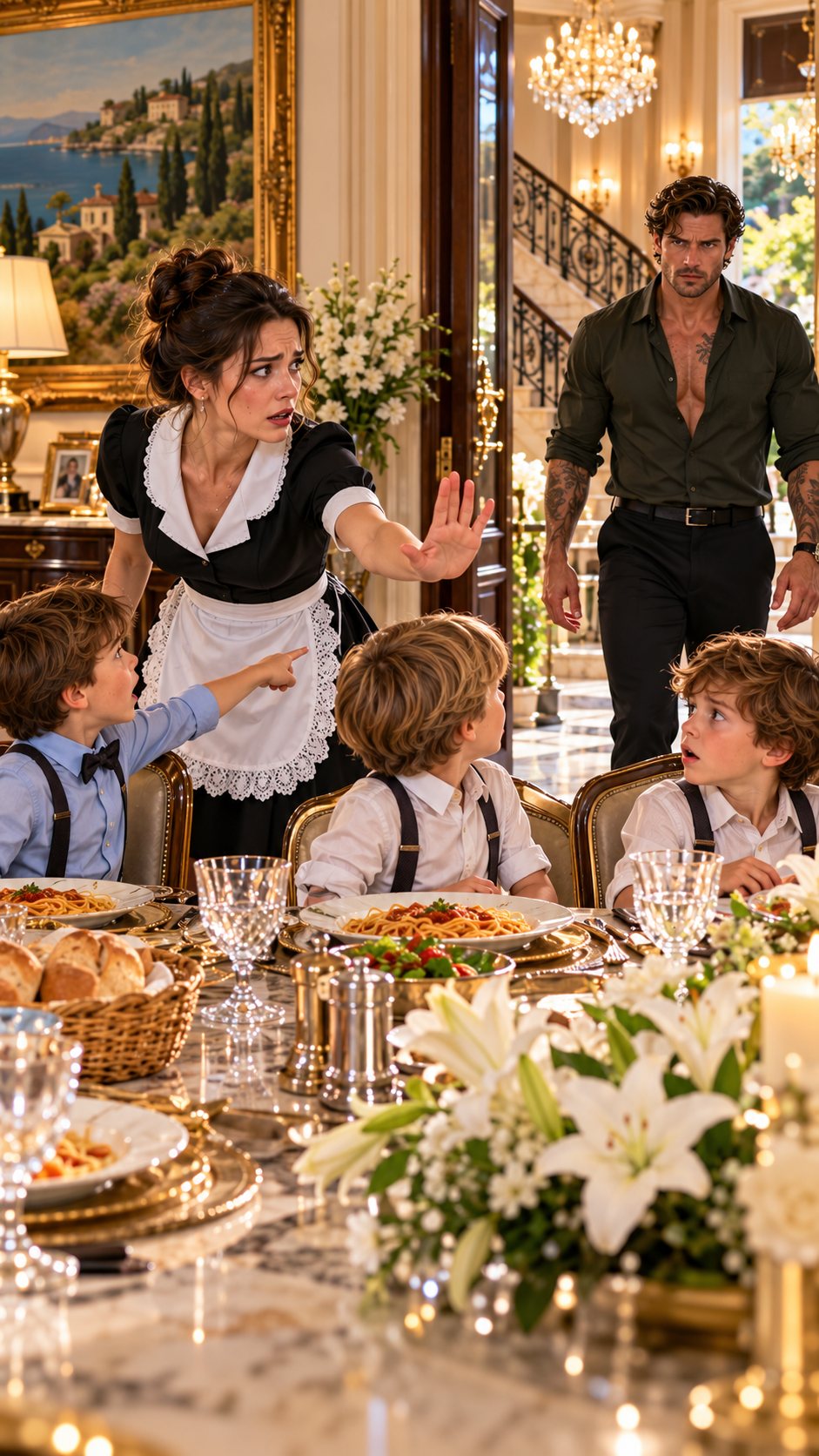
The afternoon Adrián Salvatierra found 4 identical children eating in the dining room that had remained closed since his wife’s death, he thought someone had done something insane; but one of the little boys pointed at him and asked:
“Carmen, is that the man in the photo?”
The spoon hit the floor.
For almost 20 years, the Salvatierra name had made businessmen, middlemen, and old partners in Madrid lower their voices. Adrián controlled hotels, transport companies, and nightclubs, but around his businesses there also existed a clandestine network inherited from his father, a structure of favors and silences he had never known how to leave.
That afternoon he returned to his estate in La Moraleja 3 hours early because a meeting was canceled.
He heard children’s laughter.
Children did not enter that house.
Since Lucía died 5 years earlier, the large dining room was not used either.
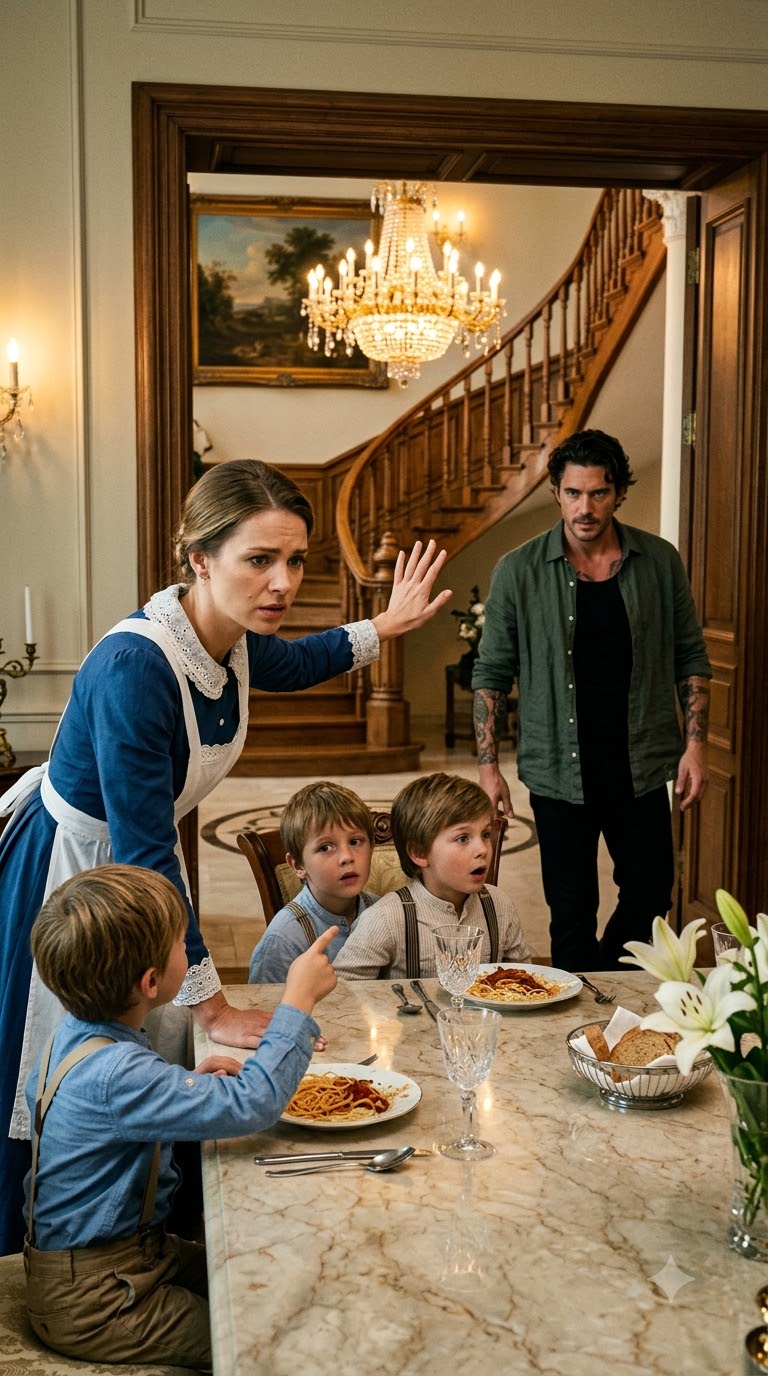
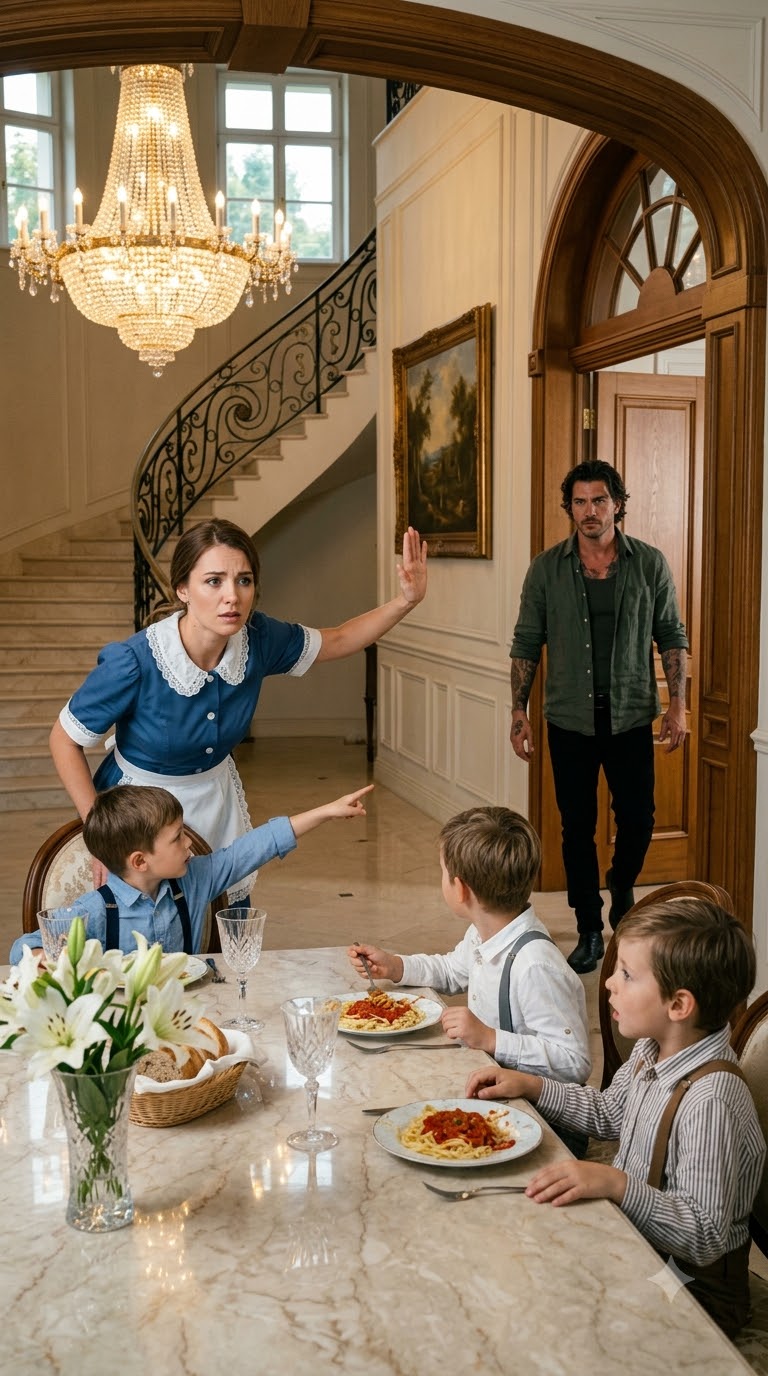
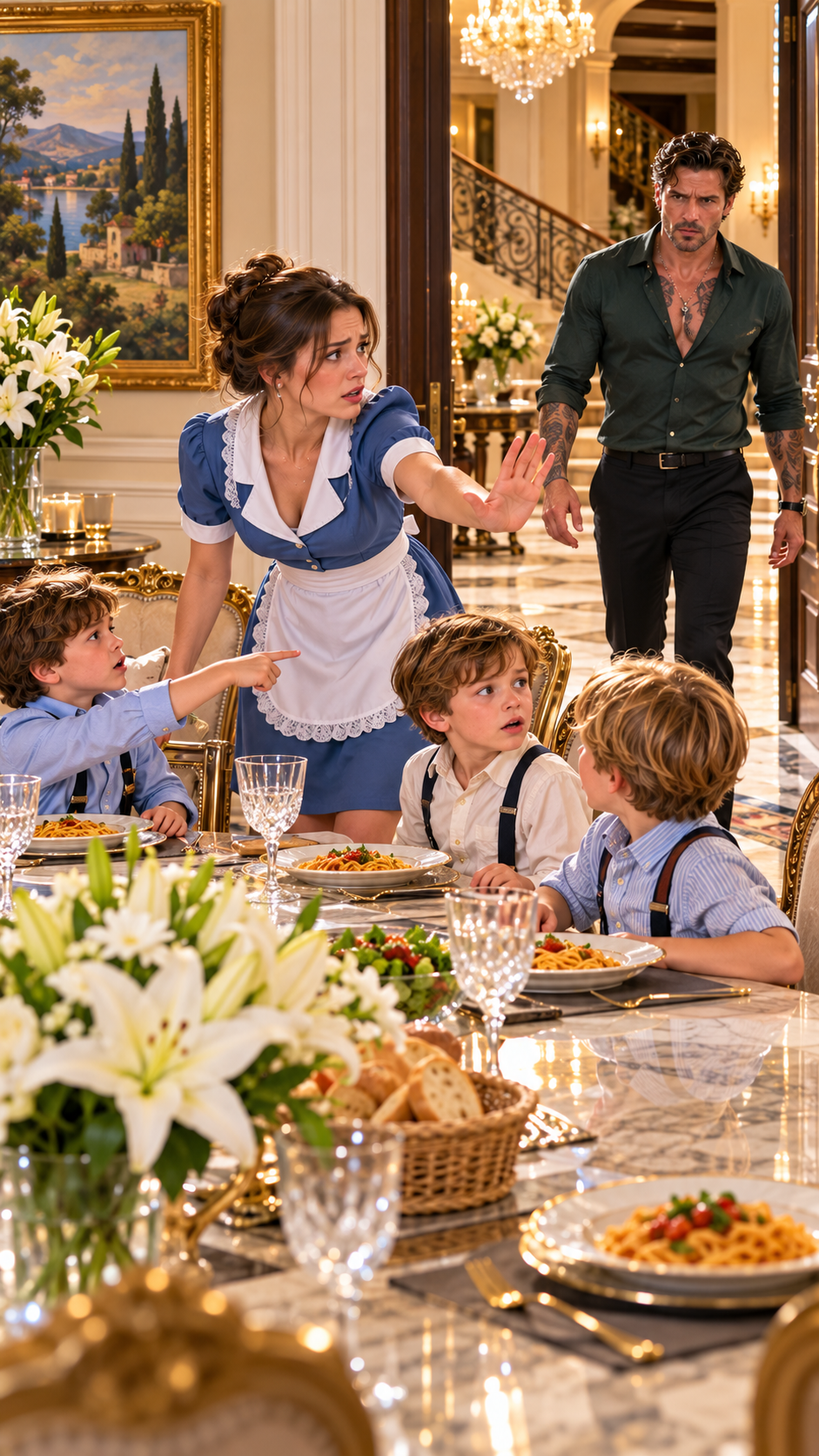
Adrián followed the voices and found Carmen, his housekeeper for 11 years, serving chicken and rice to 4 children about 5 years old. They had the same brown hair, the same dark eyes, and the same way of smiling.
Carmen had set 4 colored glasses on the table, as if that scene were normal. One of the boys was hiding peas under his bread, another was tapping the edge of his plate with his fingers, the third watched every move Adrián made, and the fourth held a folded napkin with an almost adult seriousness.
Adrián went cold.
One of them had exactly the expression he saw in his own childhood photographs.
“Who are they?”
Carmen stood up and placed herself in front of the children.
That gesture unsettled him more than any threat.
“Adrián, not in front of them.”
“I asked who they are.”
Mateo, the most restless one, opened a backpack.
“No, Mateo,” Carmen said.
Too late.
The boy pulled out a photograph of Lucía hugging Carmen. On the back was a sentence written by his wife:
“Keep them safe from Adrián until he manages to be safe from the Salvaterras.”
Adrián read it twice.
“What does this mean?”
Carmen had tears in her eyes.
“That Lucía didn’t want to protect them from you. She wanted to protect them from what surrounded you.”
Adrián looked at the 4 children.
“Are they mine?”
Carmen did not answer.
She didn’t have to.
Mateo looked up.
“Did you know our mother?”
“Yes.”
“Did you love her?”
Adrián took too long.
“More than I knew how to show.”
Then Daniel, the head of security, appeared.
“Mr. Salvatierra, 3 vehicles have arrived. They’re your uncle Julián’s men.”
Carmen lost her color.
“They’ve found us.”
Adrián turned.
“Who knew the children were here?”
Carmen shook her head.
“Only me, their guardian, and Lucía’s notary.”
Daniel avoided looking at him.
Adrián noticed.
Before he could ask, the house phone rang.
It was Julián Salvatierra, his father’s brother and the second most powerful man in the family.
“Nephew,” he said with an unbearable calm. “Open the gate. We need to talk about your 4 heirs.”
Adrián felt the air leave the room.
Lucía had been gone for 5 years.
The children had barely just entered his house.
And someone in his own family already knew exactly who they were.
PART 2
Adrián ordered that no one open the gate.
Julián called again.
“Don’t put on a show. Those children carry your blood and therefore they are part of the family.”
“They are children, not property.”
There was a brief silence on the other end.
“Carmen doesn’t get to decide that.”
Adrián hung up.
Then he looked at Daniel.
“How did he know?”
The head of security went pale.
Carmen understood before anyone else.
Daniel confessed that for months he had been informing Julián of any unusual movement on the estate. He did not know who the children were, but that morning he had seen Carmen come in with 4 identical little boys and reported it out of habit.
Adrián felt the betrayal like a blow.
Daniel had worked with him for 14 years.
“Out of my house.”
“Adrián, I was only doing what your father left established.”
“My father has been dead for 12 years.”
Carmen took the children by the hand.
“We have to leave.”
“No,” Adrián said. “If you go out now, Julián will know he can move us however he wants.”
Mateo looked at him, frightened.
Adrián lowered his voice.
“Nothing is going to happen to you here.”
A little later Beatriz Llorente arrived, a notary and a friend of Lucía’s. She came in through a side entrance with a sealed folder.
“Lucía left this for the day the Salvaterras discovered the children.”
Inside there was a declaration, paternity tests done at birth, and an unexpected clause.
Beatriz pointed to the last page.
“If you want to be recognized as their father and guardian, you must formally break with the family structure Lucía feared.”
Adrián looked at her.
“And if I don’t?”
Beatriz closed the folder.
“Then she asked that her sons never carry your last name.”
PART 3
Julián remained in front of the gate for almost an hour.
He did not come in.
Adrián did not go out either.
For the first time in his life, he understood that protecting someone did not always mean proving who had more power.
Sometimes it meant not using it.
When the vehicles left, Carmen took the children to the library. There were storybooks there, an old foosball table, and a window that looked out on the garden.
Adrián stayed in the dining room with Beatriz.
“I want to know everything.”
The notary opened the folder.
Lucía had discovered she was pregnant during a 7-month separation. Adrián and she were still in love, but they argued constantly over the Salvatierra family. He promised to leave that network of dark favors; then another debt appeared, another partner of his father’s, another obligation.
Lucía gave birth to 4 identical boys in a private clinic in Valencia.
She did not register Adrián as the father.
Carmen was with her.
So was her brother, Sergio.
“Sergio knew?” Adrián asked.
“From the beginning.”
Adrián closed his eyes.
At the funeral, Sergio had hugged him.
And he had kept silent.
“Why did no one tell me after Lucía was gone?”
Beatriz did not try to justify it.
“Because they were afraid. And because, over time, fear became convenience.”
That answer hurt him more than an excuse.
Lucía had left instructions for the children to live with Sergio and his wife until Adrián proved he could offer them a different life. But she had also written that the secret was not supposed to be permanent.
Sergio arrived that same night.
He came in furious.
“How could you let Julián find out?”
“Ask the man I just fired.”
“I knew this would happen.”
“And I just found out I have 4 sons. Don’t turn your fear into a sentence against me.”
Sergio took a step toward him.
“My sister spent years asking you to get out of that world.”
“I know.”
“No, you don’t. She had a suitcase packed every time you said that meeting with your uncle would be the last one.”
Adrián clenched his jaw.
He could argue.
He could remind him that Lucía had also hidden something enormous.
But from the library came a child’s laugh.
Both men fell silent.
“I’m not going to fight over them as if they were an inheritance,” Adrián said. “I want to get to know them.”
Sergio watched him with distrust.
“And your last name?”
“I don’t care.”
That did surprise Sergio.
Over the following weeks, Adrián kept his word.
He did not move the children onto the estate.
He did not change their school.
He did not allow photographs.
He saw them in parks, quiet cafés, and at Sergio’s house in Pozuelo.
The first time he showed up in a suit, Mateo asked:
“Do you always dress like you’re about to fire someone?”
Carmen burst out laughing.
The following week Adrián arrived in jeans.
“Better,” Mateo declared.
Little by little he learned who was who.
Mateo asked questions without stopping.
Lucas watched before he spoke.
Nico drew impossible houses.
Samuel collected leaves, seeds, and flowers.
Adrián had thought 4 identical children would be hard to tell apart.
In less than a month he understood that only an adult who wasn’t paying attention could confuse them.
He also understood Lucía.
In the Salvatierra family, children inherited more than money. They inherited expectations.
Adrián’s father had decided his school, his friendships, and his profession. When he wanted to study architecture, they laughed. When he talked about leaving Madrid with Lucía, they reminded him that a Salvatierra did not abandon his own.
By 29, Adrián was already running a life he had never chosen.
And then he made the same mistake as his father: he started calling control protection.
One afternoon, Samuel wanted to buy sneakers with little sunflowers.
The clerk smiled when he saw the 4 brothers.
“You could all wear the same ones. It would look very nice.”
Mateo chose red.
Lucas, blue.
Nico, green.
Samuel pointed to the sunflower ones.
They all looked at Adrián.
He answered:
“Let each one choose his own.”
Sergio, standing behind them, said nothing.
But that night he called Carmen.
“Maybe Lucía was right about one thing.”
“Which?”
“That he could still change.”
The real problem was still Julián.
For decades he had used the family name as a parallel company. Several of Adrián’s businesses served as a front for inherited agreements he barely reviewed.
Julián needed everything to stay the same.
And 4 possible heirs could become a form of pressure.
When Adrián announced that he would separate his legal businesses from any structure tied to his uncle, the family exploded.
His aunt Mercedes accused him of destroying 3 generations of work.
A cousin stopped speaking to him.
Two partners threatened to pull their investments.
Julián appeared in his office.
“All this for 4 children who don’t even call you dad.”
Adrián stood up slowly.
“Precisely because of that.”
“I don’t understand you.”
“I want them to call me that someday because it comes from them, not because my last name forces them to.”
Julián smiled with contempt.
“Lucía made you weak.”
“No. Lucía was the first person who told me that living in fear of disappointing my family was also a form of weakness.”
Adrián gave his lawyers enough documentation to unlink his hotels, restaurants, and transport companies from Julián’s agreements. What could be closed was closed. What needed to be investigated was left in the hands of professionals and the competent authorities.
It was neither clean nor simple.
He lost money.
He lost partners.
And he lost a part of the family that only stayed close while he obeyed.
But he started getting home before 8:00 p.m.
The estate stopped feeling like a barracks.
Then the second betrayal happened.
A magazine published that Adrián had 4 secret sons.
The photographs showed the children leaving school.
Sergio called, beside himself.
“I told you this was going to happen!”
Adrián was furious too, but he asked only one thing:
“Where are they?”
“Inside the school. Scared.”
Adrián arrived through a back entrance.
He found Samuel with his hands over his ears and Mateo trying to look brave.
“Did we do something wrong?” Lucas asked.
Adrián knelt down.
“No. The adults did something wrong.”
“They say we’re Salvaterras,” Nico said.
“You are Mateo, Lucas, Nico, and Samuel. The rest can wait.”
Beatriz found out the leak had come from Julián’s circle.
That night, Adrián gathered Sergio, Carmen, and the children.
There was no longer any point in hiding the truth.
“There is something your mother wanted to tell you when you were older,” he said.
Mateo went straight to it.
“Are you our father?”
Adrián felt that every difficult conversation of his life had been easy compared with that one.
“Yes.”
Lucas frowned.
“Then why weren’t you there?”
Adrián did not blame Lucía.
He did not present himself as a victim either.
“Because your mother and I loved each other very much, but we made bad decisions. She was afraid of the life I was living. I took too long to change. And when she wanted to tell me everything, she no longer had time.”
Samuel looked at him.
“Did you abandon us?”
“I didn’t know you had been born.”
“And now what?”
“Now I want to be here. But I’m not going to force you to love me.”
Mateo thought for a few seconds.
“We can try.”
Those 3 words were the first gift Adrián felt he did not deserve.
Days later, Sergio appeared alone at the estate.
He brought a box Lucía had left in his care.
Inside there were drawings, hospital bracelets, and 5 letters.
In Adrián’s, Lucía wrote that she had never wanted to punish him.
She told him that during the pregnancy she heard 4 heartbeats and cried with happiness and with fear.
She also confessed something Sergio had never revealed.
Two weeks before she died, Lucía had decided to return to Madrid with the children.
She had prepared a room on the estate.
She had chosen a date.
And she had called Sergio to tell him that Adrián deserved a chance.
“I tried to convince her not to come,” Sergio admitted.
Adrián looked up.
“Why?”
“Because I blamed her for still loving you. And I blamed you for everything she had suffered. After she died, I kept hiding the children because admitting that she planned to come back meant admitting that maybe I was wrong.”
Adrián was silent.
“I’m sorry,” Sergio said.
They did not hug.
They didn’t need to.
Sometimes forgiveness begins simply when someone stops defending their mistake.
Carmen took Adrián to a closed door in the west wing.
He had never gone in there since Lucía died.
Inside there were 4 small beds.
One wall showed 4 names written in pencil.
Mateo.
Lucas.
Nico.
Samuel.
Beneath them, Lucía had left a sentence:
“May this room never tell them who they have to be.”
Adrián sat down on the floor.
For the first time he cried for what he had lost and also for what he could still recover.
The months that followed transformed the house.
First came the Sundays.
Then some weekends.
Then drawings appeared on the refrigerator, balls in the hallway, and pots in every window where Samuel found light.
Adrián learned to make pancakes.
He burned the first 5.
Lucas ate one and said:
“It’s crunchy.”
“That wasn’t the intention.”
“Yeah.”
Nico taught him to draw dinosaurs.
Mateo taught him that no conversation could end with a single question.
Samuel taught him how to water a plant without drowning it.
One night, the 4 of them slept for the first time in the room Lucía had prepared.
In the dark, Lucas asked:
“Did she love us?”
“Yes.”
“But she barely knew us.”
Adrián sat down beside the beds.
“She knew you well enough to imagine a whole life for you.”
Samuel pointed to the plants he had placed in the window.
“She didn’t imagine this.”
Adrián smiled.
“Better. It means you added something new.”
Almost a year later, the children asked to live on the estate most of the time.
Sergio would still be present.
So would Carmen.
Nothing would be erased to create a new family.
During the first dinner after the change, Mateo asked:
“Do we have to call ourselves Salvatierra?”
Adrián set down his fork.
“No.”
“And if we want to?”
“When you’re older, you’ll decide.”
“And if we never want to?”
“You’ll still be my sons.”
Sergio looked down to hide the emotion.
On the anniversary of the day Adrián discovered them, Carmen served chicken and rice again in the large dining room.
This time every chair was occupied.
In the middle of dinner, Mateo pulled out the old photograph.
“I found something.”
He turned it over.
Beneath Lucía’s first sentence there was another, written in lighter ink:
“If one day Adrián manages to step out of the shadow of his last name, do not keep the children away from him. Let them be the ones who decide whether that man can be their home.”
No one spoke for a few seconds.
Lucas looked at Adrián.
“Did you already step out of the shadow?”
Adrián looked at the walls where before there had only been silence.
He looked at Nico’s drawings, Samuel’s plants, Mateo’s crumpled napkin, and Lucas sitting beside him.
“I’m still stepping out.”
Mateo smiled.
“Then hurry up. We have a game tomorrow.”
Everyone laughed.
And Adrián finally understood what Lucía had been trying to teach him.
Family was not a last name, an inheritance, or a house protected by gates.
It was having the freedom to stay.
And that night, for the first time in many years, no one in the Salvatierra house was afraid to choose.
