

Part 1
Sergio Montes pretended to board a plane bound for Berlin and, twenty-five minutes later, secretly returned to his own house to spy on the woman his six-year-old sons already ran to hug before they ran to him.
Since Elena, his wife, had died nineteen months earlier, Sergio ran his life the way he ran his real-estate company: schedules, reports, quick solutions, and no conversation that might hurt too much.
He lived with his twins, Mateo and Lucas, in a house in Sarrià, Barcelona. They had already gone through three caregivers. Mateo reacted with anger to any change. Lucas had started speaking so little that the psychologist recommended not pressuring him.
Sergio said he worked so much for them.
The problem was that he was almost never with them.
Then Inés Romero arrived.
She was thirty-five, had worked with families for years, and did not try to win the children over with gifts.
On the first day, Mateo deliberately threw a glass of cocoa on the floor.
The previous caregiver would have rushed for the mop.
Inés handed him a cloth.
“It was an accident. We’ll clean it together.”
“Aren’t you angry?”
“Would that put the cocoa back in the glass?”
Mateo stood there thinking.
Then he cleaned.
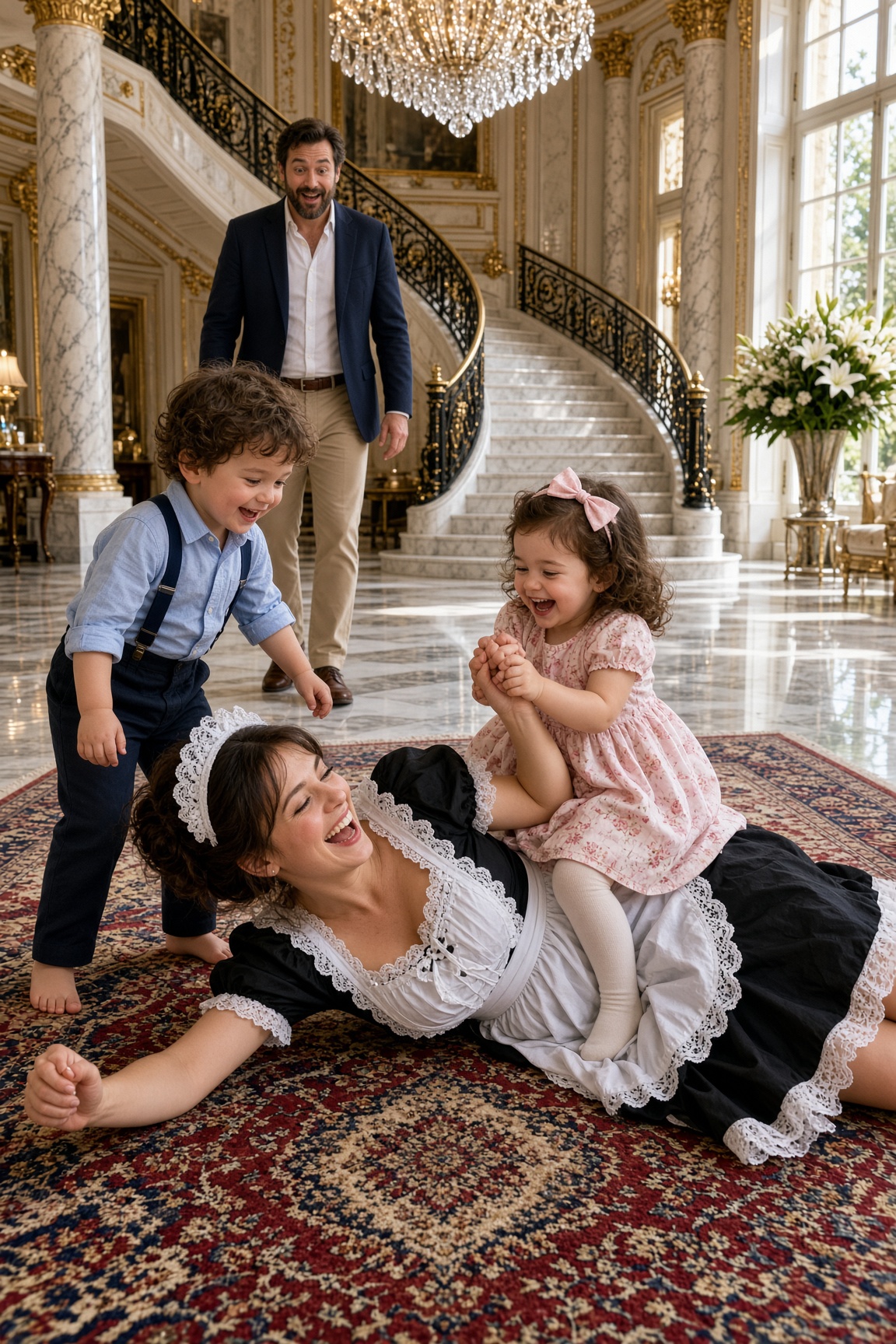
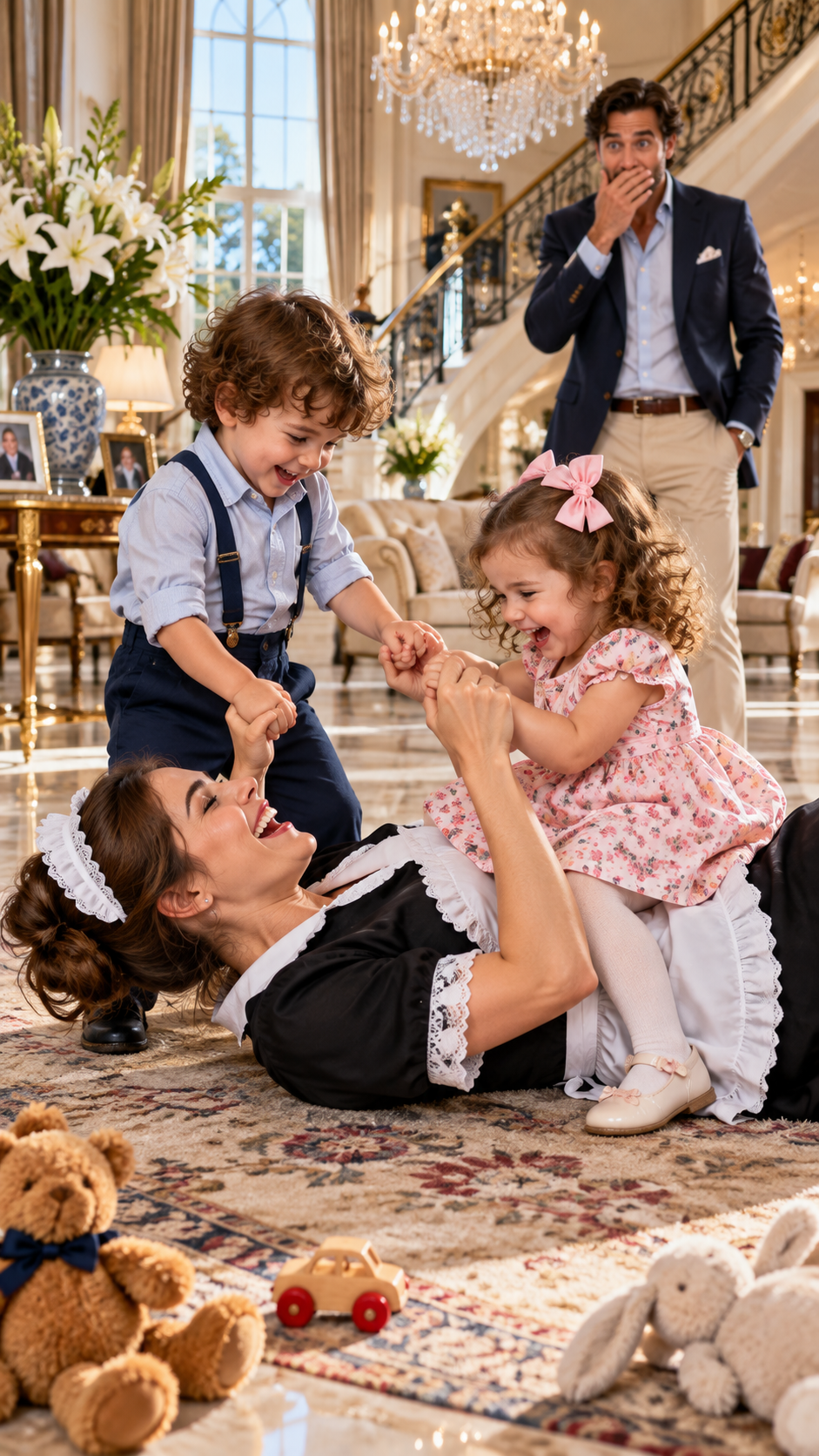
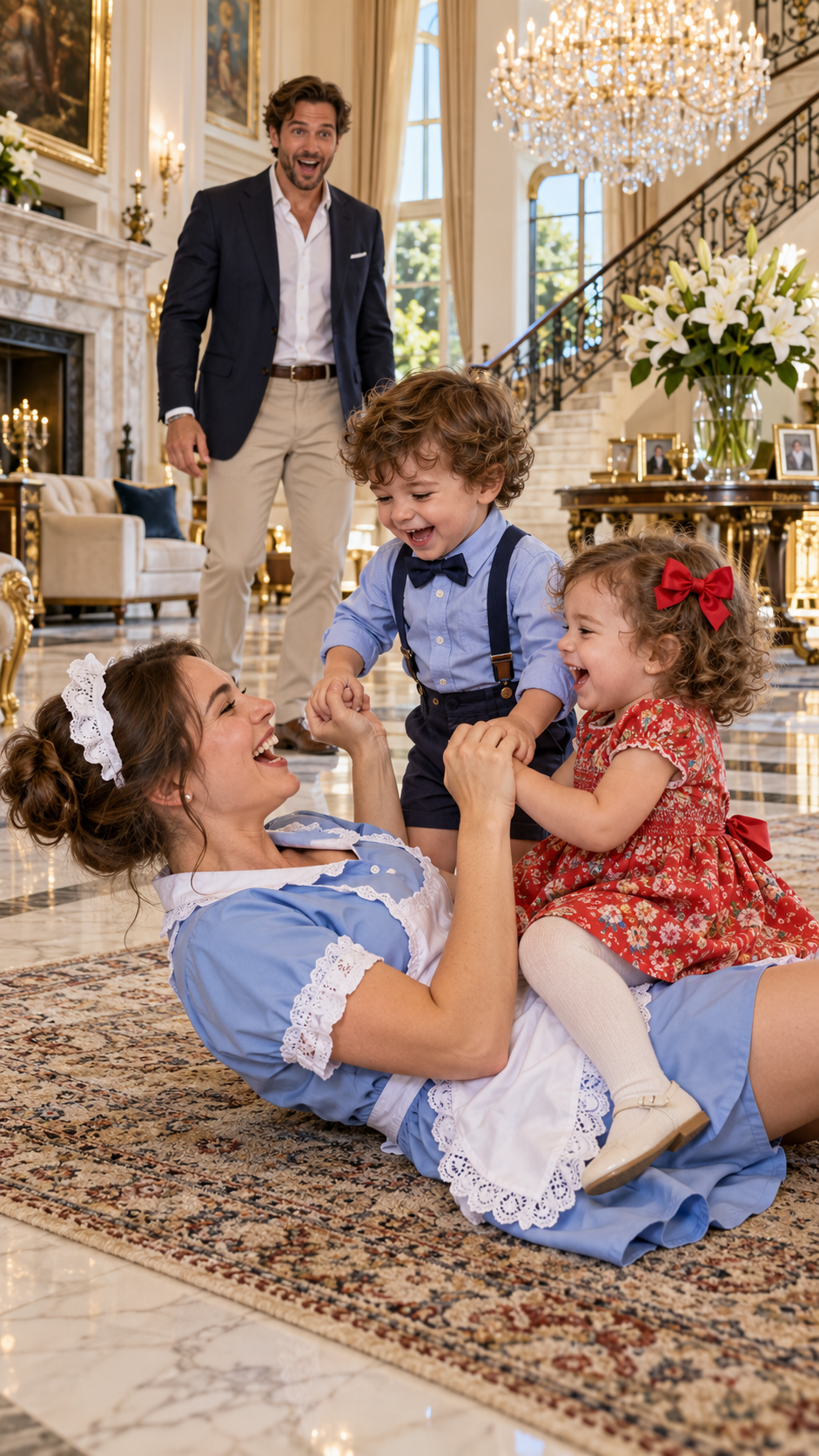
Two weeks later, Lucas was talking again about what he did at school. Mateo waited for Inés by the door. The two of them helped make omelette, argued over who watered the plants, and had started talking about their mother again.
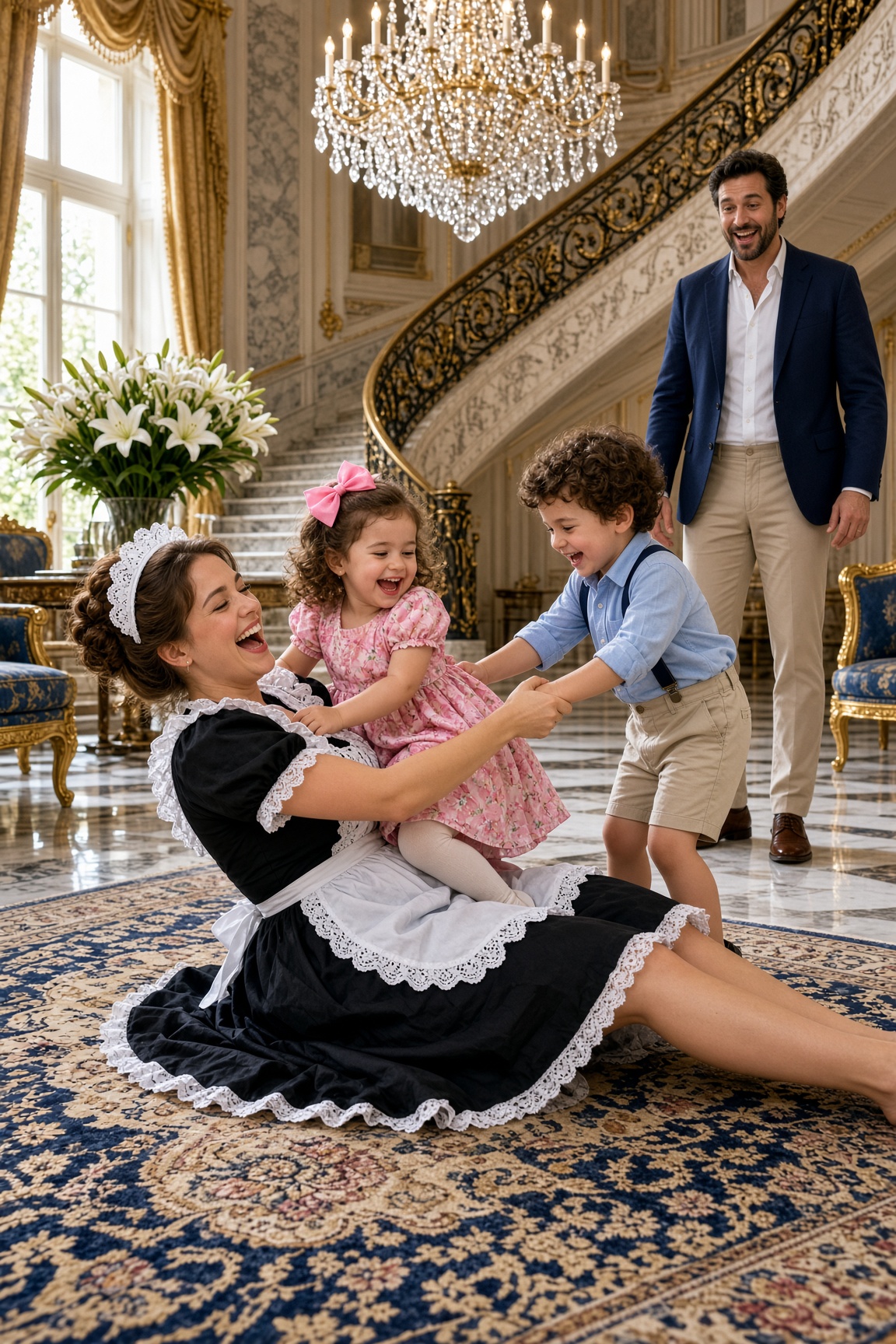
That was precisely what unsettled Nuria, Elena’s sister.
“She’s getting too involved in your lives,” she told Sergio. “The children depend on her.”
“The children are better.”
“And doesn’t it worry you that they might love an employee more than their own father?”
The sentence found exactly the wound Nuria was looking for.
Sergio began noticing details that had previously seemed good.
Mateo told Inés his problems first.
Lucas let her comfort him when he dreamed of Elena.
Even the house administrator, Andrés, trusted her.
That was how the absurd idea was born.
Sergio announced a four-day trip to Berlin.
At 7:15 he left with a suitcase.
Three streets later he ordered the driver to stop.
He came back through the garage and hid in Elena’s old study, from which he could hear a good part of the ground floor.
For one hour he confirmed something uncomfortable.
Inés did not change when she thought no one was watching her.
She let Mateo clean up his cocoa.
She listened to Lucas talk about his mother.
When the boy asked if Elena could still love him even though she was no longer there, Inés did not invent stories.
“When someone loved you that much, that love doesn’t disappear because you can no longer see it.”
Lucas rested his head against her.
Then the doorbell rang.
Nuria came in with a red folder.
“When Sergio comes back, give him this.”
Andrés did not take it.
“What’s in it?”
“The truth about Inés.”
From upstairs, Sergio moved closer to the door.
Nuria lowered her voice.
“Ask her why they fired her from the Barral family. Ask her about the rental lawsuit. And then tell my brother-in-law that a woman with secrets shouldn’t sleep under the same roof as his children.”
Sergio looked down.
He was no longer spying on Inés.
He was about to discover who was trying to destroy her.
Part 2
The next day, Nuria came back.
She set an old court claim with Inés’s name on the table.
“Look at it carefully. Your children already depend on her.”
Sergio felt afraid.
But Andrés had worked with his family for twenty-seven years and had checked references before hiring her.
“The Barral family did not fire her for misconduct,” he said. “The father came home from a trip and his children ran to hug Inés before they hugged him. He could not stand feeling replaced.”
That night, Sergio went into the twins’ room.
Mateo asked him to stay until he fell asleep.
Lucas held onto his sleeve.
Inés slipped out discreetly.
Sergio understood something brutal then: she had never tried to take his place.
She was keeping that place from disappearing.
The next morning he showed Inés the paperwork.
“I need to know everything.”
She did not defend herself.
She looked for the last page.
“Read the ruling.”
The rental claim had been dismissed. There was no outstanding debt.
Nuria had shown the accusation and deliberately hidden the outcome.
Sergio ordered a full review of the information.
Hours later he received a clean report on Inés.
But the investigator added another detail.
The agency Nuria had used regularly worked for Grupo Belmonte, the competitor that had just taken from Sergio a deal worth eighteen million euros.
Part 3
Sergio did not confront Nuria immediately.
He had spent several hours suspecting Inés only because someone had placed a folder in front of him and spoken the exact words that could frighten him.
He did not want to make the same mistake again.
He asked his lawyer to review the old case.
Seven years earlier, Inés had lived in a rented flat in L’Hospitalet de Llobregat. After losing her job with the Barrals, she fell two months behind on rent.
The landlord had signed a payment schedule with her to catch up.
Even so, he filed a claim before the agreement expired.
Inés produced transfers, messages, and the signed document.
The matter ended dismissed.
No debt.
No deceit.
None of the scandal Nuria had tried to build.
Sergio also asked to speak with the Barrals.
He expected a resentful family.
He received something else.
Two days later, Nuria appeared at the house again, this time with Carmen Barral, the mother of the children Inés had cared for years before.
Inés was preparing fruit in the kitchen.
When she saw Carmen, she set the knife on the cutting board.
“Hello, Inés.”
“Carmen.”
Nuria smiled, convinced she had brought the final proof.
“Now you can hear from her own mouth why she left that house.”
Carmen looked at Nuria.
“That’s exactly why I came.”
They sat in the living room.
Sergio stayed in front of them.
Inés chose a chair a little apart.
Carmen had her hands clasped.
“Inés worked with us for almost five years. My children were two and four when she arrived.”
“Were there problems?” Sergio asked.
“None caused by her.”
Nuria frowned.
Carmen went on.
Her husband, Fernando, traveled constantly for work. She ran a private clinic and also spent too many hours away.
Inés had been the one who took the children to the park, stayed with them when they were sick, and ate dinner with them when their parents came home late.
One afternoon Fernando returned after twelve days away.
His children heard the door.
They ran down the hall.
They passed their father.
And they hugged Inés.
That night Fernando said she had to leave.
“Not because she had done anything wrong,” Carmen admitted. “But because she made us see something we did not want to admit.”
Sergio already knew the answer.
“That the children looked for her first.”
Carmen nodded.
“Fernando said Inés was taking our place. The truth was that we had been leaving it empty for years.”
Inés kept her eyes down.
“You never told me that.”
Carmen swallowed.
“Because it would have meant admitting that we were the problem.”
She apologized.
For months, her children had asked about Inés.
Carmen had never dared to tell them why she had disappeared.
“I let you believe you had crossed some line because it was easier than facing my husband.”
Nuria cut in.
“You told me there was too much dependence.”
“Yes. Our children’s dependence on the only adult who was always there.”
Nuria opened her mouth.
Carmen stopped her.
“That did not make Inés guilty.”
The silence grew heavy.
When Carmen left, Sergio asked Andrés to take the twins into the garden.
Nuria tried to get up as well.
“You stay.”
Sergio set the report on the private agency on the table.
“Who recommended Investigaciones Litoral to you?”
“An acquaintance.”
“Which acquaintance?”
“It doesn’t matter.”
“They work for Belmonte.”
Nuria’s face changed only slightly.
That was enough.
“What have you told them?”
“Nothing important.”
“That isn’t what I asked.”
Nuria said nothing.
Sergio began listing information Grupo Belmonte had known suspiciously early over the past months.
The date of a hotel negotiation in Sitges.
The name of a German fund interested in coming in.
A private meeting with owners in Girona.
An offer whose figure only seven people knew.
Nuria denied handing over documents.
Finally she admitted something else.
She had talked.
At lunches.
At dinners.
With friends.
With a man named Alberto Crespo who presented himself as a consultant and who had ended up putting her in contact with the agency.
“I never thought he worked for Belmonte.”
“But you talked about my deals.”
“They were conversations.”
“My eighteen million lost also looked like a conversation to someone.”
Nuria put her hands to her face.
“I didn’t want to hurt you.”
Sergio breathed slowly.
That was serious, but another question was still more personal.
“Why Inés?”
Nuria talked again about safety.
About the estate.
About vulnerable children.
Sergio waited.
“That isn’t an answer.”
“I’m trying to protect my nephews.”
“No. You’re trying to drive out a woman you have no proof against.”
Nuria raised her voice.
“Because they’re forgetting Elena!”
Sergio went still.
So did Inés.
Tears appeared in Nuria’s eyes.
“They used to call me when they were afraid. They used to want me to come on Sundays. I talked to them about their mother. I brought them the cookies Elena used to make. I went with you to the cemetery.”
She pointed toward the kitchen.
“Now they only talk about Inés.”
Sergio understood.
It had not been protection.
It had been fear.
Since Elena had been gone, Nuria had turned her nephews into the last way of feeling needed inside her sister’s life.
And when the children began to get better, she felt she was losing that too.
“I thought that if she took up too much space, Elena would disappear,” she admitted.
Sergio’s answer was quiet.
“Elena does not disappear because Mateo starts laughing again.”
Nuria cried in silence.
“Or because Lucas loves someone else. Our children’s love is not a room where only one name fits.”
Then he took out the house keys Nuria still had.
For months she had come in without ringing because Sergio wanted his children to feel their family close.
He held out his hand.
“Give them to me.”
Nuria looked at him.
“Are you throwing me out?”
“No. You’re still their aunt. But you will no longer come in whenever you want, ask for files, investigate employees, or make decisions about them.”
“Sergio…”
“You put an innocent person at risk because you were afraid.”
Nuria left the keys on the table.
She left without saying goodbye to Inés.
That afternoon, Sergio found the caregiver in the kitchen.
Mateo was grating tomato for pan con tomate.
Lucas was putting pieces of fruit on three plates.
“I owe you an apology,” Sergio said.
Inés kept cutting an apple.
“For investigating me?”
“For suspecting you before I listened to you.”
She set the knife down.
“You had the right to check who comes into your children’s lives.”
“Checking is not the same as condemning.”
Inés looked at him for the first time.
“Then you’ve already learned something.”
Sergio almost smiled.
In the weeks that followed he began to learn much more.
Not from Inés.
From his sons.
Until then he knew how much Mateo and Lucas’s school cost, but he did not know which teacher they liked least.
He knew their pediatricians’ names, but not which of the two hated sleeping with the door closed.
He knew how much money he had set aside for their future, but he could not remember the last time he had breakfast with them on an ordinary Tuesday.
He started coming home earlier.
Three mornings a week he ate breakfast at home.
He canceled professional dinners other people could handle.
One Friday he took the twins to school himself.
It was a disaster.
He forgot one of Mateo’s folders.
He put Lucas’s jacket in the wrong backpack.
They arrived six minutes late.
But that afternoon, when he came back from work, Mateo ran toward him.
Not toward Inés.
Toward him.
“Dad, take us again tomorrow.”
Sergio felt a ridiculous happiness.
And an enormous guilt.
He had spent months fearing that Inés would steal his children from him.
He had never considered that he could get them back simply by being there.
Inés did not try to make herself indispensable either.
When Sergio walked into a room, she stepped back.
If Lucas wanted to show her a drawing, she encouraged him to wait for his father.
When Mateo had a problem at school, she asked him:
“Do you want to tell Dad yourself, or do you want us to do it together?”
One night at dinner, Lucas set down his fork.
“Are you going to sleep here tomorrow?”
Sergio was surprised.
“Of course.”
“And Wednesday?”
“Then too.”
Mateo cut in.
“And Thursday do you have a meeting?”
The question hurt.
To his sons, their father’s presence was not a certainty.
It was a schedule they needed to check.
Sergio put his hands on the table.
“I’m going to keep working. Sometimes I’ll be late. But I will never again let you think work always comes first.”
Mateo watched him.
“Do you promise?”
Sergio was about to say yes.
Inés looked at him.
He corrected himself.
“I promise to try every day. And if I fail one day, I’m not going to pretend it didn’t happen.”
Mateo seemed satisfied.
Inés almost smiled.
After putting the children to bed, Sergio found her in the living room.
“Why did you never tell me I was doing it wrong?”
“Because I wasn’t hired to raise you.”
“You could have warned me.”
“Your children had been doing that for months.”
That sentence hurt.
Precisely because it was true.
One Sunday, Inés appeared with an old box.
She set it on the library table.
“There is something I should have told you.”
Sergio tensed.
She took out several photographs, letters, and a small green notebook.
“My mother was named Amalia Romero.”
She had cleaned houses for more than thirty years.
She had raised Inés alone in Nou Barris.
She died when Inés was twenty-five.
“What does that have to do with me?”
Inés slid a photograph toward him.
Sergio recognized the steps at once.
Then the fountain.
Then the façade.
It was his house.
In the picture, taken many years earlier, a woman of about forty smiled beside an elderly woman.
“My mother worked here.”
Before Sergio and Elena bought the property, it had belonged to a widow named Mercedes Montaner.
Amalia had cared for her in her last years.
She had also kept the house when Mercedes’s children lived outside Spain.
“When I accepted the interview I didn’t know the address,” Inés explained. “I only knew it was in Sarrià.”
“And when you arrived?”
“I recognized the fountain.”
Sergio looked at the photograph.
“Why didn’t you tell me?”
“Because I had just met you. It would have looked as if I was after something.”
“Were you after something?”
“Work.”
Inés smiled sadly.
“Then I found something I didn’t expect.”
She looked toward the hallway where the twins usually ran.
“Two children who needed someone who was not afraid to listen when they talked about their mother.”
Sergio looked at the photograph again.
He remembered something.
During the renovation, Elena had found several old postcards behind a wardrobe.
A neighbor told them that for years a woman named Amalia had kept the property almost by herself.
Elena had said then:
“Houses usually belong on paper to some people and in memory to others.”
Sergio had barely paid attention.
Inés opened the green notebook.
There were recipes, household accounts, and small notes from Amalia.
On one page a sentence was underlined:
“A house is not remembered for how clean it was, but for how the people inside it breathed.”
Sergio lifted his eyes.
For nineteen months, that house had been impeccable.
It had also been almost dead.
Nothing out of place.
No toys on the stairs.
No stain on the table.
No laughter under the dining room.
Inés had arrived and everything had become messy again.
There was cocoa on the floor.
Slippers in the hallway.
Drawings stuck to the fridge.
Blankets turned into castles.
And Sergio began to understand that for too long he had confused order with stability.
Three weeks later, Nuria came back.
This time she rang the bell.
She waited to be let in.
She did not bring files.
Only a bag with some cookie cutters that had belonged to Elena.
She asked to speak with Inés.
“I judged you because I was afraid,” she said. “And I used incomplete things to make Sergio afraid too.”
Inés listened.
“I’m sorry.”
“Thank you for saying it.”
Nuria seemed to wait for something more.
Inés added:
“But trust does not come back with an apology. It comes back when you stop repeating what broke it.”
Nuria nodded.
She did not argue.
It was the beginning of something different.
In time she stopped competing for her nephews’ affection.
She discovered that Mateo could want to spend an afternoon with her and run toward Inés the next day.
Lucas could talk about Elena without anyone having to defend her memory.
No one was replacing anyone.
Love was simply making room.
Months later, on an autumn afternoon, Sergio found Inés sitting near the old fountain.
Mateo and Lucas were chasing dry leaves across the garden.
Amalia’s green notebook rested on her knees.
Sergio sat beside her.
“Your contract ends in June.”
“I know.”
“I want you to stay.”
Inés looked at him.
“As a caregiver?”
Sergio took a few seconds.
“I want you to keep being part of the children’s lives for as long as it makes sense for you and for them. Not because they are incapable of being without you.”
He looked at Mateo and Lucas.
“But because you already matter.”
Inés lowered her eyes.
“I don’t want to take Elena’s place.”
“You never have.”
Sergio pointed at the house.
“And I don’t want you to take mine either.”
“That depends on you.”
He smiled.
“I’m starting to understand that.”
Inés closed the notebook.
“Then I’ll stay.”
Mateo came running.
“What are you talking about?”
“Adult things,” Sergio said.
“That means it’s boring.”
Lucas arrived behind him and dropped onto the grass.
Mateo pulled his father’s sleeve.
“Come.”
“Where?”
“Here.”
Sergio ended up sitting on the ground.
Lucas leaned against him.
Mateo took Inés’s hand and made her sit down too.
From a window, Andrés watched them.
No one was occupying anyone else’s place.
There were simply more people around two children who for too long had lived surrounded by absences.
Sergio looked toward the house.
Months earlier he had faked a trip to Berlin because he wanted to find out who Inés was when he was not there.
He expected to find a lie.
A hidden intention.
Some reason to take back control.
He found the opposite.
He discovered that Inés cared the same way when no one was watching her.
He discovered that Nuria could love her nephews deeply and still be wrong out of fear.
He discovered that a woman who had died could remain present without keeping new people from coming in.
But above all he discovered something much harder to accept.
The problem had never been that his sons needed Inés too much.
It was that for months they had needed their own father too little, because they had grown used to living without him.
Sergio looked at Mateo, who was trying to put leaves on Lucas’s head.
Then he looked at Inés.
Then at that house he had protected for so long as if keeping the walls intact could stop his family from changing.
Amalia’s sentence came back to him.
A house is not remembered for how clean it was.
But for how the people inside it breathed.
That afternoon there were shouts.
Laughter.
Dry leaves on the ground.
Two children fighting.
A caregiver laughing.
An aunt trying to learn how to love without controlling.
And a father who, at last, was no longer watching his family hidden from a study.
He was sitting on the ground with them.
And when Mateo moved to make room for him, Sergio understood that his sons had never been waiting for him to be perfect.
They had only been waiting far too long for him to be there.
