

“Wasn’t the $180,000 I sent to help you enough?” she asked.
I stared at her, completely unable to understand what she was talking about.
“I never received any money.”
Her expression shifted immediately.
Within seconds, she took out her phone and called her attorneys.
The question seemed to bring the entire entrance hall of my aunt’s house in Denver, Colorado, to a complete silence.
My nine-month-old daughter, Lily, slept peacefully against my shoulder, one tiny hand curled around the collar of my worn gray hoodie. My jeans were faded at the knees, and my old sneakers remained damp from the rain outside.
Across the room, my grandmother, Margaret Whitmore, looked at me as if she had just stepped into a situation that made no sense.
We hadn’t seen each other in nearly two years.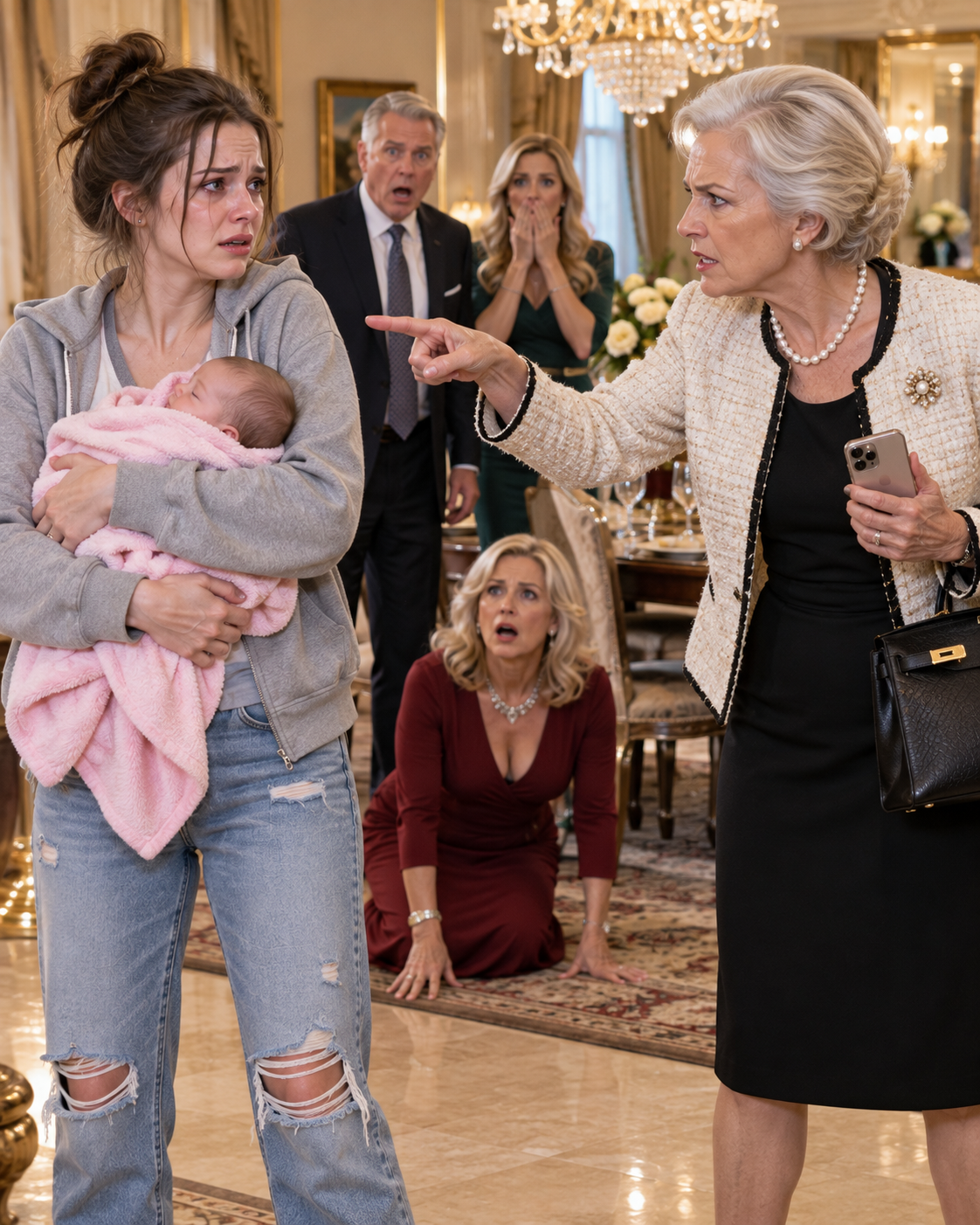
She had come from Boston for Thanksgiving, and I had only agreed to attend because my cousin Emily had repeatedly encouraged me. She said Grandma was getting older and often asked about me and Lily.
At first, Grandma had greeted me with a warm smile.
Then she noticed what I was wearing.
Her eyes moved from my hoodie to Lily’s secondhand blanket and then returned to my face.
The warmth vanished.
She stepped closer, her pearl earrings moving slightly as she tilted her head.
“Wasn’t the $180,000 I sent for you enough?” she asked again, her voice quieter this time.
I searched her expression, certain that I had misunderstood her.
“What money?”
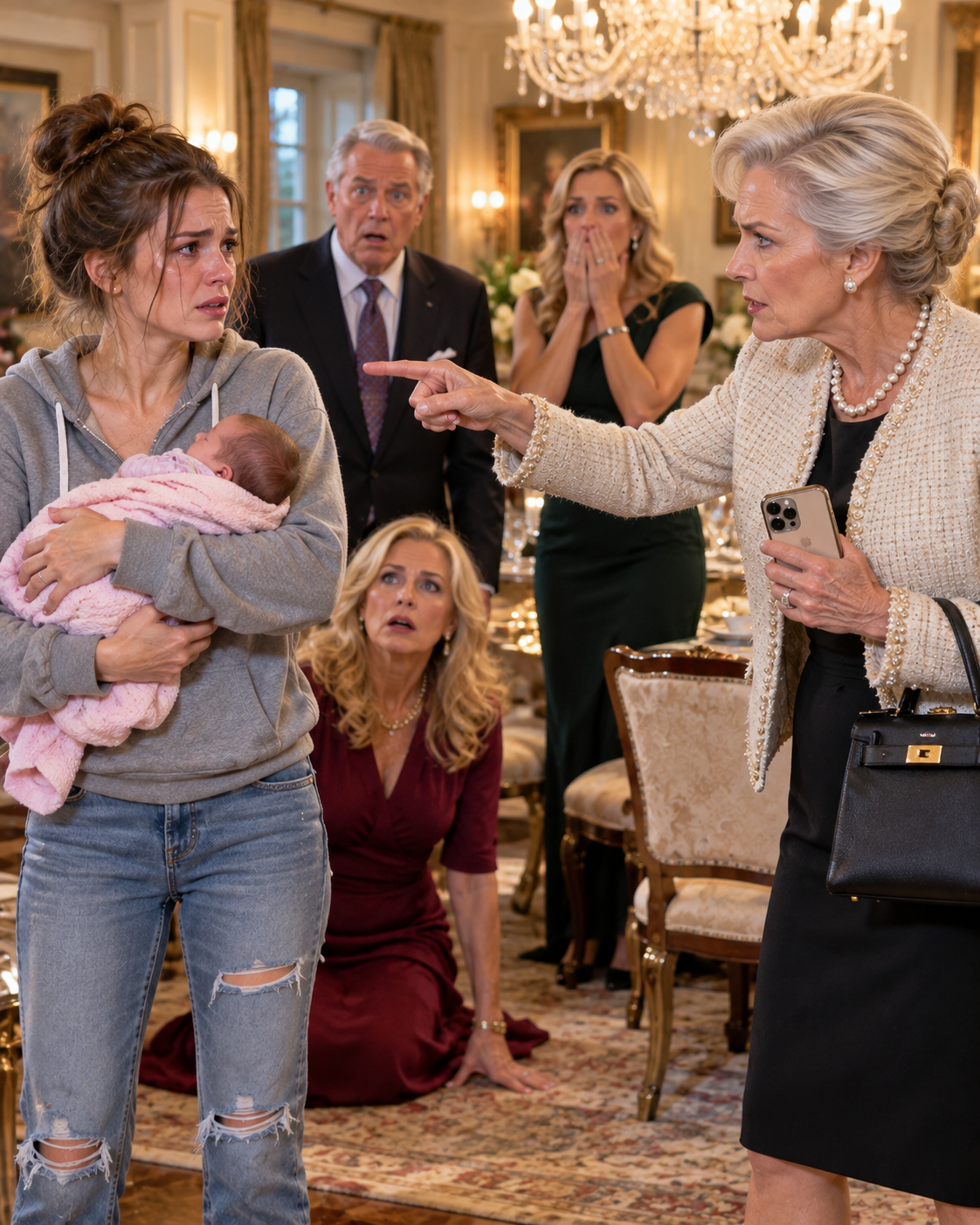
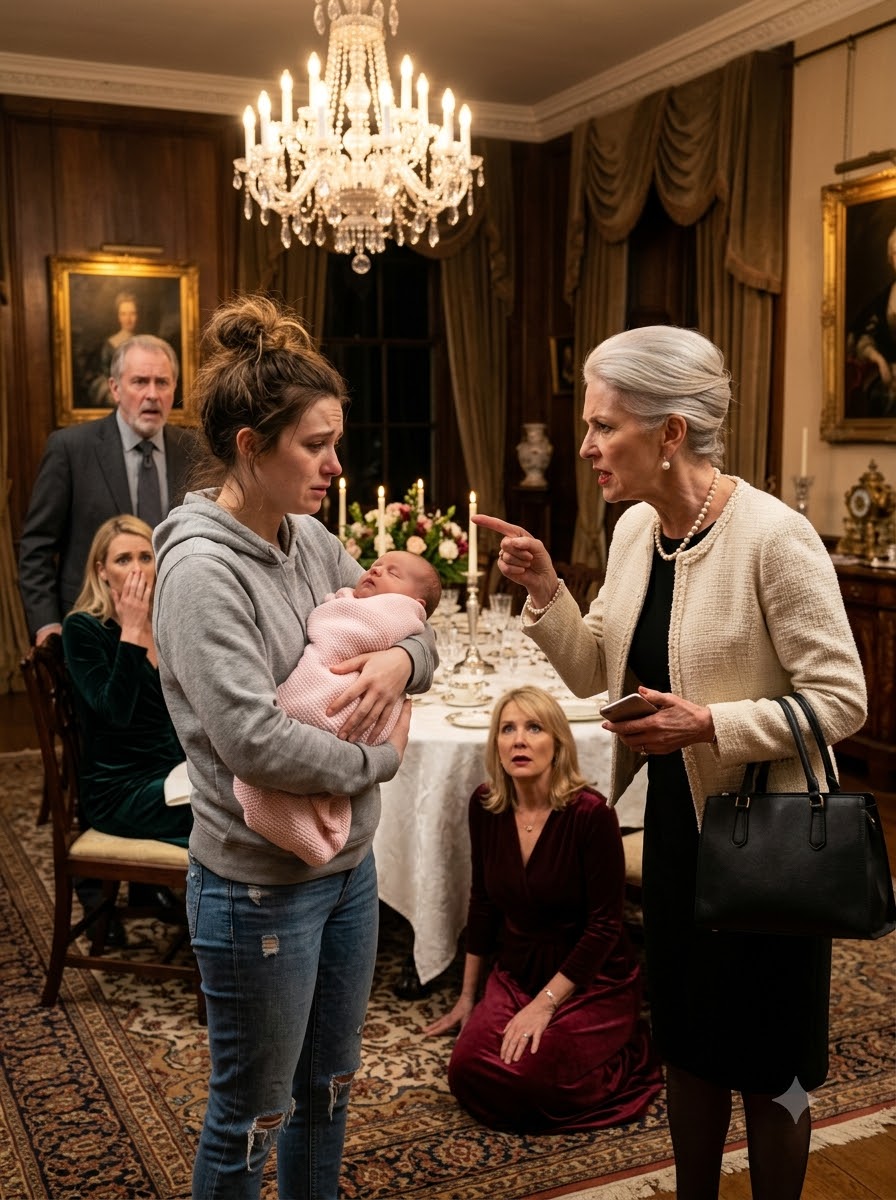
Near the dining room, my aunt Patricia dropped the candle in her hand.
It rolled across the wooden floor before hitting the baseboard.
Grandma immediately looked toward her.
“Patricia?”
My aunt’s face went completely pale.
Uncle Robert came from the kitchen, drying his hands on a towel. My mother, Denise, followed behind him carrying a glass.
Gradually, the conversations throughout the dining room died down as everyone realized something serious had just come to light.
I looked straight at Grandma.
“I never received a single dollar.”
The silence that followed felt so heavy it seemed to press against my chest.
Grandma touched the gold chain around her neck, something she always did when trying to keep herself calm.
“I transferred $180,000 after your family emergency,” she said. “Patricia told me you needed help with medical expenses, housing, childcare, and time away from work.”
She glanced at my aunt.
“She also said you were too proud to contact me yourself.”
The room seemed to tilt beneath me.
After losing my husband, Evan, in a terrible road accident, I had been left alone with a newborn, unexpected expenses, and no reliable income.
I sold jewelry, furniture, and nearly anything valuable enough to help pay the rent.
I counted every grocery item before reaching the checkout.
I accepted secondhand baby clothes, skipped meals, and took whatever work I could find while taking care of Lily.
There were nights when I sat alone in my car, counting the few bills remaining in my wallet and wondering how I would make it through another week.
All that time, my grandmother had believed I was financially secure.
She thought the money she sent was covering our home, medical expenses, and Lily’s needs.
Meanwhile, I had been struggling without telling anyone.
Grandma slowly took her phone from her handbag.
“Margaret,” Patricia said quickly, forcing a nervous smile. “There has obviously been some kind of misunderstanding.”
Grandma didn’t even look at her.
She chose a contact and raised the phone to her ear.
“Richard,” she said when the call connected, her voice calm but firm. “I need you and Clara at Patricia’s house immediately.”
Patricia’s fingers tightened around the edge of the dining table.
“Bring the bank-transfer records, the family-trust documents, and everything necessary to determine where the money went,” Grandma continued. “Be prepared to take legal action today.”
Then she ended the call.
My aunt looked as though her legs might give out.
My mother placed her glass down without saying a word.
Uncle Robert stared at Patricia, his expression slowly shifting from confusion toward suspicion.
Grandma turned her attention back to me.
Her eyes softened when she looked at Lily, who remained asleep peacefully against my shoulder, completely unaware that everything around her had suddenly changed.
“Please stay,” Grandma said. “You and Lily are not leaving until we understand exactly what happened.”
Patricia opened her mouth.
Grandma raised one hand.
“No excuses. No private conversations. And no one leaves this house until my attorneys arrive.”
For the first time that evening, my aunt looked genuinely frightened.
I held Lily closer as the truth began sinking in.
Someone had gone to my grandmother for money using my name.
Someone had convinced her that I was receiving financial support.
And while I had been selling my belongings and wondering how I would feed my daughter, $180,000 intended for us had vanished.
No one in the room knew what to say.
But judging from the cold determination on my grandmother’s face, the missing money was only the beginning of what she was about to uncover.
PART 2
Patricia looked as though her knees might give out, but Grandma ended the call before my aunt could interrupt.
My mother quietly placed her glass on the table. Uncle Robert stopped looking at Grandma and turned toward his wife instead. The confusion on his face was becoming something much harder.
Grandma came back to me.
Her expression softened when she saw Lily still sleeping against my shoulder, completely unaware of what had just happened around her.
“Please stay,” Grandma said. “You and Lily are not leaving until we understand exactly what happened.”
Patricia opened her mouth, but Grandma raised one hand before she could speak.
“No excuses. No private conversations. And no one leaves this house until my attorneys arrive.”
That was when Patricia finally looked afraid.
I tightened my hold on Lily and tried to take in everything Grandma had told me. Someone had approached her using my name. Someone had convinced her I needed $180,000 for medical bills, housing, childcare, and time away from work.
And Grandma had believed the money had reached me.
While I had been selling my belongings, skipping meals, and wondering how to keep a roof over my daughter’s head, that money had gone somewhere else.
No one at the table attempted to defend Patricia anymore.
Grandma stayed beside me, her phone still in her hand, waiting for the records that could reveal exactly where the transfer had gone.
PART 3 — THE MONEY WAS ONLY THE BEGINNING
Twenty-seven minutes later, the doorbell rang.
Nobody moved.
Patricia stood beside the dining table with both hands gripping its polished edge. My mother, Denise, had become unusually quiet. Uncle Robert remained near the kitchen doorway, staring at his wife as though he were seeing her in a completely different way.
Grandma was the only one who appeared entirely calm.
“Emily,” she said to my cousin, “would you please get the door?”
Emily nodded and quickly crossed the foyer.
A moment later, she returned with two people.
Richard Hale had been my grandmother’s attorney for more than twenty years. He was in his early sixties, silver-haired and composed, with a leather briefcase in his hand.
Beside him was Clara Bennett, a younger attorney I had met only once before at my grandfather’s memorial service.
Clara carried a laptop and a thick blue folder.
Patricia’s expression changed when she saw the folder.
Grandma noticed.
So did I.
Richard removed his coat.
“Margaret.”
“Thank you for coming.”
He looked around the room.
“I brought everything you requested.”
Grandma pointed toward the dining table.
“Then let’s begin.”
Patricia finally spoke.
“This is ridiculous. We’re having Thanksgiving dinner, not conducting an investigation.”
Grandma turned toward her.
“Then you should be very eager to clear up the misunderstanding.”
Patricia said nothing.
I sat on the couch with Lily sleeping across my lap while Clara opened her laptop.
Richard took several documents from the folder.
“The original transfer was initiated eighteen months ago,” he explained. “One hundred eighty thousand dollars from Margaret Whitmore’s personal account.”
My heart began pounding. He placed the first page on the table.
“The money was transferred to an account designated by Patricia Whitmore.”
Uncle Robert immediately looked at his wife.
“What account?”
Patricia swallowed.
“A temporary family account.”
Richard looked at her.
“No.”
One word.
Quiet.
Absolute.
He pushed another document across the table.
“It was deposited into an account controlled exclusively by you.”
Robert’s expression hardened.
“You told me Margaret gave you money from an investment.”
Patricia looked at him.
“Robert—”
“You told me it was yours.”
“I can explain.”
Grandma leaned back in her chair.
“Please do.”
Patricia glanced around the room as though hoping someone would step in and save her.
Nobody did.
Finally, she let out a breath.
“All right. Margaret called me after Evan died. She was worried about Claire.”
Hearing my name from her sounded strange.
“She asked whether Claire needed anything,” Patricia continued. “I said yes.”
“That part was true,” Grandma said.
Patricia ignored her.
“You wanted to help, but Claire wasn’t speaking to most of us then.”
I stared at her.
“I was grieving.”
Patricia looked away.
Grandma’s voice became sharper.
“And I instructed you to give the money directly to her.”
“Yes.”
“But you didn’t.”
Patricia hesitated.
“No.”
The word struck me harder than I expected.
For months, I had imagined that whoever took the money must have created some complicated scheme.
Instead, the truth was painfully simple.
Grandma trusted her daughter.
And her daughter had taken advantage of that trust.
“What did you do with it?” I asked.
Patricia looked at me.
She seemed embarrassed now, but embarrassment was not remorse.
“We were having financial problems.”
Robert stepped forward.
“What financial problems?”
Patricia flinched.
“The business was struggling.”
“My business?”
“You were worried about expanding.”
Robert stared at her.
“We never needed one hundred eighty thousand dollars.”
“It wasn’t just that.”
Richard quietly opened another folder.
“Perhaps I can help.”
Patricia immediately turned toward him.
“What does that mean?”
Richard looked at Grandma first.
“With your permission?”
Grandma nodded.
He placed three pages on the table.
“The account that received Claire’s money made several substantial payments within six weeks.”
Clara turned her laptop toward Grandma so she could see the records.
Richard continued.
“Forty-two thousand dollars went toward Patricia’s personal credit accounts.”
Robert shut his eyes.
“Twenty-eight thousand went toward a vehicle.”
My mother suddenly looked at Patricia.
“The SUV?”
Patricia said nothing.
Richard continued.
“Thirty-five thousand dollars went toward renovations on this house.”
I looked around.
The marble entrance.
The new kitchen.
The custom dining room where I had once sat while Patricia complained that I should learn to “live within my means.”
My stomach twisted.
“And the rest?” Grandma asked.
Richard paused.
“Approximately sixty-one thousand dollars was transferred to another account.”
Patricia’s face became completely still.
Grandma noticed immediately.
“Whose?”
Richard looked toward my mother.
“Denise’s.”
For several seconds, I forgot how to breathe.
Everyone turned toward Mom.
She stood beside the fireplace, frozen.
I whispered, “Mom?”
She lowered her eyes.
That hurt more than anything Patricia had done. My own mother had known.
“You knew?”
Denise quickly shook her head.
“Claire, please.”
“You knew Grandma sent money for Lily and me?”
“I didn’t know how much at first.”
My voice cracked.
“That isn’t what I asked.”
She looked at me.
“Yes.”
One word.
That was enough.
Something inside me quietly shattered.
I remembered calling her after Evan died.
I remembered telling her I was behind on rent.
I remembered asking if she could watch Lily for two days so I could take a temporary bookkeeping job.
She had told me she was too busy.
She knew.
All that time, she knew.
Grandma stood.
“You took money intended for your widowed daughter and infant granddaughter?”
Denise started crying.
“I made a terrible mistake.”
Grandma’s expression stayed firm.
“A mistake is forgetting an appointment. This required decisions.”
“Patricia told me Claire would waste it.”
My head turned sharply toward my aunt.
Patricia immediately protested.
“That is not what I said.”
“Yes, it is!” Mom shouted.
For the first time that night, Patricia lost control.
“You agreed with me!”
The sisters stared at each other.
Then, suddenly, everything came spilling out.
Patricia claimed Mom had been jealous because Grandma had always admired my independence.
Mom accused Patricia of saying I didn’t deserve the money because I had “chosen” to distance myself from the family.
Patricia accused Mom of taking sixty-one thousand dollars to pay debts.
Mom accused Patricia of keeping nearly twice that amount.
They were no longer protecting one another.
They were exposing each other.
Grandma listened for less than a minute.
Then she raised her hand.
“Enough.”
The room became silent.
She turned toward me.
I expected anger.
Instead, I saw heartbreak.
“Claire, I owe you an apology.”
I shook my head.
“You didn’t know.”
“I should have made certain.”
Her voice trembled slightly.
“I trusted someone else to deliver help when I should have called you myself.”
I looked down at Lily.
“I should have called you too.”
Grandma sat beside me.
“Why didn’t you?”
There was no accusation in the question.
So I answered honestly.
“Because everyone kept telling me you were disappointed in me.”
Her expression changed.
“What?”
I looked at Mom.
She immediately looked away.
“After Evan died, Mom said you thought I had made irresponsible choices. Patricia told me you believed I should solve my own problems.”
Grandma stared at her daughters.
“I never said either of those things.”
My chest tightened.
Two years.
Two years of silence suddenly looked completely different.
They hadn’t only taken money.
They had kept Grandma and me apart.
Richard cleared his throat.
“There is something else.”
Patricia whispered, “Richard, don’t.”
That was when I knew we still hadn’t reached the bottom.
He opened the final section of the folder.
“When Margaret asked us to retrieve the transfer records, Clara noticed several communications that had been preserved with the transaction.”
He handed Grandma printed copies.
“Emails.”
Grandma read the first page.
Then the second.
Her expression grew colder with every line. “What do they say?” I asked.
Grandma passed them to me.
My hands trembled.
The emails had been sent from an address created in my name.
The messages thanked Grandma for helping me.
They described medical appointments that never happened.
They claimed Lily had received specialized childcare.
They even included updates about how much better I was supposedly doing.
Someone had been pretending to be me.
For months.
I looked at Patricia.
“You wrote these?”
She said nothing.
“Patricia?”
At last, she whispered, “Some of them.”
My mother looked stunned.
“Some?”
Patricia’s eyes filled with panic.
“Denise, don’t.”
Mom stepped back.
“Oh my goodness.”
“What?” I demanded.
Mom covered her mouth.
“She made me send two.”
The room became completely silent again.
I stared at the two women who had spent my childhood telling me that family meant loyalty.
They had impersonated me.
They had kept Grandma away.
They had accepted money intended for my baby.
And then they had watched me struggle while convincing themselves I deserved it.
Grandma took the papers from my hands.
“Richard.”
“Yes?”
“Do whatever is appropriate and lawful to recover the funds.”
Patricia immediately stepped forward.
“Mother, please.”
Grandma looked at her.
“You will not call me that tonight as though the word itself excuses your choices.”
Patricia stopped.
Grandma continued.
“I am not interested in humiliating anyone. I am interested in accountability.”
Then she turned toward Denise.
“The same applies to you.”
Mom began crying harder.
I expected to feel satisfied.
Strangely, I felt nothing like that.
I was exhausted.
I had spent too many months simply surviving to enjoy watching anyone fall apart.
I looked at Richard.
“I don’t want revenge.”
He nodded.
“You don’t need to decide anything tonight.”
“I just want stability for Lily.”
Grandma squeezed my hand.
“And you will have it.”
But the biggest surprise came from Uncle Robert.
He went upstairs.
Patricia called after him, but he ignored her.
Ten minutes later, he returned carrying another folder.
He placed it in front of Richard.
“I want you to see these.”
Patricia stared at him.
“What are you doing?”
Robert looked at his wife.
“The right thing, apparently several months too late.”
Inside were financial records from their household accounts.
Robert explained that he had recently noticed unusual withdrawals but had believed Patricia’s explanation that she had inherited money from an old family investment.
Now he understood what had actually happened.
Some of the missing money was still sitting in a savings account.
Nearly forty thousand dollars.
“I want it returned to Claire immediately,” Robert said.
Patricia looked stunned.
“You can’t do that.”
“If it came from her money, it was never ours.”
For the first time that evening, someone besides Grandma was choosing principle over loyalty.
That mattered to me.
Over the following weeks, everything changed.
Richard and Clara handled the financial dispute carefully.
There were no dramatic public confrontations.
No newspaper headlines.
No screaming matches.
Only documents, accountants, repayment agreements, and consequences.
Most of the remaining money was recovered.
Patricia sold the SUV she had bought.
She also refinanced part of the house to repay additional funds. My mother returned what remained of her share and entered a formal repayment arrangement for the rest.
Grandma insisted that everything be documented.
“Forgiveness,” she told me, “does not require pretending something never happened.”
I remembered that sentence.
I still do.
But Grandma did something else too.
She refused to simply replace the missing money with another enormous check.
At first, I didn’t understand.
Then she explained.
“I can give you money, Claire. But I think what was stolen from you was bigger than money.”
She was right.
I had lost security.
Trust.
Time.
And the belief that asking for help was safe.
So rather than trying to fix my entire life overnight, Grandma helped me rebuild it.
She paid the deposit on a modest two-bedroom apartment near a good childcare center.
She helped establish a protected education account for Lily that no relative except me could access.
And when I told her I wanted to return to work full-time, she didn’t try to persuade me to stay home.
She asked one question.
“What do you want to build?”
Nobody had asked me that since Evan died.
I cried before I could answer.
“I want my life back.”
Grandma smiled.
“Then start there.”
Six months later, I accepted a financial operations position with a healthcare company in Denver.
The salary was good.
The hours were manageable.
Lily attended a childcare center three blocks from my office.
I bought my first new pair of sneakers in almost two years.
Not expensive ones.
Just new.
I stood in the store staring at them longer than I should have.
Because sometimes recovery looks ordinary.
A full refrigerator.
Rent paid before the due date.
A baby asleep in a safe room.
A mother who no longer checks her bank balance before buying strawberries.
Grandma visited every month.
Eventually, she rented a small apartment in Denver for part of the year.
She claimed it was because Boston winters were becoming annoying.
I knew better.
She wanted to watch Lily grow.
The first time Lily called her “Gigi,” Grandma cried for ten straight minutes and denied it afterward.
My relationship with Mom was harder.
For almost a year, we spoke only when necessary.
She attended counseling.
She completed every payment required under the agreement.
Most importantly, she stopped making excuses.
One afternoon, she asked to meet me at a park.
I almost declined.
But I went.
We sat on a bench while Lily chased bubbles across the grass.
Mom didn’t ask me to forgive her.
She didn’t blame Patricia.
She simply said, “I chose resentment over being your mother when you needed me most. I cannot change that. I can only become someone who never makes that choice again.”
For the first time, I believed she understood what she had done.
“I’m not ready to trust you,” I said.
“I know.”
“It may take years.”
“I know.”
“And things may never be what they were.”
She nodded.
“They shouldn’t be. What they were allowed me to hurt you.” That answer caught me off guard.
So I allowed her to remain part of our lives, carefully.
Slowly.
With boundaries.
Patricia took longer.
She and Robert separated for almost a year.
Eventually, they began rebuilding their marriage, although Robert made it clear that their finances would never again be handled without transparency.
Patricia sent me several letters.
I didn’t respond to the first three.
The fourth one was different.
There were no excuses.
No complaints about the consequences.
No request for forgiveness.
Only an apology.
I kept it.
I still wasn’t ready to let her back into my life.
But I stopped carrying anger with me everywhere I went.
That was enough.
Two years after that Thanksgiving, Grandma invited everyone to her seventieth birthday dinner.
When I entered the restaurant, Lily was holding my hand.
She was almost three.
She wore a yellow dress she had picked herself and insisted on carrying a tiny purple purse filled entirely with crackers.
Grandma stood when she saw us.
For a moment, I remembered the entrance hall from that Thanksgiving.
The faded hoodie.
The damp sneakers.
My sleeping baby.
The question that had changed everything.
Wasn’t the $180,000 I sent enough?
This time, Grandma looked at me and smiled.
Not because my clothes were nicer.
Not because I had a stable career.
Not because my bank account was healthier.
She smiled because we had found our way back to each other.
Lily ran toward her.
“Gigi!”
Grandma crouched down and caught her.
I watched them laugh together.
Then Richard came over to me.
“There’s one final thing.”
I laughed.
“Those words have never brought me anything simple.”
“This one might.”
He handed me an envelope.
Inside was a document establishing a charitable fund.
I looked at Grandma.
“What is this?”
She shifted Lily onto her hip.
“A project.”
The fund would provide emergency grants to widowed parents with young children facing sudden financial hardship.
Housing.
Childcare.
Food.
Transportation.
Short-term medical expenses.
Exactly the things I had once needed.
Grandma had named me director.
I stared at her.
“Why me?”
She looked almost offended by the question.
“Because you know what forty dollars left in a bank account feels like.”
My throat tightened.
“You know the difference between what looks helpful on paper and what actually helps someone survive until Friday.”
I looked down at the documents again.
The fund was substantial.
Large enough to help hundreds of families over time.
Grandma touched my arm.
“I cannot change what happened to you.”
She glanced toward Lily.
“But perhaps together we can make sure it happens to fewer people.”
That became the second life I had never expected.
I kept my job.
But I also helped build the Whitmore Family Bridge Fund.
Our first grant went to a twenty-eight-year-old father whose wife had died unexpectedly after their second child was born.
He needed six weeks of childcare and enough rent assistance to keep his apartment while he returned to work.
When I called to tell him his application had been approved, there was silence on the other end.
Then he asked, “Are you serious?”
“Yes.”
“You don’t understand what this means.”
I looked through my office window at Lily drawing beside Grandma.
Actually, I did.
“I think I do.”
Years later, when people asked me about that Thanksgiving, they expected me to talk about the money.
The $180,000.
The secret account.
The emails.
The betrayal.
But those things were only the beginning.
What I remembered most was standing in that entrance hall believing I was alone.
I wasn’t.
I had simply been separated from someone who loved me by people who benefited from keeping us apart.
That realization changed the way I understood family.
Family is not the person who demands access to your life because you share blood.
It is not someone who hurts you and then asks you to forget because holidays would be uncomfortable otherwise.
Family is built through truth.
Consistency.
Accountability.
And showing up.
Grandma showed up.
Eventually, Mom learned how to show up too.
Patricia remained at a distance, but eventually, even that distance stopped feeling like punishment.
It simply became a boundary.
And boundaries gave me something resentment never could.
Peace.
On Lily’s fifth birthday, Grandma came to my house carrying an enormous wrapped box.
Lily tore it open and discovered a bicycle.
She screamed with happiness.
I stood on the porch watching Grandma chase her down the sidewalk, calling out instructions about the brakes while Lily laughed.
For a moment, I thought about Evan.
I wished he could see us.
I wished he could see how strong his little girl had become.
Then Lily turned around.
“Mommy! Look!”
She pushed off.
For three glorious seconds, she balanced on her own.
Grandma clapped.
I laughed.
And Lily rode straight into a patch of soft grass.
She jumped back up immediately, giggling.
“I did it!”
“Yes, you did,” I called.
Grandma walked back toward me.
She slipped her arm through mine.
“You know,” she said, “I spent a long time regretting those two lost years.”
“So did I.”
She watched Lily climb onto the bicycle again.
“But maybe the best apology we can give time is to stop wasting what remains.”
I looked at her.
“That sounds suspiciously wise.”
“I’m seventy-two. I’m entitled to occasional wisdom.”
I laughed.
Then we stood together watching Lily try again.
There had been a time when I believed being strong meant surviving everything by myself.
I had been wrong.
Strength was learning who deserved to stand beside you.
It was accepting help without surrendering your independence.
It was forgiving without forgetting.
It was setting boundaries without hatred.
And sometimes, strength was simply allowing yourself to believe that after losing almost everything, life could still become beautiful again.
Lily reached the end of the sidewalk.
She turned her bicycle around and waved.
“Mommy! Gigi! Watch me!”
Grandma squeezed my hand.
“We’re watching.”
And we were.
This time, no one was looking away.
