

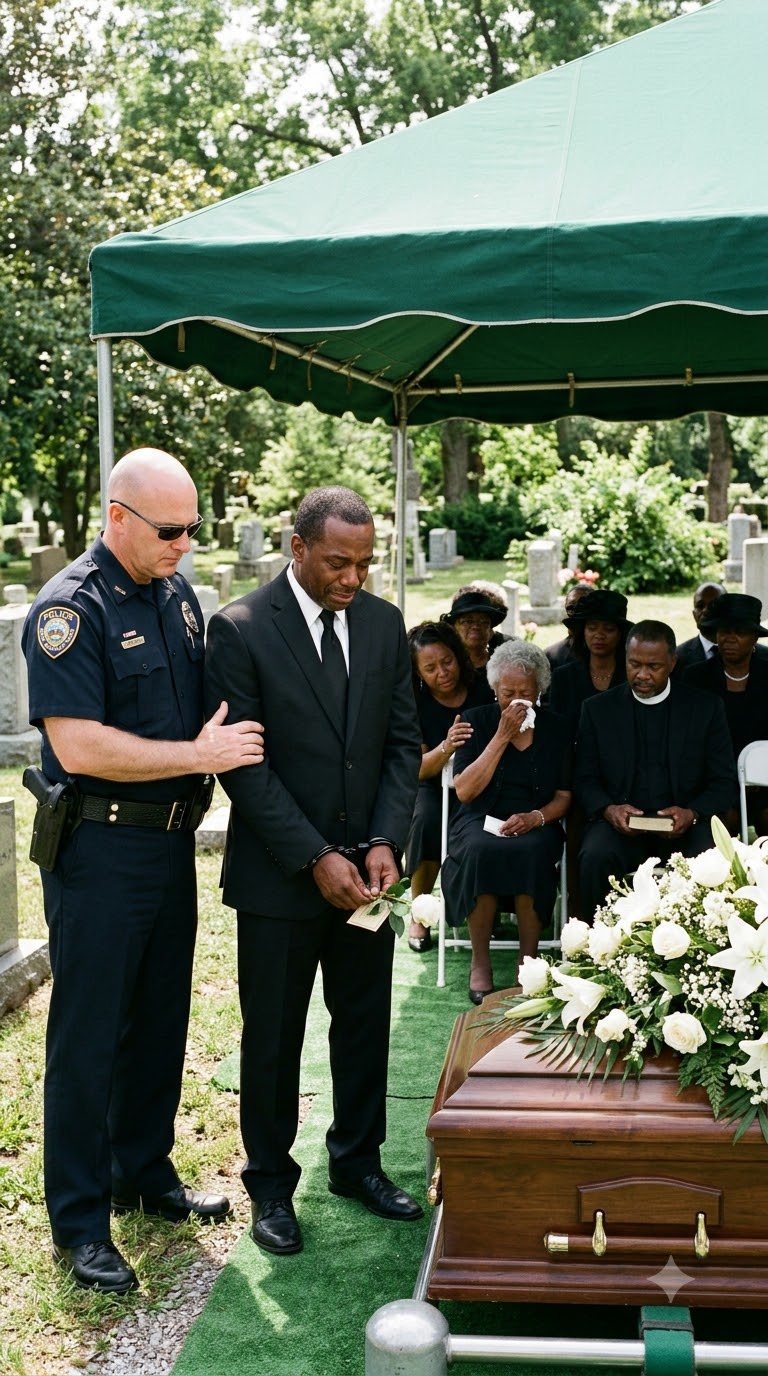
That morning the Georgia heat had no mercy.
It sat heavy over Bellview Memorial Cemetery, pressing down on the black suits, the folded programs, the white chairs, and the fresh grave waiting beneath a green canopy. The grass was bright enough to hurt the eyes. The air smelled like cut flowers, pine trees, and the kind of grief that makes people speak softly even when they have known each other for forty years.
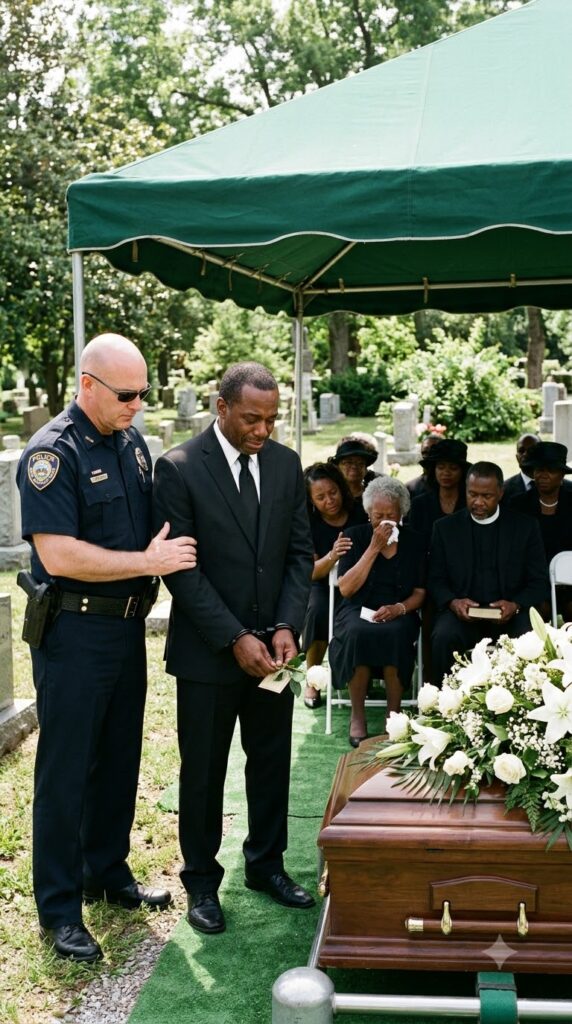
Adrian Cole stood at the front of his mother’s casket with a white lily in his hand.
His mother, Mabel Cole, had loved white lilies.
She used to say colored flowers tried to charm you, but white flowers came into the room already telling the truth. Adrian had driven across town before the service to find them fresh. It was a small thing, almost useless in the face of losing her, but grief often leaves people clinging to the last simple job they can still complete.
So he held the lily.
And he stood still.
Around him, nearly seventy people had gathered to say goodbye to Mabel Cole. Former students. Church members. Neighbors from East Bellview. Women who had cooked with her, prayed with her, argued with her at community meetings, and borrowed sugar from her kitchen like it was still 1987 and the world had not hardened so much.
They were not there out of obligation.
They were there because Mabel had been the kind of woman who turned ordinary rooms into places where people felt less alone.
His Aunt Lottie sat in the front row, thin shoulders straight beneath a black dress, a lace handkerchief clutched in one hand. She had not let go of Adrian’s sleeve since the first hymn started. Adrian let her hold on because he needed her hand there too, though he would not have admitted it out loud.
Reverend Samuel Reed stood near the casket with his Bible open.
He had baptized Adrian, buried Adrian’s father, and eaten at Mabel’s kitchen table more Sundays than anybody could count. His voice was low and steady as he read from Psalm 23, not performing grief, not decorating it, just carrying the words for everybody who could not carry them themselves.
“The Lord is my shepherd,” he said. “I shall not want.”
Adrian mouthed the words but did not say them.
Twenty-four years with the FBI had trained him to keep his face still in rooms full of danger. He had sat across from terrorists, informants, corrupt officials, frightened witnesses, and men who thought silence could make them innocent. He knew how to breathe through fear, how to listen through noise, and how to wait until a lie revealed the weak seam holding it together.
But he could not speak his mother’s favorite psalm at her funeral.
That was where the wall was.
So he stood with the white lily in his hand, staring at the photograph beside the casket. Mabel at sixty-eight, smiling in a blue church hat, reading glasses pushed up on her forehead, looking like she had just caught somebody in a foolish thought and was about to correct them with love.
Then tires rolled over gravel.
Slow.
Too slow.
Every head turned before anyone meant to.
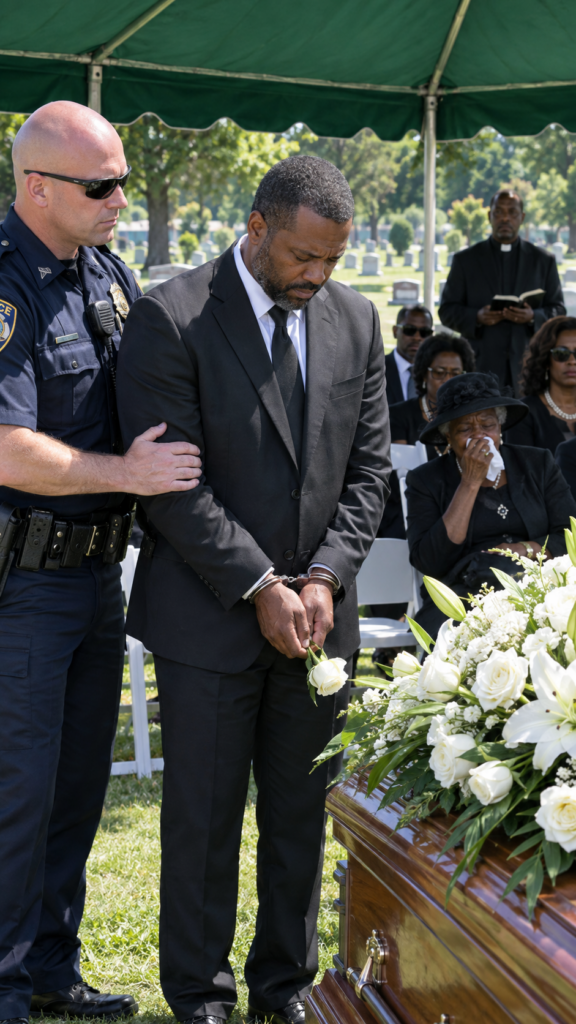
A Bellview Police Department cruiser moved along the cemetery lane and stopped near the outer row of chairs. The driver’s door opened, and an officer stepped out. He was broad through the chest, younger than Adrian expected, with a shaved head and a hand already resting on his belt like the cemetery had somehow become his scene to control.
His nameplate read BLEVINS.
Another cruiser stopped near the gate, but the second officer stayed beside it. He did not walk in. He simply stood there with both hands at his sides, his face blank in the way a man looks when he already knows something is wrong and has not decided whether courage is worth the price.
Reverend Reed kept reading for three more words.
Then he stopped.
Not by choice.
Wrongness had entered the service, and the whole cemetery felt it.
Officer Troy Blevins walked between the mourners without removing his sunglasses. He did not nod toward the casket. He did not lower his voice. He did not acknowledge the woman being buried, the family grieving, or the old people who had stood in the heat to honor her.
He stopped six feet from Adrian.
“Adrian Michael Ward,” Blevins said loudly. “Step forward. You have an active felony warrant.”
The words hit the crowd like a struck wire.
Someone gasped.
Aunt Lottie’s fingers dug into Adrian’s sleeve.
Adrian turned fully toward the officer, lily still in his right hand.
“My name is Adrian Cole,” he said evenly. “You are interrupting my mother’s funeral.”
Blevins pulled a folded paper from his vest pocket.
“Adrian M. Ward. Armed robbery. Cobb County. Black male. Mid-forties. That you?”
“No.”
“ID.”
Adrian moved slowly.
Not because he was afraid.
Because he knew exactly what frightened officers claimed when a Black man moved too fast. He shifted the lily into his left hand, reached inside his jacket with two fingers, removed his credential wallet, and opened it in front of the officer.
The gold badge caught the sun.
Federal Bureau of Investigation.
Senior Special Agent Adrian Cole.
His driver’s license was tucked beside it.
Adrian Marcus Cole.
Not Ward.
Not robbery suspect.
Not the man on that paper.
Blevins looked at the badge.
One second.
Two.
Three.
Then he said the sentence that made the mourners go silent in a different way.
“Badges can be fake.”
Aunt Lottie made a sound that was half pain, half disbelief.
Reverend Reed stepped forward with his Bible pressed to his chest.
“Officer, this man is Mabel Cole’s son. He is an FBI agent. He has shown you identification. I am asking you, respectfully, to step back and let this family bury their mother.”
Blevins did not even look at him.
His eyes stayed on Adrian.
“Turn around.”
Adrian held his gaze.
“Officer Blevins, think carefully about what you are doing.”
“I said turn around.”
The crowd shifted.
Phones came out.
Not because anyone wanted to film a funeral.
Because everybody knew the moment had left decency behind and entered evidence.
Adrian looked once at his mother’s casket.
Only once.
Then he turned around.
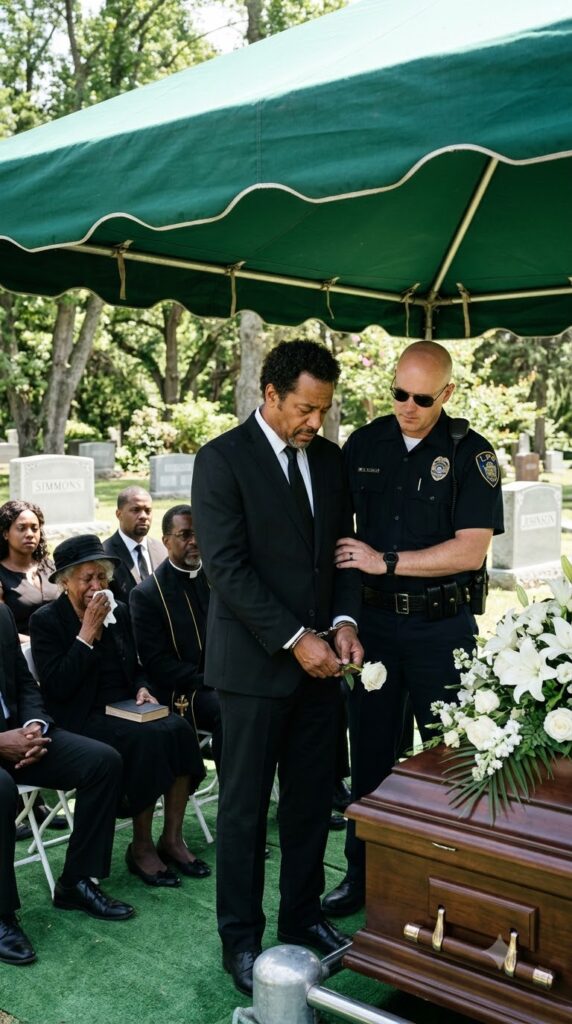
The white lily slipped from his fingers and landed on the grass.
The handcuffs clicked around his wrists.
That sound was louder than the hymn had been.
Louder than the psalm.
Louder than Aunt Lottie saying his name like a prayer that had broken in the middle.
Blevins took him by the arm and started walking him toward the cruiser.
Adrian did not resist.
He did not give the officer a movement to reinterpret.
He did not let anger become useful to the wrong man.
Behind him, Reverend Reed said, “We will stay.”
Blevins glanced back.
The reverend lifted his chin.
“We will stay until this service is finished.”
Adrian kept walking.
He did not look back again.
If he saw his mother’s casket while being led away in handcuffs, something inside him would crack open, and he would not give Blevins the satisfaction of seeing it.
The ride to the precinct took nine minutes.
Adrian counted every one.
Not because he was calm.
Because counting gave his mind something straight to hold while the rest of him processed the fact that his mother was being buried without him. The cruiser smelled like stale vinyl, dust, and cheap pine air freshener. Blevins drove with one hand on the wheel and said nothing.
Adrian said nothing either.
Bellview Police Headquarters was a low brick building beside a pawn shop and an insurance office. The flag outside hung limp in the heat. Inside, the air-conditioning was too cold, and the lobby smelled like burned coffee that had been reheated too many times.
Blevins walked Adrian through the front door with the cuffs still locked behind his back.
The desk sergeant looked up.
His nameplate read CARTER.
Sergeant Ellis Carter was old enough to have seen mistakes repeat under different badges. His eyes moved from Adrian’s suit to the cuffs, then to the property bag Blevins placed on the counter. The credential wallet sat inside, visible through the clear plastic.
Carter looked at it.
Then at Blevins.
“Run the warrant photo.”
Blevins frowned.
“I already confirmed the match.”
“Run it anyway.”
The room went quiet in the way small police departments go quiet when one officer starts questioning another in front of a detainee.
Blevins moved to the computer and typed with short, irritated strokes.
The warrant photo appeared a minute later.
Adrian M. Ward was forty-six, five feet nine, with a thick neck tattoo curling from his collarbone to behind his ear. His booking photograph showed a man who shared Adrian’s first name, middle initial, race, and approximate age.
That was the end of the resemblance.
Carter stared at the screen.
Then he looked at Adrian.
Then back at Blevins.
“Troy,” he said quietly, “that is not this man.”
Blevins crossed his arms.
“Close enough for field detention.”
“His license says Cole.”
“IDs get forged.”
“His federal credentials—”
“Those get forged too.”
Carter removed his glasses slowly.
Adrian saw the conflict move across the older man’s face. He knew that look. It was the look of a person standing at the doorway between comfort and conscience, measuring what it would cost to walk through.
Blevins pointed toward the holding area.
“Process him until Cobb confirms.”
Carter did not move immediately.
Then he looked at Adrian.
“I’m sorry,” he said under his breath.
It was not enough.
But it was something.
They put Adrian in a small interview room with a metal table, two chairs, and a frosted window that blurred the hallway into pale movement. Nobody removed the cuffs. He sat carefully, shoulders forward to relieve the pressure on his arms.
The metal bit into his wrists.
The room was cold.
His mother was in the ground.
He thought about the lily in the grass.
He thought about Reverend Reed finishing the prayer without him.
He thought about Aunt Lottie’s hand, empty now, no longer gripping his sleeve.
He breathed in.
Held.
Released.
The same way he had breathed before raids, before testimony, before walking into rooms where every exit mattered.
Outside, a phone rang.
Someone laughed at a joke.
A printer jammed.
The world continued with casual cruelty.
At 11:38 a.m., the phone on Blevins’s desk rang.
He let it ring twice before answering.
“Officer Blevins, Bellview PD.”
A woman’s voice answered, controlled and cold enough to change the temperature of the room.
“This is Special Agent in Charge Andrea Lawson, FBI Atlanta Field Office. You are currently holding Senior Special Agent Adrian Cole, badge number 3826, Counterterrorism Division.”
Blevins stood up so fast his chair rolled back.
“You need to release him immediately,” Lawson continued. “And Officer Blevins, listen carefully. That was not a suggestion. This call is being logged.”
Blevins looked across the room at the property bag.
The credentials were there.
They had always been there.
Federal Bureau of Investigation.
Senior Special Agent Adrian M. Cole.
He swallowed.
“We were verifying—”
“No,” Lawson said. “You were compounding.”
The line went dead.
Two minutes later, the interview room door opened.
Blevins stepped inside with Carter behind him.
Adrian remained seated, wrists cuffed behind him.
Blevins moved around the table and unlocked the cuffs.
His hands were not steady.
Adrian brought his arms forward slowly, rolled his shoulders once, and looked down at the red marks around both wrists. The skin had broken near his right thumb.
He stared at the marks.
Not in shock.
In documentation.
When he stood, Blevins seemed smaller than he had at the cemetery.
Adrian straightened his jacket and walked to the property counter. Carter slid the bag across to him without speaking. Adrian removed his wallet, phone, keys, and the folded funeral program someone had taken from his pocket.
He placed everything carefully where it belonged.
Then his eyes found the warrant sheet on Blevins’s desk.
Adrian M. Ward.
Armed robbery.
Cobb County.
He read the timestamp near the top.
6:31 a.m.
The funeral had started at ten.
Someone had pulled that warrant more than three hours before Blevins walked into the cemetery.
Someone had selected it.
Printed it.
Carried it.
Used it.
This had not been a mistake born in the moment.
It had been prepared.
Adrian looked at Blevins.
Blevins looked away first.
“I need to bury my mother,” Adrian said.
Then he walked out into the hard Georgia sunlight.
Outside the precinct, the heat hit him so quickly it felt almost personal.
He stood on the steps, blinking against the brightness, suddenly aware that he had no car, no escort, no lily, and no way to return to the hour that had already passed without him.
His phone buzzed.
A message from Reverend Reed.
We are waiting.
Adrian stared at the words.
Then the phone rang.
The reverend did not greet him.
“I’m coming to get you,” he said. “Don’t argue with a preacher today.”
Adrian almost smiled.
Almost.
Fifteen minutes later, Reverend Reed pulled up in Adrian’s rental car. He got out, looked at Adrian’s wrists, and said nothing for a long moment. Then he placed one hand on Adrian’s shoulder.
“She went home right,” the reverend said. “We spoke every word. We sang every song. Nobody left.”
Adrian nodded once.
That was all he could manage.
They drove back to the cemetery in silence.
Mabel’s grave was covered in white flowers.
Someone had found Adrian’s lily and laid it across the center.
He stood at the foot of the grave with his hands at his sides, wrists aching, face still.
For the first time all day, there was nobody watching him.
So he let his head bow.
The prayer he gave his mother had no words.
Later, at Mabel’s house, the kitchen was full of food.
Foil-covered pans covered the counters. Fried chicken, green beans, cornbread, potato salad, sweet tea, peach cobbler, lemon cake. The neighbors had done what Black church neighbors do when grief enters a home: they fed every surface until the house itself seemed less lonely.
Aunt Lottie sat at the table with her purse still in her lap.
“She was worried,” she said.
Adrian looked at her.
“About what?”
“The East Quarter.”
He knew the neighborhood.
Shotgun houses, old brick storefronts, porches with blue ceilings, oak trees older than anybody living under them. Mabel had taught school there for thirty-one years. After retirement, she spent more time in the East Quarter than she did at home, helping families fill out forms, organize petitions, and keep city notices from disappearing into confusion.
“She said the city was pushing people out,” Lottie continued. “Code violations, condemnations, letters nobody understood. Folks who owned their houses free and clear getting told the porch was unsafe or the wiring was illegal or the whole house needed to be vacated.”
Adrian sat down slowly.
“Why didn’t she tell me?”
Lottie’s eyes softened.
“She didn’t want you coming home angry and dangerous.”
“She should have.”
“She knew that too.”
His phone buzzed.
Unknown number.
He answered.
The voice on the line was young, low, and shaking.
“Agent Cole?”
Adrian went still.
“Who is this?”
“Deputy Miles. I was at the cemetery gate today.”
The second officer.
The one who had stayed back.
“I’m listening,” Adrian said.
“The call Blevins got this morning did not come from dispatch. It came to his personal phone. I saw the screen before he answered.”
Adrian reached for a pen.
“From who?”
A pause.
Then a whisper.
“Chief Weller’s office.”
The line clicked dead.
Adrian sat there with the phone still against his ear.
Across the kitchen, Aunt Lottie watched him.
“What is it?”
Adrian looked toward the window, where his mother’s backyard stood quiet in the afternoon heat.
“I think they used the funeral to send a message.”
That night, Adrian opened his laptop at Mabel’s kitchen table.
He began with the warrant.
Then Bellview PD.
Then Chief Harold Weller.
Then the East Quarter redevelopment plan.
He worked the way he had worked cases for half his life: slow, clean, chronological. Public records first. News archives. City council minutes. Property transfers. Arrest logs where available. Contractor filings. Campaign donations.
The first pattern took forty minutes.
The second took two hours.
By midnight, he had seven names.
Seven Black residents or organizers from the East Quarter.
All arrested at public moments.
One at a zoning hearing.
One outside a church fundraiser.
One before a tenant meeting.
One during a city council protest.
One the morning she was supposed to deliver a petition with 800 signatures.
Different charges.
Different officers.
Same result.
Humiliation first.
Charges dropped later.
By then, the moment had passed.
The speaker removed.
The meeting disrupted.
The room chilled.
Adrian created a new document.
At the top, he wrote:
What they did to my mother’s neighborhood.
Then he added a second line.
How they made silence look legal.
The next morning, Adrian went to the East Quarter.
Not with a badge out.
Not with federal posture.
On foot.
Listening.
He walked past the boarded barber shop where Mabel used to buy raffle tickets for church fundraisers. Past the community garden that had been flattened behind a fence marked unsafe structure. Past the old blue house where a city notice had been taped to the door even though the porch looked stronger than half the new decks in Bellview’s suburbs.
He knocked on doors.
People knew him before he introduced himself.
“You Mabel’s boy.”
Not a question.
A fact.
In kitchens and on porches, they told him what had been happening.
Not all at once.
People rarely hand pain over neatly.
They circled it first. Tested him. Offered coffee. Asked about Mabel. Cried without calling it crying. Then the stories came.
Mr. and Mrs. Ellis had been forced into a weekly motel after the city condemned their home for “foundation instability.” Adrian walked the house himself from the sidewalk. No visible sag. No cracks. No temporary bracing. The contractor’s report had used the wrong address twice.
A barber named Darnell Pike had his shop padlocked after he announced a neighborhood legal clinic.
A retired nurse named Celia Knox was arrested for “interfering with city personnel” while asking inspectors for paperwork on her own porch.
Mabel had visited all of them.
She had written everything down.
At two o’clock, Adrian sat across from Councilwoman Denise Rowe in her small office above a tax preparation business.
Denise Rowe was in her fifties, sharp-eyed, exhausted, and completely unsurprised to see him.
“I wondered how long before Ruth’s boy came knocking.”
“Her name was Mabel.”
“I know that,” Denise said. “But everybody in the East Quarter called her Miss Mabel when she was teaching and Miss Ruth when she got to fussing like somebody’s auntie. She had range.”
Despite himself, Adrian smiled.
Denise opened a filing cabinet and pulled out two thick folders.
“I’ve been trying to force an audit of Chief Weller’s department for eighteen months. Every motion gets buried. Every request gets delayed. Every complaint comes back inconclusive.”
She dropped the folders on the desk.
“Weller’s brother-in-law owns a development company called Brighton Crown. Brighton Crown is set to make a fortune when the East Quarter is cleared for the Meridian Square project.”
Adrian opened the first folder.
“What kind of fortune?”
“Fifteen million on phase one alone.”
“And the council?”
Denise’s mouth tightened.
“Three bought. One scared. Two trying. Me included.”
She turned her computer monitor toward him.
“Now look at this.”
The login audit showed a warrant database query at 6:31 a.m. the day of Mabel’s funeral.
User: HWELLER.
Chief Harold Weller.
Adrian stared at the screen.
The warrant had been pulled from the chief’s own credentials.
Denise’s voice softened.
“Your mother was writing letters. Making copies. Calling people. She knew enough to scare them.”
Adrian closed the folder.
“Show me everything.”
By evening, the outline was too clean to ignore.
Chief Weller.
Brighton Crown Development.
A shell consulting company tied to Weller’s wife.
Fake code violations.
Timed arrests.
Dropped charges.
Families forced out before appeal deadlines.
A redevelopment plan disguised as safety enforcement.
Adrian called Andrea Lawson at the Atlanta field office.
He laid it out without emotion.
The funeral arrest.
The wrong warrant.
The timestamp.
The chief’s login.
The East Quarter pattern.
The shell company.
His mother’s work.
When he finished, Andrea was quiet for several seconds.
“You know what I have to tell you.”
“I’m a victim and a witness.”
“Yes.”
“I’m recused.”
“Completely.”
“I’ll send you everything.”
“Adrian.”
He waited.
“I know what today cost you.”
“No,” he said. “You don’t.”
She did not argue.
Good supervisors know when apology becomes noise.
The next call went to Malcolm Pierce, a civil rights attorney who had known Mabel for thirty years and had eaten enough meals at her table to count as family.
He listened without interruption.
Then he said, “I’ve been waiting for the door to crack.”
“It cracked.”
“No,” Malcolm said. “They kicked it open themselves.”
By the next afternoon, Malcolm filed a civil complaint naming Blevins, Weller, and the city of Bellview.
Unlawful arrest.
Civil rights violations.
Retaliatory policing.
Conspiracy to suppress protected speech.
The complaint was public, precise, and impossible to ignore.
So Weller did what men like Weller do when light starts moving toward them.
He attacked the person holding the flashlight.
A state representative named Calhoun filed a formal complaint with the FBI’s Office of Professional Responsibility, claiming Adrian had abused his federal position to conduct a politically motivated investigation into local law enforcement after an “unfortunate misunderstanding” at a family funeral.
The phrase made Adrian almost laugh.
Unfortunate misunderstanding.
That was how systems washed blood out of the carpet.
Then Deputy Miles recanted.
Malcolm called at seven the next morning.
“They got to him.”
Adrian stood in Mabel’s kitchen, watching coffee drip into the glass pot she had owned longer than some agents had been alive.
“What did he say?”
“Signed statement. Says he was mistaken. Says Blevins received a standard dispatch notice and acted in good faith.”
“He has kids.”
“Yes.”
“Mortgage?”
“Probably.”
“Pension?”
“Definitely.”
Adrian closed his eyes.
“He’s scared.”
“So was everybody else they arrested,” Malcolm said.
That was not anger.
That was context.
Adrian went back to the records.
If Deputy Miles had seen the call, something else might have seen it too.
Phones synced.
Car systems logged.
Smartwatches collected more truth than people realized.
Bellview PD had issued wellness trackers six months earlier as part of an officer fatigue program funded by a county grant. Blevins wore one at the cemetery. Miles wore one too. Adrian remembered the dark band on his wrist near the gate.
He called Malcolm.
“Subpoena the wearable device sync logs.”
There was a pause.
Then Malcolm said, “Lord have mercy.”
“Data does not get scared.”
“Not unless Weller knows how to delete it.”
“If he did, Miles would not have needed to recant.”
The subpoena went out by noon.
The logs came back faster than expected because the city’s own vendor responded before Bellview’s attorney understood what had been requested.
At 7:52 a.m., Blevins’s device logged an incoming call notification from a number assigned to the chief’s executive assistant.
At 7:53, the device recorded an elevated heart rate.
At 7:54, Blevins opened the warrant image on his department phone.
At 10:07, he entered the cemetery.
Adrian read the sequence twice.
Then he called Malcolm.
“That’s the chain.”
“It is,” Malcolm said.
The first city council meeting drew more people than Bellview’s fire code probably allowed.
East Quarter families filled every seat. Church members stood along the walls. Reporters waited near the back. Councilwoman Denise Rowe sat at the dais with her hands folded, her face controlled, but her eyes bright with the kind of anger that had learned patience.
Chief Weller sat in the front row.
Not the back.
That was intentional.
He wanted everyone to see him unbothered.
He had the thick neck, silver hair, and smooth stillness of a man who had spent years making other people nervous by doing nothing more than sitting down.
At 7:12, Denise called Adrian to the podium.
He walked up without notes.
He had prepared them.
Then left them in the car.
Some truths do not need paper when they have been sitting inside your chest since your mother’s burial.
He began with names.
Celia Knox.
Darnell Pike.
Gerald Ellis.
Monique Brewer.
Terrence Hall.
Nadine Cooper.
Levi Grant.
Seven people.
Seven arrests.
Seven public moments interrupted.
Seven charges later reduced, dismissed, or quietly abandoned.
Then he described the East Quarter condemnations, the Meridian Square development plan, the shell company payments, the warrant pull at 6:31 under Weller’s login, and the wearable device logs showing Blevins received the call before the funeral.
He never raised his voice.
That made the room listen harder.
Then he said his mother’s name.
“Mabel Cole wrote three letters to this council in the month before she died. She asked why homes were being condemned without meaningful appeal. She asked why residents who objected were being arrested. She asked why a neighborhood that had survived storms, recessions, neglect, and time itself was suddenly being called unsafe right before a developer showed up with money.”
He looked across the council.
“None of you answered her.”
The room went still.
Adrian looked toward Weller.
“So they came to her funeral and arrested her son.”
Weller’s jaw tightened.
Just enough.
The motion for an independent audit passed by one vote.
Four to three.
The room erupted.
People cried, clapped, hugged, shouted, prayed.
For the first time in years, the machine looked breakable.
Then, two days later, one councilman changed his vote.
His name was Peter Sloane, and he claimed procedural concerns. His revised statement used language taken almost word for word from Brighton Crown’s legal filing. The audit was suspended pending review.
By noon, the Georgia Ledger ran a story with the headline:
FBI Agent Turns Mother’s Funeral Into Political Attack On Local Police.
Adrian read it in Mabel’s kitchen.
The article painted him as grieving, unstable, and opportunistic. It described Blevins’s arrest as a reasonable mistake. It quoted unnamed city officials claiming Adrian had used federal intimidation to pressure council members.
Andrea Lawson called ten minutes later.
“OPR complaint is active again.”
“I saw the article.”
“The director’s office is asking questions.”
“About my conduct?”
“About the optics.”
Adrian looked at Mabel’s refrigerator, still covered with church magnets, grocery lists, and a photo of him graduating from Quantico.
“Optics are what guilty people call truth when they don’t like the angle.”
“I agree,” Andrea said. “But I need you to sit still.”
He hated that.
Mostly because she was right.
That evening, Adrian sat on Mabel’s kitchen floor with his back against the lower cabinets.
He did not know how long he had been there when the light changed.
Everything was cracking.
Miles had recanted.
The audit had stalled.
The newspaper story was spreading.
The OPR complaint threatened to stain the work before the work could stand.
And Mabel was gone.
He got up because the floor was hurting his back and because his mother would have said grief did not excuse bad posture.
In her bedroom, he found her Bible on the nightstand.
It was old, soft at the spine, full of notes, receipts, pressed flowers, and church bulletins used as bookmarks. He picked it up because he wanted something her hands had held.
The back cover opened.
A small USB drive was taped inside.
Adrian stood there for a long time.
Then he carried it to the kitchen.
The folder on the drive was titled:
East Quarter Receipts.
Inside was the case Mabel had built.
Not like an agent.
Not like a lawyer.
Like a schoolteacher who understood that nobody could dismiss what was organized well enough.
Photographs.
Condemnation notices.
Names.
Dates.
Phone recordings.
City emails.
A spreadsheet of families forced out before appeal deadlines.
A scanned contractor report declaring the Ellis home structurally unstable, placed beside three photos Mabel had taken the same week showing a solid foundation, no cracks, and new support beams.
Then Adrian found the audio file.
He pressed play.
Mabel’s voice filled the kitchen.
“I’m asking for the appeal process in writing. These families have rights.”
A man answered.
Adrian recognized Chief Weller immediately.
“Mrs. Cole, I’m going to say this one time. The East Quarter project is not your concern.”
“These are my neighbors.”
“They are obstacles.”
A pause.
Mabel’s voice changed.
Not scared.
Disappointed.
“That is an ugly word for people.”
Weller laughed once.
“Keep filing letters if it makes you feel important. Nobody is reading them.”
“You read this one.”
Silence.
Then Weller said, lower now, “Your son works federal. That makes you think you’re untouchable. It doesn’t. Stay out of this before your family gets pulled into something embarrassing.”
The recording ended.
Adrian sat motionless.
There was one more folder.
Emails.
The second message from Weller to Brighton Crown’s owner, Martin Voss, was dated three days before the funeral.
The Cole woman’s son is coming in. FBI. If he starts asking questions, the East Quarter timeline becomes a problem. We need him discredited before he finds what she kept.
Voss had replied with one line.
Handle it before the burial.
Adrian read that sentence again.
Then again.
They had planned the cemetery.
The warrant.
The timing.
The humiliation.
All of it.
At 2:14 a.m., he called Andrea.
By nine the next morning, two black SUVs with federal plates stopped outside Mabel’s house.
Andrea Lawson arrived with two senior agents and U.S. Attorney Renée Caldwell from the Northern District of Georgia. They sat at Mabel’s kitchen table while Adrian showed them the USB drive, the audio recording, the emails, the warrant login, the wearable sync logs, the shell company records, and the arrest pattern.
Renée read the email twice.
Then set it down carefully.
“That is conspiracy.”
No drama.
No hesitation.
A legal conclusion landing with the weight of a door closing.
Andrea looked at Adrian.
“This is federal now.”
“I know.”
“You are out.”
“I know that too.”
“No side calls. No witness contact. No record pulling. No helping Malcolm in the background.”
He looked at her.
She softened only slightly.
“Your mother built this case. Let us carry it.”
Adrian looked around the kitchen.
At the grocery list on the fridge.
At the chipped blue mug beside the sink.
At the chair where Mabel used to sit and call him baby even after he had crossed fifty.
Then he nodded.
“Carry it right.”
For seventy-two hours, Adrian waited.
He fixed Mabel’s back step.
He patched the screen door.
He cleaned the gutters.
He found her old recipe box and cooked badly from it until Aunt Lottie came over, tasted the rice, and said, “Your mother would haunt you for less.”
Updates came in pieces.
Weller’s assistant cooperated.
She admitted Weller had pulled the warrant himself and told her to call Blevins before the service.
Deputy Miles was located in Alabama, not Tennessee like everyone first thought. Andrea offered protection. He asked for time to speak with his wife. He called back in thirty minutes and gave a full statement.
Peter Sloane, the councilman who flipped, had received a wire transfer from a consulting company tied to Brighton Crown two days before changing his vote.
Martin Voss’s accounts were frozen.
Brighton Crown’s development financing went under federal review.
The East Quarter condemnations were suspended.
Then, on Friday morning, Adrian sat at Mabel’s kitchen table and turned on the little television she used to watch during breakfast.
A breaking report interrupted the local weather.
Federal agents were outside Bellview Police Headquarters.
Footage came in live.
Black SUVs lined the curb.
Agents entered through the front and side doors.
At 8:22 a.m., Chief Harold Weller walked out of his own department in handcuffs.
Uniform pressed.
Face gray.
A man who had arranged for Adrian to be humiliated at his mother’s grave was now being led past his own officers while cameras recorded every step.
Officer Troy Blevins was arrested fifteen minutes later.
He was taken from his driveway before he could leave for shift.
By noon, Martin Voss surrendered through his attorney.
By afternoon, the Meridian Square project was dead.
Not delayed.
Dead.
A federal judge issued an emergency order freezing further condemnations and requiring independent inspections for every East Quarter property already marked unsafe. The Ellis family left the motel two days later. Their home passed inspection with minor repairs.
Celia Knox’s arrest record was vacated.
Darnell Pike got the padlock removed from his barber shop.
The community garden fence came down the following week.
Adrian watched the report until the screen blurred.
He turned the television off.
The kitchen went quiet.
Outside, the same Georgia sun lay across the yard.
The world did not look different enough for what had changed.
Two weeks later, Adrian returned to Bellview Memorial Cemetery before sunrise.
He brought white lilies.
The florist refused to take his money when she saw where he was going. She only wrapped the flowers in brown paper, squeezed his hand once, and said, “Tell Miss Mabel we said thank you.”
The cemetery was empty.
Quiet.
Soft with early light.
Adrian walked to his mother’s grave and stood for a long time before kneeling. The headstone was simple, just as she had wanted.
Mabel Louise Cole.
Teacher. Neighbor. Mother.
And beneath it, Aunt Lottie had chosen the line:
She kept the record.
Adrian placed the lilies carefully.
Then he told his mother everything.
That the East Quarter families were safe for now.
That Weller was in federal custody.
That Blevins would answer for the cuffs.
That her USB drive had done what every official meeting refused to do.
That her letters had been read at last.
That people now knew she had not been exaggerating, not meddling, not making trouble.
She had been telling the truth.
Finally, he apologized.
Not loudly.
Not in a speech.
Just as a son at a grave with nobody around to perform strength for.
“I should have come sooner,” he said.
The morning wind moved through the oaks.
It did not answer.
But it did not accuse him either.
His phone buzzed.
Andrea.
“OPR complaint is withdrawn,” she said. “No finding. No mark. The director wants to commend you formally when you return.”
Adrian looked at the lilies.
“Tell him to commend my mother.”
A pause.
“I think he will,” Andrea said.
Adrian ended the call and stood.
Bellview stretched beyond the cemetery, still imperfect, still wounded, still full of people who would have to fight for more than one news cycle to keep what was theirs. But the machine that had seemed untouchable was broken now. Not gone. Broken.
That mattered.
As he drove toward the East Quarter, the sun rose higher over the old houses, the porches, the brick storefronts, the garden that would be replanted, and the streets his mother had refused to let disappear quietly.
People would retell the story as a twist.
A cop arrested a man at his mother’s funeral.
Then learned he was FBI.
That version was easy.
It was satisfying.
It was also too small.
The truth was not that Blevins had arrested the wrong man.
There was no right man to drag away from his mother’s grave with a false warrant.
The truth was not that Adrian Cole had power.
The truth was that Mabel Cole had kept receipts when nobody powerful was watching.
She had listened to frightened neighbors.
She had saved notices, recorded calls, copied emails, photographed houses, and written down names. She had built a case from her kitchen table with a Bible, a cheap printer, and the stubborn belief that ordinary people deserved a record strong enough to survive official lies.
Adrian had spent his life chasing conspiracies in places far from home.
His mother had found one on the streets where she bought groceries.
In the end, the badge mattered.
The federal case mattered.
The arrests mattered.
But the first act of justice had not come from Washington, Atlanta, or any courtroom.
It came from Mabel Cole refusing to throw away one more notice, one more name, one more story someone powerful hoped would disappear.
That was what Adrian carried with him as he drove into the widening morning.
Not the humiliation.
Not the cuffs.
Not even the anger.
The lesson.
A quiet life is never small when it keeps the truth alive.
