

My mother is the kind of woman who apologizes for being sick.
That is the first thing anyone should understand about Helen Park. She is seventy years old and has spent nearly her entire life making sure she never inconveniences anyone. She apologizes when she is exhausted, when someone needs to drive her somewhere, when she requires medication, when she occupies a room, and sometimes even when she eats. For forty years, I have reminded her that she never needs to apologize for simply existing. She still does. Mom was raised by people who believed survival partly depended on never asking too much from anyone. Her parents came to the United States with almost nothing, and the lesson they passed down was simple: work hard, endure quietly, and never become another person’s burden.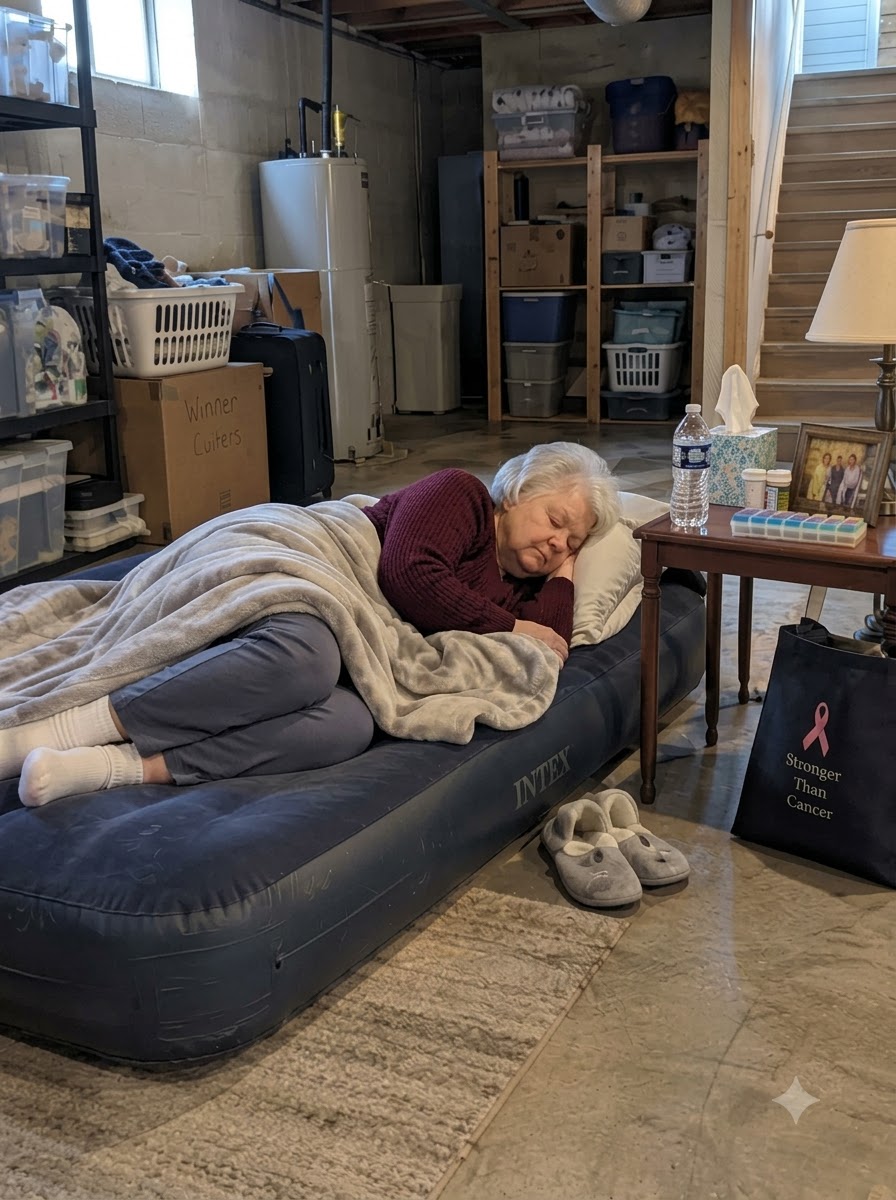
She followed that lesson so faithfully that even illness could not convince her she deserved care without feeling guilty. I understood its origin, but that never made it easier to watch. Every “sorry” sounded like proof that she still believed love had to be earned by making herself easy to care for.
My name is Sara Choi-Bennett. I am her daughter, and I had been married to Gabriel Bennett for nine years when Mom was diagnosed with stage-three breast cancer.
There was another reason her question about Gabriel bothered me. My full name is Sara Choi-Bennett. When Gabriel and I got married, he wanted me to become simply Sara Bennett. I kept Choi because it was part of me, part of my father, my mother, and the family history that existed long before my marriage. Gabriel thought the hyphen was unnecessarily complicated.
We compromised, or at least that was what I believed. Looking back, that early disagreement should have warned me. He was comfortable with compromise when the final result still leaned toward his preference. I spent years calling it personality instead of recognizing the pattern.
Her oncologist, Dr. Reyes, was straightforward. The treatment plan was encouraging, but the chemotherapy would be aggressive. Mom would need help.
“I’ll manage,” Mom said immediately.
“Mrs. Park, going through chemotherapy alone is not advisable,” Dr. Reyes replied.
“I’ve managed alone before.”
She had. My father had been gone for nineteen years, and Mom had built her life around needing as little as possible from anyone else. But this time, I refused to let her handle everything alone.
“You’re staying with me,” I said.
“Sara.”
“You’re staying with us.”
“I don’t want to be in the way.”
“You won’t be.”
Then she asked the question she was actually worried about.
“Gabriel?”
I told her I had already talked to him. Technically, that was true.
Gabriel had not been enthusiastic.
“How long is she staying?” he asked.
“As long as she needs.”
“I just want to know there’s an end date.”
“She has cancer, Gabriel. I cannot give you an end date.”
Eventually he sighed and said, “Fine.”
So Mom moved into the first-floor guest room. It was directly across from the bathroom, which was important because chemotherapy made stairs and long walks difficult. The room also looked out over our backyard garden, which Mom loved.
She arrived carrying one suitcase and a bag of medication and apologized for bringing both.
“Mom, bring whatever you need. This is your room.”
She carefully looked around.
“It’s nice.”
“It’s close to the bathroom.”
“That was thoughtful.”
“For the chemo.”
She nodded and, for once, simply said, “Thank you.”
Her first treatment lasted five hours. I stayed beside her the entire time. When the nausea began, she squeezed my hand and apologized.
“Stop saying sorry,” I told her.
“I don’t know how.”
That response hurt more than I expected.
The hardest part of those first treatments was feeling helpless. I could bring her tea, adjust a blanket, speak with the nurses, organize medications, and hold her hand when the nausea came. But I could not take the cancer from her body. During the final hours of one infusion, she slept while I watched the medication move through the line and thought about how much of her life I had never seen because she had always preferred carrying difficult things privately. Now she had no choice but to let me witness this. I decided that if being there was the only useful thing I could do, then I would be completely present.
Three weeks into treatment, I needed to travel to Seattle for four days of business meetings that had been scheduled long before the diagnosis. I prepared everything before leaving. I wrote Mom’s medication schedule on cards, filled the refrigerator with crackers, rice, broth, ginger tea, and applesauce, and texted Gabriel her appointment times.
“She takes the anti-nausea medication at eight in the morning and eight at night,” I reminded him.
“I know.”
“She will not ask you if she needs help. You have to check on her.”
“I’ll check on her.”
“Gabriel.”
“Sara, I’ve got it.”
I left because I believed him.
Each evening, Mom sent brief texts.
“Fine. Eating a little.”
“Slept okay.”
“Took the medication.”
Nothing seemed alarming.
Seattle required more concentration than I wanted to give it. The clients had paid for my attention, so during meetings I forced myself to stay mentally present instead of checking my phone every few minutes. At night, though, I read Mom’s short messages repeatedly. Her brevity reassured me because it sounded like her. She hated texting and never used five words when two would work. I also noticed Gabriel rarely volunteered updates. Whenever I asked, he said everything was fine. I accepted that because the alternative was imagining problems from hundreds of miles away while being unable to do anything.
On the fourth day, my final meeting ended four hours early. I changed my flight and decided to surprise them. I didn’t tell Gabriel I was coming back.
I landed around seven that evening. As I drove home, I was thinking about whether Mom needed more broth or ginger tea. Then I pulled into the driveway and saw Gabriel’s brother Danny’s car outside.
I assumed he had stopped by.
When I entered through the garage, the kitchen immediately looked wrong. Beer bottles covered the counter. An open bag of chips sat beside a half-eaten pizza, and a stain on the hallway carpet looked several days old.
Then I heard football playing on the television.
The sound came from the guest room.
My mother’s room.
I walked down the hallway and opened the door.
Gabriel was sitting on the bed. Danny was occupying the chair I had placed beside the window for Mom. Beer and snacks were scattered around them while a football game played loudly on the television.
Gabriel turned pale when he saw me.
“Honey. I didn’t know you were coming home early.”
I looked around once.
“Where is my mother?”
He hesitated.
“My brother came over, and we wanted to watch the game in here because there’s a television.”
“Where is my mother, Gabriel?”
“I moved her downstairs.”
I stared at him.
“The basement?”
“She’s comfortable down there.”
“This is her room.”
His expression hardened, as though becoming defensive could somehow make what he had done reasonable.
“No, it isn’t. It’s my room. This whole house is mine. I’m the man of the house.”
I said nothing. I turned around and went downstairs.
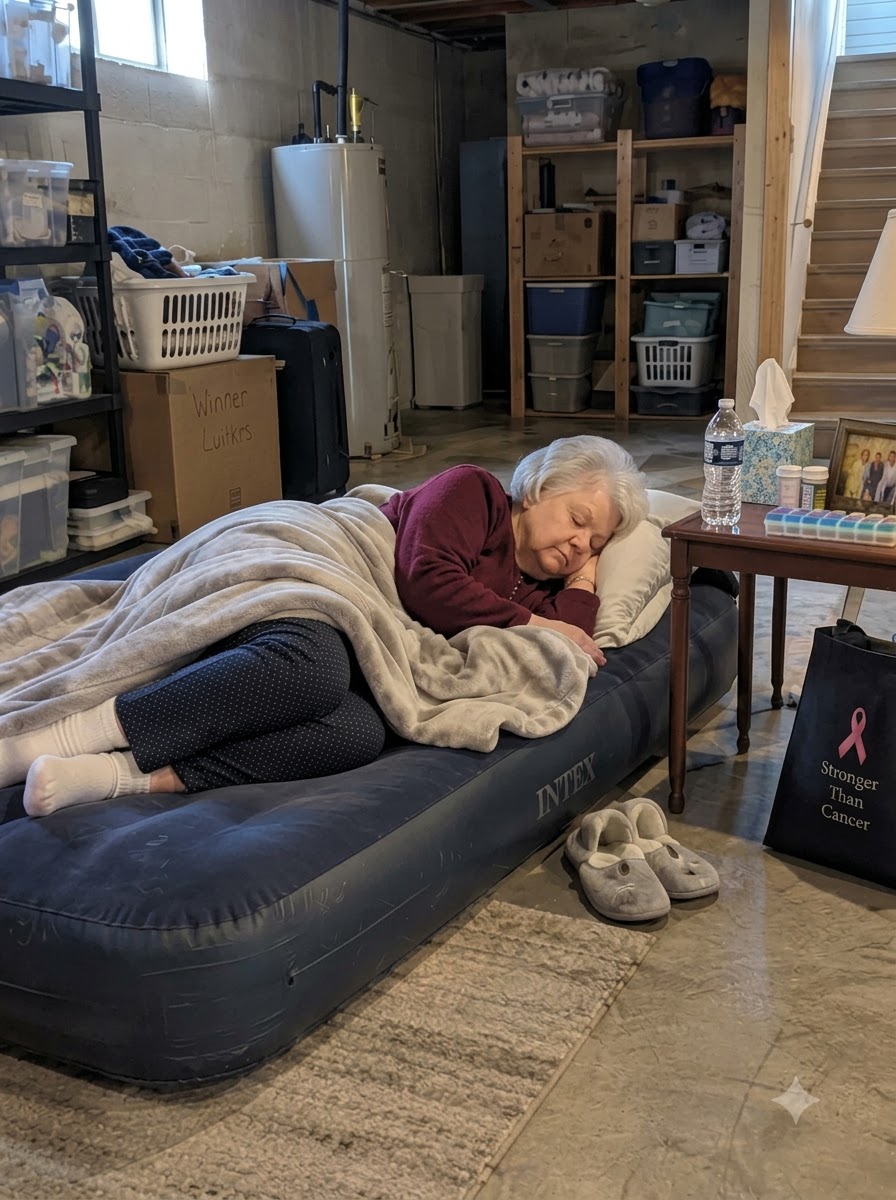
Our basement was technically finished, but nobody would have considered it a proper bedroom. There was no bathroom and no real window. It held storage, a laundry area, and the furnace.
An air mattress sat in the middle of the floor.
My seventy-year-old mother, only three weeks into chemotherapy, was asleep on it.
Her medication bottles were lying beside her on the floor.
What made seeing her downstairs even worse was knowing why every detail of the guest room had been arranged the way it was. The bathroom was only steps away because sometimes Mom had seconds of warning when nausea hit. The bed was high enough for her to stand without struggling. The chair by the window gave her somewhere to sit on days when lying down made her feel trapped. The basement had taken all of that away. To reach a bathroom, she would have to climb stairs. To get up from the air mattress, she would have to push herself off the floor. Gabriel had not simply changed where she slept. He had removed every small accommodation that made her treatment easier to manage.
I stood there, feeling something inside me turn cold.
Mom stirred and opened her eyes.
“Sara?”
“I’m here.” “You came home early.”
“Yes.”
Then, immediately, she said, “I’m sorry I’m down here.”
Of course she apologized.
“Gabriel said they needed the room. I didn’t want to cause trouble.”
“You did not cause anything.”
“Danny wanted to watch the game.”
“I know.”
“I can manage down here.”
That sentence nearly broke me because I knew she meant it. My mother could endure almost anything if enduring it meant nobody else had to adjust.
“You are not staying here.”
“Sara, what about Gabriel?”
“I’ll handle Gabriel.”
I helped her stand. She had lost weight during treatment, and the stairs exhausted her. She apologized as we climbed, apologizing for moving slowly and for needing my arm.
When we reached the guest room, Gabriel and Danny were still there.
I looked at Danny.
“Thank you for visiting. You need to leave now.”
He glanced at Gabriel.
Gabriel started to speak.
“Danny. Please leave.”
He stood and left without arguing.
Gabriel looked at me.
“Sara.”
“Get out of this room.”
“This is my house.”
“Leave the room, Gabriel.”
He studied my face, then walked out.
I helped Mom into bed, checked her medicine, and discovered she had missed a dose. I made ginger tea and sat with her while she drank it.
“I shouldn’t have let him move me,” she whispered.
“Mom, you have cancer. You are on chemotherapy. Managing Gabriel’s behavior is not your job.”
“He’s your husband.”
“Yes.”
“I don’t want to cause problems between you.”
“You didn’t.”
“He said the game was important.”
I stared at her.
“The game?”
She nodded.
“I didn’t want to be the reason for a fight.”
“You are never the reason for this fight.”
She looked tired.
“I’m not sure Gabriel sees it that way.”
“I know.”
When she finished the tea, she apologized again for my coming home to a mess.
“I’m glad I came home early,” I said.
“I would have been fine.”
“I know you would have managed. That is not the point.”
She looked at me.
“You do not have to manage everything alone anymore. You are allowed to need people.”
“It feels like weakness.”
“It isn’t weakness.”
“What is it, then?”
“It’s letting someone love you.”
She was quiet for a while.
“Your father always said I was terrible at that.”
“He was right.”
She smiled faintly.
“I’m trying.”
“I know.”
I stayed until she fell asleep, then went downstairs.
Gabriel was in the kitchen cleaning up some of the bottles.
“Sara, before you say anything, Danny called and wanted to come over. I didn’t know you were returning early.”
“I know.”
“I would have set things up differently if I knew.”
“That is exactly the problem.”
He frowned.
“What?”
“You would have behaved differently if you knew I was watching.”
“That’s not what I meant.”
“Yes, it is. You moved my seventy-year-old mother, who is receiving chemotherapy, out of the room I prepared for her and onto an air mattress in the basement because your brother wanted to watch football. You did it because you thought I would not find out for four days.”
“She was fine.”
“She was not fine.”
“She didn’t complain.”
“Gabriel, my mother has spent seventy years not complaining. She would probably apologize if you put her outside. Her silence does not make what you did acceptable.”
His jaw tightened.
“I’m the man of the house.”
There it was again.
“You are my husband,” I said. “You are not the man of the house in the way you mean it. We bought this house together. We both pay for it. We both own it. Being a man does not give you more authority than me.”
“I know she has cancer.”
“Then act like you know.”
“I do everything for this family.”
“You put a sick woman in the basement for football.”
“I needed the room.”
“For football.”
“Danny was here.”
“For football.”
He stopped arguing.
“My mother is staying here for as long as she needs treatment,” I said. “The guest room is hers while she is here. The bathroom across from it remains available to her. If you want to watch a game, use the living room.”
Then I added, “If you move her again, I will respond differently.”
“What does that mean?”
“I haven’t decided yet.”
“That sounds like a threat.”
“It is not a threat. It is information.”
“You’re being dramatic.”
“You moved a chemotherapy patient for a football game.”
“She’s your mother.”
“Yes,” I said. “Exactly. She is my mother.”
The next morning, I called Judith, my closest friend of fifteen years. She listened while I told her everything.
“What are you going to do?” she asked.
“I need to make a point Gabriel cannot argue with.”
“What kind of point?”
“He keeps saying this is his house. He says he’s the man of the house.”
“And?”
“I want him to understand exactly what this house is and what each of us contributes to it.”
“How?”
“I’m inviting someone to dinner.”
“Who?”
I told her.
Judith paused.
“Oh.”
Then she laughed softly.
“That is very elegant.”
“I thought so.”
My next call was to Patricia Greene, the real-estate attorney who had handled the purchase of our house nine years earlier. She knew exactly how the property was titled.
I explained what had happened.
“This is unusual,” she said.
“I know.”
“But it is legally straightforward.”
“I know.”
“You really want me at dinner?”
“He told me the house belongs to him. I want you to help me explain what the house actually is.”
“I can be there tonight.”
Judith understood immediately why I did not want another shouting match. I could argue with Gabriel for hours and he would reduce the argument to tone, anger, or a single bad decision. I needed something harder to reshape. I needed facts. Patricia was perfect because she had been sitting across the closing table when both of us signed the documents. She did not need my interpretation of our marriage to explain ownership. She only needed the deed. I also had years of financial records because I had always been the person who kept our household paperwork organized. For once, the invisible administrative work Gabriel barely noticed was going to make itself visible.
That afternoon, I stayed with Mom. She was having what we now called a reasonable day. She sat by the window watching me work in the garden. Later, while I prepared dinner, she sat at the kitchen counter.
“What are you making?”
“Gabriel’s favorite.” She lifted an eyebrow.
“You’re being nice to him?”
“I’m making dinner for guests.”
“Who?”
“A few people.”
“Should I stay in my room?”
“Absolutely not. You are sitting at the table.”
“Sara. Gabriel—”
“I have handled Gabriel.”
“How?”
“You’ll see.”
Gabriel arrived home at six and immediately noticed the table had been arranged for five.
“People are coming?”
“Yes.”
“Who?”
“Judith and Patricia Greene.”
His brow furrowed.
“The attorney who handled our closing?”
“Yes.”
“Why is she coming to dinner?”
“We have something to discuss.”
“About what?”
“The house.”
He fell silent.
Judith came first and quickly took the seat beside Mom, chatting with her about the garden. Patricia arrived at seven with a briefcase in hand. Gabriel recognized her at once.
“Patricia. It’s been a while.”
“Nine years,” she said.
“What brings you here?”
“Sara asked me to discuss something.”
He glanced at me.
“Let’s eat first,” I said.
Dinner was unexpectedly pleasant. Gabriel could be warm and charming when he wanted to be, which had always made confronting the other side of him more difficult. Mom ate more than she had in several days. Judith kept things easy and conversational.
After dinner, Patricia opened her briefcase and laid a document on the table.
Gabriel looked at it.
“What is that?”
“The deed to this property.”
“I know what a deed looks like.”
“I know. I prepared this one.”
She indicated the ownership section.
“When you and Sara purchased the property nine years ago, it was recorded as jointly owned property with both names on the deed.”
“Yes.”
“Equal ownership.”
“Yes, we know that.”
Patricia remained composed.
“Sara suggested there may be some confusion about it.”
Gabriel turned toward me.
“You told me this was your house,” I said.
“Sara.”
“You told me you were the man of the house and that your decision overruled mine.”
“I was angry.”
“You were asserting authority.”
“I didn’t mean it literally.”
Patricia answered before I could.
“Legally, neither spouse has unilateral ownership authority over jointly owned property.”
Gabriel leaned back.
“So this is about Helen going downstairs?”
“Yes.”
“It was one night.”
“One night was enough.”
Patricia continued. “Sara invited Helen into a designated guest room in a home Sara co-owns. Changing that arrangement without consulting Sara was not solely your decision to make.”
“Helen is a guest.”
“Yes,” Patricia said. “Sara is not.”
Gabriel was silent.
Then Patricia pulled out another document.
It was a financial analysis based on nine years of household records I had given her. It covered income contributions, mortgage payments, expenses, household administration, scheduling, logistics, and the estimated market value of the unpaid work required to maintain our life.
Patricia pointed to the total.
Gabriel stared at the figure.
“That isn’t how marriage works.”
“It becomes relevant when people start discussing ownership and the division of a marital estate,” Patricia said.
He went completely still.
“Division?”
“I have not filed anything,” I said.
“Then why is she here?”
“Because I need you to understand what this house is.”
“And what is it?”
“Ours.”
I let the word remain between us.
“Not yours. Ours.”
“Sara.”
“When you called yourself the man of the house, you were not merely using an expression. You were telling me that your preferences mattered more than mine.”
He lowered his eyes.
“I made a mistake.”
“Yes.”
“I handled it badly.”
“Yes.”
“Can we talk without the attorney here?”
Patricia stood immediately.
“I’ll give you privacy.”
Judith followed her into the kitchen.
Mom started to rise as well.
“Mom, stay.”
“Sara.”
“He needs to say this to you as well.”
She slowly lowered herself back into the chair.
Gabriel looked at her.
“Helen.”
“It’s all right,” she said automatically.
“No,” he replied. “It isn’t.”
For the first time, there was no defensiveness in his voice.
“I’m sorry.”
Mom nodded.
“I didn’t think about what I was doing.”
“I know.”
“I thought about what I wanted and not about what you needed.”
“Yes.”
He looked uncomfortable.
“I don’t know you very well.”
“No,” Mom said gently. “You don’t.”
Then she surprised me.
“You might know me better if you had spent the last three weeks paying attention.”
Gabriel looked down.
“You’re right.”
Mom continued, still calm.
“Sara chose a good man. I believe that man is still in there. But you let another version of yourself run this house while she was gone.”
“Yes.”
“Don’t do that again.”
She never raised her voice. She didn’t need to.
Gabriel nodded.
“I won’t.”
“I’m sorry, Helen.”
“I know.”
For the first time since her diagnosis, I saw Mom differently that night.
She had spent weeks apologizing for needing water, medicine, rides, meals, and a bed near a bathroom. Yet when Gabriel apologized without excuses, she did not shrink. She did not hurry to make him comfortable. She listened, responded, and told him not to repeat what he had done.
There was no cruelty in it, only certainty. I realized that taking up space did not require becoming loud or demanding. Sometimes it meant refusing to disappear simply so someone else could stay comfortable. Maybe that was what we were both learning: Mom was learning to accept care, while I was learning that equality required more than hoping someone would remember it.
Then Mom folded her hands and said, “Now let’s ask Patricia to come back so we can finish this like adults.”
I almost smiled.
Patricia returned, and we continued talking for another hour. No divorce papers were filed. No dramatic contract appeared. Instead, Gabriel and I reached a clear agreement about how the next several months would work.
Mom would remain in the guest room. Her medical needs would come first. Neither of us would make unilateral decisions about shared spaces. And the phrase “man of the house” would never again be used to justify unequal authority.
Gabriel did not like every part of the conversation, but he accepted it because he finally understood that the issue had never been one football game.
The real problem was the assumption beneath it: that his preferences were the default setting of our marriage and everyone else simply adjusted around him.
Patricia had not come to threaten him. The financial analysis was not revenge. I had only shown him something true after he repeatedly told me something false.
He said the house was his.
The deed said it was ours.
That single word was the entire lesson.
Ours.
Two people had bought it. Two people had maintained it. Two people had contributed to it, even when those contributions looked different on paper. Both were important.
After dinner, I walked Mom back to her room.
Her room.
On the first floor, across from the bathroom, with the window looking out over the garden.
She stopped at the doorway.
“Sara?”
“Yes?”
“You were always going to be all right.”
“What do you mean?”
“Even when you were little, you always figured out what was true and then said it.”
“You do that too.”
“Not like you.”
“You told Gabriel not to do it again.”
“That was easy.”
She smiled faintly.
“What you did tonight took nine years.”
I knew exactly what she meant.
“Goodnight, Mom.”
“Goodnight.”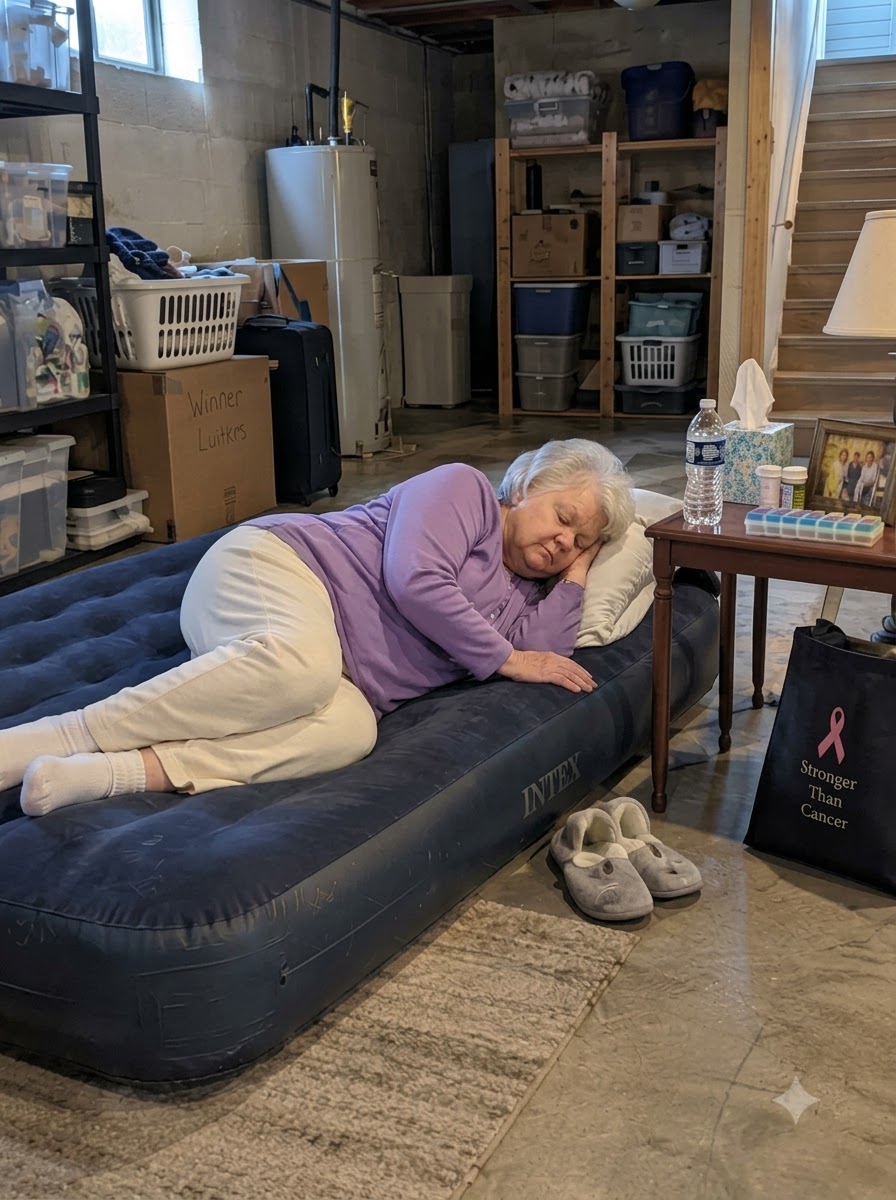
She went to sleep in the room I had promised belonged to her.
The next morning, I knew she would sit beside the window while I worked in the garden. She would probably tell me I was trimming something wrong. Maybe, eventually, she would stop apologizing for giving advice too.
That was what I hoped for.
Not some dramatic transformation.
Just a seventy-year-old woman slowly realizing that she was allowed to take up space.
One room at a time.
One meal at a time.
One suggestion at a time.
I went back to the kitchen.
GABRIEL WAS WASHING THE DISHES.
I stood beside him.
“I’m not your opponent.”
“I know.”
“I’m your wife.”
“I know.”
He paused while washing.
“I forgot what that meant.”
I waited.
“Not that I forgot you were my wife. I forgot what it means to have a wife instead of having a household that simply organizes itself around me.”
“Yes.”
“I’m sorry.”
“I know.”
He rinsed another plate.
“Patricia is extremely effective.”
“Yes.”
“Did she call you?”
“No. I called her.”
“How long had you planned tonight?”
“Since yesterday morning.”
“You built all of that in a day?”
“I already had the records.”
He looked at me.
“Why?”
“Because nine years of contributing to something deserves a record.”
“Even if you never thought you would use it?”
“Especially then.”
He gave me a small, tired smile.
“That is very like you.”
“I know.”
“I mean it as a compliment.”
“I know.”
He handed me the last plate, and I dried it.
Outside the kitchen window, the backyard was dark. I couldn’t see the garden, but I knew it was there.
In the morning, Mom would sit by the window.
I would go outside.
She would watch.
And the house would still be ours.
Every part of it.
That was the truth Gabriel had needed to understand.
And, finally, it was enough.
