

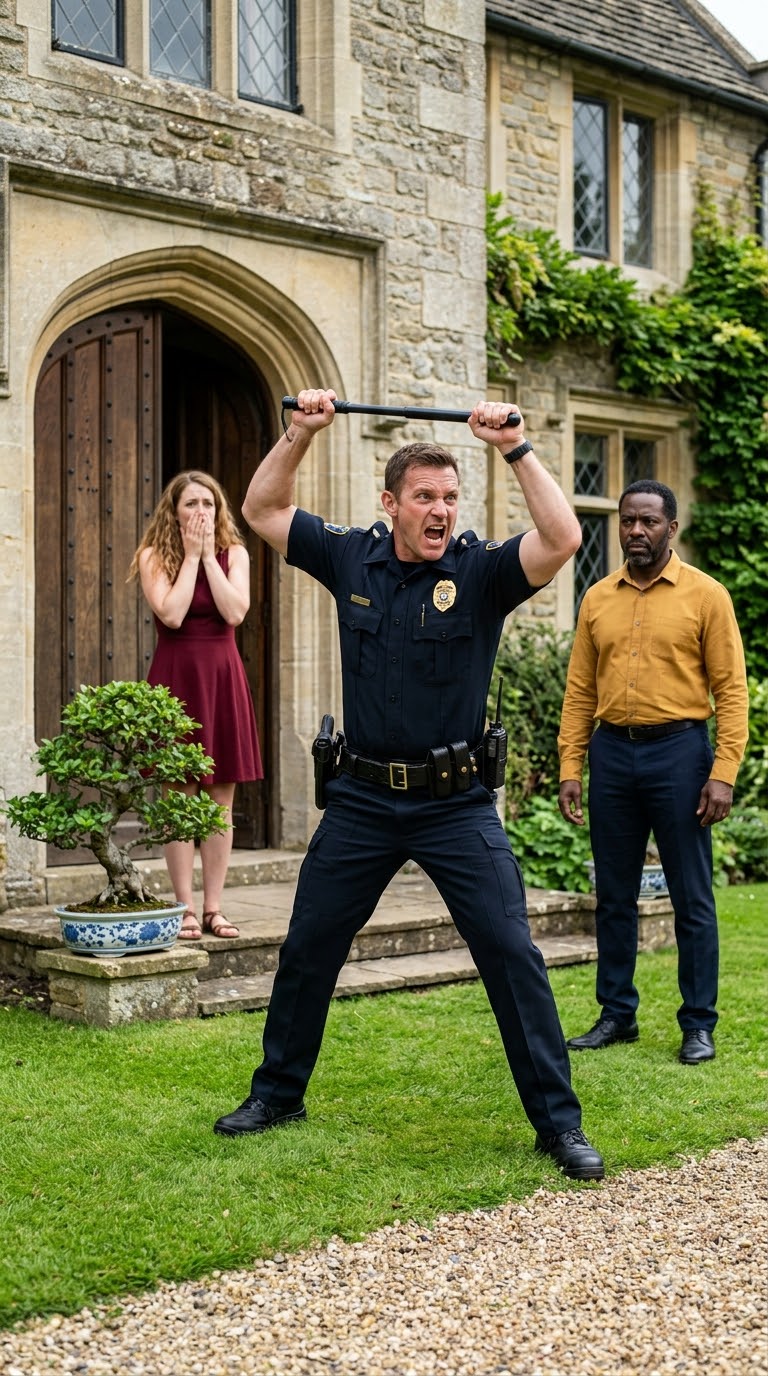
“That’s a violation,”
the officer declared, his voice saturated with condescension. “That has to go, right now. ” He pointed his baton, not toward the priceless ancient bonsai, but toward the man caring for it—a man whose skin color, in Briggs’s eyes, seemed incompatible with this neighborhood. He had no idea he wasn’t confronting some ordinary newcomer. He was provoking a sleeping giant who possessed the authority to bring his entire world crashing down with one phone call.
The morning sunlight was warm and gentle, bathing the meticulously maintained gardens of Oak Creek Estates in a golden glow. It was the kind of quiet, affluent neighborhood where the greatest disturbances were usually the faint hum of an electric lawn mower or the pleasant spray of a sprinkler across manicured grass.
That was precisely the peace Colonel Raphael Cain had been searching for.
Wearing a striking crimson silk shirt decorated with understated gold patterns, he knelt on a plush mat outside his new home. Every ounce of his attention was fixed on the masterpiece in front of him.
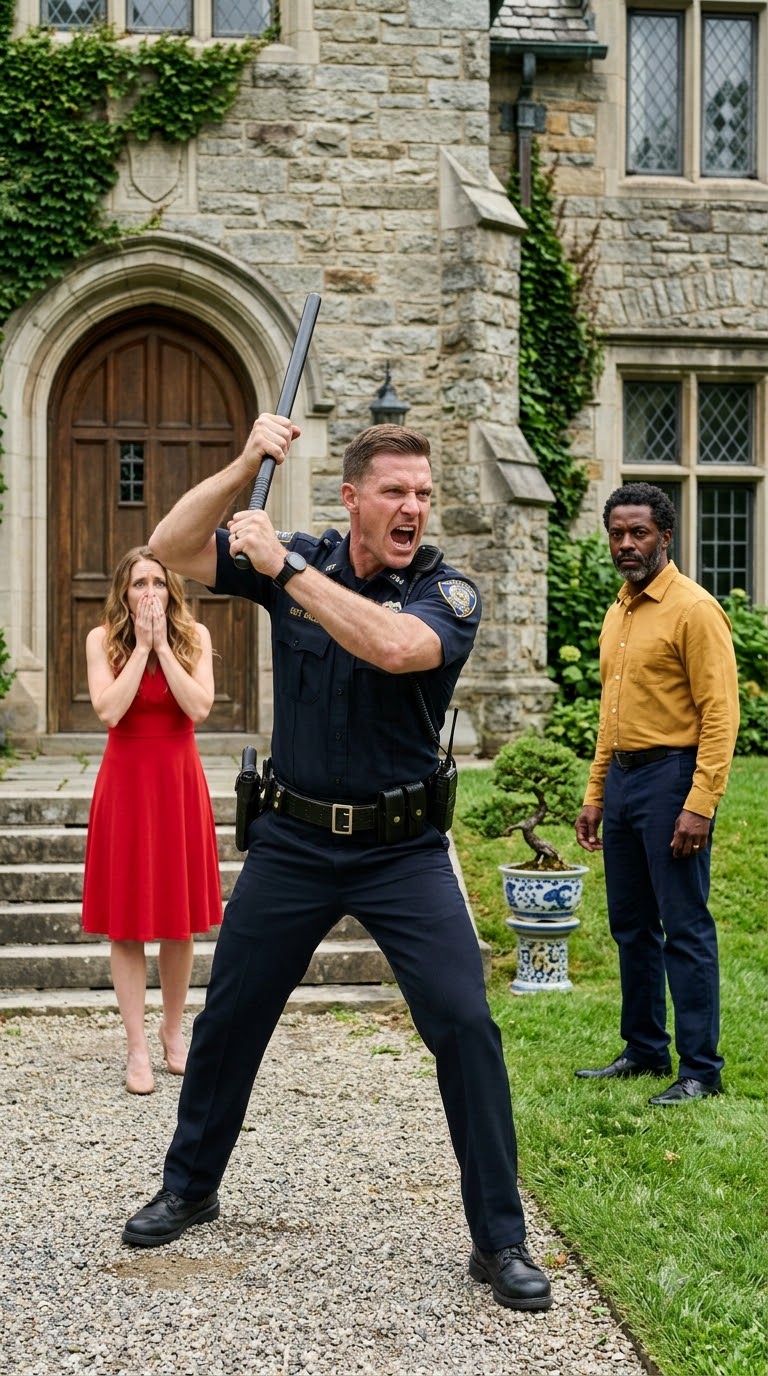
The bonsai was a Japanese black pine nearly a century old. Its twisted trunk and flawlessly sculpted branches represented decades of patience, discipline, and care. Cain had purchased it at an auction in Kyoto for an amount that would have made most of his new neighbors uncomfortable.
It wasn’t simply a plant.
It was meditation made visible.
Cain carefully clipped a loose needle, then placed the shears onto a soft cloth. A shadow suddenly crossed him.
He didn’t look up immediately.
He completed the cut with the same deliberate precision he would have used during a military procedure. Only afterward did he rise, his movements controlled and effortless, and turn toward the interruption.
A police officer stood on the immaculate stone pathway.
One hand rested against his holstered weapon in an apparently casual gesture that nonetheless carried an unmistakable suggestion of intimidation.
The nameplate identified him as Briggs.
He had a bulldog’s heavy build, a thick neck, and a face seemingly fixed in a permanent expression of contempt. But his attention wasn’t really on the tree.
It was on Cain.
His expensive shirt.
His dark skin.
His presence.
Everything about the man seemed to bother him.
“Good morning, officer. ” Kane said in a calm, deep voice carrying quiet authority.
“Is there something I can help you with? ”
Briggs ignored the greeting.
Instead, he tapped his baton against his thigh, creating an irritating rhythmic sound.
“We have a complaint. ”
Cain lifted an eyebrow.
“A complaint? I’ve only just arrived.
I haven’t even had the chance to bother anyone yet. ”
Briggs’s smile became tighter.
“That’s a matter of opinion. The complaint is about this. ”
He gestured toward the bonsai with his baton.
“It’s a violation of the Oak Creek Homeowners Association aesthetic code, section C, paragraph four. All front yard and porch decorations must be traditional American or European in style.
That is neither. ”
Cain nearly smiled at the absurdity.
He had studied the homeowners association bylaws thoroughly before purchasing the property. He had researched everything.
“Actually, officer, those bylaws were amended to allow botanical art of cultural significance, provided it is preserved and maintained. I have the documentation right here, signed by the association board president herself, if you’d like to see it. ”
Briggs’s face reddened.
He had expected resistance, perhaps confusion.
He had certainly not expected calm, articulate resistance.
“I’m telling you as a law enforcement officer that it’s a violation. ”
“I don’t need to see your documentation.”
“People in this neighborhood have certain preferences. They don’t appreciate a visual nuisance. ”
The word remained suspended between them.
Nuisance.
The people who were looking at the tree weren’t really seeing the tree.
Across the street, a curtain shifted.
Cain noticed his neighbor, Elanor Lang, watching from the window of her large colonial home before quickly disappearing from sight.
She understood exactly what was happening.
So did everyone else.
“I assure you the tree will be meticulously maintained,” Kane replied serenely, concealing the anger slowly gathering inside him. “It is an invaluable work of art and poses no threat to anyone. ”
Briggs gave a short, ugly laugh.
“Invaluable or not, it’s a twig in a pot, and I’m telling you it’s a problem. Your kind always thinks the rules don’t apply to them, moving into places where you don’t belong, believing you can do whatever you want. ”
The disguise was gone.
The HOA regulations had merely been an excuse.
Now the prejudice underneath them stood exposed.
Cain’s military training immediately took over.
Remain calm.
De-escalate.
Observe.
Reveal nothing.
His mind, the same mind that had briefed generals inside the Pentagon, began cataloging every detail.
Briggs’s posture.
The sweat above his lip.
The tension in his shoulders.
The whitening knuckles wrapped around his baton.
This was no longer a disagreement about neighborhood aesthetics.
It was an attempted display of authority.
“There is no violation, Kane said, lowering his voice slightly, stripping it of warmth until it became hard and steel-edged. You are trespassing on my property without cause. I am politely asking you to leave.”
For a moment, Briggs looked genuinely stunned.
His expression quickly changed to anger.
He wasn’t accustomed to being challenged.
Certainly not by someone he believed should have been intimidated by him.
He moved closer.
His large body invaded Cain’s personal space.
The smell of cheap coffee and stale cigarettes reached Cain.
“You’re asking me to leave.
Is that a threat? Are you threatening an officer?”
“I am stating a fact, Kane said, holding the officer’s gaze without blinking. You have no right to be here. Leave now.”
Briggs’s gaze shifted from Cain to the fragile bonsai.
Something changed behind his bloodshot eyes.
A cruel idea was taking shape.
He stepped beside the priceless tree.
“You’re right,” he said in a low growl. “There’s no violation here.
But there’s about to be.”
The atmosphere seemed to thicken.
Cain remained motionless.
Every instinct told him exactly what Briggs was preparing to do.
“You really don’t want to do this, officer,” Kane said in a low, dangerous voice.
It wasn’t a plea.
It was an assessment.
A final warning.
Briggs interpreted it differently.
It only intensified his rage.
“Oh, I really do. ”
The baton rose.
For one brief moment, sunlight reflected from its polished surface.
Then it came down.
The crack shattered the peaceful morning.
The ceramic pot exploded across the porch.
The ancient bonsai toppled violently onto the stone.
Briggs struck again.
The baton smashed into the main trunk.
Nearly a century of careful cultivation was destroyed in seconds.
A thick branch split with a sound disturbingly similar to breaking bone.
A collective gasp came from the surrounding homes.
Mrs. Lang appeared in her doorway, one hand covering her mouth.
Another neighbor stood frozen beside his vehicle, a running hose spilling water around his shoes.
They had witnessed something more than vandalism.
They had witnessed deliberate destruction.
Soil, moss, roots, and fragments of antique ceramic covered the immaculate porch.
The bonsai, once a symbol of harmony and patience, lay broken.
A priceless work of living art had been destroyed by a cheap baton wielded by a man whose hatred possessed no value whatsoever.
Cain didn’t move.
He didn’t shout.
His expression remained almost unnaturally calm.
Only his eyes revealed what was happening inside him.
Cold fury.
He looked down at the remains of the tree.
Then he slowly raised his gaze.
Briggs was breathing heavily.
His chest was inflated with satisfaction.
He believed he had won.
“There! ” Briggs gasped, pointing toward the wreckage. “Now it’s just trash. See? Problem solved. Maybe next time you’ll listen to a friendly warning. ”
Cain finally answered.
His voice was completely emotionless.
“You have just made the greatest mistake of your career, and possibly of your life. ”
For the first time, uncertainty flickered across Briggs’s face.
But retreat was no longer possible.
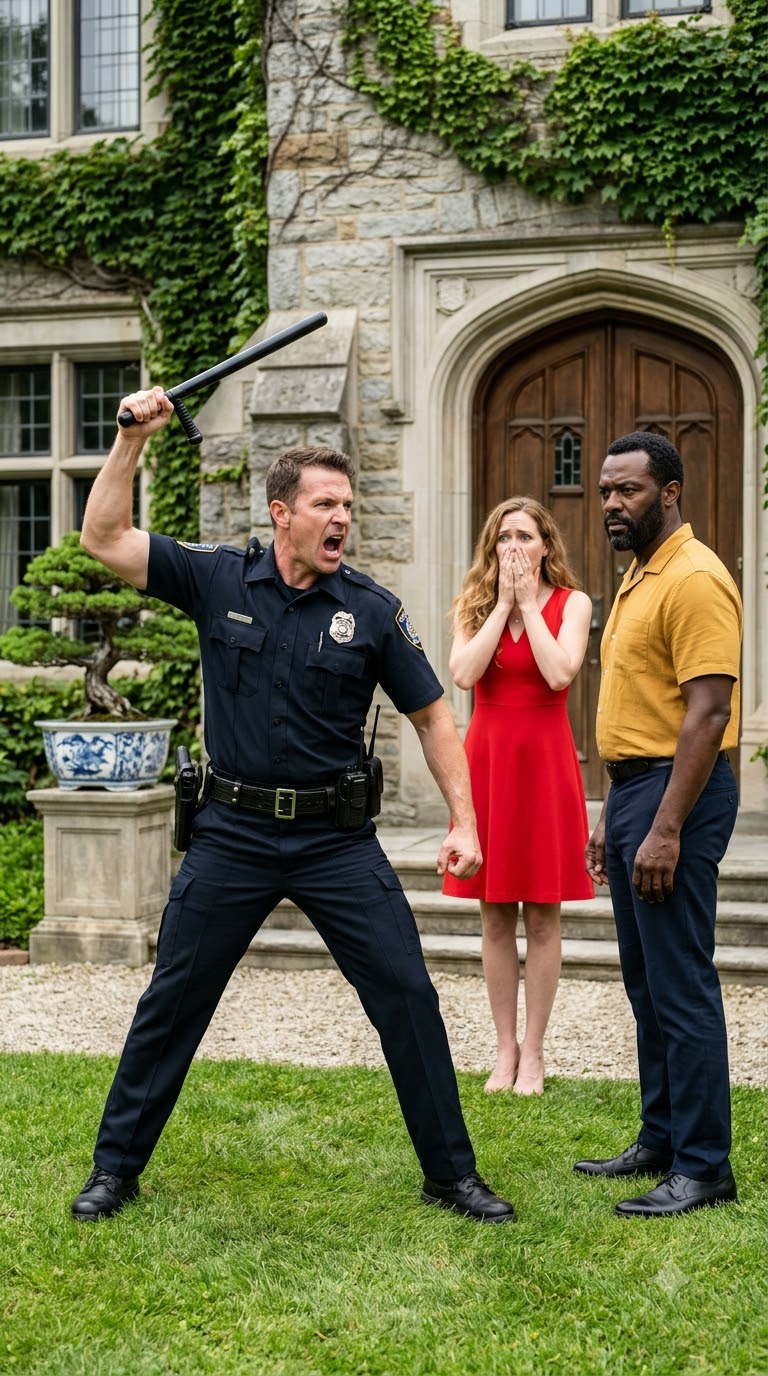
“That’s another threat.
I heard it. Threatening an officer. That’s it. You’re under arrest.”
Briggs seized Cain’s arm.
He twisted it behind his back and forced him against the porch pillar.
The crimson silk shirt tore at the seam.
The handcuffs snapped around Cain’s wrists.
“You’re arresting me? ” Cain asked as the cold metal tightened around his hands. “On what grounds? ”
“Resisting arrest, threatening an officer, maliciously destroying community harmony. ”
Briggs raised his voice so the neighbors could hear.
He was constructing a story.
He was turning himself into the hero.
“You have the right to remain silent. ”
Cain was shoved toward the patrol vehicle.
He stumbled slightly but immediately regained his balance.
His training prevented him from reacting physically.
He looked across the street at Mrs. Lang.
Her expression was filled with fear and shame.
She had seen everything.
They all had.
And none of them had intervened.
The patrol-car door slammed shut.
Briggs climbed into the driver’s seat and pulled away.
He hummed cheerfully as he drove, convinced that he had finally put the intimidating newcomer in his place.
He had no idea what he had actually done.
He had not broken Colonel Cain.
He had activated him.
The drive to Oak Creek Police Station was short.
The silence in the vehicle was interrupted only by Briggs’s satisfied whistling and occasional bursts of radio static.
Cain sat in the back with his cuffed hands resting in his lap.
He wasn’t thinking about the discomfort.
He wasn’t thinking about the torn shirt.
He wasn’t even thinking primarily about the bonsai anymore.
He was thinking.
His mind operated like a finely tuned strategic instrument.
Threats.
Evidence.
Witnesses.
Documentation.
Chain of command.
Potential legal violations.
Every element was being placed into a mental map.
The bonsai was no longer simply a destroyed possession.
It was evidence.
A catalyst.
A doorway into something much larger.
Briggs might have been the immediate offender.
But Cain suspected he was only one piece of a much larger system.
The station entrance was through a rear door.
Briggs avoided the public lobby and pushed Cain through a grimy corridor smelling of industrial cleaner, stale coffee, and exhaustion.
Fluorescent lights buzzed overhead.
“Got a live one here,” Briggs announced to the desk sergeant.
The sergeant barely looked up.
“What’s the charge this time, Briggs? ”
“Threatening an officer, resisting arrest, disorderly conduct, the usual. Some big shot in a fancy shirt who thinks he’s above the law. ”
Cain was taken into a small processing room.
One hand was uncuffed and attached to a metal loop on the table.
The door slammed.
For several minutes, Cain simply listened.
Voices traveled easily through the thin walls.
Then he heard Briggs laughing with another officer.
“You should have seen this guy,” Briggs was saying, “put some weird little tree on his porch and acts like the king of England when I tell him to move it.
Had to teach him a little respect. ”
“One of them moves into the estates? ” the other officer asked.
“I figured it was only a matter of time. Not for long if I have anything to say about it,” Briggs boasted.
The door eventually opened.
Chief Langford entered.
Unlike Briggs, Langford didn’t need physical intimidation.
His authority was quieter.
More polished.
And potentially more dangerous.
His uniform was immaculate.
His gray hair was carefully groomed.
His badge identified him as Chief Langford.
He placed a thin folder on the table and sat opposite Cain.
“Mr. Kane,” he began in a soft, measured voice, “I’ve just read Officer Briggs’s preliminary report. It seems you’ve had a rather eventful morning. ”
“Your officer,” Kane stated evenly, “assaulted me and destroyed my property before arresting me on false charges. I would like to speak with my attorney. ”
Langford smiled.
“All in due time. First, let’s talk about how we can resolve all of this. Officer Briggs can be enthusiastic in his duties. He is passionate about preserving the character of our community.
Sometimes misunderstandings arise.”
Cain understood immediately.
This was the offer.
Take the fine.
Accept the story.
Leave quietly.
Don’t challenge the system.
“There was no misunderstanding, Chief,” Kane said, locking eyes with Langford. “I witnessed a crime, a hate crime, to be precise.
Your officer is a violent bigot who uses his badge as a weapon. ”
Langford’s smile disappeared.
“You need to be very careful with the words you choose, Mr. Kane. In this town, a police officer’s report carries a great deal of weight, especially when it is corroborated.
And I assure you it will be.”
He tapped the folder.
“Right now, this is a simple disorderly conduct charge. But if you persist with your fantasies, it can escalate. Assaulting a police officer carries a mandatory prison sentence.
Do you understand me?”
The message was unmistakable.
The system was closing around him.
Langford wasn’t simply Briggs’s superior.
He was his shield.
The man who protected the culture that allowed officers like Briggs to operate without fear.
“I understand perfectly, Kane said. You’re telling me you are complicit in assault, destruction of property, and violation of civil rights. You’re telling me you intend to falsify official reports to protect a criminal on your force. I understand that you are every bit as guilty as he is.”
Langford’s face changed.
The polite administrator disappeared.
He rose abruptly.
“You’re a real mouthpiece. I’ll give you that. Let’s see how good you are after a night in a cell with no bed, no blanket, just concrete floor and a toilet without a lid.”
He leaned toward Cain.
“This is my town. Briggs is my officer. The law here is whatever I say it is. And you’re just more trash that needs to be taken out.”
He stormed away.
Cain heard him shouting down the hallway.
“Book him. Full charges. No bond until the magistrate sees him.
And lose his paperwork for a few hours. Let him sit.”
The room became silent.
They believed they had isolated him.
They believed the handcuffs had stripped him of power.
They believed the walls of the station represented the boundaries of his world.
They were wrong.
The booking process became deliberately slow.
Cain was fingerprinted.
Photographed.
Searched.
His wallet, keys, expensive watch, and phone were placed into a plastic evidence bag.
Then something unexpected happened.
A young civilian employee carrying paperwork entered the processing area.
She glanced at Cain.
Then at the booking screen.
Her expression suddenly changed.
“Colonel?”
The room went quiet.
Briggs, standing nearby, turned.
“What did you call him?”
The employee swallowed.
“I said Colonel.”
Briggs laughed.
“He’s not a colonel.”
She looked again at the computer.
Her face had gone pale.
“That’s what the system says.”
Briggs stepped closer.
“Read it.”
She hesitated.
Then she read the identification information aloud.
“Colonel Raphael Elijah Cain. United States Army. Retired.”
Briggs’s smile faded.
Langford, who had just returned to the room, stopped in the doorway.
“Retired?” he asked.
The employee nodded.
“Highly decorated.”
The silence became absolute.
Langford crossed the room.
“Show me.”
She turned the monitor toward him.
Langford read the information.
Then read it again.
His expression hardened.
“What exactly does it say?”
The employee answered quietly.
“Former commander. Multiple combat deployments. Senior leadership assignments. Pentagon advisory service.”
Briggs stared at Cain.
The man he’d called an outsider.
The man he’d treated like powerless trash.
The man whose property he’d destroyed.
The man he’d arrested.
Wasn’t merely some wealthy new resident.
He was a retired Army colonel whose career had placed him in rooms Briggs could never have entered.
Cain remained seated.
His expression hadn’t changed.
Langford finally understood something else.
The calmness wasn’t fear.
It wasn’t submission.
It was discipline.
The kind of discipline that had been built over decades.
“Why didn’t you tell us?” Langford asked.
Cain looked at him.
“You never asked.”
That answer hit harder than a shout.
Langford looked toward Briggs.
For the first time, the two men seemed uncertain of one another.
Then Briggs made another mistake.
“He still threatened me.”
Cain slowly turned his head.
“Then produce the recording.”
Briggs froze.
“What recording?”
“The body-camera recording.”
Neither officer answered.
Cain continued.
“The patrol vehicle has audio. The station has cameras. My neighbors witnessed the incident. The homeowners association has the amendment. And my property contains surveillance equipment.”
Briggs’s face drained of color.
Langford’s eyes narrowed.
“You were recording?”
Cain shook his head.
“My home was.”
The distinction mattered.
He hadn’t needed to prepare an elaborate trap.
They had created the evidence themselves.
Everything Briggs had done was documented.
The assault.
The destruction.
The arrest.
The statements.
The racial remarks.
And now the attempt to falsify the report.
Langford realized the situation was no longer contained inside Oak Creek.
Cain looked directly at him.
“You made one mistake.”
Langford said nothing.
“You assumed my silence meant helplessness.”
The colonel leaned back slightly.
“It meant I was observing.”
At that exact moment, Cain’s phone, sealed inside the property bag, began vibrating.
Briggs stared at it.
Langford stared at it too.
The desk sergeant picked up the bag.
“Chief…”
A second phone notification appeared.
Then another.
And another.
The young employee looked at the screen.
“Someone is contacting the station.”
“Who?”
She read the message.
“Military legal affairs.”
Langford’s expression collapsed.
Briggs took one involuntary step backward.
Cain finally allowed himself the smallest hint of a smile.
“I told you,” he said quietly.
“You have just made the greatest mistake of your career, and possibly of your life.”
Within an hour, the station was no longer quiet.
An attorney arrived.
Then another official.
Then investigators from outside the department.
The body-camera footage was secured.
The station surveillance recordings were preserved.
Cain’s home surveillance was collected under proper legal procedures.
And the witnesses from Oak Creek were interviewed separately.
Mrs. Lang was the first.
She told investigators everything.
She described Briggs approaching Cain.
She described the remarks.
She described the bonsai.
She described the attack.
And then she admitted something that had been weighing on her since the moment she watched Cain being driven away.
“I should have said something.”
The investigator asked what she meant.
Mrs. Lang looked down.
“I was afraid.”
Then she looked up.
“But I saw what happened.”
One by one, the neighbors began speaking.
The narrative Briggs had created collapsed.
There was no assault on an officer.
No resistance.
No threat.
No disorderly conduct.
There was a deliberate destruction of property followed by an unlawful arrest.
And there was something else.
The investigation uncovered complaints from other residents.
Complaints that had never been properly investigated.
Traffic stops.
Harassment.
Threats.
Reports altered after the fact.
People who had quietly left Oak Creek rather than fight a system they believed they couldn’t defeat.
Briggs hadn’t created the problem.
He had simply exposed it.
Langford’s protection of him was now part of the evidence.
The chief was placed on administrative leave pending investigation.
Briggs was suspended.
The fabricated charges against Cain were dismissed.
And the case moved far beyond Oak Creek.
Weeks later, Cain returned to his porch.
The broken bonsai was still there.
Most people would have thrown it away.
Cain hadn’t.
He had carefully collected every surviving fragment.
The cracked ceramic pot had been repaired.
The broken trunk had been stabilized.
Some branches could not be saved.
But enough remained.
A bonsai wasn’t about perfection.
It was about survival.
Cain sat beside it in the morning light.
Mrs. Lang crossed the street.
She stopped at the edge of his property.
“Colonel?”
Cain looked up.
“Yes?”
She held something in both hands.
A small envelope.
“I wanted to give you this.”
Cain accepted it.
Inside was a handwritten letter signed by several neighbors.
They apologized.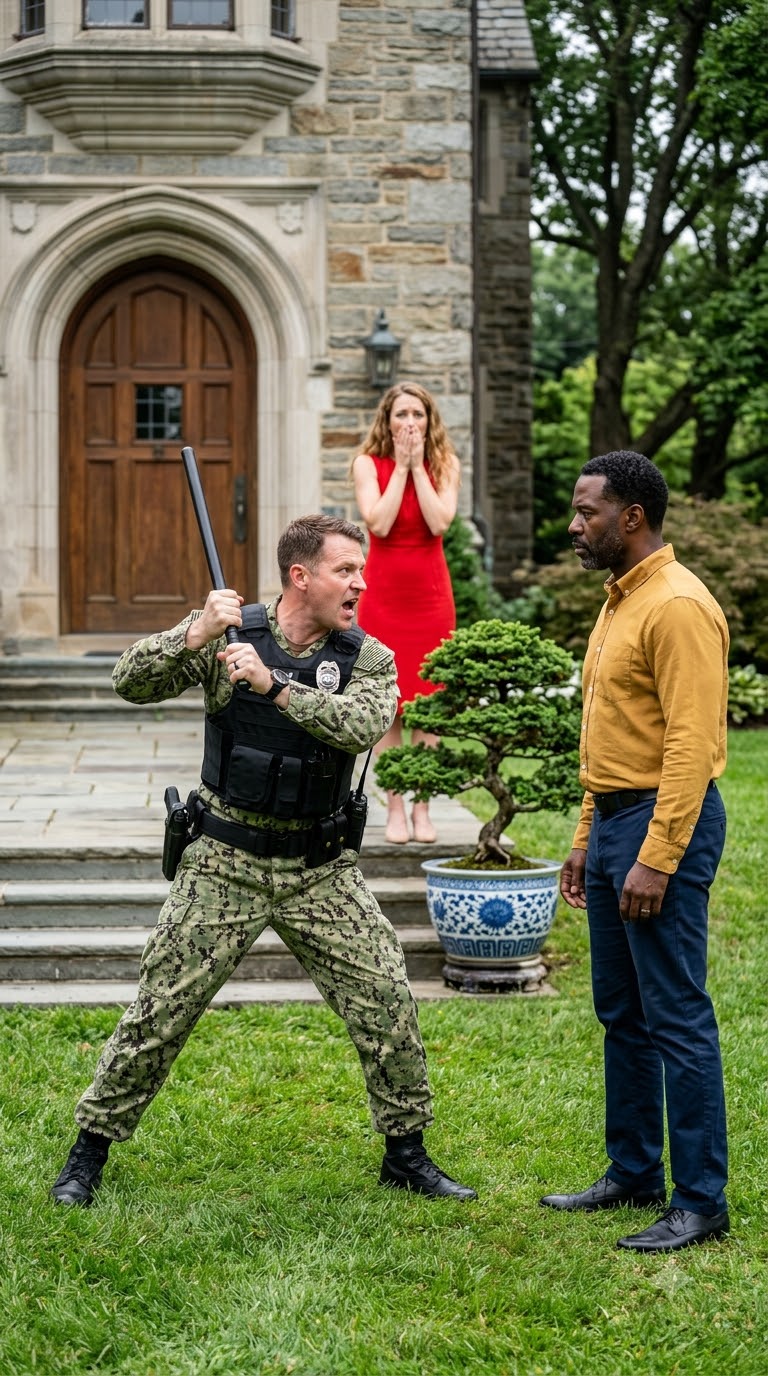
Not for Briggs’s actions.
They couldn’t erase those.
They apologized for standing silently.
Cain read the letter without speaking.
Then he looked at Mrs. Lang.
“You don’t owe me an apology.”
She shook her head.
“Maybe not. But we owed you courage.”
Cain considered her words.
Then he looked at the damaged bonsai.
“It survived.”
Mrs. Lang smiled faintly.
“So did you.”
Cain nodded.
The investigation eventually led to reforms inside the department.
New oversight procedures were introduced.
Complaints were independently reviewed.
Body-camera footage could no longer simply disappear.
Officers were retrained.
And the culture that had protected Briggs and Langford began to fracture.
Cain never sought revenge.
He sought accountability.
There was a difference.
Months later, the repaired bonsai stood again on his porch.
It wasn’t the same.
The scars were visible.
One major branch was gone forever.
The trunk carried a permanent wound.
But it was alive.
Stronger in an imperfect way.
Cain stood before it, carefully examining a new shoot emerging near the damaged section.
He smiled.
The tree had been broken.
But it had refused to die.
Behind him, Oak Creek was beginning to change.
Neighbors who had once avoided one another now spoke openly.
People who had been silent began attending community meetings.
And every time someone asked Cain why he had fought so hard over a tree, he gave them the same answer.
Because it wasn’t just a tree.
It represented patience.
Discipline.
Heritage.
And the belief that something could be damaged without being destroyed.
The officer had thought he was breaking a stranger’s property.
He had actually exposed an entire system.
He had thought he was humiliating a powerless man.
He had instead challenged a colonel who understood exactly how systems worked.
And most importantly, he had believed that dignity could be beaten out of someone with a baton.
He was wrong.
Because dignity isn’t something another person can take.
It is something you choose to keep.
And Colonel Raphael Cain had never surrendered his.
