

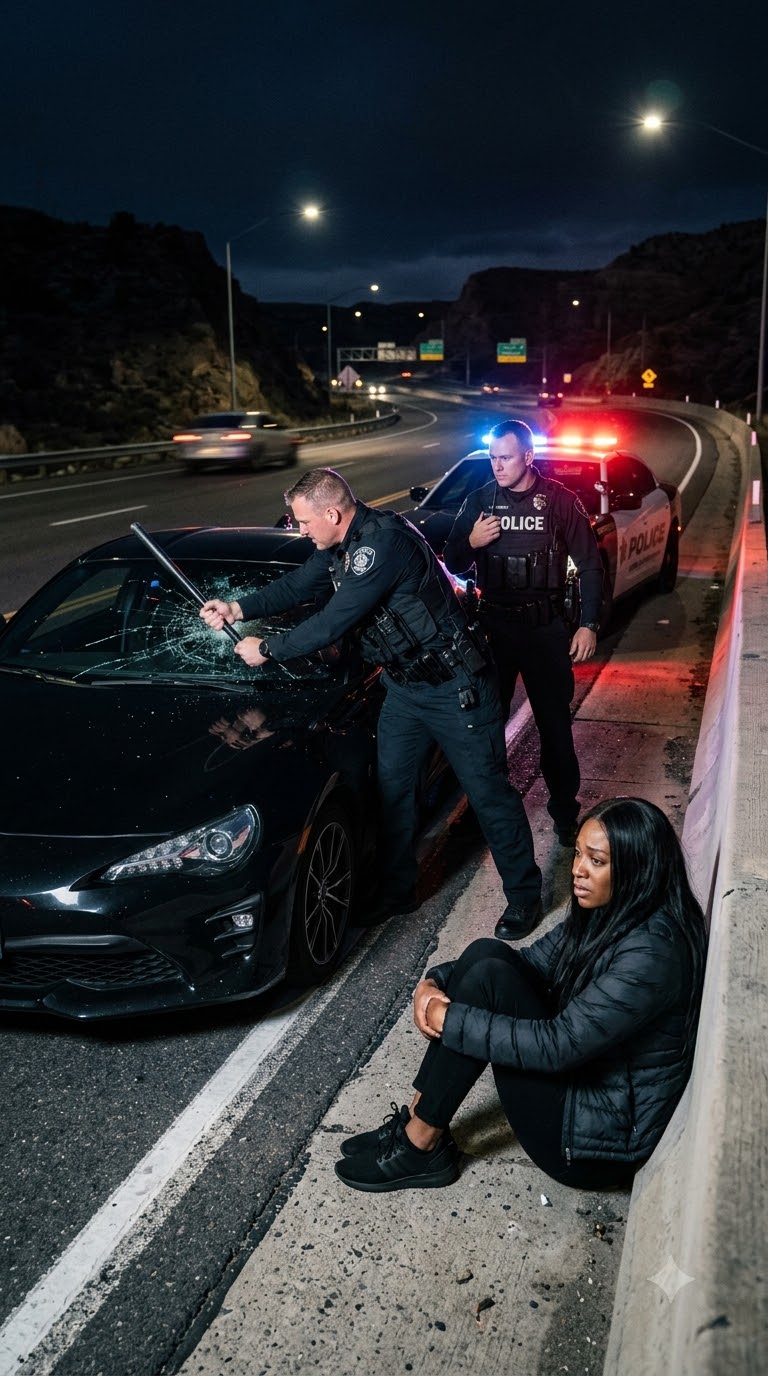
A 24-year-old tech prodigy is stopped on a deserted stretch of I-84. Three veteran cops rip apart her $300,000 McLaren while searching for illicit cash. But what they actually discovered inside that wrecked trunk didn’t just destroy their careers. It landed them in federal prison.
The dashboard clock of the Onyx black 2024 McLaren 720S showed a crisp 1:14 a.m. Nia Caldwell kept her hands lightly resting on the Alcantara steering wheel, feeling the steady hum of the twin-turbo V8 engine vibrating through the carbon-fiber chassis. She was 24 years old, exhausted, and completely at peace. Just 72 hours earlier, the cybersecurity firm she had built from a cramped college dorm room had officially been acquired by a Silicon Valley giant. The deal was finalized.
The wire transfer had cleared. The McLaren was her sole indulgence, a childhood dream transformed into sleek aerodynamic perfection, bought entirely with cash. She was driving home to Portland, Oregon, while the wet pavement of Interstate 84 hissed beneath her Pirelli tires. The highway was a deserted strip of black winding through the towering pines of the Pacific Northwest. Nia had set the cruise control precisely at 65 mph.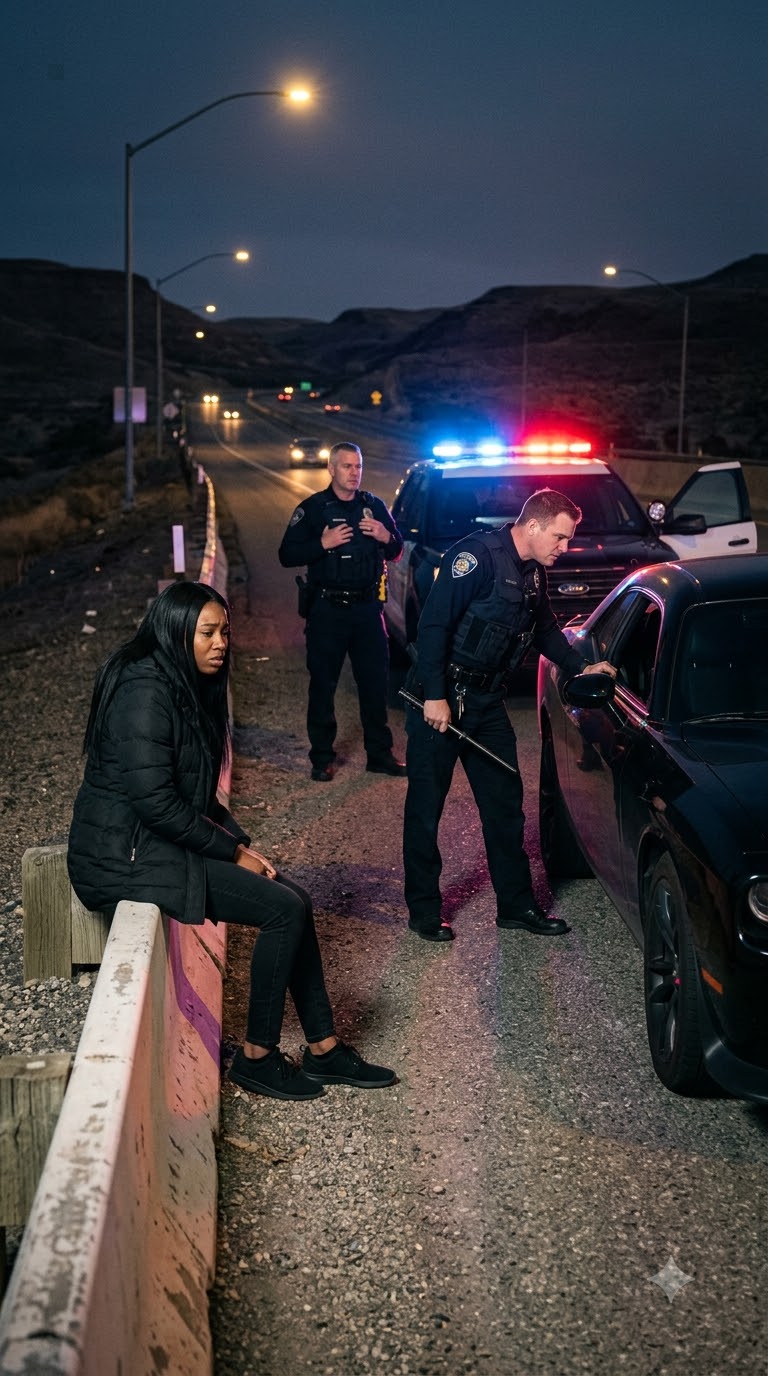
She wasn’t speeding. She wasn’t swerving. She was simply existing in the quiet triumph of her own hard work. Then the darkness behind her exploded into a violent flash of red and blue. Nia’s pulse gave its familiar flutter, a conditioned reaction she had learned to control over the years.
She didn’t brake sharply. She checked her mirrors, switched on her right turn signal, and smoothly steered the low-slung supercar onto the broad gravel shoulder, bringing it to a flawless stop beneath the cruiser’s harsh spotlight. She shifted into park, lowered all the windows, switched off the engine, and placed both hands flat on top of the steering wheel. She knew the drill. Keep your hands visible.
No sudden movements. In the side mirror, she watched the heavily reinforced door of the police cruiser open. Officer Thomas Reiker stepped out. He was a man in his late 40s, his uniform stretched tightly across a broad, rigid chest, his thumbs casually hooked into his tactical belt. Behind him, a younger, leaner officer, Brendan Hayes, climbed out of the passenger side and positioned himself near the front quarter panel of the cruiser.
His hand rested cautiously on his hip as Riker moved at his own pace. He slowly walked around the McLaren, sweeping his heavy mag light across the flowing curves of the bodywork, lingering over the custom forged wheels before finally directing the blinding beam straight at Nia’s face. “License, registration, and proof of insurance,” Riker said. His voice was a gravelly baritone with a distinct edge of bored authority. He didn’t offer a greeting.
He didn’t explain the reason for the stop. Nia squinted against the harsh light, her voice steady and polite. “My license is in my wallet, in my purse on the passenger seat. My registration and insurance are in the glove compartment. I have to reach across to get them.
Is that all right with you, officer?” Reiker’s flashlight dipped slightly, revealing the pristine cream-colored leather inside. He chewed the inside of his cheek. “Go ahead. Slowly.” Nia reached over, retrieved the documents, and passed them through the window.
Reiker snatched them and held them beneath his flashlight. He examined the Oregon driver’s license, noting her age and photo, then looked back at her. A tight, patronizing smirk tugged at the corners of his mouth. “Nia Caldwell,” Riker read aloud, stretching the syllables as if tasting something sour. “Nice car, Nia.
Whose is it? Your boyfriend’s? A rental company in Seattle?” “It’s mine, officer,” Nia said, keeping her eyes ahead. “Registered in my name.
The documents you’re holding confirm that.” Reiker gave a short, breathy laugh. He tapped the laminated registration against his knuckles. “A 24-year-old in a $300,000 piece of British engineering. Forgive me if I find that a little hard to swallow.
What do you do for a living, Miss Caldwell?” “I’m a software engineer,” Nia replied evenly, keeping both hands visible on the steering wheel. “May I ask why I was pulled over? I was maintaining the speed limit and haven’t violated any traffic laws that I’m aware of.” “You crossed the solid white line onto the shoulder about two miles back.”
Reiker lied smoothly. His expression stayed neutral, as though he were describing a routine traffic violation. It was a phantom offense, impossible to prove or disprove, but it gave him the perfect excuse for a fishing expedition. He leaned slightly toward the open window, studying her face. “You also seem a little nervous,” he continued.
“You carrying anything in the vehicle I should know about? Weapons? Large amounts of currency? Narcotics?” Nia’s fingers tightened slightly around the steering wheel, but her voice stayed calm. “”No, officer. No, sir.
Just my luggage in the front trunk.” Riker leaned closer, his face inches from the window frame. He took a deep, theatrical sniff of the air inside the cabin. “That’s funny because I’m picking up the distinct odor of unburnt marijuana.” Nia’s stomach tightened, but her face remained an unreadable mask. “That’s impossible, officer. “I don’t smoke, and no one has ever smoked in this car.”
“My nose says different,” Riker countered, stepping back and unhooking his radio. “Hayes, run these plates. I’m calling in Sergeant Kesler. We’ve got a probable cause search.” He looked back at Nia, his eyes cold and predatory.
“Step out of the vehicle, Miss Caldwell.”
By the time Sergeant David Kesler arrived 15 minutes later in a heavy-duty Chevy Tahoe interceptor, the shoulder of I-84 resembled a crime scene. Two cruisers had the McLaren boxed in, their strobes casting frantic bursts of neon across the trees. Nia sat quietly on the damp concrete of the highway barrier, her coat wrapped tightly around her against the biting Oregon night chill. She watched as Kesler, a 20-year veteran known for aggressive civil asset forfeiture, swaggered out of his vehicle. Kesler was the type of cop who operated entirely in the gray areas of the law.
He had built his career on hunches that conveniently led to the seizure of millions of dollars in cash and property over the years, assets that often bypassed the courts and went directly into the department’s slush fund. Reiker met Kesler halfway. Nia couldn’t make out their exact words over the rushing wind from passing semi-trucks, but she could understand their body language. Reiker pointed toward her, then toward the car, gesturing wildly. Kesler nodded, his eyes fixed on the McLaren with the hungry gleam of a man staring at a winning lottery ticket.
They believed they had landed a whale: a young black woman driving a hypercar in the middle of the night. In their prejudiced calculation, she couldn’t possibly be a tech CEO. She had to be a high-level mule for one of the West Coast syndicates moving drug money or crypto-laundering hardware. Kesler approached Nia and stopped just a few feet away. “Miss Caldwell, I’m Sergeant Kesler.”
“Officer Riker tells me he detected the odor of narcotics in your vehicle. Under the motor vehicle exception, that gives us the right to conduct a thorough search.”
“I do not consent to any search of my vehicle,” Nia said clearly, her voice cutting through the surrounding highway noise. “There are no drugs in that car.
Officer Reiker is lying, and you are violating my Fourth Amendment rights.”
Kesler’s smile held no warmth. “Consent isn’t required, sweetheart. Sit tight.”
The nightmare began.
Riker and Hayes put on black nitrile gloves and started tearing through the interior. They began with the basics. They ripped apart Nia’s purse, dumping her wallet, makeup, and house keys onto the driver’s seat. They pulled out the floor mats and tossed them onto the wet gravel. They opened the glove box, scattering manuals and service records.
When the initial sweep produced nothing but a pack of gum and a charging cable, Kesler’s patience disappeared. He marched over to his Tahoe and opened the rear hatch. When he came back, he wasn’t carrying a flashlight. He had a steel pry bar and a set of heavy-duty mechanic screwdrivers in his hands. Nia’s heart pounded against her ribs, but she forced herself to remain seated.
“Sergeant,” she called out, her voice dangerously calm. “If you take tools to that car, you are going to be liable for hundreds of thousands of dollars in damages. I strongly advise you to stop.”
Kesler ignored her. He walked toward the passenger-side door.
“Couriers use aftermarket voids,” he grunted to Riker. “Behind the door panels, under the center console, start popping the trim.”
Nia watched in surreal horror as Reiker drove the flathead screwdriver into the seam of the bespoke leather door panel. With a sickening crack, the fragile carbon-fiber clips snapped. Riker wrenched the panel backward, ripping the delicate wiring of the ambient lighting system.
He threw the ruined panel onto the shoulder. They moved like vandals disguised in badges. Hayes, visibly nervous but unwilling to challenge his superiors, began tearing up the custom Alcantara carpeting in the footwells. Kesler took the pry bar to the center console, using violent leverage until the sleek digital infotainment screen spiderwebbed with cracks and the housing tore free from the dashboard, exposing a tangled mass of copper wires.
“Nothing in the dash, Sarge,” Riker panted, sweat beading across his forehead despite the cold air.
They had spent 45 minutes tearing through the vehicle, checking compartments, pulling panels, and ripping apart anything that could conceal contraband. The McLaren’s interior, once a masterpiece of automotive art, now looked as though it had been run through a shredder. Leather panels hung loose, wires spilled from beneath the dashboard, and expensive trim had been ripped away and scattered across the seats and floor. Kesler stood beside the wreckage, his face flushed with frustration and adrenaline. He was too deep into it now.
He had personally authorized the destruction of a vehicle worth more than his house. And if the search came up empty, there was no easy explanation. Without contraband, the internal affairs fallout would be catastrophic. He needed to find something. He had to find something.
“Check the frunk,” Kesler barked, pointing toward the front trunk. “Pull the liner out. Tap the chassis. Listen for hollow spots. They hide the cash in vacuum-sealed lead boxes to beat the dogs, tear it all out.”
Reiker opened the front hood. He threw Nia’s overnight bag onto the ground, unzipped it, and scattered her clothes across the dirt. Then he grabbed the edges of the carpeted trunk liner and pulled with all his strength. The retaining bolts shrieked as they sheared off, and the entire fiberglass tub lifted upward, exposing the bare aluminum chassis and front suspension components. Riker leaned inside, tapping a heavy metal flashlight against the framework.
Clink, clink, clink, thud.
He stopped. He tapped it again.
Thud.
It was a dense, hollow sound, completely out of rhythm with the rest of the metal.
Reiker’s eyes widened. “Sarge,” he yelled, his voice cracking with desperate excitement. “I got something. Passenger side deep in the firewall recess. There’s a bolted steel plate.” “Looks totally aftermarket. It’s a hidden compartment.”
Kesler practically sprinted to the front of the car, shoving Hayes aside. He directed his light into the dark recess. Sure enough, flush against the firewall was a matte black steel plate fastened with four heavy-duty torque screws.
It looked completely out of place against the polished aluminum of the McLaren’s skeleton. A sickeningly triumphant grin spread across Kesler’s face. He turned toward Nia, who remained perfectly still on the barrier. “Well, well, well, Miss Caldwell,” Kesler sneered, tapping the pry bar against his palm. “Looks like your little tech nerd disguise just fell apart.
Let’s see how much cartel cash you’re hauling.”
“Bring me the cordless drill,” Kesler commanded, keeping his eyes fixed on the hidden plate. Hayes hurried to the Tahoe and returned with a heavy 20-volt drill and a set of bit extractors. The three men gathered around the ruined supercar like vultures circling a carcass. The highway was eerily quiet except for the whining shriek of the drill as Kesler forced the bit into the hardened torque screws. Sparks sprayed through the darkness, bouncing off the expensive paintwork and leaving tiny burn marks in the clear coat.
It took them 10 agonizing minutes to strip the screws and pry the heavy steel plate loose. Kesler tossed the metal aside. It struck the pavement with a heavy clang. “All right, Riker, shine the light in there. Let’s see what we got.”
Inside the dark rectangular recess sat a seamless matte black box roughly the size of a thick hardcover book. It had no visible hinges, keyholes, or markings. A thick bundle of braided wires extended from the back of the box, splicing directly into the McLaren’s main battery harness. On the front was a single tiny LED that pulsed with a steady rhythmic green light. Beside it was a small circular glass aperture.
The three cops stared at it. The triumphant mood suddenly disappeared, replaced by tense, palpable confusion. “What the hell is that?” Hayes muttered, taking an instinctive half step backward. “Sarge, is that a bomb?”
“Don’t be an idiot,” Hayes, Kesler snapped, though his own voice betrayed a tremor of doubt. “It’s a GPS tracker or a crypto wallet hard drive.
These cartels are getting high-tech. They wire the cash ledgers directly into the car’s power so they can wipe it remotely if they get pulled over.”
Riker reached out, his thick fingers gripping the edges of the box. He pulled hard, trying to tear it free, but it was firmly welded to a secondary bracket. “It ain’t budging, Sarge.
Do we cut the wires?”
Before Kesler could respond, a voice came from the concrete barrier. “If you cut those wires, you will trigger a localized electromagnetic fail safe that will brick the vehicle’s entire ECU,” Nia said. She slowly stood, brushing dust from her coat. She no longer looked like a frightened civilian. “She didn’t look like a cornered mule.”
She walked straight to the edge of the police tape they had haphazardly strung between the cruisers, stopping a few feet from the mutilated nose of her car. Her posture was absolute steel. “You wanted to know what I do for a living, Officer Riker?” Nia asked, her voice carrying a chilling authority that made all three men freeze. “I build tamper-proof closed loop surveillance and telemetry systems for high-risk assets. My company just sold the patent to a defense contractor.”
Kesler sneered, trying to reclaim control. “I don’t care if you build spaceships, Caldwell.
You have an illegal undeclared hidden compartment in a motor vehicle. That’s a felony in this state. You’re going in cuffs.”
“That’s not a hidden compartment for drugs, Sergeant,” Nia said, tilting her head slightly.
“That box is a proprietary black-box surveillance node. It is hardwired into the vehicle’s architecture. And that small glass circle you’re staring at, that’s a wide-angle Leica lens.”
Riker looked down at the box, then slowly back at Nia. The blood drained from his face as the implication began to sink in.
“A camera,” he stammered.
“Not just a camera,” Nia corrected, her voice remaining remarkably calm. She shifted her gaze from Riker to Kesler, locking eyes with the sergeant. “It’s the central hub for a network of 12 micro cameras embedded throughout the cabin, the rearview mirror, the exterior trim, and the dashboard.”
Kesler’s expression tightened.
Nia continued, “Each word deliberate. They’re equipped with omnidirectional audio receptors, so they captured more than just video. Every conversation, every threat, and every order you’ve given since you stopped me was recorded.”
She paused, allowing the silence to linger. “And it doesn’t store the data locally,” she added. “Which means destroying this box won’t erase anything.”
Hayes swallowed hard, his hands beginning to shake.
“Where does it store it?”
Nia offered a smile that didn’t reach her eyes. “The moment Officer Riker’s cruiser activated its light bar, the system woke up. It has been live streaming encrypted 4K video, multidirectional audio, and biometric telemetry directly to a secure Amazon Web Services server managed by my corporate legal team. It operates on an independent satellite uplink.”
Silence descended over the highway.
Even the wind seemed to stop. “Every word you’ve said,” Nia continued, stepping closer. “Every lie you told about smelling marijuana, every swing of that pry bar, every piece of carbon fiber you snapped. It has all been broadcast in real time in high-definition. You can’t unplug it.
You can’t smash it. And my lead attorney, who woke up the moment the damage sensors triggered an alert on his phone 45 minutes ago, has been watching this entire illegal search from his living room in Seattle.”
Kesler’s face shifted through shades of red, purple, and finally an ashen white. He looked at the shattered interior of the $300,000 car. He looked at the pry bar in Riker’s hand.
He suddenly understood that he hadn’t merely violated department policy. He had committed a dozen federal civil rights violations on a live, unerasable broadcast. Panic is a dangerous thing in desperate men. Kesler’s veteran instincts, the dark, corrupt ones that had protected him for 20 years, took control. If the car was a total loss, and the camera had captured them tearing it apart, he needed a trump card. He needed a justification. Kesler slowly reached into the deep cargo pocket of his tactical pants. His fingers closed around a small, heavy plastic baggie he always kept for emergencies. Drop gear: a few ounces of confiscated cocaine that had never made it into the evidence locker.
“That’s a very nice story, Miss Caldwell,” Kesler said, his voice dropping to a lethal, quiet rasp as he subtly withdrew his hand from his pocket, keeping his back angled away from the front of the car.
“But a camera only records what it sees and what it’s going to see.”
He moved quickly toward the passenger door, intending to toss the baggie into the ripped-up floorboards where they could “discover” it.
“Is that a bag of cocaine in your right hand, Sergeant Kesler?” Nia asked loudly, her voice carrying clearly through the crisp night air.
Kesler froze midstride, his arm hovering over the open door.
“Because,” Nia said, pointing toward a tiny, nearly invisible pinhole in the passenger-side A-pillar, “the interior cameras have night vision overlay, and you just pulled a bag of narcotics out of your own uniform pocket on a live feed.”
The plastic bag slipped from Kesler’s trembling fingers, landing softly on the damp gravel.
The small baggie of cocaine rested on the damp, oil-stained gravel of Interstate 84 like a live grenade. Sergeant David Kesler stared at it, the color draining completely from his weathered face. For 20 years, that little bag had been his ultimate insurance policy.
The drop gear that justified illegal searches, secured falsified arrests, and protected his pension whenever a hunch came up empty. Now, illuminated by the flashing red and blue strobes of his own cruiser, it was physical evidence of his total destruction.
“Pick it up, Sergeant,” Nia said, her voice eerily calm, cutting through the chilling Oregon wind. “Or leave it.
It doesn’t matter. The high-definition macro lens in the A-pillar just logged the serial number printed on the edge of that Ziploc bag.”
Officer Brendan Hayes, the youngest of the three, suddenly staggered backward until his shoulder struck the side of the destroyed McLaren. He was hyperventilating, his hands frantically gripping the fabric of his ballistic vest.
“Sarge!” he gasped, his voice rising into a panicked whine.
“Sarge, tell me she’s bluffing. Tell me this isn’t broadcasting.”
“Shut up, Hayes.” Officer Thomas Reiker barked, but Riker’s own voice trembled.
He dropped the heavy metal pry bar he had used to tear apart the car’s $15,000 dashboard. It struck the pavement with a hollow clatter that echoed into the tree line.
Kesler didn’t move. His mind, usually so skilled at twisting the law into knots, had flatlined. He stared at the tiny green LED pulsing steadily on the black telemetry box embedded in the supercar’s firewall.
Pulse, pulse, pulse.
Every flash represented another megabyte of incontrovertible federal evidence streaming to a server he couldn’t access, couldn’t smash, and couldn’t burn.
Inside the cabin of the ruined car, Nia’s iPhone, buried somewhere beneath the shredded Alcantara floor mats, suddenly began ringing loudly through the Bluetooth system that was miraculously still connected to the surviving speakers. Nia didn’t ask permission. She stepped past the frozen officers, reached into the passenger side, and pulled her phone from the debris.
The caller ID displayed on the cracked center console screen read, “Harrison Mitchell, Esq., Seattle.”
She answered the call and put it on speaker.
“Nia, are you unharmed?”
A sharp, authoritative voice boomed through the McLaren’s premium Bowers and Wilkins sound system. Harrison Mitchell wasn’t merely a corporate attorney. He was a former federal prosecutor who now commanded one of the most ruthless white-collar law firms on the West Coast.
“I’m physically fine, Harrison,” Nia replied, her eyes fixed on Kesler.
“But the vehicle is a total loss. And I believe Sergeant Kesler just attempted to plant a schedule 2 narcotic in the cabin.”
“I saw it,” Mitchell’s voice crackled, vibrating with lethal intent. “My entire crisis team is watching the feed in the boardroom. We have the drop gear on multiple camera angles complete with thermal imaging.
Now listen to me carefully. Do not let those men touch that vehicle again.”
Kesler finally found his voice, a desperate, raspy growl. “Listen here, counselor. We had probable cause, the smell of—”
“Save it for the grand jury,” Sergeant Mitchell interrupted, his tone dripping with absolute disdain.
“I don’t care about your fabricated probable cause. 15 minutes ago, while you were taking a cordless drill to a $300,000 asset, I bypassed your local precinct and woke up Gregory Pierce, the special agent in charge of the FBI’s Portland field office. I also contacted Captain Rebecca Davis of the Oregon State Police. They are converging on your location right now. If you attempt to leave or if you touch my client, it will be classified as a federal flight risk.”
Hayes released a muffled sob.
He turned away, bent over the highway barrier, and vomited into the dark brush. Riker slowly raised his hands, palms outward, backing away from the vehicle as though it were radioactive.
“I was just following orders.”
“Sarge told me to pull the trim. He said he had a warrant exception.”
“You broke it, Riker.
You own it,” Kesler spat venomously, the brotherhood of the badge dissolving instantly in the face of federal prison time.
Ten excruciating minutes passed. The highway remained deserted, an isolated bubble of shattered fiberglass and shattered lives. Then the distinct high-pitched wail of European-style sirens pierced the night.
Three Oregon State Police cruisers descended on the scene, surrounding Kesler and Riker’s vehicles. Before the cruisers had even fully parked, heavily armed state troopers poured out. Leading them was Captain Rebecca Davis, a tall, uncompromising woman who despised the reputation dirty cops gave her state.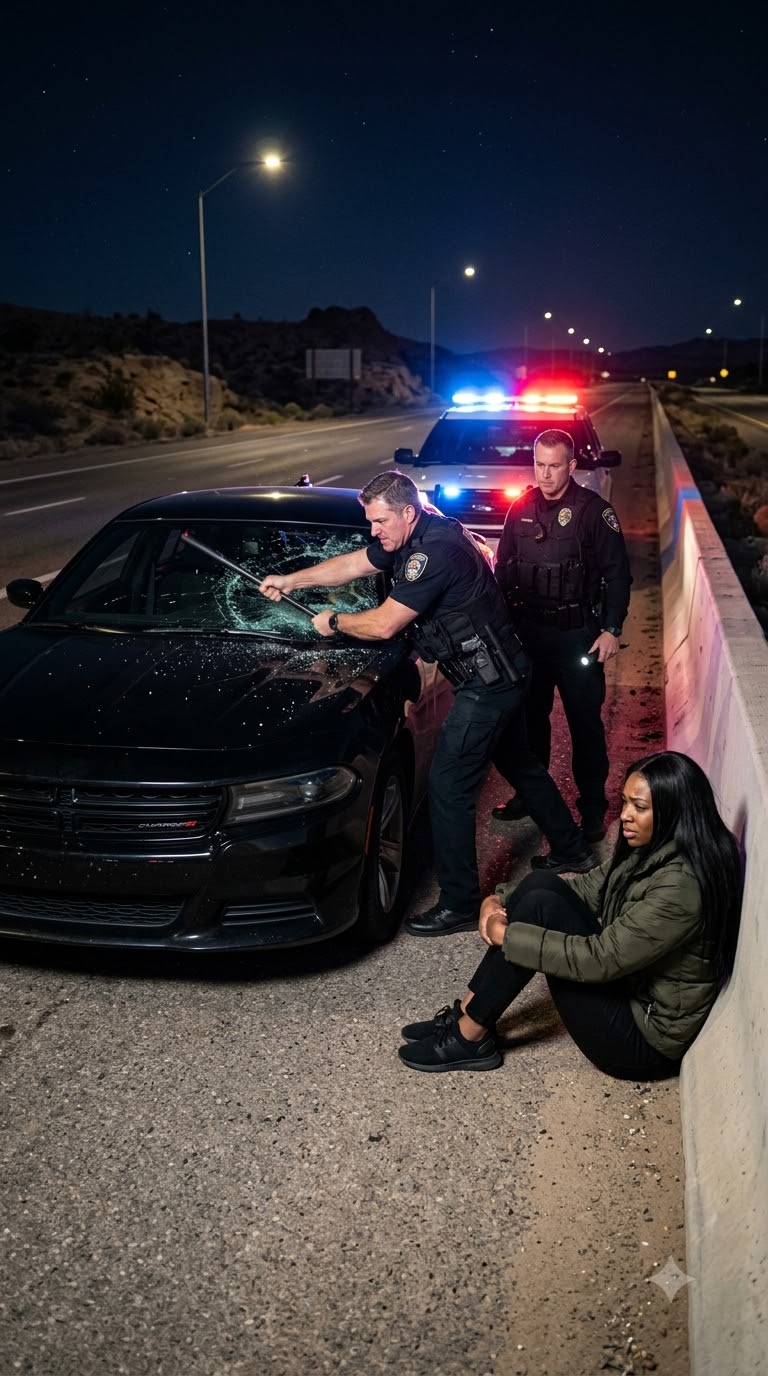
“Hands away from your weapons. Step away from the vehicle,” Davis commanded over her cruiser’s PA system.
For the first time in his career, David Kesler found himself staring down the barrel of a fellow officer’s sidearm.
Slowly, mechanically, he unclipped his duty belt, allowing his Glock, taser, and radio to fall onto the gravel. Riker and Hayes quickly followed suit.
Right behind the state troopers, two unmarked black Chevrolet Suburbans skidded onto the shoulder. Special Agent Gregory Pierce stepped out wearing a windbreaker with FBI emblazoned in bold yellow letters across the back.
He walked straight past the surrendered cops and approached Nia.
“Miss Caldwell?” Agent Pierce asked, pulling out his badge. “I’m Agent Pierce. We have your attorneys on an open line. We’ve secured the AWS server data.” You’re safe now.”
Nia finally released a long, shuddering breath. The adrenaline that had kept her spine perfectly straight for the past two hours began to fade, leaving behind profound exhaustion. She looked at her beloved McLaren—the torn leather, shattered carbon fiber, sheared bolts, and violated chassis.
“They tore it apart, Agent Pierce,” Nia said softly.
The full weight of the vandalism finally hit her. “They ripped it to pieces because they couldn’t fathom that I earned it.”
Pierce looked over the wreckage, then turned toward Kesler, who was being forcefully pressed against the hood of a state police cruiser to be handcuffed.
“They’re going to pay for every single bolt,” Pierce promised. “And then they’re going to pay with their freedom.”
The trial of the United States v. David Kesler, Thomas Reiker, and Brendan Hayes didn’t merely make the local evening news. It became an international spectacle, a digital wildfire that held the nation’s attention for six straight months. It was a perfect storm of modern paranoia, police accountability, and high-tech corporate vengeance. It wasn’t simply another police brutality case.
It was a high-stakes thriller that exposed the darkest, most predatory corners of civil asset forfeiture to the world in unblinking 4K resolution. Within 48 hours of the disastrous highway stop, the police department officially fired all three officers, desperately attempting to amputate the infected limb before it poisoned the city’s entire administration. But losing their badges was only the appetizer for the legal feast Harrison Mitchell and the Department of Justice had meticulously prepared. The federal grand jury moved with terrifying, unprecedented speed under 18 USC Section 242, deprivation of rights under color of law.
All three men were federally indicted. To add fuel to the inferno, federal prosecutor Amanda Croft, a woman known for merciless cross-examinations, added serious charges of evidence tampering, conspiracy to commit fraud, and destruction of property to prevent seizure of evidence. Faced with the very real prospect of decades in a federal penitentiary, the infamous thin blue line completely fractured. The brotherhood of the badge vanished inside the cold, sterile interrogation rooms of the FBI field office.
Officer Brendan Hayes, the youngest and most frightened of the trio, didn’t just flip. He completely shattered.
Plagued by panic attacks and facing the reality of a ruined life, Hayes signed a comprehensive, ironclad plea agreement within the first week. He agreed to testify about absolutely everything, holding nothing back in exchange for immunity from the most severe federal conspiracy charges. When the trial finally began in the imposing oak-paneled courtroom of the Honorable Judge Wallace Trent, Hayes took the witness stand and sang like a canary.
For two grueling days, he described Kesler’s long-standing, insidious practice of targeting expensive vehicles driven by young minorities on interstate highways, specifically searching for out-of-state cash to seize for the department’s discretionary funds. Hayes admitted under the crushing weight of his oath and federal scrutiny that the odor of unburnt marijuana was a pre-planned, completely fabricated script Reiker used to manufacture probable cause whenever Kesler wanted to bypass the Fourth Amendment.
But the true nail in the coffin, the moment replayed across every major news network around the world, wasn’t Hayes’s damning testimony.
It was the tape.
During the second week of the trial, federal prosecutors dimmed the courtroom lights and projected the AWS live-feed footage onto a massive theater-sized screen positioned directly before the jury box. The 12 jurors, assembled press pool, and packed gallery sat in stunned, breathless silence as they watched the crystal-clear night-vision footage. The courtroom’s surround-sound system amplified the agonizing, sickening snap of Riker violently breaking the fragile carbon-fiber door panels.
They heard Kesler’s greedy, heavy breathing echo through the high-fidelity audio as he forcefully drove a cordless drill into the McLaren’s firewall. Then came the climax. The footage switched to the high-definition, thermal-enhanced macro lens hidden seamlessly in the A-pillar. The entire courtroom watched with undeniable clarity as Kesler reached into his cargo pocket. They watched his hand emerge clutching the small plastic baggie of cocaine.
The video captured the exact moment his arm froze midair, bathed in the red and blue strobes of his own cruiser as Nia’s voice echoed from the highway barrier, exposing his corruption in real time. Kesler’s expensive, desperately aggressive defense attorney attempted a Hail Mary maneuver, vehemently arguing that the telemetry box constituted an illegal wiretap and seeking to have the footage excluded from evidence.
Judge Trent, a no-nonsense jurist with a notoriously low tolerance for courtroom theatrics, literally laughed from the bench. He instantly denied the motion, stating with absolute finality that armed officers conducting an official, taxpayer-funded traffic stop on a public interstate have absolutely zero expectation of privacy.
The jury deliberated for less than four hours.
Many legal analysts later guessed that three and a half of those hours were simply spent ordering lunch.
The verdict was read aloud in a deathly quiet room.
Guilty on all counts.
A month later, Judge Trent showed no mercy at sentencing. Looking down from his elevated bench, his eyes fixed on the three disgraced men in their orange jumpsuits.
He delivered a blistering reprimand that would be quoted in law schools for a decade. “You were entrusted with the sacred power of the state to protect its citizens,” Trent’s voice boomed. “Instead, you operated as a legally sanctioned, heavily armed street gang. You weaponized your badges to terrorize, to plunder, and to destroy a young woman simply because her sheer success offended your deep-seated prejudice.
You are a disgrace to the uniform, and society must be protected from you.”
David Kesler, the ringleader, was sentenced to 14 years in federal prison without the possibility of early parole, completely stripped of his municipal pension, and ordered to pay massive criminal restitution. The color drained entirely from his face as the US marshals locked his cuffs and dragged him away. Thomas Riker received seven hard years for his active role in the conspiracy and the willing, gleeful destruction of the vehicle.
Brendan Hayes, true to his plea deal, avoided federal lockup but received three years of heavily monitored federal probation, hundreds of hours of community service, a lifetime ban from holding any law enforcement or private security position, and a permanent, life-ruining felony record.
But the federal criminal trial was only half the battle. While the former cops were being shipped to prison, Harrison Mitchell spearheaded a devastating civil lawsuit against the city, the police department’s leadership, and the officers personally. The city’s risk management department and the mayor’s office took one look at Mitchell’s witness list and the looming PR nightmare of a civil jury trial and surrendered unconditionally behind closed doors.
The city settled with Nia Caldwell for a staggering $18.5 million, one of the largest single civil rights payouts in Pacific Northwest history. Nia didn’t keep a single dollar of the settlement for her own lifestyle.
The lucrative sale of her cybersecurity firm had already made her independently wealthy for several lifetimes over. Instead, she took $18 million of that municipal blood money and founded the Caldwell Initiative, a ruthless, heavily funded legal defense foundation dedicated exclusively to providing elite white-shoe corporate lawyers to low-income victims of civil asset forfeiture and police corruption across the United States.
As for the ruined McLaren 720S, the insurance company paid the full $300,000 policy. Nia simply picked up the phone, called the dealership, and purchased a brand-new model. This one was painted a defiant, blindingly bright shade of volcanic orange.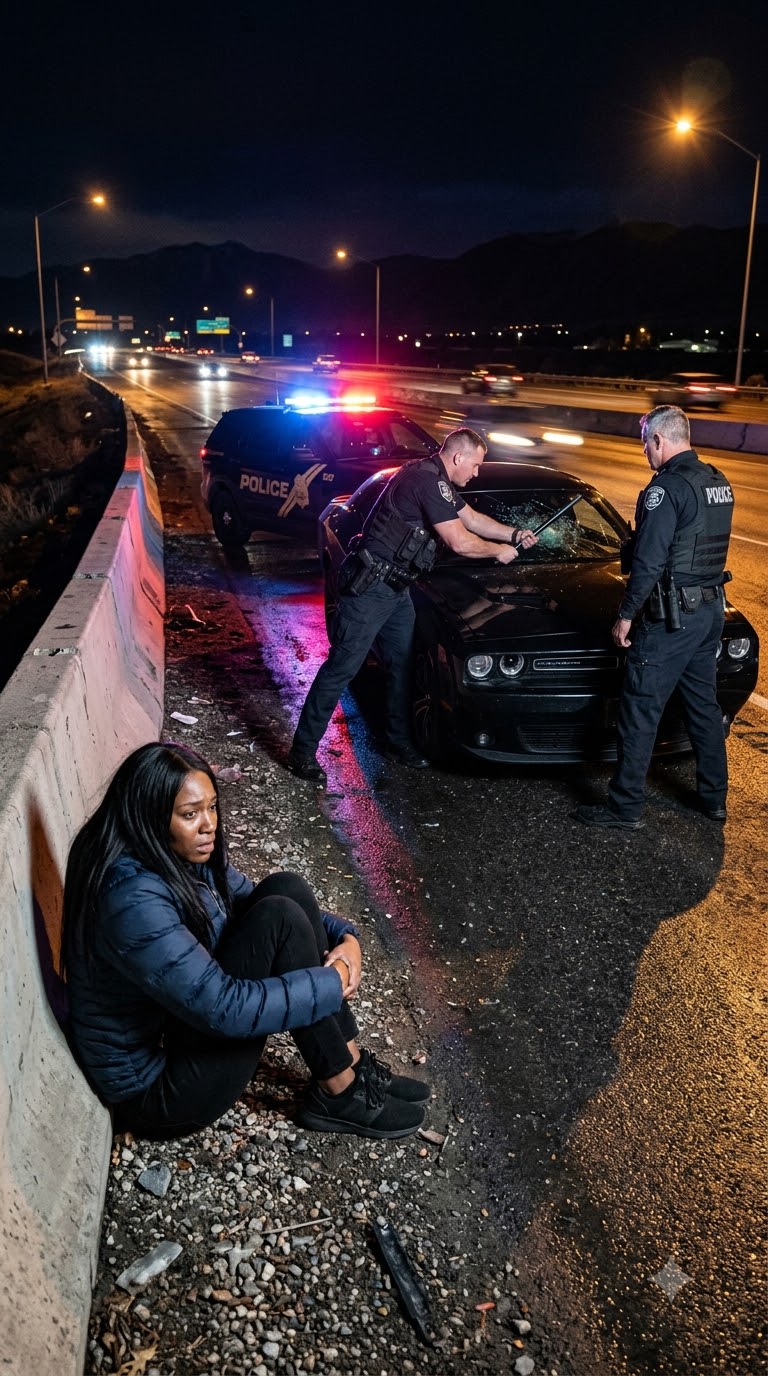
But she refused to let the city scrap the original, destroyed Onyx black car. She bought the salvaged chassis back from the insurance adjusters for a fraction of the cost. Today, that shattered, hollowed-out supercar sits at the center of the soaring glass atrium of her new corporate headquarters in Silicon Valley. The torn cream leather, smashed dashboard, and drilled-out steel firewall remain exactly as David Kesler left them on that dark highway.
Beside the ruined car sits a heavy, polished brass plaque. It doesn’t mention the V8 engine’s horsepower, the aerodynamic downforce, or the carbon-fiber tub. It reads simply, “The cost of assuming you know who someone is.”
And that is how a $300,000 mistake cost three corrupt cops their badges, their freedom, and ultimately gave birth to an $18 million foundation for justice. They thought they had cornered an easy target in the dead of night, but they had walked straight into a high-tech trap they could never have understood.
