

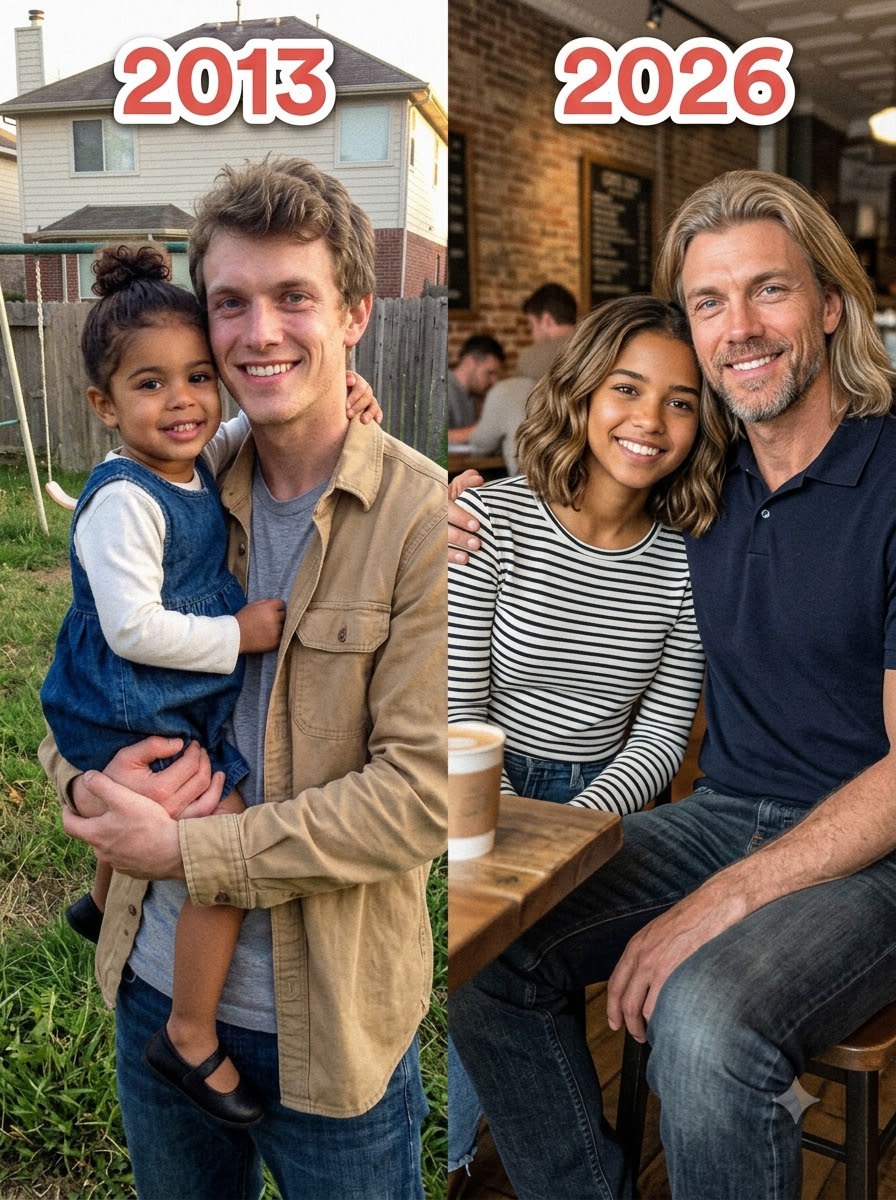
The crash happened on a wet Thursday in March, on the county road that bends too sharply after the feed store.
I was not in the other car.
I was three vehicles back, late for a shift I no longer remember the point of, when the sound arrived ahead of the lights.
By the time I reached the ditch, the young couple in the blue sedan were already beyond anyone’s help.
In the back, still strapped in, a little girl was screaming a word that was not quite a name.
Her name was Lily.
She was three.
There was no family waiting at the hospital who could take her that night.
There was a grandmother in another state who was already ill, and a file that filled itself with the cold language of temporary custody.
I was thirty-one, unmarried, a man who fixed other people’s boilers and came home to a quiet kitchen.
I had no business believing I could raise a child.
I also could not leave her in a corridor with a social worker and a stuffed rabbit that still smelled like someone else’s perfume.
The adoption took months of rooms and signatures.
When it was finished, the rabbit sat on a shelf in the small bedroom at the end of my hall, and Lily called me by my first name for a year before the word Dad arrived, cautiously, as if it might be taken back.
I thought providing was the same as fathering.
I thought if the rent was paid and her shoes fit and there was always milk, grief would have nowhere to live.
I was wrong in the way men are often wrong when they are trying very hard and looking at the wrong evidence.
For a long time she seemed all right.
She drew pictures.
She asked for pancakes on Sundays.
She kept a photograph of her parents in a frame I bought at the drugstore — a smiling woman with a gap between her front teeth, a man with paint on his knuckles.
I told her their names whenever she asked.
Claire.
Daniel.
I did not pretend they had been distant relatives.
I did not hide the crash.
I only made the mistake of thinking that telling the facts was the same as sitting with the feeling.
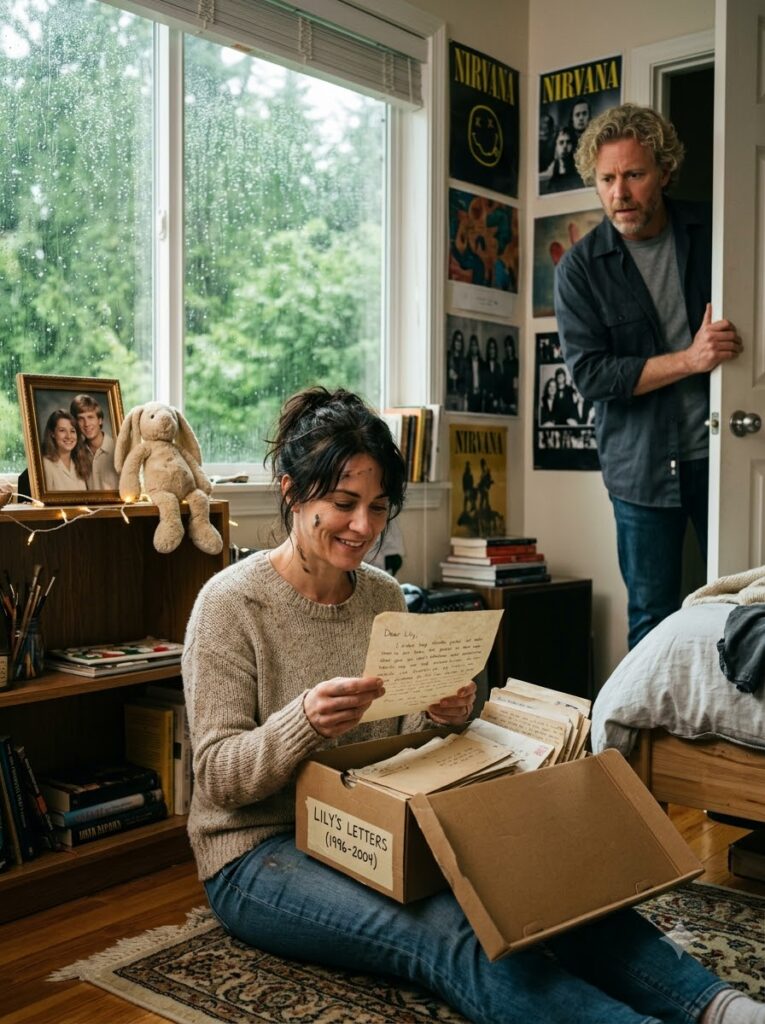
When Lily turned thirteen, she began to change.
She grew quieter.
She came home from school and went straight down the hall.
The door closed with a softness that was worse than a slam.
She answered questions in the fewest words that would get her out of the room.
I told myself it was ordinary.
Girls that age built rooms inside themselves and posted signs.
I worked later.
I took the Saturday calls.
I bought the brand of cereal she used to like and found the box untouched.
I thought she was becoming independent.
I told myself she would outgrow it.
She was not becoming independent.
She was grieving — still, again — the parents she had lost when she was too small to keep them and old enough, now, to understand the size of the hole.
While I focused on overtime and a roof that did not leak, I failed to see the pain she carried in silence.
I thought I was doing enough.
I missed what mattered most.
Sophie came into our lives the winter Lily was fifteen.
She taught art at the community center on Tuesdays and Thursdays.
I met her because the boiler there had a personality and I was the man they called when it decided to sulk.
Sophie had paint in her hair more often than not and a way of standing in a doorway that did not block it.
She did not arrive as a solution.
She arrived as a person who laughed at my bad jokes and who, when she first met Lily, did not crouch or brighten her voice or ask to be liked.
“Hello,” she said.
“I’m Sophie.”
“Your father says you draw.”
Lily said, “Sometimes.”
Sophie said, “All right,” and did not push the sometimes into a tour of the sketchbook.
That was the beginning of it.
She was patient.
She was kind.
She never forced a bond.
She cooked on nights I was late and left a plate in the oven without a speech about family.
She asked Lily about school as if the answer might be none of her business and still deserved courtesy.
Some evenings Lily stayed in her room.
Sophie did not take it as an insult.
She sat with me at the table and talked about ordinary things until the house felt less like a test I was failing.
One evening she told me, gently, that Lily was hiding something.
We were doing the dishes.
Lily’s door was shut.
The hall light made a thin line underneath it.
“I don’t mean trouble,” Sophie said.
“I mean a weight.”
“She looks at you sometimes as if she’s protecting you from a weather you haven’t noticed.”
I dismissed it.
I said teenagers had weather.
I said Lily had always been private.
I said if there were something wrong I would know, because I had been there since she was three, and presence was supposed to be a kind of X-ray.
Sophie did not argue.
She dried a glass and set it down.
“All right,” she said.
“I could be mistaken.”
She was not mistaken.
It happened on a Saturday thirteen years after the crash — Lily sixteen, the house smelling of coffee and the rain that would not decide whether to stay.
I had gone out for parts.
Sophie had come over to help paint the landing, which was a practical excuse for not leaving a girl alone with a closed door and a father who kept buying the wrong cereal.
Lily was at her friend Mara’s.
Sophie went into the bedroom to fetch the drop cloth we kept under the bed, because that was where we stuffed the things that had no better place.
Her hand met a box.
It was small.
Cardboard.
The kind shoes come in if you still buy shoes in boxes.
It had been pushed back against the wall, not carelessly — carefully, the way a person hides something they cannot throw away and cannot leave in the open.
Sophie sat on the floor with it for a long time before she called me.
“I didn’t read them all,” she said when I came in.
Her voice was steady and unhappy.
“I read enough to know you need to.”
“I shouldn’t have opened it.”
“I also couldn’t put it back and pretend I hadn’t.”
Inside were letters.
Dozens of them.
Some on notebook paper with the fringe still attached.
Some on stationery I did not remember buying.
The earliest ones were in the large, proud letters of a child who has just learned that writing can send a message into the dark.
Dear Mommy and Daddy, one began, the pencil pressed so hard it had ridged the page.
I went to school.
I have a rabbit.
His name is still Rabbit.
Dad made eggs.
I did not tell him I dreamed the rain again.
Another, a year or two later: I hate the bend in the road.
I hate that I don’t remember your voices except the screaming which might not even be yours.
I am sorry I lived.
I am also not sorry.
Is that allowed.
They were not a diary of events.
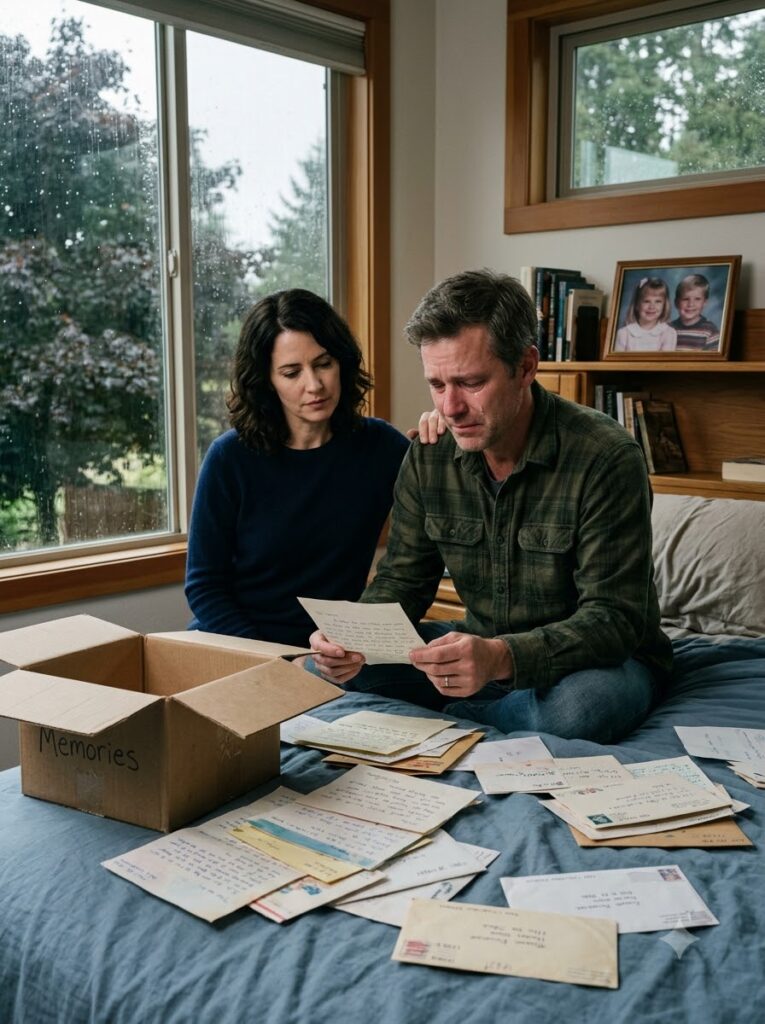
They were a correspondence with the dead, written across the years I had been congratulating myself for keeping her fed.
Some were innocent and childlike — reports of lost teeth, a science fair, the first time she swam the length of the public pool.
Others were filled with anger.
You left.
You left and he works and the house is quiet and I have to be good so he doesn’t think he made a mistake.
Confusion.
If I love him more, do you get smaller.
Longing.
I wish you could see that I am tall now.
I wish that without wishing you back, because wishing you back means the crash didn’t happen and then he isn’t here and I don’t know how to want both worlds at once.
I sat on the edge of her bed — the same room, the same shelf, Rabbit faded now and listing to one side — and I felt the particular shame of a man who has been in the house the whole time and has still been absent.
At the bottom was a recent letter.
The handwriting had settled into the young woman she was becoming.
The date was the week before.
Sophie had not been wrong to say it changed everything.
It did not change the facts.
It changed the story I had been telling myself about the facts.
Lily had written that she was no longer angry.
Not because the loss had become reasonable — it had not — but because anger had worn itself down against the ordinary days and left something else standing.
She wrote that she had spent years trying to keep her grief in that box so it would not spill onto me.
She had seen me tired.
She had seen me count money at the table.
She had seen me flinch, once, when a news report mentioned a pileup, and she had decided that her job was to be the easy child, the surviving child, the one who did not make the living parent pay twice.
Then she wrote that she could not do that anymore, and that this was not a failure of love.
Because of what I lost, she wrote, I found you.
I hate that sentence and I also know it is true.
You weren’t perfect.
You worked too much.
You thought cereal was a conversation.
You stayed.
You stayed when the grandmother died and the file closed and there was no one left to give me back to.
You stayed when I was ugly in the kitchen.
You stayed when I stopped talking.
Staying is not small.
I used to think I had to protect you from missing them.
I don’t think that now.
I think you can hold it.
I think I can say their names in this house without it meaning I want to leave.
You are not a replacement.
You are the father I have.
That is enough.
You are enough.
I cried in a way I had not allowed myself at the hospital, or at the funeral of two people I had not known, or on the night a three-year-old fell asleep on my chest with her fist in my shirt.
Sophie put her hand on my shoulder and did not tell me it was all right.
It was not all right.
It was true, which is different.
When Lily came home, the box was on her desk.
I had not tidied it.
Hiding it again would have been another version of the same mistake.
She stopped in the doorway.
For a moment she was three again and sixteen at once — the child from the ditch and the girl who had been writing to the dead in order to spare the living.
“Sophie found it,” I said.
“She told me.”
“I read them.”
“I should have known without being shown.”
Lily’s mouth trembled.
“They weren’t for you.”
“I know.”
“I wasn’t going to send them.”
“There’s nowhere to send them.”
“I know that too.”
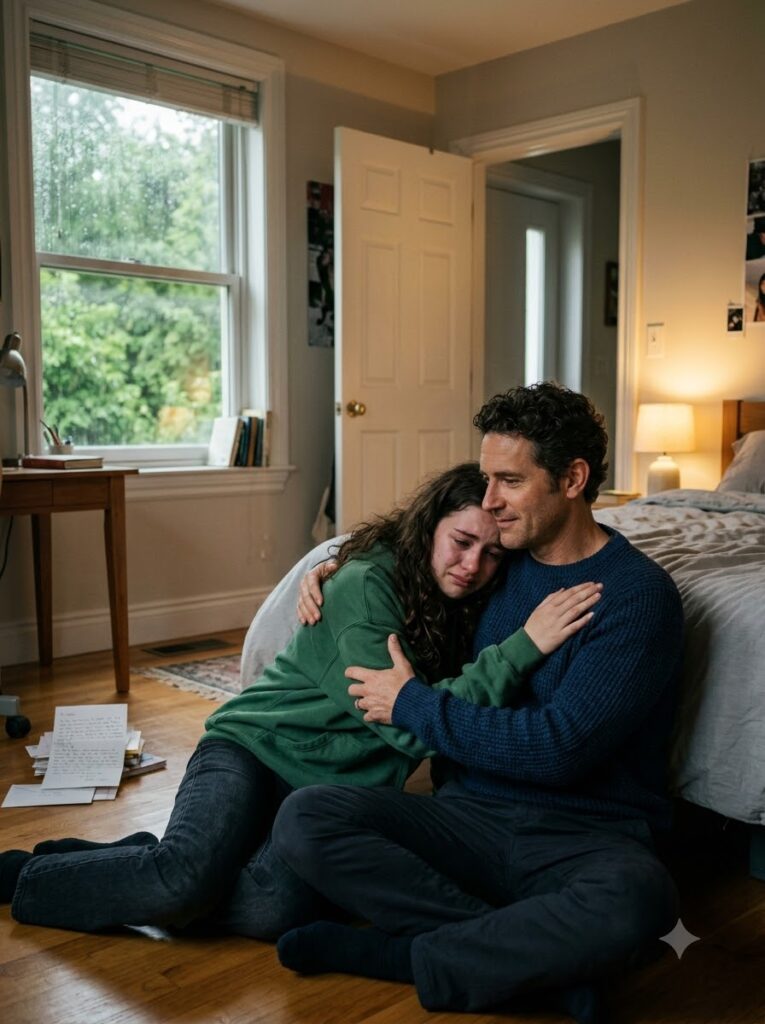
She sat on the floor with her back against the bed, which is where she used to sit when she was small and the thunder came.
I sat on the floor with her.
Sophie stood, then left us the room without making a ceremony of leaving.
I told Lily she had never been required to hide her feelings in order to keep her place.
I told her that loving Claire and Daniel did not threaten what we had.
Their photograph could stay on the shelf.
Their names could be said at breakfast.
Grief was not a loyalty test I would fail if she passed.
“I thought if I was sad you would think I wanted a different life,” she said.
“You can want them and still want this,” I said.
“Those are not opposite rooms.”
She cried then, not the tight, private crying of the closed door, but the kind that has been waiting for permission.
I held her the way I had held her on the first night, except that now she was almost as tall as I was and the holding was a choice on both sides.
For the first time I understood what she had been doing in that room: not rejecting me, not becoming a stranger, but keeping a vigil I had been too busy — and too afraid — to join.
We talked until the light went.
She told me about the letters I had not reached yet.
I told her about the bend in the road, and about the moment I picked her up and felt the weight of a life that was not supposed to be mine and was mine anyway.
I told her I had used work as a way of not sitting still with how close I had come to driving past that ditch and remaining a man with only a quiet kitchen.
Family, I had thought, was something the paperwork completed.
Sitting on that floor I understood it was not defined by blood, and not even by the crash that had thrown us into the same house.
It was defined by presence, by the choice to stay, and by the love that is willing to look at what a child has hidden in order to be easy.
Lily did not become my daughter on the day the judge signed.
I did not become her father because a file needed a name.
We became those things because we kept choosing each other — imperfectly, with closed doors and wrong cereal and a box of letters that had to be found before I learned how to read my own house.
She is grown now, or nearly.
She still writes sometimes, though not only to the dead.
She still remembers the rain and the rabbit and the gap in her mother’s teeth.
She does not remember them alone.
Sophie is in the next room more evenings than not, still refusing to force a bond that has, without force, become a kind of home.
And every day, in ways that would not impress anyone — a name said aloud, a photograph dusted, a door left open — we remind each other that what we have is real, lasting, and more than enough.
