

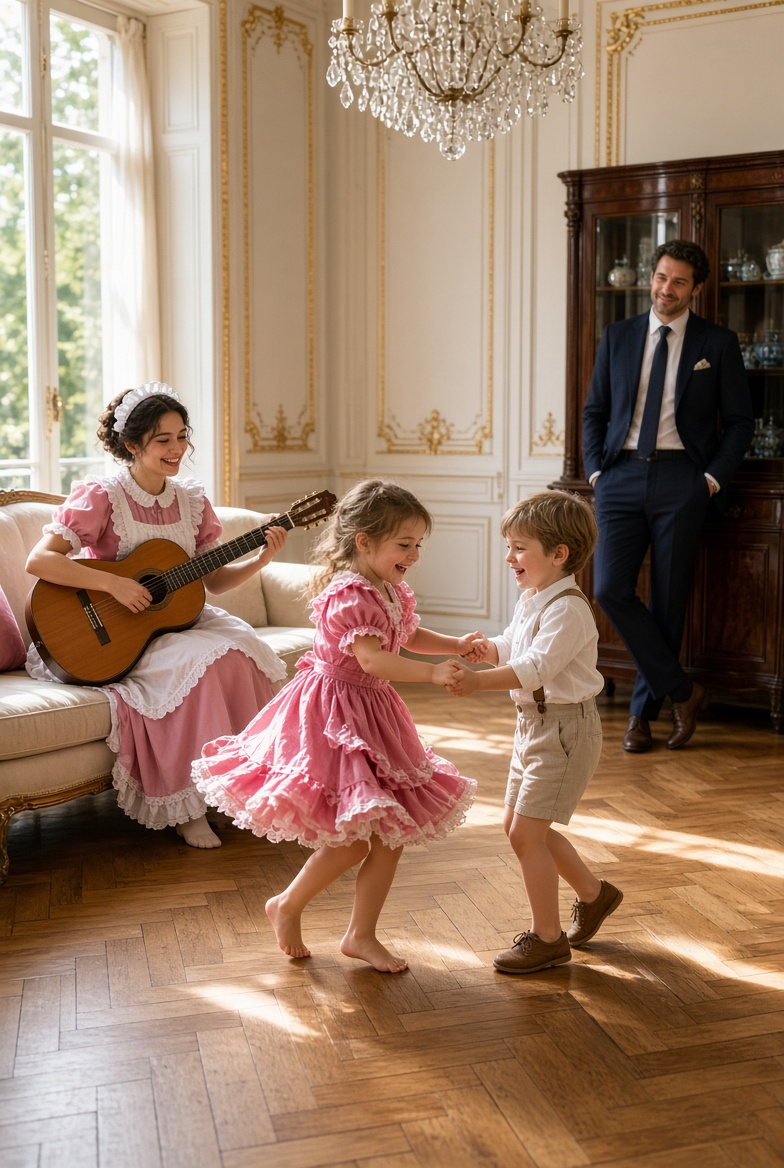
Daniel Whitmore pulled into the circular driveway of his sprawling estate in Greenwich, Connecticut, feeling like a man hollowed out by his own success. It had been another fourteen-hour day—board meetings, tense conference calls, lawyers dissecting contracts worth more than most people earned in a lifetime.
He stepped out of his black sedan without glancing at the manicured hedges and marble fountain. Inside, he expected the usual: silence, polished floors, central air humming softly. A house that looked like it belonged in a luxury magazine—beautiful, pristine… and empty.
But that afternoon, there was no silence.
The moment he stepped into the living room, he heard laughter. Children’s laughter. And music—soft, warm, alive. It clashed with the designer furniture and curated artwork.
Daniel froze.
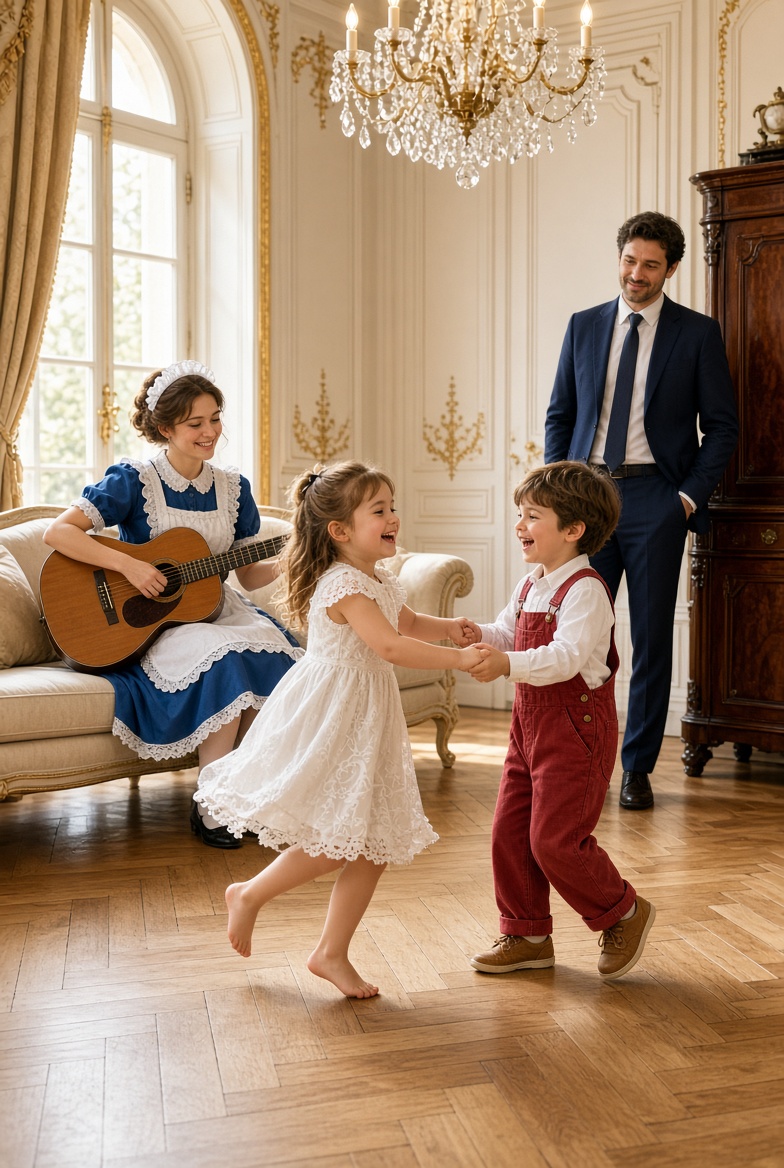
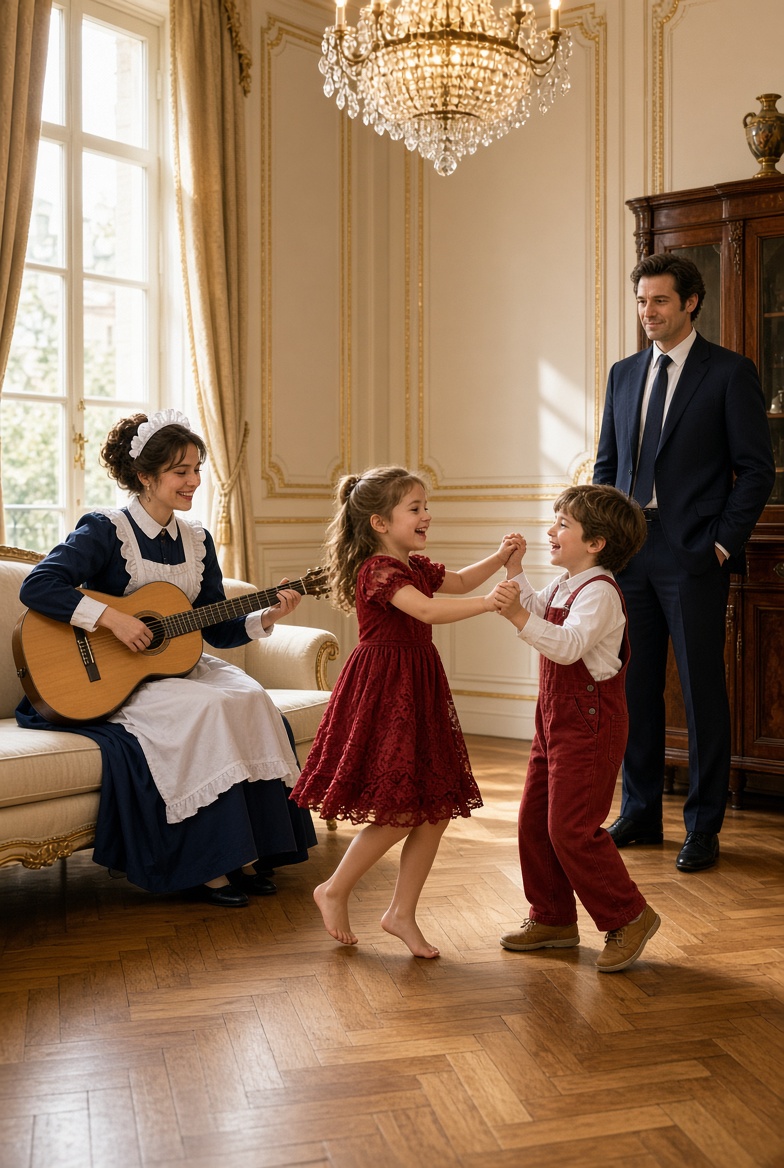
On the Persian rug, his five-year-old daughter, Lily, twirled in a white dress that looked straight out of a catalog shoot. Across from her, a little boy about her age—wearing worn but clean denim overalls—tried to copy her steps with intense concentration. Lily grabbed his hands, giggling like the world was nothing but that small spinning circle.
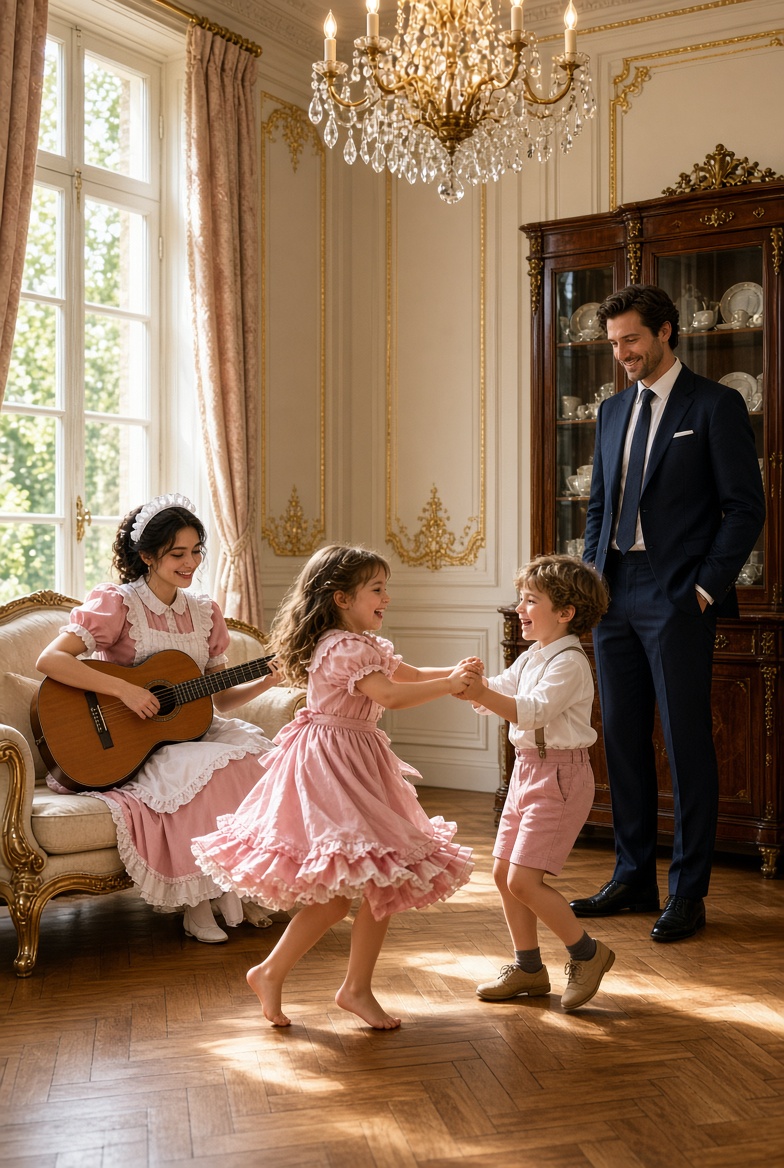
On the couch sat Elena Morales, the housekeeper who cleaned six days a week, still in her black-and-white uniform. She was playing a guitar. Not casually—beautifully. Like someone who had once dreamed of stages bigger than this living room.
Near the bookshelf stood Marcus, Daniel’s longtime driver, watching quietly as if this had been inevitable.
For a moment, no one noticed Daniel.
Then his leather briefcase slipped from his hand and hit the floor with a sharp crack.
The music stopped.
Lily’s eyes widened—then lit up.
“Daddy! You’re home!”
She ran into his arms. Daniel lifted her instinctively, breathing in the scent of her shampoo, feeling how small she still was. And suddenly it hit him harder than the falling briefcase: she hugged him like she hadn’t seen him in years.
The little boy stood stiff, hands clenched in front of him, brown eyes wide with fear—like he’d been caught stealing something he didn’t own.
Elena quickly set the guitar down and stood.
“Mr. Whitmore, I—I didn’t expect you this early. I’m sorry. My sitter got sick and—”
Daniel raised a hand gently. He wasn’t ready for apologies. He was trying to understand what was happening in his own home.
Lily pressed her lips to his ear and whispered, as if sharing something precious.
“Daddy, this is Mateo. He’s my friend. He came to play because I was alone again.”
Again.
The word landed like a punch.
He knew Lily spent too much time alone in this enormous house. Nannies came and went. Tutors rotated in shifts. Expensive toys sat unopened. Her mother had left when Lily was a baby—leaving behind a letter that said she was never meant to be a mother. Daniel had buried the humiliation and poured himself into building his empire, convincing himself it was all for Lily.
He looked at the boy again. Mateo stood slightly in front of his mother now, protective in a way no five-year-old should have to be.
Elena spoke softly.
“He’s my son. I had no one else today. I promised he’d stay in the staff quarters, but Lily heard us… and asked him to play.”
Her voice trembled at the edges. She was bracing herself to be fired.
Marcus stepped forward.
“Sir, Elena’s one of the hardest workers we’ve ever had.”
Daniel barely heard him. What shook him was the realization that Elena had worked in his home for nearly a year—and he knew nothing about her life. Not where she lived. Not that she was raising a child alone.
“Where’s his father?” Daniel asked quietly.
Elena swallowed.
“He left when I was pregnant.”
Daniel nodded slowly. Different story. Same abandonment.
Lily clutched Mateo’s hand.
“Can he stay for dinner? Please? I don’t want to be alone.”
Once, Daniel would have said no. There were rules. Boundaries. Appearances.
Instead, he crouched to Mateo’s level.
“Do you like soccer?”
“A little… sir,” the boy whispered.
“There’s a ball in the backyard. I think you two should use it before dinner.”
Lily squealed and dragged Mateo toward the garden.
Silence settled between the adults.
Daniel looked at Elena. “You don’t need to be afraid of losing your job.”
Her eyes filled anyway.
“I’m behind on rent. I didn’t know what else to do.”
That was the moment something shifted inside him.
At the far end of the property sat a small guest cottage, empty for years.
“You and Mateo can move into the cottage,” Daniel said. “No rent. And starting tomorrow, your salary doubles.”
Elena stared at him as if he’d spoken another language.
“That’s too much.”
“No,” he replied. “It’s not enough.”
That night, the dining table—usually set for one adult and a child—held four plates. There was laughter. Stories. Lily glowing in a way he hadn’t seen before.
In the weeks that followed, the house changed. Quietly.
Elena and Mateo moved into the cottage. Lily helped unpack like she was welcoming family. Daniel began leaving the office earlier—not out of duty, but desire. He found himself listening to Lily’s clumsy guitar chords, watching the children chase each other across the lawn, smelling homemade meals drifting from the kitchen.
One evening, they baked a lopsided chocolate cake together. Daniel, awkward and out of practice with anything domestic, cracked eggs disastrously. Lily laughed until she hiccupped. Mateo showed him how to do it properly. Elena corrected him gently, their hands brushing once—brief, electric.
For the first time in years, Daniel didn’t feel successful.
He felt present.
Months passed. Affection grew—slow, undeniable. Daniel discovered Elena had once dreamed of finishing college. That she had sacrificed everything to survive. That Mateo had learned to take up as little space as possible in the world.
One night on the terrace, after the children were asleep, Daniel admitted,
“I thought if I worked hard enough, no one could hurt me again.”
Elena looked at him softly.
“You deserve happiness too.”
When he finally told her he was falling in love with her, she trembled.
“People will talk,” she warned.
“Let them,” he said. “I’m done living for appearances.”
They kissed beneath the porch light—slow, cautious, real.
The whispers came, of course. But Daniel held her hand publicly. And every time doubt crept in, Lily would shrug and say,
“I like my family this way.”
Years later, when someone asked Daniel Whitmore what his greatest investment had been, he didn’t mention mergers or skyscrapers.
He would smile at Lily and Mateo—now older, arguing like siblings and defending each other like siblings—at Elena singing softly in the kitchen.
And he would answer:
“The afternoon I came home exhausted… and heard music where there used to be silence.”
Because that was the day he dropped a briefcase—
—and picked up an entire life.
