


PART 1 — THE HOUSE WHERE NO ONE KNEW HOW TO LISTEN
At 7:15 every morning, Holden Mercer closed the front door of his mansion and left before the house could accuse him.
The latch clicked behind him with a clean, expensive sound.
Then the silence returned.
It settled over the marble hallway, slipped beneath the closed doors, and climbed the curved staircase toward the second floor. Pale winter light shone across spotless furniture no one used. Paintings hung perfectly level. Fresh flowers appeared every Monday and died untouched in crystal vases.
The house smelled faintly of lemon polish, coffee, and absence.
Upstairs, Holden’s five-year-old daughter was already awake.
Tessa always woke at seven.
She sat on the soft rug in her blue bedroom, lifted the brown-haired doll from beside her pillow, and began arranging the others into precise rows.
Blonde dolls on the left.
Red-haired dolls near the window.
Cloth dolls beside the reading chair.
Porcelain dolls facing the room unless something in the house felt wrong.
Her favorite doll was named Sarah.
Holden had chosen the name after his wife, Charlotte, died, though Tessa had never confirmed it. She simply kept Sarah close, brushed the doll’s hair with ritual care, and sometimes whispered into its fabric ear.
The words were too soft for Holden to understand.
The doctors called Tessa autistic.
Holden did not know whether the word comforted him or frightened him.
It explained her sensitivity to sound, her need for order, the panic that seized her when plans changed. It explained why she covered her ears during thunderstorms and why the wrong texture of food could reduce an ordinary dinner to tears.
But the diagnosis did not teach Holden how to become the father she needed.
It did not tell him what to do when his daughter pulled away from his hugs.
It did not explain why she turned every doll toward the wall when distressed.
It did not give him a sentence to use when she stood silently in front of the refrigerator because she was hungry but could not make the request leave her mouth.
He had tried schools.
Three of them.
The first said they lacked appropriate resources.
The second called him almost every afternoon.
The third refused enrollment after a single meeting and used the phrase “not a good fit” so gently that it felt like an insult wrapped in silk.

After that, Holden stopped trying.
He hired therapists.
Specialists.
Consultants whose hourly fees were larger than most people’s weekly wages.
They arrived with laminated cards, weighted blankets, visual schedules, and professional voices.
Tessa tolerated some of them.
She hid from others.
None remained longer than four months.
At work, Holden commanded rooms full of investors, lawyers, and executives who measured their words around him.
At home, he stood outside his daughter’s bedroom like a stranger requesting permission to enter grief.
Charlotte had been the bridge between them.
She understood when Tessa’s silence meant fear and when it meant concentration. She knew which seams had to be removed from dresses and how long to wait after asking a question.
When Charlotte died in a car accident eighteen months earlier, the bridge disappeared.
Holden compensated in the only language he understood.
Money.
He purchased sensory equipment.
He renovated the garden.
He hired a chef who could reproduce Tessa’s preferred meals exactly.
He arranged his schedule so that he returned for dinner at least three nights each week.
Yet every morning, he still left early.
And every night, the distance between him and his daughter seemed wider.
Then Elena Marlow arrived.
She was twenty-seven and carried one navy suitcase, a wool coat with a repaired sleeve, and a folder containing references from families Holden had never heard of.
She had calm brown eyes and a quietness that did not feel empty.
Mrs. Morrison, the elderly neighbor who had been helping with Tessa, could no longer manage the stairs. Holden’s staffing agency sent six candidates.
Elena was the only one who did not begin the interview by describing her experience with “difficult children.”
“You understand this is primarily a housekeeping position,” Holden said.
They sat across from each other in the library.
“Yes.”
“You will also supervise my daughter during the day.”
“Yes.”
“Tessa does not respond well to strangers.”
Elena folded her hands in her lap.
“Then I won’t ask her to respond.”
The sentence unsettled him.
Most candidates promised they could win Tessa over.
They spoke about patience as though it were a tool they intended to use against her resistance.
Elena offered no such promise.
Holden hired her that afternoon.
He showed her the spotless rooms, the laundry schedule, the kitchen cabinets, and the ground-floor bedroom where she would stay.
He explained the alarm system, household routines, emergency numbers, and food restrictions in the same voice he used when discussing corporate acquisitions.
Elena listened without interrupting.
When he finished, she asked, “May I meet Tessa now?”
Holden paused.
Most people saved Tessa for last.
“She may ignore you.”
“That’s all right.”
“She may leave.”
“That’s all right too.”
“She might become upset if you move anything.”
“Then I won’t move anything.”
Upstairs, Elena knocked softly on the half-open bedroom door.
“Tessa? May I come in?”
No answer.
Elena entered anyway, but only two steps.
She did not approach the rug.
She did not bend too close, clap her hands, or use the bright false voice adults often adopted when difference made them uncomfortable.
She stood near the door and allowed the room to become accustomed to her breathing.
Tessa sat among three dolls.
Her fingers smoothed the green skirt of a red-haired doll again and again.
“Hello, Tessa,” Elena said softly. “My name is Elena. I’ll be working here in your home.”
Tessa did not answer.
But her fingers paused for half a second.
Elena noticed.
Holden did too.
Elena lowered herself onto the floor near the doorway, leaving several feet between them.
She took a loose thread from her sleeve and wound it around one finger.
Then she waited.
Five minutes passed.
Holden’s phone vibrated twice inside his pocket.
He ignored it.
Finally, Tessa lifted the red-haired doll.
“She doesn’t like your shoes.”
Holden’s breath caught.
It was the first complete sentence Tessa had spoken in his presence in eleven days.
Elena looked down at her plain black shoes.
“Why not?”
“They make hard sounds.”
Elena removed them.
She placed them neatly beside the door and remained in her socks.
“Better?”
Tessa listened.
Then nodded once.
Elena smiled, but she did not praise her.
She did not turn the moment into an event.
“Thank you for telling me.”
That evening, Holden found Elena cleaning the kitchen barefoot.
“You do not need to remove your shoes in the entire house.”
“I know.”
“Then why are you?”
“She hears them from upstairs.”
He looked toward the ceiling.
“You cannot know that.”
Elena rinsed a cloth beneath the faucet.
“No,” she said. “But she can.”
During the first week, Elena did not attempt to make Tessa talk.
She learned the house instead.
She learned that the child ate toast only when it was cut into four equal rectangles.
She learned that vacuum cleaners could not be used before noon.
She learned that a spoon placed on the wrong side of a bowl could ruin breakfast.
More importantly, she learned that Tessa communicated constantly.
Her dolls faced the window when she wanted to be left alone.
Sarah lay beneath the chair when she had a headache.
A red ribbon tied around Lily’s wrist meant she was hungry.
When Tessa brought a porcelain doll to the hallway and placed it on the third stair, she wanted Holden home.
Elena discovered that last signal on a Wednesday.
Holden returned at ten thirty that night.
Tessa was asleep.
The porcelain doll sat on the third stair.
“What is this doing here?” he asked.
Elena stood in the hallway holding folded towels.
“She put it there at six.”
“Why?”
“I think she was asking for you.”
His expression closed.
“Tessa knows I work late.”
“Knowing does not make missing you disappear.”
He removed his coat.
“You have been here nine days.”
“Yes.”
“You should be careful about interpreting behavior you do not fully understand.”
Elena held his gaze.
“So should you.”
For a second, the house seemed to stop breathing.
No employee had spoken to Holden Mercer that way in years.
He should have dismissed her.
Instead, he looked at the doll.
Then carried it upstairs himself.
The language lessons began accidentally.
A week later, Elena was dusting a shelf while Tessa arranged her dolls.
Elena glanced toward the child and said casually, “Hola, Tessa.”
The word floated into the room like a colored ribbon.
Tessa’s hands stopped.
After almost a minute, she looked up.
“What’s that?”
Elena kept her surprise hidden.
“It means hello in Spanish.”
Tessa looked from her doll to Elena.
“Do you know more words like that?”
“Yes.”
“Show me.”
“In French, hello is bonjour. In Italian, ciao. In German, hallo.”
Tessa repeated each word.
Softly.
Exactly.
Then Elena raised one hand and demonstrated the sign for hello in American Sign Language.
Tessa copied the gesture almost perfectly.
That was when Elena saw the door.
Not a locked door.
Not a barrier.
A door hidden among patterns.
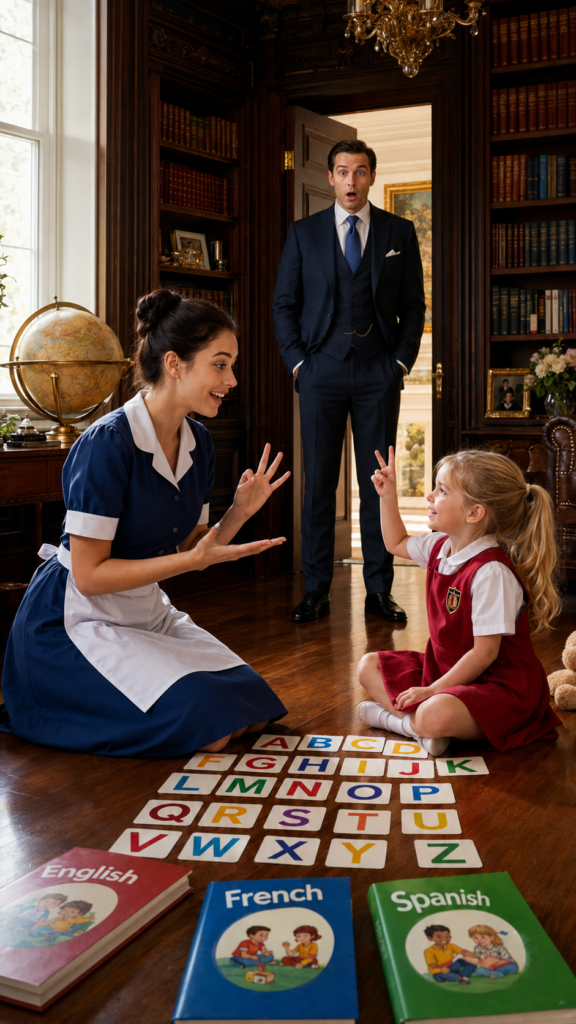
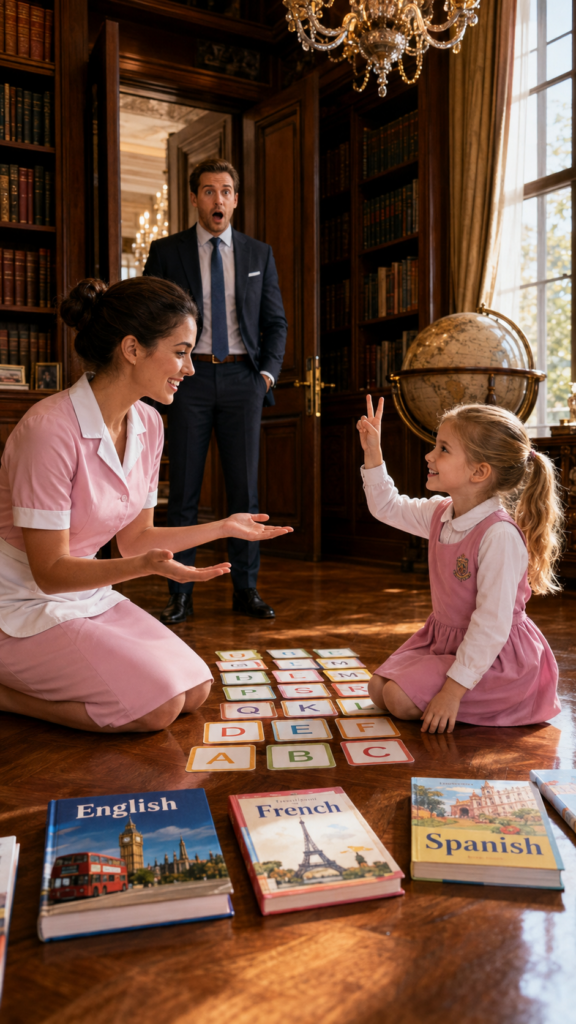
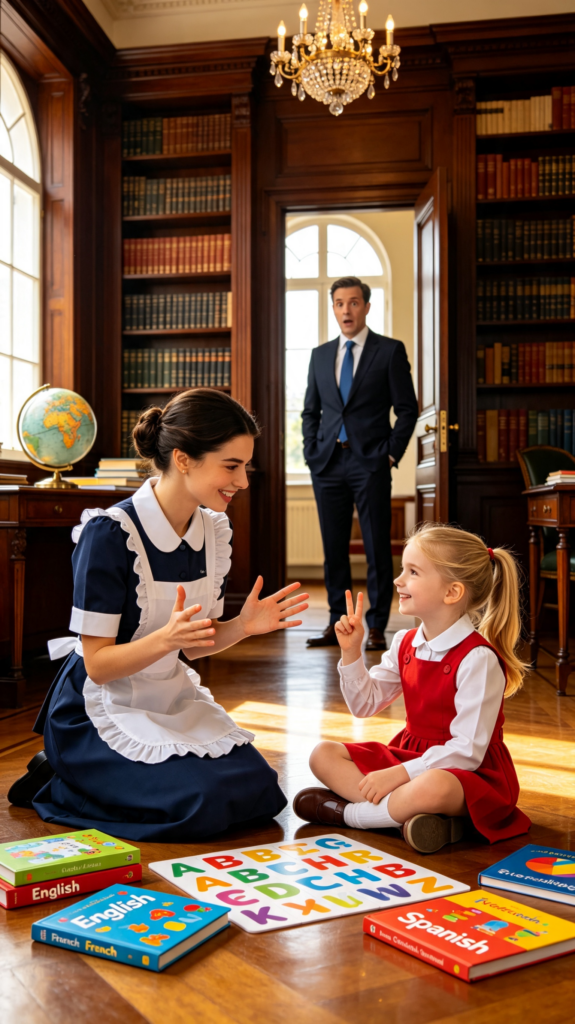
“Tessa,” she asked, “would your dolls like to learn different languages too?”
For the first time, light appeared in the child’s eyes.
She held out the red-haired doll in the green dress.
“This is Lily. She speaks English.”
Elena accepted the doll as though receiving a passport into a hidden country.
“Nice to meet you, Lily.”
Tessa brought the doll to her ear and listened.
“Lily wants to know how to say thank you.”
“In French, merci. In Spanish, gracias. In Italian, grazie.”
Tessa repeated every word.
By Friday, the dolls had been assigned languages.
Lily spoke English.
Sophie spoke French.
Carmen spoke Spanish.
Bella spoke Italian.
Nina spoke with her hands.
Elena placed small colored stickers beneath their shoes so Tessa could identify them without changing the order of the room.
The dolls became a map.
French was used for feelings too tender to say directly.
Spanish was used for requests.
Italian belonged to memories.
German belonged to rules.
Sign language belonged to things that felt too large for sound.
Tessa had not lacked words.
She had lacked places to put them.
Holden knew none of this.
Until one Thursday afternoon, his three o’clock meeting was canceled.
He almost stayed at the office.
He had reports to review and a dinner with investors that evening. Returning home in the middle of the day would disrupt his routine.
Then he remembered the porcelain doll on the third stair.
At 3:42, Holden entered his house without calling ahead.
He heard voices upstairs.
One belonged to Elena.
The other belonged to his daughter.
He climbed slowly.
At the top of the staircase, he stopped.
Tessa’s bedroom door stood open.
Inside, Elena sat cross-legged on the rug.
Five dolls formed a circle between them.
Tessa held the blonde doll in both hands.
“Je suis triste,” she said.
The French was careful but clear.
Elena answered softly.
“Pourquoi es-tu triste?”
Tessa touched the doll’s dress.
“Papa part toujours.”
Holden’s chest tightened.
He knew enough French to understand.
Daddy always leaves.
Tessa exchanged the doll for Carmen.
“Quiero que vuelva antes de que esté oscuro.”
I want him to come home before it gets dark.
Then Bella.
“Mi manca.”
I miss him.
She placed Bella down and lifted both hands.
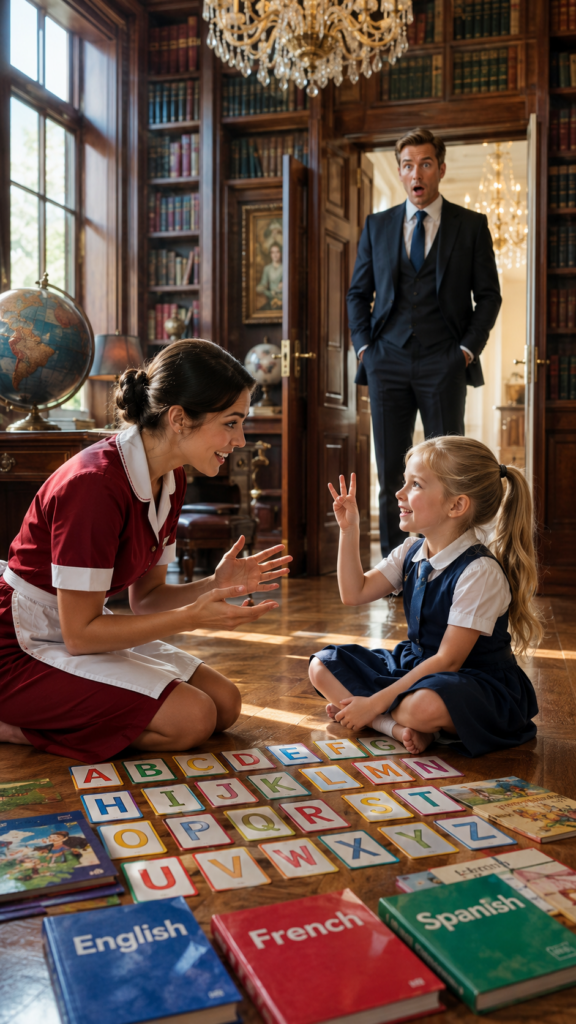
Her small fingers formed a sign Holden did not recognize.
Elena’s face changed.
She signed something back.
Tessa nodded.
Then she picked up the German doll.
“Papa hört nicht.”
Daddy does not listen.
Holden’s hand tightened around the doorframe.
A floorboard creaked beneath his shoe.
Tessa turned.
Every doll remained facing inward except Sarah.
Sarah had been positioned toward the door.
Toward him.
Tessa had known he was there.
Elena rose slowly.
“Mr. Mercer.”
“What is this?”
Tessa’s shoulders lifted toward her ears.
Elena did not move closer to her.
“We were practicing.”
“In five languages?”
“Yes.”
“You were hired to supervise her, not conduct an experiment.”
Tessa covered both ears.
Elena lowered her voice.
“Please do not raise yours.”
“I am not raising my voice.”
“You are tightening it.”
Holden looked at his daughter.
She had curled around Sarah.
“What did she sign?”
Elena hesitated.
“What did she sign?”
Tessa spoke before Elena could answer.
“She said you are angry because I can speak to her.”
Holden stared.
The sentence was complete.
Natural.
Direct.
“Tessa.”
The child pressed Sarah against her chest.
“I can speak.”
“I know.”
“No, you don’t.”
The words struck harder than an accusation shouted by an adult.
Holden stepped into the room.
“Why didn’t you speak to me?”
Tessa looked toward Elena.
Holden saw it.
The trust.
The safety.
The thing he had spent money trying to create and a housekeeper had found in weeks.
Pain turned quickly into defensiveness.
“Elena, leave us.”
Tessa’s breathing changed.
Elena remained still.
“Mr. Mercer—”
“I said leave.”
Tessa stood.
Her face had gone pale.
“If she leaves, I won’t speak to you anymore.”
The room became silent.
Holden looked at his daughter.
She had barely spoken to him for more than a year.
Now her voice was steady.
Not loud.
Steady.
“If she leaves this room?”
Tessa shook her head.
“If she leaves this house.”
“Tessa, you do not decide who works here.”
“No.”
She tightened her grip on Sarah.
“But I decide who gets my words.”
Something inside Holden broke.
Not dramatically.
There was no shout.
No collapse.
Only the sudden realization that his daughter’s silence had never been an empty room.
It had been a locked room filled with words.
And she had stopped opening the door for him.
Elena looked between them.
“I’m not leaving today,” she said quietly. “But both of you need time.”
Holden turned toward her.
“How did you do this?”
“I listened.”
“I hired specialists.”
“They tried to teach her how to enter their world.”
“And you?”
“I asked whether I could visit hers.”
Tessa sat down again.
One by one, she turned the dolls toward the wall.
All except Sarah.
Sarah remained facing Holden.
That night, Holden canceled his investor dinner.
At seven fifteen—the same time he usually left each morning—he sat outside Tessa’s bedroom door.
He did not knock.
He did not enter.
He sat on the floor with his back against the wall and waited.
After twenty-three minutes, the door opened two inches.
Tessa’s hand appeared.
She placed the German doll beside him.
Then the door closed.
A yellow card had been tied around the doll’s waist.
One word was written on it.
Warten.
Wait.
So Holden waited.
PART 2 — THE WORDS CHARLOTTE LEFT BEHIND
The next morning, Holden did not go to the office.
At seven fifteen, he stood in the kitchen attempting to prepare toast.
The first two slices were too dark.
The third was uneven.
The fourth broke when he tried to cut it into rectangles.
Elena watched from the opposite counter.
“You can say it.”
He kept his eyes on the bread.
“Say what?”
“That you don’t know what you’re doing.”
“I know how to make toast.”
“You know how to burn several pieces in a row.”
He placed the knife down.
“What does she eat with it?”
“Strawberry jam on Tuesdays. Butter on Thursdays. Today is Friday.”
“Which means?”
“Plain.”
He stared at the toast.
“Why?”
“Because Friday already feels different.”
Holden looked toward her.
“How do you know these things?”
“She told me.”
“In which language?”
“Not always with words.”
He pushed the plate aside.
“Teach me.”
Elena blinked.
“Teach you what?”
“How to listen.”
For the next two weeks, Holden came home before dark.
Not every day.
But enough for Tessa to notice.
He stopped entering her room without permission.
He learned the signs for hungry, tired, finished, frightened, and stay.
He learned that asking “What is wrong?” was too large a question.
Elena taught him to ask smaller ones.
“Is the light too bright?”
“Is the sound hurting?”
“Do you want me close or far?”
“Do you need words or quiet?”
The first time Holden signed good morning, Tessa corrected the angle of his wrist.
The second time, she did not look away.
The third time, she signed it back.
He treated each response carefully.
No applause.
No demands for more.
No turning her progress into proof that he had finally succeeded.
At the office, his executives noticed the difference.
Meetings ended on time.
Evening calls were rejected.
His assistant, Benjamin, once found him practicing German pronunciation beside a stack of acquisition documents.
“Should I ask?” Benjamin said.
“No.”
“Is that a business phrase?”
“It means the blue cup is in the dishwasher.”
Benjamin nodded solemnly.
“Critical international negotiation.”
Holden almost smiled.
At home, the dolls began to face the room more often.
Tessa used Spanish to ask for pancakes.
French to tell Elena she was afraid of thunder.
Italian for memories of Charlotte.
German for schedules.
Sign language for things that still hurt too much.
One evening, Holden entered the library and found Tessa beneath the grand piano.
Charlotte’s piano.
No one had played it since her death.
Tessa held Bella, the Italian doll, against her cheek.
Holden sat several feet away.
He did not ask her to come out.
After a while, she whispered, “Mama sang here.”
“Yes.”
“In Italian.”
Holden frowned.
“Your mother didn’t speak Italian.”
Tessa looked at him.
“Yes, she did.”
“No. Charlotte studied French in school, but—”
“She sang Italian when you weren’t home.”
The child crawled farther beneath the piano.
Holden’s pulse changed.
“What did she sing?”
Tessa hummed four notes.
A simple rising melody.
Holden had heard it before.
Not from Charlotte.
From the old music box she kept locked inside her dressing room.
He had found it after the funeral, but the key was missing.
“Elena,” Tessa called.
Elena appeared in the doorway.
Tessa hummed the notes again.
Elena’s face drained of color.
Holden noticed.
“You recognize it.”
“No.”
The answer came too quickly.
“Elena.”
She looked toward Tessa.
Then at the piano.
“It is an old Italian children’s song.”
“What is it called?”
“Dormi, piccola rosa.”
Sleep, little rose.
Tessa emerged from beneath the piano and crossed the room.
She placed Bella in Elena’s hands.
“Mama said Elena knows the second part.”
Holden stopped breathing.
Elena closed her eyes.
Tessa repeated the sentence.
“Mama said Elena knows the second part.”
Holden stood.
“What does she mean?”
Elena’s fingers closed around the doll.
“Tessa may be remembering something incorrectly.”
“No,” Tessa said.
Her voice was immediate.
“Mama showed me your picture.”
Holden turned toward Elena.
“What picture?”
Tessa ran from the library.
Holden started after her, but Elena caught his sleeve.
“Do not chase her.”
“She just said my dead wife knew you.”
“I heard her.”
“Then explain.”
“I can’t.”
“Can’t or won’t?”
Elena released him.
“Not in front of her.”
Tessa returned carrying Sarah.
She opened the small zipper in the doll’s back and removed a folded photograph.
Holden recognized Charlotte instantly.
The picture had been taken years before their marriage.
Charlotte stood outside a language institute in Paris with one arm around a teenage girl.
The girl was Elena.
On the back, written in Charlotte’s handwriting, were six words.
For Tessa, when Elena finally comes.
Holden looked up.
The room seemed to tilt.
“You knew my wife.”
Elena sat down slowly.
“Yes.”
“How?”
“She was my teacher.”
Holden laughed once.
Not from humor.
“Charlotte worked in publishing.”
“Before that, she volunteered at a language program for displaced children.”
“What displaced children?”
Elena looked at the photograph.
“Refugees. Foster children. Girls removed from trafficking networks.”
Tessa climbed onto the sofa and curled around Sarah.
Holden lowered his voice.
“Which were you?”
Elena did not answer.
He understood.
Charlotte had never told him.
Not about the institute.
Not about Elena.
Not about speaking Italian.
He felt the old injury of grief reopen.
“What else did my wife hide?”
Elena looked at Tessa.
“More than I knew.”
She explained that she had met Charlotte at fourteen.
Elena’s mother had died during the journey from Albania to Italy. Her father had disappeared years earlier. After being moved through several temporary homes, Elena arrived at the Paris institute angry, silent, and unwilling to trust anyone.
Charlotte taught language classes there.
Not one language.
Five.
“She said children who had lost their homes deserved more than one way to ask for safety,” Elena said.
Holden looked toward the dolls.
“French, Spanish, Italian, German, sign language.”
“Yes.”
“She taught you exactly what you’re teaching Tessa.”
“Not exactly.”
“What is different?”
“Charlotte was better.”
Tessa shook her head.
“No.”
Elena looked at her.
Tessa signed something.
Holden recognized the movement now.
Same.
Elena’s eyes filled.
“Charlotte stayed in contact with me after I left the program,” she continued. “She paid for my education. She helped me study linguistics and child development.”
“You are not a housekeeper.”
“I am a housekeeper.”
“You have a degree.”
“Two.”
Anger rose in him again.
“You entered my home under false pretenses.”
“I entered under my legal name.”
“You concealed your relationship with my wife.”
“Yes.”
“Why?”
“Because Charlotte asked me to.”
He stared at her.
“When?”
Elena removed a small envelope from her pocket.
The paper had softened along the folds from being opened too often.
“She mailed this to me six weeks before she died.”
Holden did not take it.
“Read it.”
Elena unfolded the letter.
Her voice trembled only once.
“Elena, if you receive this, something has happened to me. Do not contact Holden immediately. He is a good man, but grief makes him confuse control with care.”
Holden looked away.
The truth hurt because it was precise.
Elena continued.
“Tessa will lose more than her mother. She may lose the person who understands how she speaks. Give him time. When the blue dolls begin facing the wall, apply through Mercer Domestic Staffing. Use your own name. Do not tell Holden who you are until Tessa does.”
Holden’s attention snapped back.
“The blue dolls?”
Tessa glanced toward the staircase.
“When did Charlotte write this?”
“Six weeks before the accident.”
“She knew she was going to die?”
“I don’t know.”
The letter continued.
“Tessa may remember the languages. She may not. Do not force her. Give each language a home, and she will decide whether to enter.”
Elena stopped reading.
“There is more.”
“Read it.”
“If Holden asks why I chose you, tell him you once survived because someone listened before demanding that you speak. Tessa will need that person.”
Holden took the letter.
Charlotte’s handwriting blurred before him.
“Why did you wait eighteen months?”
“I applied three times.”
“What?”
“Your agency rejected me twice because I lacked formal domestic experience.”
“And the third?”
“Mrs. Morrison found my name among the applications.”
Holden remembered the elderly woman insisting he interview Elena personally.
Charlotte’s plan had depended on chance, bureaucracy, and one observant neighbor.
Or perhaps Charlotte had known people better than he did.
“What did she mean by the dolls facing the wall?”
Elena looked toward Tessa.
“I think it was a signal.”
“A signal for what?”
“That Tessa remembered.”
“Remembered what?”
Tessa climbed down from the sofa.
She walked to the piano and pressed one key.
Then another.
Four notes.
The same melody.
She looked directly at Holden.
“Mama left something in the blue room.”
The blue room was Charlotte’s dressing room.
Holden had sealed it after the funeral.
No one entered.
Not cleaners.
Not staff.
Not him.
He kept the key in the safe behind his office desk.
At nine that night, he unlocked the door.
The room smelled faintly of Charlotte’s perfume.
Lavender and orange blossom.
Her dresses remained beneath protective covers. A silver brush rested on the vanity. A half-read novel lay face down beside the chaise as though she might return after dinner.
Holden could not step inside.
For eighteen months, he had avoided this room because entering felt like admitting she would never use it again.
Tessa walked past him.
She went directly to the music box on the dresser.
The white enamel lid was painted with small blue flowers.
“Where is the key?” Holden asked.
Tessa lifted Sarah.
Inside the doll’s fabric hand, sewn beneath the lace cuff, was a tiny brass key.
Holden sank onto the vanity stool.
Charlotte had placed it there.
Possibly months before her death.
Tessa inserted the key.
The music box opened.
The four-note melody began.
Beneath the turning porcelain ballerina was a false panel.
Inside lay a memory card and another letter.
This one was addressed to Holden.
His hands shook as he unfolded it.
My love,
If you are reading this, Tessa has trusted you enough to bring you here.
He stopped.
Charlotte had not written when you find this.
She had written when Tessa trusted you enough.
Even after death, she had understood their daughter better than he did.
Holden continued reading.
I need you to know the accident was not an accident.
The words erased the room.
Elena stepped closer.
Holden read the line again.
“What does it say?” she asked.
He could not answer.
Tessa covered her ears.
The music box continued turning.
Holden removed the memory card and inserted it into the small player hidden beneath the compartment.
Charlotte’s face appeared on the screen.
She sat in the blue room wearing a cream sweater.
She looked healthy.
Alive.
“Holden,” the recording began, “I am sorry.”
His knees weakened.
“I discovered irregularities inside the Mercer Foundation. Money intended for autism research and educational programs was being transferred through shell organizations.”
Holden stared at the screen.
The foundation had been established by his father.
After the older man’s death, Holden left its management to a board chaired by his uncle, Arthur Mercer.
Charlotte continued.
“At first, I believed it was financial fraud. Then I learned children’s medical records were being sold to private companies. Families were pressured into experimental programs without informed consent.”
Elena covered her mouth.
Holden’s pulse thundered.
“I collected proof. Arthur discovered what I was doing.”
The recording paused.
Charlotte looked toward something beyond the camera.
“Tessa knows more than anyone realizes. She was in the hall when Arthur threatened me. She heard him say the brakes could fail on any road.”
Tessa dropped Sarah.
The doll struck the carpet.
“No,” Holden whispered.
His daughter began rocking.
Elena lowered herself beside her, leaving space between them.
“Tessa,” she said softly, “you are here. The blue room is quiet. No car. No road.”
Tessa signed rapidly.
Elena watched.
“What is she saying?” Holden demanded.
Elena’s face had gone pale.
“She says Uncle Arthur came after the loud phone call.”
Holden knelt.
“Tessa, did you see him?”
The child looked at Charlotte’s frozen image on the screen.
“He told Mama not to make Daddy choose.”
“Choose what?”
“Her or the company.”
Holden closed his eyes.
He had been in London the night Charlotte died.
Arthur had called him first.
Arthur had identified the body.
Arthur had arranged the funeral.
Every detail of Holden’s grief had passed through the hands of the man Charlotte feared.
The recording continued.
“If anything happens to me, do not confront Arthur until you have the files. Tessa remembers patterns, voices, and sequences. She may hold the key without understanding it.”
Charlotte smiled sadly.
“Elena will know how to help her find it.”
The video ended.
Tessa lifted Nina, the doll who spoke with her hands.
She signed three numbers.
Five.
Two.
One.
Then she pointed toward the wall behind Charlotte’s dresses.
Holden removed the garment covers.
A small safe had been built into the paneling.
The code was 521.
Inside were financial records, recorded calls, photographs, and a copy of the foundation’s internal database.
Enough to destroy Arthur Mercer.
Enough to explain Charlotte’s death.
Holden sat on the floor among his wife’s dresses and wept.
Not quietly.
Not carefully.
He pressed both hands over his face as eighteen months of controlled grief tore through him.
He had believed Charlotte’s death was random.
He had believed work protected his family.
He had believed leaving the house each morning was sacrifice.
But while he built companies and negotiated fortunes, his wife had been fighting corruption beneath his name.
And his daughter had carried the final evidence in silence.
Tessa watched him.
Then she walked across the room.
For the first time since Charlotte’s funeral, she placed both arms around his neck.
Holden froze.
He did not pull her closer.
He did not risk turning comfort into demand.
He let her decide the pressure.
Her cheek rested against his shoulder.
In Italian, she whispered, “Papa, ascolta.”
Daddy, listen.
“I’m listening,” he said.
Then Tessa spoke the sentence that broke him.
“Mama said you would hear me after you stopped trying to fix me.”
PART 3 — THE LANGUAGE OF STAYING
Arthur Mercer was arrested forty-eight hours later.
Holden did not confront him privately.
He did not threaten him.
He handed every file to federal investigators and watched agents enter the foundation’s headquarters through the same glass doors Arthur had used for twenty years.
The scandal spread quickly.
Medical records had been sold.
Research funds had been redirected.
Several children had been enrolled in unapproved pharmaceutical trials through clinics funded by the Mercer Foundation.
Arthur denied involvement.
Then prosecutors played Charlotte’s recordings.
His lawyers stopped speaking to the press.
Holden closed the foundation immediately.
He created an independent restitution fund for affected families and placed control in the hands of physicians, disability advocates, and parents.
He removed his own name from the board.
Reporters called it an act of accountability.
Holden knew better.
It was the smallest thing he could do.
At home, life changed more slowly.
Tessa did not suddenly become talkative.
She did not wake one morning transformed into the child strangers expected.
Some days she spoke in full sentences.
Some days she used signs.
Some days the world became too loud and she communicated only by turning dolls.
Holden learned not to measure love by volume.
He changed his schedule.
Breakfast became sacred.
He left the office by five on most evenings.
When emergencies required him to travel, he showed Tessa the calendar in advance and placed a small wooden plane on the correct days.
He stopped promising he would be home “soon.”
Soon had no shape.
Instead, he said, “I will return Friday before dinner.”
Then he returned Friday before dinner.
Trust grew through accuracy.
Elena remained in the house.
Officially, she still supervised Tessa and managed parts of the household.

Unofficially, she had become the person around whom both father and daughter reorganized themselves.
Holden offered her a position directing a new language-access program for autistic children.
She refused.
“You have the qualifications.”
“I know.”
“The salary would be ten times what you earn here.”
“I know that too.”
“Then why refuse?”
They stood in the kitchen while rain tapped the windows.
Elena cut strawberries into equal pieces for Tessa’s lunch.
“Because you are trying to turn gratitude into a promotion.”
“That is not my intention.”
“It is a very billionaire intention.”
He leaned against the counter.
“What do you want?”
Elena set down the knife.
“To finish what Charlotte asked me to do.”
“You already have.”
“No.”
“She is speaking.”
“That was never the goal.”
“Then what was?”
Elena looked toward the doorway.
Tessa sat in the hall teaching Sarah the sign for rain.
“The goal was for her to be understood even when she didn’t.”
Holden absorbed the sentence.
“And after that?”
Elena resumed slicing strawberries.
“I don’t know.”
The answer frightened him.
Not because she seemed uncertain.
Because he suddenly understood that Elena might leave.
Tessa understood too.
The dolls began facing the wall again.
First one.
Then two.
By the end of the week, all except Sarah had been turned away.
Holden found Elena packing her navy suitcase on Sunday afternoon.
He stood in the doorway of the ground-floor bedroom.
“What are you doing?”
“My visa expires next month.”
He stared at her.
“You never mentioned a visa.”
“It was not relevant before.”
“It is relevant now.”
“I applied for an extension.”
“And?”
“It was denied.”
“We’ll appeal.”
“I already did.”
“I’ll hire attorneys.”
“I have an attorney.”
“You have my resources.”
Elena closed the suitcase.
“That is the problem.”
He stepped inside.
“My resources are a problem?”
“You believe every closed door is an invitation to purchase the building.”
“If the door is keeping you from staying, yes.”
She looked tired.
“Holden.”
It was the first time she had used his name without anger or emergency.
He became still.
“I cannot become another person whose life is controlled by your fear of losing her.”
“That is not what this is.”
“It is exactly what this is.”
“I am trying to help.”
“You are trying to make leaving impossible.”
“Because Tessa needs you.”
Elena’s expression changed.
Not much.
Enough.
Holden heard the cowardice in his own words.
He had not said I need you.
He had hidden behind his daughter.
Elena lifted the suitcase from the bed.
“Tessa needs people who stay because they choose her. Not because you trap them inside solutions.”
“I am not trapping you.”
“No. You are offering me a golden cage.”
She carried the suitcase toward the door.
Holden moved aside.
It was one of the hardest things he had ever done.
“When will you tell her?”
“Tonight.”
“She will think you abandoned her.”
“I know.”
“She may stop speaking.”
“I know.”
His voice broke.
Elena’s eyes filled.
“I know.”
That evening, they sat together in Tessa’s room.
All five language dolls faced the wall.
Sarah lay in the child’s lap.
Elena explained that she might need to leave the country for a while.
Tessa did not react.
Elena used English first.
Then French.
Spanish.
Italian.
German.
Finally, sign language.
Tessa watched her hands.
When Elena finished, the child carried Sarah to the window.
“Did I do something wrong?”

“No,” Elena said.
“Did Daddy?”
Holden looked down.
Elena answered carefully.
“No.”
“Then why?”
“Because sometimes adults are allowed to stay in a country only if papers say yes.”
Tessa stared outside.
“Papers don’t know you.”
“No.”
“They don’t know me.”
“No.”
“Then papers are stupid.”
Holden almost laughed.
Instead, he pressed a hand against his mouth.
Tessa turned toward Elena.
“If you leave, I won’t speak to Daddy anymore.”
The same sentence.
The threat that had once forced Holden to listen.
Elena moved closer, but did not touch her.
“No, Tessa.”
The child’s face tightened.
“You said words belong to me.”
“They do.”
“I decide who gets them.”
“Yes.”
“Then he doesn’t.”
Elena’s voice softened.
“You may choose silence whenever you need it. But you cannot use silence to punish someone into keeping another person.”
Tessa looked confused.
“That is what frightened people do when they think asking honestly will not work.”
Holden felt the words enter him too.
Tessa looked at her father.
He knelt.
“I want Elena to stay.”
The child waited.
He forced himself to continue.
“Not only because of you.”
Elena’s breath caught.
“I want her to stay because this house feels alive when she is in it. Because she tells me when I am wrong. Because she knew how to hear you before I did.”
His voice became unsteady.
“And because I do not want every person I love to become someone I only speak to through recordings.”
The room went silent.
Elena looked away.
Tessa studied both adults.
Then she selected Sophie, the French doll.
“Je veux qu’elle reste.”
I want her to stay.
Holden answered in clumsy French.
“Moi aussi.”
Me too.
Elena laughed through tears.
But she still left three weeks later.
There was no legal solution fast enough.
No emergency exception Holden could create without turning her right to choose into another transaction.
At the airport, Tessa wore noise-canceling headphones and held all five dolls inside a transparent backpack.
She did not cry.
She handed Elena Sarah.
“For the plane.”
Elena shook her head.
“Sarah belongs with you.”
“She speaks Italian.”
“So do you.”
Tessa pushed the doll into her arms.
“Bring her back.”
Elena looked at Holden.
He wanted to promise.
He did not.
Instead, he said, “We will call Tuesday at six.”
Tessa corrected him.
“Six fifteen.”
“Six fifteen.”
Elena boarded the flight.
For six months, they built a family across screens.
Tuesday calls.
Thursday language lessons.
Sunday dinners with Elena’s face propped on a tablet at the end of the table.
Tessa showed her drawings.
Holden reported every burnt meal.
Elena began working at a language center in Florence while her immigration case was reviewed.
The house became quieter.
But it no longer confused quiet with emptiness.
Then, one October morning, an envelope arrived from the United States Citizenship and Immigration Services.
Holden placed it unopened on the breakfast table.
Tessa stared at it.
“Is it the paper?”
“Yes.”
“The stupid one?”
“Possibly.”
They called Elena before opening it.
Her face appeared on the screen from a small apartment kitchen.
“Do it together,” she said.
Holden slid his finger beneath the flap.
The petition had been approved.
Elena could return under a specialized professional visa connected to the language-access program she had once refused to direct.
Tessa screamed.
Not from distress.
From joy.
She ran around the table, knocking over a glass of orange juice, and did not stop to correct its position.
Holden laughed so hard he had to sit down.
Elena covered her face and cried.
For twenty minutes, happiness filled the house without asking permission.
Elena returned two weeks later.
Tessa waited at the airport wearing a dress with all five language colors sewn into the hem.
When Elena appeared beyond the security doors, the child ran.
She struck Elena with enough force to make the suitcase fall.
Elena held her.
Holden watched from several feet away.
Then Elena lifted one hand toward him.
He joined them.
For the first time since Charlotte’s death, he allowed himself to believe that love might arrive without announcing its future departure.
That night, Tessa insisted on showing Elena everything that had changed.
The new visual calendar.
The language cards.
The piano Holden had finally tuned.
Charlotte’s blue room, which was no longer sealed.
They entered together.
The music box remained on the dresser.
Tessa turned the key.
Dormi, piccola rosa filled the room.
Elena picked up a framed photograph Holden had recently placed beside the mirror.
Charlotte at the Paris language institute.
Elena at fourteen.
They stood with their arms around each other.
“I don’t remember this being taken,” Elena said.
Holden looked at the photograph.
“Neither did Charlotte.”
Elena frowned.
“What do you mean?”
“The date on the back is wrong.”
He handed her a second photograph found among the foundation evidence.
It showed the same building.
The same afternoon.
But Charlotte was not standing beside Elena.
She was holding a baby.
Tessa.
Elena stared.
“That’s impossible. Tessa wasn’t born yet.”
“The date on your photograph was altered.”
Holden placed Charlotte’s final unopened file on the vanity.
It had been discovered inside Arthur’s private safe after his conviction.
A sealed letter addressed to Elena.
She opened it slowly.
The first line changed her face.
Elena,
I told Holden that you were my student because I was ashamed of the truth.
Elena sat down.
Holden remained beside Tessa.
Charlotte’s letter continued.
Your mother did not die during your journey to Italy. She brought you to the Paris institute and worked there under another name.
Elena stopped breathing.
“She lied to me?”
Holden said nothing.
The letter trembled in her hands.
Her name was Miriam Marlow.
She became ill shortly after your arrival. Before she died, she told me who your father was.
Elena looked up.
“No.”
Holden already knew what came next.
He had read the letter once.
Only once.
Your father was Richard Mercer.
Holden’s father.
The room seemed to narrow around them.
Elena read the sentence again.
Richard had met Miriam during a Mercer Foundation project overseas. When she became pregnant, he denied responsibility and used foundation money to move her from country to country.
Charlotte discovered the truth years later while volunteering at the institute.
Elena was not simply her student.
She was Holden’s half sister.
Arthur had known.
That was why Elena’s first applications were rejected.
That was why he monitored Charlotte’s contact with her.
That was why the foundation kept a file on Elena even after Richard Mercer died.
Holden sat beside her.
“I didn’t know until last week.”
Elena stared at him.
“You knew when I returned?”
“No. The letter arrived yesterday.”
“Why didn’t you tell me at the airport?”
“Because Tessa had waited six months to be happy.”
Elena looked toward the child.
Tessa stood beside the music box, listening.
“So Charlotte brought me into this house because I am family.”
“Yes.”
“All this time, she knew.”
“Yes.”
Elena laughed once, but the sound collapsed.
“I thought she chose me because I was good at listening.”
Tessa walked toward her.
She placed Sarah in Elena’s lap.
“She did.”
Elena’s face crumpled.
Tessa touched the letter.
“Family is not why you hear me.”
“No,” Holden said.
“It is only why Charlotte knew where to look.”
Elena began to cry.
Not the quiet tears she allowed other people to see.
She bent over the doll, grieving a mother she had been told died differently, a father who had abandoned her, and a sister who had loved her through secrets.
Holden sat beside her.
He did not promise to fix it.
He did not offer lawyers, money, or revenge.
He waited.
After several minutes, Elena leaned against him.
His arm came around her carefully.
Tessa climbed between them.
Outside, evening settled over the house.
The rooms remained large.
The ceilings remained high.
The past remained cruel.
But the silence no longer felt like accusation.
It felt like three people breathing together.
Later that night, Tessa returned every doll to its place.
Lily on the left.
Sophie near the lamp.
Carmen beside the books.
Bella facing the piano.
Nina with her hands raised.
Then she placed Sarah between the two bedroom doors—Holden’s at one end of the hallway and Elena’s at the other.
The doll faced neither room.
She faced the space between them.
And beneath her tiny fabric hand, Tessa placed a new card bearing the only language they had all spent years learning too late: Stay.
