

All I wanted was a quiet place where my daughter and I could finally put down roots. Instead, only days after moving in, I found myself facing a neighbor determined to make us wish we had never arrived.
The moving truck pulled away just after two o’clock that afternoon. I stood in the driveway with a cardboard box balanced against my hip, gazing at the small house that was finally mine.
The paint peeled from the siding in thin curls. One side of the porch sagged slightly, as if the house had leaned forward to listen to a secret. It was old, simple, and weathered—but it belonged to us. My eight-year-old daughter, Olivia, had already kicked off her sneakers and was running barefoot through the tall grass behind the house. She stretched both arms toward the lake as though greeting it herself.
“Mom, there’s a frog,” she shouted. “A real one! I named him Kevin!”
“Kevin the frog stays outside,” I called back with a laugh. “He’s a wild animal.”
I set the box on the porch step and finally let myself exhale.
My father had left me the lake house after he passed away six months earlier. For the first time in years as a single mother, I would no longer be paying rent to someone else.
Olivia and I had spent so many years in a cramped one-bedroom apartment that she thought having a hallway felt extravagant.
Now she had a backyard, a frog named Kevin, and a bedroom window looking out over real trees.
The gravel crunched beneath my shoes as I walked back toward the car.
The driveway ran in a narrow strip beside the house, only just wide enough for my aging blue Chevrolet. It was the only place to park. There was no garage, no additional lot, and nowhere else the car could go.
I turned and noticed an older man wearing a faded cap, leaning comfortably against the fence separating our properties.
His face was lined with age but welcoming, and he carried himself with an easygoing warmth.
“Hello, I’m Harold,” he said. “Your dad and I used to fish off that dock back there. He talked about you all the time. He mentioned you’d get the house.”
“Samantha,” I replied, stepping over to shake his hand.
“And that barefoot tornado is Olivia.”
“She’s a keeper,” my new neighbor said with a smile.
His eyes drifted toward the porch.
“That railing’s about ready to give up on life. I’ve got tools. You just say the word.”
“Retired contractor, ma’am. If I don’t fix things, I go stir-crazy.”
I laughed, and some of the tension I had been carrying finally eased.
Then I felt it—that uneasy sensation at the back of my neck that comes when someone is watching.
I looked uphill.
The house next door stood higher than the others on the street. It was large, elegant, and featured a second-floor balcony overlooking the lake. A woman wrapped in silk stood there, holding a cup like a royal scepter.
She didn’t smile.
She didn’t wave.
Instead, she stared at my Chevrolet as though it had personally offended her.
“Morning,” I called, trying to sound welcoming.
She paused before answering.
“Could you park it somewhere else?” she finally asked, gesturing toward my car with two fingers. “It’s ruining my view of the lake.”
I blinked in disbelief.
“I’m sorry, but this is my driveway. I have nowhere else to park.”
“That’s Valerie,” Harold quietly said beside me.
Valerie tilted her head without changing her expression.
“Well,” she said with an exaggerated eye roll, “I don’t care. Park that piece of junk somewhere else. I don’t want to see that eyesore from my balcony.”
Then she turned, walked back inside, and quietly closed the balcony door behind her.
It was obvious my new neighbor had decided she disliked me before we had even properly met.
I stayed where I was, my keys still in my hand, feeling a quiet warning settle deep in my stomach. Someone like Valerie was unlikely to stop after a single complaint.
Three days later, I was checking the mailbox at the edge of the gravel driveway when I heard the sharp click of heels against the stones behind me.
I knew who it was before I even turned around.
Valerie had traded her coffee cup for a designer handbag, but her expression remained exactly the same.
“We need to talk about your vehicle,” she said.
“We really don’t,” I replied, pulling a stack of envelopes from the mailbox. “It’s parked on my property.”
“It’s hideous,” Valerie answered.
Heat rushed into my cheeks.
She stepped closer until I could smell her perfume, then slowly looked me up and down.
“Let me be clear with you, sweetheart. Maybe people like you don’t belong in a neighborhood like this. Normal, wealthy people live here. Not single moms in rusted-out Chevrolets.”
Anger surged through me.
“My daughter and I live here now,” I said. “You’ll have to get used to the view.”
“We’ll see about that.”
She walked away, her heels striking the pavement with sharp, deliberate clicks, while I stood clutching a water bill until the shaking in my hands finally stopped.
I didn’t realize Olivia had heard everything until we sat down for dinner.
She quietly pushed peas around her plate before looking up at me.
“Mom, why does that lady hate us?”
“She said we don’t belong.”
I set my fork down.
Olivia was only eight years old, yet she already understood the meaning hidden beneath grown-up words.
“Some people think a nice view is more important than being nice,” I told her. “That’s their problem, not ours.”
“But you looked sad.”
“I wasn’t sad. I was thinking.”
Olivia chewed thoughtfully.
“About what?”
“About how proud Grandpa would be that we live in his house.”
A small smile returned to her face, and I hoped that would be the end of it.
It wasn’t.
The next afternoon, Harold walked up the path carrying a plate of cookies wrapped in plastic and wearing an expression that looked far too casual to be genuine.
“A small welcome to the neighborhood gift,” he said, holding them out to me. “My late wife’s recipe. She’d want the new neighbors to have them.”
“You didn’t have to.”
“I know. Can I sit for a minute?”
I motioned toward the porch steps.
Olivia was inside coloring, but the moment Harold sat down, I noticed her head turn toward the screen door.
“So,” he said, setting his cap beside him. “Valerie.”
“You heard.”
“Ma’am, half the street heard. She’s not exactly a whisperer.”
Despite everything, I laughed.
“She’s done this before,” Harold continued. “Two families in five years. Both left. She has a way of making people feel like renters in their own homes.”
“Wonderful.”
“Here’s the thing.” He glanced at me. “That balcony of hers? Not permitted. The stone wall along her side yard? Sitting three feet into the public easement land. Those fancy statues by her walkway? Also on the easement. Her contractor doesn’t have a license in this state.”
I stared at him. “What do you mean by that?”
“Because I’ve been keeping a file, ma’am. I was your dad’s friend for 30 years. He asked me once to keep an eye on things over here if anything ever happened to him. I’ve been documenting everything for years.”
“Mr. Harold…”
“Just Harold’s fine.”
“Why are you telling me this?”
He picked up one of the cookies, examined it for a moment, then quietly placed it back on the plate.
“Because you’re going to need it. Document everything, Samantha. Every conversation. Every look. Get it time-stamped. Don’t confront her. Don’t yell. Just record it.”
I gave a slow nod.
From inside the house, the sound of a crayon moving across paper suddenly stopped.
Harold stood, settled his cap back onto his head, and started down the walkway. Before reaching the end, he glanced back over his shoulder.
“And keep parking that Chevy right where it is. That’s your driveway.”
I followed his advice.
There simply wasn’t anywhere else to leave it.
That night, I sat beside Olivia’s bed, pulling the quilt snugly around her just the way she liked.
“Mom?”
“Yeah, baby.”
“I’ve been thinking,” my daughter started.
“That’s dangerous.”
She laughed softly before her face grew thoughtful again. She wore the same concentrated expression she always had whenever she was trying to solve a problem.
“I have an idea,” she said.
“About what?”
“About the lady.”
I gently brushed a few strands of hair away from her forehead.
“Sweetheart, you don’t need to worry about the lady. That’s my job.”
“I’m not worried,” Olivia yawned dramatically. “I just had an idea.”
“Olivia, what idea?”
She had already turned toward the wall and pulled the quilt over her shoulder. Within moments, her breathing settled into a slow, peaceful rhythm.
I remained seated beside her, wondering what kind of plan an eight-year-old could possibly have come up with.
Outside, Kevin croaked as if he was asking the very same question.
Friday traffic had been exhausting.
By the time I finally turned onto our street, all I wanted was to kick off my work shoes and enjoy a cold drink.
I waved at my coworker Denise as her Corolla disappeared around the corner. Like every afternoon that week, Harold had walked Olivia home from the bus stop.
Then I saw the truck.
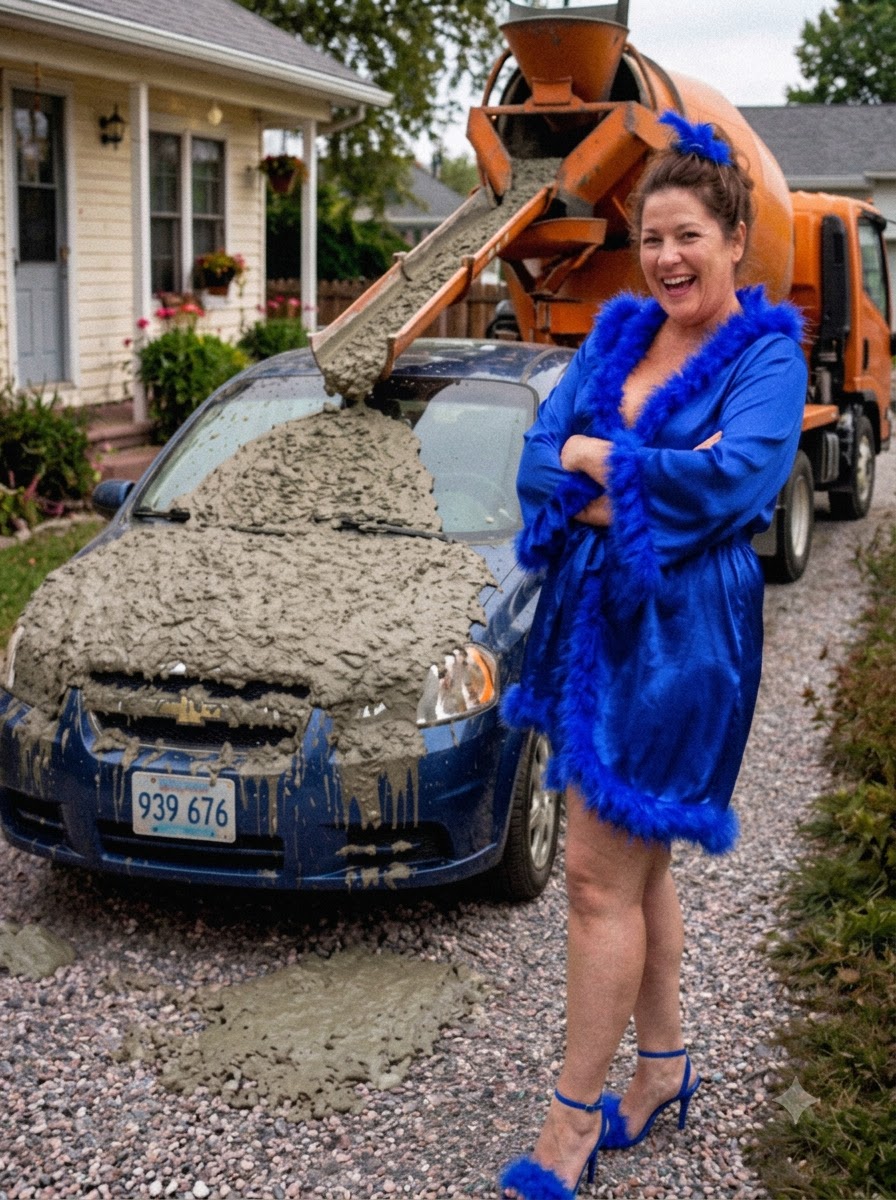
A concrete mixer sat directly in front of my house, its chute stretched across my gravel driveway.
Fresh gray concrete was pouring over the hood of my Chevrolet, slowly crawling across the windshield.
I froze in the middle of the street.
For several long seconds, I questioned whether fatigue was causing me to misread what I was seeing.
Then I spotted Valerie.
She stood calmly at the edge of her yard in yet another silk robe, watching everything unfold as though she were admiring newly planted flowers.
I hurried toward the driveway so fast I nearly tripped over my handbag.
“What are you doing?!” I shouted.
Valerie smiled.
“I guess you’ve finally learned your lesson,” she said. “Now you’ll park that junk somewhere else.”
My hands were shaking so badly that I almost dropped my phone twice while pulling it from my purse.
I was just about to dial 911 when the screen door behind me opened.
Olivia stepped out onto the porch holding a juice box. She glanced at the concrete truck, then shifted her gaze to Valerie, and finally looked at me.
Then, completely unexpectedly, she gave me a wink.
“Baby, get back inside,” I said.
Instead of listening, she calmly walked past me and stopped a polite distance from Valerie.
“Ma’am,” Olivia said, facing our neighbor, “I’m really sorry, but look. I think something is happening to your porch.”
Valerie’s confident smile faltered.
“What are you talking about, child?”
“Up there.” Olivia gestured with her juice box. “The men. The one with the clipboard.”
Valerie immediately looked toward her house.
I followed her gaze.
Two men were standing on her front steps, their vehicle parked in her driveway.
One of them, dressed in a city uniform, was fastening a bright orange notice to the front door. The other, a stocky man in a dusty work jacket, held a phone to his ear while angrily pointing toward the concrete mixer beside my house.
The color drained from Valerie’s face.
“Oh God, no,” Valerie whispered. “Please, not this!”
“What is that?” I asked quietly. “Olivia. What did you do?”
“I got Mr. Harold involved like I planned. I told him,” my daughter said.
She paused for a sip from her juice box.
“This morning. She was on her phone in the yard while I was waiting for the bus.”
“You told him what?”
“That the mean lady was on her phone in her yard. She was talking really loudly. She told the concrete people the car was on her property and it was fine, and to come at four. But it wasn’t her address she gave, Mom. It was ours.”
I could only stare at her.
“So, when Mr. Harold came to wait with me for the bus after locking up our door,” she continued, “I told him. And he said I did the right thing. Then he made a bunch of calls.”
Valerie had already broken into a hurried run toward her house.
Her silk robe billowed behind her as she rushed up the driveway, calling out, “Please wait, please, there’s been a mistake!”
The man in the dusty work jacket ended his phone call and marched toward the concrete mixer.
He sliced his hand across his throat toward the driver.
“Shut it down,” he barked. “Shut it down right now! We were lied to!”
The stream of concrete came to an immediate stop.
The mixer’s loud rumbling gradually faded into a dull, uneven sputter.
Harold appeared beside the fence separating our properties with a manila folder tucked beneath one arm.
He caught my eye and offered a quiet, reassuring nod.
I would later learn that the folder held years’ worth of documentation.
Every unauthorized construction project.
Every section of public easement Valerie had taken over with her expensive decorative statues.
Every code violation Harold had quietly warned me about while sharing homemade cookies.
I slowly lowered my phone.
My hands were no longer trembling.
Across the driveway, Valerie hurried toward the stop-work notice flapping against her front door.
“Oliv,” I said, my voice breaking. “Come here.”
She stepped into my embrace as though this were just another ordinary afternoon.
I wrapped my arms tightly around her because I already knew nothing would ever be quite the same again.
Valerie’s face lost even more color as the concrete company’s supervisor approached, still holding his phone.
“Ma’am, we were told this pour was on your property,” he said. “You lied to my crew.”
Valerie struggled to find any words.
The supervisor tapped his screen and played a recording through the speaker.
Her own voice echoed across the driveway, clearly saying “my property” and referring to “the driveway on the west side.”
The city inspector glanced down at his clipboard.
“We also need to talk about the unpermitted work and those garden statues sitting on public easement land.”
I said nothing, keeping one hand gently on Olivia’s shoulder.
The supervisor turned to face me.
“Ma’am, we’re immensely sorry about this. We’ll cover the full cost of repairing your vehicle. Your neighbor will pay. You have my word.”
“Thank you,” I replied.
Nothing else.
No cheering.
No dramatic words.
Valerie made one last attempt to redirect everyone’s attention.
No one acknowledged her.
Then Olivia stepped forward wearing the solemn expression of a little judge and held out her juice box toward Valerie.
“My mom says a cold drink helps on a hard day.”
Valerie looked at the juice box as though it were the last thing she expected to be offered.
Several weeks passed before my Chevrolet returned to the driveway, fully repaired, spotless, and running more smoothly than ever.
The porch had been refreshed with a coat of soft pale-yellow paint thanks to Harold and one determined eight-year-old who proudly handled a paint roller nearly as tall as she was.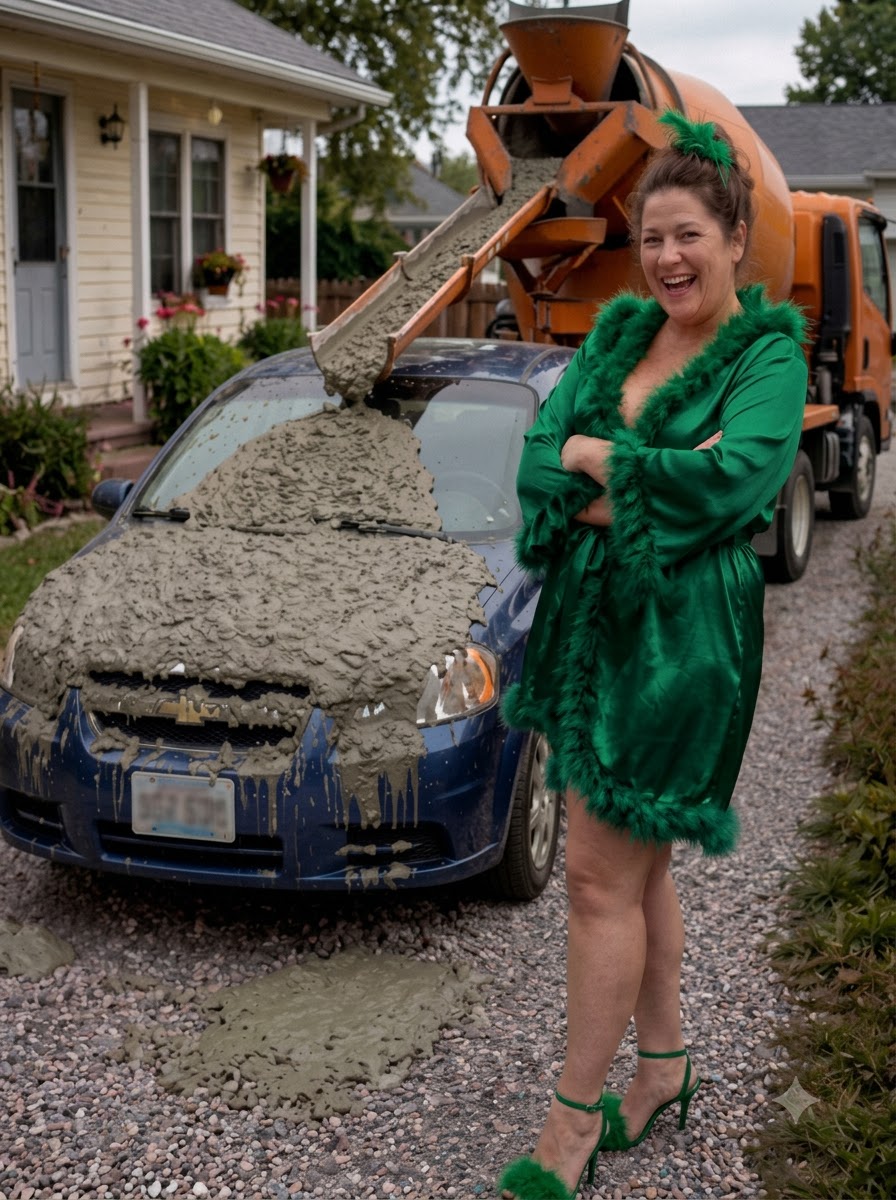
Once the fines were issued, a large “For Sale” sign appeared in Valerie’s front yard.
Olivia leaned comfortably against me on the newly restored porch as the evening sun slowly settled over the lake.
“Yeah, baby,” I whispered. “We’re home.”
At that quiet moment, I realized my father had left me far more than an aging lakeside house.
He had given us a place where we genuinely belonged.
If you combine this with the previous rewritten sections, the tone and style will remain consistent throughout the entire story.
