

Part 1: The Night My Daughter And I Were Left Outside
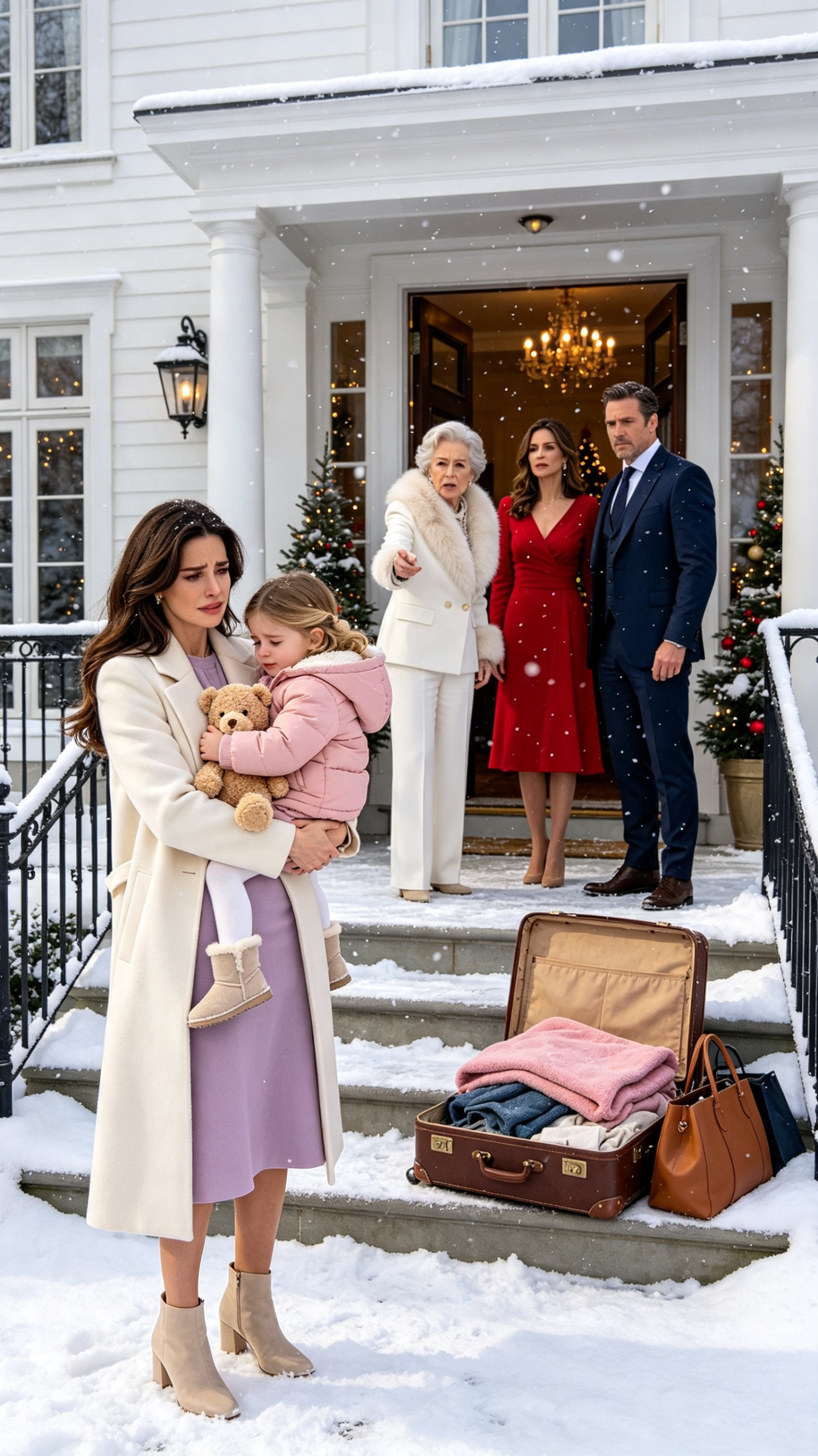
The snow had already covered the front steps when I arrived at my father’s home just before eleven on Christmas Eve.
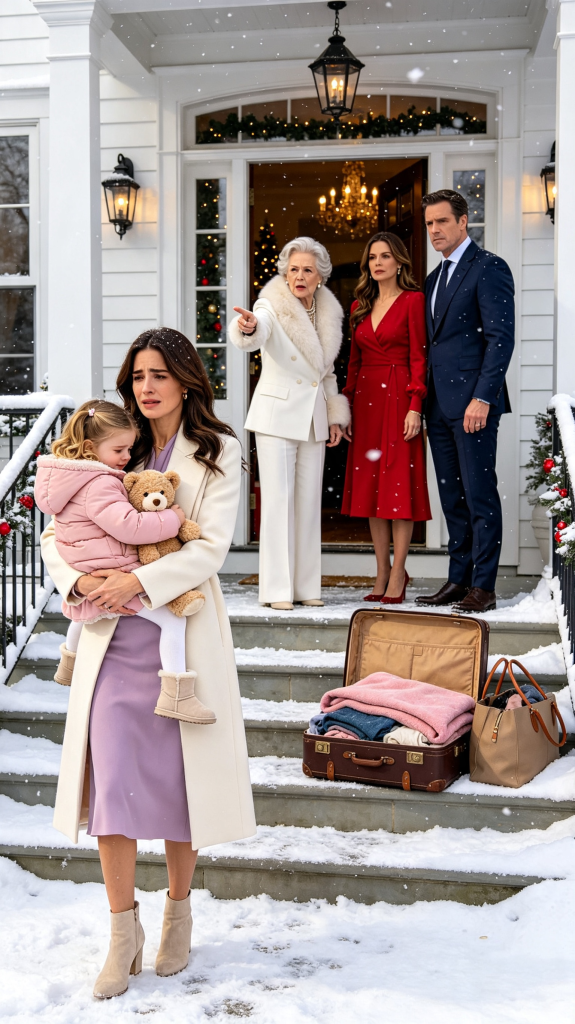
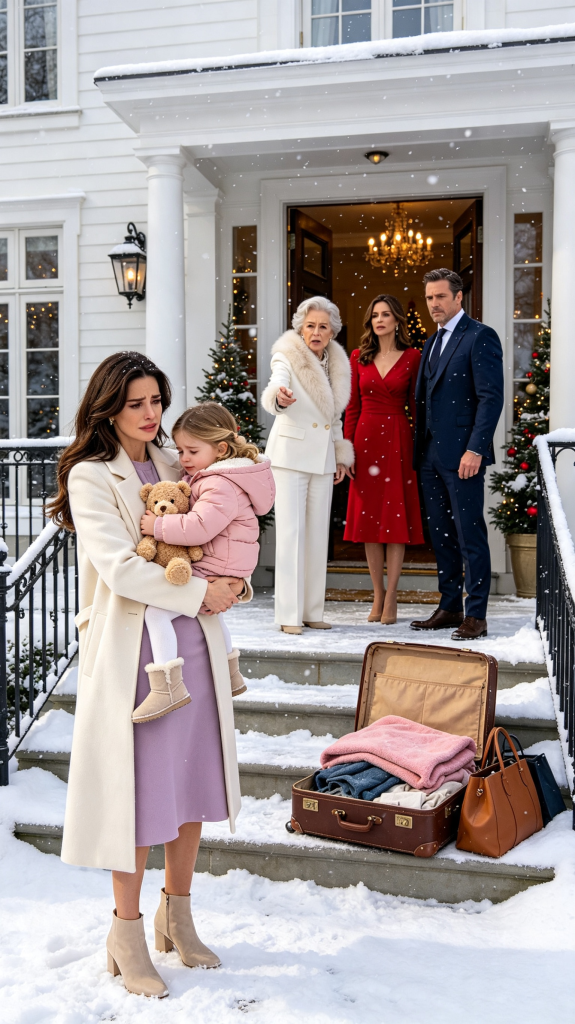
I carried my eighteen-month-old daughter against my chest while pulling a damaged suitcase and two black contractor bags behind me.
My fingers were so cold that closing them around the brass door knocker was almost impossible.
My daughter’s cheeks looked frighteningly pale beneath the hood of her soaked pink coat.
I knocked three times before my father opened the door.
Calvin Bennett took one look at me.
He did not ask questions.
He immediately reached for Lily, wrapped her inside his wool coat, and carried her toward the warmth of the fireplace.
Then he motioned for me to bring the bags inside before more snow blew into the entryway.
“We will talk after she is warm,” he said. “Nothing matters before that.”
My name is Hannah Bennett, and at thirty-four years old, I had spent most of the previous six years trying to convince myself that my marriage to Andrew Collins was worth every sacrifice I had made.
I had walked away from a promising communications career in Boston.
I had moved to an expensive suburb outside Providence.
And little by little, I allowed my husband to control every financial decision because he insisted that one person needed to properly manage the household.
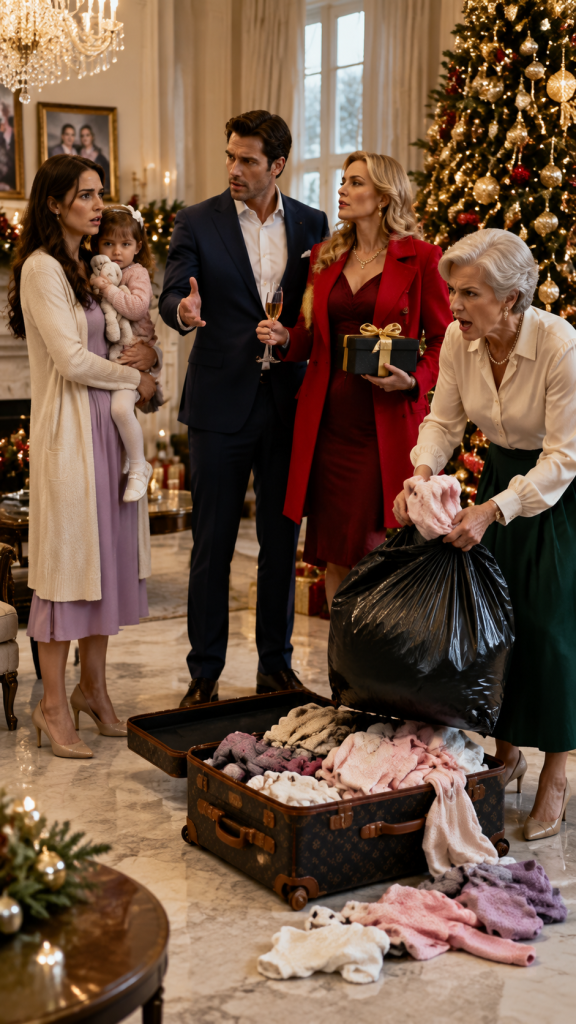
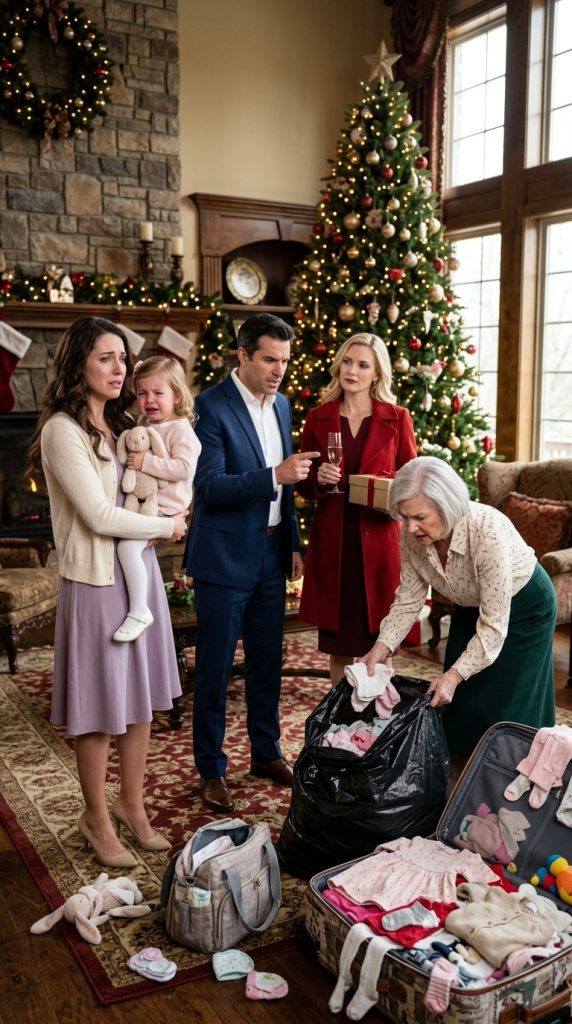
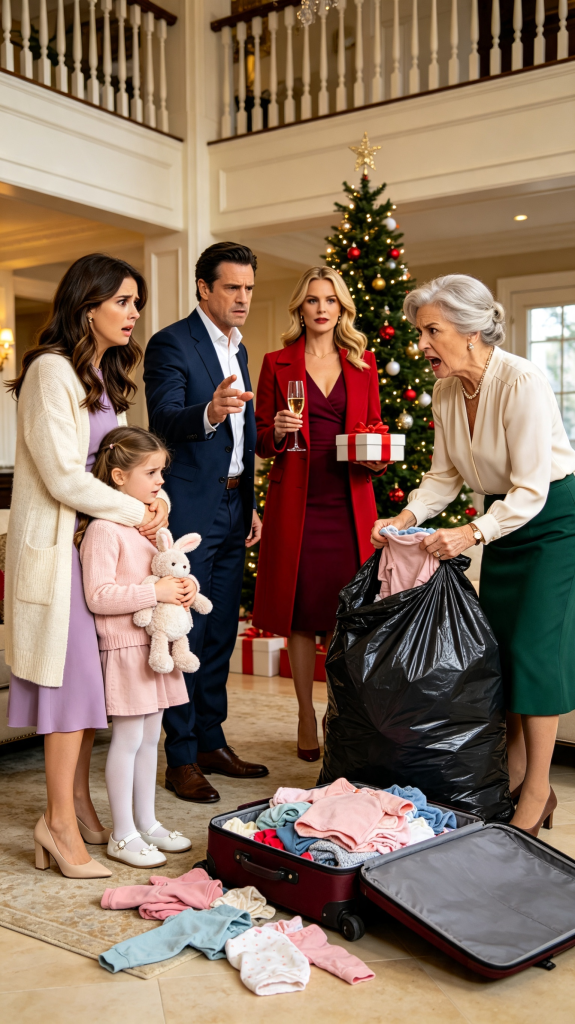
On that Christmas Eve, Andrew brought his girlfriend into our living room while his mother stood beside him as though she were introducing someone important.
Vanessa Reed arrived carrying a gold-wrapped present and wearing a red cashmere coat that likely cost more than my monthly grocery expenses.
Andrew placed his hand on her back and spoke with the confidence of someone making an announcement instead of admitting a betrayal.
“Vanessa will be staying here for Christmas, and after the holidays we will discuss how to make the separation permanent.”
I stared at him while Lily played near the Christmas tree with a wooden train.
“You brought another woman into our home while your daughter is sitting ten feet away.”
Andrew’s mother, Margaret Collins, stepped out from the dining room carrying several empty contractor bags.
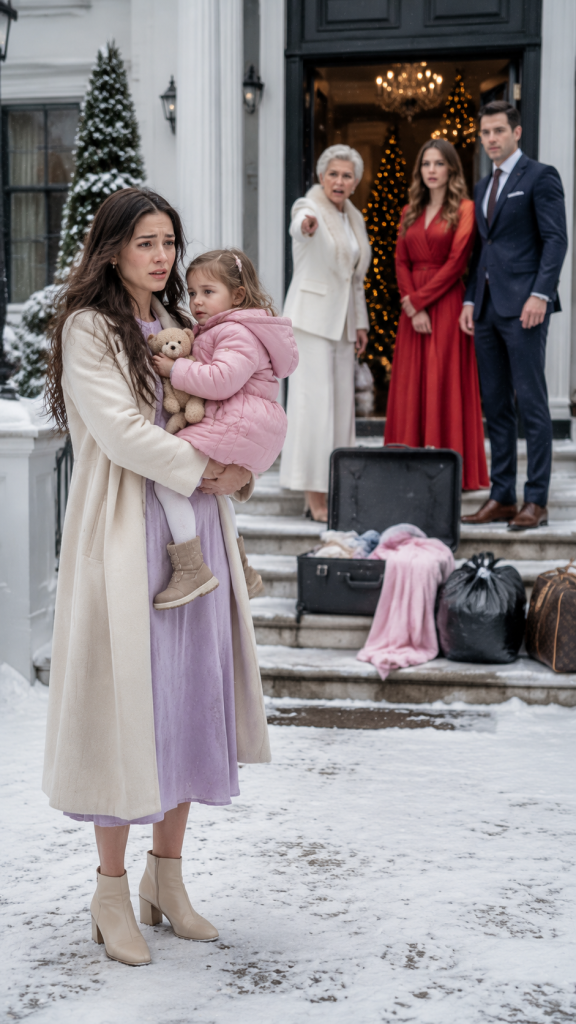
“Please do not create a scene,” she said. “Andrew has been unhappy for a long time, and everyone deserves the chance to begin again.”
I looked at her in disbelief.
“Where do you expect Lily and me to go tonight?”
Margaret opened one of the bags and began placing clothes from the laundry basket inside.
“You still have a father.”
Andrew refused to meet my eyes.
“I have made my choice, Hannah.”
That sentence stayed with me more than anything else that happened that night.
He did not say he was confused.
He did not say he was sorry.
He did not even pretend to regret it.
He spoke about abandoning his wife and daughter as if he were simply choosing between two acceptable futures.
Margaret packed Lily’s diapers, pajamas, and winter clothes into trash bags while Vanessa stood near the staircase holding her champagne glass.
Andrew watched from the doorway as I carried our daughter into the freezing night.
He never stepped outside.
By the time Calvin placed Lily beside the fireplace, she was shivering in her sleep.
My father changed her wet clothes, wrapped her in the handmade blanket my late mother had knitted, and watched her breathing until the color slowly returned to her face.
Only after that did he sit across from me with two cups of chamomile tea.
“Tell me everything from the beginning,” he said.
I told him about Andrew’s late nights.
The guarded phone.
Margaret’s growing control over our home.
The way every disagreement slowly became proof that I was an ungrateful wife.
I admitted that Andrew had removed my access to the main savings account three months earlier, claiming he needed to reorganize our finances.
Calvin listened without interrupting.
He had spent more than thirty years practicing estate and property law.
But he did not respond like an attorney searching for arguments.
He responded like a father trying to understand how his daughter had become afraid to ask for help.
When I finished, he looked toward Lily.
“Do you want to repair this marriage?”
I thought about every memory I had spent years trying to protect.
But the image of Andrew staying inside a warm house while his daughter disappeared into a snowstorm answered for me.
“No. I want Lily to grow up somewhere nobody can remove her from safety just to punish me.”
My father slowly nodded.
“Then that is what we will protect first.”
The next morning, after Lily ate pancakes beside the Christmas tree, Calvin returned from his study carrying a thick folder.
“I prepared this when you purchased the house,” he said. “I hoped we would never need it.”
Inside were documents carrying my signature, Andrew’s signature, and the county registry seal.
Calvin turned to the final pages.
“Your husband believes he owns the house without restrictions. He is about to discover how little attention he paid when he signed these papers.”
Part 2: The Agreement Andrew Never Bothered to Read
Six years earlier, Calvin had provided most of the down payment for the colonial-style house Andrew and I bought outside Providence.
Andrew always called that money a wedding gift.
I believed my father simply wanted to help us start our marriage with stability.
But the documents revealed something far more complicated.
Calvin had arranged the money as a recorded second mortgage secured against the property.
Andrew had signed a promissory note requiring the full amount to be repaid, along with interest, before either of us could receive money from a sale or refinance.
Additional clauses allowed immediate enforcement if the marriage ended because of abandonment, misuse of marital funds, or actions that endangered a child’s safety.
I looked at my father.
“Did you expect him to betray me?”
Calvin answered calmly.
“I expected human beings to remain unpredictable. Good planning is not cynicism. It is the refusal to let someone else’s character determine whether you survive financially.”
Andrew had signed every page without reading beyond the sections that were highlighted.
He believed legal documents were just obstacles beneath his attention.
Something for assistants and attorneys to handle while he focused on bigger goals.
That morning, an email arrived from Andrew’s divorce attorney.
The proposed agreement would allow Andrew to keep the house, most of the savings, and nearly all household possessions.
I would receive limited temporary support and would have to give up any future claim to his retirement account.
The document described my leaving as voluntary.
It said nothing about the snowstorm.
Nothing about the contractor bags.
Nothing about our daughter shaking on my father’s porch.
Calvin read the proposal once.
“They are negotiating as though you have no evidence and no leverage.”
That afternoon, Andrew sent me a message.
“Let us handle this respectfully. Sign the house over, and I will make sure you and Lily receive enough to start somewhere smaller.”
I forwarded the message to my attorney, Rachel Mendoza, a family-law specialist who had handled complicated property matters with Calvin before.
Rachel advised me not to respond directly.
Meanwhile, Margaret uploaded pictures from Christmas dinner online.
Vanessa was sitting in my chair, wearing the diamond pendant Andrew had given me after Lily was born.
The caption said:
“Finally celebrating with the people who truly understand family.”
When a cousin asked where Lily and I were, Margaret replied that I had chosen to leave after causing unnecessary drama.
I wanted to respond publicly.
I wanted everyone to know what had really happened.
But Calvin stopped me.
“The truth is most useful when it protects your future, not when it only satisfies your anger for a moment.”
Three days later, we attended the first settlement conference.
Andrew arrived twenty minutes late wearing a perfectly tailored navy suit and carrying himself like someone expecting everyone to appreciate his generosity.
“We should finish this quickly,” he said. “Dragging things out only hurts Lily.”
Rachel placed the recorded second mortgage and promissory note on the table.
Andrew’s attorney skimmed the first page casually.
By the fifth page, he stopped writing notes.
By the eighth, he removed his glasses and looked directly at his client.
“Did you review this agreement before signing it?”
Andrew frowned.
“It was standard paperwork connected to the down payment.”
The attorney shook his head.
“It is not standard, and the lien remains enforceable.”
Rachel explained that the house could not be sold, transferred, or refinanced without satisfying Calvin’s loan.
Because Andrew’s abandonment and financial behavior could activate the repayment clauses, the equity he expected to keep could nearly disappear.
Andrew stared at my father.
“You set a trap.”
Calvin remained completely calm.
“Your own attorney helped finalize the language after negotiations and revisions. You had every opportunity to read it.”
Andrew’s lawyer requested a recess.
When everyone returned, the demand that I surrender the house was gone.
That evening, Andrew sent another message.
“Why did you hide your father’s loan from me?”
I locked my phone without answering.
He had signed the agreement.
He had received copies.
He had stored them in his own office.
My silence had not hidden anything.
His arrogance had stopped him from looking.
Part 3: The Video That Changed the Custody Case
Our legal position became even stronger when a neighbor across the street contacted Rachel.
His doorbell camera had captured the entire Christmas Eve confrontation from outside the house.
The footage showed Margaret carrying the black bags out to the curb.
It showed me standing in the snow with Lily in my arms while the cold gathered around us.
Most importantly, it showed Andrew standing inside the open doorway with his arms crossed while his daughter cried and reached toward the house.
The recording had no audio.
But the silence made the image even more powerful.
Andrew could not claim he had been upstairs.
He could not claim he did not know what was happening.
He could not claim he tried to stop his mother.
He watched his daughter leave.
Rachel paused the video at the exact moment Lily reached one small hand toward him.
“This will matter more than the affair during any temporary custody hearing,” she said. “Infidelity may end a marriage, but knowingly allowing a toddler to remain outside during dangerous weather raises questions about parental judgment.”
At the same time, court-ordered financial disclosures revealed another layer of dishonesty.
Andrew had used our joint account to cover expensive hotels, flights, restaurants, and gifts for Vanessa while repeatedly telling me we could not afford childcare help or even new winter clothing for Lily.
Corporate records created even more issues.
Andrew worked as a regional vice president for a national consulting company.
An internal review found that several trips with Vanessa had been recorded as client-development expenses.
Emails also revealed Andrew had described me to coworkers as unstable, clinically depressed, and likely to abandon our daughter during disagreements.
None of those claims came from a doctor.
I had never received such a diagnosis.
He had been creating a story before he ever ended the marriage.
If I challenged his financial demands, he planned to use that story to attack my parenting and reputation.
“He did not simply leave you,” Rachel explained. “He spent months creating a version of you that would make his behavior appear reasonable.”
The discovery hurt in a different way than the affair.
Andrew knew my deepest fear after my mother passed away was becoming overwhelmed and failing Lily.
He took that fear and transformed it into something he could use against me.
When his company confirmed the misuse of corporate funds, Andrew lost his annual bonus and was placed on administrative leave.
Vanessa left the house less than two weeks later after learning about the mortgage lien, the investigation, and the possibility that Andrew would owe significant support payments.
That evening, Margaret called me.
“Vanessa abandoned him when he needed her most,” she said.
I stayed quiet.
“Do you have nothing to say?”
“I do not understand what response you expect from me.”
“Andrew made a terrible mistake, but he is still Lily’s father.”
“He made many decisions over several months, and one of them was allowing Lily to be carried into a snowstorm.”
Margaret began crying.
“He needs his family now.”
“His daughter needed her father that night.”
I ended the call.
A week later, Margaret arrived at Calvin’s house carrying a tray of Christmas pastries that had been frozen since the holiday.
My father opened the door but did not invite her inside.
“I need to speak with Hannah,” she said.
“About what?”
“We remain family despite everything.”
Calvin studied her quietly.
“You removed yourself from that relationship when you placed my granddaughter’s clothes inside trash bags and sent her outside during dangerous weather.”
Margaret looked down.
“I was protecting my son.”
“From his wife and infant daughter?”
She held out the tray.
“I hope one day you can forgive us.”
Calvin gently returned it.
“Forgiveness does not require reopening the door to someone who remains dangerous.”
He closed the door without anger.
And I understood that protection did not always look like confrontation.
Sometimes it looked like deciding who no longer had access.
Part 4: The Courtroom Where The Snowstorm Spoke
The temporary custody hearing took place in February.
Andrew requested unsupervised weekend visits, arguing that adult conflict should not interfere with his relationship with Lily.
His attorney described him as a loving father who had become overwhelmed during a difficult separation.
Rachel did not focus on the affair.
She did not focus on the social media posts.
She did not even focus on the financial misconduct.
She asked permission to play the doorbell footage.
The courtroom screen showed Margaret carrying the bags outside while I struggled with Lily and the suitcase.
Andrew remained behind the glass door, standing beneath the warm lights of the home.
The judge watched the recording twice.
“Was Mr. Collins present during this event?” she asked.
Andrew’s attorney shifted in his chair.
“Yes, Your Honor.”
“Did he take any action to bring the child inside or arrange safe transportation?”
“Not according to the footage.”
The judge looked directly at Andrew.
“You understood the weather conditions that evening?”
Andrew stood.
“I was upset, and everything happened quickly.”
The judge’s expression remained firm.
“Your child was eighteen months old. Her safety did not become optional because you were upset.”
The court ordered supervised visitation, a parental fitness evaluation, and completion of a parenting-responsibility program.
The decision was not based on the affair.
It was based on Andrew’s failure to protect his daughter during a clear moment of danger.
Outside the courtroom, he followed me into the hallway.
“You are trying to take Lily away from me.”
I stopped and turned around.
“No. You chose not to protect her, and the court is responding to that choice.”
“My mother created the situation.”
“You were her father.”
“I lost control.”
“Lily lost body heat.”
He opened his mouth.
But nothing came out.
Calvin stood several feet away.
In the past, he would have stepped forward and defended me.
This time, he stayed where he was.
Because I no longer needed someone else to speak for me.
Part 5: The Financial Life Andrew Kept Hidden
The complete financial disclosures arrived three weeks later.
They revealed that Andrew had spent nearly sixty thousand dollars on Vanessa during the final year of our marriage.
The expenses included jewelry, weekends in New York, a ski trip to Colorado, and payments toward an apartment she planned to share with him after the divorce.
During those same months, he repeatedly criticized me for going over the grocery budget and refused to replace Lily’s car seat even after it reached the manufacturer’s recommended limit.
He had also taken money from the education account my mother created for Lily.
Some of that money had been used to purchase furniture for Vanessa.
When Rachel confronted Andrew’s attorney with the records, the entire settlement discussion changed.
Andrew could no longer reasonably claim he lacked the financial ability to support Lily.
The unauthorized withdrawals also created repayment responsibilities.
His employer completed its internal investigation shortly afterward.
They terminated him for expense fraud, falsified business travel records, and misuse of company systems.
Losing his job did not reduce his child-support obligation because the court determined his unemployment was the result of intentional misconduct.
Andrew left several voicemails.
“Hannah, the attorneys are turning this into a war. We can solve it ourselves if you stop listening to your father.”
Another message came afterward.
“Think about Lily. She deserves parents who can cooperate.”
I saved every recording.
He mentioned Lily most often when his own consequences became unavoidable.
While his life became smaller, mine slowly began growing again.
I updated my professional portfolio and reached out to a former supervisor at a Boston communications agency.
She offered me a flexible position managing nonprofit campaigns, allowing me to work remotely several days each week.
The income was modest compared with Andrew’s former salary.
But the first paycheck deposited into an account that belonged only to me made me cry while sitting alone in my car.
That evening, Calvin found me looking over a new household budget.
“You look different,” he said.
“I am working again.”
“That is part of it, but you are also making decisions without wondering whether someone will punish you for them.”
His words made me realize how much Andrew had changed the meaning of everyday choices.
During our marriage, buying groceries, calling a friend, or accepting a work opportunity meant first considering how Andrew would react.
Freedom did not arrive dramatically.
It arrived through the simple absence of needing permission.
Part 6: The House Andrew Thought He Had Won
The marital home went on the market in March because neither Andrew nor I could realistically maintain it after the financial investigation.
At first, Andrew resisted.
He still believed he could convince a lender to approve a refinance.
But Calvin’s lien made that impossible.
After the primary mortgage was paid, Calvin’s secured loan and interest were satisfied.
The remaining equity was divided according to the temporary property order, with further adjustments for Andrew’s misuse of joint funds and Lily’s education account.
Andrew received far less than he expected.
During one final settlement conference, he complained that Calvin’s agreement had destroyed his financial future.
My father answered without anger.
“The agreement did not destroy your future. It prevented you from building that future with my daughter’s security.”
Andrew looked exhausted.
“I should have read everything before signing.”
Calvin looked at him.
“Your greatest mistake was not failing to read a mortgage. It was believing ownership of a building gave you the right to decide who deserved safety inside it.”
The final divorce hearing took place in April beneath steady spring rain.
Lily carried the stuffed rabbit Calvin had repaired after one ear tore during our move.
Andrew stood outside the courtroom looking older and thinner.
When he reached toward Lily, she watched him silently for a moment before wrapping both arms around my leg.
Inside the courtroom, the judge reviewed everything.
The financial records.
The corporate investigation.
The doorbell footage.
The parental evaluation.
The supervised visitation reports.
Andrew’s attorney emphasized that he regretted the way the marriage ended.
The judge looked directly at him.
“Do you deny that your daughter was removed from her home during a winter storm?”
“No, Your Honor.”
“Do you deny being present?”
“No.”
“Do you deny choosing not to intervene?”
His answer was barely audible.
“No.”
The judge granted me primary physical custody.
Andrew kept structured visitation that could gradually expand if he completed counseling, showed stability, and followed every safety requirement.
He was ordered to repay the education account, provide child support based on earning capacity, and communicate with me only through a court-approved parenting application.
When the divorce became final, there was no celebration.
No victory speech.
Only signatures, closed folders, and the quiet realization that the life I was afraid of losing had already disappeared months earlier.
In the hallway, Andrew approached carefully.
“I am sorry, Hannah.”
For years, I had imagined those words fixing something.
Hearing them showed me how little an apology could repair without consistent actions behind it.
“I am glad you can finally say it,” I answered. “However, regret cannot erase a deliberate choice.”
He turned toward Calvin.
“I thought you wanted to ruin me.”
“You handled that without my assistance,” my father replied.
Andrew looked at Lily holding the repaired rabbit.
Then he said nothing else.
Part 7: The Home We Created Afterward
Several months later, Lily and I moved into a bright apartment near Providence with large windows and enough room for a small home office.
It was not the kind of place Andrew would have considered impressive.
But nobody questioned the grocery budget.
Nobody checked my phone.
Nobody used silence as a way to make me feel afraid.
Calvin made waffles every Saturday morning and read stories to Lily every Sunday afternoon.
His love rarely came through grand speeches.
It showed up in repaired toys, full gas tanks, and the cardigan that belonged to my mother that he had carefully washed before the night I came back.
Andrew continued with supervised visits.
I followed every court order because boundaries were not a form of revenge.
Lily deserved the chance to know her father if he became someone capable of acting responsibly.
Whether he rebuilt that relationship depended on his choices.
Not on my ability to erase what happened.
The next Christmas Eve arrived sooner than I expected.
Snow began falling that afternoon, but this time Lily watched it safely from Calvin’s living-room window while wearing red pajamas and eating apple slices beside the Christmas tree.
I wore my mother’s old cardigan.
Calvin stood beside me as Lily tried to place a gold star on the highest branch.
“Are you thinking about last Christmas?” he asked.
“A little.”
“What feels different now?”
I watched Lily laugh as the star leaned slightly to one side.
“Neither of us has to wonder whether we are safe here.”
Calvin smiled.
“You never will.”
For months, I believed we survived because my father had created a strong contract, Rachel understood the law, and the evidence revealed Andrew’s lies.
Those things mattered.
But they were not the true reason we were saved.
The difference began on the porch.
When Calvin opened the door, he did not ask what I had done wrong.
He did not ask whether Andrew had an explanation.
He did not question how helping me might affect him.
He saw a freezing child.
And he offered warmth before asking for a story.
Andrew and Margaret saw that same child and treated her safety as something they could use as leverage.
That difference explained everything.
A house could be sold.
A mortgage could be paid.
Money could be divided.
But a real home was something different.
It was the place where vulnerability did not need to prove it deserved compassion.
It was where someone could knock on the door while terrified and not have to prepare a defense before being welcomed inside.
On the previous Christmas Eve, I believed Andrew had taken away my home, my financial security, and my sense of family in one night.
One year later, I understood something different.
He had only removed us from a building where love had already been replaced by control.
Calvin helped Lily steady the star, and she clapped when the Christmas lights reflected across the golden decoration.
I looked around the room where nobody measured love against obedience.
For the first time, I understood that coming home was not a return to childhood.
It was not an admission of failure.
It was choosing to return to the people who never made me earn the right to feel safe.
Andrew once told me he had made his choice.
Eventually, I made mine.
I chose a life where my daughter would never believe love meant standing outside in the cold while someone else decided whether she deserved to come back in.
THE END
