

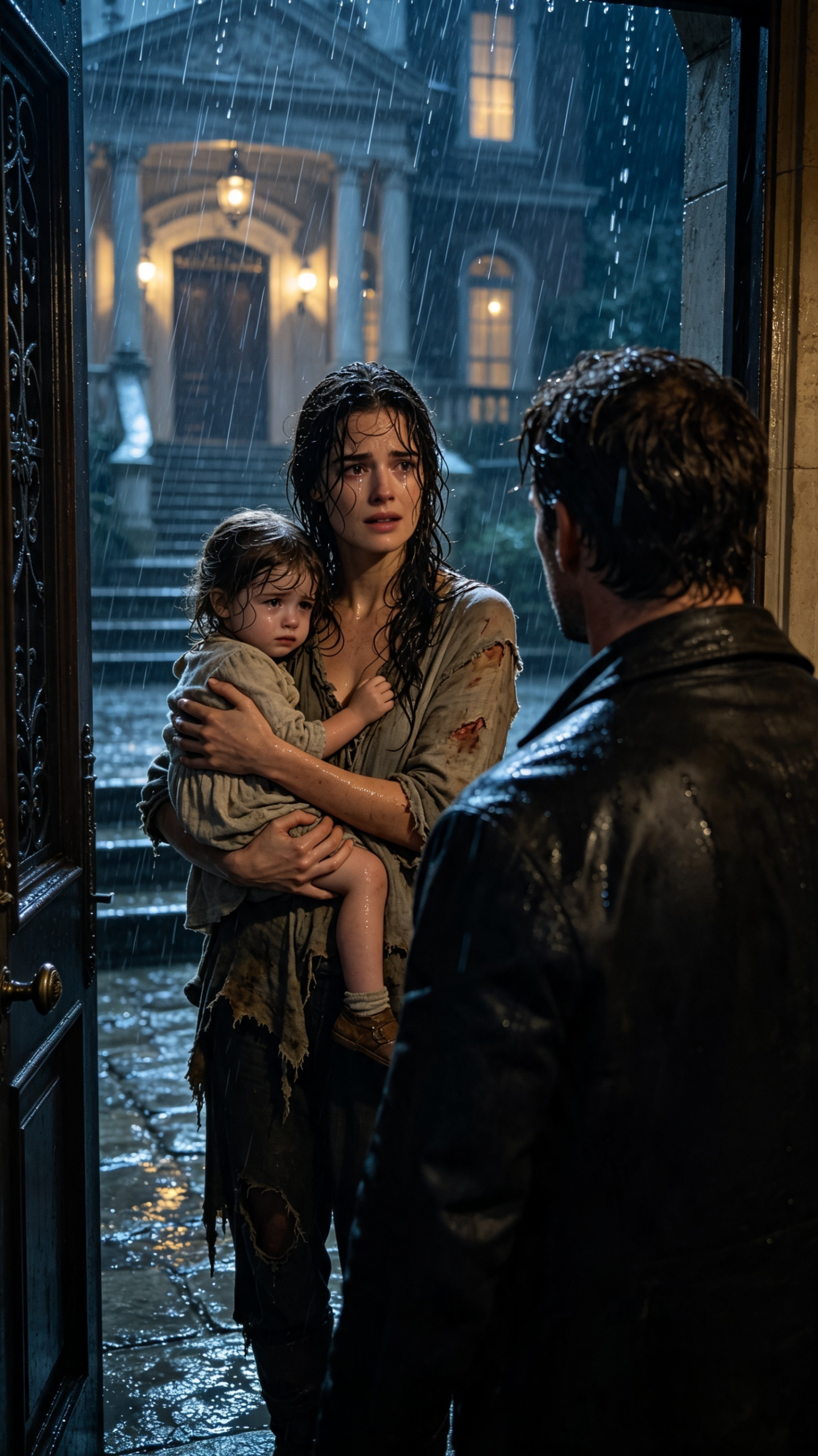
I arrived at a mansion in the rain with my daughter in my arms and asked the owner if I could clean his house in exchange for a plate of food. What I didn’t know was that the man who opened the door was Julián Maddox, the love I had left behind seven years earlier… and the only one who could recognize the truth in my little girl’s eyes.
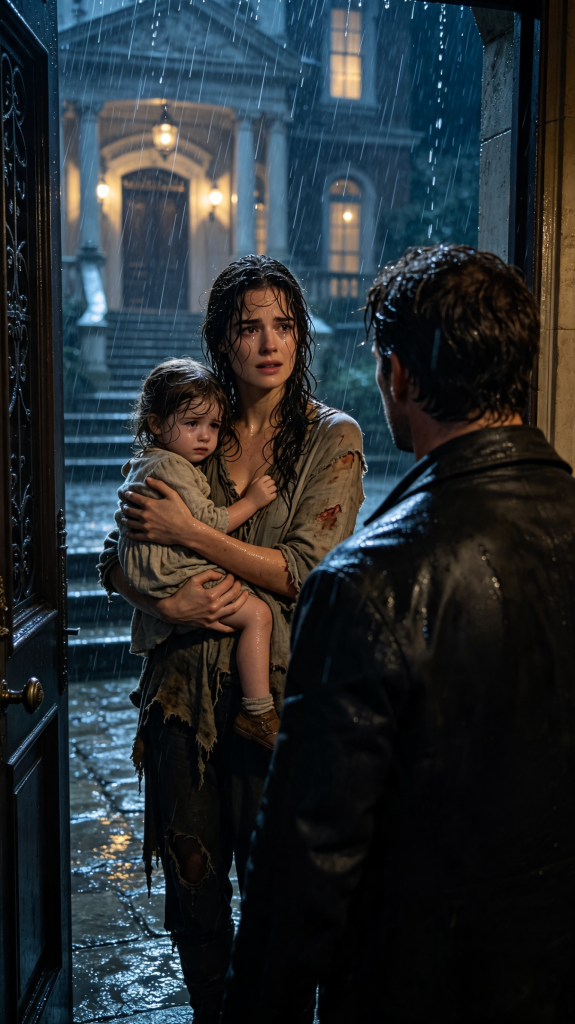
The water ran down my neck as if the rain wanted to finish erasing me. My sneakers were torn, my sweater was stuck to my body, and Lila was wrapped against my chest, trembling slightly without complaining. We had walked too far. I could no longer feel my hands.
When I knocked on that huge dark glass door, I wasn’t expecting mercy. I expected someone to slam it in my face and that would be it.
But the door opened.
A tall man in a black shirt, holding a cup of coffee, with tired eyes, froze in front of me. Behind him I could see a lit fireplace, shiny floors, expensive paintings—that kind of silence that only exists in houses where everything is in abundance except affection.
“Excuse me,” I said, swallowing my shame. “I don’t want to bother you. I haven’t eaten in two days. I can clean your house… anything. I just need a plate of food for my daughter and me.”
The little girl hid her face in my neck.
He didn’t look at my shoes or my clothes. He looked at me.
And then the glass in his hand trembled.
“Emily?” he whispered.
I felt the cold rise from my feet to my throat.
Because I knew that voice.
I slowly raised my gaze, with my hair stuck to my face, and saw the same eyes I had left behind when I still believed that leaving was an act of love.
“Julián?” I barely managed to say.
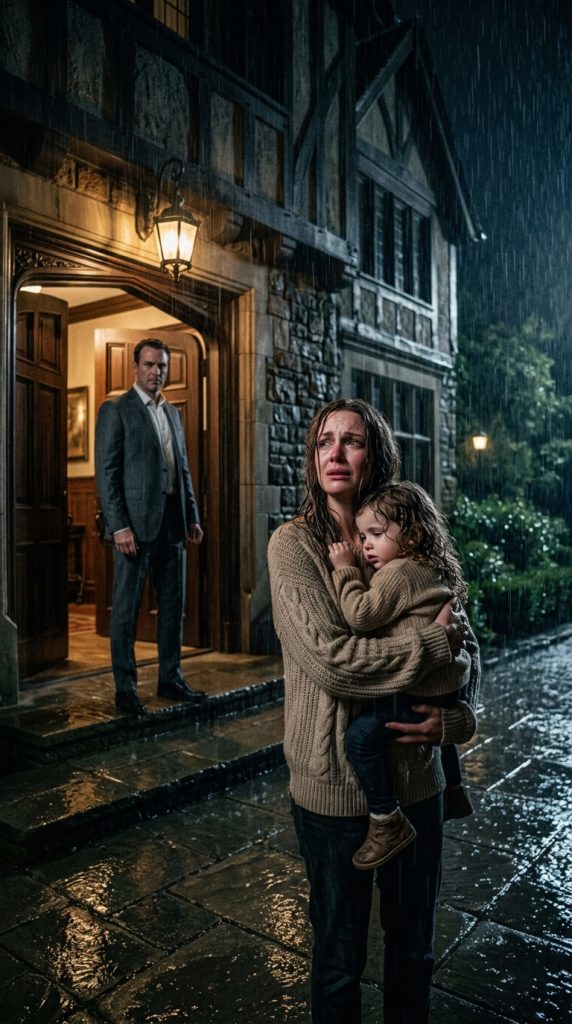
His expression changed. It wasn’t tenderness. It wasn’t joy. It was something worse: recognition mixed with an old wound, the kind that doesn’t heal even if you buy half the world to cover it.
For a few seconds, neither of us moved. The rain beat against the glass roof above us. Lila clutched the edge of my sweater with her little fingers, right where I carried a hidden, worn red ribbon that once tied a summer dress I wore in his garden. A silly thing. A piece of fabric I kept when I had almost nothing else left.
Julián lowered his gaze to my daughter.
His eyes stayed there.
Lila had light curls, pale cheeks, and the blue eyes of Julián’s mother. I saw him realize it before he could speak.
“Come in,” he said, stepping aside.
“I didn’t come for this,” I replied quickly. “I just need food. Then I’ll leave.”
His jaw tightened.
“You’re soaked. The girl is shivering. You’re not leaving like this.”
I entered carefully, leaving puddles on the marble. I felt ashamed seeing my dirty footprints on that perfect floor. A woman from the staff appeared in the background, stopped when she saw us, and lowered her gaze as if she understood she shouldn’t ask questions.
Julián ordered food in a controlled voice, but his hands betrayed him. He couldn’t stop looking at Lila.
“What’s her name?” he asked.
I hugged my daughter tighter.
“Lila.”
The name fell between us like a breaking glass.
Because we had chosen that name one absurd afternoon years ago, lying in the grass of his garden, when we still talked about a future that I ended up burying alone.
Julián leaned on the edge of the table.
“Emily… tell me one thing.”
I knew what it was.
It hurt before I even heard it.
“Is she mine?”
I didn’t answer.
I just turned my face away.
And that silence made more noise than any confession.
Lila, not understanding anything, reached her hand toward a bowl of strawberries on the table. Julián took one, wiped it with a damp napkin, and offered it to her. She looked at him with distrust, then accepted it.
“Thank you,” she said softly.
Julián closed his eyes for a second.
I saw something break inside him.
“Where have you been for seven years?” he asked, this time without raising his voice.
The food arrived. Hot bread, soup, fruit. The smell made my eyes burn. I sat down only because my legs could no longer hold me. Lila began to eat hungrily, in silence, as if she had learned too soon not to ask for more.
“I didn’t come for a reunion,” I said. “I came because I was desperate.”
“I was desperate too when you disappeared,” he replied. “But I didn’t have a door to knock on.”
I swallowed hard.
I remembered the hospital. The white envelope with my diagnosis. The bathroom in a clinic where I cried without making a sound so no one would hear me. The phone in my hand with Julián’s name on the screen, and my finger unable to call.
“I left because I was pregnant,” I said at last. “And because that same week they told me I had cancer.”
Julián stayed still.
Even the fireplace seemed to go silent.
“No,” he murmured.
“I didn’t know if I was going to live. You were building your company, sleeping three hours, carrying half the world on your shoulders. I didn’t want to force you to choose between your future and a woman who might die.”
His gaze hardened, but not with cruelty. With pain.
“That decision wasn’t yours to make.”
“I know.”
Lila yawned and rested her head against my arm.
Julián looked at the girl, then at me.
“You’re not leaving tonight.”
“Julián…”
“I’m not asking.”
I stood up slowly, with dignity even though my knees were shaking.
“You can’t decide for me now just because you opened the door.”
He took a step toward the table and picked up the red ribbon that had fallen from my sweater when I sat down. He held it between his fingers, recognizing it.
“Then explain to me why you kept this.”
Before I could respond, Lila lifted her little face and said, pointing at him:
“Mommy, is he my daddy?”
The question hung in the room as if someone had turned off the world.
Julián stopped breathing.
I felt my fingers loosen around the spoon. Lila looked at both of us with that brutal innocence of children, unaware that she had just opened a door I had been pushing closed with my back for seven years.
“Lila,” I said carefully, “finish your soup, my love.”
“But he has your eyes when you get sad,” she insisted.
Julián brought a hand to his mouth. He didn’t cry. He was one of those men who had learned to swallow everything before someone could use it against him. But his eyes filled with a moisture he couldn’t hide.
“Yes,” I said at last, very softly. “He is your daddy.”
The girl didn’t smile right away. First she frowned, as if she were putting together pieces of a puzzle no one had explained to her.
“And why wasn’t he here?”
That was the question that broke me.
Julián raised his eyes to me. He didn’t accuse me. He didn’t need to. Everything he had suffered was there, in the rigid set of his shoulders, in the fist closed around the red ribbon, in that held breath of a man who had just learned he had a daughter he didn’t see born, didn’t hold, didn’t hear her first word.
“Because Mommy was scared,” I answered.
Lila looked at her soup.
“Scared of him?”
“Scared of dying,” I said.
The room fell silent.
The woman from the staff, who had returned with a blanket, stopped a few steps away. Her eyes lowered quickly, but I managed to see that she had heard. She handed me the blanket without saying anything and placed it over Lila’s shoulders with a gentleness that made me want to cry.
“Mr. Maddox,” she said, “the blue room is ready.”
Julián didn’t take his eyes off us.
“Thank you, Clara.”
Lila began blinking slowly. She was exhausted. She had eaten as if every spoonful was a promise that the day would finally end.
“I’ll carry her up,” Julián said.
My first instinct was to say no. I had survived too long without letting anyone touch her, without trusting anyone, without resting. But Lila raised her arms toward him naturally, as if her blood recognized what history had denied her.
Julián looked surprised, almost scared.
“May I?” he asked me.
He didn’t snatch anything from me. He didn’t move without permission. After so many years of hospitals, poorly paid jobs, and closed doors, that seemed stronger than any declaration.
I nodded.
He carried her with sweet awkwardness. Lila rested her head on his shoulder and touched the collar of his shirt.
“You’re warm,” she murmured.
Julián closed his eyes.
“You will be too, princess.”
We went up a wide staircase. I followed behind, with the damp blanket against my chest and the red ribbon tucked back into my fist. The walls had photos of buildings, awards, recognitions. No family photos. No framed laughter. Only achievements.
In the blue room there was a huge bed, white blankets, and a soft lamp. Julián laid Lila down as if he were placing a crystal glass on an unstable table. She turned, hugged the pillow, and fell asleep almost instantly.
We stood there looking at her.
Seven years of questions fit into that silence.
When we stepped out into the hallway, Julián closed the door slowly.
“I want to know everything,” he said.
“Not tonight.”
“Seven years, Emily.”
“I know.”
“No. You don’t know. You knew where I was. You knew my name, my number, my office, my house. I didn’t know if you were alive.”
I leaned against the wall. Exhaustion was catching up to me like a fever.
“I was diagnosed in a small clinic. I didn’t have enough insurance. I sold what little I had. I left because I thought if I called you, you would drop everything.”
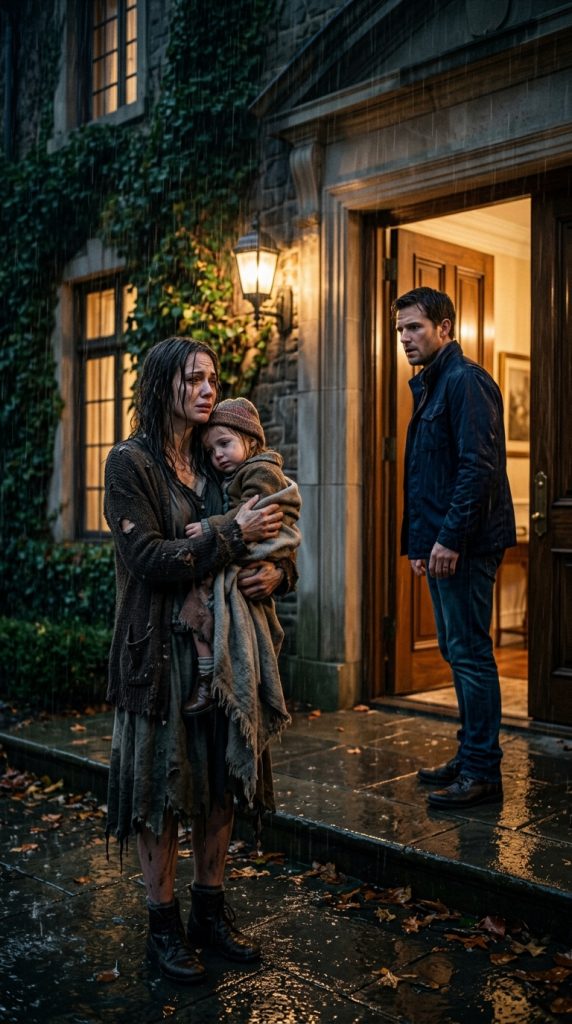
“Of course I would have dropped everything.”
“That’s exactly why I didn’t call you.”
Julián let out a dry, humorless laugh.
“Do you realize how cruel that sounds?”
“Yes.”
“You took away my chance to love you at your worst.”
That sentence hurt worse than a scream.
I looked at the floor. There was still dried mud on my shoes. I remembered a night of chemotherapy, sitting in a plastic chair, with a stranger holding my hair while I vomited. I remembered newborn Lila, so tiny I was afraid to sleep in case she stopped breathing. I remembered counting coins in a pharmacy.
“I wasn’t brave, Julián,” I said. “I was a coward. But I was also sick. And alone. And pregnant. And in my twenties. I did what I could with the fear I had.”
He lowered his gaze.
The anger didn’t leave him, but it changed places.
“The cancer?”
“In remission for three years.”
His eyes closed tightly.
“Three years,” he repeated. “You could have called me three years ago.”
“Yes.”
I didn’t give him an excuse because there wasn’t one. After surviving, the silence was no longer a sacrifice. It was shame. It was fear of arriving too late to a life I myself had broken. It was listening to Lila ask about her daddy and answering with incomplete stories because I didn’t know how to tell her: your daddy exists, but I decided he shouldn’t know about you.
“Why did you come here today?” he asked.
“I didn’t know it was your house.”
“How could you not know?”
“Because I don’t live in your world, Julián. I saw a gate, a light on, and a roof where we wouldn’t get wet. I knocked because Lila was hungry.”
That hit him hard.
He looked toward the door of the room.
“Where were you living?”
I stayed silent.
“Emily.”
“In a rented room. They kicked me out yesterday. I couldn’t pay.”
“And you had no one?”
I smiled faintly, but it came out tired.
“People help until it becomes inconvenient for them.”
Julián ran a hand through his hair. He walked a few steps, then came back. He was fighting the impulse to fix everything with money, as if a transfer could buy back lost time.
“Tomorrow we’re going to the doctor,” he said. “For you and Lila.”
“I don’t need you to buy me anything.”
“I’m not buying anything.”
“Julián, I came in here asking for food. I know how it looks.”
“It looks like the mother of my daughter arriving soaked at my door because no one held her up.”
My eyes burned.
“Don’t make me a victim to forgive me more easily.”
He came closer but stopped before invading my space.
“I’m not forgiving you. I still don’t know how.”
That honesty hurt, but it also gave me peace. I didn’t want a perfect scene. I didn’t want him to hug me as if seven years didn’t weigh anything. I wanted something real, even if it was hard.
That night Clara gave me clean clothes. A gray robe, socks, a brush. I stayed in the guest bathroom looking at my reflection in the huge mirror. My cheekbones were more pronounced, my eye bags deep, my hair stuck in clumps. I didn’t look like the girl in the red dress. I looked like a woman who had crossed too many storms and still didn’t know if she had the right to enter.
When I came out, I found Julián in the living room, sitting in front of the fireplace. On the table there was a black folder. I didn’t like seeing it.
“Don’t be scared,” he said, noticing my face. “They’re not lawyers.”
I sat down in front of him.
“Then?”
He opened the folder. Inside was an old photograph. Me in his garden, in the red dress, laughing. Him beside me, looking at me as if the world were simpler than it was.
“You kept it,” I said.
“I hid it,” he replied. “It’s different.”
Next to the photo were unsent letters. Some with my name. None opened by me.
“I wrote to you the first year,” he said. “Then I stopped because I realized I was only talking to a ghost.”
I picked up one letter. I didn’t open it.
“I wrote to you too.”
I took out a folded, rain-stained envelope from the pocket of my sweater. I had carried it for years. I never thought I would deliver it. It was the first letter I wrote from the clinic, before I knew if the treatment would work.
Julián looked at it as if it were evidence of a crime.
“Why did you carry it?”
“Because sometimes I thought that if something happened to me, someone should find it and know the truth.”
“What does it say?”
“That I was pregnant. That I loved you. That I was scared. That if I didn’t survive, I wanted our daughter to know her daddy didn’t abandon her.”
His fingers touched the envelope, but he didn’t take it.
“Lila thought I abandoned her.”
“No. I never told her that.”
“But you also never told her I existed.”
I couldn’t defend myself.
Then a phone rang on the table. Julián’s. The screen showed a name: Victoria.
He didn’t answer.
“Your wife?” I asked, feeling a pang I had no right to feel.
“No.”
“Girlfriend?”
“Fiancée, according to the press. According to her. According to my board. Not according to me.”
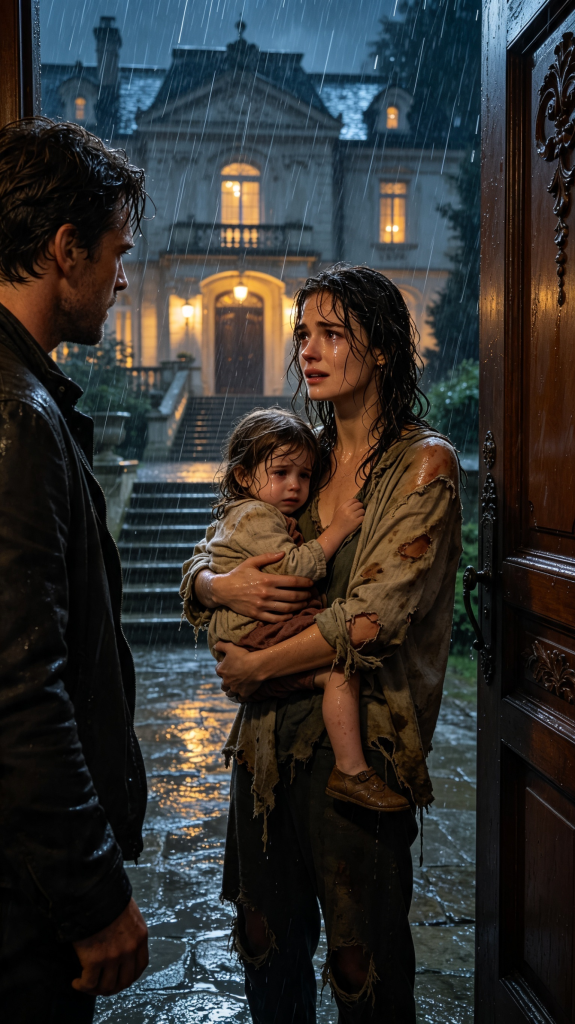
I laughed softly, bitterly.
“You’re still surrounded by people deciding for you.”
His gaze fixed on me.
“And you still believe that leaving is protecting.”
The phone rang again.
This time he answered.
“Not now, Victoria.”
A woman’s voice could be heard even from where I was. Clara, from the kitchen, barely looked up.
“Who is in your house?” Victoria asked in a dry tone.
Julián looked at me.
“My family.”
The silence on the other end was sharp.
“Don’t play with me, Julián.”
“I’m not playing.”
He hung up.
I stood up.
“You shouldn’t have said that.”
“Why?”
“Because you don’t know what we are.”
“I know what Lila is.”
“And you don’t know if you want to forgive me.”
“I don’t need to forgive you to recognize my daughter.”
I wanted to respond, but at that moment Lila cried from upstairs.
I ran up.
I found her sitting on the bed, scared, searching with her hands.
“Mommy.”
I hugged her.
“I’m here.”
Julián arrived behind me but stayed at the door.
Lila saw him.
“I dreamed they closed the door on us again.”
I bit my tongue to keep from crying.
Julián entered slowly and knelt in front of her.
“In this house, no one is going to close the door on you.”
“Promise?”
He looked into my eyes before answering.
“Promise.”
The next morning, the storm had eased, but the sky was still gray. We had breakfast at a table that was too big. Lila ate toast with jam, still in her pajamas, looking at everything with curiosity.
Julián had sent for girl’s clothes. Not boutique dresses or ridiculous bows. Comfortable clothes, sneakers, a little yellow jacket. That moved me more than I wanted to admit.
Clara placed coffee in front of me.
“Ma’am, would you like more fruit for the girl?”
The word “ma’am” made me feel like an outsider.
“Emily is fine,” I said.
Clara smiled slightly.
“Emily, then.”
That small correction was the first time in a long while that someone treated me like a person, not a problem.
Julián sat down with some medical papers.
“There’s a specialist available at noon.”
“So fast?”
“Yes.”
“That doesn’t happen for normal people.”
“Today it does.”
I didn’t know whether to get angry or thank him.
Before we left, Victoria arrived.
She entered without knocking, like someone who believed she owned the air. Tall, impeccable, beige coat, perfect hair. Her perfume filled the foyer before her words did. She looked at Lila, then at my new sneakers, then at Julián.
“So it’s true.”
Julián stood up.
“This isn’t a good time.”
“On the contrary,” she said. “It seems like the perfect time to understand why you canceled the meeting with the investors.”
Lila came to me and took my hand.
Victoria saw her with a smile that didn’t reach her eyes.
“And this girl?”
“My daughter,” Julián said.
The sentence came out firm.
Victoria lost color for a second but recovered quickly.
“How convenient.”
I felt something inside me close.
“I’m not going to allow you to talk about my daughter like that.”
She looked at me for the first time truly. She didn’t see a woman. She saw borrowed clothes, tired hair, dry hands. She saw someone she could humiliate.
“Sorry,” she said. “I didn’t know that now anyone can arrive soaked at a mansion and leave with a last name.”
Julián took a step.
“Victoria.”
But I raised my hand.
I didn’t need him to fight for me this time.
“You’re right about one thing,” I said calmly. “I arrived soaked. I arrived hungry. I arrived with nothing that could impress anyone. But I didn’t arrive lying.”
Victoria let out a short laugh.
“Do you have proof?”
“I didn’t come prepared for a trial.”
“Of course not.”
Julián spoke with a coldness I hadn’t heard from him before.
“Enough.”
“No, Julián. You can be as sentimental as you want, but I’m not going to watch a stranger destroy your life with a girl who conveniently has blue eyes.”
Lila squeezed my hand.
“Mommy, does she want to kick us out?”
I knelt in front of her.
“No one is going to kick you out.”
Then I stood up and looked at Julián.
“I need my bag.”
He brought it immediately. I took out the stained envelope. Also an old hospital bracelet, kept inside a transparent bag. It had my name, Lila’s birth date, and the hospital where she was born.
“It’s not a DNA test,” I said. “But it’s the beginning of the truth.”
Victoria tried to speak, but Clara appeared from the hallway.
“Mr. Maddox,” she said in a nervous voice, “sorry to interrupt.”
We all turned.
Clara was holding a tray, but her hands were trembling.
“Last night I heard the girl call you daddy. And I saw how you looked at her. I worked here when your mother was alive, sir. That girl has Doña Lillian’s eyes.”
The name of his mother changed the room.
Julián swallowed.
“Thank you, Clara.”
Victoria clicked her tongue.
“What cheap sentimentality.”
Then Lila did something no one expected.
She let go of my hand, walked to the table, and picked up the red ribbon Julián had left there. She lifted it carefully.
“My mommy cries when she touches this,” she said. “She says it was from when she was happy.”
Julián’s face fell apart.
Victoria looked at the ribbon as if it were garbage.
“How touching.”
Julián turned toward her.
“Leave.”
“Excuse me?”
“Get out of my house.”
Victoria opened her mouth, incredulous.
“You’re making a mistake.”
“No. The mistake was letting people like you think my life was a company that could be managed.”
She picked up her bag, furious.
“When this blows up in your face, don’t come looking for me.”
“I didn’t when I had no one,” he replied.
The door closed behind her with an elegant and violent slam.
Lila got scared. Julián knelt in front of her.
“Sorry, princess.”
“Does she give orders here?”
He shook his head.
“Not anymore.”
That “not anymore” wasn’t just for Victoria.
It was for all the years in which Julián had allowed money, image, and others to speak louder than him.
We went to the doctor. Then to the laboratory. I signed papers with a steady hand, though inside I was a knot. Julián did too. No one said the test was necessary to love Lila, but we both knew the world would demand documents to respect what the heart had already recognized.
The results took just over a day.
That day was strange. Lila explored the house as if it were a museum. Julián followed her from a distance, learning her gestures: how she wrinkled her nose when she didn’t like something, how she said “look” before pointing at anything, how she saved little pieces of bread in a napkin “just in case.”
It destroyed him.
“Does she always do that?” he asked me.
“Sometimes.”
“Saving food.”
I didn’t answer.
He looked toward the wet garden.
“Never again.”
“Don’t promise things life can break.”
“Then I promise to try every day.”
That one I believed.
In the afternoon, while Lila napped, Julián finally opened my letter. He read it standing by the window. I didn’t want to look at his face, but I heard when his breathing changed.
The letter was a farewell I never sent.
It said I loved him. That if I died, I didn’t want him to remember me as someone who ran away, but as someone who was afraid of taking away his future. It said that our daughter, if she was born, deserved to know she had been wanted before she existed.
Julián folded the page carefully.
“You took a lot from me,” he said.
“Yes.”
“But I’m not going to take any more time from Lila by punishing you.”
That was the first form of forgiveness I received: not an absolution, but an adult decision.
The next day the results arrived.
The laboratory sent a secure email. Julián opened it in the library. I was by his side, with Lila sitting on the rug drawing a house with three stick figures outside.
He read it first.
He didn’t need to tell me anything.
He covered his face with one hand and sat down.
Lila looked up.
“What happened?”
Julián called her with a gesture.
“Come.”
She approached.
He took her hands with immense respect.
“What happened is that no one will ever be able to say you’re not my daughter.”
Lila smiled a little.
“So you really are my daddy?”
“Yes.”
“And are you going to learn my songs?”
Julián let out a broken laugh.
“All of them.”
That night there was no party, no music, no big speeches. We just had dinner together. Clara put fresh flowers on the table without anyone asking. Julián cut Lila’s food into clumsy little pieces. I watched him make mistakes, learn, listen.
After putting the girl to bed, I went down to the covered garden. The rain had left the smell of wet earth. Julián was there, with the red ribbon in his hand.
“I don’t want you to stay because you have nowhere to go,” he said.
“Then don’t ask me like that.”
“I want you to have a home, even if it’s not with me. I want Lila to have her room. I want to be in her life. And if one day you and I talk about us, let it be without hunger, without fear, and without debts in between.”
I was surprised by the maturity of that.
“I want that too.”
He came closer and handed me the ribbon.
“This doesn’t have to be a chain.”
I looked at it. That piece of fabric had been nostalgia, guilt, punishment. I had carried it like someone carrying proof that they had once been loved.
“No,” I said. “It can be memory.”
I tied it around Lila’s wrist the next day, not as a romantic promise, but as a bridge.
The months that followed were not perfect. We had therapy. We had hard arguments. There were days when Julián looked at me and I knew he was remembering everything he had lost. There were days when I wanted to run away before feeling too loved.
But I didn’t leave anymore.
I got follow-up treatment. I went back to studying in the afternoons. Julián learned to comb Lila’s hair, badly at first, then better. She started running around the house without saving food in napkins.
One day, weeks later, Lila left half a piece of bread on her plate and said:
“I’m not going to save it anymore. There’s tomorrow here, right?”
Julián looked at me.
I nodded, my throat tight.
“Yes, my love. There’s tomorrow here.”
And for the first time in seven years, that word didn’t scare me.
