

The Silence in the Living Room
“You cannot expect him to spend the rest of his life taking care of you.”
Patricia Reeves said it from the middle of my living room, in front of my four children, with the cold impatience of someone talking about an object that had become inconvenient. She did not soften her voice or look toward the children before speaking. Instead, she adjusted the collar of her cream wool coat and stared at my crutches as if they had personally offended her.
My fingers tightened around the handles.
Across the room, my husband, Colin, stood beside the fireplace with his eyes lowered to the hardwood floor. He was thirty-seven, healthy, well-dressed, and fully capable of speaking, yet he offered nothing—not a defense, not an objection, not even a quiet request for his mother to stop.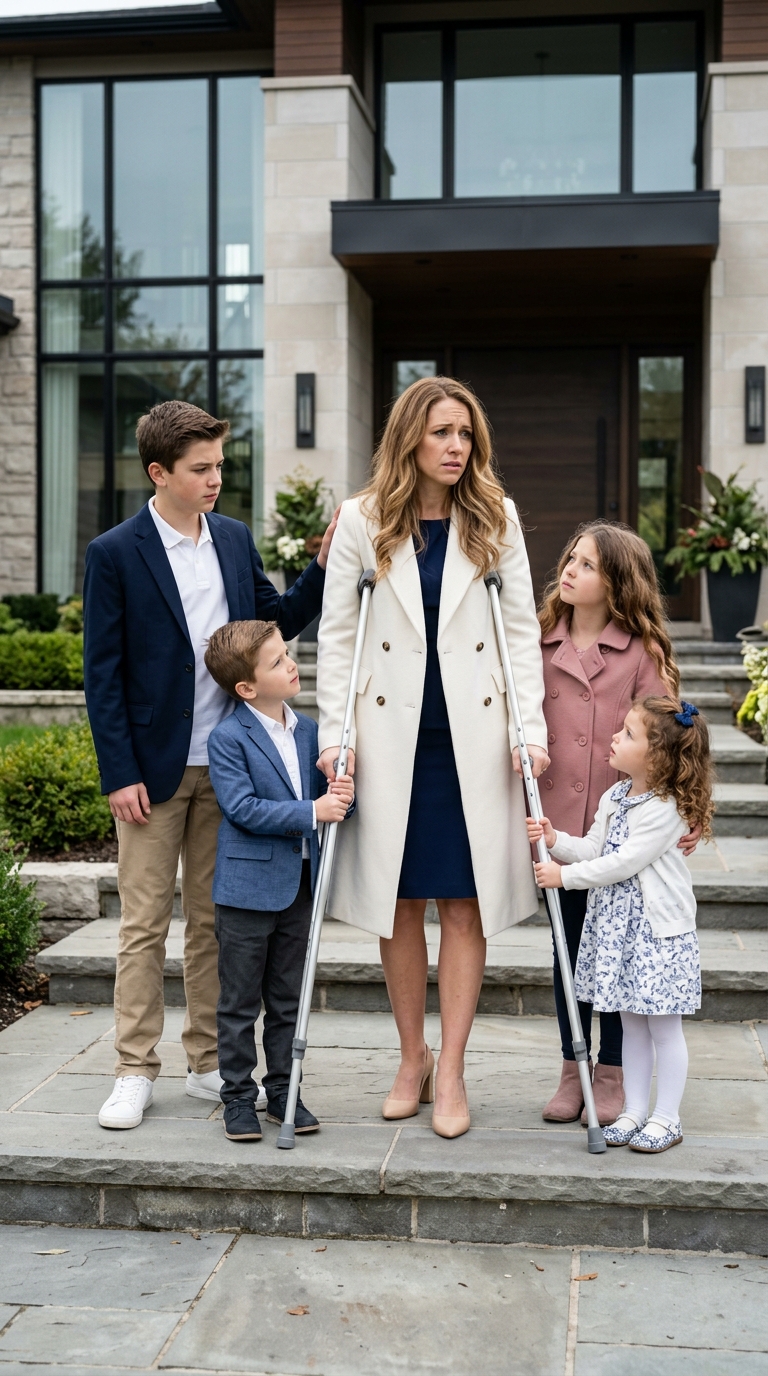
Our oldest son, Aiden, was eleven. He stepped between Patricia and me, his shoulders squared as he tried to make his small frame appear bigger.
“Don’t talk to my mom like that.”
Patricia blinked at him, almost entertained.
“This is an adult conversation.”
“Then act like an adult,” he replied.
In another situation, I might have corrected him for speaking harshly to his grandmother. That afternoon, I could only stare at my son and wonder how an eleven-year-old had discovered the courage his father could not find.
Before the highway accident, people often told me how lucky I was. We lived in a two-story house outside Boise, Idaho, in a neighborhood with neatly kept lawns, quiet roads, and school buses that arrived at the same time every morning. Colin worked as a regional construction estimator, and I had spent nearly ten years managing our home while raising Aiden, Owen, Lily, and four-year-old Maisie.
From the outside, our life appeared stable.
But inside, I had always known Patricia viewed me as temporary.
She came from a family that judged people by their property, college backgrounds, and the scale of their holiday celebrations. I grew up above my father’s hardware store in a small town near Twin Falls. My parents had been gone for years, and the only family member I still spoke with was my older brother, Trevor, though we had never been especially close.
Patricia never missed a chance to remind me that the house had been bought with Colin’s income.
“My son built this life,” she would say during Sunday dinners. “Not everyone gets invited into a family like ours.”
I had ignored those comments for years because avoiding conflict felt easier than fighting back. I prepared meals, remembered birthdays, packed lunches, washed uniforms, attended school performances, and stayed awake beside sick children. Colin earned the paycheck, but I quietly created the structure of our home until everyone eventually assumed my effort simply happened.
Then, on a rainy Tuesday in November, everything changed.
I had picked up Owen and Lily from an after-school music program when another driver rushed through an intersection and crashed into the driver’s side of our vehicle. The children suffered only minor injuries, but the damage to my spine left me unable to stand without assistance.
I spent weeks in the hospital and several more in a rehabilitation center. My doctors were honest: with time and therapy, I might regain much of my mobility, but no one could promise how complete my recovery would be.
At first, Colin came every evening. He brought coffee, held my hand, and told me we would face whatever happened together.
“You’re still you,” he said. “Nothing important has changed.”
But by the time I came home in a wheelchair, something important had changed. His therapy visits became less frequent. He complained about laundry, meals, and taking the children to school. When I asked him to help me move from the chair to the bed, he sighed before helping me.
He no longer saw me as his wife.
He saw me as a responsibility added to an already full schedule.
Patricia started coming almost every day. She would sit near the window, watching me practice standing with my physical therapist, then turn toward Colin and speak as if I was not there.
“You look exhausted, sweetheart. This is far too much for one person.”
I wanted him to say that I was the exhausted one. I wanted him to remind her that I had spent years caring for everyone in that house without ever calling them burdens.
Instead, he accepted her sympathy.
Four months after the collision, I overheard them in the kitchen. “You’re still young,” Patricia said. “You cannot spend the next thirty years arranging your entire life around her limitations.”
A long silence followed.
Then Colin answered quietly.
“I know.”
That was the moment my marriage ended in my heart—not when Patricia told me to leave a week later, but when my husband accepted that my worth had vanished along with my ability to walk without difficulty.
After Patricia finished speaking in the living room, I looked at Colin one final time.
“Do you want us to go?”
He rubbed the back of his neck.
“Maybe some space would help everyone think.”
Even then, he could not bring himself to say it directly.
I nodded, asked the children to pack whatever they could carry, and opened the blue medical folder I kept beside my chair. Inside were medical records, insurance documents, financial details, and copies of every message Colin had sent after my injury. I placed the folder inside a canvas bag and secured it carefully.
We left with two bags, four scared children, and less than three hundred dollars.
No one offered us a ride.
The Door That Closed Twice
Aiden carried my document bag while we waited for a rideshare at the corner. The November wind slipped through his thin jacket, but he refused to go back inside for a warmer one.
“I’m not going inside that house again,” he said.
We went to my brother Trevor’s apartment in Nampa. He lived with his girlfriend, Kelsey, in a small two-bedroom unit above an auto-parts store. When I called, he paused before finally agreeing.
“A few nights,” he said. “That’s all I can promise.”
I told myself that a few nights would be enough. I would find work, reach out to support services, and create a plan. I still believed that when life became difficult, family members made space for one another.
The first night, Aiden and Owen slept on the floor. Lily shared the couch with Maisie, while I stayed sitting in a dining chair because lying down hurt too much.
By the third day, Kelsey complained about the children leaving their shoes by the door. By the fifth, she said the apartment felt like a daycare. Trevor never disagreed with her.
On the eighth morning, he asked me to talk in the kitchen.
“This isn’t working, Nora.”
“I know it’s crowded. I’m trying to find somewhere else.”
He folded his arms.
“Kelsey can’t relax in her own home. I have responsibilities too.”
“Trevor, I can barely walk, and I have four children. I need a little more time.”
He looked away toward the window.
“You’ve always figured things out. You’ll figure this out too.”
There was no point arguing. Someone who wants to help looks for solutions. Someone who wants you gone looks for reasons.
That afternoon, Trevor drove us to Harbor House, a transitional shelter for mothers and children. He carried our bags to the entrance, hugged the children quickly, and left before Maisie woke from her nap.
The shelter was clean and organized, though privacy was limited. We shared a room with another mother and her two daughters. Meals were served at specific times, showers had schedules, and lights went out at ten.
I applied for jobs at front desks, insurance offices, retail stores, and dental clinics. During every interview, the manager’s eyes moved to my crutches before returning to my face.
They needed someone who could move quickly. Someone who could stand for hours. Someone whose situation was simpler.
No one directly said I was incapable, but the message was clear.
At night, after the children fell asleep, I used an old laptop from the shelter’s resource room. I began writing product descriptions for online sellers—lamp shades, kitchen organizers, gardening gloves, anything clients assigned. The money was small, but I could do the work while sitting.
I taught myself basic design, email marketing, and website editing through free online courses. Most nights, I worked until two or three in the morning, stopping whenever pain spread through my lower back.
Aiden became protective in a way no child should have to be. He helped Owen with homework, brushed Maisie’s hair, and checked that Lily had packed her school bag.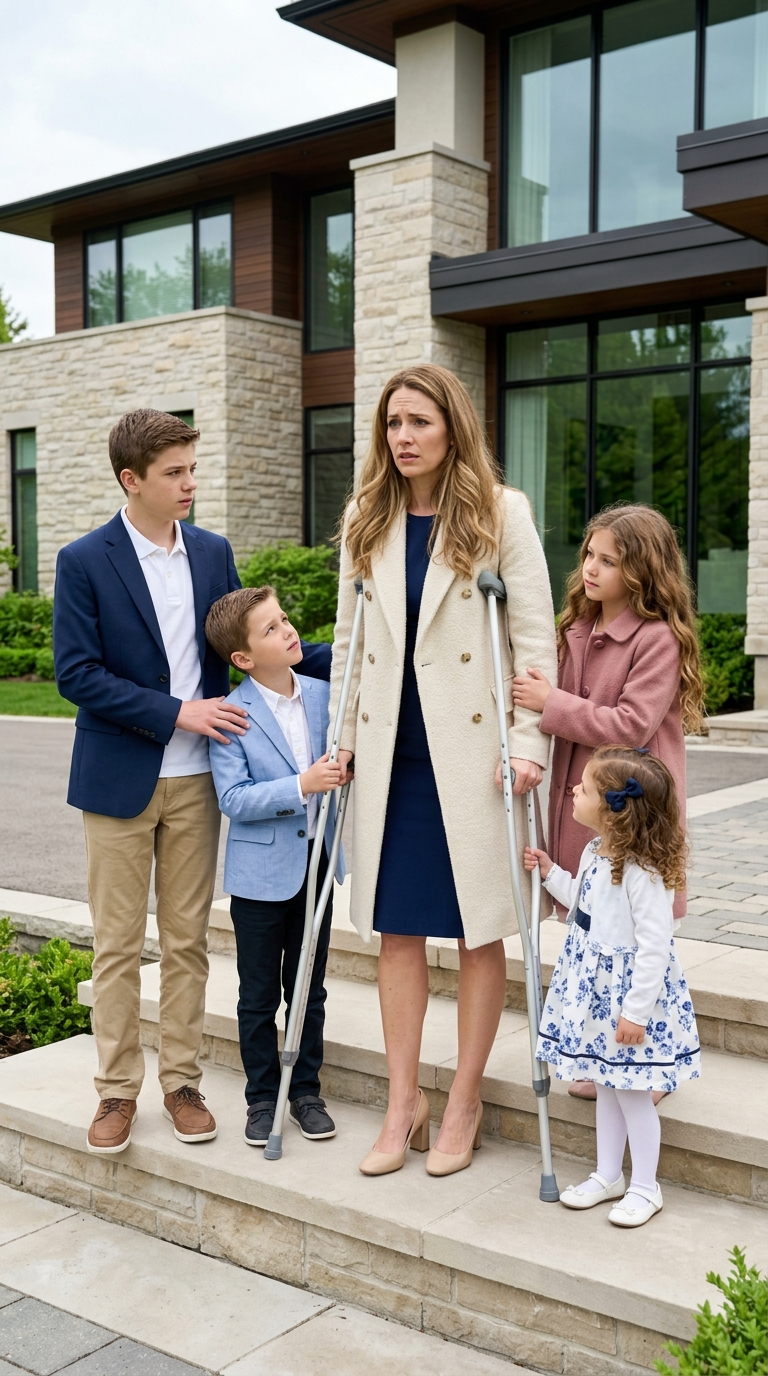
One night, I found him sitting beside the bedroom door long after everyone else was asleep.
“What are you doing out here?”
“Making sure nobody tells us to leave.”
I lowered myself beside him, even though the movement caused pain through my side.
“No one is sending us away tonight.”
“But they could.”
I wanted to promise him it would never happen again. Instead, I gave him the only promise I could honestly make.
“I’m building something that belongs to us. It may take time, but I’m not stopping.”
The shelter director, Rebecca Hale, often noticed me working after midnight. One evening, she placed a cup of tea beside my computer.
“What exactly are you trying to create?”
“A life no one else can take apart.”
She pulled out the chair across from me.
“Then keep going. Eventually, you’ll become too skilled for people to overlook.”
Ten months later, a small outdoor-equipment company hired me to manage its website content. Four months after that, I saved enough to rent a worn two-bedroom apartment.
The paint was peeling, the kitchen cabinets leaned slightly, and the carpet had been cleaned so often that its original color was impossible to tell. None of that mattered.
When I closed the front door with all four children safely inside, Aiden checked the lock twice.
I placed my hand over his.
“This door is ours.”
For the first time, he smiled.
The Story They Told Without Me
Nearly two years after we left Colin’s house, I attended a parent conference at Lily’s elementary school. By then, I had moved from crutches to a cane and could stand for several minutes at a time.
Another mother approached me in the hallway.
“It’s nice to see you doing better,” she said. “I always wondered what really happened between you and Colin.”
I studied her face.
“What were you told?”
She lowered her voice. “Patricia said you rejected everyone’s help, took the children away, and stopped Colin from seeing them. She said he did everything he could.”
For two years, I chose not to speak badly about Colin in front of the children. I never told them about the unpaid bills or the messages he left unanswered. I believed staying quiet would protect them.
Instead, Colin and Patricia used that silence to create a version of events where they were the ones who cared and I was the one who refused.
That night, I opened the blue folder.
Inside were medical records, shelter documents, rental receipts, childcare costs, job applications, messages regarding missed support payments, and Colin’s written complaints about having to adjust his life because of me.
I had not kept those documents to hurt anyone. I kept them because after being forced out of your own home, paperwork can become another form of protection.
Rebecca connected me with Margaret Sloan, an attorney who focused on family financial disputes. Margaret examined every page in the folder carefully.
“This is not about revenge,” she said. “It is about creating stability for your children and correcting a false account of what happened.”
The legal process took time. Colin first dismissed it as unnecessary. Then anger replaced his confidence. Once he realized how carefully I had recorded the missed payments and our time in transitional housing, he wanted to handle everything privately.
Patricia continued telling relatives that all I wanted was money.
At the hearing, I wore a simple green dress and carried my cane without hiding it. For months, I had tried to keep it out of pictures or avoid using it during brief outings. That morning, I understood it was not a symbol of weakness. It represented everything I had endured—hundreds of therapy appointments, painful steps, and countless mornings when I stood up knowing the next movement would be difficult.
Margaret presented the facts calmly and clearly. She explained the separation, the missing financial support, the shelter stay, and the work I had done to provide for four children.
Colin described everything as a family misunderstanding.
Then Margaret brought out his messages.
In one message, written shortly before we were forced to leave, Colin admitted his mother was right and that caring for me no longer felt like a marriage.
In another, written after we entered the shelter, he complained that the children were preventing him from starting over.
The judge ordered him to address the unpaid support, created clear parenting arrangements, and documented the history of abandonment in the official record.
There was no emotional scene. No shouting. Justice came through the simple wording of signed documents.
For me, that was enough.
The record showed that I had not walked away because of stubbornness. We had been pushed toward the exit and expected to quietly disappear.
We did not disappear.
A Home With My Name on It
My writing business expanded slowly, one client at a time. Product descriptions turned into website work, and website projects grew into complete marketing campaigns for local contractors, medical offices, family restaurants, and real estate companies.
Three years after leaving the shelter, I hired my first employee, a designer working remotely from Montana. Later, I brought on an editor and a social media coordinator. What started with a donated laptop became a small creative agency with six employees.
The children healed in their own ways.
Aiden checked every lock before sleeping for years. I never laughed at him or told him to stop. I simply walked through the apartment with him.
“We’re secure,” I would say. “You can rest.”
Owen developed a love for repairing things. He fixed loose chair legs, cabinet hinges, and broken toys.
“I don’t like leaving things damaged,” he once explained.
I knew he meant more than objects.
Lily discovered an incredible gift for mathematics, while Maisie grew up understanding that a strong mother was simply someone who sometimes used a cane, worked at a computer, and still made pancakes every Sunday morning.
Seven years after Colin’s silence in the living room, I bought a modest three-bedroom home on a quiet street outside Spokane, Washington.
When the closing agent placed the documents before me, I stared at my name printed on the deed.
Mine.
Not Colin’s. Not Patricia’s. Mine.
On moving day, Aiden carried boxes, Owen arrived with a toolbox, Lily measured spaces for furniture, and Maisie ran through the backyard announcing where she would grow sunflowers.
I stood alone in the empty living room for a moment and allowed myself to cry.
For years, part of me had expected someone else to arrive with authority over my home and tell me I no longer belonged there.
No one could do that anymore.
Colin eventually married again, though that relationship ended after only a few years. Later, he developed a serious health condition that required regular appointments and daily assistance. Patricia, older and with less energy, became the person responsible for caring for him.
I did not take pleasure in their struggles. Colin was still my children’s father, and once, many years earlier, I had loved him.
But life placed him in the exact position he once believed made someone less valuable. The family that had viewed dependence as a personal weakness was forced to understand that almost anyone may eventually need patience, dignity, and support.
When the children grew older, Colin asked to reconnect with them. Each child made their own decision. Aiden refused. Owen agreed to a short meeting. Lily went because she wanted answers. Maisie, who barely remembered him, asked what she should do.
“You don’t have to dislike anyone for my sake,” I told her. “But you also don’t owe closeness to someone simply because you are related.”
A few weeks later, Colin sent me a handwritten letter. He admitted he had been afraid to stand against his mother. He wrote that he had watched me leave on crutches and thought about stopping me, but staying silent had seemed easier.
He said that moment had remained with him for years.
I read the letter once and placed it inside the blue folder.
I never answered.
Some forgiveness happens quietly. It does not mean allowing someone back in, and it does not erase what happened. It is simply the moment when you choose that the past will no longer take over every part of your life.
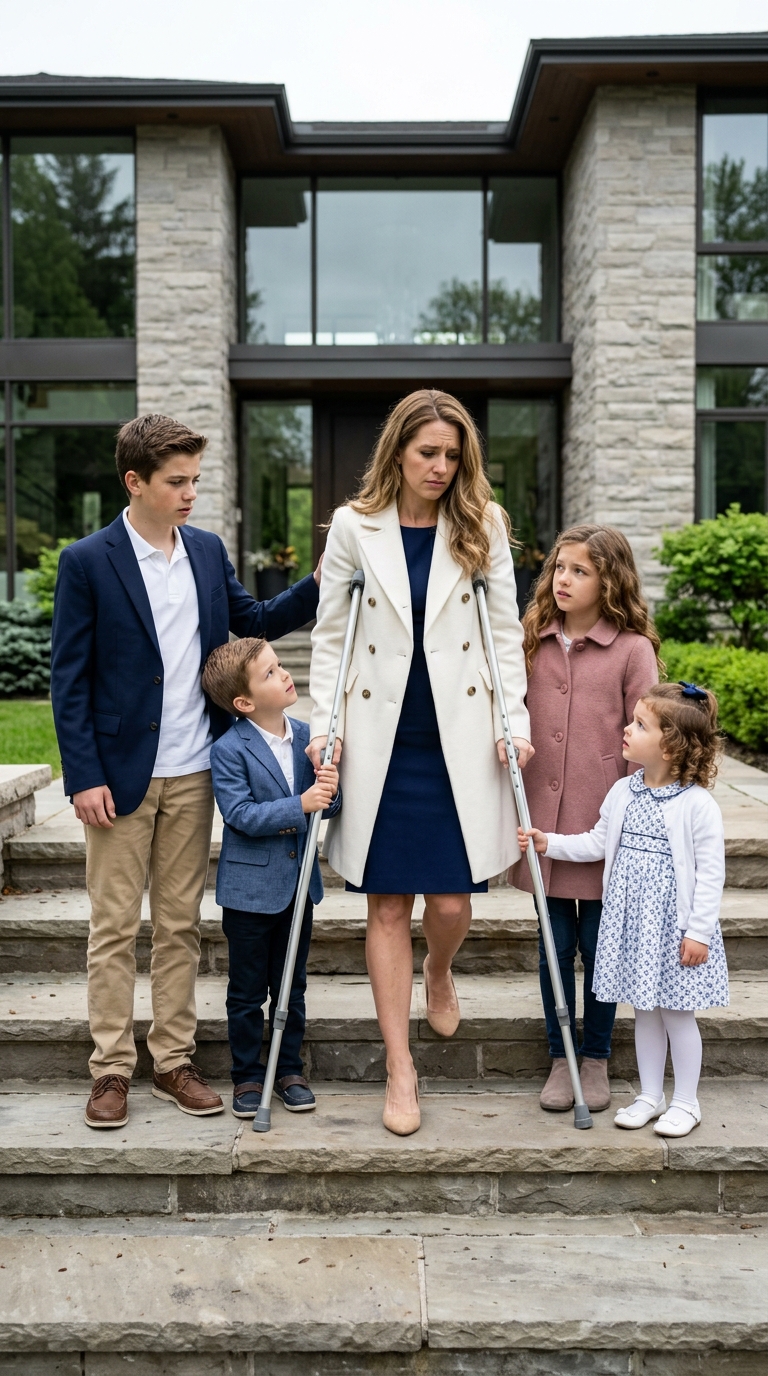
Today, when I watch my children gathered around the kitchen table, I sometimes remember that cold afternoon outside the house: four children, two bags, a pair of crutches, and nowhere certain to go.
Back then, I thought we had lost everything. I understand now that we had not lost everything. We had only lost the people who were never truly standing beside us.
A home does not belong to the person who constantly reminds others that they paid for it or uses possession of the keys to make someone feel insignificant. A home is where children can sleep peacefully without fearing they might be told to leave the next day.
Family is not created by sharing the same last name. It is defined by the people who stay when health changes, finances become difficult, dreams fall apart, and life stops being convenient.
Patricia called me a burden.
Colin responded with silence.
Trevor walked away and left us at a shelter.
But I am still here—not because someone came to save me, but because when every familiar hand let go of mine, I discovered that my own hands were still strong enough to create a different life.
