

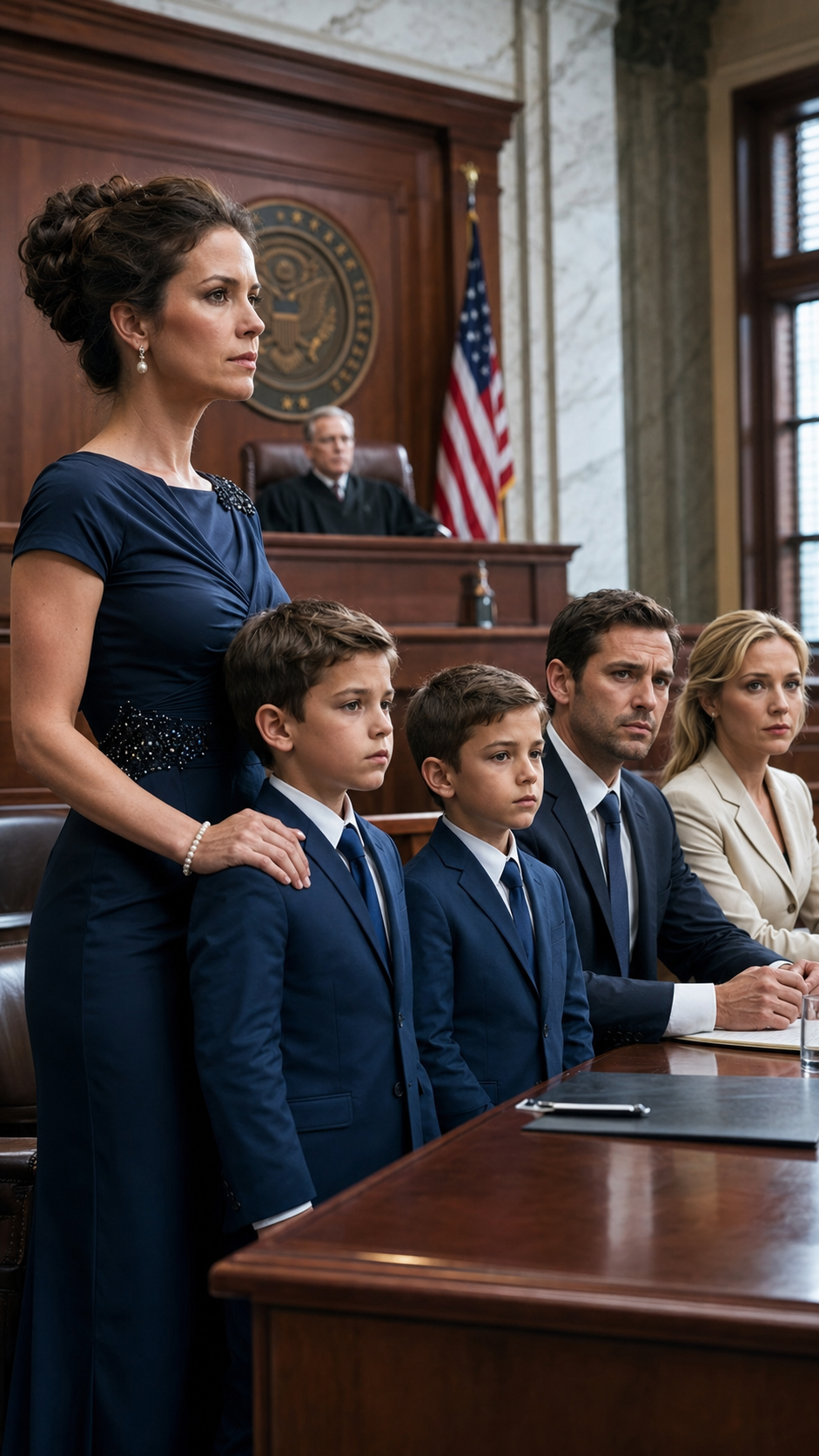
The Morning Everyone Assumed She Would Lose
By the time the custody hearing began on a cold Thursday morning in Fairfax County, almost every chair in Courtroom Four was occupied. Some had come because the Hollis divorce had turned into a subject of local fascination. Adrian Hollis was the polished public image of Hollis Transit Systems, a fast-growing freight-management company whose name was displayed on office towers, conference signs, and charity events throughout the East Coast. His picture had appeared in business publications alongside stories celebrating his decisions, discipline, and extraordinary ability to expand.
The public knew much less about his wife.
For almost twelve years, Mara Lane had stood beside him at charity events and company dinners, usually remaining slightly behind while Adrian accepted recognition for another profitable year. She almost never spoke with reporters, never corrected those who labeled her a homemaker, and slowly vanished from public appearances after giving birth to their twin sons.
That quietness had given others the opportunity to create her image for her.
By the morning of the hearing, the popular story was straightforward. Adrian had created a successful company while Mara lived the comfortable life his career had funded. Their marriage had fallen apart, she had become challenging, and now she was fighting against what his lawyers described as a reasonable custody plan.
At the table on the right side of the courtroom, Adrian appeared like a man arriving to claim something he believed was already his. His navy suit had been custom-made in Manhattan, his silver watch stood out from beneath his sleeve, and a thick folder rested in front of him with colorful tabs separating financial records, school documents, household costs, and pictures of the newly remodeled home where he planned for the boys to stay.
Sitting beside his legal team was Paige Ellison, the company’s communications director and the woman Adrian intended to marry after the divorce was finalized.
Paige wore a light blue suit, pearl earrings, and the controlled expression of someone acting as if she had no emotional stake in the result. Still, she leaned closer to Adrian whenever his attorney turned away, and the comfortable familiarity between them revealed the truth to everyone watching.
Adrian’s main attorney, Russell Crane, had built a reputation for transforming family conflicts into clear financial wins. He had spent weeks creating a picture of Mara as reliant, alone, and incapable of raising two children without her husband’s wealth.
Russell was confident the prenuptial agreement would quickly resolve the property dispute. The document stated that each spouse would keep any assets they owned before marriage, while anything gained in Adrian’s name during the marriage would remain controlled by him.
Because the home, investment funds, vehicles, and company shares all appeared registered to Adrian, Russell believed there was almost nothing left to challenge.
At nine forty-two, Judge Henry Calder walked into the courtroom and sat behind the bench. He was a thin-faced man in his early sixties who had spent enough time in family court to identify staged affection, calculated emotions, and carefully arranged versions of reality.
The clerk called the case, and Russell stood.
“We’re ready to proceed, Your Honor.”
Judge Calder looked toward the vacant table across the room.
“Where is Mrs. Lane?”
No one responded.
Adrian glanced at his watch and smiled without humor.
“She has always had trouble respecting other people’s time.”
Paige looked down, covering a quiet laugh.
Russell confirmed Mara had received the hearing notice and recommended moving forward without her. He had only started describing Adrian’s request for primary custody when the courtroom doors opened at the back.
Mara walked in calmly.
She wore a dark green coat over a plain charcoal dress, and her brown hair was tied neatly at the back of her neck. She carried no piles of legal documents and had no high-priced lawyer following behind her.
Instead, she held the hands of two eight-year-old boys.
Samuel and Owen looked exactly alike except for the small silver frame resting on Samuel’s glasses. Both wore dark pants, white shirts, and matching jackets. They seemed uneasy in their formal outfits, but they stayed beside their mother without squirming or whispering. The courtroom became restless as Mara led the boys toward the vacant table.
Paige leaned closer to Adrian.
“She brought them here? What is she trying to prove?”
Judge Calder looked straight at her.
“Ms. Ellison, you are not a party to this case. Another interruption and you will be asked to leave.”
Paige’s face flushed with embarrassment.
Mara stopped in front of the bench.
“I apologize for being late, Your Honor. The boys asked to come.”
The judge watched her carefully for a moment.
“Children are usually better protected from proceedings like this.”
Mara placed a hand on each of her sons’ shoulders.
“I agree. But their father has been telling them that I abandoned our home, that I have no way to care for them, and that they will soon be living with him and Ms. Ellison. I wanted them to hear the truth from the adults responsible for deciding their future.”
Adrian’s face tightened.
“That is completely inappropriate.”
Mara kept her eyes away from him.
Judge Calder instructed the boys to sit in two chairs along the side wall, where a court officer could stay nearby. Then he faced Russell again and permitted the argument to proceed.
Russell spoke for almost twenty minutes. He explained Adrian’s earnings, his spacious home in McLean, the boys’ private education, and the financial security his client could offer. He pointed out that Mara had shown no significant income throughout the marriage and was currently living in a rented townhouse.
He portrayed her as a woman with little professional background who had relied almost entirely on Adrian.
Then he moved to custody.
“Mr. Hollis can provide stability, educational advantages, and a safe environment. We are requesting that the court award him primary physical custody, with reasonable visitation for Mrs. Lane.”
Mara listened quietly without writing anything down.
After Russell finished, Judge Calder turned toward her.
“Mrs. Lane, who is representing you?”
“I am speaking for myself today.”
Adrian leaned back and crossed his arms. For the first time that morning, he looked entirely at ease.
The judge lowered his glasses.
“You understand that Mr. Crane has made several serious accusations concerning your finances and your ability to care for your sons.”
“Yes, Your Honor.”
“Then this is your chance to answer.”
Mara reached into the leather bag beside her and pulled out a single sealed envelope.
The Envelope Placed Before the Judge
Mara held onto the envelope for a few moments before handing it to the bailiff.
“I am not asking the court to disregard the prenuptial agreement,” she said. “I signed it willingly, and the signature is mine.”
Adrian whispered something to Paige, and she smiled slightly.
Mara continued.
“But the agreement requires full financial disclosure from both parties. Mr. Hollis did not provide that disclosure because he has spent years presenting property as his own when it was never his.”
Russell immediately stood.
“Your Honor, every asset under my client’s control was properly disclosed.”
“Under his control,” Mara repeated. “That is not the same as ownership.”
Judge Calder opened the envelope.
Inside were certified company formation papers, patent documents, shareholder agreements, trust records, and a letter from an independent accounting firm. As he reviewed the pages, the impatience disappeared from his expression.
He went back to the opening document and read it once more.
Then he looked at Adrian.
“Mr. Hollis, who founded Hollis Transit Systems?”
Adrian stared as if the question was too simple to require thought.
“I did.”
“Did you create the routing platform that the company’s first contracts were built upon?”
“I led the team that developed it.”
Mara finally looked in his direction.
“There was no team.”
A quiet whisper passed through the gallery.
She turned back toward the judge.
“I created the first freight-routing system while Adrian was still employed as a regional sales manager for a warehouse equipment company. I built the prototype in the second bedroom of our apartment in Raleigh, three years before we got married.”
Adrian let out a brief laugh.
“She helped with some early software. That doesn’t make the company hers.”
Judge Calder raised one of the documents.
“This record names the creator of the original system as Mara Winslow. Who is Mara Winslow?”
The courtroom fell silent.
Mara took a calm breath.
“I am.”
Adrian looked at her in disbelief.
For most of her adult life, Mara had used her mother’s maiden name, Lane. At twenty-three, after years of media attention surrounding her family, she legally changed to it and created a quieter existence away from Chicago.
Before that, she had been Mara Winslow, granddaughter of the founder of Winslow Rail and daughter of a family whose private investment firm managed interests in manufacturing, transportation, and commercial real estate across multiple states.
She had not hidden her background because she was embarrassed by it. She had hidden it because she wanted to discover whether she could create something without her family name unlocking every opportunity.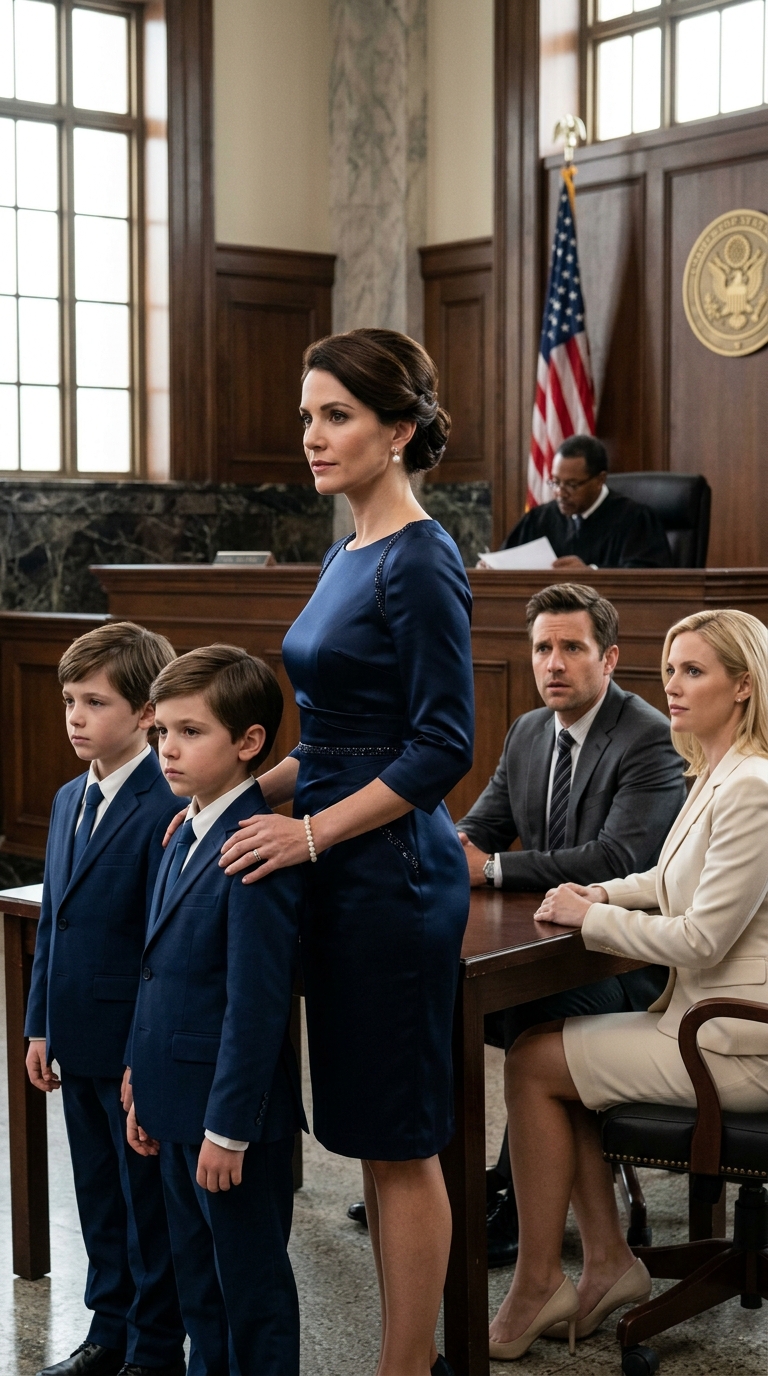
Hollis Transit Systems had been that challenge.
The company had started as a small logistics program known as RouteNorth Analytics. Mara wrote the original code, registered the patents through a holding company, and obtained the first funding through a trust created by her grandmother.
Adrian joined one year later. He was convincing, self-assured, and exceptionally skilled when speaking with investors. Mara preferred technical meetings over media attention, so their arrangement seemed logical at the time. She built the systems while Adrian introduced them to the world. After the wedding, Adrian pushed for the company to be renamed Hollis Transit Systems because he believed his last name carried more credibility.
Mara accepted because she thought they were creating a future together.
As the years passed, Adrian began describing the company as if he had built it alone while she had simply stayed home watching from the sidelines. Her name vanished from presentations. Her technical contributions were minimized in company records. New employees were told she had only provided occasional administrative assistance during the early stages.
By the time their twins arrived, Adrian had convinced himself that public recognition and actual ownership were the same thing.
Judge Calder studied the shareholder statement.
“According to this document, Winslow Venture Trust owns sixty-two percent of the voting interest.”
“That is correct,” Mara said.
“And you are the sole beneficiary with authority over that trust?”
“Yes.”
Russell took the documents after the bailiff handed him a copy. His eyes quickly moved across the pages, and the certainty he had brought into the courtroom started to disappear.
Adrian pushed himself away from the table.
“You told me those investors were family friends.”
“They were.”
“You allowed me to believe I owned the company.”
Mara remained calm, though her fingers gripped the edge of the table more tightly.
“You owned eighteen percent when we married. You now own eleven percent because you used part of your interest as collateral for personal loans.”
Paige immediately turned toward him.
“What private loans?”
Judge Calder lifted his hand.
“Ms. Ellison, remain silent.”
Mara looked at her sons. Samuel was staring down at his shoes, while Owen looked at his father with a seriousness no eight-year-old should have carried.
She had not come to court to humiliate Adrian. Even after discovering Paige, she had wanted the divorce handled quietly and hoped to shield the children from the anger between them.
But then Adrian had transferred money from company accounts, taken away her access to their home, and told the boys that their mother had chosen to leave.
One week later, his lawyers requested full custody.
That was when Mara realized her silence was no longer protecting her children. It was protecting the person damaging their sense of safety.
What the Company Records Exposed
Mara reached into her bag again and removed a small encrypted drive.
“The ownership documents are not the only reason I asked for this hearing to continue.”
Russell’s expression became tense.
“What is on that device?”
“Company financial records, internal communications, security footage from the executive offices, and copies of conversations between Mr. Hollis and Ms. Ellison.”
Adrian stood.
“Those records are confidential.”
Judge Calder’s voice stayed steady.
“Sit down, Mr. Hollis.”
“She had no right to take company files.”
Mara looked directly at him.
“I did not take them. I accessed records belonging to a company I control.”
The court technician connected the drive to a secure system. Mara handed over a printed index so the judge could examine the information without turning the hearing into a public spectacle.
The first set of records revealed that Adrian had moved company funds into three consulting companies established by former associates. Those payments were later transferred into an account used for a condominium, expensive trips, and personal expenses connected to Paige.
The second collection of documents showed that Adrian had instructed his financial team to postpone reporting several major contracts. By making the company appear less valuable during the divorce, he hoped to lower the worth of the shares registered under his name.
Then the technician played an audio file recorded from an executive conference room.
Adrian’s voice echoed through the courtroom.
“Once the temporary custody order is signed, she’ll have no reason to stay in Virginia. She doesn’t have the money to keep fighting.”
Paige responded.
“And the boys?”
“They’ll adjust. Mara has spent so long letting everyone think she does nothing that no judge will believe she built any part of this.”
A loud movement came from the gallery.
Mara kept her eyes fixed on the judge.
The next recording was from several weeks later.
“After the divorce, we’ll move the remaining software rights into the new holding company,” Paige said. “Can she stop that?”
“Not if she never finds out,” Adrian replied. “She trusts paperwork because she still believes people mean what they say.”
Judge Calder motioned for the recording to end.
The courtroom stayed completely quiet.
Adrian’s attorney leaned closer and spoke softly to him. Adrian shook his head and whispered back, his frustration growing with every word.
Paige sat facing forward, her hands locked together so tightly her knuckles had turned pale. Judge Calder looked over the financial summary one final time before turning to Russell.
“Was your office aware of these transfers?”
“No, Your Honor.”
“Was your office aware that Mr. Hollis submitted a company valuation based on incomplete contract reporting?”
Russell hesitated.
“No.”
The judge looked toward Adrian.
“Your request for immediate primary custody is denied. The current shared arrangement will remain temporarily, with the children residing primarily with their mother until a complete custody evaluation has been conducted.”
Adrian leaned forward.
“You can’t make that decision based on business records.”
“I am making it based on your decision to misrepresent finances, influence the children’s perception of their mother, and use custody as a weapon in a property conflict.”
The judge ordered the company records to be preserved and instructed both sides to undergo an independent financial examination. He also directed the clerk to send copies of the relevant documents to the appropriate regulatory agencies for review.
The prenuptial agreement would not be addressed until all assets had been fully disclosed and verified.
Adrian stared at Mara as if he no longer recognized the woman sitting only twenty feet away.
“You planned this,” he said. “You waited until everyone was watching.”
Mara slowly shook her head.
“I waited because I kept hoping you would remember that our sons were listening.”
The Walk Down the Courthouse Steps
When the hearing ended, Mara walked across the courtroom and lowered herself in front of Samuel and Owen.
She adjusted Samuel’s glasses and brushed the front of Owen’s jacket smooth.
“Are we going back to the townhouse?” Owen asked.
“Yes.”
“Is Dad coming?”
Mara looked across the room.
Adrian remained seated while Russell collected the papers around him. Paige had already moved away from his table, as if creating distance could separate her from everything revealed inside the courtroom.
“Not today,” Mara answered softly. “Your dad and I still have things to figure out.”
Samuel looked up at her.
“Did you really make his company?”
Mara paused before answering.
For years, she had avoided discussing her role because she never wanted the boys to feel caught between their parents. She still felt the same.
“I helped build it,” she said. “Your father helped too. But sometimes people get so accustomed to receiving praise that they forget who was standing beside them.”
As Mara reached for their hands, Adrian called her name.
She stopped but refused to turn.
“What happens to me now?” he asked.
His voice no longer carried anger. Only uncertainty.
Mara looked at her sons, then back at the man she had once trusted with every unfinished dream, every quiet hope, and every vision of their future.
“That depends on what you do after today.”
“You’re taking everything.”
Mara held his gaze.
“No, Adrian. I am taking responsibility for what was always mine. There is a difference.”
Outside, reporters filled the courthouse steps, shouting questions about the company, the hidden ownership documents, and the custody ruling. Mara gave them no response.
She led the twins through the crowd and into a waiting car, where their backpacks and winter jackets were already placed on the back seat.
When the doors shut, the voices outside faded into the background.
Samuel rested his forehead against the window.
“Why did all those people want your picture?”
Mara secured his seat belt.
“Because they only knew one part of the story, and now they want to know the rest.”
Owen reached for her hand.
“Are you famous?”
For the first time that morning, she smiled.
“No. I’m your mother.”
That answer was enough for both boys.
As the car traveled through Northern Virginia, Mara watched the courthouse vanish behind them. The financial investigations would last for months. The divorce would bring additional hearings, paperwork, and difficult discussions. Hollis Transit Systems would require new direction, and hundreds of employees would rely on her to stabilize a company whose public reputation had shifted in a single day.
None of that scared her the way it once had.
For years, Mara had confused silence with devotion. She believed protecting Adrian’s pride would protect their marriage, and that letting him stand in the spotlight would not matter as long as they were walking toward the same future.
Now she understood that love did not mean disappearing.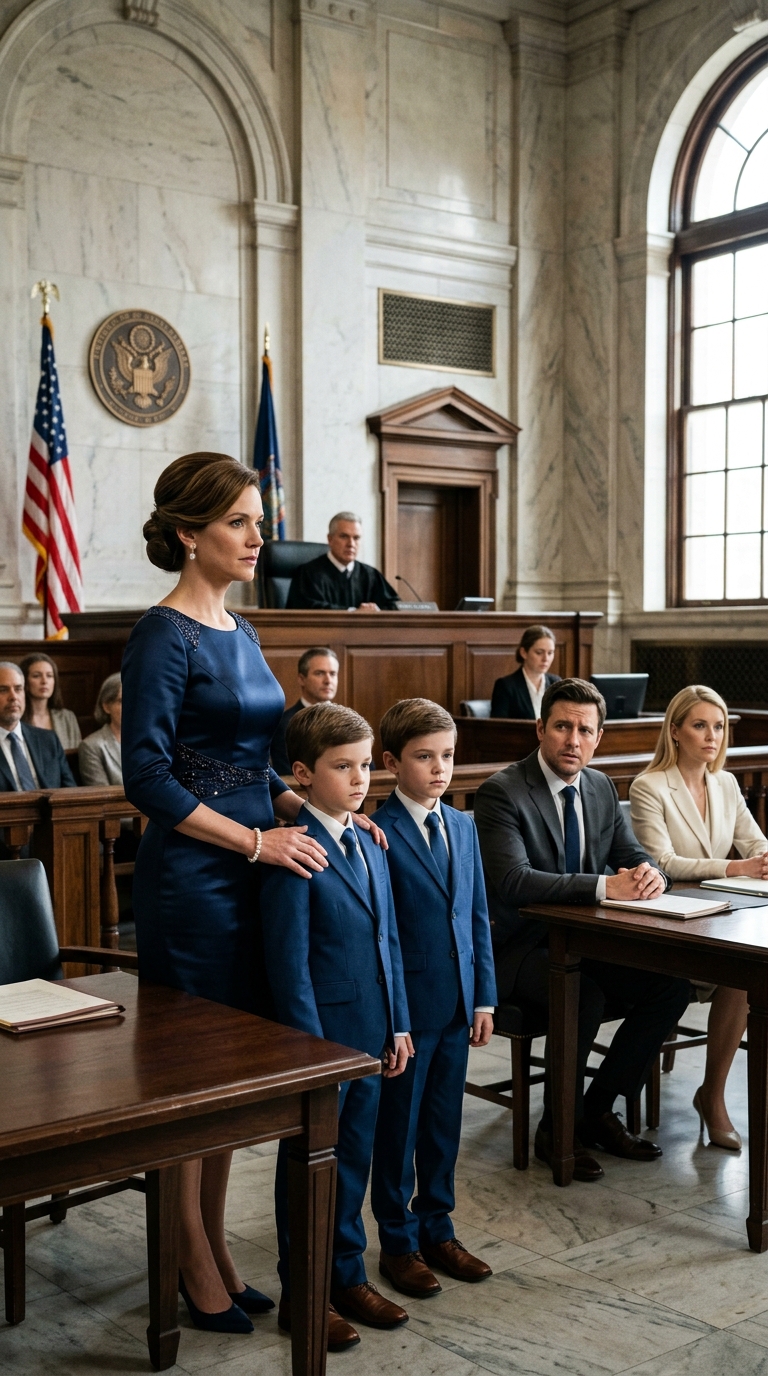
At the townhouse, the boys rushed inside and changed out of their formal outfits. Mara prepared grilled cheese sandwiches while they debated which movie to watch, and within an hour, the courtroom felt like it belonged to another world.
Later that night, she found them asleep together on the living room sofa, one blanket tangled around both sets of legs.
Mara sat beside them and listened to their quiet breathing.
Soon, the world would discover that she had created the foundation behind Adrian’s admired career. Business journalists would revisit her old patents, and people who had overlooked her for years would suddenly claim they had always recognized her talent.
But none of that mattered as much as what her sons had seen.
They had watched their mother walk into a room where everyone expected her to lower her head.
They had watched her speak without bitterness, stand without regret, and reveal the truth without needing approval.
For Mara, that was the only victory she wanted to bring home.
