

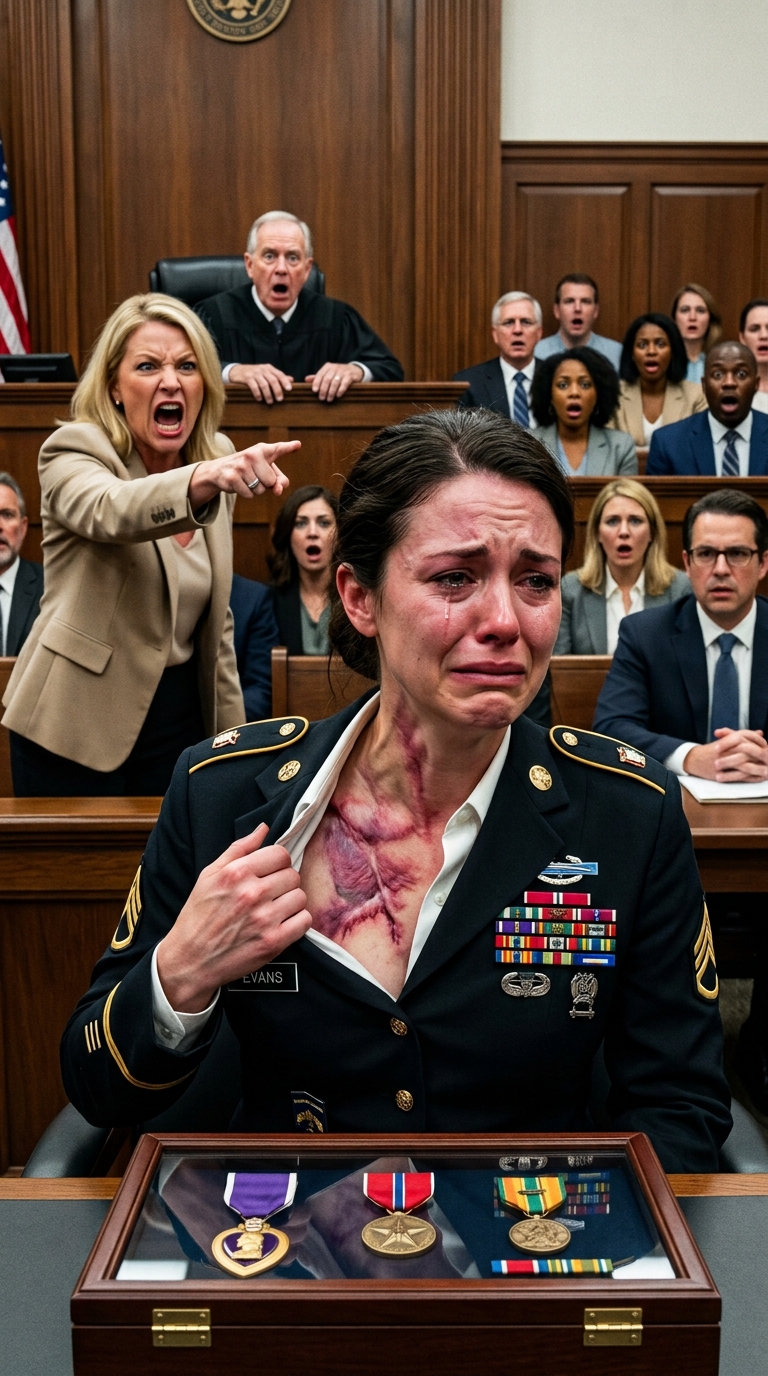
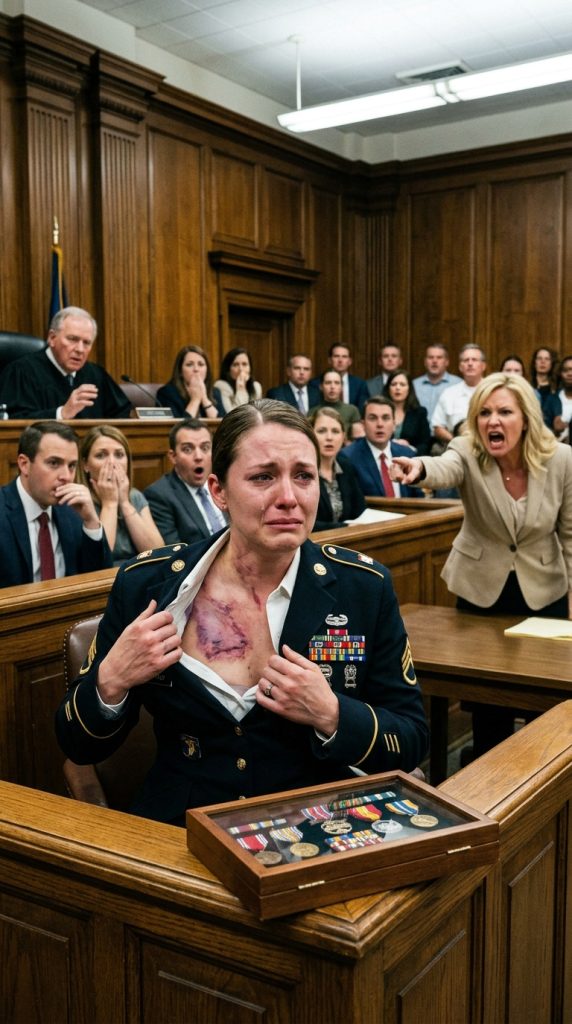
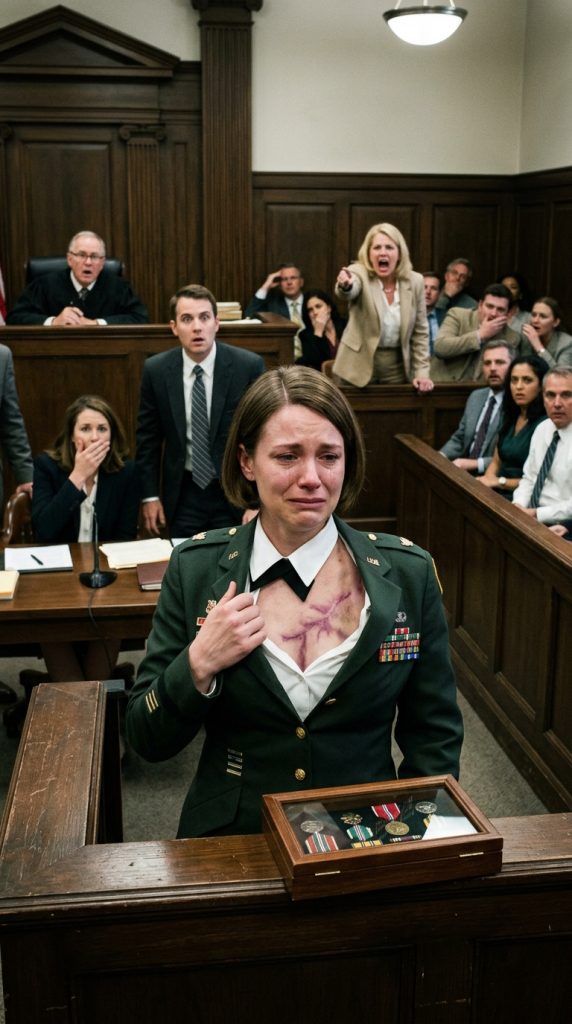
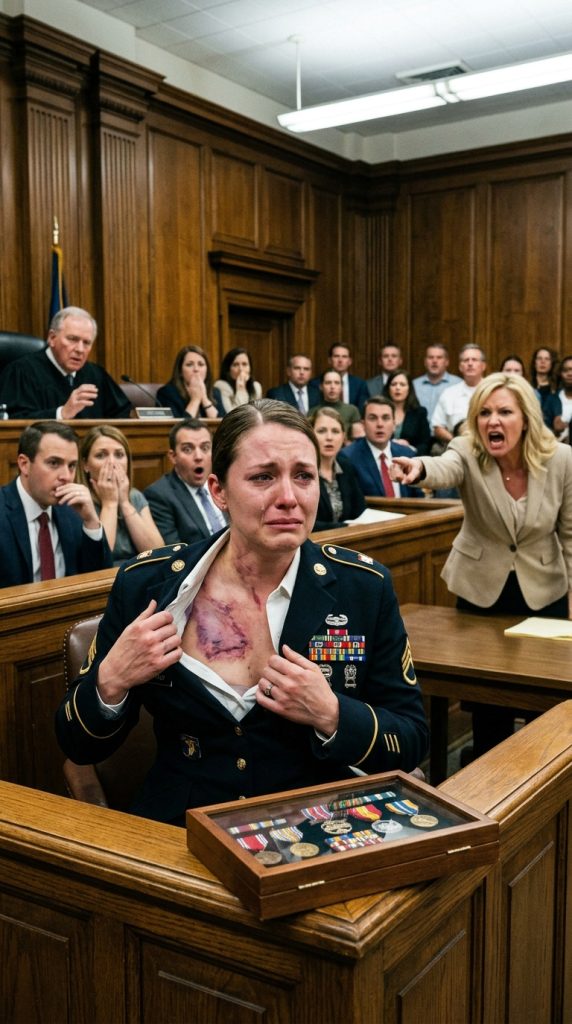
I stood motionless as I watched my own mother take the stand and swear under oath that I had never served my country. She met the judge’s gaze without hesitation, gestured toward the scars hidden beneath my clothing, and insisted they were nothing but fakes. In front of a packed courtroom, she coldly claimed I had invented twelve years of military service, purchased my medals online, and built my entire identity on deception. The jurors believed every word. Reporters scribbled furiously, capturing each accusation. Even my younger brother sat there wearing a smug grin, certain victory was already his. But there was one thing none of them knew—I was counting every passing minute. Just beyond those courtroom doors, the only people capable of proving the truth were on their way. And the moment those doors finally swung open, my family’s greatest lie would begin to collapse.
My name is Mara Bennett, and betrayal is often delivered most calmly by the people who share your blood.
The first lie my mother told cost me twelve years of my life.
The second was meant to send me to prison.
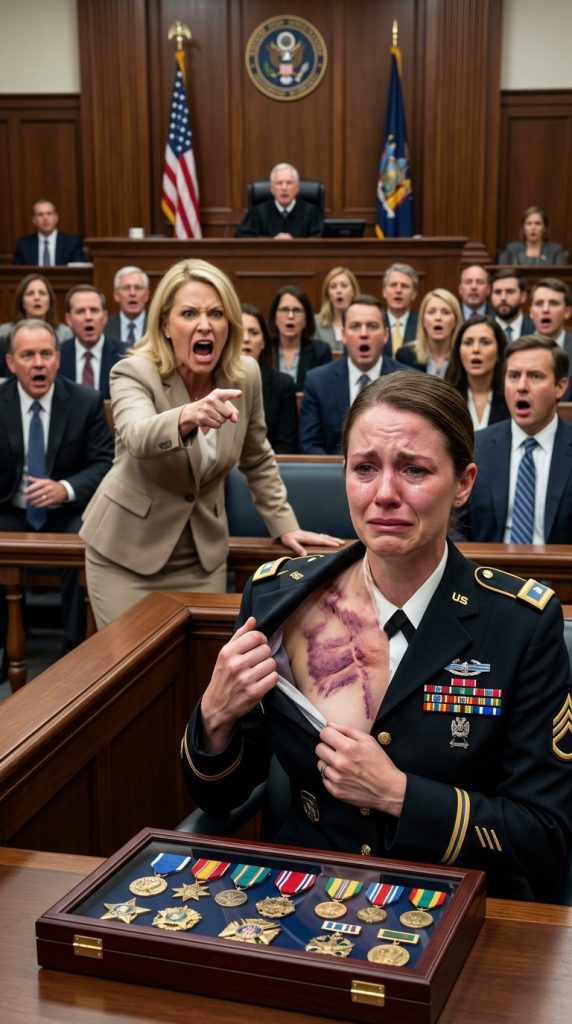
“She was never in the Army,” my mother, Victoria Bennett, said with total confidence. “The scars, the medals, the entire story—she made it all up.”
Whispers spread across the courtroom.
I remained perfectly still.
My attorney leaned closer. “Mara… don’t react.”
“I won’t,” I whispered.
He searched my expression. “That worries me more.”
Across the aisle, my younger brother, Caleb, lowered his head, trying to hide his satisfied smile.
The case had started as a dispute over my father’s defense technology company, Bennett Meridian Systems. Before his death, Dad left me the controlling shares and appointed me executor of his estate.
Only three days after the funeral, Caleb suddenly presented a new will that transferred everything to him.
When I challenged its legitimacy, he escalated his attack.
He accused me of fabricating military records, inventing combat experience, and using stolen valor to manipulate our father.
Soon afterward, prosecutors became involved.
Fraud.
Forgery.
Falsified federal documents.
The prosecutor lifted a wooden shadow box and displayed it to the jury.
Inside rested my Silver Star, my Purple Heart, and the burned unit patch I had brought home from the mission that had nearly claimed my life.
My mother curled her lip.
“She bought those online.”
Several jurors looked at me with open disgust.
I knew exactly what they believed.
Fraud.
Liar.
Imposter.
Beneath my blouse, the scar along my ribs ached, as though it remembered the explosion before my mind did.
For an instant, I was overseas again.
Helicopter blades.
Smoke.
Blood soaking through my uniform.
Major Daniel Hayes pulling me through shattered wreckage while gunfire ripped through the air.
Those memories were real.
But I could not speak about them.
The mission remained classified.
My military records had been sealed for reasons of national security.
Caleb knew that.
That was exactly why he had built his entire case around it.
The truth could not defend me.
Not yet.
My father knew everything.
Before cancer drained the last of his strength, he held my hand tightly.
“They’re moving money through shell companies,” he whispered. “Protect the company… but don’t expose your unit.”
“I promise.”
And I intended to keep that promise.
My father’s attorney stood and approached my mother.
“Mrs. Bennett, did your daughter ever deploy overseas?”
“No.”
“Did she ever serve in the United States Army?”
“Never.”
Then she turned to face me.
A small smile of victory spread across her face.
She believed I had run out of places to hide.
I quietly folded my hands on the defense table and glanced up at the clock above the judge.
11:47 a.m.
My heartbeat remained calm.
My lawyer noticed.
“What are you waiting for?”
Without taking my eyes off the clock, I answered,
“Authorization.”
He frowned.
“For what?”
For the first time that day, I smiled.
“In thirteen minutes, classified becomes declassified.”
At that precise moment, the courtroom doors rattled as someone on the other side reached for the handle.
Part 2: The Courtroom Door Opens
The courtroom doors opened exactly at noon.
Not with drama.
Only with the quiet scrape of aged wood and the measured footsteps of people who valued procedure over spectacle.
Every head turned.
My mother’s smile vanished first.
Then Caleb’s.
Three people walked inside: a woman dressed in a navy suit carrying a sealed government envelope, a gray-haired colonel in full dress uniform, and behind them, moving with a cane yet wearing the same unwavering expression I remembered, Major Daniel Hayes.
For a single heartbeat, I forgot to breathe.
Daniel was alive.
The last time I had seen him, he was lying on a stretcher beneath harsh hospital lights, telling me to stay awake while medics fought to save both of us. After that day, his records disappeared behind the same wall of classification as mine. I wrote letters I never mailed and searched databases that revealed nothing.
Now he stood inside a Virginia courtroom, older, leaner, but undeniably real.
My attorney, Samuel Price, slowly stood.
“Your Honor,” the woman in navy said, “my name is Dana Whitfield, counsel for the Department of Defense. We request permission to approach.”
The judge looked surprised but composed.
“On what matter?”
“The authenticity of Captain Mara Bennett’s military service and the admissibility of newly declassified records.”
A wave of murmurs swept through the gallery.
Reporters straightened in their seats.
Jurors leaned forward.
My mother remained frozen in the witness chair.
Caleb whispered something to his attorney, but the man simply shook his head, unable to take his eyes off the sealed envelope.
Samuel looked down at me, his expression filled with shock, relief, and one unspoken question.
I nodded.
Yes.
This was exactly what I had been waiting for.
Part 3: The Record They Couldn’t Erase
The judge ordered a recess, but no one truly relaxed. The jury was escorted from the courtroom. The gallery buzzed with quiet conversation, like distant thunder behind glass. My mother stepped down from the witness stand with rigid composure, though her hand shook as she reached into her purse.
Caleb hurried to her side.
“Mom,” he whispered too loudly.
She ignored him and stared directly at me.
Not frightened.
Angry.
That was Victoria Bennett. Even when confronted with the truth, she resented the inconvenience.
Inside the judge’s chambers, Dana placed the sealed envelope on the desk and presented her identification, security clearances, and written authorization that had taken months to obtain.
The colonel introduced himself as Colonel Marcus Reed, former commander of a special operations support unit that had never appeared in my public military file.
Then Daniel spoke.
His voice was softer than I remembered.
“Captain Bennett served under my command. Her record is genuine. Her commendations are genuine. Her injuries were sustained during service.”
The judge examined the documents carefully.
The prosecutor, Helen Marr, read them with an increasingly tense expression. I did not envy her. She had built her case around records that appeared incomplete because the truth had been classified, not because it did not exist.
At last, she looked toward me.
“Captain Bennett,” she said, addressing me by rank for the first time, “why didn’t you disclose this earlier?”
“I was under binding nondisclosure orders,” I answered. “I petitioned for limited release through proper channels. Authorization was granted at noon today.”
“And you knew it would arrive during trial?”
“I hoped it would.”
The judge turned toward Dana.
“How much can be stated publicly?”
“Enough to verify service, rank, deployment history, awards, and the authenticity of the injuries relevant to this case. Operational details remain sealed.”
The judge nodded.
“Then we will reconvene.”
When we returned to the courtroom, my mother refused to look at me.
That hurt more than I expected.
Some stubborn part of me still wanted her to see the uniformed officers, understand what she had done, and quietly admit she was sorry.
She didn’t.
She took her seat beside Caleb and stared straight ahead.
Dana testified first, explaining why my service record had remained sealed and why a limited release had finally been authorized. She offered no emotional arguments. She simply presented the facts.
Then Colonel Reed took the stand.
Yes, I had served honorably.
Yes, my medals were authentic.
Yes, the shadow box displayed in court contained genuine military decorations.
The prosecutor rose, visibly uneasy.
“Colonel, why would a civilian search fail to locate Captain Bennett’s complete service history?”
“Because portions were classified.”
“So absence from certain public databases does not prove nonservice?”
“No, ma’am. It proves the search was incomplete.”
One juror lowered his eyes to his hands.
I wondered if he had been among those who looked at my medals with disgust earlier. I did not resent him. People believe what the evidence allows them to believe. Caleb had simply turned that evidence into a weapon.
Part 4: Daniel’s Testimony
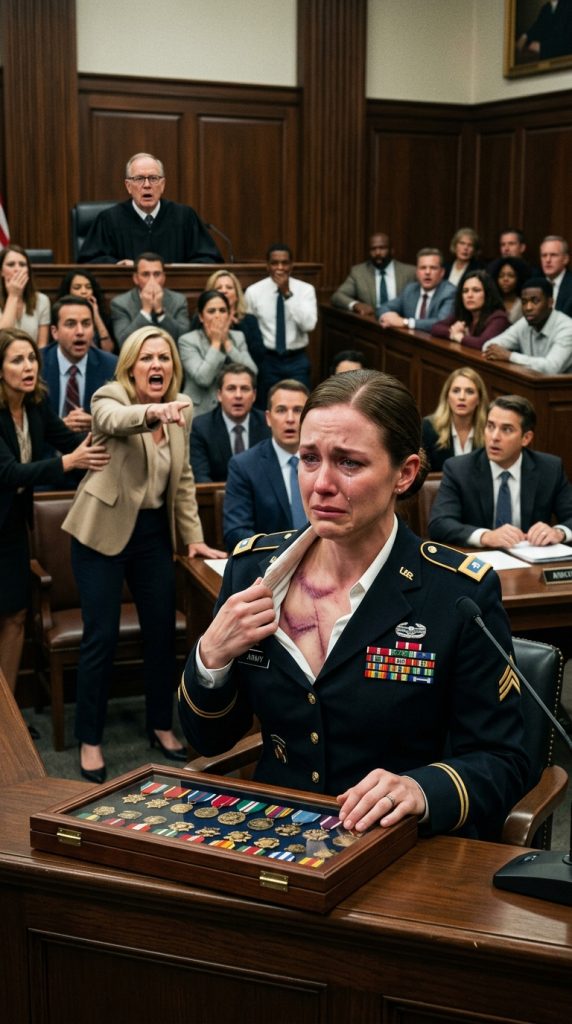
Then Daniel Hayes stepped onto the witness stand.
He walked with care, yet nothing about him appeared fragile. As he took the oath, his gaze found mine for one fleeting moment.
Twelve years of memories moved silently between us.
Smoke.
Dust.
Commands breaking through static.
A hand gripping mine when I believed I would never return home.
Samuel approached him cautiously.
“Major Hayes, do you know Mara Bennett?”
“Yes.”
“How?”
“She served with me.”
“Were you present when Captain Bennett sustained the injuries her family called false?”
Daniel’s jaw hardened.
“Yes.”
“Without discussing classified details, were those injuries sustained in the line of duty?”
“They were.”
My voice nearly gave out even though I had not spoken.
“She saved lives that day,” Daniel continued. “Including mine.”
The entire courtroom fell silent.
My mother finally raised her head.
For the first time, doubt appeared across her face.
Samuel allowed the silence to remain.
“Did Captain Bennett ever falsify her service to your knowledge?”
“No.”
“Did she exaggerate it?”
“No. If anything, she avoided discussing it.”
“Why?”
Daniel looked in my direction once more.
“Because she understood that some service requires silence.”
The words touched something inside me that had remained sealed for years.
Silence had protected operations.
Silence had protected lives.
But silence had also given my brother room to rewrite my history.
When the prosecutor chose not to pursue any meaningful cross-examination, everyone understood that the stolen valor accusation had fallen apart.
But the case was far from over.
Caleb still possessed the will.
My father’s company was still trapped inside his deception.
And I still had a promise left to fulfill.
Part 5: The Lie Was Older Than I Knew
During the afternoon recess, Samuel led me into a quiet room beside the courtroom. Daniel was waiting there with Colonel Reed and Dana.
For several seconds, no one said anything.
Then Daniel gave me a faint smile.
“Captain.”
I forced myself to swallow.
“Major.”
His expression softened.
“You look like you want to hit me and hug me.”
“I thought you were dead.”
“I know.”
“That is not an apology.”
“No,” he said. “Only the beginning of one.”
Dana gave us privacy and stepped into the hallway with Colonel Reed. Samuel paused uncertainly, but I told him I would join him shortly.
Daniel rested his weight against his cane. Standing closer, I noticed the scar near his temple, the streaks of silver in his hair, and the weariness that clung to him like another uniform.
“I tried to contact you,” he said.
“When?”
“After recovery. Twice. Both times I was told contact could compromise your reassignment and review.”
“Who told you that?”
His face shifted.
“A liaison at Bennett Meridian.”
My father’s company.
My stomach clenched.
“Do you remember a name?”
“I didn’t then. I do now.”
He removed a folded sheet of paper from inside his jacket.
“Caleb Bennett.”
For a moment, everything in the room seemed to close around that name.
Caleb had not simply attacked my service after Dad’s death.
He had interfered years before, while I was injured, cut off, and struggling to rebuild my life beneath restrictions I could barely discuss.
“Why?” I whispered.
“I don’t know,” Daniel said. “But I think your father found out.”
“How?”
“Three months before he died, Harold Bennett called me.”
Hearing my father’s name brought fresh pain.
“What did he say?”
“He apologized.”
“For what?”
“For trusting the wrong child with the wrong information.”
Before I could question him further, Samuel opened the door.
“Mara,” he said quietly, “court is resuming.”
I returned to the defense table carrying a new heaviness inside me.
The truth about my military service had destroyed one lie, but beneath it, another older chamber had opened.
Caleb had been constructing this deception far longer than I had realized.
Part 6: My Mother Breaks on the Stand
Samuel filed a motion to dismiss the criminal fraud charges tied to the accusations of falsified military service. The judge granted part of the request and held the rest for a final decision, but the damage to the prosecution’s case was undeniable.
Helen Marr rose.
“Given the newly verified military records, the Commonwealth requests time to review whether remaining charges can proceed.”
Caleb’s attorney argued that the estate dispute remained a separate matter. The judge permitted the trial to continue, but the entire narrative had shifted.
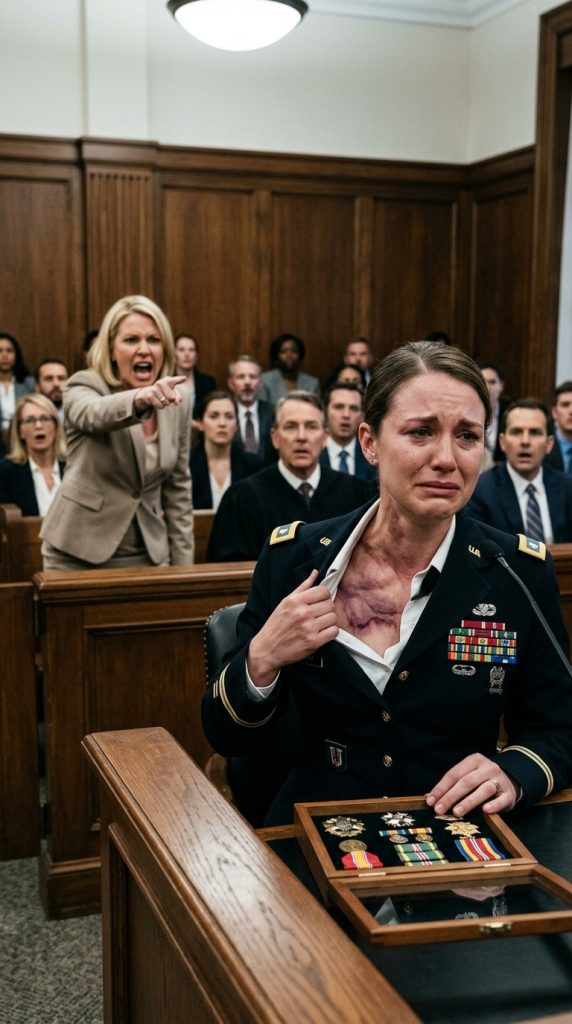
My mother was called back to the stand.
This time, her confidence looked carefully applied.
Samuel approached her at a measured pace.
“Mrs. Bennett, earlier today you testified that your daughter had never served in the Army.”
“Yes.”
“Was that testimony true?”
“At the time, I believed it was.”
A low murmur traveled through the courtroom.
Samuel asked the judge to direct her to answer the question plainly.
The judge fixed his eyes on her.
“Mrs. Bennett, was your testimony true?”
“No.”
The answer was almost too quiet to hear.
“Louder,” the judge said.
“No.”
Samuel went on.
“You testified that Mara’s scars were fake.”
“I was mistaken.”
“Did you examine them?”
“No.”
“Did a doctor tell you they were fake?”
“No.”
“Did Caleb tell you she invented her service?”
Caleb remained completely still.
My mother looked toward him.
There it was.
The first fracture.
“Yes,” she said.
“Did he provide proof?”
“He showed me documents.”
“What documents?”
“Search results. Articles. Some records.”
“Prepared by whom?”
“I don’t know.”
Samuel displayed an invoice from Vantage Trace, an investigative firm paid through a consulting account linked to Bennett Meridian Systems and approved by Caleb.
Caleb was no longer smiling.
“Mrs. Bennett,” Samuel asked, “did you personally verify Mara’s military history before calling her a liar in court?”
“No.”
“Why not?”
My mother turned her eyes toward me.
For the first time that day, I saw something human behind them.
“I trusted my son.”
Those four words carried the weight of decades.
My mother had always placed her faith in Caleb.
When we were children, he damaged things, and I was blamed for failing to supervise him. He struggled in school and was given tutors. I earned scholarships and was warned not to boast. He wandered through careers, money, and direction, constantly shielded by her belief that his greatness was simply waiting to be discovered.
I went to war.
He remained at home.
Yet somehow, he was still treated as the vulnerable one.
Samuel stepped away.
“No further questions.”
My mother descended from the witness stand looking smaller than she had before.
I thought I would feel satisfied.
Instead, exhaustion settled over me.
The truth could not return what lies had stolen. It could only reveal the shape of everything that had been lost.
Part 7: The Will Beneath the Will
The next witness caught everyone by surprise.
Graham Ellis, my father’s former chief financial officer, entered the courtroom carrying a leather-covered ledger.
Caleb immediately leaned toward his attorney.
Samuel glanced at me.
I shook my head. I had not known Graham would appear.
He had resigned from Bennett Meridian six weeks before Dad’s death and stopped answering my calls. I had assumed either grief or guilt had driven him away.
Now he took the oath with a grave expression.
“Mr. Ellis,” Samuel asked, “why did you leave Bennett Meridian Systems?”
Graham looked first at Caleb and then at me.
“Because I discovered irregular transfers connected to Mr. Caleb Bennett.”
Caleb’s attorney objected at once, but the judge permitted the testimony within limited boundaries.
“What kind of transfers?”
“Payments to shell consultants. Licensing advances redirected before approval. Research funds moved into temporary accounts.”
“Did Harold Bennett know?”
“Yes.”
My breath caught in my chest.
“When?”
“About four months before his death.”
“What did he do?”
“He began preparing a revised estate plan and internal audit.”
Samuel displayed a document on the courtroom screen.
“Do you recognize this will?”
“Yes.”
“Is this the will Caleb Bennett submitted after Harold Bennett died?”
“Yes.”
“Had you seen it before?”
“Not that version.”
“What do you mean?”
Graham’s voice began to shake.
“Harold drafted a will naming Mara as controlling heir and requiring an audit before Caleb received any management interest. The version presented after his death removed the audit clause and transferred control to Caleb.”
The courtroom seemed to draw one collective breath.
“Was the submitted will altered?”
“Yes.”
Caleb shot to his feet.
“He’s lying.”
His attorney pulled him back into his seat. The judge issued a single warning.
Graham continued.
“Harold suspected Caleb had been exploiting Mara’s classified status to damage her credibility. He said if Mara could not defend her service publicly, Caleb would use that silence against her someday.”
My eyes stung.
Dad had known.
He had recognized the trap before I had.
Samuel raised another sheet.
“Did Harold Bennett leave instructions if his will was challenged?”
“Yes. He created a sealed contingency file.”
“Where is it?”
Graham paused.
“I don’t have it.”
Caleb’s posture eased slightly.
Then Graham continued:
“Mara does.”
I stared at him.
“No,” I whispered.
Graham met my eyes.
“Your father said he gave you the key years ago. He said you would never think to use it until you stopped believing the house was empty.”
The house.
The home where I grew up.
Dad’s study.
The scent of pipe tobacco, cedar, and lemon drops.
Then the memory returned.
The brass key Dad had placed in my hand before my final deployment.
“For when you come home,” he had said.
“It doesn’t open the front door.”
“No,” he replied. “It opens what matters.”
I had kept it with my dog tags until the explosion. Later, when my personal effects were returned, the key was missing.
At least, that was what I believed.
My hand drifted without thought toward the scar beneath my blouse.
Daniel, seated in the rear row, leaned forward.
He had remembered something too.
The judge adjourned the court until the next morning.
Part 8: The Lake House Archive
Outside the courtroom, reporters pushed forward, but Dana Whitfield’s presence held them at a distance. Samuel guided me into a conference room, where Daniel and Graham were already waiting.
“What key?” Samuel asked.
I looked at Daniel.
“When my effects were returned, was there a brass key?”
His jaw became tense.
“Yes.”
“Where is it?”
“I gave it to the Bennett Meridian liaison.”
“Caleb,” I said.
Daniel nodded.
“He signed for it.”
Silence filled the room.
Graham lowered himself heavily into a chair.
“Then he may already have the contingency file.”
“Not necessarily,” he said. “Harold was careful. The key alone would not be enough.”
“What does it open?” Samuel asked.
Graham turned toward me.
“Your father’s private archive beneath the old lake house.”
A shocked laugh almost escaped me.
“The lake house was sold.”
“No,” Graham said. “That’s what everyone believed. Harold transferred it into a trust after Mara deployed.”
My father had concealed an entire house from his own family.
Samuel started writing notes.
“Where?”
“Lake Minnetonka. North shore. Small property, gray shutters, stone boathouse.”
I remembered the place.
We had spent our childhood summers there. Dad taught me how to skip stones from the dock. My mother complained about the mosquitoes. Caleb complained about the unreliable internet.
I loved it because it was where Dad seemed happiest.
That night, I did not return home.
Samuel arranged a hotel room for me, with Daniel staying next door and a security consultant positioned near the elevator. It felt unnecessary until Samuel showed me three missed calls from Caleb and a message from my mother.
Mara, stop this before you destroy what remains of us.
What remains of us.
I studied those words for a long time.
Then I wrote:
What remains of us has to be true.
I never sent it.
Some truths do not require delivery.
Close to midnight, sleep remained impossible. I stood beside the window, thinking about my father’s hands, my mother’s testimony, Caleb’s smug expression, and Daniel’s impossible return.
A knock came from the connecting door.
“Mara?” Daniel called softly.
I opened it.
He was holding two paper cups of tea from the lobby.
“I figured coffee would be a mistake.”
“It is always a mistake after noon.”
“You used to drink it at midnight.”
“I used to jump out of aircraft too. People evolve.”
We sat together near the window beneath the dim light. For some time, we spoke about ordinary things because everything extraordinary had exhausted us.
Then Daniel said, “I’m sorry I disappeared.”
“You were injured.”
“I was alive.”
“So was I.”
The room became crowded with everything we could never regain.
“I needed a friend,” I admitted. “Afterward. Everyone thanked me for service they couldn’t understand or doubted service they couldn’t see. Dad tried, but he was sick. My family…”
“I know.”
“No,” I said gently. “You don’t. But you may be one of the few people who can.”
He lowered his eyes.
“I read your letters.”
I went still.
“What letters?”
“The ones you wrote and never sent. They were in the packet Caleb’s office returned to me last month. I think they sent them by mistake.”
I had written those letters during endless nights when pain medication softened the ceiling and made the world feel distant. I wrote to Daniel because I could not be honest in mission reports, could not explain anything to my mother, and could never tell Dad enough.
“I didn’t read all of them,” he said quickly. “Only enough to understand you thought I abandoned you.”
“Didn’t you?”
“No. But I let official silence become personal silence. That was my failure.”
His honesty caught me off guard.
“We both survived,” I said. “That doesn’t mean we knew how to live afterward.”
“No,” he said. “It doesn’t.”
Before sunrise, Samuel arranged for us to travel to the lake house. Court was scheduled to resume at ten. Dana accompanied us because the contingency file might contain materials related to defense contracts. Graham came as well, silent and uneasy.
Daniel drove.
The morning sun turned Lake Minnetonka a washed-out blue as the road narrowed between trees and water.
At the end of a thin lane, the house appeared.
Gray shutters.
Stone boathouse.
A porch dipping slightly on one side.
I stepped from the vehicle and immediately felt eight years old again, racing barefoot through the grass while Dad called after me:
“Careful, Mara-bear, heroes still need shoes.”
My throat tightened.
Inside the boathouse, beneath a stack of faded life jackets, Samuel discovered a panel in the floor. Below it was a steel hatch fitted with a keypad and a keyhole.
“We don’t have the key,” Samuel said.
I knelt next to the hatch.
An inscription had been carved above the keypad.
WHAT MATTERS?
My father’s words came back to me.
It opens what matters.
I entered:
TRUTH
Red.
Incorrect.
Dad had never cared for obvious answers.
I entered:
MARA
Red once more.
Daniel crouched at my side.
“What did he call you?”
“Mara-bear.”
“Try it.”
I entered:
MARABEAR
Green.
A lock released with a click.
The hatch opened, revealing a narrow staircase.
Below us was a dry, quietly humming archive lined with metal shelving. Cardboard boxes carried labels in Dad’s handwriting: contracts, audits, letters, medical records.
A secured cabinet stood against the far wall.
This time, there was no keypad.
Only a biometric reader.
Graham’s brow furrowed.
“That wasn’t there before.”
Dana moved nearer.
“Someone upgraded this.”
A small envelope had been taped beside the scanner.
My name was written across it.
Inside, Dad had left a note:
If this room has changed, then someone found the outer door before you. Use what I gave you that no one else can copy.
I remembered Dad asking me to sign trust documents before deployment. One form had required my fingerprint. I had teased him for acting like a spy.
He had given me a sad smile.
“No, honey. Just a father.”
I pressed my thumb against the scanner.
Green light.
The cabinet unlocked.
Inside rested the contingency file.
Next to it was another folder:
CALEB BENNETT: PATERNITY AND ADOPTION RECORDS
I stopped breathing.
Inside was an official adoption decree.
Caleb was not my father’s biological child.
He had been adopted when he was two years old.
The following page made the room shift beneath me.
Birth father:
Thomas Vail.
Everyone in the defense technology industry recognized that name.
Thomas Vail had established Vail Strategic Group, Bennett Meridian’s greatest rival—the same corporation attempting to gain control of us through Caleb’s shell accounts.
At the bottom of the folder was a photograph of my mother years earlier, standing beside Thomas Vail.
A toddler stood between them.
Caleb.
On the back, my father had written a single sentence:
Victoria’s first lie was not about Mara.
Part 9: The Secret That Broke the Case
For several long moments, silence settled over the underground archive.
My eyes remained fixed on the photograph.
My mother.
Thomas Vail.
Caleb as a toddler.
My brother, who had spent his entire life carrying the Bennett name with pride, had entered the world connected to the very family determined to dismantle my father’s company.
Daniel lowered himself beside me. He never reached for the folder, only stayed close enough to remind me I was not facing this alone.
“Mara,” he said quietly, “breathe.”
Samuel carefully examined the adoption decree while Dana reviewed the Vail file.
“This isn’t only family history,” she said. “There are defense contract implications.”
Graham stood near the shelves, his face drained of color.
“Harold suspected Vail Strategic was influencing Caleb, but I don’t think he knew how direct the connection was until near the end.”
“My father knew Caleb wasn’t his biological son?”
Graham gave a slow nod.
“Yes. But he loved him anyway.”
That truth struck me more deeply than I expected.
I had prepared myself for fraud.
Not love.
Samuel opened the contingency file. Inside were copies of the original will, summaries of the audit, emails exchanged between Caleb and consultants connected to Vail Strategic, and a sealed letter addressed to me.
I recognized Dad’s handwriting immediately.
He wrote that Caleb would always be my brother, that blood explained biology but never belonging. He said he had chosen Caleb, raised him, and loved him. But he warned that love separated from truth eventually becomes dangerous.
He explained that my mother’s past included Thomas Vail, and Caleb had come from that chapter of her life. Dad admitted he had kept the secret for too many years because she had pleaded with him not to destroy Caleb.
Then the letter became personal.
If Caleb had used my silence, my service, or my name to take control, Dad urged me not to respond with anger.
Answer with daylight.
Let auditors audit.
Let courts judge.
Let truth stand where fear had hidden it.
He asked me to protect the company without allowing my heart to become another battlefield.
I folded the letter carefully and held it against my chest.
For years, I believed Dad had left me nothing more than a company, a responsibility, and a fight.
Instead, he had entrusted me with something even more difficult.
Mercy with boundaries.
Justice without hatred.
We had to return to court.
As we stepped back into the morning light, my phone buzzed.
A message from my mother:
Mara, please don’t open what your father buried. You don’t understand what it will do to Caleb.
I stared at the screen.
Daniel gently touched my elbow.
“She knows,” he said.
“Yes,” I whispered. “And she still thinks the truth belongs to him more than it belongs to me.”
When we arrived at the courthouse, reporters crowded the front steps. Samuel led us inside through a side entrance.
Just before we walked in, Daniel stopped me.
“Whatever happens in there, you don’t owe anyone your pain as proof.”
I looked at him.
For years, everyone had demanded proof from me.
Records.
Scars.
Medals.
Explanations.
Now another part of my life was about to become evidence.
“My pain isn’t proof,” I said softly. “It’s just mine.”
He nodded.
Then the doors opened.
My mother sat beside Caleb, looking as though she had aged ten years overnight. Her posture remained perfectly straight, pearls fastened neatly at her throat, but her hands were clenched so tightly her knuckles had turned white.
Caleb whispered urgently.
She never answered.
When her eyes met mine, they filled with fear.
Not fear of me.
Fear of what I carried.
Part 10: Truth Enters the Room
The proceedings resumed.
Samuel requested permission to submit the contingency file, the original will, and documents connected to undue influence and financial misconduct. Caleb’s attorney objected immediately and with great intensity.
The judge silently reviewed the opening pages.
At last, he looked over the top of his glasses.
“The court will allow limited admission subject to foundation. Proceed carefully.”
Graham returned to the witness stand and explained the audit, the missing funds, the shell payments, and concerns that proprietary research had been shared with outside parties.
Samuel displayed the original will.
“In this version, who is named controlling shareholder?”
“Mara Bennett.”
“And what condition was placed on Caleb Bennett receiving executive authority?”
“Completion of an independent financial audit.”
Samuel placed the version submitted after Harold Bennett’s death beside it.
“What is missing from the version presented after Harold Bennett’s death?”
“The audit clause. The restriction on Caleb’s authority. Several protective provisions.”
Caleb stared at the documents as though anger alone could change the words written on the page.
Samuel continued.
“Did Harold Bennett intend to disinherit Caleb?”
“No,” Graham answered firmly. “He wanted Caleb cared for and included. But he no longer trusted him to run the company without oversight.”
My mother closed her eyes.
That statement seemed to wound her more deeply than any discussion of money.
Samuel then introduced the payments made to Vantage Trace, the investigative firm Caleb had hired to create doubt surrounding my military service.
Finally, he held up the adoption file.
The atmosphere shifted.
Caleb’s attorney objected, arguing that it contained private family information.
Samuel responded that it was directly relevant to conflicts of interest and outside influence.
The attorneys approached the bench.
While they argued, I watched my mother.
She watched Caleb.
He no longer looked angry.
He looked confused.
For one unexpected instant, I saw the little boy who used to trail behind me to the creek, begging me to catch frogs because he hated touching the mud himself.
He didn’t know.
The realization struck me with surprising force.
Caleb truly did not know.
My mother had hidden this truth from him as well.
The judge permitted limited questioning while forbidding unnecessary personal details.
Samuel proceeded carefully.
“Mr. Ellis, did Harold Bennett have concerns that Caleb Bennett had undisclosed ties to Vail Strategic Group?”
“Yes.”
“Did those concerns relate to Bennett Meridian’s ownership and defense contracts?”
“Yes.”
“Did Harold document a possible personal connection between Caleb Bennett and Thomas Vail?”
“Yes.”
Caleb slowly rose to his feet.
“What connection?”
His attorney grabbed his arm, but Caleb pulled free.
“What connection?” he repeated.
The judge struck the gavel.
“Mr. Bennett, sit down.”
He remained standing.
Instead, he turned toward our mother.
“Mom?”
Victoria’s composure finally broke.
“Caleb,” she whispered.
His voice grew smaller.
“What connection?”
The judge ordered another recess.
Inside a private conference room, the truth finally emerged without an audience watching.
My mother sat at the end of the table, twisting a tissue nervously between her fingers. Caleb stood against the wall with folded arms, his face drained of color. I sat across from her with Samuel beside me. Daniel remained quietly near the door.
Victoria spoke first, and the sentence seemed to cost her everything.
“Thomas Vail is Caleb’s biological father.”
Caleb shook his head.
“No.”
She reached toward him, but he stepped away.
“No,” he repeated more quietly. “Dad was my father.”
“He was,” I said.
Every face turned toward me.
“Dad was your father. This doesn’t take that from you.”
Caleb’s mouth trembled before he turned away.
My mother explained that she had known Thomas Vail before meeting Dad. Their relationship had ended badly. She was pregnant, alone, and terrified when Harold Bennett came into her life with kindness. He married her after Caleb was born, legally adopted him, and raised him as his own son.
“Harold wanted to tell you when you were old enough,” she said. “I begged him not to.”
Caleb’s voice sounded empty.
“Then why did Vail know?”
My mother’s tears stopped.
That question landed at the center of the room.
“I don’t know,” she whispered.
But she knew enough to fear the answer.
Caleb looked at me.
There was no smugness.
No triumph.
Only someone completely lost.
“Did you know?”
“No.”
“Dad knew?”
“Yes.”
“And he didn’t tell me.”
“He wrote that he loved you before anything else.”
Caleb swallowed with difficulty.
For years, I had looked at him as a rival.
Then as an enemy.
Then as a danger.
Now I saw something even more tragic.
A man who had become an easy target for anyone willing to convince him he deserved what he secretly feared he had never truly earned.
Samuel leaned forward.
“Caleb, did Thomas Vail contact you before your father died?”
Caleb hesitated.
His attorney started to object, but Caleb raised one hand.
“Yes.”
My mother covered her mouth.
“He said he had known Dad for years,” Caleb said. “He said Bennett Meridian needed someone with ambition. He said Mara would sell the company to bureaucrats and bury Dad’s legacy under caution.”
I looked directly at him.
“You believed him?”
Caleb’s face tightened.
“I wanted someone to believe in me.”
For a single moment, that honesty quieted my anger.
Then I remembered the witness stand, my mother’s testimony, and the way the jurors had stared at my medals as though they were cheap costume jewelry.
“And that was worth destroying me?”
He lowered his gaze.
“No.”
It was the first completely truthful answer he had given me in years.
Part 11: What Remains Must Be True
By that afternoon, the entire case had begun to come apart.
Caleb’s attorney requested a continuance. The prosecutor, confronted with verified military records and evidence showing information had been manipulated, moved to dismiss the remaining criminal charges pending further investigation.
The judge granted the dismissal without ceremony.
No applause.
No dramatic breakdown.
Only formal legal language restoring what should never have been questioned in the first place.
Captain Mara Bennett’s military service was officially recognized in the record.
My medals were genuine.
My scars were genuine.
My silence had been service—not deception.
I remained still as those words became part of the official transcript.
Behind me, Daniel lowered his head.
Samuel rested a hand over mine.
“It’s done.”
But it wasn’t.
The estate matter continued as a separate case. The original will entered probate review. The altered version was referred for forensic examination. Bennett Meridian’s board placed Caleb on leave. Dana notified federal authorities about possible interference involving defense contractors.
Everything moved through the very process my father had trusted.
Audits.
Courts.
Oversight.
Daylight.
Outside the courthouse, reporters called out questions.
“Captain Bennett, do you have a statement?”
I paused at the top of the courthouse steps.
Samuel spoke quietly.
“You don’t have to.”
But I wanted to.
Not for the reporters.
For the woman I had been while sitting in that courtroom as my own mother erased me.
“My service has been verified,” I said. “I’m grateful to those who made verification possible while protecting what must remain protected. As for my family, truth will move through proper channels. I am not interested in spectacle. I am interested in repair where possible and accountability where necessary.”
One reporter called out,
“Do you forgive your mother?”
I looked past the cameras.
My mother stood alone near the courthouse doors.
“I don’t know yet,” I said. “But forgiveness cannot begin before truth.”
Then I walked away.
That evening, I returned to Dad’s house for the first time without feeling like a stranger inside my own grief. His study still carried the scent of cedar, old paper, and lemon drops. His reading glasses rested beside a half-finished book. A blanket remained draped across his leather chair.
I sat there until darkness settled outside.
A knock came at the door.
Caleb stood in the doorway.
“I won’t stay if you don’t want me to.”
“You always hated this room,” I said.
“Because he could see through me here.”
“He could see through everyone here.”
A faint, broken smile crossed Caleb’s face.
Then it disappeared.
“I didn’t know about Vail. Not at first.”
I waited.
“He came after Dad got sick. Said he respected my instincts. Said Dad underestimated me because of you.”
“He knew exactly what to say.”
Caleb nodded.
“I sent him reports. Nothing classified, I thought. Business projections. Board tensions. Things he said would help prove I was ready.”
“And the will?”
“I didn’t alter it.”
I studied him carefully.
For the first time, he did not avoid my eyes.
“Then who did?”
“I signed papers Vail’s attorney prepared. I thought they were strategy documents. Later, when the new will appeared, I knew something was wrong. But by then, I had already accused you. If I admitted doubts, I lost everything.”
“So you let me stand trial.”
His eyes filled with tears.
“Yes.”
There was no excuse.
Only a confession.
“I don’t know what happens to you now,” I said.
“Neither do I.”
“You need to tell investigators everything.”
“I will.”
“And Caleb?”
He looked at me.
“If you lie again, I won’t protect you from consequences.”
He nodded.
“I don’t deserve that much.”
“No. You deserve the truth. Consequences are part of it.”
He turned toward the door, then stopped.
“Mara?”
“Yes?”
“Did Dad really say he loved me?”
I opened the desk drawer and handed him a copy of Dad’s letter.
Caleb read the opening line.
Caleb is your brother. Let that be clear before anything else.
His breath caught.
He lowered himself onto the floor beside Dad’s bookshelves and wept openly, making no attempt to hide his tears.
I did not go to him.
Not yet.
But I remained there in the room.
Sometimes that is where mercy begins.
Part 12: Repair, Not Erasure
My mother arrived two days later.
She came without warning, dressed in a gray coat with no pearls, carrying a casserole dish as though it belonged to another version of our lives.
“I didn’t know what else to bring.”
“I’m not hungry.”
“No,” she whispered. “I suppose not.”
I stepped aside and let her enter.
In the kitchen, she placed the dish on the counter.
“Caleb is cooperating,” she said.
“I heard.”
“Vail’s people contacted him more than he admitted. He is frightened.”
“He should be.”
For once, she made no attempt to defend him.
Then she turned toward me.
“Mara, I knew you served.”
The words settled between us with quiet finality.
I stared at her.
“You knew.”
“Not the details. Harold told me enough. I knew you had been injured. I knew your medals were real.”
My fingers tightened around the edge of the counter.
“Then why?”
She covered her face, then slowly lowered her hands.
“Because if your record was real, Caleb’s accusation was false. And if Caleb’s accusation was false, I had to face what he had become. What I helped him become.”
I could hardly force the words out.
“You let them call me a fraud because it was easier than admitting Caleb lied?”
“Yes,” she whispered.
The truth cut more deeply than any lie had.
I turned toward the window and watched the bare branches sway in the wind.
“When I was overseas,” I said, “I used to imagine coming home. Not to parades. Just home. I imagined you making tea and pretending not to worry. Dad asking too many questions. Caleb acting annoyed but carrying my bag anyway.”
My voice trembled.
“I survived by believing there was a place where I would not have to prove I was real.”
A single sob escaped my mother.
“And then you made that place another courtroom.”
She lowered herself into a chair.
“I’m sorry. I know that is too small.”
“It is.”
“I don’t expect forgiveness.”
“Good. Because I can’t give you that today.”
She nodded.
“But I can tell you what repair looks like,” I said.
She raised her eyes.
“You tell the truth under oath. Publicly if required. You cooperate with investigators. You stop choosing Caleb’s comfort over everyone else’s reality.”
“I will.”
“And you get real help. Not reputation management. Someone who will ask why love had to look like denial.”
Her lips shook.
“I don’t know if I’m brave enough.”
Dad’s words returned to me.
Answer with daylight.
“Then start scared,” I said.
Three weeks later, Victoria Bennett appeared in court again without her pearls.
She corrected her earlier testimony. She admitted Caleb had influenced what she said. She acknowledged that she had known my military service was genuine. She confirmed Dad’s original will and the family history she had concealed.
Her voice failed only once.
“When I lied,” she said, “I told myself I was protecting my son. But I was protecting my fear. My daughter paid the price.”
I sat in the gallery with Daniel beside me.
Caleb sat two rows in front of us, staring down at the floor.
The legal consequences came slowly and without perfection. My mother faced possible penalties for perjury, though her cooperation carried weight. Caleb entered negotiations with prosecutors and federal investigators. Vail Strategic became part of a wider investigation.
Bennett Meridian endured.
At first, barely.
Then with increasing stability.
The board confirmed me as controlling shareholder under Dad’s original will, but I did not seize authority in the way people expected. I appointed an interim CEO experienced in defense ethics, formed an independent audit committee, and established a veterans’ advisory board for employees moving from classified service into civilian careers.
At the first board meeting, I placed Dad’s letter in front of me.
Protect the company, but do not let it turn your heart into another battlefield.
So I refused to let it.
I transformed it into a place where silence could no longer be turned against the people who had served within it.
Part 13: Coming Home
The months passed.
Winter gradually softened into spring.
My military record remained partially sealed, but the public portions were corrected. Newspapers published retractions. Some were brief. Some reluctant. A few offered thoughtful reflections on classified service and what happens when secrecy collides with family ambition.
I never read any of them more than once.
Daniel remained in town far longer than he had planned.
At first, he claimed it was because of testimony. Then medical appointments. Then policy review.
Eventually, he stopped offering explanations.
One afternoon, I found him sitting on the dock at the lake house, his cane resting across his knees as he watched sunlight scatter over the water.
“For a man trained in operational clarity,” I said, taking a seat beside him, “you are terrible at saying why you’re still here.”
He smiled.
“I thought you preferred silence.”
“Not that kind.”
He kept his gaze on the lake.
“I’m here because the last time we survived something together, we let the aftermath separate us. I don’t want to make that mistake twice.”
My chest tightened.
“Daniel.”
“I’m not asking for anything you can’t give.”
“That’s wise, because I don’t know what I can give.”
“I know.”
He slipped a hand into his coat pocket and removed a small object.
My brass key.
I stared at it.
“How?”
“Caleb returned it through his attorney. He said it belonged to you.”
I accepted it.
The metal had been worn smooth and felt as familiar as an old prayer.
“I wore this overseas,” I whispered.
“I know.”
Dad had given it to me for the day I returned home.
It took years, a trial, a hidden archive, and the collapse of comfortable lies before I finally understood.
Home was not a place untouched by pain.
Home was where truth could walk through the door and still find a chair waiting.
That summer, we held a small memorial for Dad at the lake house.
It was not the official kind filled with polished speeches. It was only me, Daniel, Graham, Samuel, Colonel Reed, and several employees who had cared enough about Dad to speak the truth when it mattered most.
To my surprise, Caleb attended.
My mother came too.
They arrived separately.
Caleb had agreed to testify against Vail’s network in exchange for consideration. He surrendered every claim to management at Bennett Meridian and began the long work of restitution. I did not trust him yet.
But he was trying to become someone who might one day deserve trust.
My mother had moved into a small apartment near the river. She attended counseling and sent letters I did not always answer. The letters no longer contained defenses. They remembered, apologized, and demanded nothing.
That afternoon, she brought a tin filled with Dad’s lemon drops.
“I found them in the pantry,” she said.
I took one.
It tasted of childhood and loss.
After the memorial, Caleb approached me holding a photograph.
It showed us at the lake as children: me gripping a fishing pole, Caleb with mud covering his knees, and Dad standing behind us with one hand resting on each of our shoulders.
“I used to think he loved you more,” Caleb said.
“I used to think Mom loved you more.”
He released a sorrowful breath.
“Maybe we both measured the wrong things.”
For once, I had nothing to argue.
We placed the photograph inside the boathouse archive, not as evidence, but as memory.
Later, my mother found me alone on the porch.
“Mara,” she said, “there is one more thing I need to tell you.”
My whole body tightened.
She noticed and flinched.
“It isn’t another betrayal. At least I hope it isn’t.”
She handed me a small velvet pouch.
Inside rested my Silver Star.
The original one.
“The one in court was authentic,” she said. “But this was the first presentation medal. Harold kept it after you sent it home because he said you would never display it yourself.”
I touched the medal with care.
“He told me he lost it.”
“He lied,” she said with a sorrowful smile. “Your father had his own protective secrets.”
A note in Dad’s handwriting had been attached to the back of the case:
For Mara, who never needed medals to prove courage, but deserves to have every part of herself returned.
I dropped heavily onto the porch step.
That was the final truth I had never realized I needed.
Not about Caleb.
Not about my mother.
Not about the company.
About me.
For years, I had treated survival as something that needed to remain hidden so no one else would feel uncomfortable. I had allowed silence to become a room I continued living in long after the mission was over.
But Dad had kept the medal because he believed that one day I might be ready to accept what I had earned without apology.
I raised my eyes to my mother.
“Thank you for giving it back.”
Her eyes filled with tears.
“You’re welcome.”
It was not forgiveness.
But it was one board laid across a bridge.
Sometimes that is enough for a single day.
One year later, Bennett Meridian opened the Harold Bennett Center for Ethical Defense Innovation on the renovated lake property. The old archive was converted into a secure records room. The boathouse became a retreat for veterans, engineers, and families living along the strange boundary between service and secrecy.
At the dedication ceremony, I wore a simple navy dress.
No uniform.
No medals.
Only the brass key resting around my neck.
Caleb stood quietly near the back. My mother sat in the second row.
When I approached the microphone, her eyes found mine.
No demand.
Only presence.
I looked over the lake, toward Daniel standing near the dock with his cane and the same steady gaze that had once guided me through smoke.
Then I began.
“My father believed what matters must be protected. For a long time, I thought protection meant silence. I thought it meant locking away pain, service, mistakes, and family secrets until no one could use them against us.”
I touched the key hanging at my throat.
“But locks can protect truth, and they can also imprison it. The difference is whether we remember where the key belongs.”
The crowd remained silent.
“My family lost many things because we confused love with concealment, loyalty with denial, and ambition with worth. But truth does not only expose what is broken. It also shows what can still be repaired.”
I looked toward Caleb.
He lowered his head.
I turned toward my mother.
She pressed one hand against her heart.
Then I looked at Daniel.
Some people enter your life as rescue.
Some return as witness.
A few become both.
“Today, this center opens not as a monument to a perfect man or a perfect family,” I continued. “It opens because imperfect people finally chose to stop hiding from what mattered.”
After the ceremony, Daniel found me standing by the dock.
“You sounded like a commander,” he said.
“I was a captain.”
“Still outranked my common sense.”
“That was never difficult.”
He laughed, sounding lighter than I remembered from the life we once shared.
“Dinner?” he asked.
“With you?”
“With me.”
“Is this strategic?”
“No,” he said. “Personal.”
I looked at him, at all the years that stood between us, at the scars neither of us had chosen, and at the quiet possibility waiting without pressure.
“Then yes.”
Behind us, the lake house glowed beneath warm lights. Inside, my mother helped Graham arrange the chairs. Caleb spoke with Samuel near the entrance. Colonel Reed pretended he was not taking a second piece of cake.
It was not the family I had once imagined returning home to.
It was not untouched.
It was not simple.
But it was real.
And for the first time in years, reality felt like enough.
Later that evening, after everyone had gone, I walked alone to the boathouse archive. I opened the cabinet with my thumbprint and placed Dad’s final letter beside the original will, the adoption documents, and the childhood photograph.
Then I added one final item.
The courtroom transcript confirming my military service.
Not because I needed the archive to tell me who I was.
Because one day, someone might find themselves standing in a room filled with doubt, carrying a truth too heavy to explain, and need to understand this:
Silence is not emptiness.
Scars are not shame.
And the people who try to erase your story do not get to write the ending.
I locked the cabinet, climbed the stairs, and stepped outside into the moonlit air.
The lake shimmered.
The house waited.
For when you come home, Dad had said.
I looked down at the key resting in my hand and finally understood that I had.
