

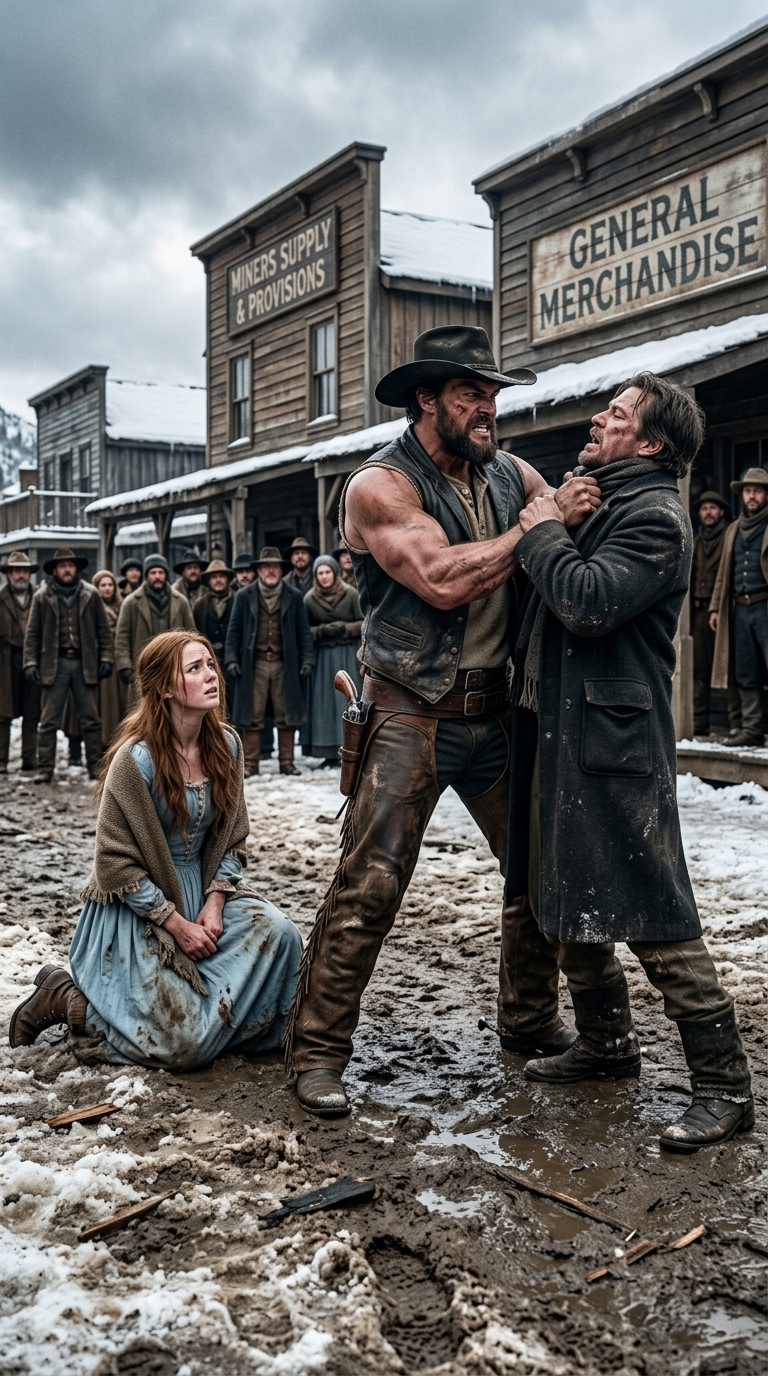
Catalina Villaseñor fell face-first into the cold mud of the square, and no one in San Miguel de la Sierra lifted a finger to help her.
The November wind swept down from the Durango mountains with a knife’s edge. The skirt of her wool dress was soaked, her wrists burned from the ropes, and a stone had split open her cheek. Around her, the merchants, the mule drivers, the women leaving mass, and even the schoolchildren looked the other way, as if suddenly the adobe walls, the horseshoes nailed to the doorways, or the dust on the road were far more important than a woman tied up in the middle of the town.
Catalina, the only daughter of Don Esteban Villaseñor, owner of the Santa Lucía ranch, had known these people since she was a child. Don Matías the shopkeeper had received corn on credit from her father during years of drought. Teacher Jacinta had taught her to read with a yellowish primer. Commissioner Robledo had eaten at their table more than once. Yet that morning, they all lowered their gaze.
Because when Don Teodoro Ledesma, the town’s political chief, decided to take something from someone, all of San Miguel learned to go blind.
“Get her up,” Don Teodoro ordered, adjusting his black coat.
One of his men yanked the rope until Catalina was forced to her knees. She clenched her teeth to keep from screaming. In front of her, Evaristo Ledesma, the political chief’s son, smiled with the arrogance of someone who had never received a “no” without exacting revenge.
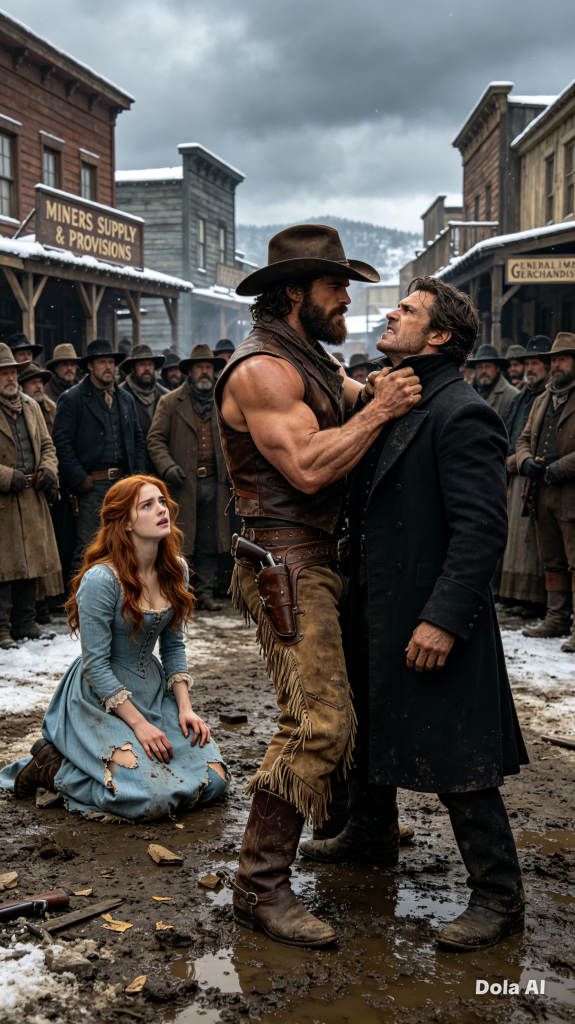
“Sign and it’s all over,” Evaristo said, showing her a folded paper. “No one wants to see you suffer, Catalina.”
“You do,” she replied, her voice broken but firm.
Don Teodoro sighed as if she were a spoiled child.
“Your father left debts. The bank in the capital transferred the promissory notes to us. The lands by the stream, the northern pastures, and the water passage now belong to my company. All that’s missing is your signature to avoid scandals.”
Catalina spat mud to the side and lifted her face.
“My father paid those loans. I have the receipts in his iron box. You stole the bank records.”
A murmur ran through the square. It lasted barely a second. Then silence returned.
Evaristo leaned in until he was close to her face.
“A woman alone does not accuse a Ledesma and continue living peacefully.”
Catalina held his gaze.
“Then I will live without peace. But I will not sign.”
The blow did not come with a hand, but with a silent order. Evaristo looked at the man holding the rope, and he shoved Catalina back to the ground. The entire square heard the impact of her body hitting the mud.
Don Teodoro spoke with cruel calm.
“This could have been resolved in an office.”
Catalina tried to get up. Her hands were tied behind her back, her fingers numb, her hair stuck to her face. She used her shoulder, her elbow, her knee—any part of her body that still obeyed her. She did not rise gracefully. She did not rise quickly. But she rose.
And then something changed.
The silence in the square became different. Catalina felt it before she saw it. Evaristo stopped smiling. Don Teodoro narrowed his eyes. The armed men turned their heads toward the entrance of the town.
A rider was stopped beside the doorway of the blacksmith’s shop.
He was tall, broad-shouldered, wearing a dark hat, an unkempt beard, and a gray sarape over a worn jacket. He was dressed neither like a landowner nor like a soldier. His horse, a large and calm sorrel, stood still as if it understood that the moment did not allow for whinnies or nerves.
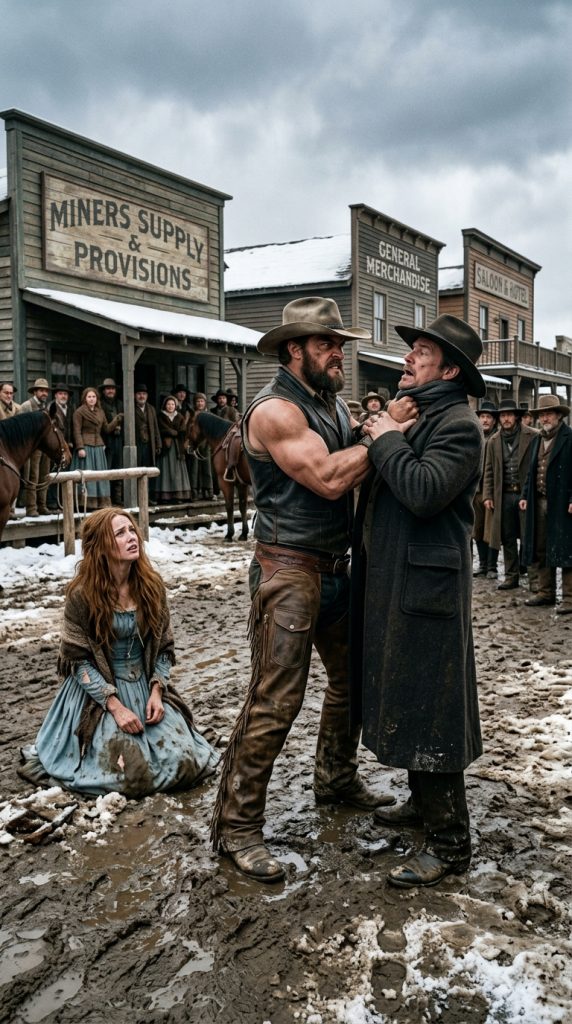
The man was looking at Catalina.
Not at the papers. Not at the rifles. Not at the Ledesmas.
At her.
And in that gaze, Catalina found something she had not received from anyone since her father’s death: recognition. He was seeing her as a person, not as a debt, not as an obstacle, not as property.
“Continue on your way, stranger,” Evaristo said. “This matter does not concern you.”
The man dismounted without haste.
“If you tie up a woman and throw her into the mud in the middle of a square, the matter is no longer private.”
His voice was low, but it reached the doorways.
Don Teodoro examined him.
“Who are you?”
“Julián Arriaga.”
The name produced no reaction in most, but Commissioner Robledo turned slightly pale.
Evaristo clicked his tongue.
“I don’t know any Julián Arriaga.”
“That doesn’t take away my name.”
The man advanced toward Catalina. One of the guards blocked his path.
“Not one step further.”
Julián looked at him.
“Cut the rope.”
The guard let out a laugh.
“And if I don’t want to?”
No one could explain afterward how it happened. They only saw a dry, precise movement, without show. The guard ended up on his knees, his arm twisted and his knife in Julián’s hand. There was no shot. There was no scream. Only the sound of a body falling into the mud.
Julián reached Catalina and cut the ropes.
Blood returned to her fingers like fire. She pressed her hands against her chest and breathed deeply.
“Thank you,” she whispered.
“Not yet,” he said. “We still have to get you out of here.”
Don Teodoro raised his voice.
“You have assaulted an agent of the authority.”
Julián placed the knife on the scribe’s table, in plain view of everyone.
“And you have carried out a collection with ropes. We’re even in oddities.”
Someone in the square let out a nervous laugh and immediately swallowed it.
Catalina took a step forward.
“I need to return to the ranch. The receipts are in my father’s iron box.”
“You won’t go by the main road,” Julián said. “They’ll already have men waiting for you.”
She looked at him in surprise.
“How do you know that?”
“Because I came with two horses.”
Indeed, beside the doorway, behind the sorrel, there was a saddled chestnut mare.
Evaristo took a step toward them.
“Catalina is not going anywhere.”
For the first time, Julián placed his hand near his revolver.
“I would prefer not to discuss it.”
He did not say it as a threat, but as an honest warning. And perhaps for that reason, Ledesma’s men did not move.
Catalina mounted the mare with difficulty. Everything hurt, but she did not allow anyone to help her. Julián mounted his horse and took an alley behind the church. Fine snow began to fall as they left the town toward the high pastures.
They had not gone even half a league when they heard hooves behind them.
“Three,” Julián said without looking back.
Catalina tightened the reins.
“Evaristo will not give up.”
“Then we’ll head up into the sierra.”
She looked at the pine-covered mountains. The northern trail was dangerous even in summer. In November it could be a death sentence.
“Is there another option?”
“Yes. To surrender.”
Catalina did not hesitate.
“Let’s go up.”
They rode between increasingly dense pines when Julián told her that an old mule driver named Máximo had come looking for him two days earlier at his cabin. He told him that the Ledesmas were preparing a “collection” against the Villaseñor heiress and that no one in the town would dare intervene.
“And why did you come?” Catalina asked.
Julián took time to answer.
“Because six years ago no one intervened for my brother.”
His brother Tomás Arriaga had owned a small plot south of the valley. One night, supposed bandits attacked his house, killed Tomás and his wife, burned the shack, and took the cattle. His baby daughter survived because her mother hid her in a root cellar. The authorities blamed an unnamed gang and closed the case.
“But they weren’t bandits,” Catalina said.
Julián looked at her.
“How do you know?”
She took from an inner pocket a folded paper that not even Ledesma’s men had found.
“Because my father knew it too.”
They reached a cabin hidden among the pines as evening fell. Julián lit the iron stove, closed the shutters, and placed paper, ink, and pens on the table. Catalina unfolded the document.
It was a letter written by Don Esteban before he died. It spoke of a railroad project that would cross the San Miguel valley. It mentioned lands bought by the Ledesma company through false debts, threats, and attacks disguised as robberies. In a list appeared six properties. The second carried the name of Tomás Arriaga.
Julián read in silence. When he finished, his eyes were dry, but his face seemed to have aged ten years.
“My brother died for land he didn’t even know was worth so much.”
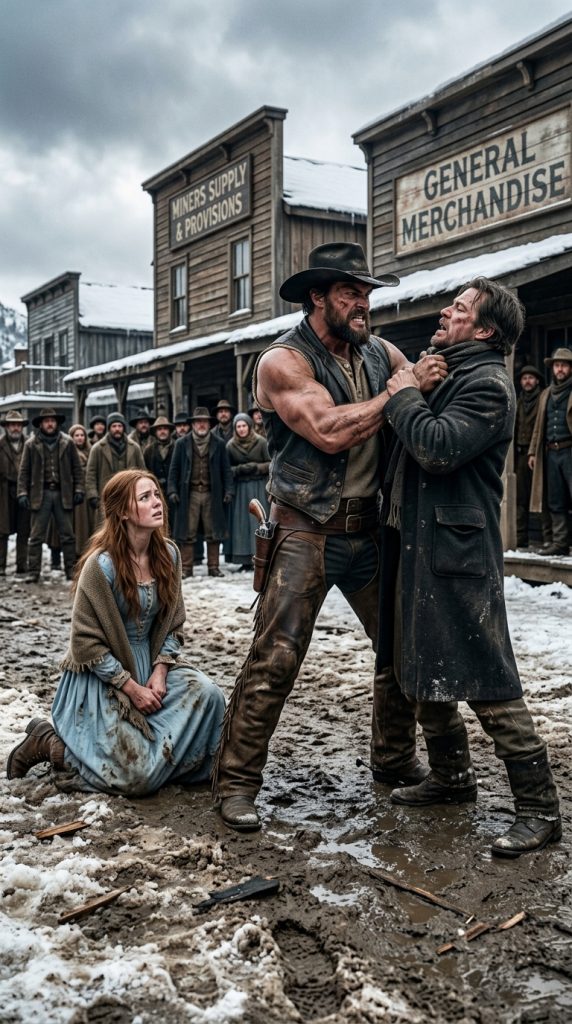
“My father died for discovering it,” Catalina said. “They found him in a ravine with three bullet wounds and said it was a fall from a horse.”
The wind beat against the cabin. The snow erased the world outside.
“I have the loan receipts at the ranch,” she continued. “And books with dates, names, and payments. If we manage to get this to a federal judge in Durango, Ledesma won’t be able to buy it the way he buys the commissioner.”
Julián sat down in front of her.
“Then we’ll make copies.”
They worked all night. Catalina wrote until her fingers trembled. Julián copied names, dates, and testimonies. She reconstructed her father’s accounts; he dictated every detail he remembered of his brother’s murder. By dawn they had two packages of documents wrapped in oilcloth.
“One must reach the ranch,” Catalina said. “The iron box is there.”
“And the other to Máximo’s mail service,” Julián added. “He can take it to Durango by the mule drivers’ route.”
They decided to descend by a hidden trail. In the stable of the Santa Lucía ranch they found Mateo, a fifteen-year-old boy who had worked for the Villaseñors since childhood. When he saw Catalina alive, he almost cried.
“Miss, they said you had been kidnapped.”
“They’ll say that louder tomorrow. Listen to me carefully.”
She handed him one of the packages.
“Take this to Máximo without going through the town. Tell him it’s going to the federal courthouse in Durango. And if anyone stops you, swallow the small paper with the names, understood?”
Mateo swallowed hard but nodded.
“Your father taught me to ride. I won’t fail him.”
The boy left along the stream.
Catalina and Julián recovered the iron box. Inside were the original receipts, bank letters, and a map of the railroad route. There was also her father’s handkerchief. Catalina pressed it against her face for a moment.
“He did not die in vain,” Julián said.
“We still don’t know that.”
They found out as they left.
Ten men surrounded the ranch. Leading them was a rural captain hired by Ledesma, with orders to arrest Julián for kidnapping and Catalina for fraud. Evaristo was with them.
“The ride is over,” he shouted. “Hand over the papers.”
Julián slowly raised his hands, but Catalina stepped forward with the box against her chest.
“Captain, before obeying a bought order, read this.”
The captain mocked her.
“I don’t read little ladies’ stories.”
Then another voice was heard from the road.
“But I do.”
A carriage arrived escorted by four federal soldiers. From it stepped Licenciado Ramiro Beltrán, a judge sent from Durango. Beside him came Máximo, covered in dust, hat in hand. Mateo had succeeded.
The judge opened the package in front of everyone. He read the receipts. He examined the map. He compared signatures. With every minute that passed, Evaristo’s face lost color.
“Arrest that man,” the judge ordered, pointing at him. “And the political chief Teodoro Ledesma as soon as he sets foot in the town.”
Evaristo tried to draw his pistol, but Julián was faster. He did not shoot. He only struck his wrist with the barrel and the weapon fell to the ground.
“It’s not worth dying for a thief,” he told him.
The trial lasted months. For the first time, San Miguel de la Sierra spoke. Don Matías testified about false promissory notes. Teacher Jacinta delivered hidden letters. Commissioner Robledo confessed out of fear. The names of the dead were spoken aloud again.
Don Teodoro Ledesma lost his stolen lands, his position, and his freedom. Evaristo was sent to prison. The dispossessed families recovered what remained of their plots. The railroad line was built years later, but no longer over corpses or lies.
Catalina kept Santa Lucía. She opened a school for the children of the peons and hired the widows of the murdered men to manage the dairy and the looms on the ranch. Julián returned at first to his cabin, but he soon began coming down every week with any excuse: to repair a fence, check a horse, accompany Catalina to the courthouse.
A year later, under the ash trees in the courtyard, Catalina told him:
“You appeared when the whole town was looking at the ground.”
Julián smiled faintly.
“You stood up before I did anything.”
“I stood up because someone finally looked at me as if I still had value.”
He took her hand.
“You had value before I arrived. I only came to remind you of it.”
They were married at the end of the harvest. The orphaned daughter of Tomás Arriaga, Julián’s niece, grew up at Santa Lucía as their own daughter. Every November, Catalina walked to the square of San Miguel and left a flower beside the post where they had forced her to kneel.
She did not do it out of pain.
She did it to remember the day when fear began to break.
Because an entire town can get used to looking the other way. But sometimes it only takes one person looking straight ahead for everyone to remember that they still have a soul.
