

The stagecoach coming from Guadalajara arrived in Santa Lucía del Mezquite as the sun slanted across the clay rooftops. The dust from the road rose like a golden curtain around the horses, and the townspeople, used to watching every new arrival, stopped in the square to see who would step down.
First came an old trunk, tied tightly with a rope.
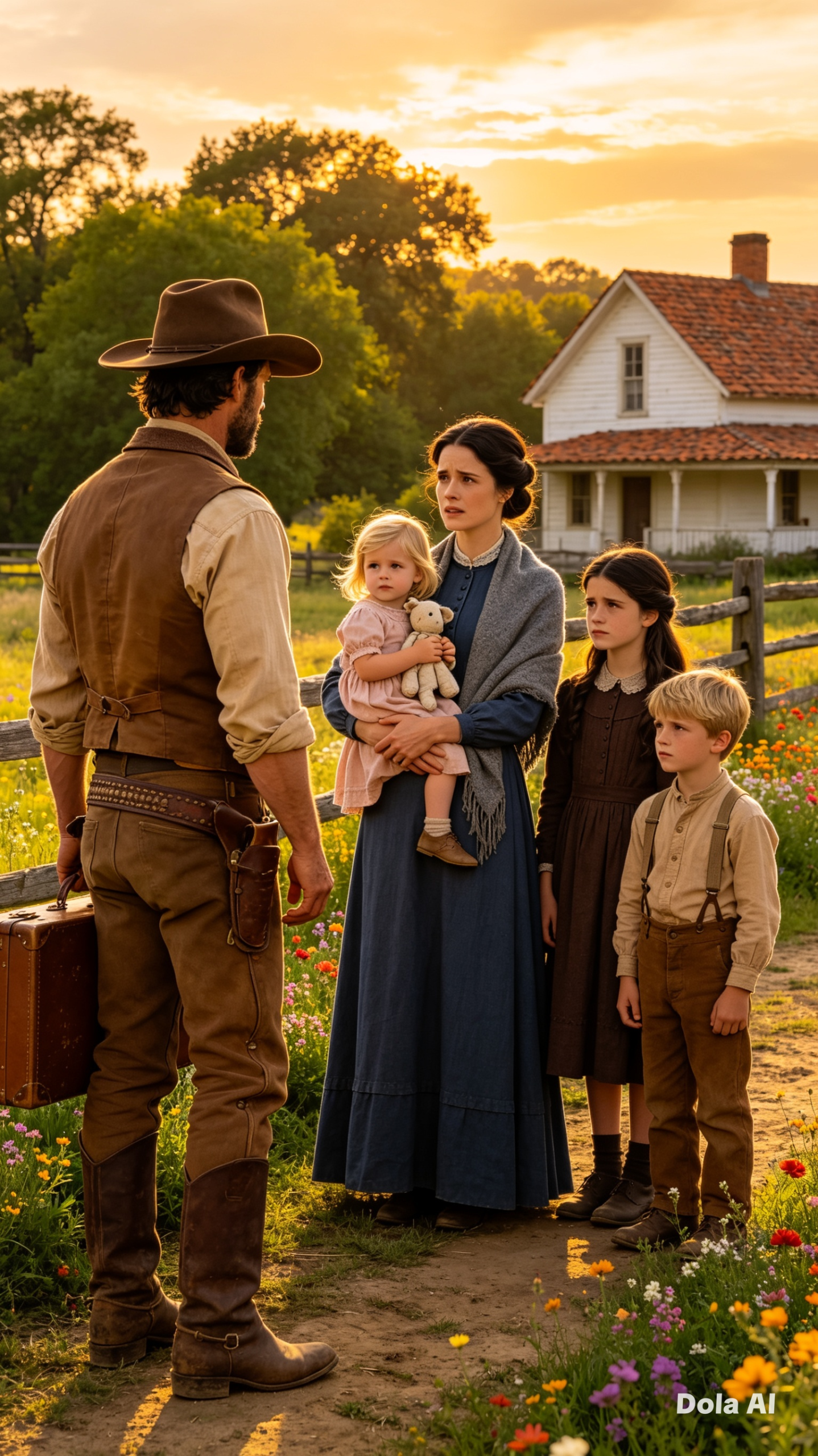
Then a young woman, no more than 29 years old, carefully stepped down, carrying a little girl on her hip. Behind her came a seven-year-old boy and a ten-year-old girl, both holding onto her skirt as if the world might take their mother away from them at any moment.
The woman’s name was Mariana Salcedo. She was a widow. Her children were Inés, the oldest; Mateo, the restless one; and Lupita, the youngest, who held a rag doll with a single button eye tightly against her chest.
Across the square, beside the horses’ watering trough, a tall man with sun-darkened skin waited. He wore a fine cotton jacket, leather boots, and a wide-brimmed hat. He was Julián Aranda, the owner of a ranch an hour away from town, the man with whom Mariana had exchanged letters for months.
Mariana had read those letters so many times during the journey that the folds of the paper had become as soft as fabric. But a letter was one thing; a real man standing beneath the sun was something entirely different.
And before Julián could politely greet her, before he could offer a courteous smile and later regret it, Mariana said what she had been rehearsing since the first stop on the journey.
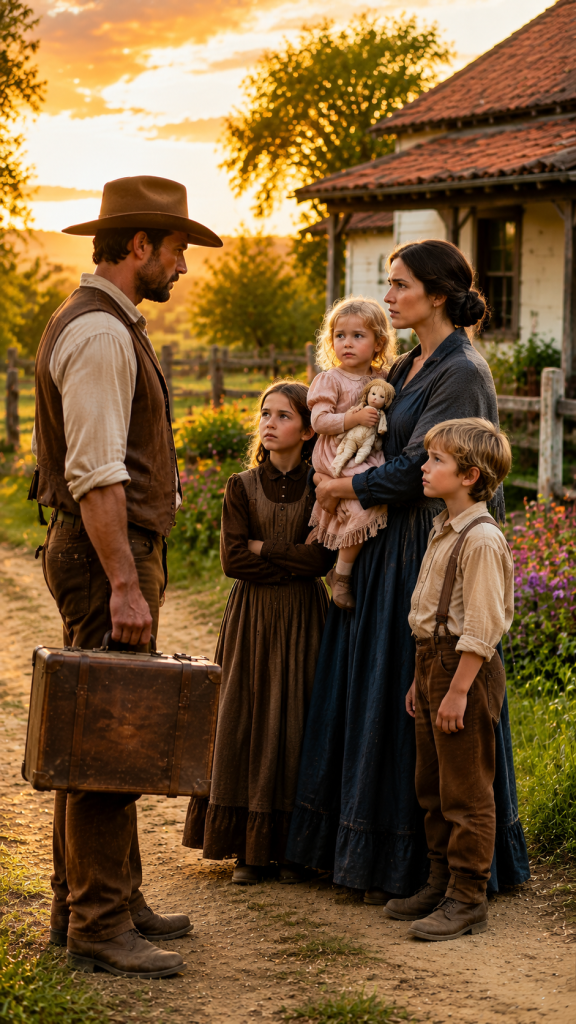
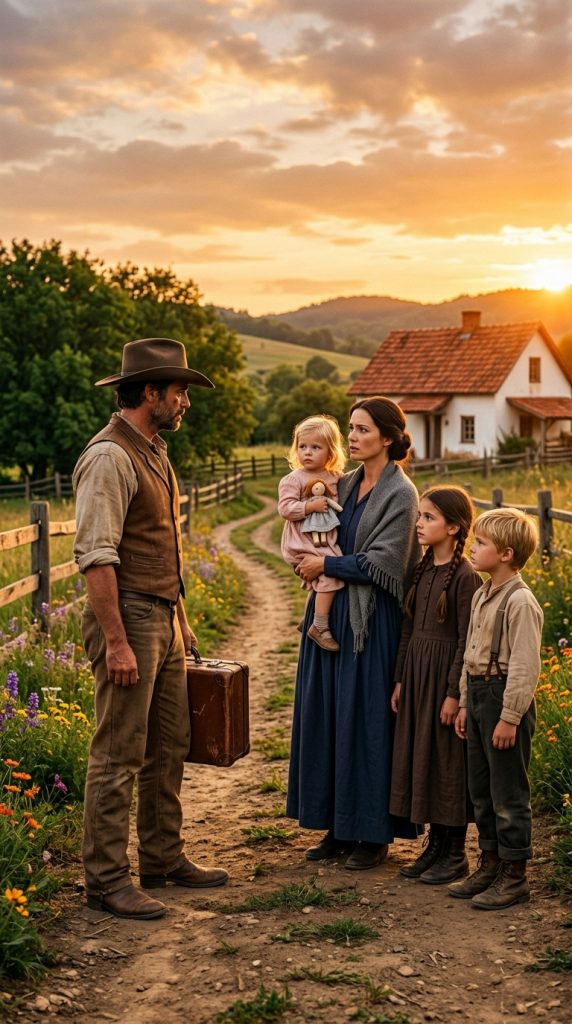
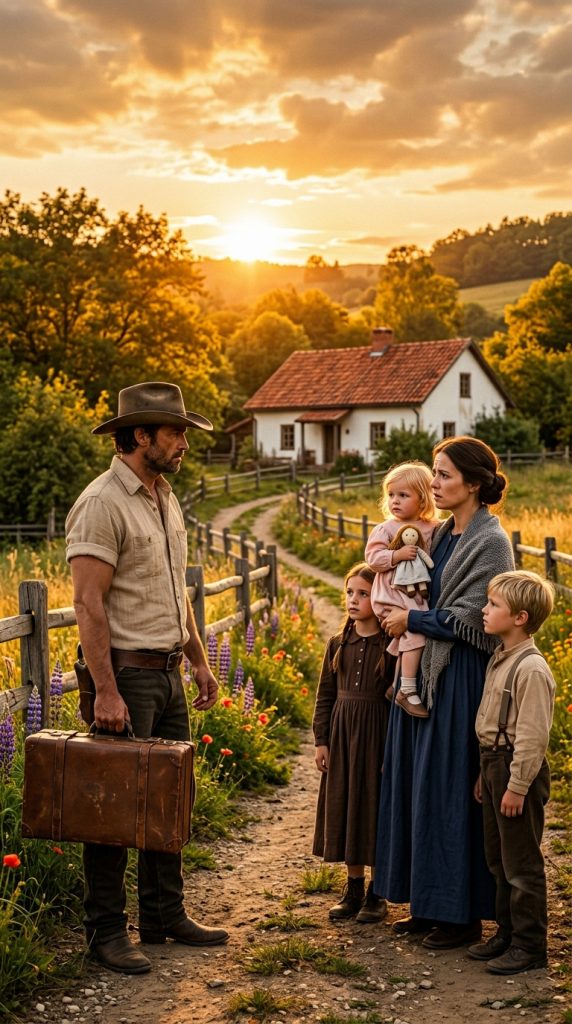
“Don Julián, no man wants a wife with three children. If you’ve changed your mind, tell me now. I won’t blame you. I came all this way so you could tell me to my face.”
The town seemed to stop breathing.
Inés gripped her mother’s skirt even tighter.
Mateo lowered his eyes.
Lupita, not understanding what was happening, hid her face against Mariana’s shoulder.
Julián didn’t answer immediately.
He looked at Mariana, then at the little girl holding her broken doll, at the thin boy trying to appear brave, and at the serious young girl watching everything as if she expected the pain before it even arrived.
Then he smiled.
Not with mockery.
Not with pity.
But with such peaceful happiness that Mariana didn’t know how to defend herself against it.
“Doña Mariana,” he said, “I’ve always wanted a big family. I just never imagined God would be kind enough to give me the whole thing all at once.”
Mariana stood frozen.
Those words were too wonderful to believe.
And over the past two years, Mariana had learned that a man’s kindness could disappear very quickly when there were mouths to feed, shoes to repair, and children crying in the middle of the night.
She had been married to Tomás Salcedo, a good man who worked at a mill in Puebla. They were never rich, but their home was warm, there was always enough bread, and Sundays were filled with laughter.
Then a fever came during the winter.
It entered the streets like a shadow and took away the elderly, the children, and strong men alike.
It took Tomás in nine days.
Mariana watched him fade away beneath damp sheets, whispered prayers, and useless remedies until his hand finally stopped holding hers.
Then came the worst part: not the grief itself, but life after grief.
The money slowly disappeared.
Mariana sewed clothes for others, washed sheets, and prepared sweets to sell in the town square.
She did everything a respectable woman could do, and still it wasn’t enough.
What hurt her the most was not the exhaustion.
It was the way people looked at her.
Landlords looked at her children as if they were debts.
The few men who approached her looked at her face first, and then counted the children.
One of them had been sitting at her table one afternoon when his expression changed after Mateo spilled a cup of atole.
At that moment, Mariana understood what the world thought of her.
A young widow could still be a hope.
A widow with three children was a burden.
That was why, when she saw Julián Aranda’s advertisement on a piece of paper brought by a muleteer, she almost didn’t respond.
He was looking for a wife for his ranch, the announcement said. He had land, a house, and loneliness.
Mariana wrote him the truth from the second line:
“I am a widow. I have three children. I will not come without them. I will not pretend they are less of a burden than people think they are.”
She expected silence.
Instead, a letter arrived.
Julián never spoke about the children as a problem.
He spoke about the land, the agave fields, the rains, and a large house that had become far too quiet.
At the end, he wrote:
“A house with children is the only kind of home I have ever wanted. Don’t think you are bringing me problems. You are bringing me exactly what I am missing.”
Mariana didn’t believe him.
But she had no savings left and nowhere else to go.
So she sold what little she had remaining, packed everything into a trunk, and boarded the stagecoach with her children.
Julián’s ranch was larger than she had imagined.
It had wide hallways, a smoke-filled kitchen, a courtyard full of bougainvillea, and several empty rooms.
When she saw it, Mariana didn’t think, “This is where we can live.”
She thought, “There is enough space here so my children won’t bother anyone.”
During the first few weeks, that became her plan: to make herself smaller.
She silenced Mateo whenever he laughed too loudly.
She kept Lupita close to the kitchen so she wouldn’t run through the hallways.
She asked Inés to help with chores until the girl seemed much older than she really was.
Mariana wanted to prove that she hadn’t brought a burden too heavy for anyone to carry.
Julián noticed quickly.
He noticed that Mateo became stiff whenever he entered the room, as if he expected to be scolded.
He noticed that Mariana would take Lupita out of the sitting room the moment he sat down.
He noticed that Inés looked at him the way someone looks at an unfamiliar dog: without trust, but never taking her eyes off him.
One morning, Mateo disappeared.
Mariana searched for him with her heart in her throat and found him beside the corral, sitting on a fence.
Julián was beside him, teaching him how to slowly place his hand near the muzzle of an old mare so the animal could smell him before allowing itself to be touched.
“Mateo, don’t bother Don Julián,” Mariana said quickly.
Julián turned his head.
“A boy who wants to learn about horses isn’t a bother, Doña Mariana. He keeps me company. Let him.”
Mateo smiled for the first time since they arrived.
Then it was Lupita who crossed the line Mariana had drawn.
One afternoon, her rag doll, the one she called Botoncita, lost an arm because of an old loose seam.
Lupita cried as if the whole world had broken.
Mariana ran down from Inés’s room, but she stopped on the final step.
Julián was sitting at the kitchen table with the doll in one hand, a needle in the other, and dark thread between his clumsy fingers.
His stitches were large and uneven, the work of a man who had never sewn anything delicate before.
But he worked slowly and carefully.
Meanwhile, Lupita, her tears already gone, rested her head against his knee and watched him as if that man could repair anything in the world.
Mariana wanted to say thank you, but no words came out.
Inés was the hardest one.
She was ten years old and already knew too much.
She had seen her father die.
She had seen her mother hide her tears.
She had seen the faces of men who counted her siblings as if they were sacks of corn.
Inés was never rude to Julián.
She was polite, obedient, and cold.
She gave him nothing.
Julián never pressured her. He didn’t buy her gifts. He didn’t try to win her over with promises. He simply remained the same man every single day.
The man who patiently taught Mateo.
The man who repaired dolls with terrible stitches.
The man who never raised his voice when a cup broke.
For a girl who expected the ground to collapse beneath her feet, there was no greater gift than proving, day after day, that the ground was still solid.
But Mariana still wouldn’t allow herself to believe.
Then Lupita became ill.
At first, it was just a flush on her cheeks. Then came the constant complaints, followed by the terrible heat of a fever that made her little body tremble.
On the third day, Mariana felt the same fear she had felt beside Tomás’s bed.
The same smell of damp cloths.
The same helplessness.
The same certainty that death could enter without asking permission.
Julián appeared at the bedroom door and didn’t waste time asking unnecessary questions. He looked at the child, looked at Mariana’s pale face, and picked up his hat.
“I’m going for Doctor Luján. The mare knows the way. I’ll be back before sunrise.”
Mariana wanted to tell him there was no need, that he shouldn’t spend money on a doctor, that she could handle it herself.
But Julián was already crossing the courtyard toward the stables.
A bitter voice inside her whispered:
“Now he’ll see what a made family costs. A sick child, a medicine bill, sleepless nights. Now he’ll start counting.”
But Julián never counted.
He crossed the darkness, reached the town, woke the doctor, and returned when the sky was only beginning to brighten.
Doctor Luján examined Lupita, prepared herbal remedies, and said the fever was severe, but it could be broken if they cared for her properly.
Julián did not go to sleep.
He stayed.
That night, and the night after, he took turns with Mariana. He soaked cloths, kept the lamp burning, and carried Lupita when the little girl became delirious, asking to see the stars.
Mateo slept on the floor in short moments.
Inés remained in a corner, awake, watching everything.
On the second night, when Lupita finally began breathing more peacefully, Mariana looked at Julián from across the bed.
They were both exhausted.
“Why do you do this?” she whispered. “She isn’t yours. None of them are. You could marry a woman without children, without problems, without a past.”
Julián lowered his eyes toward Lupita.
“When I was a child, I had six brothers and sisters,” he said. “My parents’ house was never quiet. There were always arguments, laughter, crying, someone running around, someone asking for more tortillas. I thought that noise would stay with me for the rest of my life.”
He paused.
The candle flame trembled.
“Then a fever like this came. It took two of my siblings in one week. Later, the others grew up and left. My parents passed away. I built this ranch thinking that one day it would be full again. But when I finished the house, there was no one left. I had land, cattle, and strong walls. And a loneliness louder than any storm.”
Mariana listened without moving.
“You think you brought me a burden,” Julián continued. “You don’t understand. You brought me the one thing my money could never buy. You brought me voices, footsteps, questions, extra plates on the table. You brought me life.”
Mariana felt something inside her break.
But not like something being destroyed.
Like an old door finally opening.
On the third morning, the fever finally broke.
Lupita woke up sweaty, pale, and hungry.
The first thing she asked for was Botoncita.
When Mariana placed the doll in her arms, the little girl smiled, and everyone knew death had passed them by.
Inés was the one who spoke the first truth.
That morning, she found Julián sitting in the kitchen, his eyes red from exhaustion.
She stood in front of him, completely serious.
“Thank you for bringing the doctor for Lupita.”
Julián nodded.
Inés swallowed and added:
“My father would have done that.”
Then she ran away, embarrassed for having said too much.
Julián remained still.
He understood that the girl had not simply given him thanks.
She had given him a place.
A week later, while the children slept, Mariana came downstairs to the kitchen.
Julián was repairing a bridle beneath the light of the candle.
She sat across from him.
“Since the day I stepped off that stagecoach, I’ve been waiting for you to regret it,” she said. “I’ve kept my children quiet because I thought that if they bothered you less, maybe you would take longer to send us away. In Puebla, I learned that a woman with three children is too much. A burden that a kind man can carry for a while, but not for a lifetime.”
Julián placed the bridle on the table.
“Mariana,” he said, and it was the first time he had called her by her name, “this house was built to have noise. Not for you to hide your children in the corners.”
She lowered her head.
For the first time in two years, she cried without apologizing.
She didn’t cry for Tomás.
She didn’t cry for hunger.
She didn’t cry from fear.
She cried from the relief of letting go of a stone she had carried for so long that she had begun to believe it was part of her own body.
Julián didn’t touch her right away.
He waited.
When she calmed down, he spoke in a steady voice.
“We will marry when you want. Not one day sooner. But I would be grateful if you stopped silencing those children because of me. If Mateo wants to run, let him run. If Lupita wants to sing, let her sing. If Inés wants to look at me with suspicion for another year, let her. I have patience. What I don’t want is a silent house.”
Mariana laughed through her tears.
A broken, wet, genuine laugh.
“Then you’ll have noise, Don Julián,” she said. “A lot of noise.”
They married in the autumn, in the small church of Santa Lucía del Mezquite, with the three children standing at the front.
The priest smiled and joked that it was the first wedding where the bride arrived with her own line of family already waiting.
Over time, Mateo learned to ride the old mare and then younger horses. Julián told people in town that the boy had a natural touch with animals, and Mateo stood taller with pride whenever he heard it.
Lupita grew up following Julián everywhere, always carrying Botoncita under her arm.
She never allowed anyone to fix the ugly stitches on the doll’s arm.
When Mariana offered to repair it properly, Lupita shook her head firmly.
“No, Mama. This way I know she’s mine.”
Inés took the longest.
Trust, when it is born from fear, grows slowly.
But one day, almost a year later, a gate at the corral came loose, and she called from the yard:
“Dad, the latch fell again.”
She said it without ceremony, as if she had always said it.
Julián stood with his back turned, staring at the gate, and it took him a moment to answer because his eyes had filled with tears.
The ranch was never silent again.
There were footsteps in the hallways, laughter in the kitchen, arguments over tortillas, stains on the tablecloths, off-key singing, and far too many voices at dinner.
Sometimes, in the middle of all that chaos, Julián would stop and listen with the expression of a man hearing music.
Mariana would look at him and remember the dusty square of Santa Lucía, the stagecoach, her old trunk, her three children clinging to her skirt, and the words she had spoken to protect herself before anyone could hurt her:
“No man wants a wife with three children.”
Then she would look at Julián sitting at the table, with Lupita on his lap, Mateo talking about horses, and Inés pouring him coffee like a daughter would for a father.
And she understood that he had told her the truth from the very first day.
He had always wanted a big family.
He just never imagined he would be blessed enough to receive the whole family all at once.
