

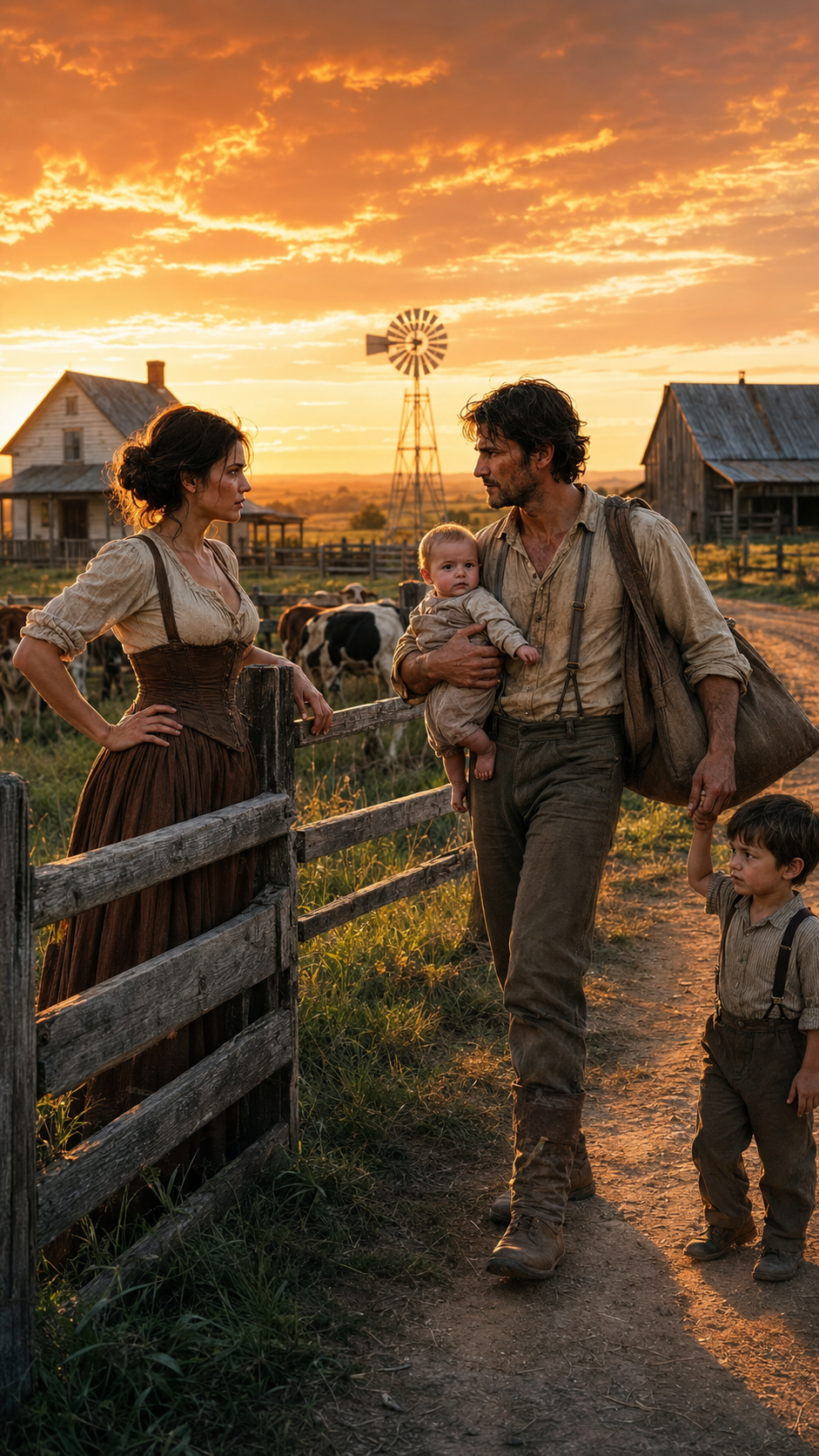
“You need milk for your children… and I need a husband.”
Those were the first words Teresa Ibarra said to Mateo Salcedo on the afternoon he arrived at the El Milagro de la Sierra ranch with a baby crying from hunger in his arms, a six-year-old boy holding his hand, and the look of a man who had been walking for several days without knowing if he still had a destination left.
Mateo did not respond.
Not because he hadn’t heard, but because those words sounded too big for someone who could barely stand on his own two feet.
He was 37 years old, though grief made him look older. His wife, Elena, had died five months earlier from a poorly treated fever in a town where the doctor always arrived late and death, on the other hand, always arrived on time. Since then, Mateo had tried to keep working at the San Jacinto ranch, but one early morning he fell asleep next to the corral with the baby in his arms and left a gate open. Eight head of cattle escaped. The next day, the boss put a few coins in his hand.
“I’m sorry, Mateo. But a ranch isn’t built on sadness.”
So Mateo took his children and began looking for work.
The boy was named Julián. He had learned to stay quiet far too soon. The baby was named Clara, after Elena’s mother, and she cried with that small desperation that breaks hearts more than any adult scream.
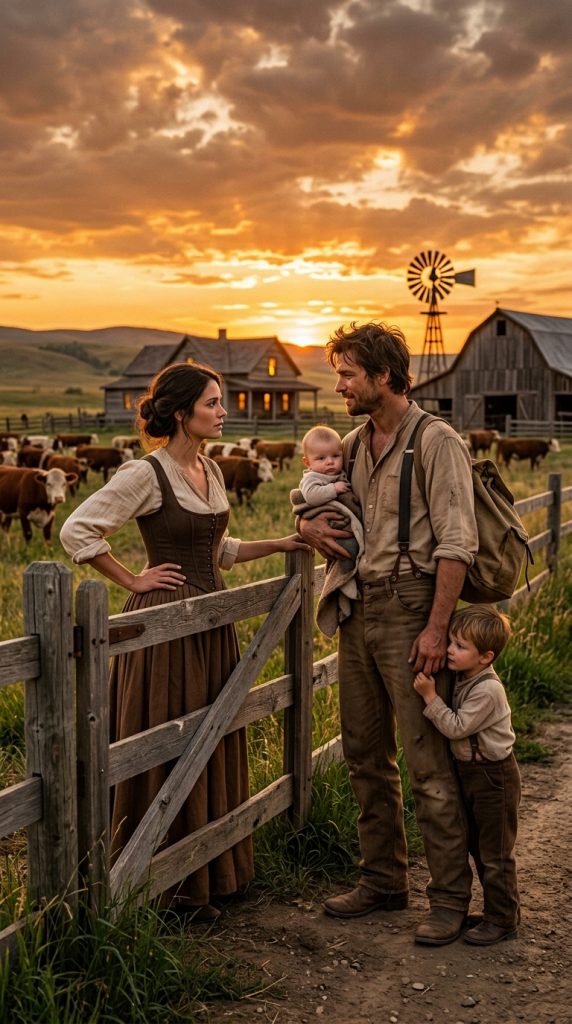
When they arrived at El Milagro de la Sierra, the sun was setting over the hills of Jalisco and the Holstein cows were lined up waiting to be milked. Teresa was leaning against the corral fence, wearing a dark skirt, a white blouse rolled up to her elbows, and her black hair pulled back in a severe bun. She was 43 years old, a widow, and everyone in the municipality knew she had been running her ranch alone since her husband, Anselmo, died after falling from a horse.
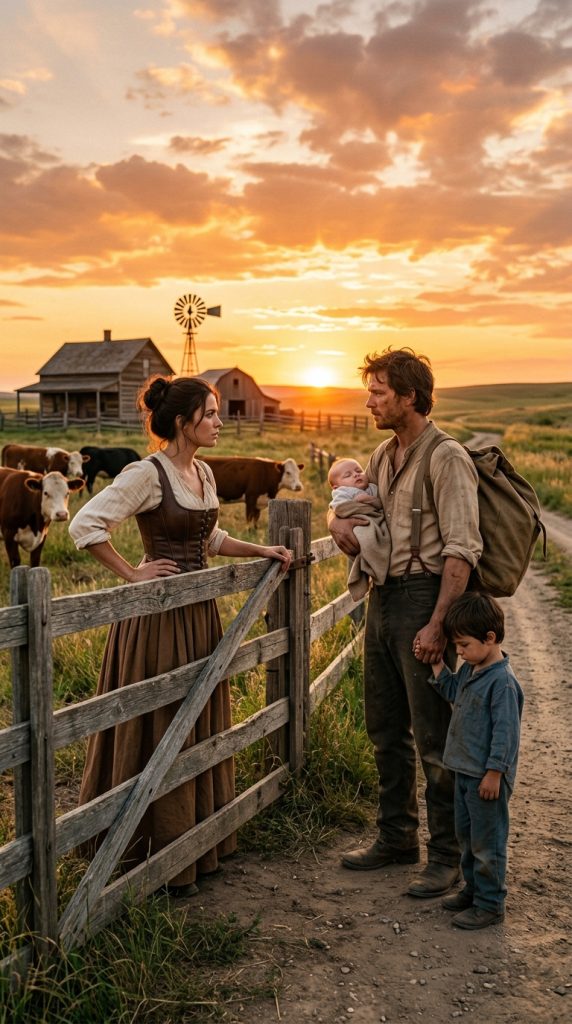
Mateo took off his hat.
“Good afternoon. I was told you might have work here.”
Teresa looked first at the baby, then at the boy, then at the torn sack Mateo was carrying on his back.
“Do you know how to milk cows?”
“Yes, ma’am.”
“Do you know how to treat ticks?”
“Yes.”
“Do you know how to build fences?”
“Since I was a boy.”
“When did this baby last eat?”
Mateo clenched his jaw.
“I gave her a piece of bread a while ago.”
Teresa showed no sign of pity. Pity humiliates when it comes before help. She simply opened the corral gate and said the words that changed his life.
“You need milk for your children… and I need a husband. Come in and eat. We’ll talk about the rest later.”
The ranch kitchen smelled of beans, warm milk, and freshly made tortillas. Teresa placed a small jar in Mateo’s hands.
“Give it to her slowly. If she drinks too fast, she’ll choke.”
Clara drank with silent eagerness. Julián sat in front of a plate of beans with fresh cheese and looked at his father, waiting for permission.
“Eat, son,” Mateo said.
The boy ate without spilling a single crumb.
Teresa prepared another plate for Mateo. He wanted to say he was fine, but she looked at him in a way that did not allow lies.
“Here, the men who work eat.”
During dinner, Mateo told her only what was necessary: Elena’s death, being fired, the three ranches that had rejected him because no one wanted to hire a widower with two children. Teresa listened without interrupting.
Then she said:
“My husband died three years ago. We never had children. Not because we didn’t want them.”
The silence that followed was not awkward. It was the silence of two wounds recognizing each other without touching.
That night, Teresa gave him the old foreman’s room. In one corner there was a wooden cradle covered with a clean blanket. Mateo understood that the cradle had been waiting for a child who never came.
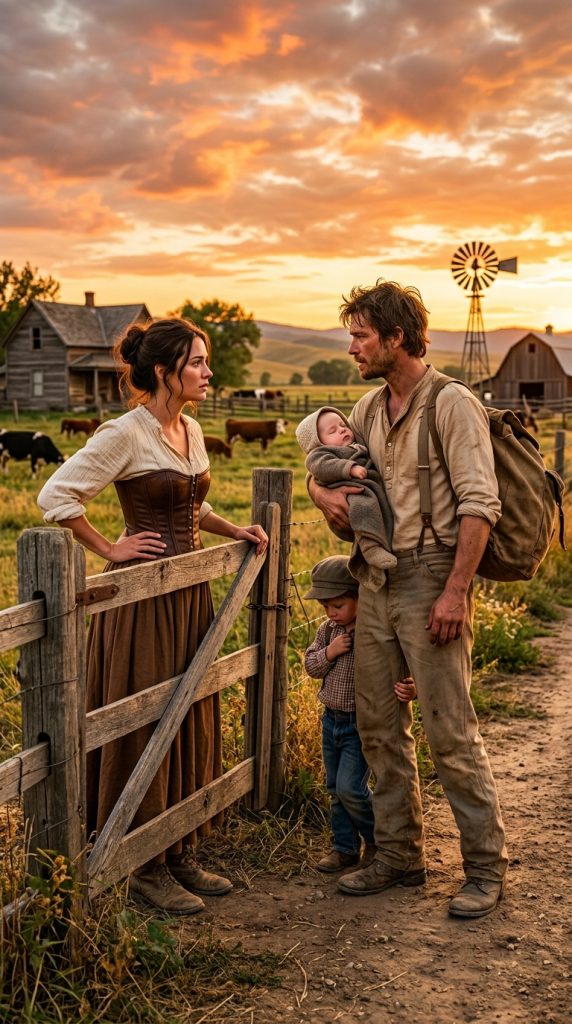
The first days were filled with work and caution. Mateo rose before dawn, milked the cows, checked fences, cleaned the stables, and fixed anything he saw broken without Teresa having to ask. Teresa gave few orders, but she observed everything. If he did something wrong, she corrected him. If he did it well, she didn’t praise him too much, but the next day she entrusted him with something more important.
This was how a plain, unadorned trust was born between them.
Julián was the first to find his place. One morning, while Teresa was peeling chilies in the kitchen, the boy sat down in front of her and asked:
“Why don’t you have children?”
Teresa didn’t stop working.
“Because God didn’t send me any.”
“And you still wanted them?”
Teresa’s hand paused.
“You never stop wanting what you once wanted. You just learn to carry it in a different way.”
Julián thought for a moment, then picked up a chili.
“Can I help?”
Teresa taught him how to remove the seeds without rubbing his eyes.
Clara was more difficult. Not because the baby rejected Teresa, but because she trusted her too quickly. Every time Teresa picked her up, Clara would rest her head on her chest as if she had found a safe place there. One afternoon, Mateo saw Teresa standing motionless under the corridor with the sleeping baby in her arms and her eyes glistening. He said nothing. He simply took Clara carefully and carried her to the cradle.
In the second week, the problem arrived.
His name was Hilario Mondragón, owner of the neighboring Los Laureles ranch, a 50-year-old man with a thin smile and the habit of speaking as if everything belonged to him.
“Teresa,” he greeted from his horse. “I came to see how a woman alone is managing with so much land.”
“I’m not alone,” she replied.
Hilario saw Mateo by the stable.
“New peon?”
“New foreman,” Teresa said.
Hilario smiled without joy. Then he spoke about the stream on the southern boundary. He said his cattle needed water and that Anselmo, while alive, had allowed him to use it.
“Anselmo is no longer here,” Teresa answered. “And the stream is on my land.”
“We’ll talk about it.”
When Hilario left, Mateo approached.
“Does he come often?”
“Ever since my husband died. Before, he came to deal with him. Now he comes to see if he can deal with a woman alone.”
Mateo looked at the dust left by the horse.
“That’s over.”
Teresa then looked at him differently, as if she had just heard something she had needed for years.
The branding fiesta arrived in November. Neighbors, cowboys, families from the town, and the priest came to bless the cattle. Hilario Mondragón also came with his two older sons. Everyone was looking at Mateo. Everyone knew the widower was living on the widow’s ranch.
During the meal, Hilario approached with a cup in his hand.
“The ranch looks good,” he said. “Though I don’t know if a man who came from nowhere can sustain it.”
Mateo did not lower his gaze.
“A ranch is sustained by work, not by a last name.”
Hilario hardened his smile.
“We’ll see.”
That night, after the fiesta, Teresa and Mateo washed the dishes in silence. Julián was sleeping in a chair on the corridor and Clara in the cradle.
“They’re going to talk,” Teresa said.
“They already are.”
“Does it bother you?”
Mateo set the plate down on the table.
“I care about my children. I care about the work. And I care that that man doesn’t take even one meter of what is yours.”
Teresa lowered her gaze.
“Thank you for staying.”
“Thank you for letting me exist here.”
It was the first time she smiled without hiding it.
December came with heavy rains. The roof of the large stable, which was already damaged, began to leak. One night, while Mateo was moving cattle in the storm, Teresa appeared in rubber boots with a lantern.
“What are you doing here?” he asked.
“The same as you.”
They worked until four in the morning, soaked and exhausted, saving sacks of feed and small calves. When they finally sat down under the eaves, Mateo felt something he hadn’t felt since Elena’s death: that he was in the right place.
It wasn’t love yet. It was something humbler and firmer. It was belonging.
But Hilario was not finished.
One early morning, Julián woke Mateo.
“Dad, the cows are making noise.”
Mateo ran outside. In the southern corral, three men were trying to cut the fence to open a path to the stream. One of them was Hilario’s eldest son.
“Stop right there!” Mateo shouted.
There was a scuffle. One of the men hit him with a post. Mateo fell into the mud but got back up. Teresa arrived with Anselmo’s old shotgun in her hands.
“One more step and tomorrow the whole municipality will know that the Mondragóns steal water like highway robbers.”
The men fled.
At dawn, Teresa took Mateo to town—not to the doctor first, but to the courthouse. There she presented the ranch papers, the boundary maps, and, to everyone’s surprise, a letter written by Anselmo before he died. In it, he stated that Hilario had been trying for years to take the stream and had never had legal permission to use it.
The judge summoned Hilario. In front of half the town, the man tried to deny everything. Then Julián appeared—small, serious, holding a piece of cut wire in his hand.
“I saw your son, sir. And my dad didn’t fall by himself. They knocked him down.”
The silence was so heavy it seemed to stop even the flies.
Hilario had to pay damages, sign a boundary agreement, and withdraw his men. For the first time in years, Teresa left the courthouse without feeling she was defending her life alone.
That night, Julián asked Mateo:
“Dad, are we going to stay here forever?”
Mateo looked toward the kitchen, where Teresa was rocking Clara while warming milk.
“Do you want to stay?”
“Yes. Clara does too. And I think Mrs. Teresa wants to be our family, even if she doesn’t say it.”
Mateo didn’t sleep well.
The next day, he found Teresa on the corridor, looking out at the pasture.
“Julián asked me if we’re going to stay.”
Teresa didn’t look at him.
“And what did you tell him?”
“That I first needed to talk to you.”
She took a deep breath.
“I didn’t ask you for love that first day, Mateo. I asked you for truth. You needed milk. I needed company. But now…”
She didn’t finish.
Mateo sat down beside her.
“Elena is still with me.”
“Anselmo is still with me too.”
“I don’t want to replace anyone.”
“Neither do I.”
They remained silent, listening to the mill turning.
“I don’t have much to offer,” Mateo said. “Just work, two children, and a heart that is still learning to live again.”
Teresa finally looked at him.
“I have a ranch, debts, enemies, a bed that’s too big, and a kitchen that no longer feels empty when your children are in it.”
Mateo smiled faintly.
“Then together we’ll build something.”
They were married in January at the town courthouse, without a big celebration. Julián wore a white shirt. Clara, who was already trying to stand, fell asleep in Teresa’s arms during the signing. The neighbors talked, of course. But this time Teresa cared less than ever.
The ranch changed over the months. The southern fence stood firm. The stable roof was repaired. The stream flowed again without threats. Julián started school in town. Clara learned to walk between the kitchen and the corridor, falling and getting up with a stubbornness that Teresa called character.
One morning, while Teresa was making tortillas, Clara raised her arms toward her and babbled:
“Te… sa.”
Teresa froze with the dough in her hands.
“What did you say, my child?”
“Tesa,” Clara repeated confidently.
Teresa lifted her and pressed her to her chest. She cried a little, quietly. Mateo, from the doorway, saw everything and said nothing. He simply placed a hand on her back.
One year after that first day, Mateo sat with Teresa on the corridor at sunset. The cows were returning to the corral, Julián was running after an iguana he had named Guadalupe, and Clara was taking clumsy steps beside the table.
“When I arrived here,” Mateo said, “I was only looking for milk for my children.”
Teresa looked out at the pasture.
“And I was only looking to not eat dinner alone.”
He took her hand.
“We found more.”
Teresa was not a woman of sweet words. But that afternoon she squeezed Mateo’s fingers and said:
“Yes. We found a home.”
And in El Milagro de la Sierra, where two grieving souls had sat face to face without knowing what to do with each other, a new life finally began. Not perfect. Not easy. But true.
And for them, that was happiness enough.
