

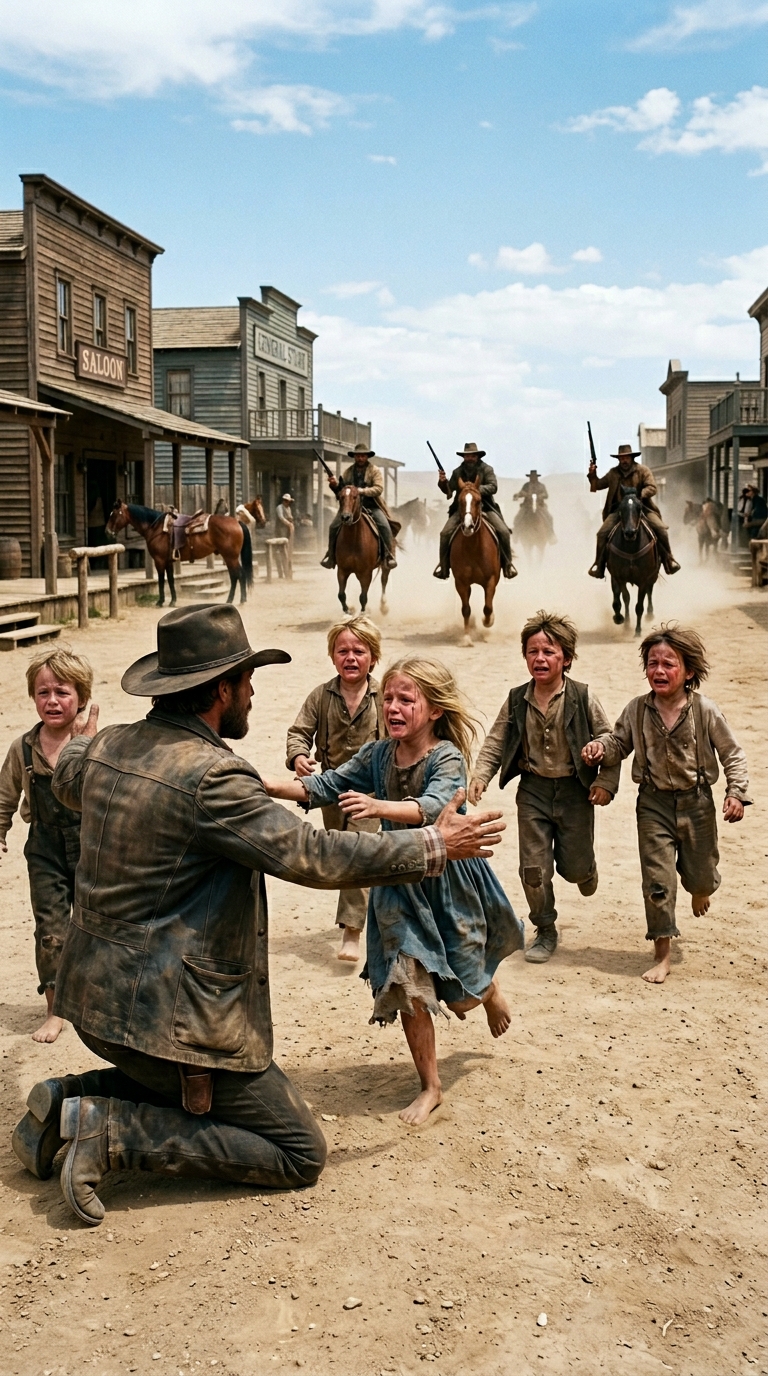
The children appeared out of the dust as if the earth itself had expelled them to save them.
Don Mateo Arriaga was repairing the fence of his ranch on the outskirts of San Jacinto del Llano when he saw five small figures running along the old arroyo road. It was an afternoon in 1897, one of those Porfiriato afternoons when the sun seemed to pierce the back of the neck and vultures circled over the dry pastures. At first, he thought they were the children of some farmhand racing each other, but then he noticed they weren’t running like children. They were running as if fleeing from death itself.
The oldest was a girl of about 12, dark-skinned and thin, with black hair plastered to her face by sweat. She carried a baby wrapped in a torn blanket in her arms. Behind her came a 9-year-old boy, a smaller girl, and another little boy who was barely 5. All of them were barefoot, their feet stained with blood and dirt. The girl kept looking back every few steps.
Mateo followed her gaze.
On the hill, three horsemen were advancing slowly. They weren’t galloping. They didn’t need to. They came with the certainty that they would catch the children. That calm sent a chill through Mateo’s blood, because it was the calm of men accustomed to no one ever telling them no.
He straightened up with difficulty. He was 47 years old, but the pain in his back and in his soul made him feel 80. He had been a rural soldier, had chased bandits in the mountains, and had seen too much violence to fail to recognize it from afar. However, for the past 3 years he had not raised his voice against anyone. Ever since the fever took his wife, Isabel, and his two daughters, Clara and Rosita, Mateo had lived like a shadow among empty walls.
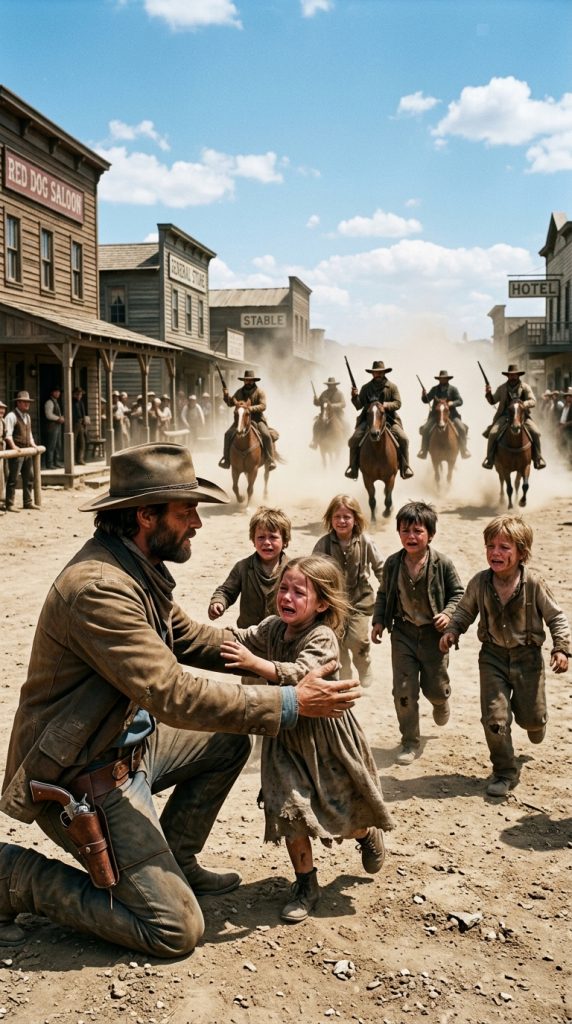
The girl reached the fence almost breathless.
“Please, sir,” she said, clutching the baby to her chest. “Don’t let them take us. They’re going to separate us.”
The 9-year-old boy stepped in front of his younger siblings, fists clenched, trembling with fear but determined to fight. The baby let out only a weak whimper, too exhausted to cry.
Mateo looked at the horsemen. The first one wore a wide-brimmed hat, a trimmed mustache, and a leather band across his chest. It was Commander Evaristo Beltrán, head of the rural guard of San Jacinto, a man who smiled with his lips and threatened with his eyes. The other two were armed guards.
They were not lawmen pursuing criminals. They were three armed adults chasing five hungry children.
Something broke inside Mateo. For 3 years he had kept his heart closed, like a room where the dead are kept so as not to say goodbye to them. But seeing that girl holding the baby, seeing the blood on the little boy’s feet, he felt a pang so strong it nearly buckled his knees.
It was pain, yes. But it was also something else.
It was life.
“Get behind me,” he said in a rough voice. “All of you. And don’t move.”
The girl hesitated. She didn’t trust him, and Mateo understood. When the world has failed you so many times, kindness also looks like a trap. But the horses were already close, so she slipped through the gap in the fence and the others followed.
Commander Beltrán stopped his horse in front of the ranch.
“Don Mateo Arriaga,” he greeted with false courtesy. “Don’t get involved in matters that don’t concern you.”
“These children came onto my property,” Mateo replied. “While they’re here, they are my concern.”
Beltrán snorted a laugh.
“They are orphans from the Robles family. Their parents died of fever three weeks ago. Judge Iriarte ordered them to be taken to the orphanage in Guadalajara. I’m just following orders.”
“With rifles?” Mateo asked.
One of the guards looked down.
Beltrán lost his smile.
“Step aside.”
Mateo didn’t move.
“Show me a paper signed by an honest judge, not one who wants to take the lands of the dead.”
The commander clenched his jaw. Judge Iriarte had wanted the Robles family’s 30 hectares for years, because the new commercial road to the capital would pass through there. Everyone in San Jacinto knew it, but no one dared say it.
“Tomorrow I’ll return with papers, witnesses, and enough men,” said Beltrán. “And if you get in the way again, I’ll take you to prison.”
“Then come back tomorrow,” Mateo answered. “Today you’re not taking any children.”
The horsemen rode away, raising a cloud of dust. Mateo remained motionless until they disappeared. Only then did he turn to the little ones.
The oldest girl was still hugging the baby as if it were the only thing keeping her standing.
“What’s your name?”
“Esperanza Robles,” she said. “He is Jacinto. She is Lupita. The little one is Toñito. And the baby is called Luz.”
Mateo swallowed hard. Luz. That was the name Isabel had wanted to give another daughter if God had granted them one.
“Come in,” he said. “There’s water. And something to eat.”
Mateo’s house smelled of old wood, stale coffee, and memories. In the kitchen, the children sat on a bench without speaking. Esperanza didn’t let go of Luz even when Mateo placed beans, hard tortillas warmed on the comal, and a jug of goat’s milk on the table.
They ate with silent desperation. Toñito fell asleep with half a tortilla in his hand. Lupita cried while chewing, not from sadness but from relief. Jacinto watched the door as if expecting Beltrán to burst in at any moment.
Mateo observed them from the stove. Every movement they made opened a wound. Clara had been the same age as Lupita when she died. Rosita had been smaller than Toñito. For years, Mateo had avoided looking at toys, braids, dolls, or laughter. Now his house was full of all that again, but in the form of hunger and fear.
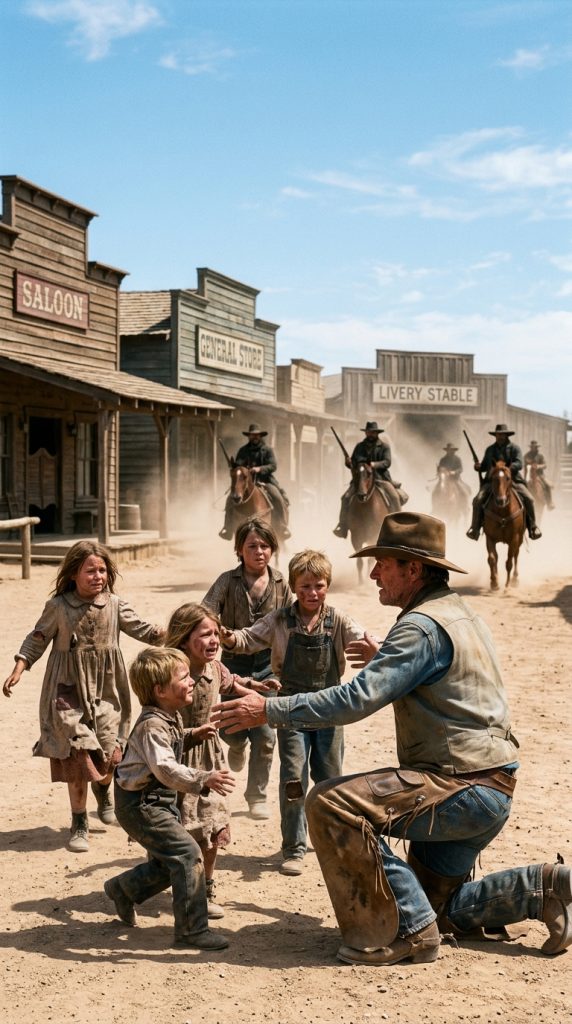
“Why did you help us?” Esperanza asked suddenly.
Mateo stayed still.
“Because someone had to.”
“People always say that when there’s no longer any danger.”
Her answer hit him harder than an insult. That girl spoke like an adult because life had not allowed her to remain a child.
“You’re right,” he said. “You don’t know if I’ll still be here tomorrow.”
Esperanza lowered her gaze to Luz.
“I promised my mother I wouldn’t let them separate us. She asked me before she died. If they take us to the orphanage, Luz will go to one family, Toñito to another, Jacinto to some boss who needs hands for work. We’ll never see each other again.”
Mateo sat down in front of her.
“I also made promises I couldn’t keep.”
Esperanza looked up.
“To whom?”
“To my wife. To my daughters. I promised I would take care of them. The fever didn’t let me.”
The kitchen fell silent. Outside, the wind moved the door as if someone were breathing behind it.
“I’m sorry,” said Esperanza.
Mateo nodded. It had been a long time since anyone had said those words to him as if they truly carried weight.
That night the children slept in the room that had belonged to Clara and Rosita. Mateo had not entered there in 3 years. The small beds were still made with quilts embroidered by Isabel. On a shelf there was a wooden horse, a one-eyed doll, and a little box with old ribbons. Esperanza noticed that Mateo stopped at the door and didn’t dare go inside.
“We can sleep in the kitchen,” she said.
“No,” he replied, his voice breaking. “This room needs to remember what it was made for.”
At dawn, Luz had a fever.
Esperanza turned pale. Mateo felt the past closing its hands around his throat again. Not again, he thought. Not in front of me.
“We have to take her to Doctor Salvatierra,” he said.
“We’re all going,” Esperanza answered immediately.
“The town is dangerous.”
“More dangerous is separating us.”
Mateo didn’t argue. Wrapped in a clean blanket, Luz was carried in Esperanza’s arms while the others walked close to Mateo. They entered San Jacinto along the main street. Women sweeping their doorways stopped sweeping. Men in the store stopped talking. Everyone already knew that the commander was looking for those orphans.
Doctor Salvatierra, a thin man with a white beard, examined the baby carefully.
“It’s not the same fever that killed her parents,” he said at last. “It’s hunger, thirst, and exhaustion. If she gets milk, warmth, and care, she will live.”
Esperanza covered her mouth with her hand. Jacinto looked at the ceiling so no one would see his tears.
“But she needs a home,” the doctor added, looking at Mateo. “Not just one night of compassion. A home.”
Mateo looked at Luz. Then at the other four. For the first time in 3 years, his empty house no longer seemed like a tomb, but an answer.
“They will have one,” he said.
As they left the clinic, Commander Beltrán was waiting for them in front of the command post. Beside him stood Judge Iriarte and two well-dressed men with leather briefcases.
“How convenient,” said Beltrán. “You’ve saved me the trip to the ranch.”
The whole town stopped. The entire square seemed to hold its breath.
The judge unfolded a document.
“By legal order, the minor Robles children are placed under the custody of the municipality. Don Mateo Arriaga, you are accused of hiding orphans and obstructing authority.”
Beltrán advanced toward Esperanza.
“Give me the baby.”
Jacinto stepped in front of her.
“Don’t touch her.”
The commander raised his hand to push him, but Mateo grabbed his wrist. It wasn’t a punch. It wasn’t an open threat. Just a firm grip, enough to remind the commander that the sad rancher had once been one of the most feared men in the region.
“If you touch a child,” Mateo said quietly, “you’ll have to explain it to this whole town.”
Beltrán looked around. There were too many eyes. Too many witnesses.
“Tomorrow I’ll come for them at your ranch,” he spat. “And I won’t come alone.”
That afternoon, Mateo nailed boards to the corral gate and cleaned his old rifle. The children helped as best they could. Esperanza washed clothes. Lupita prepared water for Luz. Jacinto carried firewood. Toñito, who hadn’t smiled since his parents’ death, sat on the porch hugging a rag doll.
Mateo watched him for a long time. Then he went into the house and came out with Clara’s wooden horse.
“This belonged to my daughter,” he said, sitting down beside him. “His name was Relámpago. Though, to be honest, he never ran much because he was missing a leg.”
Toñito looked at the toy. Indeed, it had a broken leg.
Mateo made it walk clumsily across the porch board.
“Relámpago was famous throughout the republic for always arriving late to battles.”
Toñito let out a small laugh, almost a sneeze. But it was a laugh.
Esperanza, from the doorway, stood motionless. Then she placed a hand on her chest, as if that sound had been a miracle.
The next day, Beltrán arrived with 8 armed men. Judge Iriarte came in a cart, protected under a black umbrella, as if even the sun seemed beneath him.
Mateo stepped out into the yard. Behind him stood Esperanza and her siblings. Not hidden. Together.
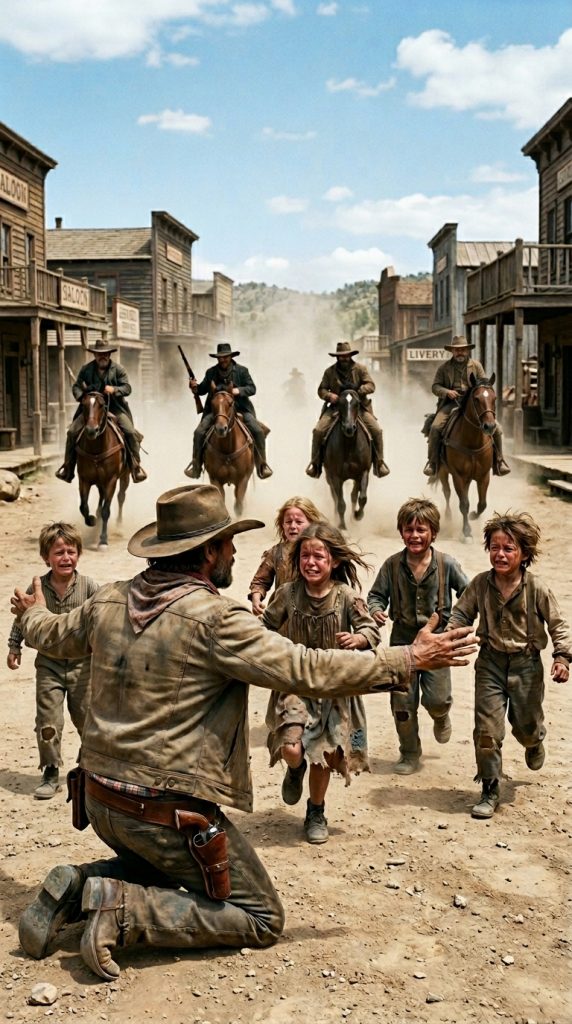
“Last chance,” Beltrán shouted. “Hand over the children.”
“No.”
The guards raised their rifles.
Then a bell rang.
It wasn’t the church bell. It was the old ranch bell, the one Mateo used years ago to call the farmhands during harvest. Jacinto was ringing it with all his strength. Its sound traveled across the plain, bounced off the rocks, and crossed the pastures.
And from the roads, people began to appear.
First Doctor Salvatierra. Then Doña Petra, the shopkeeper. Then several peasants, mule drivers, widows, farmhands, mothers with children in their arms. Some carried sticks. Others, simple rosaries. They didn’t come to fight against rifles. They came to look them in the eye.
Among them arrived an old man in a dusty cassock: Father Eusebio, the priest of San Jacinto.
“Mr. Judge,” said the priest, “before you take these children, perhaps you should read this.”
He took a yellowish envelope from his bag.
Iriarte turned pale.
The priest opened it in front of everyone.
“It is the will of Aurelio Robles, the children’s father. It was signed before me and two witnesses four years ago, when the little Luz was born. It states that, in the event of his and his wife’s death, custody of their children would not pass to the municipality, but to the godfather of the girl’s baptism.”
Esperanza frowned.
“Godfather?”
Father Eusebio looked at Mateo.
“Don Mateo Arriaga.”
Mateo felt the world stop.
“That can’t be,” he whispered.
The priest softened his voice.
“You didn’t attend the baptism because your wife fell ill that week. But Aurelio Robles insisted on putting your name. He said you saved his life in the mountains when you were young. He said that if his children ever needed a just man, it should be you.”
Mateo then remembered a wounded boy, a rainy night, a forgotten rescue among so many sorrows. Aurelio Robles. Esperanza’s father.
Judge Iriarte tried to snatch the paper.
“That has no validity!”
“Yes, it does,” said a new voice.
A man stepped down from a stagecoach at the end of the road. He wore a dark suit, carried a briefcase, and walked with calm. It was Licenciado Ramiro Castañeda, a lawyer from Guadalajara, sent by a distant relative of the Robles family who had received news of the deaths too late.
“And furthermore,” the lawyer added, “I have registered copies. I also have proof that you, Judge Iriarte, prepared the sale of the Robles lands before declaring the children orphans.”
An angry murmur ran through the crowd.
Beltrán took a step back. His own men lowered their rifles. One of them took off his hat, ashamed.
The judge opened and closed his mouth but found no words. For the first time, the bought law stood naked before true justice.
“Commander Beltrán,” said the lawyer, “if you carry out the judge’s order, you will fall with him.”
Beltrán looked at the judge, then at Mateo, then at the town. He cursed under his breath, mounted his horse, and rode away without looking back. Iriarte was escorted away by the same men he had brought to intimidate.
Esperanza didn’t move until the cart disappeared. Then her legs gave out. Mateo caught her before she fell.
“It’s over,” he told her.
She shook her head, crying for the first time like a child.
“I didn’t know how afraid I was.”
Mateo hugged her carefully, as one holds something sacred.
“Neither did I.”
Months later, Mateo’s ranch no longer looked like a tomb. There was laundry hanging in the yard, laughter in the kitchen, milk warming for Luz, and small footsteps everywhere. Jacinto learned to ride. Lupita planted flowers beside Isabel and the girls’ grave. Toñito carried Relámpago, the wooden horse, everywhere. Luz grew chubby, laughed, and learned to stretch her arms toward Mateo.
Esperanza remained serious, but she no longer slept with her shoes on. One afternoon, as the sun set over the magueys, she found Mateo repairing the same fence where everything had begun.
“My mother asked me to keep the family together,” she said.
Mateo set down the hammer.
“You did it.”
“Not alone.”
He looked at her. Esperanza took from her pocket a faded blue ribbon that had belonged to her mother. She tied it to the fence, right where she had crossed that day with Luz in her arms.
“So we don’t forget,” she said. “This is where we stopped running.”
Mateo felt his eyes fill with tears. Not from pain this time, but from gratitude.
That night, at the table, there were 6 plates. Mateo watched the children eating, fighting over the last tortilla, laughing, living. For the first time in 3 years, he didn’t hear the silence of the dead, but the imperfect music of a house that had begun to breathe again.
And when Toñito raised his cup of milk and shouted:
“To Relámpago, the slowest horse in Mexico!”
Everyone laughed. Even Mateo.
Outside, the old bell moved with the wind and let out a soft sound. It was not an alarm. It was not a cry for help.
It was, at last, a welcome.
