

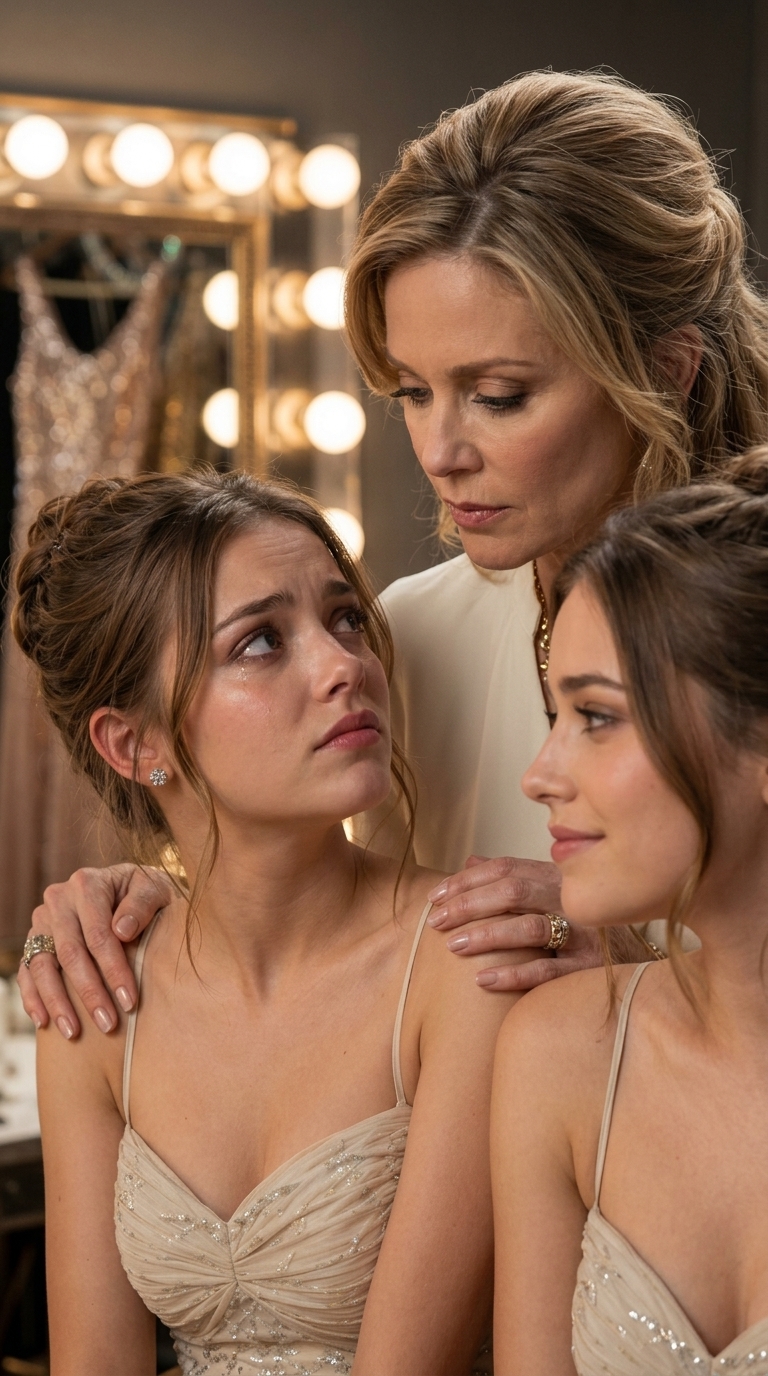
When their mother said, “You two would be famous if you stayed as one,” Avery Blake felt her stomach drop.
Her identical twin, Arden, smiled.
And that tiny difference would become the betrayal Avery never saw coming.
PART 1
Avery and Arden Blake were identical in the way strangers loved to point out.
Same hazel eyes. Same chestnut hair. Same dimple on the left cheek. Same small scar near the eyebrow from the summer they both tried to climb the same apple tree and failed in the same dramatic way.
But inside, they were never the same.
Avery liked quiet mornings, old bookstores, sketching birds in the margins of her notebooks, and wearing sweaters that made her feel invisible in the safest way.
Arden liked cameras, applause, bright lipstick, and the way people turned their heads when she entered a room.
Their mother, Marissa Blake, noticed the difference early.
And instead of loving them for who they were, she decided one daughter was useful… and the other needed to be shaped.
“You girls don’t understand what you have,” Marissa said one Saturday afternoon, standing in front of the full-length mirror in their living room. “People would pay attention to you. Brands would love you. TV shows. Modeling. Interviews. You’d be famous if you stayed together.”
Avery was thirteen then.
She remembered the exact smell of lemon polish on the floor, the afternoon sun burning gold through the curtains, and the way her mother’s hand rested on Arden’s shoulder like a crown.
Arden tilted her head, studying their reflection.
Together, they looked unreal. Two matching girls in white dresses, two perfect smiles, two faces that could confuse anyone.
Avery stepped back.
“I don’t want that,” she whispered.
Marissa’s eyes sharpened in the mirror.
“What did you say?”
Avery swallowed. “I don’t want to be famous.”
Arden didn’t look at her. She smiled wider.
That was the first time Avery understood that being identical did not mean being protected.
By sixteen, Marissa had created a social media account for them called The Blake Twins. At first, it was harmless. Matching outfits. Dance videos. “Twin telepathy” challenges. Cute birthday posts.
Then came the rules.
No separate hairstyles.
No separate friends.
No separate hobbies on camera.
If Avery wanted to post a drawing, Arden had to be in the photo.
If Arden got invited somewhere, Avery had to go, too.
If one girl smiled, the other had to smile.
Marissa said it was branding.
Avery called it disappearing.
The account grew faster than anyone expected. Local stores offered free clothes. A children’s talent agency called. A lifestyle magazine asked for a feature.
Arden loved every second of it.
Avery began to dread the sound of the ring light turning on.
At school, people stopped calling them by their names.
“Hey, twins!”
“Which one are you?”
“Do you two ever do anything alone?”
Avery would say, “I’m Avery.”
Most people laughed like she had told a joke.
Only one person didn’t.
Ethan Cole, a quiet boy from art class, always called her by her name.
He noticed the tiny things. Avery wore a silver moon necklace; Arden wore a gold star. Avery drew with her left hand; Arden signed autographs with her right. Avery looked down when overwhelmed; Arden leaned toward attention like a flower toward light.
“You don’t like being part of the twin thing, do you?” Ethan asked once, after class.
Avery froze.
Nobody had ever asked her that.
She wanted to answer honestly, but fear had trained her mouth to be careful.
“It’s complicated,” she said.
Ethan nodded. “You’re allowed to be complicated.”
Those five words stayed with her for years.
At seventeen, Avery was offered something she had secretly dreamed about: a summer art scholarship in Vermont. Six weeks. No cameras. No matching outfits. Just pencils, paint, trees, and people who would know her as Avery Blake.
She hid the acceptance email for three days before telling her family.
When she finally placed the printed letter on the kitchen table, Marissa stared at it as if Avery had brought home a crime.
“Six weeks away?” her mother asked.
“It’s an amazing program,” Avery said. “They only chose twelve students.”
Arden picked up the letter.
Her smile was slow.
“So what happens to the partnership?”
Avery blinked. “It’s not a partnership. It’s my life.”
The silence after that was so sharp it felt physical.
Marissa leaned back in her chair. “After everything I built for you girls?”
“For us?” Avery asked softly. “Or for you?”
Arden’s eyes flashed.
“That’s unfair.”
“No,” Avery said, voice trembling. “Unfair is being told I can’t cut my hair because strangers like us matching. Unfair is pretending I love things I hate. Unfair is losing my name.”
For one beautiful second, Avery thought she had finally said enough.
Then Arden folded the scholarship letter and placed it neatly beside Marissa’s coffee cup.
“You’re being selfish,” Arden said.
Avery stared at her twin.
Not because the words hurt.
Because Arden sounded exactly like their mother.
That night, Avery packed a small bag and hid it under her bed. She decided she would talk to her father, Russell, who had always stayed quiet in the background, working long shifts, avoiding conflict, pretending peace was the same as love.
But before Avery could reach him, everything changed.
The next morning, The Blake Twins account posted a video.
In it, Arden sat in their bedroom, crying softly.
Avery’s silver moon necklace hung around Arden’s neck.
The caption said:
“My sister Avery has been struggling. She decided to turn down the scholarship so we can heal together as a family. Please send love.”
Avery watched the video three times before she understood.
Arden had pretended to be her.
Thousands of comments poured in.
“So mature.”
“Family first.”
“You girls are strongest together.”
“Avery is lucky to have Arden.”
By noon, the scholarship director had received an email from “Avery Blake” declining the offer.
By dinner, Marissa had already signed a contract for a national twin reality special.
And by midnight, Avery stood in front of the bathroom mirror with scissors in her hand, staring at the one thing everyone said made her valuable.
Her identical face.
Her identical hair.
Her identical life.
Then Arden appeared in the doorway.
For a moment, neither sister moved.
Avery whispered, “Why?”
Arden’s answer was quiet.
“Because you were going to leave me as the ordinary one.”
That sentence broke something in Avery.
Not loudly.
Not dramatically.
But deep enough that she knew she would never again confuse sameness with love.
PART 2
Avery did not cut her hair that night.
Not because she forgave Arden.
Because she realized one impulsive moment would not give her freedom. It would only give her mother another story to sell.
So she put the scissors down.
Then she did something nobody expected.
She became quiet.
Not weak quiet.
Watching quiet.
For three weeks, Avery collected everything: the fake email declining her scholarship, the contract her mother signed using both girls’ names, screenshots of Arden pretending to be her, and messages from agencies asking Marissa whether “the shy twin” could be made more emotional on camera.
Ethan helped her print copies at the school library.
Her father, Russell, finally noticed the bruised silence inside his own home.
“What happened to my daughter?” he asked one evening.
Avery looked at him and said, “Which one?”
That was the first time Russell cried in front of her.
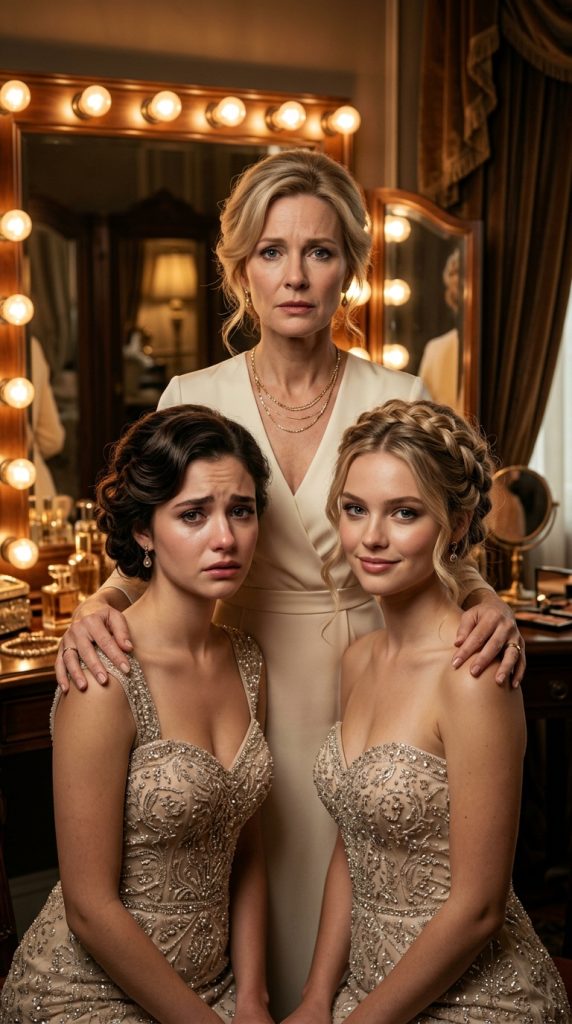
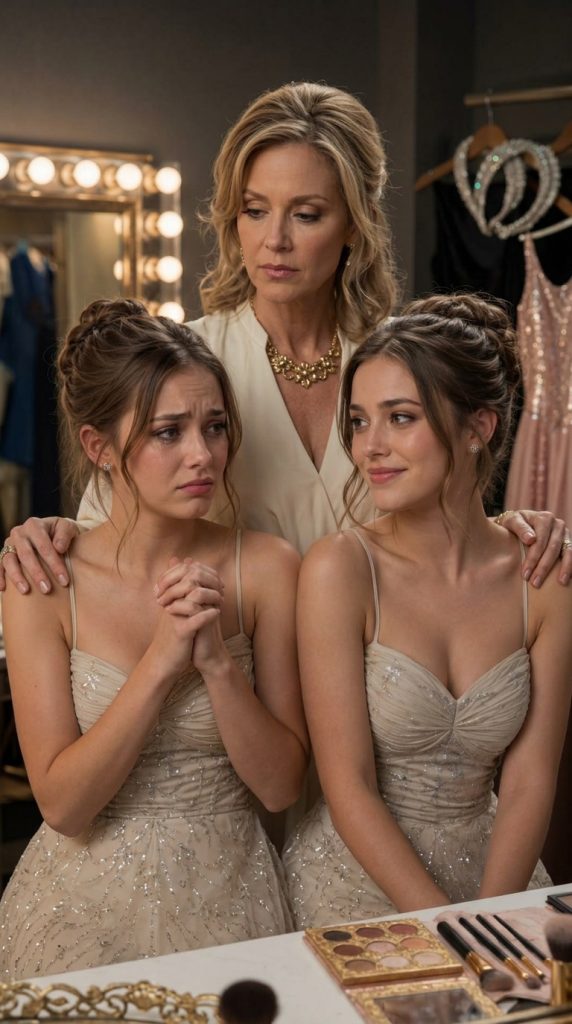
The reality special was filmed at a downtown studio in Chicago. Marissa dressed them in matching cream dresses and told Avery to smile like nothing had happened.
Arden squeezed Avery’s hand before they walked onstage.
“Don’t ruin this,” she whispered.
Avery looked at their joined hands.
For years, people had called that bond beautiful.
But a hand can hold you.
Or it can hold you down.
When the host asked, “What is the secret to being so close?” Arden leaned toward the microphone.
Avery got there first.
“The secret,” she said clearly, “is that nobody ever asked if I wanted to be close this way.”
The studio went silent.
Marissa’s face turned pale.
Arden stopped smiling.
And Avery reached under her chair for the folder that would change all of their lives.
PART 3
For one second, Avery Blake could hear everything.
The studio lights buzzing overhead.
The soft click of a camera lens.
Her mother’s breath catching in the front row.
Arden’s fingernails pressing into the fabric of her dress.
The host, Meredith Lane, sat across from them on a white couch designed to look warm and harmless. Behind her, a giant screen displayed a polished photo of The Blake Twins: Avery and Arden smiling in matching cream dresses, their shoulders touching, their faces edited until they looked less like girls and more like a product.
Meredith was a professional. She had interviewed actors, politicians, musicians, and families with perfect smiles hiding imperfect truths.
But even she seemed unsure what to do when Avery said, “Nobody ever asked if I wanted to be close this way.”
The audience did not clap.
They did not laugh.
They leaned forward.
That was when Avery understood something she had not known before.
Truth does not always need volume.
Sometimes it only needs one person to stop pretending.
Meredith lowered her cue cards.
“Avery,” she said gently, “what do you mean by that?”
Marissa stood so fast her chair scraped the floor.
“This is not appropriate,” she snapped. “She’s overwhelmed. My daughter gets anxious under pressure.”
There it was again.
The family script.
Avery is fragile.
Avery is emotional.
Avery does not know what she means.
For years, those words had been soft ropes tied around Avery’s wrists.
But this time, millions of people were not watching a perfectly edited video controlled by Marissa.
They were watching live.
Avery opened the folder on her lap.
“My mother signed a media contract using my name when I had not agreed,” she said.
Marissa’s mouth opened.
Avery kept going.
“My sister posted a video pretending to be me. She wore my necklace, used my room, cried on camera, and told our followers that I had declined an art scholarship. I didn’t decline it.”
The host looked toward the producer behind the cameras.
Avery could see panic moving through the room like a wave.
Arden whispered, “Stop.”
Avery turned to her.
It was strange looking at her twin in that moment. Same face. Same eyes. Same dimple. But Avery could finally see the difference clearly.
Arden was not fearless.
She was terrified too.
Just terrified of being unseen.
Avery’s voice softened, but it did not break.
“You took my name,” she said. “You let strangers praise you for stealing my choice.”
Arden’s eyes filled with tears.
Avery expected anger.
Instead, Arden looked small.
For a moment, the sister from childhood flickered there—the girl who used to crawl into Avery’s bed during thunderstorms, the girl who would whisper secrets into the dark, the girl who once promised that if the world ever became too loud, they would hide together under a blanket and count stars painted on the ceiling.
Then Arden blinked, and the polished smile returned.
“You’re twisting this,” Arden said, loud enough for the microphones. “I was trying to protect you.”
Avery almost laughed.
Not because anything was funny.
Because that was the sentence people used when they wanted control to sound like love.
Meredith leaned in. “Avery, do you have proof?”
Avery placed the first paper on the coffee table.
It was the scholarship acceptance letter.
Then the fake withdrawal email.
Then screenshots showing the login location from Arden’s phone.
Then the contract pages with both names signed in the same handwriting—Marissa’s sharp, slanted script.
The camera zoomed in.
The studio became so quiet Avery could hear someone in the audience whisper, “Oh my God.”
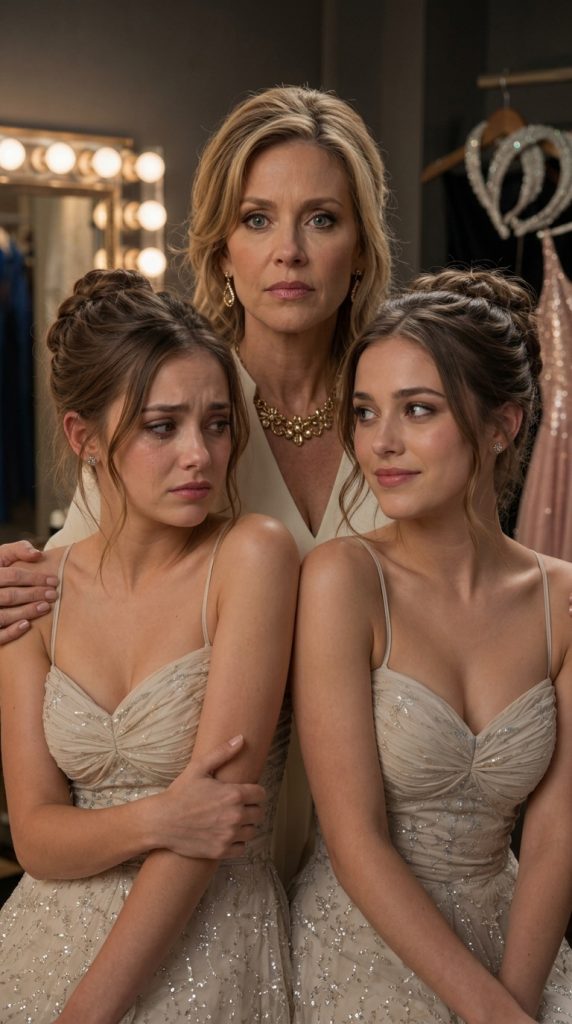
Marissa rushed toward the stage.
A producer stepped between them.
“You ungrateful girl,” Marissa hissed, no longer caring who heard her. “Everything you have is because of me.”
Avery looked at her mother.
She had spent most of her life trying to earn warmth from that face.
She had smiled when she wanted to cry.
She had worn clothes that felt like costumes.
She had laughed at jokes that made her feel less human.
She had allowed strangers to treat her as half of a set because she thought maybe, one day, if she stayed agreeable enough, her mother would look at her and see a daughter instead of an opportunity.
But Marissa’s eyes were not full of regret.
They were full of rage.
That hurt.
Then, strangely, it freed her.
“No,” Avery said. “Everything I lost was because of you.”
Meredith stood.
“We’re going to pause for a moment,” she told the cameras, voice controlled but shaken. “Our team will review the materials Avery has brought forward.”
The live feed cut to commercial.
The second the red camera light went off, chaos erupted.
Marissa tried to reach Avery again, but Russell Blake stepped into the aisle.
Avery had not even known her father was there.
He wore his work jacket, the navy one with a faded company logo on the chest. He looked older than he had that morning, like the truth had aged him all at once.
“Marissa,” he said.
His voice was low.
She turned on him. “You stay out of this.”
That had always worked before.
Russell would lower his eyes, retreat into silence, and let the storm pass through the house.
But this time, he did not move.
“No,” he said. “I stayed out of it too long.”
Avery’s throat tightened.
Arden stared at their father as if she did not recognize him.
Maybe none of them did.
Russell walked to the stage and looked at both daughters.
“I told myself your mother knew better because she was the one handling the cameras, the managers, the emails. I told myself you girls were happy because the videos looked happy.”
His voice cracked.
“I should have asked you when the cameras were off.”
Avery could not speak.
For years, she had been angry at him for being absent inside his own home. Hearing him admit it did not erase that pain, but it opened a door she had thought was sealed forever.
Marissa laughed bitterly.
“Oh, please. Don’t turn into the hero now. You liked the money too.”
Russell flinched.
Then he nodded.
“Yes,” he said. “I did. And I’m ashamed of that.”
That quiet admission stunned Marissa more than any accusation could have.
People who build their power on denial are often most frightened by honesty.
Arden rose from the couch.
“We can fix this,” she said quickly. “Avery, tell them it was a misunderstanding. Say you were nervous. We’ll apologize privately. We can still do the special.”
Avery looked at her sister.
“The special?”
Arden wiped her cheeks. “You don’t understand. This is bigger than us now.”
“It was always bigger than me,” Avery said. “That was the problem.”
A producer approached Meredith with a tablet. They spoke in tense whispers. The network’s legal team had clearly entered the conversation. Assistants hurried across the studio floor. The audience remained seated, unsure whether they were witnesses to a scandal or a family falling apart.
Maybe both.
Ethan stood near the back row.
He had come because Avery asked him to be there, though she had not told him exactly what she planned. He held up both hands slightly, palms open, not clapping, not celebrating.
Just reminding her she was not alone.
That simple gesture steadied her.
After twenty minutes, Meredith returned to the stage. Her expression had changed. The warm entertainment-show smile was gone. In its place was something more serious.
She looked at Avery.
“We are not going back on air with the original segment,” she said. “But the network wants to offer you a choice. You can end this here, or you can make a short statement.”
Marissa stepped forward. “She is a minor.”
“She is seventeen,” Meredith replied. “And based on what we have seen, she may have been used in contractual agreements without informed consent. Our legal team is documenting everything.”
Marissa went pale.
Arden gripped her own hands.
Avery thought of the girl she had been at thirteen, standing in front of the mirror, hearing her mother say they could be famous if they stayed as one.
She thought of the terror rising in her chest.
She thought of Arden smiling beside her.
Back then, Avery had believed that smile meant Arden was stronger.
Now she understood it meant Arden had chosen a different way to survive.
Some people disappear by becoming quiet.
Others disappear by becoming exactly what someone powerful wants them to be.
Avery did not excuse her sister.
But she saw her.
That made the betrayal more painful, not less.
“I’ll make a statement,” Avery said.
Meredith nodded.
Two minutes later, the red camera light came back on.
Across America, viewers who had been expecting a sweet twin story returned from commercial to see Avery Blake sitting alone on the couch.
Arden was no longer beside her.
Marissa was no longer in frame.
For the first time in the history of The Blake Twins, Avery was on camera by herself.
Her hands trembled, so she folded them in her lap.
“My name is Avery Blake,” she began.
She paused after her own name.
Not because she forgot what to say.
Because saying it alone felt like stepping into sunlight after years underground.
“I am an artist. I am a daughter. I am a sister. I am also a person separate from my twin.”
Her eyes burned, but she kept going.
“For a long time, people thought my sister and I were interesting because we looked the same. But being loved only when you match someone else is not love. Being praised only when you perform happiness is not happiness. Being told that family means giving up your dreams is not family.”
In the audience, someone began to cry softly.
Avery looked directly into the camera.
“If there is someone watching this who feels trapped inside a role they never chose, I want you to know something I wish someone had told me earlier: you are not selfish for wanting your own life.”
Her voice shook on the last word.
But it held.
The statement lasted less than two minutes.
It changed everything.
By sunset, the clip had spread everywhere.
Not the polished videos.
Not the matching dresses.
Not the brand.
Avery’s statement.
People began sharing their own stories in the comments. Twins who had been compared their entire lives. Siblings forced to compete. Children turned into family trophies. Adults who still felt guilty for leaving homes where love came with conditions.
The hashtag #MyOwnName began trending by morning.
Marissa called it a disaster.
Avery called it proof.
The first night after the studio, Avery did not go home.
Russell took her to her Aunt Diana’s house in Evanston, a small blue place with creaky floors, mismatched mugs, and a guest room full of old quilts.
Avery slept for fourteen hours.
When she woke, she found Russell sitting at the kitchen table with coffee untouched in front of him.
“I spoke to a lawyer,” he said.
Avery sat slowly.
“About what?”
“About the contracts. The money. Your scholarship. Your right to refuse future filming.”
He rubbed both hands over his face.
“And about separating from your mother.”
Avery looked down.
She had imagined freedom many times.
She had imagined packing bags, changing her hair, leaving town, becoming unrecognizable.
But she had not imagined her father choosing truth loudly enough to break the house apart.
“Are you doing that because of me?” she asked.
Russell shook his head.
“I should have done it because of you years ago. But I’m doing it now because I finally understand that keeping a family together doesn’t matter if everyone inside it is disappearing.”
Avery cried then.
Not the pretty kind of crying people do in movies.
She cried with her shoulders shaking and her face hidden in her sleeves, because grief is not only about what happened.
Sometimes it is about realizing what should have happened instead.
Her father did not try to stop her tears.
He just sat beside her.
For once, silence felt safe.
The next weeks were messy.
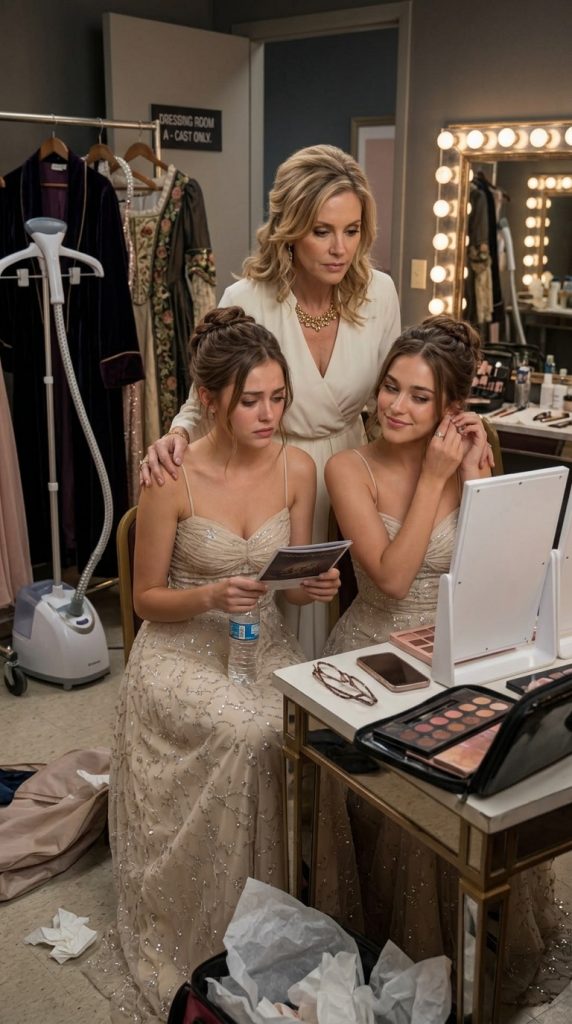
Marissa denied everything publicly. She posted a long statement claiming Avery had been manipulated by “outside influences.” She hinted that Ethan was jealous. She accused Russell of turning the girls against her.
But documents are stubborn things.
The agency suspended the twin special.
Brands removed sponsored posts.
A family attorney filed to freeze the account earnings until both daughters’ rights could be reviewed.
The scholarship program reached out too.
Dr. Helena Morris, the director of the Vermont art residency, called Avery personally.
“We saw what happened,” she said. “Your place was never given away.”
Avery pressed the phone hard against her ear.
“It wasn’t?”
“No,” Dr. Morris said. “Something about the withdrawal felt strange, so we held it for a while. Then the segment aired.”
Avery closed her eyes.
For the first time in months, hope entered her body carefully, like a bird landing on an open hand.
“There is one week left before the program begins,” Dr. Morris continued. “The offer still stands.”
Avery wanted to say yes immediately.
Then guilt rose like a familiar ghost.
What about Arden?
What about her father?
What about the comments, the lawyers, the mess she had exposed?
Old fear whispered: You caused this.
A stronger voice answered: No. You revealed it.
“I want to come,” Avery said.
The day before she left for Vermont, Arden came to Aunt Diana’s house.
Avery saw her through the front window before the doorbell rang.
Her twin stood on the porch wearing jeans, a gray hoodie, and no makeup. Without the styling, without the coordinated outfit, without Marissa’s direction, Arden looked younger than seventeen.
Almost like the sister Avery had been searching for under all that performance.
Avery opened the door but did not step aside.
Arden’s eyes moved over her face.
“You cut your hair,” she said.
Avery touched the blunt shoulder-length ends.
“Just four inches.”
“It looks different.”
“I know.”
For a while, neither of them spoke.
Then Arden held out a small box.
Inside was Avery’s silver moon necklace.
Avery stared at it.
Arden’s voice was barely audible. “I shouldn’t have worn it in the video.”
“No,” Avery said. “You shouldn’t have.”
Arden flinched.
Avery did not soften the truth to make her sister comfortable.
That was new.
Arden looked toward the street, where a car waited by the curb. Marissa was not inside. Russell had driven her, probably waiting far enough away to give them privacy.
“I thought if you left, everyone would see that you were the talented one,” Arden said.
Avery frowned. “What?”
Arden laughed once, bitter and broken.
“You think I wanted the cameras because I felt special. But I wanted them because when people looked at us together, they couldn’t tell which one was better. If you left for art school, you’d be Avery the artist. And I’d just be Arden, the one who liked attention.”
Avery studied her sister.
“That doesn’t excuse what you did.”
“I know.”
“Do you?”
Arden’s eyes filled again.
“I’m starting to.”
Those words mattered because they were not dramatic. They were not a perfect apology wrapped in music and tears. They were small, unfinished, uncomfortable.
Real.
Avery took the necklace, but she did not put it on.
“Why did you smile that day?” she asked.
Arden looked confused.
“What day?”
“When Mom said we’d be famous if we stayed together. I was terrified. You smiled.”
Arden’s face changed.
Avery had carried that memory for four years like evidence that her sister had betrayed her from the beginning.
But Arden’s answer came slowly.
“Because Mom was looking at me like she was proud,” Arden said. “And I didn’t know how to make her look at me that way unless I smiled.”
Avery felt the old memory shift.
Not disappear.
Not heal.
Just shift.
Two little girls in matching dresses.
One afraid of losing herself.
One afraid she had no self worth losing.
Avery leaned against the doorframe.
“We were kids,” she said.
Arden nodded.
“Then we grew up and still hurt each other,” Avery added.
Arden wiped her cheek. “I know.”
Avery looked at the necklace in her palm.
“I’m leaving tomorrow.”
“For Vermont?”
“Yes.”
Arden nodded, but her mouth trembled.
“I won’t stop you.”
Avery almost said thank you.
Then she realized the words were wrong.
Permission from Arden was not the gift.
Her own choice was.
“I know,” Avery said.
Arden took a small envelope from her hoodie pocket.
“What’s that?”
“A letter to the scholarship director. I wrote what really happened. I don’t know if it helps anymore, but… I wanted it on paper.”
Avery took the envelope carefully.
“Thank you.”
The words were small, but this time they were the right ones.
Arden stepped back.
“Do you hate me?”
Avery looked at her twin, at the face that had been used to erase her and reflect her, comfort her and wound her.
“No,” she said honestly. “But I don’t trust you right now.”
Arden nodded like the answer hurt but made sense.
“I want to earn that back.”
Avery did not promise she could.
She only said, “Then start by becoming someone without needing me beside you.”
The next morning, Avery left for Vermont with one suitcase, one sketchbook, and her moon necklace tucked inside her bag instead of around her neck.
The art residency was held on a quiet campus surrounded by pine trees and clean summer air. No one there cared about The Blake Twins. A few recognized her from the viral clip, but Dr. Morris had warned everyone that Avery was there as a student, not a story.
On the first day, the instructors asked each student to introduce themselves and name one thing they wanted to explore.
Avery’s heart pounded as her turn came.
She almost said what she always said.
Hi, I’m Avery, one of the Blake twins.
Instead, she stood and said, “I’m Avery Blake. I want to learn how to draw people as they are, not as others expect them to be.”
Dr. Morris smiled.
“That’s a worthy subject.”
For six weeks, Avery learned the shape of freedom.
Freedom was waking up and choosing her clothes without asking whether they matched anyone.
Freedom was eating breakfast alone beneath a maple tree.
Freedom was introducing herself once and not being asked where her sister was.
Freedom was making bad art and not having it posted online.
Freedom was making good art and realizing she did not need applause for it to matter.
She painted hands most often.
Hands reaching.
Hands releasing.
Hands folded in silence.
Hands holding scissors.
Hands holding a necklace.
Hands that looked identical until you studied the details.
At the end of the program, each student displayed a final piece in a small gallery open to families, faculty, and local visitors.
Avery’s piece was a large charcoal portrait of two girls standing in front of a mirror.
At first glance, they seemed identical.
But the longer people looked, the more differences appeared.
One girl’s shoulders curled inward.
The other’s smile looked too practiced.
Behind them stood the faint outline of a woman holding a ring light like a halo.
The title was simple:
Not One.
Avery did not invite Marissa.
She did invite Russell.
She also invited Arden.
She did not expect her sister to come.
But twenty minutes before the gallery opened, Arden walked in wearing a green dress Avery had never seen before. Her hair was parted differently. She wore no star necklace. No matching anything.
For the first time in their lives, they stood in a room where nobody had dressed them to belong to each other.
Arden stopped in front of the portrait.
She stared for a long time.
Then she whispered, “That’s how I looked?”
Avery stood beside her.
“That’s how we both looked.”
Arden covered her mouth.
Russell arrived a few minutes later and stood behind them. He did not say much, but Avery saw him wipe his eyes when he read the title card.
Dr. Morris approached, greeting him warmly.
“You must be Avery’s father.”
Russell shook her hand.
“I’m trying to deserve that sentence,” he said.
Avery looked at him.
He meant it.
That mattered.
The gallery evening should have been peaceful.
But near the end, as visitors moved through the room with paper cups of lemonade and quiet compliments, the front door opened again.
Marissa walked in.
The air changed instantly.
Avery felt it before she turned around, the way a house feels different when a storm moves over it.
Her mother wore a cream pantsuit, diamond earrings, and the wounded expression of a woman who knew how to perform dignity.
Arden stiffened.
Russell stepped forward. “Marissa, you shouldn’t be here.”
“I came to see my daughter’s work,” Marissa said.
Avery noticed the phrase.
My daughter.
Singular when useful.
Plural when profitable.
Dr. Morris approached politely. “This is a student exhibition. We ask that family interactions remain respectful.”
Marissa smiled at her without warmth.
“Of course.”
Then she walked to Avery’s portrait.
For a while, she said nothing.
Avery felt every old instinct rising inside her.
Explain it.
Soften it.
Apologize.
Make her comfortable.
Instead, she breathed slowly.
Marissa looked at the title.
Not One.
Then she turned to Avery.
“You embarrassed me,” she said.
Not “I’m sorry.”
Not “I hurt you.”
Not “I understand.”
Just the wound that mattered most to her: her image.
Avery nodded once.
“I told the truth.”
“You destroyed opportunities your sister wanted.”
Arden spoke before Avery could.
“No, Mom.”
Marissa looked at her sharply.
Arden’s voice trembled, but she continued.
“You wanted them. I just thought wanting what you wanted would make me important.”
For the first time, Marissa looked truly startled.
“You loved performing,” she said.
“I loved being praised,” Arden answered. “There’s a difference.”
Avery looked at her sister.
Something loosened in the room.
Marissa’s face hardened.
“So now both of you are against me.”
Russell stepped beside his daughters.
“No,” he said. “We are beside them. There’s a difference.”
Marissa laughed softly, but her eyes shone.
“You all think you’re so noble. Do you know how hard it was to get anyone to care about this family? Do you know how many doors opened because of what I built?”
Avery surprised herself by answering gently.
“I know you wanted to be seen too.”
Marissa went silent.
It was the first sentence that reached past her armor.
Avery did not say it to excuse her mother. She said it because truth had many rooms, and she was no longer afraid to enter all of them.
“But you used us to do it,” Avery continued. “And I can understand your hunger without letting it eat my life.”
Marissa’s mouth tightened.
The old Avery would have watched for approval.
The new Avery watched for nothing.
Marissa turned away first.
She walked to the door, then paused.
For one strange second, Avery thought her mother might apologize.
Instead, Marissa said, “You’ll regret throwing away what we had.”
Avery held her gaze.
“What we had was not love. It was a stage.”
Marissa left.
The door closed softly behind her.
No dramatic music. No thunder. No collapse.
Just a woman leaving a room she could no longer control.
Arden exhaled like she had been holding her breath for years.
Russell reached for both daughters, then stopped himself.
That small hesitation meant more to Avery than any forced hug.
He was asking without words.
Avery took his hand.
After a moment, Arden took the other.
They stood that way beneath Avery’s portrait, not as a brand, not as a performance, not as proof that everything was healed.
As three people learning how to be honest too late, but not too late to begin.
Years passed.
Not the kind that magically fix everything.
The real kind.
The kind with court dates and therapy appointments, awkward holidays, blocked numbers, unblocked numbers, letters written and never sent.
The money from The Blake Twins account was eventually divided under supervision. A portion went into protected education funds for both girls. Another portion was used to pay legal fees. The account itself remained online but inactive, a museum of smiles that looked different once people knew the cost behind them.
Avery studied illustration in college.
She became known for portraits that captured people in the moment between hiding and becoming.
Her first small gallery show in Boston was called Separate Light.
On the opening wall, she wrote:
“No one should have to disappear to be loved.”
The line was shared thousands of times.
But this time, Avery did not feel trapped by the attention.
Because it belonged to her work, not her wounds.
Arden took a longer road.
At first, she tried to become an influencer on her own. The audience was curious, but curiosity is not the same as loyalty. Without Avery beside her, without the twin illusion, Arden struggled.
For months, she chased the old feeling.
Then one afternoon, she deleted every staged post and uploaded a single video.
No makeup.
No bright lighting.
No fake cheer.
“My name is Arden Blake,” she said. “I hurt my sister because I was afraid I had no value unless we were seen together. That fear was real. What I did with it was wrong.”
The video did not go viral in the way her old posts had.
But it reached the people who needed it.
Girls who felt compared to sisters. Young performers pushed by parents. People addicted to applause because silence felt like rejection.
Arden began speaking at small schools about identity, pressure, and online performance. Not as a celebrity. Not as an expert.
As someone still learning.
Avery watched one of the talks online late one night.
Arden stood on a school auditorium stage in a blue sweater, her hair cut short to her chin.
A student asked, “Are you and your sister close now?”
Arden paused.
Then she smiled sadly.
“We’re honest now,” she said. “Close might come later. Honest had to come first.”
Avery closed the laptop and cried.
Not from sadness exactly.
From recognition.
At twenty-six, Avery returned to Chicago for Russell’s retirement dinner.
It was held in a modest Italian restaurant with red-checkered tablecloths and framed photographs of Lake Michigan on the walls. Russell had invited a handful of coworkers, Aunt Diana, Avery, Arden, and no one else.
Marissa had moved to Florida two years earlier. She sent cards on birthdays, always signed “Love, Mom,” always containing carefully chosen sentences that sounded almost like apologies but never quite became one.
Avery had stopped waiting for the perfect words.
Some people never give you the healing you deserve.
That does not mean you cannot heal.
During dinner, Russell stood with a glass of sparkling water.
“I’m not good at speeches,” he began.
Arden muttered, “That’s genetic.”
Avery laughed before she could stop herself.
Russell smiled.
“I spent too many years thinking quiet was peace. My daughters taught me quiet can also be where harm hides.”
His voice grew thick.
“I am proud of who you both became when no one was forcing you to be the same.”
Avery looked at Arden across the table.
They were still identical enough that strangers glanced twice.
But they no longer looked like copies.
Avery wore a black dress with paint under one fingernail she had missed while cleaning up from her studio.
Arden wore a yellow scarf and silver earrings shaped like tiny birds.
Different details.
Different lives.
Same history.
Not the same person.
After dinner, the sisters walked outside together.
Chicago wind moved cold between the buildings. A taxi honked at the corner. Somewhere down the street, music spilled from a bar.
Arden tucked her hands into her coat pockets.
“I saw your Boston show,” she said.
Avery glanced at her.
“You came?”
“I stood in the back. I didn’t know if you wanted to see me there.”
Avery considered that.
“Thank you for giving me the choice.”
Arden nodded.
They walked a little farther.
Then Arden said, “I’m sorry I took Vermont from you, even for a while. I’m sorry I let Mom make me believe your freedom was my failure. I’m sorry I smiled when you were scared.”
Avery stopped walking.
For years, she had imagined an apology as something that would fix the past.
But standing under the streetlight, hearing the words at last, she realized an apology cannot return what was stolen.
It can only tell the truth about who stole it.
And sometimes that is still powerful.
“I believe you,” Avery said.
Arden’s eyes filled.
Avery continued, “I’m not glad it happened. I’ll never be glad. But I like who I became after I stopped letting it define me.”
Arden nodded quickly, wiping her cheek.
“I like who you became too.”
Avery smiled a little.
“I’m still becoming.”
“Me too.”
A group of people passed them on the sidewalk.
One woman stared, then whispered to her friend, “Wait, are those the Blake twins?”
Avery heard it.
So did Arden.
For a moment, the old reflex returned.
Smile.
Match.
Perform.
Instead, Arden looked at Avery.
Avery looked at Arden.
Then they both laughed.
Not for the strangers.
For themselves.
The woman looked confused and kept walking.
Arden shook her head. “That used to feel like oxygen.”
“What?”
“Being recognized.”
Avery looked down the street.
“What does it feel like now?”
Arden thought about it.
“Like a doorbell ringing at a house I don’t live in anymore.”
Avery smiled.
“That’s a good line.”
“I’ve been practicing having original thoughts.”
Avery laughed again.
This time, it came easily.
Two months later, Avery received an invitation to speak at a national youth arts conference. The topic was identity and creative ownership. She almost declined, afraid the story would follow her forever.
Then she realized she could decide how to tell it.
That was the difference.
At the conference, a teenage girl approached her after the talk.
The girl had a twin sister waiting shyly near the wall.
“My mom wants us to start a channel,” the girl said. “My sister wants to. I don’t. I thought that made me mean.”
Avery looked at both girls.
Their faces were similar but not identical. One had nervous fingers. The other had hopeful eyes. Neither was wrong for wanting what she wanted.
Avery crouched slightly so her voice felt private.
“It doesn’t make you mean,” she said. “It makes you honest. Love should be big enough for two different answers.”
The girl began to cry.
Her sister came over and took her hand.
Not to hold her down.
To stand with her.
Avery watched them walk away together, talking softly.
And for the first time, the memory of that living room mirror did not hurt as sharply.
She could still see it: Marissa behind them, Arden smiling, Avery shrinking.
But now another image stood beside it.
Two girls at a conference learning early what Avery and Arden had learned the hard way.
Being close is beautiful only when leaving space is allowed.
That night, Avery returned to her hotel and found a message from Arden.
It was a photo of a small stage at a community center. Arden had just finished speaking to a parent group about children and online pressure.
Below the photo, she wrote:
“I told them fame is a terrible substitute for being known.”
Avery stared at the message for a long time.
Then she typed back:
“That sounds like something you learned honestly.”
Arden replied with a moon emoji and a star emoji.
Avery almost corrected her old instinct.
The moon had been hers. The star had been Arden’s.
For years, even symbols had felt like borders.
But now, somehow, seeing them side by side did not feel like a cage.
It felt like history.
Avery placed her phone on the nightstand and opened her sketchbook.
She drew two birds on the same branch.
Not tied.
Not mirrored.
One facing east.
One facing west.
Both free to fly.
Years later, when people asked Avery what saved her, they expected a dramatic answer.
They expected the live television moment.
The folder of evidence.
The viral statement.
The scholarship.
The courtroom.
The haircut.
But Avery always answered differently.
“What saved me,” she would say, “was the moment I stopped asking the people who benefited from my silence to give me permission to speak.”
And if they asked whether she forgave her sister, Avery would pause.
Not because she did not know.
Because she respected the weight of the word.
“I forgave her enough to stop carrying the sharpest part,” she would say. “But forgiveness did not mean becoming one again. It meant allowing both of us to become whole separately.”
That was the lesson people remembered.
Not because it was dramatic.
Because it was true.
Avery and Arden never became The Blake Twins again.
They became Avery and Arden.
Two names.
Two lives.
Two women who looked alike from a distance but carried different stories in their hands.
And whenever Avery wore her silver moon necklace, she no longer wore it to prove she was different from her sister.
She wore it because she had finally learned that identity is not something you protect once.
It is something you choose every day.
The last time Avery saw Marissa was at Aunt Diana’s seventy-fifth birthday.
Marissa arrived late, older, quieter, with a gift bag and a careful smile.
She watched Avery and Arden talking near the kitchen, laughing about a childhood memory involving spilled pancake batter and a ruined school uniform.
For once, Marissa did not interrupt.
She did not suggest a photo.
She did not say, “Stand together.”
She simply watched.
Near the end of the evening, she approached Avery.
“I saw your latest book cover,” Marissa said. “It was beautiful.”
Avery nodded. “Thank you.”
Marissa looked as if she wanted to say more.
Maybe sorry.
Maybe I was wrong.
Maybe I missed knowing you because I was too busy trying to show you off.
But the words did not come.
Avery no longer pulled apologies out of people who were not ready to give them.
So she offered the only truth she could.
“I’m happy now,” Avery said.
Marissa’s eyes glistened.
“I can see that.”
It was not enough to repair everything.
But it was enough to end the conversation without bitterness.
Sometimes peace is not a grand reunion.
Sometimes it is standing in the same room as someone who hurt you and realizing they no longer control the temperature of your heart.
Before leaving, Marissa asked softly, “Could I take a picture of you girls?”
Avery felt Arden tense beside her.
The room seemed to wait.
Then Marissa added, “Only if you both want to.”
Avery looked at Arden.
Arden looked back.
The choice was theirs.
Avery smiled.
“Not tonight,” she said.
Marissa swallowed, then nodded.
“Okay.”
One small word.
One small acceptance.
For some families, healing begins with hugs.
For theirs, it began with a mother finally hearing no and not turning it into war.
Outside, Avery and Arden walked to their cars beneath a quiet sky.
Arden looked up.
“Remember when we used to count stars on the ceiling?”
Avery smiled. “You always cheated.”
“They were painted stars. There were only thirty-six.”
“You still counted thirty-seven.”
“I was ambitious.”
Avery laughed.
Then Arden grew thoughtful.
“Do you ever wish we had been normal sisters?”
Avery considered the question.
Normal.
Such a small word for such an impossible dream.
“I wish we had been allowed to be children,” she said.
Arden nodded.
Then Avery added, “But I’m glad we’re learning how to be sisters now.”
Arden’s eyes softened.
“Me too.”
They hugged beside the cars.
Not for a camera.
Not because anyone told them to.
Not because matching faces made a beautiful image.
The hug was imperfect and careful and real.
When Avery pulled away, she saw her reflection in Arden’s car window. Arden stood beside her, their faces close enough to confuse a stranger.
But Avery did not feel erased.
She saw herself clearly.
And beside her, not over her, not instead of her, stood her sister.
That was the ending nobody would have clicked for at thirteen.
No scandal.
No fame.
No perfect twin brand.
Just two women who had survived being turned into a symbol and chosen to become human again.
And maybe that was the deepest kind of victory.
Not being recognized by the world.
Being recognized by yourself.
