

PART 1
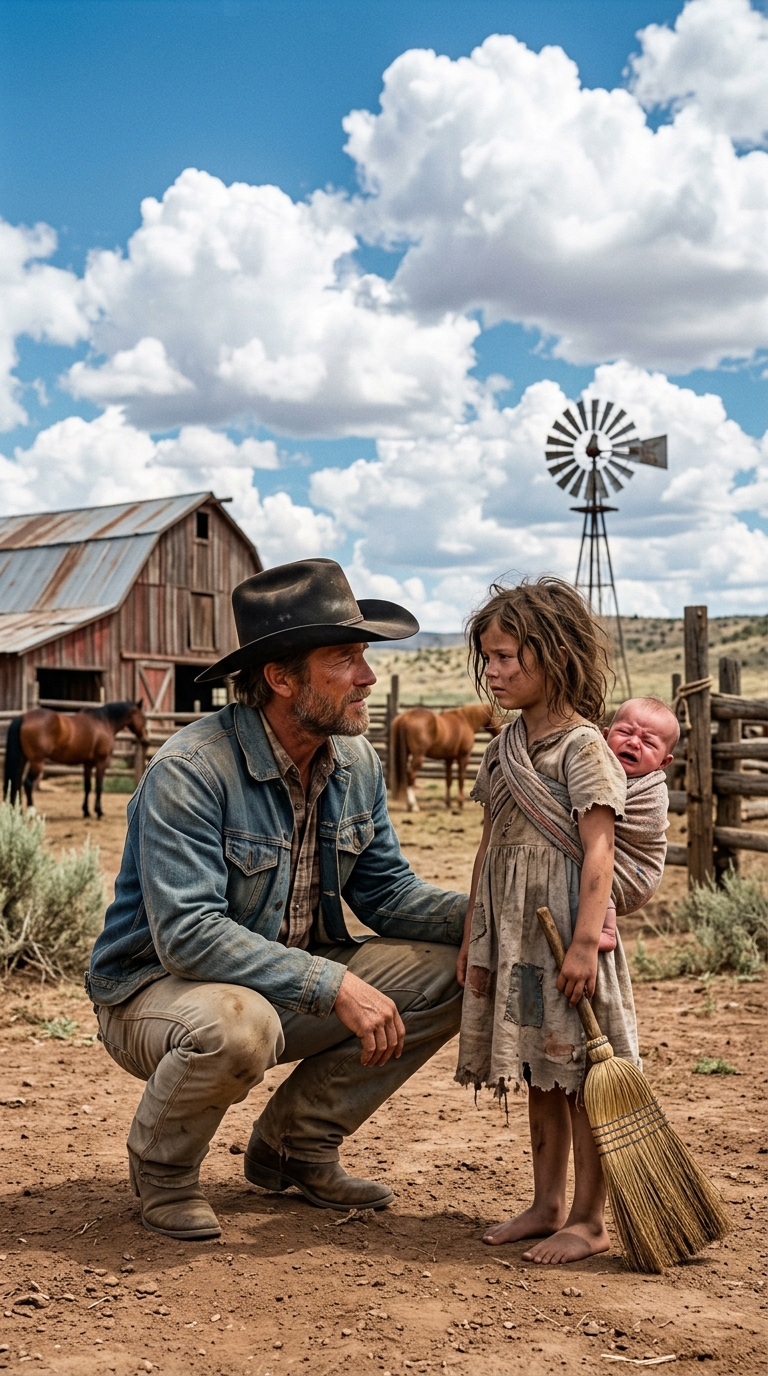
Luz Valenzuela was 4 years old when she reached the eighth door that night, her feet purple, her lips cracked, and her little brother tied to her back with an old shawl.
The cold of the Sierra de Chihuahua was unforgiving. It was January, the air cut like a knife, and the mist descended between the pines as if it wanted to swallow the path.
Mateo, who was 14 months old, had stopped crying.
That was what scared Luz the most.
A hungry baby cries, kicks, searches for the breast, and fusses. But Mateo had been quiet for nearly three hours, pressed against her back, breathing so faintly that she had to stop every few moments to check if he was still alive.
At the first house, a woman opened the door just a crack.
“Ma’am, my little brother hasn’t eaten since yesterday. I can sweep, mop, wash dishes. We don’t want to be any trouble.”
The woman looked at the baby, then at the dark street.
“And your parents?”
“My mom died. My dad left and never came back. We were living with my Aunt Tere.”
The crack in the door grew smaller.
“That’s something for the DIF to handle, child. I don’t get involved in trouble.”
And she closed the door.
At the second house, a man with a drunkard’s voice didn’t even let her speak.
“We don’t give handouts here. Get lost before I set the dog on you.”
At the third house, a woman gave her half a cold tortilla with a tiny piece of cheese but wouldn’t let her inside.
“Forgive me, mija. If my husband finds out, he’ll make a scene.”
Luz sat down beside a post. She soaked the tortilla in melted snow and brought it to Mateo. The boy sucked on it slowly, without strength.
She ate nothing.
“Hold on, Mati. Just a little longer.”
The fourth door was closed.
The fifth had a light on, but no one would come out.
At the sixth, they told her that other people’s children brought problems.
At the seventh, a woman prayed for her from the window but didn’t open the door.
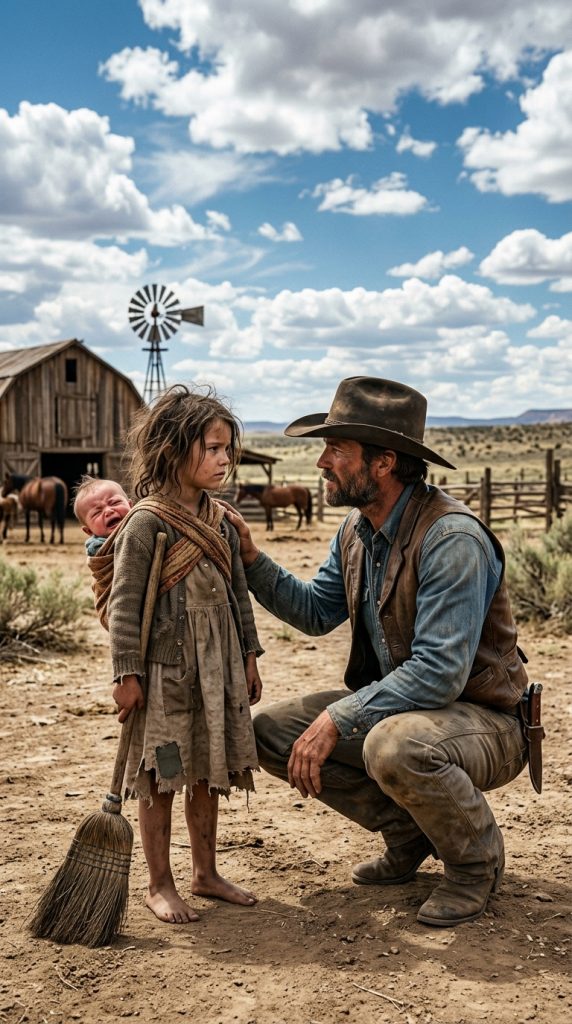
By the time Luz reached Rancho El Encino, she could no longer feel her legs. It was an old adobe house with a tin roof, a yellow lamp glowing in the window, and smoke rising from the chimney.
There were two horses under a shed, shaking their heads against the cold.
There was life there.
Maybe there was a heart there too.
Luz knocked with her cracked knuckles.
No one answered.
She knocked again, harder.
The door opened and a tall, gray-haired man appeared, wearing a flannel shirt and holding a cup of coffee. His face looked tired—the kind of face that had cried a lot in silence.
“Virgin Mary… what are you doing here, child?”
Luz tried to say the phrase she had repeated all the way there, but her voice broke.
“My little brother is hungry. I can work for food.”
The man looked at the bundle on her back. He looked at her bleeding feet. He looked at the frozen shawl wrapped around the baby.
Something cracked in his eyes.
“Come in. Right now.”
His name was Jacinto Valdés. He had lived alone since his wife Rosa died six years earlier. At first, he didn’t ask too many questions.
He lifted Mateo from her back with large but gentle hands, as if carrying something sacred. He warmed milk in a small pot, fed it to the baby with a spoon, and sat Luz by the stove with a plate of beans, rice, and hot broth.
Luz ate four spoonfuls and set the plate aside.
“Don’t you like it?”
“Yes, sir. It’s for Mateo, in case he wakes up hungry.”
Jacinto clenched his jaw.
“No one saves hunger for later here. Eat.”
Luz looked at him with distrust, but obeyed.
Later, while Jacinto was looking for clean blankets, he saw the marks on the girl’s arms. They were thin scars, one on top of the other. They didn’t look like falls. They didn’t look like play.
“Who did this to you?”
Luz lowered her gaze.
“My Aunt Tere. When she drank.”
“And the boy?”
For the first time, Luz lifted her face with anger.
“Not him. I got in the way.”
Jacinto felt his chest tighten.
“Is that why you ran away?”
The girl hugged the warm cup with both hands.
Outside, the wind slammed against the door.
“I left because I heard my aunt say she was going to sell Mateo.”
Jacinto froze.
“What do you mean, sell him?”
Luz swallowed.
“She said on the phone that a man from Juárez would pay 800 pesos for a healthy boy. She said I was in the way, but Mateo was still useful.”
At that moment, the horses whinnied loudly outside.
Jacinto went to the window and saw lights moving along the dirt road, heading straight for the ranch.
Luz saw them too.
Her face went white.
“It’s her. She’s come for us.”
PART 2
Jacinto turned off the lamp with a quick motion and signaled Luz to stay quiet.
The lights approached slowly, illuminating the fence, the pines, and the old gate. The girl hugged Mateo tightly to her chest, as if her arms could hide him from the entire world.
A gray pickup truck stopped for a few seconds in front of the ranch.
No one got out.
Then it moved forward a few meters, turned around, and disappeared into the mist.
But Luz never breathed normally again.
That night she refused to lie down. She stayed seated beside the drawer where Jacinto had settled Mateo among blankets, with one hand slipped under the cover to feel his chest.
Jacinto didn’t force her.
He simply added more wood to the fire.
At dawn, he found her standing on a chair, beating eggs in a tin pan. She was wearing Rosa’s flowered apron, tied twice around her waist because it was far too big.
“What are you doing, kid?”
“Breakfast. You don’t have to give me anything for free. I can cook, sweep, wash clothes, and feed the animals if they don’t bite.”
Jacinto stood in the doorway.
This girl wasn’t asking for a home.
She was offering a deal, because life had taught her that even a plate of food had a price.
“Children don’t pay to eat here,” he said.
Luz kept beating the eggs.
“They did at my aunt’s house.”
Jacinto didn’t reply. He simply went out to the corral, washed his face with ice-cold water, and looked up at the sky as if complaining to God.
That same day he went to town.
At the grocery store, everyone was already talking about it. That a girl and a baby had arrived at the widower Jacinto’s ranch in the middle of the night. That who knows what a man alone was doing with other people’s children. That the right thing was to notify the DIF. That family, even if bad, was still family.
Jacinto listened, bought milk, diapers, sweet bread, and a new blanket.
Then he went straight to Licenciada Salma, the municipal social worker, and afterward to the commander.
“I don’t want to hide anything,” Jacinto said. “But I’m not going to hand these children back to the wolf’s mouth either.”
Salma, a woman with glasses, a calm voice, and a firm gaze, took note of everything.
“If what the girl says is true, we have to protect them. But we need to do things the right way.”
“Do them the right way, Licenciada. But do them quickly.”
When Jacinto returned to the ranch, Luz was mopping the kitchen with Mateo sitting on a blanket, eating mashed banana with his fingers.
“Some people are coming to ask questions,” he said.
Luz set the mop down.
“People who ask questions always end up taking something.”
Jacinto knelt in front of her.
“I’m not going to let them take your brother away.”
“You can’t promise that.”
The old man swallowed.
“You’re right. But I can promise you that if anyone tries to do it wrong, they’ll have to go through me.”
The next day Salma and the commander arrived.
As soon as Luz saw the uniform through the window, she picked up Mateo and hid in the storage room under the stairs. Jacinto knelt in front of the door.
“Luz, no one is going to touch you without your permission.”
“My aunt used to say the same thing when government people came.”
“I’m not your aunt.”
“But they are government.”
The statement left everyone silent.
Salma sat on the floor on the other side of the door.
“I’m not here to take you away, Luz. I’m here to listen. No one is going to rip Mateo out of your arms today.”
Many minutes passed.
Then the door opened just a little.
Luz came out with her chin raised, carrying Mateo as if she were an old mother trapped in a child’s body.
Salma spoke to her gently, without touching her.
She asked if Jacinto had hurt her.
Luz looked at the old man.
“He opened the door.”
That was all.
But it was enough for Salma to lower her gaze.
The problem didn’t end there.
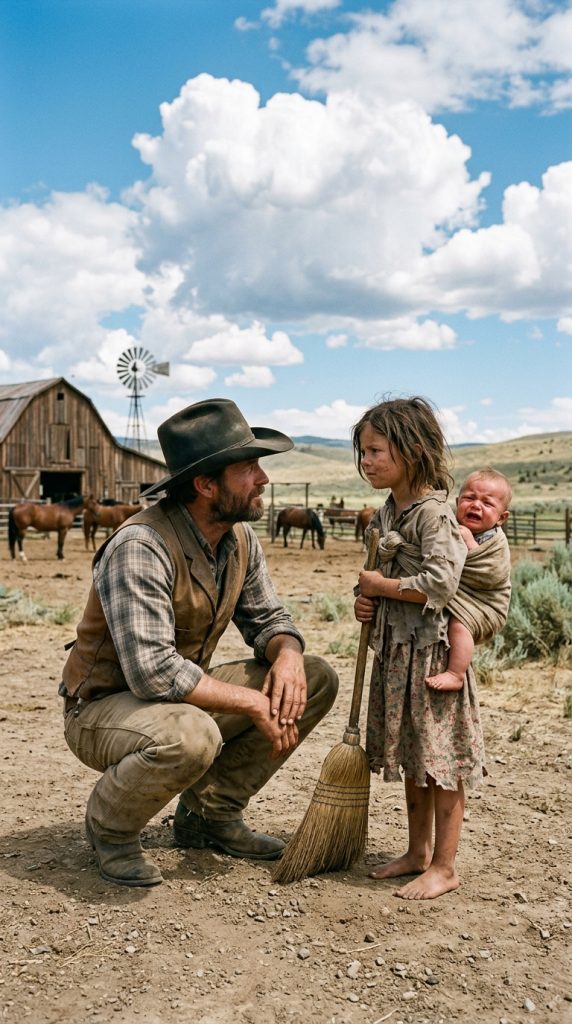
That same afternoon, a gray pickup truck parked in front of the gate. Teresa Paredes, Luz’s aunt, got out wearing a black dress, red lipstick, and clutching a folder tightly to her chest.
She was accompanied by a skinny lawyer in a cheap suit and an unknown man who couldn’t take his eyes off Mateo.
“Those children are mine by blood!” Teresa shouted. “That old man stole them from me!”
Luz hid behind Jacinto.
Teresa raised some papers.
She had filed a kidnapping report. She claimed Luz was a lying child who had run away because of a tantrum and that Jacinto wanted to keep the government support money.
“I took them in when no one else wanted them!” she yelled. “I gave them a roof, food, a family!”
Jacinto didn’t open the gate.
“Food? The girl arrived with the baby nearly dead from hunger.”
Teresa let out a laugh.
“Oh please. She was always dramatic. Just like her mother.”
Then the unknown man stepped forward. He wore new boots, a leather jacket, and had a crooked smile.
“Look, Doña Tere, don’t drag me into your problems. I was already promised the boy. If you don’t hand him over today, I want my money back.”
A heavy silence fell.
Salma, who was still at the ranch, froze.
The commander placed his hand on his radio.
Teresa turned furiously toward the man.
“Shut up, idiot!”
But it was too late.
Mateo began to cry, and Luz covered her ears as if that phrase had confirmed the nightmare was real.
The case reached the family court in Cuauhtémoc three days later.
Luz entered wearing a blue dress that Salma had gotten her from a donation. Her hair was braided by herself—crooked, but firm. She didn’t let go of Mateo until Jacinto sat beside her.
Teresa arrived perfumed, made up, and offended.
Her lawyer spoke of legitimate custody, family rights, and a “suggestible” child. He said Jacinto was a man alone, old, with no experience caring for minors.
Teresa cried in front of the judge.
“I only wanted to give them a home. This girl was always rebellious. She makes things up because she doesn’t want to obey.”
For a moment, some people in the courtroom seemed to doubt.
Then Salma placed the reports on the table.
There were ignored neighbor complaints from months earlier. Receipts for support money collected by Teresa for eight months. No kindergarten enrollment. No medical visits for Mateo. Photographs of Luz’s arms. A doctor’s certificate confirming mild malnutrition in both children.
Afterward, Doña Elvira, the neighbor who had given her half a tortilla, entered.
She came in pale, trembling, hands clutching her purse.
“I heard Teresa say the boy was worth 800 pesos,” she confessed. “I also saw Luz washing floors in two houses while carrying the baby. Once I wanted to speak up, but I was afraid. I was afraid to get involved.”
Teresa jumped to her feet.
“You old gossip!”
The judge slammed the table.
“Sit down.”
Doña Elvira began to cry.
“That girl did what we adults didn’t have the courage to do. She carried her little brother and left.”
Then the judge asked to hear from Luz.
Jacinto wanted to accompany her, but she shook her head.
She walked alone to the front. She barely reached the table, but her voice came out clear.
“I know I’m little. But I do know when someone loves a child and when they only want what they get for having one. My aunt didn’t love Mateo. She wanted to sell him. And she hit me because I wouldn’t let her.”
The judge took off his glasses.
“Why do you want to stay with Mr. Jacinto?”
Luz looked at the old man.
Jacinto had Mateo sleeping against his chest.
“Because he didn’t ask how much we cost before opening the door. Because when I told him I could work for food, he said children don’t pay to eat. Because Mateo no longer falls asleep hungry. And because when I’m afraid a door will close, he opens it again.”
No one spoke.
Not Teresa’s lawyer.
Not the commander.
Not Salma, who wiped her eyes without hiding it.
The turning point came when the man from the truck, pressured by the Public Prosecutor, confessed that he had given money as a “deposit” for the boy.
He didn’t call it a sale.
He called it “a favor.”
But everyone understood.
The judge granted immediate provisional custody to Jacinto Valdés, opened a criminal investigation against Teresa Paredes, and ordered an urgent review for institutional negligence.
Teresa left in handcuffs, screaming that Luz was an ungrateful child.
The girl didn’t turn around.
At that moment, Mateo woke up, stretched out his little hand, touched Jacinto’s white beard, and said softly:
“Papa.”
Jacinto closed his eyes.
Luz looked at him with fear.
“Is it okay for him to call you that?”
The old man swallowed.
“It’s okay. And if one day that word is born in you too, it will be here.”
That night they returned to Rancho El Encino.
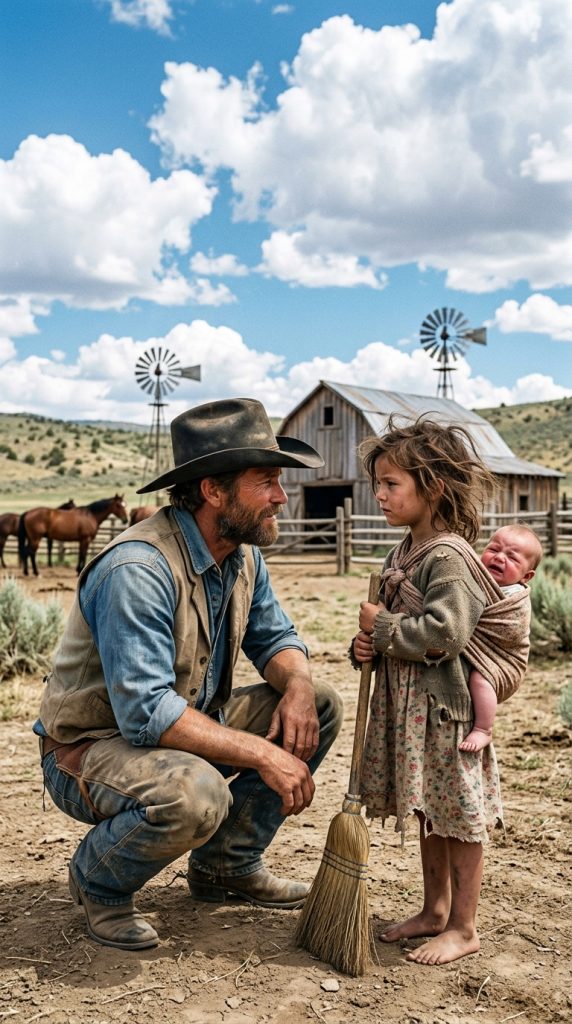
Luz ate a full plate for the first time without hiding food for Mateo. Afterward she stood staring at the front door, as if she still couldn’t believe no one would take them away.
Jacinto found her touching the doorknob.
“What are you doing, child?”
“Nothing. I just wanted to see if it was still open.”
Jacinto opened the door. Cold air entered, carrying the scent of pine and damp earth. Then he closed it slowly and placed his hand over hers.
“This door will never close on you again. Not while I’m still breathing.”
Luz said nothing.
She simply hugged him with all the strength she had left, finally releasing the weight of the seven closed doors, the hunger, the beatings, and the night.
From then on, every winter Jacinto left a lamp burning in the window of the ranch.
Not out of habit.
But in case some lost child needed to find a home where no one would ever again ask how much it cost to save them.
