

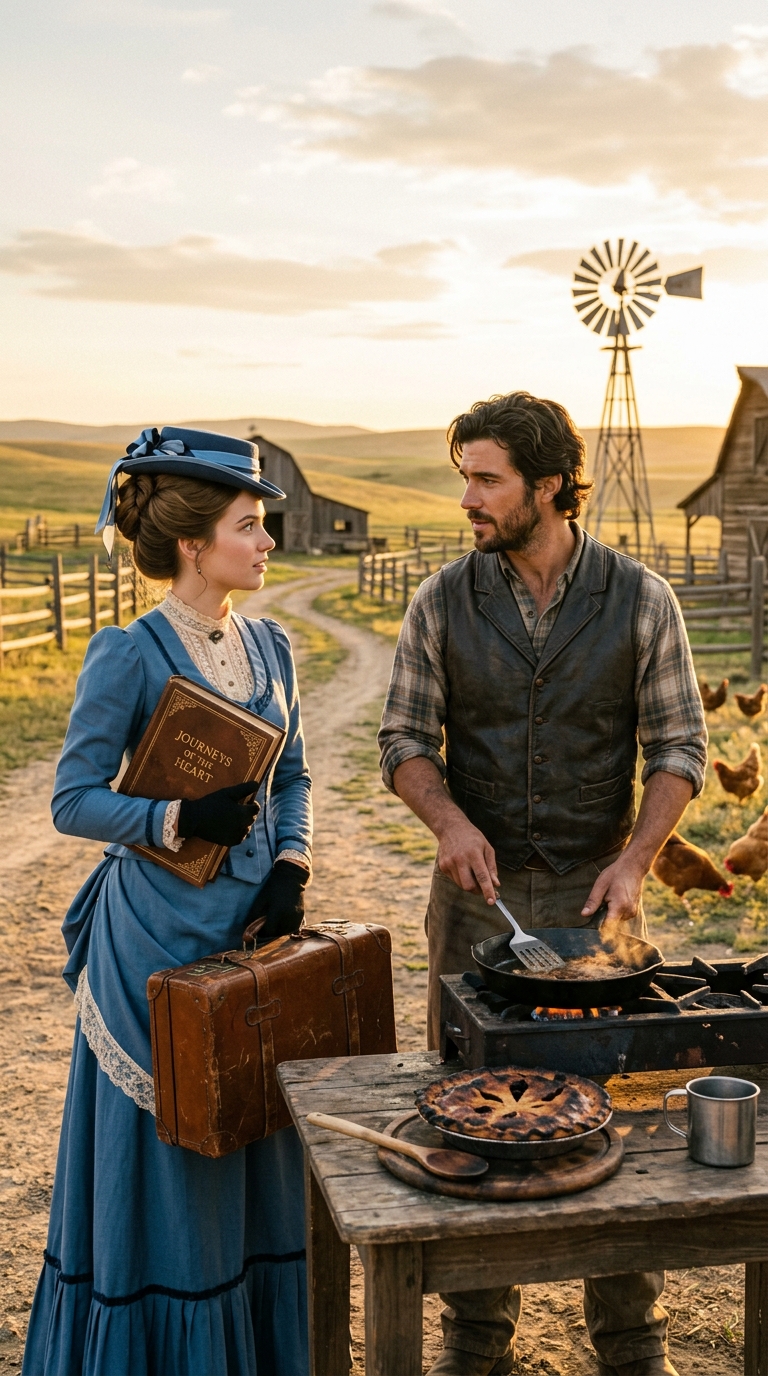
Two letters, two lies.
Chihuahua, 1885.
Aurelio Soto’s letter said that he owned a prosperous ranch in the Casas Grandes valley, with fertile land, a comfortable house, and good relations with the community.
It did not say that the “prosperous ranch” consisted of sixty hectares of hard land, barely tamed by the plow. It did not say that the “comfortable house” was a two-room cabin with a dirt floor, a roof patched with old tin sheets, and walls through which the wind entered without asking permission. Nor did it say that his “good relations with the community” consisted of a Tarahumara neighbor who spoke little Spanish, a skinny dog named General, and a merchant who would only extend him credit for beans when he was in a good mood.
Mariana Paredes’s letter said that she was a cultured, educated young woman, skilled in the domestic arts.
It did not say that Mariana had never lit a wood stove, had never milked a cow, had once burned water while trying to make tea, and that her greatest domestic achievement had been arranging flowers in a porcelain vase without breaking it.
Both of them had lied.
And, without knowing it yet, they were perfect for each other.
Aurelio Soto was thirty-four years old, his skin tanned by the northern sun and his body lean, straight, and resilient like old mesquite wood. He had spent six years rising before dawn to turn that piece of wild land into something resembling a ranch. If one looked with hope, one could see furrows, fences, a half-functional well, and a corral that held together more out of stubbornness than good construction.
Aurelio had not sought a wife for love.
He had written to a matrimonial agency in Mexico City because he needed to survive. He needed a woman who knew how to cook, salt meat, preserve food, take care of chickens, milk a cow, and maintain a house that did not smell of a solitary man, old leather, and burnt coffee.
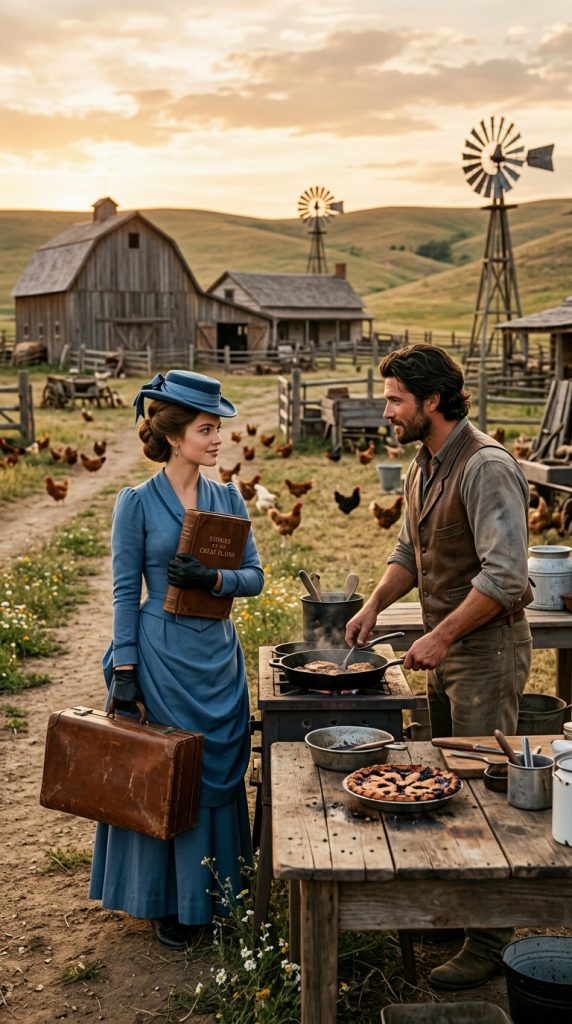
Mariana arrived by train one September afternoon.
Aurelio waited for her at the station in his only white shirt, washed with so much soap that it had almost lost its color. He had shaved for the first time in two weeks and had combed his hair with water, though the Chihuahua wind had already undone all his effort.
When Mariana stepped down from the train car, she wore an elegant little hat, a light parasol, fine gloves, and an expression of pure horror.
Aurelio’s first thought was:
“She’s pretty.”
Then he thought:
“She brought a parasol to Chihuahua.”
And finally:
“I have just made the worst mistake of my life.”
Mariana observed the dusty station, the men in wide-brimmed hats, the carts, the dogs lying in the shade, and the empty horizon.
“Where is the town?” she asked.
Aurelio pointed behind them.
“We just left it.”
Mariana blinked.
“That was a town?”
Aurelio did not know what to answer.
During the ride to the ranch, she did not speak much. She sat in the cart, holding her little hat so the wind would not carry it away, gazing at the dry land with a mixture of fear, disappointment, and wounded dignity.
When they arrived, Mariana got down slowly.
She looked at the cabin.
She looked at the dirt floor.
She looked at the wood stove, held together with wire and a faith that seemed more religious than practical.
“Your letter said comfortable house,” she said.
Aurelio removed his hat.
“It’s comfortable compared to sleeping under a cart.”
Mariana looked at him coldly.
“I have never slept under a cart, Mr. Soto. That comparison does not help me.”
That first night, Mariana tried to prepare dinner.
She had written to the agency that she had experience managing a household. Technically it was not a lie: in her father’s house in Puebla, she had given orders to cooks, laundresses, and maids. The problem was that giving orders and doing the work with her own hands were completely different skills.
The biscuits came out raw inside and hard outside. The coffee was so strong that Aurelio thought it could be used to strip paint. The beans were burnt at the bottom and stiff on top, a combination he had not believed possible until that night.
Aurelio ate everything.
He did not say a word.
Afterward, he washed the dishes himself while Mariana remained seated at the table, her back straight and her eyes fixed on her hands, making a heroic effort not to cry.
What Aurelio did not know was that Mariana’s disappointment was as deep as his own.
And for reasons he could not even imagine.
Mariana Paredes had not come north because she wanted to marry a rancher. She had come because she no longer had anywhere to return to.
She was the third daughter of an old banker from Puebla who had lost everything in a bad investment involving railways and mines. The family home was sold. The servants were dismissed. Her two older sisters had married before the ruin, one to a wealthy lawyer and the other to a landowner in Morelos.
Mariana had not been so lucky.
At twenty-six years old, unmarried, without a profession, without a dowry, and living in her sister’s guest room, she understood that family charity could be served on fine china and still taste like humiliation.
The matrimonial agency had been her idea.
Not because she dreamed of a husband.
But because she wanted to stop being a burden.
She read Aurelio’s letter and imagined a serious man, owner of land, perhaps rough, but honorable. She imagined a simple house with a small library, a clean table, chickens in the yard, and quiet afternoons looking at the mountains.
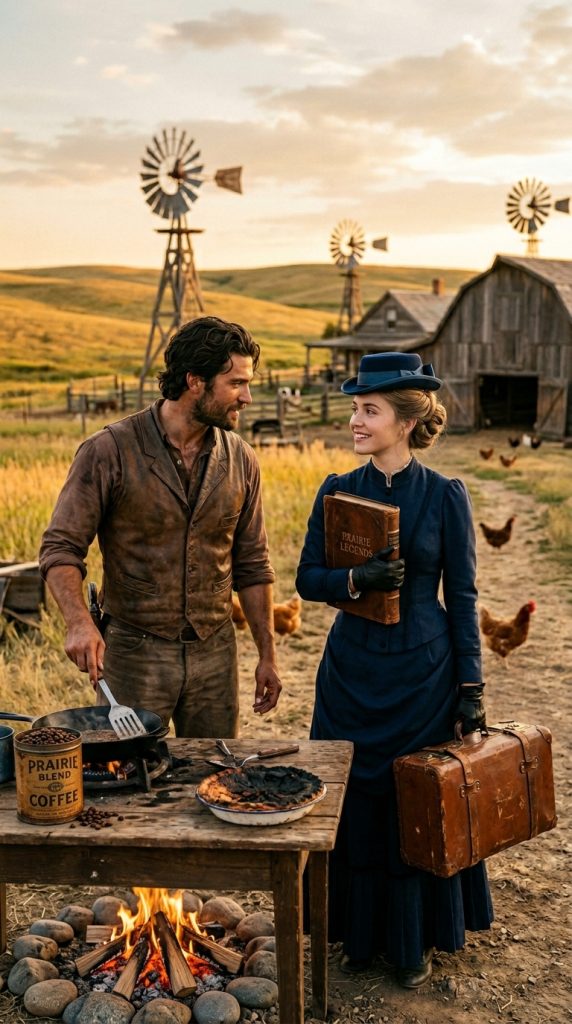
What she found was a cabin where the wind whistled through the cracks, a man who smelled of horse and earth, a cow that looked at her as if it knew she was useless, and a single book in the entire house: a 1882 seed catalog.
That night she did not cry in front of Aurelio.
She waited until he fell asleep.
Then she went out to the porch, sat on a wooden crate, and cried silently under a sky so full of stars that it seemed a cruel mockery.
So much beauty above so much hardship.
The next morning, Mariana made a decision.
She was not going to love this place.
She was not going to accept it.
But she was going to learn it.
Because she had spent her entire life being decorative, educated, proper, and useless. And she was tired.
She entered the kitchen at five in the morning. Aurelio was lighting the stove.
“Teach me,” she said.
He looked up.
“Teach you what?”
“Everything. How to cook. How to milk. How to make bread. How to preserve food. How not to die here.”
Aurelio observed her.
He had expected a woman who already knew how to do those things. Instead, he had a young lady from Puebla with soft hands, wearing a skirt that probably cost more than his cow, asking him to teach her how to survive.
“Do you really not know how to cook?” he asked.
“I really don’t.”
“Nothing?”
“Nothing useful.”
“And you plan to learn?”
Mariana lifted her chin.
“I have a good memory. I just lack experience.”
Aurelio wanted to laugh, but he didn’t.
For the first time since he saw her step off the train, he felt something like respect.
The following months tested them both.
Not because the work was hard, though it was. But because learning to live with a person you don’t yet understand is harder than plowing dry land.
Mariana learned to cook.
At first badly. Then acceptably. Later, surprisingly well.
The biscuits went from being throwable weapons to real food. The coffee stopped resembling divine punishment. She learned to salt meat, dry apples, preserve chiles, mend trousers, light fires with damp wood, and read the sky to know if frost was coming.
Her hands filled with blisters.
Then they cracked open.
Then they healed.
And afterward they became different hands: hands that carried, kneaded, gripped, and held.
Aurelio also learned.
He learned that he did not need just a cook. He needed a voice in the house. A conversation at the end of the day. A woman who, even though she couldn’t tell a mule from a donkey in the first week, was capable of getting up before sunrise without complaining.
Mariana had brought only one book from Puebla, hidden among her dresses: a worn volume of poems by Sor Juana.
One November night, while the wind battered the cabin outside, Mariana began to read aloud.
Aurelio, who had only ever used words to buy, sell, pray, or curse when a fence broke, sat motionless.
He had never heard language used for beauty.
Not to give instructions.
Not to ask for credit.
Not to survive.
But to accompany the soul.
A few days later, he built a shelf for the book.
It was not straight. The boards were poorly cut and the nails stuck out everywhere. But Mariana looked at it as if it were a palace piece of furniture.
“It’s the first gift I’ve received that was thought for who I am,” she said.
Aurelio looked down, uncomfortable.
“It’s just a crooked shelf.”
“No,” she replied. “It’s a place for something I love.”
In January, more books arrived from Puebla. Her sister sent the few that had not been sold with the family furniture. Aurelio started by reading the seed catalog, then an agriculture manual, then a short novel, and finally one night returned to the table with Sor Juana’s book.
“I don’t understand everything,” he confessed.
Mariana smiled.
“You don’t need to understand everything to feel it.”
They were not in love yet.
But they were teaching each other.
And sometimes love begins like that: not like fire, but like patience.
The moment when everything changed came during the coldest night of winter.
It was the nineteenth of January, 1886.
The cold fell over the valley like a curse. The water in the bucket turned to ice. The wind entered through the cracks like little knives. Outside, the dog General refused to leave from under the table, and Aurelio said he had never seen an animal with so much common sense.
At midnight, the best cow on the ranch began to give birth.
Aurelio got up abruptly.
Mariana did too.
“I’ll be back soon,” he said, putting on his coat.
“I’m coming with you.”
“No.”
“Yes.”
“Mariana, it’s freezing cold out there.”
“Then you shouldn’t go alone.”
He argued no further.
In the stable, the cow was lying down, breathing with difficulty. Aurelio knelt beside her and immediately understood the problem.
The calf was coming in the wrong position.
He needed both hands to help it out. He needed light. He needed calm. For six years he had worked alone, and more than once he had lost animals because he lacked an extra pair of hands.
That night, Mariana held the lamp.
She held it for forty-five minutes.
The cold bit at her fingers. The wind came through the boards. Her arms trembled. Tears froze on her eyelashes.
But she did not let go of the light.
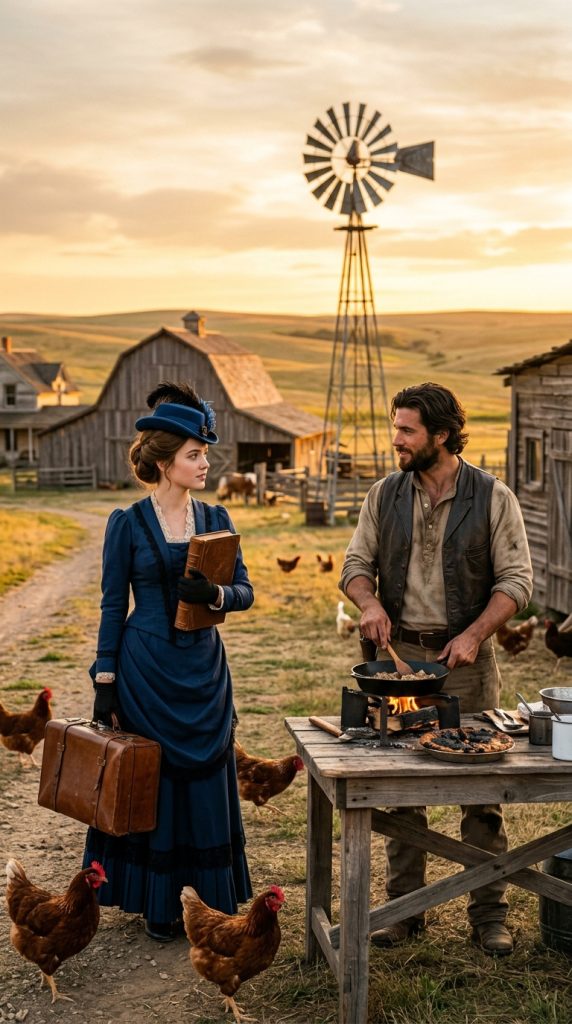
Aurelio struggled with the calf, spoke softly to the cow, sweated in the middle of the ice, and when it seemed everything was lost, the calf came out alive, wet, trembling, breathing.
Mariana let out a sound that was half laughter and half sob.
Aurelio took the animal in his arms and brought it close to its mother. Then he turned to her.
Mariana was pale. Her hands remained clenched around the handle of the lamp, but she could no longer open her fingers.
Aurelio carefully took the lamp from her.
He took her hands in his and began to blow on them, slowly, finger by finger.
“Your letter said prosperous ranch,” she murmured, her lips purple.
Aurelio smiled faintly.
“Yours said expert in household chores.”
Mariana let out a weak laugh.
“We are terrible liars.”
“Yes.”
“But I wouldn’t change my letter.”
Aurelio looked at her.
The stable smelled of hay, milk, newborn animal, and cold. The lamp barely illuminated Mariana’s tired face, her hair escaping from its pinning, her injured hands, her eyes full of a strength he had not known how to see at the beginning.
“I wouldn’t change mine either,” he said.
And then they understood.
They did not have what they had asked for.
They had something better.
At dawn, they returned to the cabin. Mariana prepared coffee, this time perfect. Aurelio watched her move around the kitchen with the confidence of someone who had conquered a world through sheer stubbornness.
“Mariana,” he said.
She turned.
“When I wrote to the agency, I was looking for a wife to survive.”
“I know.”
“But now… I don’t want to survive with you.”
Mariana stood still.
Aurelio swallowed.
“I want to live with you.”
She lowered her gaze, and for the first time since she arrived in the north, she did not think of Puebla, or the lost house, or the life that no longer existed.
She thought of the crooked shelf.
Of the living calf.
Of the bread rising next to the stove.
Of that quiet man who had learned to listen to poetry.
“Then let’s do it right,” she said.
They were officially married in March 1886, in the small church in the town. Mariana wore a dress she had sewn herself. Aurelio wore the same white shirt from the station, this time better ironed. The Tarahumara neighbor attended with his family. The merchant who used to extend him credit for beans brought sweet bread. The dog General lay down at the church door as if he were the godfather.
There was no elegant party.
There was atole, violin music, hot tortillas, and a simple happiness, the kind that does not need rich witnesses to be true.
Over the years, the sixty hectares became one hundred twenty, then two hundred. They raised cattle, planted corn, wheat, and chiles. They had four children: Elena, Tomás, Inés, and Rafael.
Mariana taught them all to read before they turned five.
Aurelio taught them to work before they turned seven.
The dirt-floor cabin became a solid wooden house, with large windows and a library that occupied an entire wall. Aurelio built that wall with his own hands. At first badly. Then better. Mariana never stopped saying it was the most beautiful part of the house.
With time, she became famous in the valley for her cooking. Her breads, her preserves, her stews, and her atoles were talked about at baptisms, weddings, and gatherings.
She always replied:
“I’m not that good. It’s just that everyone here had very low expectations.”
Aurelio, for his part, read every book in the library. One afternoon, a neighbor asked him if he regretted having asked for a wife by letter.
Aurelio looked toward the house, where Mariana was reading in the shade of the mesquite.
“I asked for a cook,” he said, “and I got a library. It was the best deal of my life.”
Many years later, when their children already had children of their own, Mariana found the two original letters kept in a box.
Aurelio’s, with its prosperous ranch and comfortable house.
Hers, with her imaginary domestic talents.
She read them sitting beside him on the porch, while the sun set over the fields they had built together.
“We were such frauds,” Mariana said.
Aurelio smiled.
“Yes.”
“Were you scared when you saw me get off the train?”
“Terrified.”
“Me too.”
He took her hand, now wrinkled, strong, marked by a full life.
“Good thing you lied.”
Mariana rested her head on his shoulder.
“Good thing you did too.”
Aurelio died in 1918, surrounded by children, grandchildren, and books. Mariana lived until 1932. Every afternoon until the end, she read poetry aloud, even though there was no longer anyone sitting in front of her.
She said that beautiful words also nourished.
And in that house in the north, built on hard land, burnt biscuits, a cow in labor, and two letters full of lies, a truth remained stronger than any written promise:
Sometimes life does not give you what you asked for.
It gives you the person who can teach you to turn everything into home.
