

The doorknob turned again, this time more slowly.
Then I heard it.
Two sets of footsteps moving inside the house.
My son, Noah, pressed himself closer against me on the bathroom floor, his forehead damp with sweat, his breathing thin and uneven. I still had 911 on the line, the phone gripped so tightly that my fingers had gone numb.
“They’re on their way,” the operator said quietly. “Do not open that door under any circumstances.”
My husband entered first.
I recognized Daniel Carter immediately—not by sight, but by the cadence of his steps. Fast. Controlled. The same assured pace he used whenever he believed control belonged to him.
The woman with him wore heels.
Narrow heels.
Each click across the hardwood echoed through the house like a ticking clock.
“They’re not here,” she said, uneasy.
A suitcase dropped onto the floor.
“What do you mean they’re not here?” Daniel snapped.
Cabinets swung open.
Drawers were pulled out and slammed shut.
I heard him moving through the kitchen, then the living room.
Then his steps shifted.
Toward the hallway.
Toward us.
Noah’s fingers tightened around my wrist.
I ran my hand through his hair, trying to soothe him even as my own hands shook uncontrollably.
The bathroom handle shook violently.
“Rachel,” Daniel called.
The soft tone he usually used was gone.
“Open the door.”
I said nothing.
The handle rattled harder. “I know you’re in there.”
The woman spoke again.
Her voice trembled now.
“Daniel, maybe we should leave.”
“Be quiet.”
His palm struck the door.
Once.
Then again.
Harder.
Noah flinched against me.
“Rachel, listen,” Daniel said. “Things got out of hand. Open the door and we’ll talk.”
I leaned toward the phone.
“He’s here,” I whispered. “He’s trying to get in.”
The operator answered immediately.
“Officers are outside. Stay where you are.”
Then everything broke at once.
Sirens cut through the distance.
A heavy knock shook the house.
“Police!”
The woman gasped.
Daniel cursed.
His footsteps ran away from the bathroom.
Shouting erupted near the front door.
Then a struggle.
I unlocked the bathroom door.
Noah could barely stand, so I wrapped my arm around him and guided him into the hallway.
Two officers entered, weapons drawn but lowered.
Daniel immediately raised his hands.
The shift was instant.
The man who had spoken about our deaths half an hour earlier vanished.
In his place stood a shaken husband.
A worried father.
A liar.
“Thank God,” he said, forcing calm. “My wife is having a breakdown. My son got sick, and she started making insane accusations.”
“He poisoned us!” I shouted.
My voice broke.
But it came out.
The room went silent.
One officer looked at me.
Then at Noah.
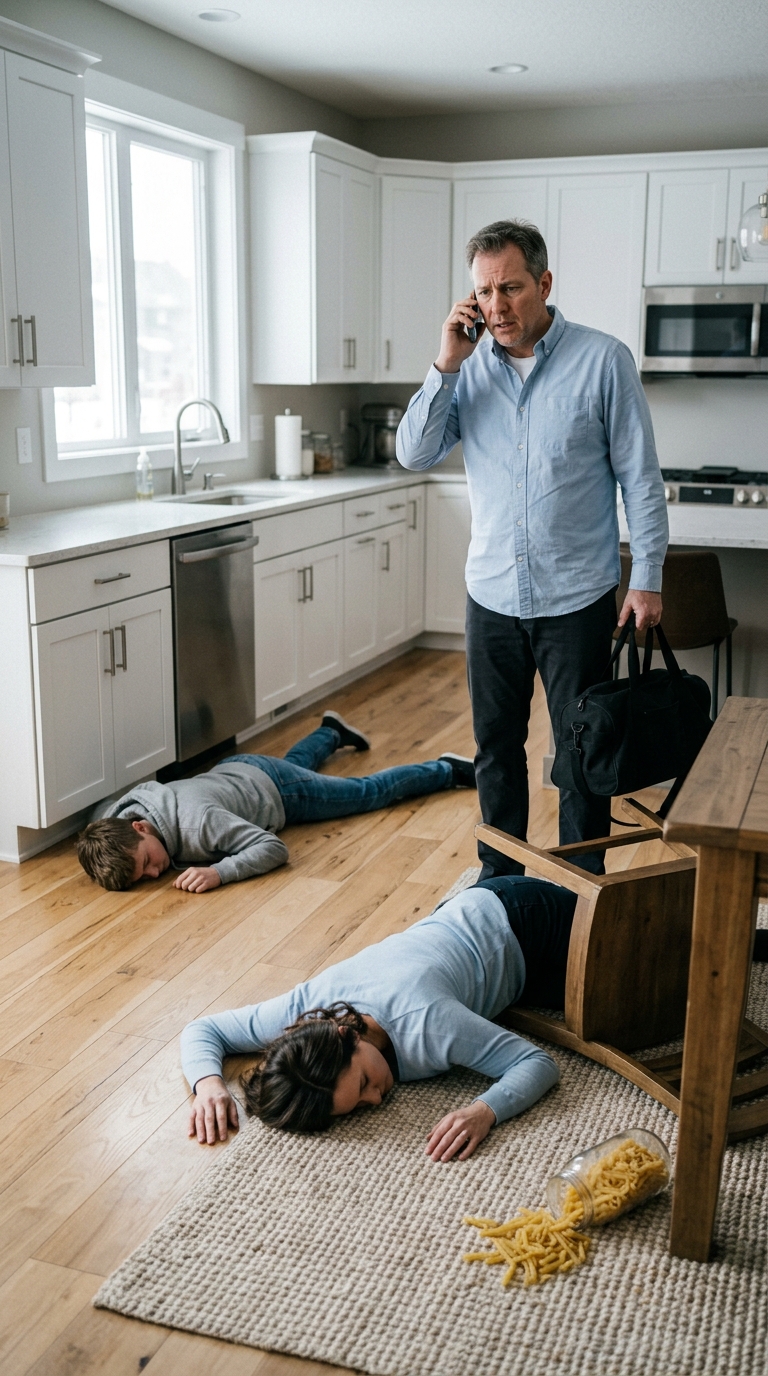
Then at the dining table.
The half-eaten plates.
The overturned chair.
The suitcase by the door.
The woman frozen beside the kitchen counter.
No explanation was needed anymore.
Within minutes, paramedics rushed us outside.
Cold night air hit my face.
It felt unreal.
They placed Noah and me into the ambulance.
I refused to let go of his hand.
As the paramedic fitted an oxygen mask over him, Noah suddenly jerked forward and vomited onto the blanket.
It was horrible.
And it was relief.
Because it meant he was still fighting.
Still alive.
At the hospital, doctors separated us briefly.
I protested.
Panicked.
But they insisted.
Eventually, a physician came to speak with me.
His expression was serious.
Careful. “We found a powerful sedative in both of your systems,” he explained. “Mixed with a veterinary tranquilizer.” I stared at him.
“In adults, it can cause unconsciousness,” he continued. “In children, it can suppress breathing.”
My knees nearly gave out.
“Will my son survive?”
The doctor paused.
That awful silence doctors use when certainty hasn’t caught up yet.
“He’s responding to treatment,” he finally said. “That’s encouraging.”
Encouraging.
Not a guarantee.
Just something to hold onto.
I spent the rest of the night clinging to those two words.
Just before dawn, a detective arrived.
His name was Detective Harrison Reed.
He carried a worn notebook and had the tired composure of a man who had spent years confronting human cruelty.
But he listened.
Really listened.
He asked questions.
And I answered every one of them.
The dinner.
The strange taste.
Daniel’s phone call.
The whisper I overheard.
The suitcase.
The woman.
Then I showed him the anonymous text message that had appeared on my phone shortly before I called 911.
DON’T EAT ANY MORE. SOMETHING IS WRONG. CALL FOR HELP NOW.
Detective Reed studied the screen.
“Do you know who sent this?”
I shook my head.
“No.”
“But it saved us.”
He nodded slowly.
Then he said something that made my stomach tighten.
“We found evidence in your trash can.”
An empty vial.
Powder residue.
Disposable gloves.
Torn packaging.
Fresh fingerprints.
Daniel had returned to the house after realizing he had left evidence behind.
What he didn’t know was that someone else had already seen it.
The next morning, my younger sister, Olivia Bennett, arrived at the hospital.
She held me carefully.
Neither of us spoke for several seconds.
Noah was stable.
Still weak.
Still recovering.
But alive.
That was enough.
Later that afternoon, Detective Reed returned.
A woman was with him.
Short dark hair.
Tan jacket.
Nervous hands.
It took me a moment to recognize her.
Susan Harper.
My neighbor.
We had lived across the street from each other for six years.
She had taken our packages.
Watered my plants during vacations.
Once driven Noah to school when my car battery died.
“I sent the text,” she said quietly.
I stared at her.
She explained everything.
The night before, she had seen Daniel leave through the side door carrying a small bag.
She watched him throw something into the kitchen trash.
It struck her as strange because we never took out trash at night.
Then he drove away.
Something felt wrong immediately.
All the lights in my house were still on.
Yet the house itself was silent.
Too silent.
Susan crossed the street.
She didn’t go inside.
But she looked through the kitchen window.
The dining table was still set.
One chair had been knocked over.
One of my shoes lay abandoned in the hallway.
Then she looked into the trash bin.
And saw the broken vial.
“I didn’t touch anything,” she said. “But I knew something was wrong.”
Tears ran down my face.
“You saved our lives.”
She began to cry too.
“I wasn’t sure,” she admitted.
“But I couldn’t ignore it.”
Later, investigators uncovered the rest.
The woman with Daniel was named Vanessa Monroe.
She wasn’t a one-time affair.
She had been involved with him for nearly a year.
At first, she claimed she believed Daniel only intended to sedate us and leave. Then detectives recovered deleted messages.
One message from Vanessa read:
And Noah too?
Daniel’s response was even shorter.
No loose ends.
When Detective Reed showed me those words, something inside me shifted.
Not fear.
Not grief.
Clarity.
This wasn’t an accident.
It wasn’t a moment of lost control.
It was deliberate.
A plan.
Daniel was drowning in debt.
Credit cards.
Private loans.
Gambling losses.
Collection notices stacking up.
Two weeks before the poisoning, he had increased my life insurance policy.
He had also researched payout procedures involving toxic substances.
He didn’t just want us gone.
He wanted it to pay off.
Noah and I stayed in the hospital for three days.
Children recover in ways adults struggle to understand.
The first time Noah managed to sit up and ask for water, I cried in the hallway.
The first time he gave me a weak smile, I cried again.
Then one evening he asked a question that broke something in me.
“Mom?”
“Yes, sweetheart?”
“Did Dad want me to die too?”
The room went painfully still.
I sat beside him and took his hand.
“Your father made a very bad choice.”
His eyes filled with tears.
“But did he want me to die?”
I tightened my grip on his hand.
“Yes.”
The truth hurt.
But lies would have hurt more.
Noah nodded slowly.
Then he whispered:
“I don’t want to go home.”
I kissed his forehead.
“We won’t.”
And I meant it.
After we were discharged, we stayed with Olivia.
Police collected our belongings.
Among them was a drawing Noah had placed on the refrigerator the morning before the poisoning.
Three stick figures.
A man.
A woman.
A child.
All smiling.
Across the top, Noah had written:
Family Night
I couldn’t look at it for long.
Daniel remained in custody.
Vanessa also faced charges.
Lawyers entered the picture.
Court dates.
Evidence hearings.
Statements.
Procedures.
But the truth of what happened doesn’t live inside legal paperwork.
The truth is this:
My son sat down to eat a meal his father served with a smile.
And survived.
So did I.
Sometimes I still wake up at night smelling cilantro that isn’t there.
Sometimes a chair scraping across the floor makes my chest tighten.
Sometimes Noah sleeps with a lamp on.
I never ask him to turn it off.
Susan visits every Sunday.
She never brings flowers.
She brings practical things.
Bread.
Batteries.
Groceries.
The kind of help that quietly holds people together when they’re trying not to fall apart.
I don’t know exactly when Noah and I will feel safe again.
Maybe safety doesn’t return all at once.
Maybe it comes back in fragments.
A full night’s sleep.
A locked door.
A laugh that doesn’t feel forced.
A future that feels possible again.
But I know one thing with absolute certainty.
The next time I see Daniel Carter…
It won’t be across a dinner table.
It will be across a courtroom.
And this time, he won’t control how the story ends.
