

PART 1
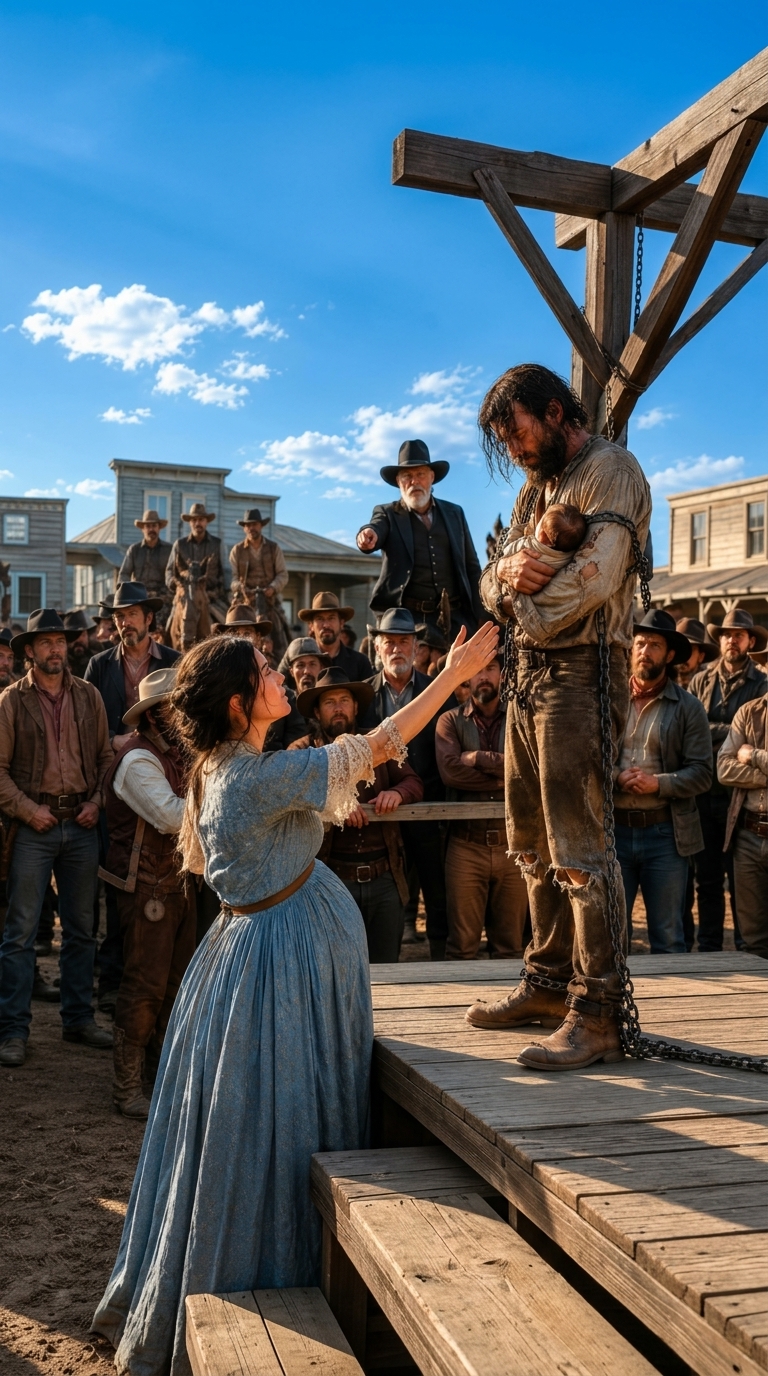
Mariana Salcedo’s blood ran cold when she saw them auctioning off a chained man with a newborn baby girl pressed tightly against his chest, as if the two of them were lost animals in the square of San Jacinto.
It wasn’t the chains that stopped her.
It was the baby.
The man stood on an old platform in front of the municipal market under a gray November sky that smelled of rain and damp firewood. He was huge, broad-shouldered, with a thick beard, torn denim clothes, and boots covered in dry mud. A long scar crossed his right cheek from temple to jaw, as if the sierra had left its signature on his face.
Yet his hands, though bound in iron, cradled the little girl with a gentleness that didn’t match his appearance.
Every time the wind blew down from the Sierra Madre, he turned his body to shield her. The baby, wrapped in a faded blue blanket, made only a weak, hungry, almost extinguished sound.
Mariana gripped the basket of eggs she carried on her arm. Her other arm instinctively protected her eight-month pregnant belly. Nine weeks earlier, she had buried her husband, Julián Salcedo, under the shade of a mesquite tree. Everyone in the village said he had been crushed by a beam in the stable.
Everyone except her.
Because the night before he died, Julián had told her in a voice that still scraped her soul:
“If anything happens to me, don’t believe anything Don Ernesto Arriaga says. And don’t sign any papers that come from him.”
Don Ernesto was there, in the front row, wearing a fine hat and a fur coat, with that calm smile of men who bought wills as easily as they bought cattle. He owned half of San Jacinto by deed and the other half by fear. He lent money to desperate peasants, funded the patron saint festival, sat in the front pew at mass, and then left entire families without land.
The town crier struck the table with a wooden paddle.
“Debt and labor contract. Name: Mateo Rivas. Outstanding amount: 815 pesos. Includes the newborn minor, at no extra charge.”
Some men laughed.
Mariana felt disgust.
A woman beside her murmured:
“They say his wife died giving birth at a loading station near Parral. He couldn’t pay the doctor or the burial.”
The man on the platform lowered his head as soon as he heard the baby cry. His beard brushed the baby’s forehead. He said nothing, but his gesture was so human, so desperate, that something inside Mariana broke.
Don Ernesto raised two fingers.
“Two hundred pesos.”
The town crier smiled nervously.
“Don Ernesto offers 200. Anyone give 250?”
No one responded.
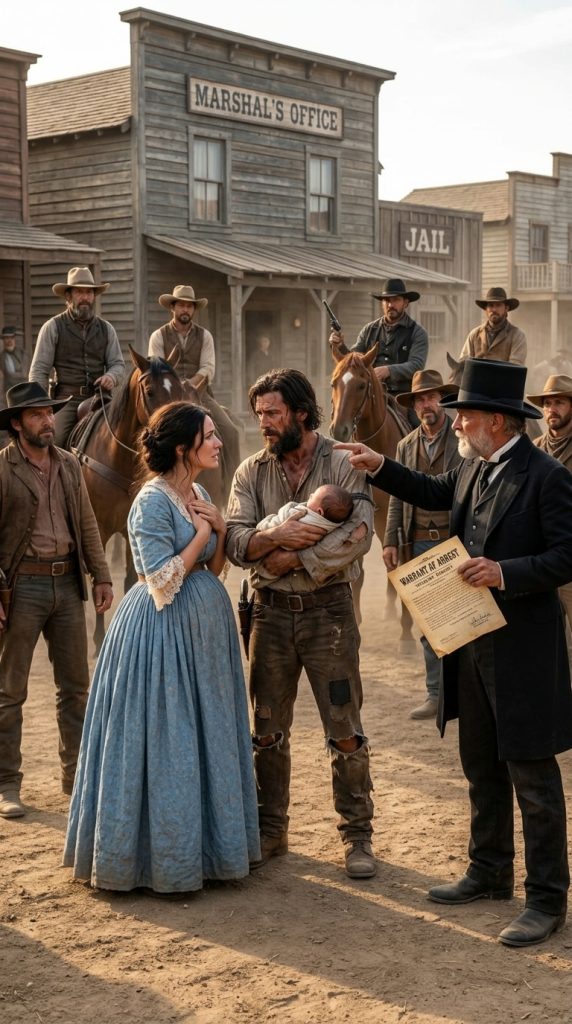
Mariana knew exactly how much money she had: 240 pesos sewn into the lining of her coat. It was for oil, corn, fabric for the birth, and to pay Doña Refugio the midwife if the baby came in the wrong position.
The baby let out another whimper.
Mariana raised her voice before fear closed her throat.
“Two hundred and forty.”
The entire square turned around.
Don Ernesto stopped smiling.
“Doña Mariana,” he said, soft as poison. “You can barely keep your ranch standing. Don’t get involved in matters you don’t understand.”
She took a step forward.
“I understand perfectly when a man with money thinks he can buy a child.”
A murmur spread through the crowd.
Don Ernesto looked her up and down, pausing at her belly.
“Three hundred.”
Mariana felt the baby inside her move strongly, as if protesting too. She didn’t have 300. She had nothing more. But then she remembered the small bag of coins she had kept in the basket — the last from that morning’s goat cheese sales.
“Three hundred and twelve,” she said.
The town crier blinked.
“Three hundred and twelve pesos?”
“Three hundred and twelve,” Mariana repeated. “And not a cent more.”
Don Ernesto tilted his head. For a moment, everyone thought he would raise the bid just to humiliate her. Then he let out a low laugh.
“Let the widow have her act of charity. I have no use for a half-dead mountain man with a screaming baby.”
The paddle fell on the table.
“Sold to Doña Mariana Salcedo.”
No one applauded.
Mateo Rivas did not thank her. He did not beg. When the blacksmith removed his shackles, he only rubbed one wrist once and adjusted the baby more securely under his jacket.
Mariana climbed onto the platform with difficulty. Up close, he looked even worse: deep dark circles, cracked lips, dried blood on his sleeve, two fingers almost purple from the cold. The little girl opened her eyes for just a moment.
“What’s her name?” Mariana asked.
Mateo’s voice came out hoarse, as if he hadn’t used it in days.
“Luna.”
Mariana looked at the contract papers.
“Can you read?”
He watched her with a mix of exhaustion and wounded pride.
“Yes, ma’am.”
That “ma’am” told her more than any explanation. This man was not a savage. Something had destroyed him, but it had not emptied him.
Mariana signed with a trembling hand. When she finished, Mateo stood waiting for orders, as if she were about to point him toward the corral or work.
But Mariana said:
“My ranch is six kilometers away, by the Laureles stream. The roof leaks, the stable is falling down, and there’s a broken fence. I can offer food. Not much. But that baby is not going to sleep in the street.”
Mateo stared at her.
“Why?”
Mariana didn’t know how to explain that she had recognized in his eyes the same darkness she saw every morning in her mirror since Julián died. She didn’t know how to say she was tired of men like Don Ernesto deciding who deserved to stand and who should kneel.
So she answered:
“Because I’m sick of the poor having a price in this town while the rich are never to blame.”
For the first time, something changed in Mateo’s face. It wasn’t gratitude. Not yet. It was surprise.
Then he held Luna more carefully and stepped down from the platform.
Don Ernesto watched her from the square without moving a single muscle in his face.
That night, as Mariana guided the cart toward her ranch with Mateo walking behind, she had no idea she had just bought the only living man who had seen how Julián was murdered.
PART 2
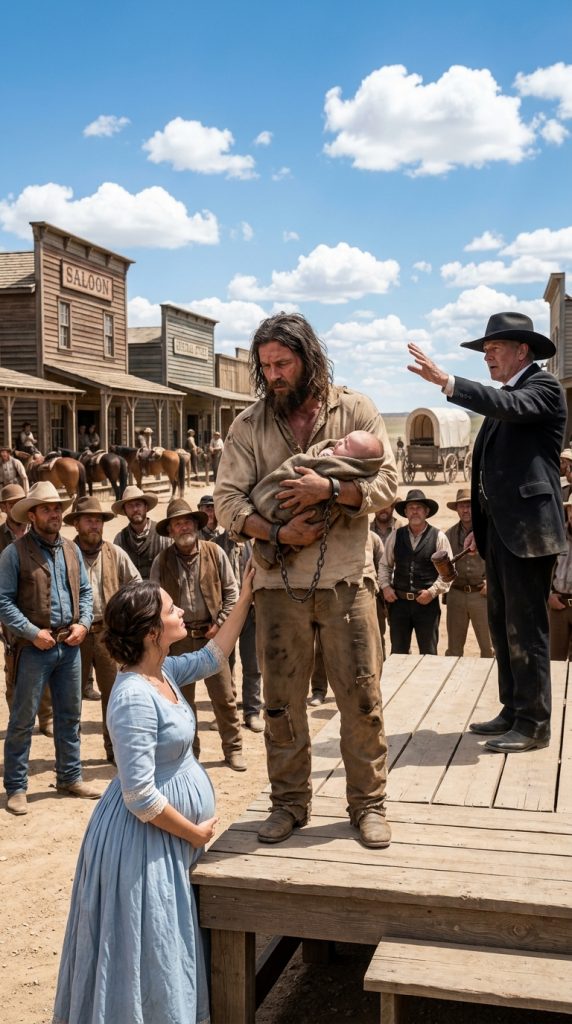
Mariana’s ranch seemed to hold itself up by sheer pride: an adobe house full of cracks, a leaning stable, four scrawny chickens, two goats, and a stream that turned into a mirror of ice in winter.
Mateo asked for neither bed nor blanket.
He left Luna near the hearth, checked the windows, the back door, the roof, the corral, and then began working as if every repaired board could pull a memory from his chest.
In seven days he fixed the chicken coop, raised the fence, patched the leak over the kitchen, and cut enough firewood for two months.
Mariana watched him move in silence, huge and tired, but every time Luna cried, he would drop whatever he was holding and go to her as if the whole world could wait.
Mariana learned small things: he slept sitting up with a machete nearby; he never turned his back to the door; he knew how to boil cloths, check for fever with his wrist, and calm a newborn baby better than many mothers.
One night, while she was sewing clothes for the child about to be born, pain shot through her back like a knife.
At first she thought it was exhaustion, then she saw the dark wetness under her skirt and felt fear.
The midwife lived fourteen kilometers away, the road was full of mud, and a storm was pounding the hills.
Mateo knelt in front of her, pale but firm.
He didn’t raise his voice.
He simply put water on to heat, arranged clean blankets, and told her to breathe.
For six hours the house was filled with screams, rain, fire, and blood.
Overcome by pain, Mariana clenched her teeth and believed she would die just like Mateo’s wife.
He wouldn’t let her sink.
He spoke to her with a hard calm, like someone who had already seen death enter through a door and had no intention of letting it pass again.
At dawn, a baby boy cried strongly against Mariana’s chest.
She named him Emiliano, as Julián had wanted.
Mateo stepped away to give her privacy, but he didn’t sleep.
He stayed up all night sitting by the door with Julián’s old shotgun across his legs, guarding Mariana, Luna, and the newborn as if they were the last frontier of the world.
Winter fell over San Jacinto, and with it came rumors.
Don Ernesto said in the cantina that Mariana had gone crazy, that she had a stranger living in her house, that a pregnant widow should not tarnish her husband’s name.
Some women stopped greeting her at the store.
The village priest suggested “prudence.”
But Mateo kept working.
He carved two wooden cradles, one for Luna and one for Emiliano, with small stars on the railings.
Mariana began to notice that the silence between them no longer hurt as much.
One afternoon, while looking for blankets in the attic trunk, she found a false board.
Beneath it was a leather notebook, a map, and a package tied with blue thread.
She recognized Julián’s handwriting on the first page and felt the floor shift beneath her feet.
It was a letter addressed to a lawyer in Chihuahua:
“Don Ernesto Arriaga is paying officials to falsify boundaries and dispossess families in the valley. If I die before delivering this, look for Mateo Rivas. He saw what they did in the stable. Do not trust Commander Salazar.”
Mariana called Mateo.
He read it without breathing.
When he finished, he closed his eyes.
Then he confessed what he had kept silent out of fear and shame: three nights before Julián’s death, while bringing down cargo on the hill road, he saw two men entering the stable with a lantern.
One was Hilario, Don Ernesto’s foreman.
The other wore Don Ernesto’s coat.
They were sawing the main beam halfway through so it would collapse later.
Mateo tried to warn Julián, but they beat him in an alley, accused him of theft, and Commander Salazar locked him up.
While Mateo was in prison, Julián died crushed.
Then his wife died, Luna was born, debts piled up, and Don Ernesto turned him into merchandise to bury him alive without killing him.
Mariana then understood that she had not saved a stranger: she had brought into her home the truth they had tried to make disappear.
That same night, Mateo decided to go to Don Ernesto’s office to steal his account books and send the proof to the lawyer in Chihuahua.
Mariana wanted to go with him, but she could barely stand.
He left under the rain with Julián’s notebook wrapped in leather.
After midnight, Mariana heard hoofbeats.
It wasn’t one horse.
It was four.
She blew out the lamp and grabbed the shotgun.
Don Ernesto pounded on the door with Commander Salazar, and his voice sounded calm from outside:
“Open up, Mariana. We’ve come for what your peón stole.”
In that instant, she understood that Mateo had found something so serious that Don Ernesto could no longer allow any of them to see another sunrise.
PART 3
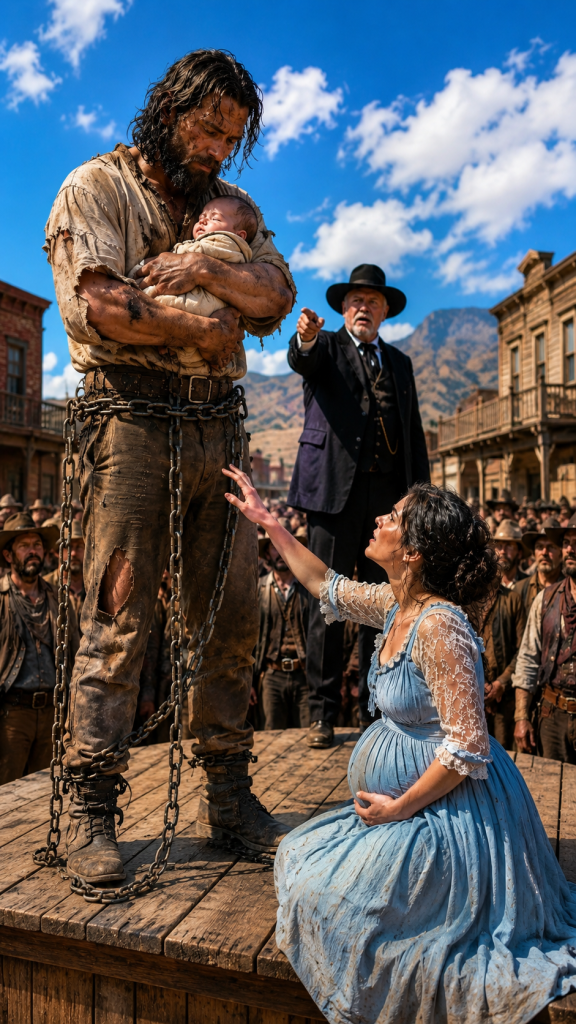
Mariana held the shotgun with trembling hands while Emiliano slept in a basket and Luna breathed wrapped up beside the hearth.
Outside, Don Ernesto pounded on the door again, no longer pretending courtesy.
Commander Salazar shouted that he had orders to enter, but Mariana demanded that he read the judge’s name, the date, and the offense.
There was a heavy silence from the other side.
Men accustomed to giving orders hated it when a widow asked for papers.
Then Don Ernesto changed his tone and promised to let her keep the house if she handed over the notebook, Mateo, and any documents hidden by Julián.
Mariana felt like crying — not from fear, but from rage: for the first time the murderer of her husband was confessing without saying it.
The wood creaked as one of the men rammed the door.
Mariana aimed.
But before the second blow, more horses arrived from the stream road.
A deep voice cut through the rain:
“Salazar, take your hands off that door or tomorrow you’ll explain in Chihuahua why you raided a widow’s house at midnight.”
It was Mateo.
He was soaked, with a torn sleeve and blood running down his arm, but behind him rode two state agents and a lawyer named Beltrán, sent by the same attorney Julián had tried to write to.
Mateo had managed to enter Don Ernesto’s office, find the false loan books, the payments to the agrarian registry, the altered signatures, and a letter where Don Ernesto himself ordered “that the stable accident look like something caused by dampness and carelessness.”
Don Ernesto tried to draw a pistol, but one of the agents subdued him before he could raise it.
Salazar denied everything until Beltrán opened the account book under the rain and read aloud the payments with dates, names, and amounts.
By dawn, Don Ernesto, Salazar, and the registry official were handcuffed in the same square where weeks earlier they had sold Mateo as if he were not a man.
The entire village came out to watch.
Some lowered their heads.
Others cried upon discovering that their lands too had been marked for dispossession.
Mariana said nothing.
She simply picked up Emiliano and watched as they took away the man who had turned her grief into a lie.
Later, inside the house, she finally saw Mateo’s wound.
He tried to say it was nothing, but she sat him down with a look that accepted no heroics.
She boiled water, cleaned the blood, and bandaged the cut with one of Julián’s old shirts.
Mateo took out the debt contract from his pocket — the one that had made her “buy” him in the square.
Beltrán had confirmed it was fake, illegal, fabricated by Don Ernesto to silence him.
Mateo placed the paper on the table.
Mariana took it without hesitation and threw it into the fire.
The flames curled the contract until it became ash.
Mateo looked at her with moist eyes.
He didn’t thank her.
There was no need.
Spring arrived late, but it arrived.
Julián’s case opened an investigation across the entire valley.
Five families recovered stolen parcels.
Mariana’s ranch was protected by a clean deed.
Julián’s name was read in the square not as that of a clumsy man who died by accident, but as the man who had tried to save his people.
Mateo stayed — not as a peón or a debt, but as part of a house he himself had helped raise from the ruins.
Luna learned to laugh by throwing spoons from the porch so he would pretend to be angry.
Emiliano grew up reaching for his finger with his tiny hand every time he heard his voice.
One golden afternoon by the stream, Mariana handed Mateo an official letter: the valley lands were now under protection and the file carried Julián Salcedo’s name as the origin of the complaint.
Mateo read it in silence.
Then he tucked the letter close to his chest and looked at Mariana with that broken seriousness she already knew.
He told her he had no wealth, only two hands, a tired back, and a life that no longer wanted to walk far from her, from Emiliano, and from Luna.
Mariana did not answer immediately.
She looked at the cradles, the new fence, the straightened stable, the stream shining as if the world had been washed clean.
Then she took Mateo’s hand and said yes — not like a woman surrendering to another man, but like someone choosing family after surviving cruelty.
When he embraced her, there was no music or celebration, only two sleeping babies, the smell of damp earth, and a house that finally stopped feeling borrowed.
And from that day on, every time someone in San Jacinto passed by Mariana’s ranch, they saw the firm fence, the smoke from the kitchen, and Mateo carrying Luna while Emiliano ran after the chickens, and they understood that some truths do not return to destroy everything, but to give back name, land, and peace to those who refused to die in silence.
