

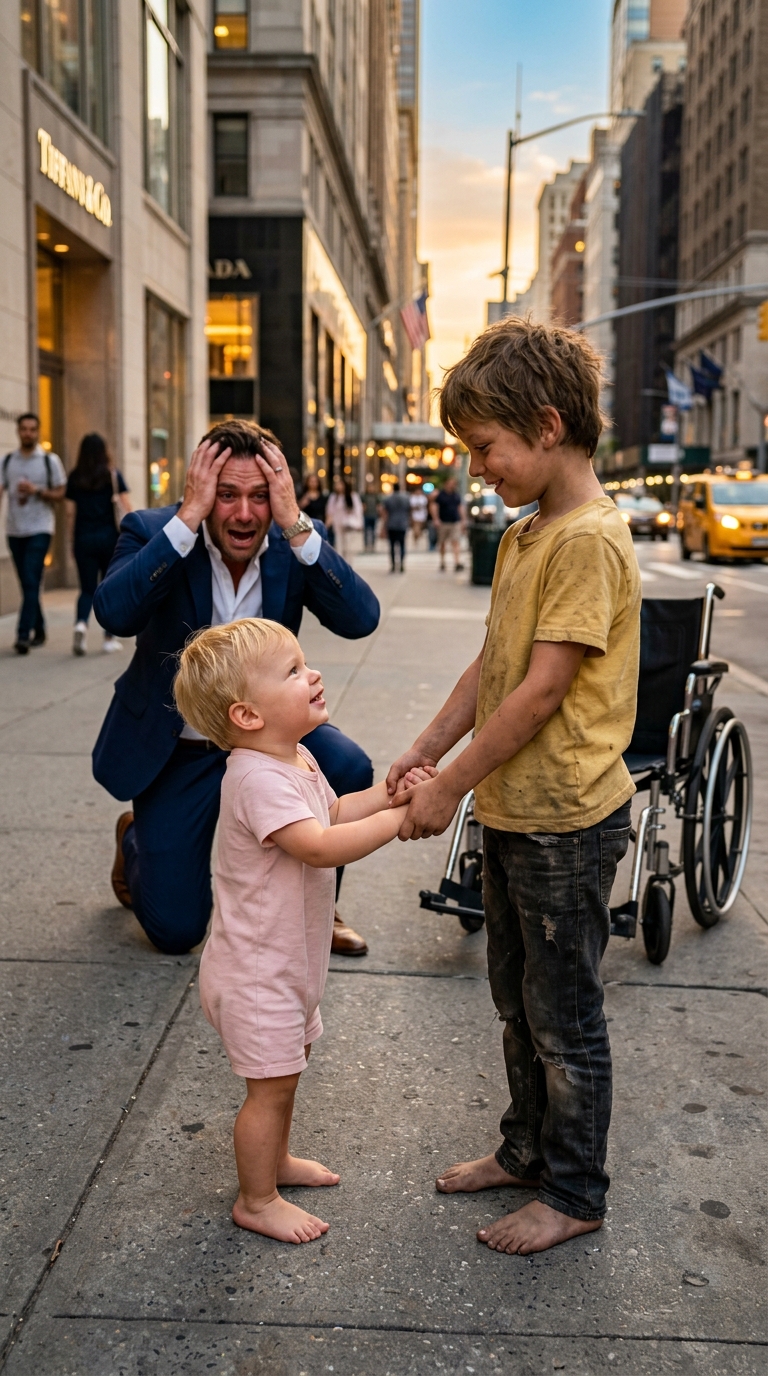
The Four Days They Could Not Accept
Grant Ellison had never been afraid of cold buildings, serious doctors, or the sound of expensive machines doing the work human hands could not do. He had built a life in which problems were supposed to have solutions. If a company failed, he bought time. If a deal fell apart, he found leverage. If a door closed, money usually opened another one.
But none of that meant anything in the pediatric wing of Harborview Medical Center in Portland, Maine.
The hallway outside the intensive care unit felt colder than winter. It settled into his bones and stayed there. Grant sat in his wheelchair with a set of medical reports trembling in his hands, staring at the pages as if they might change if he looked long enough. They did not. The specialists had already said what no parent should ever hear. His two-year-old son, Owen, had a rare and rapidly worsening breathing condition. His tiny body was no longer responding the way they had hoped.
At best, they had told him, the boy had four days.
Through the glass, Grant watched his son lying in the ICU bed, surrounded by tubing, sensors, and monitors that blinked and chimed with indifferent precision. Owen’s small chest rose and fell with visible strain. Every breath looked like work. Every second felt borrowed.
His lips parted, though he knew the child could not hear him through the glass.
“Daddy’s right here, buddy. I’m not going anywhere.”
His voice came out rough and quiet, worn thin by too many sleepless nights.
Five years earlier, Grant had survived a highway crash that took the use of his legs. At the time, he had thought that loss would be the hardest lesson of his life. He had been wrong. Nothing had prepared him for sitting helplessly outside his son’s room, rich enough to own buildings, powerless to buy one easy breath for the child he loved more than himself.
His wife, Marielle, had finally been given something to calm her after breaking down in a family room down the hall. Grant had insisted she rest for a little while. He told her one of them needed strength. The truth was, he did not know how to carry his own grief and hers at the same time.
He sat there alone, looking into a room full of machines, and felt smaller than he ever had in his life.
A Boy Who Did Not Belong There
“Mr. Ellison?”
The voice came softly, carefully, as if afraid to disturb the sorrow hanging in the air.
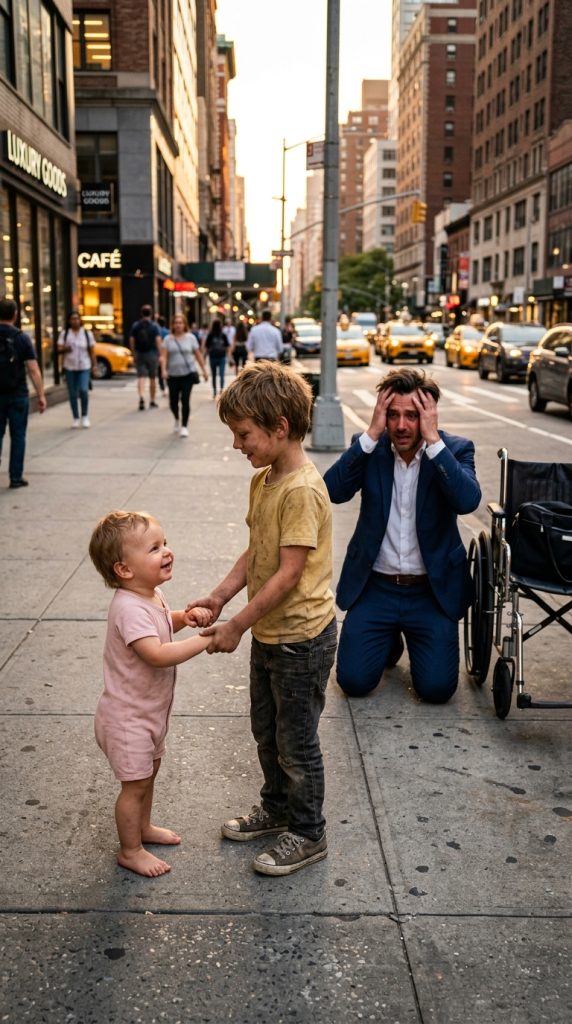
Grant turned his chair and saw Nurse Tessa Moreno standing a few feet away. Beside her stood a boy who looked so out of place in the polished hospital hallway that the contrast almost startled him. He was maybe eight years old, skinny and barefoot, with sandy brown hair that had not been brushed properly in days. His shirt was faded, his jeans were worn thin at the knees, and his face held the sun-darkened look of a child who spent more time outdoors than indoors.
Yet his eyes were steady.
Not timid. Not wandering. Steady.
Tessa looked embarrassed. “I’m sorry to bother you right now. This is Rowan. He helps Mrs. Bell in housekeeping sometimes for food and a place to rest during the day. He kept insisting he needed to speak with you. I tried to send him away, but he wouldn’t leave.”
Grant might have dismissed the interruption under any other circumstances. He was exhausted, raw, and in no mood for strange conversations. But the boy was already looking past him, through the glass, toward Owen’s room.
“Your little boy is pulling hard to breathe,” Rowan said. “His belly keeps sinking in when he tries to take air.”
Grant blinked.
The child had not spoken like a child guessing. He had spoken like someone who had seen it before.
“How do you know that?” Grant asked, more sharply than he intended.
Rowan lifted one shoulder. “My grandma knew how to help babies who couldn’t get air right. She took care of people in our neighborhood when they had no one else. She taught me what to look for.”
Tessa gave a small nervous laugh that carried no humor. “He tells stories. I’m sorry, sir. He means well.”
But Grant did not look at the nurse. He kept his eyes on Rowan.
There was no performance in that boy’s face. No attempt to impress. Only urgency.
“What did your grandmother teach you?” Grant asked.
Rowan stepped closer to the wheelchair and lowered his voice, as if he did not want the walls to overhear.
“Sometimes babies get laid back wrong when everyone is focused on the tubes and the noise. If the neck is stretched too far, it can make it harder for the air to move the way it should. My baby brother had trouble like that. We didn’t know in time. He didn’t make it.”
The last sentence landed quietly, but it carried weight.
“After that,” Rowan continued, “my grandma showed me how to help. How to line them up better. How to rub the chest and back so the body can relax enough to remember what it’s supposed to do.”
Grant felt something shift in him. It was not belief, not yet. It was something more dangerous: hope.
When Science Had Run Out of Comfort
Before he could ask another question, the alarms in Owen’s room changed.
The sound was immediate and sharp, tearing through the hallway like glass breaking.
Nurses rushed in. A respiratory therapist appeared almost instantly. The monitor inside the room showed falling oxygen numbers. One of the physicians came in at a run, followed by another staff member carrying supplies. Orders were being called out. Everything moved fast, but to Grant it felt slow and distorted, as if he were trapped underwater watching panic unfold on the other side of a wall.
Dr. Benjamin Hale, the attending physician, reached the bedside and began issuing instructions for an emergency procedure. His face was controlled, but Grant could see the strain beneath it.
A risky intervention. That was what they were preparing for.
A desperate one.
Grant looked from the doctor to the monitor, from the monitor to his son’s face, and then back to Rowan, who was staring into the room with unsettling calm.
Not indifference. Certainty.
It was the certainty that broke something open in Grant.
The specialists had already given his son four days. Now his son looked like he might not even get four more minutes. The people inside that room were not calm because they had a sure answer. They were moving because they could not bear to do nothing.
Neither could he.
Grant pushed his wheelchair toward the door.
“Wait.”
The word came out louder than he expected, and everyone turned.
Dr. Hale looked at him, stunned. “Mr. Ellison, please step back. We need room.”
Grant’s hands tightened on the wheels.
“Let the boy in.”
For one second, no one moved.
Then the doctor frowned in disbelief. “Absolutely not. Your son is crashing. We are preparing to intervene.”
Grant’s face hardened with the kind of determination that had once built companies from empty offices and impossible odds.
“You told me my son may only have four days. Now you’re telling me the procedure in front of him may not even save him. So no, doctor, I will not stand out here and pretend certainty still lives in this room.”
Tessa inhaled sharply. Dr. Hale looked offended, then angry, then tired.
Grant pointed toward Rowan. “That boy sees something all of us missed. Maybe he’s wrong. Maybe he isn’t. But right now you are asking me to trust fear over one more chance. I won’t do it.”
“Mr. Ellison, this is not medicine,” Dr. Hale snapped.
Grant’s eyes shone with tears he was no longer trying to hide.
“Maybe not. But neither is giving up.”
He swallowed hard, then spoke more quietly.
“Two minutes. That’s all I’m asking. If nothing changes, you do what you believe you must. But let him try.”
Two Minutes That Changed Everything
There was still protest in the room, but hesitation had entered it too.
Maybe it was the authority in Grant’s voice. Maybe it was the falling oxygen levels and the knowledge that they were losing ground anyway. Maybe it was simple human desperation. Whatever the reason, no one stopped Rowan when he stepped forward.
The boy moved with surprising composure. He washed his hands quickly at the sanitizer station, then approached Owen’s bed without fear. The room felt too bright, too loud, too full of adult worry for someone his age, but Rowan did not seem swallowed by it.
He looked at Owen first, not the machines.
“Hey, little man,” he whispered. “You stay with us, okay?”
Grant wheeled himself to the bedside, tears blurring his view. Up close, Owen looked even smaller than before. His face had gone pale, almost gray around the lips. His body was fighting so hard that the effort itself looked painful.
Rowan glanced at Grant.
“Can you help tilt him just a little?”
Grant nodded immediately.
Under Rowan’s direction, they raised the mattress slightly and eased Owen into a gentler position. Then Rowan slid one careful hand beneath the boy’s head and another near his neck, adjusting him by the smallest degree. It was not dramatic. It was not theatrical. It was the kind of change an exhausted adult might overlook.
But as soon as the alignment shifted, the sound of Owen’s breathing changed.
It was subtle at first. The harsh, tight noise softened. Not gone, but different.
Rowan kept working.
He placed his fingertips lightly at the center of Owen’s chest and began small, steady circles, then a rhythmic pattern that looked more like comfort than treatment. Under his breath, he spoke in a tone so gentle it almost disappeared beneath the monitors.
“That’s it. Easy now. Easy. You know how to do this.”
Dr. Hale glanced sharply at the screen and then looked again.
The oxygen level had stopped dropping.
A nurse leaned closer to the monitor, thinking she had misread it.
Then it began to rise.
Seventy-two.
Seventy-six.
Eighty-one.
No one spoke for several seconds. The room seemed to hold its breath with the child.
Rowan turned Owen carefully and used the heel of his hand to apply light pressure near the upper back, close to the shoulder blades, then repeated the motion in measured intervals.
Owen coughed.
Once. Then harder.
A raw, living sound.
And then he cried.
Not a weak whimper, not a fading little noise, but a real cry, strong and angry and full of air.
Grant broke.
He covered his mouth with his hand and sobbed openly, shoulders shaking in his chair.
“He’s crying,” he said, laughing and crying at once. “That’s my boy. That’s my boy.”
The alarms quieted. The room settled into a different rhythm. The numbers steadied. Color returned to Owen’s face little by little, like dawn spreading through a dark sky.
When Marielle came running into the room, half awake and wild with fear, she stopped at the doorway and stared.
Her son was breathing.
Grant reached for her, and she fell beside him, one hand on Owen, the other gripping the arm of Grant’s chair.
Neither of them could speak at first.
The Child No One Had Seen
Dr. Hale removed his glasses and wiped his face with a trembling hand. The arrogance he had worn like armor all week was gone.
He looked at Rowan as though seeing him for the first time.
“How did you know?” he asked quietly.
Rowan shrugged, suddenly looking like a little boy again rather than the calm center of a miracle.
“My grandma used to say the body talks before it gives up. Most people are too rushed to listen.”
Tessa covered her mouth with one hand, tears spilling down her cheeks.
Grant turned his wheelchair toward Rowan. For a moment he could not say anything. The child standing there with dusty feet and tired clothes had done what wealth, reputation, and the best specialists in the state had not been able to do. He had given their son back to them.
Finally Grant found his voice.
“You saved my family.”
Rowan looked uncomfortable with the weight of the words.
“I just helped him breathe.”
Marielle knelt in front of him and cupped his face in both hands as if she were afraid he might vanish.
“No,” she whispered. “You did much more than that.”
Over the next few days, Owen continued to improve. The team adjusted his treatment plan, watched him carefully, and admitted with humility that the change in position and manual chest work had made an immediate difference when his body most needed it. The crisis that had seemed final became the beginning of recovery.
But while doctors reviewed charts and revised their understanding, Grant and Marielle could think of only one thing.
Rowan.
They learned he had been drifting through a hard life no child should have to carry. His grandmother, Alma Reed, had raised him in a struggling neighborhood outside the city and taught him the practical care she had learned from older women before her. After she passed away, Rowan had been left with almost nothing. He picked up small cleaning jobs, found corners where people tolerated his presence, and survived on the edges of other people’s routines.
He had no real home.
No steady protection.
No one who belonged to him.
Grant could not accept that.
A New Name, A New Home
The day Owen was finally moved out of intensive care, Grant asked Tessa to bring Rowan to the private family lounge.
The boy came in carefully, shoulders stiff, as if he expected trouble the moment an adult used a serious voice.
Grant smiled as warmly as he could.
“You’re not in trouble.”
Rowan stood in the doorway anyway.
“Then why did you ask for me?”
Marielle reached for his hand and guided him inside. On the table near the window sat a fresh meal, a pair of new sneakers, and a folded sweatshirt. Rowan looked at them, then quickly away, as though he had trained himself not to want things that might be taken back.
Grant spoke slowly.
“You once told me not to let my son lose what your brother lost. I heard you. And now I need you to hear me.”
Rowan glanced up.
“You are not going back to sleeping in storage rooms or earning food by scrubbing floors. Not if we can help it.”
The boy’s face changed, fear flashing across it.
“Did I do something wrong?”
Marielle shook her head at once.
“Sweetheart, you did everything right.”
Grant steadied his breathing.
“You saved Owen. You gave us our son back. We would like to give you something too, but not as charity. Not as payment. As family, if you’ll let us.”
Rowan stared at them both in silence.
The room became very still.
“What does that mean?” he whispered.
Marielle’s eyes filled.
“It means if you want, you never have to be alone again.”
Rowan’s lower lip trembled, and for the first time since Grant had met him, the child looked his age.
“You mean… stay?”
Grant nodded.
“Yes. Stay.”
The boy began to cry then, quietly at first, like someone ashamed to be seen hoping. Marielle wrapped him in her arms, and he clung to her with the desperation of a child who had waited too long to be held without condition.
That was the real beginning.
Not the legal papers. Not the hearings. Not the signatures that came later.
The beginning was that moment in the hospital lounge when a boy who had spent too much of life being overlooked realized someone was finally choosing him.
The Years That Followed
Life did not become perfect overnight. Healing never works that way.
Rowan had to learn that food would still be there tomorrow. He had to learn that locked doors at night could mean safety instead of exclusion. He had to learn that when Grant or Marielle raised their voices from another room, it did not mean danger. Owen, once strong enough to run and laugh and ask endless questions, grew up knowing without embarrassment that the brother who tucked him in at night was the same brother who had first taught him how precious every breath could be.
They were different boys in every visible way.
One had been born into comfort.
The other had arrived from loss.
But love made room for both without comparison.
Grant and Marielle did more than give Rowan shelter. They listened when he talked about his grandmother’s methods. They made sure he had teachers who respected both science and curiosity. They told him that wisdom did not become less valuable because it came from poor neighborhoods, old hands, or voices the world considered unimportant.
Owen adored him from the start.
Whenever anyone asked about the story later, Owen would grin and say, “My brother is the reason I’m here.”
As they grew older, that bond only deepened. Rowan studied medicine with relentless dedication, not because he wanted prestige, but because he never forgot what it felt like to stand in a room where adults had stopped believing a child might know something important. He wanted to become the kind of doctor who listened before speaking, touched a patient’s hand before reviewing a chart, and never forgot that fear can make even the best-trained people miss what matters most.
Grant used his money differently after that. He still led companies, but success no longer meant expansion for its own sake. He and Marielle created the Alma Reed Foundation in honor of the grandmother whose lessons had traveled farther than anyone could have imagined. Their programs supported family-centered care, early intervention, and the respectful study of practical healing knowledge too often dismissed because of where it came from.
Owen grew into a thoughtful, creative young man with a deep love for light, space, and design. He became an architect, eventually helping plan clinics and recovery centers that felt less like institutions and more like places where hope could breathe.
And Rowan became exactly who Grant had sensed he might become the day he first met him in that cold hospital corridor.
A healer.
The Speech That Brought It Full Circle
Twenty years after the worst day of the Ellison family’s life, a large auditorium in Stockholm stood in respectful silence as Dr. Rowan Reed Ellison stepped to the podium.
He was twenty-eight years old, dressed in a dark formal suit, composed but visibly moved. The audience knew his published work. They knew the research that had transformed pediatric respiratory support and brought new attention to hands-on positioning and humane care practices in critical treatment settings. They knew the awards, the institutions, the lives changed.
What they did not fully know was the boy he had once been.
Rowan looked toward the front row.
Grant was older now, silver at the temples, his posture gentler than it had once been, his face marked by age and gratitude. Marielle sat beside him with tears already shining in her eyes. Owen, tall and smiling, applauded before anyone else did.
Rowan took a breath and began.
“This honor does not belong to me alone.”
The room went still.
“It belongs to a woman named Alma Reed, who never had letters after her name and never stood in rooms like this, but who understood care in a way the world still needs to remember.”
He paused, the memory visible in his face.
“It belongs to two parents who were willing to trust a frightened, dirty little boy when certainty had failed them. They gave me a home, but more than that, they gave me the dignity of being seen.”
Grant bowed his head, overwhelmed.
Rowan turned slightly toward Owen.
“And it belongs to my brother, who fought for every breath when he was too young to understand what any of us were losing, and who gave my life its direction before either of us knew what the future would hold.”
By then, Marielle was openly crying, and Owen was wiping his eyes with one hand while still clapping with the other.
Rowan’s voice softened on his final words.
“Medicine can become brilliant and still forget how to be human. We must never allow that. The body is not a machine separated from comfort, position, touch, love, memory, and fear. We heal best when knowledge and humanity walk together.”
The applause rose slowly, then all at once.
It filled the hall.
But for Rowan, the most important part of the night came later, when the ceremony ended and he walked back to the people who had become his first true home. Grant hugged him with shaking arms. Marielle kissed his cheek. Owen laughed through tears and said the same thing he had been saying since childhood.
“I told you my brother could change the world.”
Rowan smiled and answered the way he always did.
“Only because all of you changed mine first.”
The Legacy They Left Behind
In the years that followed, the Alma Reed Foundation continued to grow. Hospitals across the country adopted more family-aware care models because of Rowan’s work. Training programs taught young clinicians to notice posture, distress signals, and the quiet details often hidden behind technology. Owen designed healing spaces filled with daylight, gardens, and warm corners where frightened families could hold on to one another through long nights.
Grant often told people that the worst day of his life had also become the day that taught him how little status mattered if it could not kneel down and recognize worth in someone everyone else had ignored.
Near the end of his life, he would sometimes sit on the porch with his grandchildren around him and say, “I lost the use of my legs and thought life was taking something from me. But being forced to stop long enough to really look may have been the thing that saved our family.”
And somewhere in that truth lived the heart of everything that came after.
A dying child survived.
A forgotten boy found a home.
A family built itself out of grief, courage, trust, and a door opened at exactly the right moment.
Sometimes the world changes through grand plans and famous names.
And sometimes it changes because, in a cold hallway, one brokenhearted father decided to listen to a child nobody else had thought mattered.
