

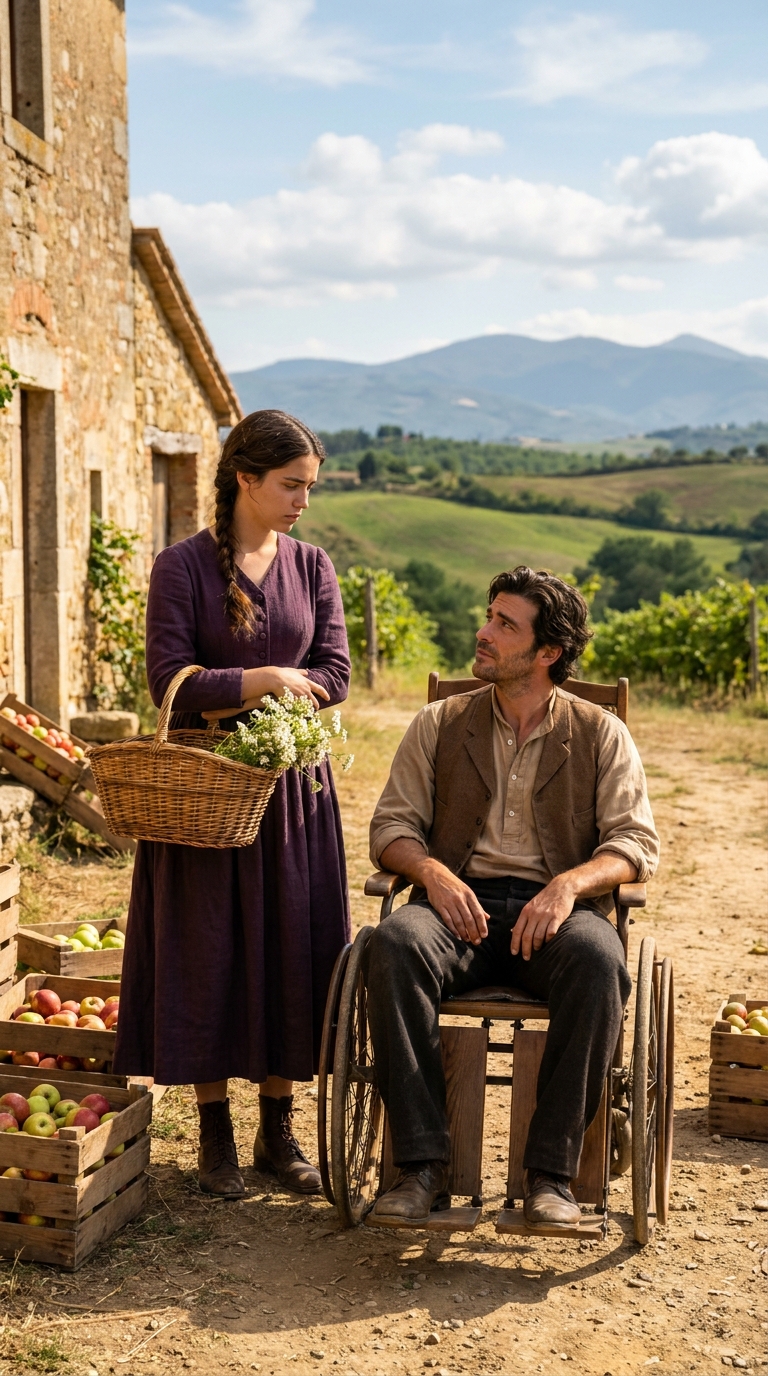
Santiago Arriaga was thirty-six years old, but from his wheelchair he looked at the world like a man who had already aged inside. Before the accident, everyone in Zacatlán knew him as the strongest landowner in the region: he rode horseback at dawn, inspected the apple orchards with his boots covered in dirt, and ran the old La Esperanza hacienda with the confidence of someone who carried the countryside in his blood. But one stormy night, a fire in the warehouse changed his life. A beam fell on his back while he tried to save the harvest, and from then on his legs stopped obeying him.
The hacienda faded along with him. The trees still bore fruit, but no one picked the apples in time. The main gate hung crooked, the walls were stained with dampness, and the smell of cider that once filled the cellar was replaced by dust, ash, and silence.
“Again watching the apples rot,” said Doña Meche as she entered the living room with a cup of pot coffee.
Doña Meche was over sixty years old and had served the Arriaga family since Santiago was a child. She loved him like a son, which is why she was the only one who dared speak to him without fear.
“Let them be,” he replied without turning. “Just like me, they’re no longer good for anything.”
“Don’t talk nonsense, patrón. Fallen apples can still be made into preserves. Fallen men can too.”
Santiago let out a bitter laugh.
“That sounds nice coming from someone who can still walk.”
Doña Meche was about to respond when a boy came running in from the patio.
“Patrón! There’s a woman coming up the road. She’s alone, with a knapsack and her shoes full of dust.”
Santiago tightened his fingers on the arms of his chair.
“If Don Severo sent her, tell her I’m not selling.”
Don Severo Castañeda was the richest man in town and the hungriest for other people’s land. Since the accident, he had been circling the hacienda like a vulture, waiting for Santiago to completely break so he could buy La Esperanza for next to nothing.
“She doesn’t look like one of Don Severo’s people,” said the boy. “She looks like she’s come from far away.”
Before Santiago could order the door closed, the woman appeared in the doorway.
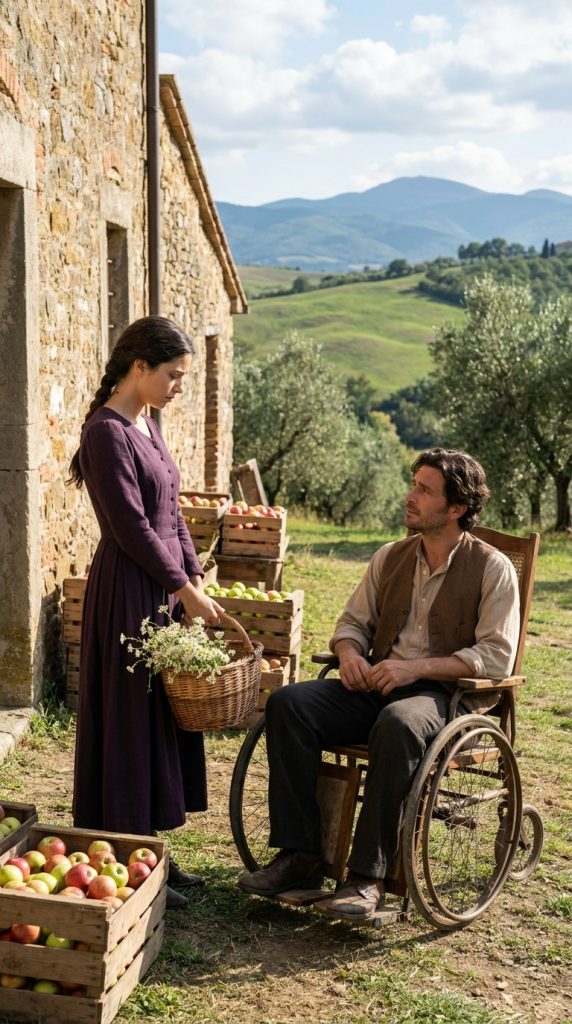
Her name was Valeria Montes. She was about twenty-seven years old. She wore her dark hair in a braid, a simple dress, and a cloth knapsack over her shoulder. She didn’t look rich, but she didn’t look defeated either. Her eyes held a strange firmness, as if she had cried a lot before arriving and had decided not to cry anymore.
“Good afternoon,” she said. “I’m looking for work.”
Santiago looked her up and down.
“There’s no work here.”
“That’s not true,” she replied, looking out the window toward the orchards. “I saw apples rotting, a broken fence, empty chicken coops, and a closed cellar. There’s plenty of work. What’s missing is willpower.”
Doña Meche’s eyes widened in surprise. No one spoke to the patrón like that.
“I have no money to pay wages,” Santiago said dryly.
“I didn’t ask for money. I’m asking for a roof, food, and one month to prove I can be useful. If I’m not, I’ll leave without claiming anything.”
Santiago let out a joyless laugh.
“Working for food on a half-dead hacienda? You’re either crazy or running from something worse.”
Valeria did not lower her gaze.
“I’m running from staying still. That really kills you.”
Those words hurt Santiago more than he wanted to admit.
“One month,” he said at last. “Doña Meche, give her the room next to the pantry. If she doesn’t get up before sunrise tomorrow, she’s gone.”
The next morning, Santiago woke to a smell he hadn’t felt in months: apples cooked with cinnamon. He sat up as best he could, moved from the bed to his chair, and went to the kitchen. There he found Valeria standing by the stove, stirring a huge pot. On the table were sorted baskets: good apples, bruised apples, and nearly spoiled ones. The patio boy was clumsily peeling fruit, and Doña Meche was washing old jars with a smile she tried to hide.
“What the hell is this?” Santiago asked.
“Jam,” Valeria replied without stopping stirring. “The bruised apples are good for this. We’ll sell the good ones fresh. The rotten ones will go to compost.”
“No one gave you permission to dispose of my harvest.”
Valeria turned off the fire and looked him straight in the eyes.
“With all due respect, Don Santiago, you didn’t have a harvest. You had waste. If you want to throw me out, go ahead. But don’t ask me to sit and watch everything die.”
Santiago felt anger, but behind the anger came something forgotten: shame. This woman had done in one morning what he hadn’t dared to order in months.
During the following weeks, La Esperanza began to awaken. Valeria cleaned windows, organized the kitchen, convinced Doña Meche to bake bread again, and put the boy to work repairing the gate. She sold jam at the market, traded fruit for flour, and even managed to get two neighbors to return and work half-days in exchange for a share of future profits.
Santiago watched her from his chair, uncomfortable. He was annoyed by her energy, by the way she neither asked for pity nor offered it. But he also waited every morning for the sound of her footsteps in the hallway.
One afternoon, Valeria entered his room with a tray and a jar of rosemary oil.
“Today we’re going to do something different.”
“Now what? Are you going to teach me how to dance?”
“I’m going to massage your legs.”
Santiago’s face hardened.
“My legs don’t feel anything.”
“Then it won’t bother you.”
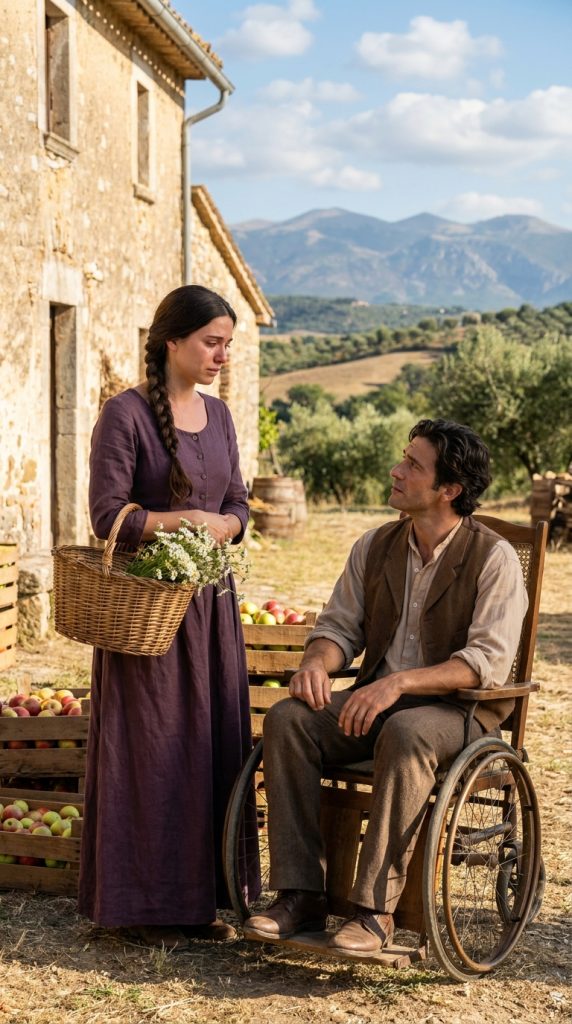
Before he could refuse, Valeria knelt in front of the chair and began massaging his feet with firm hands. Santiago looked toward the window, humiliated by how vulnerable he felt. Then it happened: a tiny prick, like an electric spark, rose from his ankle to his knee.
He tensed.
Valeria looked up.
“You felt something.”
“No.”
“Don’t lie to me.”
“I said no!”
He pushed the chair back furiously. Valeria stood up calmly.
“Hope hurts more than resignation, doesn’t it? That’s why you’re so afraid of it.”
Santiago didn’t answer. That night he didn’t sleep. He stared at his feet under the blanket, wondering if that spark had been real or a cruel joke from his body.
The next day Don Severo arrived.
He entered the hacienda with shiny boots, an expensive hat, and a venomous smile. Two men followed him.
“Well, well,” he said, looking at Valeria. “Looks like the patrón got himself a new servant.”
“If you’ve come for the land, you’re wasting your time,” she replied.
Severo laughed.
“The land is practically mine already. Santiago took out a loan after the fire, and your debt was bought by my finance company. You have thirty days to pay seventy thousand pesos in overdue interest. If you don’t, La Esperanza becomes mine.”
Santiago pushed his chair into the corridor.
“That wasn’t what we agreed.”
“You should have read the fine print before becoming useless.”
The insult landed like a stone. Valeria stepped forward, but Santiago raised his hand to stop her. Severo smiled, satisfied, and left in a cloud of dust.
That night, Santiago locked himself in his room.
“It’s over,” he said when Valeria entered. “Tomorrow you leave. I’m not going to let you sink with me.”
“You gave me a month.”
“And you’ve seen there’s no way out.”
“Yes, there is.”
Santiago laughed desperately.
“Which is? Praying?”
“Making cider.”
He looked at her as if she had lost her mind.
“The cellar has been closed for years.”
“But the barrels are still there. So is the press. You know how to make cider better than anyone. There’s an artisanal fair in Puebla in three weeks. If we manage to sell and win the prize, we pay the debt.”
“That’s impossible.”
Valeria approached him.
“Impossible was raising this house from abandonment, and look at it now. Impossible was for you to feel your legs, and you felt them.”
Santiago looked down.
“Don’t give me hopes you can’t fulfill.”
“I’m not the one giving them to you. You’re giving them to yourself—you just haven’t dared to take them yet.”
The next morning, the hacienda became a whirlwind. Santiago, from his chair, began giving orders again. He ordered the cellar opened, the barrels checked, the press cleaned. He explained which apples were good for fermenting, which gave acidity, which gave sweetness. His voice regained strength. His eyes stopped looking dull.
Valeria was the heart of that effort. She worked from before dawn until night. She washed fruit, carried bottles, kept accounts, sold jam, and every night, no matter how exhausted she was, she returned to massage Santiago’s legs.
One early morning, while the aroma of fermentation filled the cellar, he took her hand.
“Why did you stay, Valeria? You could have left when you saw the disaster.”
She took a moment to answer.
“Because I was also lying on the ground, like your apples. My father wanted to marry me to a man who saw me as property. I ran away without knowing where to go. You opened the door when I had nothing.”
Santiago felt something break inside him—not from pain, but from tenderness.
“I’m not the man you think I am.”
“No,” she said softly. “You’re more.”
Before he could say anything else, a shout pierced the night.
They went out to the patio. The small storeroom where they had kept the first finished bottles was on fire. The flames lit up the trees like a nightmare. Among the shadows, Santiago glimpsed a truck driving away. It belonged to Severo.
“The bottles!” Valeria shouted, running toward the entrance.
“Don’t go in!” Santiago roared.
But she was already inside, trying to save a box. A burning beam creaked above her head.
In that instant, something fierce awakened in Santiago. He didn’t think. He planted his hands on the arms of the chair, felt a fire rise up his back, and stood up. His legs trembled like branches in a storm, but they responded. He took one step, then another, and threw himself toward Valeria just as the beam fell.
Both rolled out of the storeroom amid ash and sparks.
Valeria opened her eyes, covered in soot.
“Santiago… you walked.”
He tried to get up, but his legs failed again. He fell back to the ground. However, nothing was the same anymore.
“There are still barrels in the cellar,” he said, breathing with difficulty. “And we still have ten days.”
The next day, the town doctor tried to dampen their hopes.
“It was adrenaline,” he said. “Don’t expect miracles.”
Santiago retreated back into his bitterness. But this time Valeria wouldn’t allow it.
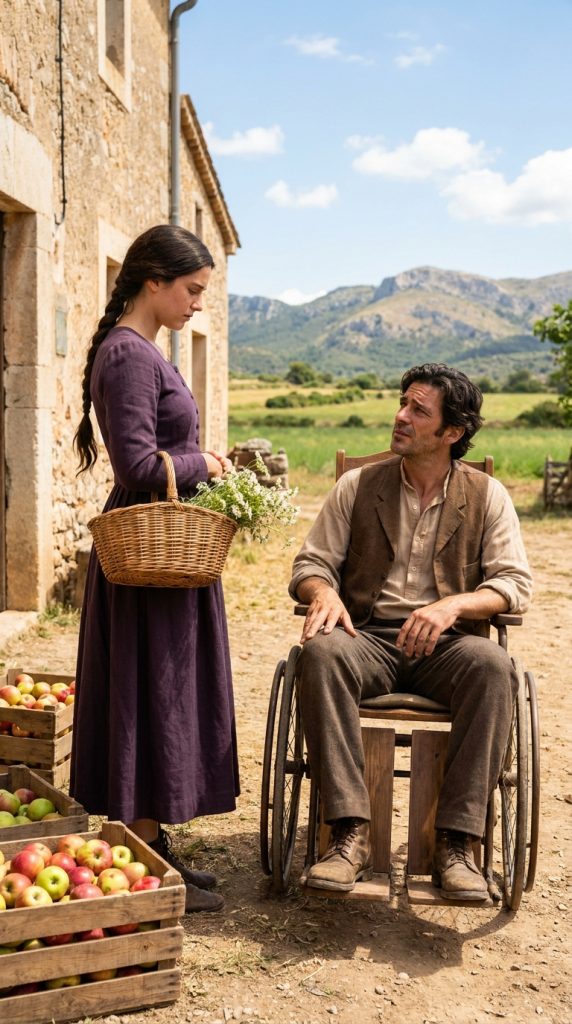
“I didn’t come looking for a man who could walk,” she told him with tears of anger. “I came looking for work and found a man who knows how to raise a hacienda with his head and his heart. If your legs can’t, use your voice. But don’t use your pain as an excuse to give up.”
Outside, neighbors began to arrive. Old workers from his father’s time, young people from the town, women with baskets of food, men with wood and tools. They had all heard about the fire.
“Your father fed us during the drought,” said Don Tomás, an old foreman. “An Arriaga doesn’t fall alone.”
Santiago felt his eyes fill with tears.
“Then let’s open the big cellar,” he ordered. “If we’re going to fight, let’s fight with the best we have.”
The final days were madness. They bottled three hundred bottles of artisanal cider, sealed them with red wax, and gave them a simple label: Sidra La Esperanza. Valeria drew a golden apple crossed by a small flame.
On the day of the fair, they arrived in Puebla in an old truck. Their stall was humble, with wooden crates and embroidered tablecloths. In front of them stood Severo’s enormous stand, full of lights, hostesses, and industrial bottles.
“How touching,” Severo mocked. “The invalid and the runaway playing at being entrepreneurs.”
Santiago looked at him calmly.
“Your cider tastes like business. Ours tastes like the land.”
People began to taste it. One glass, then another. Some closed their eyes as they savored. They said it reminded them of their grandparents’ house, village festivals, cold afternoons with sweet bread. By midday they had sold more than half.
But Severo didn’t give up. He sent two men to threaten Valeria in the parking lot. They snatched her sales notebook and pushed her against a wall.
“Tell your patrón that if he accepts the prize, next time we’ll burn the hacienda with everyone inside.”
Valeria returned pale.
“We have to leave, Santiago.”
He took her hand.
“All my life after the accident I let fear decide for me. Not today.”
Minutes later they announced the main prize.
“The award for the best artisanal beverage of the year and the one-hundred-thousand-peso grant goes to… Sidra La Esperanza.”
Applause erupted like rain on a tin roof. Severo stood up furious.
“Fraud! That man can’t even stand on his own feet!”
Santiago looked at the stage ramp. Valeria prepared to push the chair, but he stopped her.
“Help me stand up.”
“Santiago…”
“Just hold my hand.”
With an effort that made his whole body tremble, Santiago stood up. The entire venue fell silent. He took a step. It hurt as if glass were being driven into his back. He took another. Valeria walked beside him, holding him, crying without letting go.
When he reached the microphone, he looked at Severo.
“La Esperanza is not for sale. Not for debt, not for fear, not for fire. What falls to the ground can rot… or it can rise with love and become something better.”
The applause was deafening.
With the prize they paid the debt. With the sales they rebuilt the storeroom. And with the fame the cider gained, La Esperanza came back to life. Orders arrived from Guadalajara, Monterrey, and Mexico City. The orchards filled with workers. The gate was repaired and painted blue.
Months later, Santiago walked with a cane made of apple wood. Not quickly, not perfectly, but he walked. Valeria remained by his side, no longer as an employee, but as partner, companion, and root.
One afternoon, under the oldest tree in the orchard, Santiago took a small silver medal shaped like an apple from his pocket.
“Valeria, I inherited this land from my family, but you gave it back its soul. Stay with me, not to save me, but to live what we built together.”
Valeria smiled with eyes full of light.
“I arrived looking for a roof. I found a home.”
They kissed as the wind moved the apple trees and the sweet aroma of cider drifted from the cellar.
Since then, in Zacatlán they say that at La Esperanza no one leaves an apple lying on the ground. Because Santiago and Valeria learned better than anyone that even what seems lost can become sweet, if someone has the courage to pick it up in time.
